

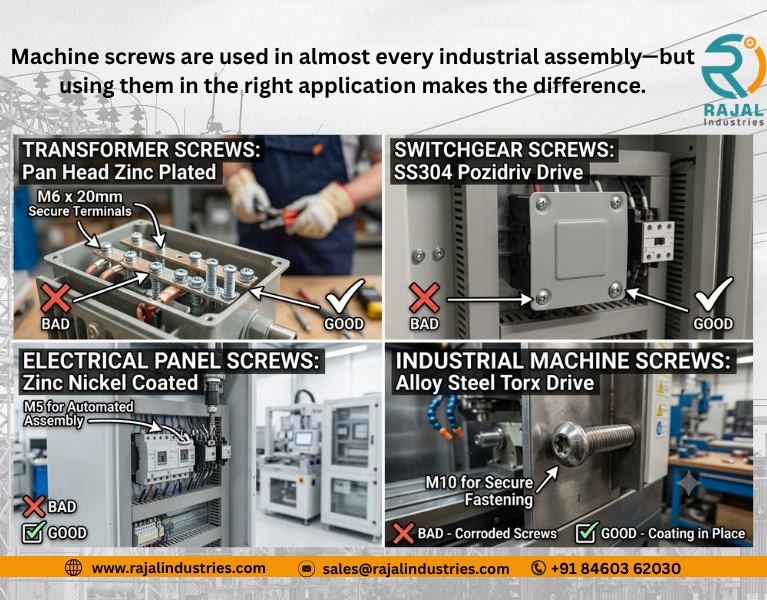
Machine screws are among the most widely used precision fasteners in industrial manufacturing because they provide secure, reusable and accurate fastening for assemblies that require maintenance or repeated disassembly. Unlike self-tapping screws, machine screws are installed into threaded holes, threaded inserts or nuts, making them ideal for OEM equipment where dimensional accuracy and long-term reliability are essential.
Today, machine screws are used extensively across industries such as transformer manufacturing, switchgear, electrical panels, industrial machinery, automation systems, elevators, telecom infrastructure, data centers and renewable energy equipment. Their availability in multiple head styles, drive types, materials and international standards allows engineers to select the right fastener for almost any application.
Engineers and procurement teams frequently search for Machine Screw Applications, Transformer Screws, Panel Screws, Industrial Machine Screws, Machine Screws for Electrical Panels and OEM Machine Screws when selecting fasteners for new equipment or maintenance projects.
This guide explains where machine screws are commonly used, why they are preferred over other fastening solutions and what engineers should consider before selecting them for industrial applications.
Quick Answer
Machine screws are widely used in:
- Power Transformers
- Distribution Transformers
- Switchgear
- Electrical Panels
- Industrial Machinery
- Elevator Systems
- Automation Equipment
- Telecom Cabinets
- Data Centers
- Control Panels
- Electronic Enclosures
- Renewable Energy Equipment
They are preferred because they provide:
- Precision fastening
- Easy maintenance
- Standard thread compatibility
- Reliable clamping force
- Excellent dimensional accuracy
- Long service life
Why Machine Screws Are Preferred in Industrial Equipment
Industrial equipment often requires components to be assembled, inspected and serviced throughout their operating life. Machine screws provide a practical fastening solution because they can be removed and reinstalled without damaging the threaded connection.
Key advantages include:
- Accurate positioning
- Consistent tightening
- Repeatable assembly
- Easy replacement during maintenance
- Availability in standard sizes
- Suitable for automated production
These benefits make machine screws one of the most commonly specified fasteners in OEM manufacturing.
Applications in Major Industries
Transformer Manufacturing
Machine screws are widely used in transformer manufacturing for assembling and securing non-structural components.
Typical applications include:
- Terminal Boxes
- Control Boxes
- Cooling Fan Assemblies
- Instrument Mounting
- Name Plates
- Cable Clamps
- Junction Boxes
- Protective Covers
Because transformers require periodic inspection and servicing, machine screws allow components to be removed and reinstalled without damaging the assembly.
Switchgear Manufacturing
Switchgear assemblies contain numerous precision components that require secure fastening.
Common applications include:
- Breaker Assemblies
- Busbar Supports
- Relay Mounting
- Protective Covers
- Terminal Supports
- Control Wiring Components
- Instrument Panels
Machine screws help maintain accurate alignment while allowing convenient maintenance.
Electrical Panels
Machine screws are extensively used in:
- PCC Panels
- MCC Panels
- LT Panels
- HT Panels
- Distribution Boards
- PLC Panels
- Automation Panels
- Control Cabinets
They provide secure fastening for electrical accessories while supporting easy replacement of components during servicing.
Industrial Machinery
Industrial machinery manufacturers use machine screws in equipment such as:
- CNC Machines
- Pumps
- Compressors
- Gearboxes
- Packaging Machines
- Processing Equipment
- Machine Guards
- Sensor Mounting
Their precise threads make them suitable for equipment requiring frequent maintenance.
Automation Equipment
Machine screws are commonly found in:
- PLC Cabinets
- Robotic Systems
- Vision Systems
- Machine Guarding
- Sensor Brackets
- Automation Frames
- Control Units
Their dimensional accuracy supports consistent assembly across automated production lines.
Elevator Systems
Machine screws are widely used for:
- Control Panels
- Door Mechanisms
- Sensor Mounting
- Safety Devices
- Electrical Assemblies
- Interior Components
Easy removal and replacement make them suitable for regular maintenance.
Telecom & Data Centers
Machine screws secure critical infrastructure components such as:
- Server Cabinets
- Telecom Racks
- Network Enclosures
- Cable Management Systems
- Power Distribution Units
- Communication Equipment
Reliable fastening helps maintain system integrity while allowing quick equipment upgrades.
Renewable Energy Equipment
Machine screws are used in:
- Solar Inverter Cabinets
- Battery Energy Storage Systems (BESS)
- Control Panels
- Monitoring Equipment
- Electrical Junction Boxes
Their corrosion-resistant material options make them suitable for demanding environments.
Common Machine Screw Head Styles Used
The selected head style depends on the application and installation requirements.
Common options include:
- Pan Head
- Cheese Head
- Countersunk Head
- Raised Countersunk Head
- Button Head
- Truss Head
- Round Head
- Fillister Head
Engineers select the head style based on available space, appearance and clamping requirements.
Common Drive Types
Machine screws are available with several drive systems.
Popular choices include:
- Phillips
- Slotted
- Pozidriv
- Torx
- Hex Socket
- Combination Drive
- Security Torx
The drive system should match the production process and maintenance requirements.
Materials Used for Industrial Applications
Material selection depends on operating conditions and industry requirements.
| Material | Typical Applications |
| Carbon Steel | General Industrial Equipment |
| Alloy Steel | Heavy Machinery |
| SS304 | Electrical Equipment |
| SS316 | Marine & Chemical Industries |
| Brass | Electrical Components |
| Aluminium | Lightweight Equipment |
Material selection should consider:
- Strength
- Corrosion resistance
- Operating environment
- Electrical conductivity (where applicable)
- Expected service life
How to Select the Right Machine Screw for Your Application
Selecting the correct machine screw requires evaluating both the equipment and the operating environment.
Step 1 – Understand the Equipment
Determine:
- Equipment type
- Indoor or outdoor use
- Static or dynamic loading
- Service requirements
Step 2 – Select the Thread Size
Verify:
- Thread diameter
- Thread pitch
- Required engagement
- Mating thread compatibility
Step 3 – Choose the Appropriate Head Style
The head design should suit:
- Available installation space
- Flush mounting requirements
- Clamping area
- Tool accessibility
Step 4 – Select the Material
Material selection should match:
- Mechanical load
- Corrosion exposure
- Industry standards
- Customer specifications
Step 5 – Choose the Surface Finish
Select the finish based on:
- Environmental conditions
- Corrosion requirements
- Product life expectancy
- Maintenance schedule
Step 6 – Select the Right Surface Finish
The performance of a machine screw depends not only on its material but also on the correct surface finish. Industrial equipment operates in different environments, so selecting the appropriate coating helps improve corrosion resistance, durability and service life.
Before selecting a finish, evaluate:
- Indoor or outdoor installation
- Humidity
- Chemical exposure
- Coastal environment
- Operating temperature
- Maintenance interval
- Industry requirements
Zinc Plated
Recommended for:
- Electrical Panels
- Switchgear
- Control Cabinets
- Industrial Machinery
Advantages
- Economical
- Good indoor corrosion resistance
- Bright appearance
- Suitable for general industrial applications
Zinc Nickel
Recommended for:
- Automotive Equipment
- Outdoor Electrical Enclosures
- Industrial Machinery
- High Humidity Areas
Advantages
- Better corrosion resistance than zinc plating
- Longer service life
- Improved wear resistance
Black Oxide
Suitable for:
- CNC Machines
- Automation Equipment
- Industrial Machinery
- Machine Tools
Advantages
- Uniform black finish
- Low light reflection
- Suitable for indoor applications
Nickel Plated
Commonly used in:
- Electrical Components
- Electronics
- Precision Instruments
- Decorative Equipment
Advantages
- Attractive finish
- Good corrosion resistance
- Better wear resistance
Stainless Steel
Recommended for:
- Marine Equipment
- Food Processing Plants
- Pharmaceutical Industries
- Chemical Processing Equipment
- Outdoor Installations
Advantages
- Excellent corrosion resistance
- Long service life
- Hygienic surface
- Low maintenance
Dacromet / Zinc Flake
Suitable for:
- Renewable Energy Projects
- Heavy Engineering
- Automotive OEMs
- Outdoor Industrial Equipment
Advantages
- High corrosion resistance
- Excellent salt spray performance
- Long operating life
Selecting the Right Machine Screw for Different Industries
Although the same machine screw design may be used across industries, the material and finish often vary depending on the operating conditions.
| Industry | Common Recommendation |
| Transformers | Carbon Steel with Zinc Plating |
| Switchgear | Zinc Plated or SS304 |
| Electrical Panels | Zinc Plated or SS304 |
| Industrial Machinery | Alloy Steel or Carbon Steel |
| Automation Equipment | Carbon Steel or SS304 |
| Telecom Equipment | SS304 or Zinc Nickel |
| Data Centers | SS304 |
| HVAC Equipment | Zinc Plated |
| Solar Equipment | SS316 or Dacromet |
| BESS Equipment | SS304 or Zinc Nickel |
Always follow the equipment manufacturer’s specifications and engineering drawings when selecting materials and finishes.
Machine Screw vs Self-Tapping Screw for Industrial Equipment
| Feature | Machine Screw | Self-Tapping Screw |
| Requires Threaded Hole | ✔ | ✘ |
| Creates Own Thread | ✘ | ✔ |
| Suitable for Repeated Maintenance | ✔ | Limited |
| Precision Assemblies | ✔ | Moderate |
| Electrical Panels | ✔ | ✔ |
| Sheet Metal | Limited | ✔ |
| Plastic Components | Limited | ✔ |
Machine screws are generally preferred for assemblies that require periodic servicing or replacement.
Machine Screw vs Bolt
| Feature | Machine Screw | Hex Bolt |
| Typical Size | Small to Medium | Medium to Large |
| Precision Equipment | ✔ | Limited |
| Heavy Structural Connections | Limited | ✔ |
| Threaded Hole Installation | ✔ | ✔ |
| Industrial Machinery | ✔ | ✔ |
| Electrical Equipment | ✔ | Moderate |
Both fasteners have important roles, and selection should be based on the application rather than appearance.
Common Engineering & Procurement Mistakes
Selecting the wrong fastener can increase maintenance costs and reduce equipment reliability.
Ignoring the Application
Always determine:
- Load conditions
- Service environment
- Maintenance requirements
- Equipment type
Selecting Only by Size
Two screws with the same diameter may have different:
- Head styles
- Thread pitches
- Materials
- Strength classes
- Surface finishes
Always review the complete specification.
Choosing an Incorrect Material
Material selection should match:
- Mechanical load
- Corrosion exposure
- Operating conditions
- Industry standards
Ignoring International Standards
Always confirm whether the drawing specifies:
- DIN
- ISO
- ANSI
- Customer-specific standards
Using the correct standard ensures proper fit and interchangeability.
Sending Incomplete RFQs
For accurate quotations, include:
- Thread Size
- Thread Pitch
- Screw Length
- Head Style
- Drive Type
- Material Grade
- Surface Finish
- Applicable Standard
- Quantity
- Annual Requirement
- Engineering Drawing
Providing complete information reduces quotation time and minimizes specification errors.
Quality Inspection Checklist
Before dispatch, machine screws should be inspected for:
| Inspection Item | Verify |
| Drawing Compliance | ✔ |
| Thread Diameter | ✔ |
| Thread Pitch | ✔ |
| Screw Length | ✔ |
| Head Dimensions | ✔ |
| Drive Recess | ✔ |
| Material Grade | ✔ |
| Surface Finish | ✔ |
| Coating Thickness | ✔ |
| Thread Quality | ✔ |
| Mechanical Properties | ✔ |
| Visual Inspection | ✔ |
| Batch Traceability | ✔ |
| Material Test Certificate (If Required) | ✔ |
Consistent inspection helps ensure reliable product quality and long-term performance.
Why Rajal Industries?
Rajal Industries manufactures standard and custom machine screws for OEM manufacturers across India and export markets.
Our capabilities include:
- Bulk production from 50,000+ pieces
- Standard & Custom Machine Screws
- Manufacturing as per Customer Drawings
- Carbon Steel, Alloy Steel, SS304, SS316 & Brass
- Precision Cold Forging
- CNC Machining
- Thread Rolling
- Controlled Heat Treatment
- Zinc, Zinc Nickel, Black Oxide, Nickel & Dacromet Finishes
- Dimensional Inspection
- Mechanical Property Testing
- Batch Traceability
- PPAP Support (where required)
- RMTC & Material Test Certificates
- OEM Packaging
- Export Supply Programmes
We supply fasteners to:
- Transformer Manufacturers
- Switchgear Manufacturers
- Electrical Panel OEMs
- Industrial Machinery Manufacturers
- Elevator Companies
- Automation Equipment Manufacturers
- Telecom Equipment Manufacturers
- Renewable Energy Equipment Manufacturers
OEM RFQ Checklist
Before requesting a quotation, include:
☐ Thread Size
☐ Thread Pitch
☐ Screw Length
☐ Head Style
☐ Drive Type
☐ Material Grade
☐ Surface Finish
☐ Applicable Standard (DIN / ISO / ANSI)
☐ Quantity
☐ Annual Requirement
☐ Engineering Drawing
☐ Packaging Requirements
☐ Delivery Schedule
Providing complete technical information enables suppliers to recommend the correct machine screw and prepare accurate commercial quotations.
Key Takeaways
- Machine screws are widely used in transformers, switchgear, electrical panels and industrial machinery because they provide precise and reusable fastening.
- Selecting the correct material, dimensions and surface finish improves equipment reliability and maintenance efficiency.
- International standards such as DIN and ISO simplify compatibility across OEM applications.
- Choosing the right manufacturing partner helps ensure consistent quality, traceability and dependable long-term supply.
Frequently Asked Questions
Why are machine screws commonly used in transformers?
Machine screws are used to secure terminal boxes, control boxes, protective covers, cable clamps and other serviceable components that require accurate fastening and periodic maintenance.
Are machine screws suitable for electrical panels?
Yes. Machine screws are widely used in MCC panels, PCC panels, LT panels, HT panels and control cabinets because they provide secure fastening with easy removal during servicing.
Which material is best for industrial machine screws?
The material depends on the application. Carbon steel is commonly used for general industrial equipment, while SS304 and SS316 are preferred where corrosion resistance is required.
What standards are commonly used for machine screws?
Common standards include DIN 84, DIN 85, DIN 7985, DIN 965, DIN 966, ISO standards and ANSI/ASME standards.
Can Rajal Industries manufacture custom machine screws?
Yes. Rajal Industries manufactures both standard and drawing-based machine screws according to customer specifications and OEM requirements.
What is your minimum production quantity?
Rajal Industries primarily manufactures bulk OEM orders from 50,000+ pieces, depending on the product design, material and manufacturing process.
Conclusion
Machine screws play an essential role in modern industrial manufacturing by providing precise, reliable and reusable fastening for equipment that requires long service life and regular maintenance. They are widely used in transformers, switchgear, electrical panels, industrial machinery, automation systems, telecom equipment and renewable energy applications, where dimensional accuracy and dependable performance are critical.
Selecting the correct machine screw dimensions, material, head style, drive type and surface finish ensures reliable assembly, easier maintenance and improved equipment performance throughout its operating life.
If your organization requires standard or custom machine screws for OEM production, Rajal Industries manufactures high-quality fasteners according to customer drawings and international standards, with bulk production starting from 50,000 pieces.
Related Keywords
Machine Screw Applications, Transformer Screws, Panel Screws, Industrial Machine Screws, Machine Screws for Electrical Panels, Machine Screws for Switchgear, OEM Machine Screws, Precision Machine Screws, Industrial Fasteners, Machine Screw Uses, DIN Machine Screws, Custom Machine Screws.