

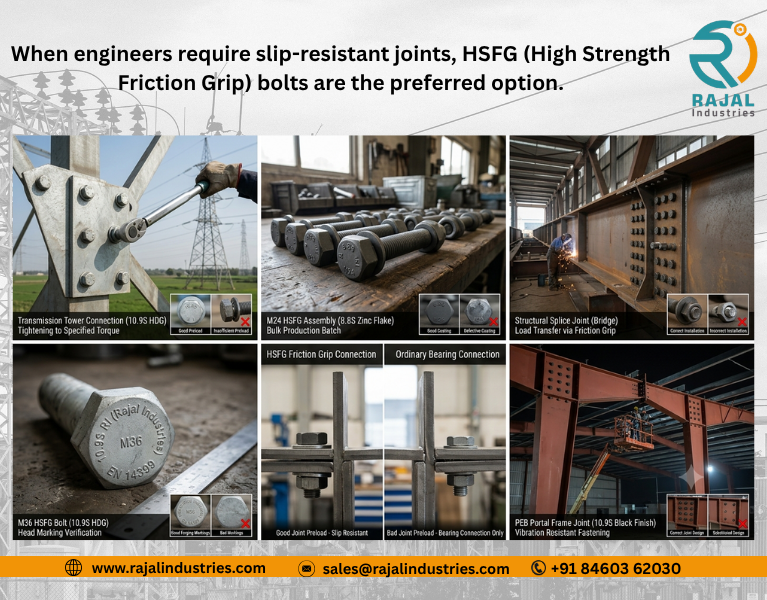
Modern steel structures demand more than ordinary fastening. Bridges, steel buildings, substations, transmission towers, heavy industrial plants and Power Equipment are exposed to continuous vibration, wind loads, fatigue and dynamic forces. In these applications, engineers often specify HSFG Bolts (High Strength Friction Grip Bolts) because they create a preloaded friction joint instead of allowing the bolt shank to carry the load in shear.
Procurement teams frequently search for HSFG Bolt Manufacturer, HSFG Bolt Supplier, High Strength Friction Grip Bolt, Structural Bolt Manufacturer, HSFG Fastener Manufacturer, and HSFG Bolt India when sourcing reliable fastening solutions for infrastructure and industrial projects.
At Rajal Industries, we manufacture HSFG Bolts for structural fabricators, EPC contractors, transformer manufacturers and industrial OEMs requiring bulk production from 50,000+ pieces. Our manufacturing follows recognised standards and customer drawings to ensure reliable performance for demanding structural applications.
Quick Answer
An HSFG Bolt (High Strength Friction Grip Bolt) is a high-strength structural fastener designed to create a friction grip connection between steel plates through controlled preload rather than relying only on shear resistance.
HSFG bolts are widely used in:
- Steel Structures
- Pre-Engineered Buildings (PEB)
- Bridges
- Power Plants
- Transmission Towers
- Industrial Buildings
- Heavy Equipment
- Substations
- Wind Energy Projects
- Oil & Gas Facilities
Selection depends on:
- Applicable standard
- Property class
- Bolt diameter
- Bolt length
- Surface coating
- Joint design
- Required preload
- Engineering specifications
What is an HSFG Bolt?
HSFG stands for High Strength Friction Grip.
Unlike ordinary bolts, an HSFG bolt is tightened to a specified preload. This high clamping force creates friction between the connected steel plates, allowing the joint to transfer loads through friction instead of permitting movement between plates.
This provides several advantages:
- Higher joint reliability
- Slip-resistant connections
- Excellent vibration resistance
- Better fatigue performance
- Reduced joint movement
- Improved structural safety
These characteristics make HSFG bolts the preferred choice for safety-critical structural projects.
Why Structural Engineers Specify HSFG Bolts
Structural engineers choose HSFG bolts where joint movement must be minimised.
Typical reasons include:
- Heavy structural loads
- Dynamic loading
- Wind loading
- Crane loading
- Repeated vibration
- Fatigue resistance
- Long design life
Because the connection relies on friction between steel surfaces, the joint remains stable even under fluctuating loads when installed correctly.
Industries That Buy HSFG Bolts in Bulk
Structural Steel Fabricators
HSFG bolts are widely used for:
- Steel columns
- Beams
- Trusses
- Roof structures
- Industrial sheds
- Mezzanine floors
Pre-Engineered Building (PEB) Manufacturers
Applications include:
- Primary steel structures
- Secondary framing
- Portal frames
- Crane structures
- Roof connections
Power Transmission & Distribution
Typical applications:
- Transmission towers
- Switchyard structures
- Transformer support structures
- Substation steelwork
- Gantry structures
Bridge Construction
HSFG bolts are commonly specified for:
- Steel bridge connections
- Cross girders
- Main girders
- Structural splice joints
- Maintenance platforms
Renewable Energy Projects
Widely used in:
- Wind turbine structures
- Solar mounting systems
- Battery Energy Storage Systems (BESS)
- Utility steel structures
Heavy Industrial Plants
Applications include:
- Cement plants
- Steel plants
- Refineries
- Petrochemical facilities
- Process equipment structures
Common HSFG Bolt Standards
HSFG bolts are manufactured according to recognised structural standards.
Common standards include:
| Standard | Typical Application |
| IS 3757 | Indian Structural Steel Projects |
| DIN 6914 | High Strength Structural Bolts |
| EN 14399 | Preloaded Structural Bolting Assemblies |
| ASTM F3125 | Structural Steel Connections |
The applicable standard should always follow the project specification and engineering drawing.
Common Property Classes
The most common HSFG bolt property classes include:
- 8.8S
- 10.9S
These grades are specifically designed for structural steel friction grip connections and should not be confused with standard Grade 8.8 or 10.9 machine bolts.
Step 1 – Understand the Joint Design
Before selecting an HSFG bolt, engineers first evaluate the connection.
Important factors include:
- Slip-critical joint
- Bearing joint
- Static load
- Dynamic load
- Fatigue loading
- Wind loading
- Vibration
- Structural design life
HSFG bolts are generally preferred where joint slip must be prevented.
Step 2 – Select the Correct Bolt Diameter
Bolt diameter depends on:
- Structural calculations
- Plate thickness
- Connection design
- Bolt spacing
- Required preload
Common structural sizes include:
| Thread Size | Typical Applications |
| M16 | Secondary Steel |
| M20 | Industrial Buildings |
| M22 | Structural Connections |
| M24 | Bridges & PEB |
| M27 | Heavy Structures |
| M30 | Transmission Towers |
| M36 | Large Infrastructure Projects |
Final dimensions should always follow structural calculations and approved project drawings.
Step 3 – Select the Correct Property Class
Most structural projects specify:
The selection depends on:
- Structural load
- Connection type
- Design calculations
- Applicable standard
- Customer specification
Higher grades should only be selected where required by engineering design.
Step 4 – Understand HSFG Bolt Preload
The main advantage of an HSFG (High Strength Friction Grip) Bolt is its controlled preload. During installation, the bolt is tightened to a specified tension so that the connected steel plates are clamped together with sufficient force. The load is then transferred through friction between the plates rather than by the bolt carrying shear loads directly.
A properly preloaded HSFG joint offers:
- Slip-resistant connections
- Better fatigue performance
- Improved vibration resistance
- Higher structural reliability
- Longer service life
- Reduced maintenance
For this reason, correct tightening procedures are as important as selecting the correct bolt.
Step 5 – Select the Correct Surface Finish
The surface finish should match the project environment and corrosion protection requirements.
Before selecting the finish, engineers should evaluate:
- Indoor or outdoor installation
- Humidity
- Coastal atmosphere
- Chemical exposure
- Service life requirement
- Maintenance accessibility
Black Finish HSFG Bolts
Commonly used for:
- Indoor structural steel
- Factory buildings
- Heavy machinery
- Industrial structures
Advantages:
- Good dimensional accuracy
- Suitable for controlled environments
- Cost-effective for indoor use
Hot Dip Galvanized (HDG) HSFG Bolts
Recommended for:
- Transmission towers
- Outdoor substations
- Bridges
- Solar structures
- Wind energy projects
- Industrial infrastructure
Advantages:
- Excellent corrosion resistance
- Long outdoor service life
- Reduced maintenance
- Suitable for harsh weather conditions
Zinc Flake (Geomet / Dacromet) Coatings
Used for:
- Renewable energy projects
- Utility infrastructure
- Heavy industrial structures
- Corrosive environments
Advantages:
- High salt spray resistance
- Uniform coating thickness
- Long-term corrosion protection
HSFG Bolts vs Ordinary High Tensile Bolts
Although both are high-strength fasteners, their applications are different.
| Feature | HSFG Bolt | Ordinary High Tensile Bolt |
| Joint Type | Friction Grip | Bearing Connection |
| Load Transfer | Friction Between Plates | Bolt Shear & Bearing |
| Slip Resistance | Excellent | Moderate |
| Structural Applications | Preferred | Limited |
| Preload Requirement | Mandatory | Depends on Design |
| Typical Industries | Bridges, PEB, Towers | Machinery, Equipment, OEM Products |
HSFG bolts are selected where structural movement must be minimised and long-term joint stability is critical.
Where HSFG Bolts Are Commonly Used
Steel Structures
Applications include:
- Industrial buildings
- Pipe racks
- Equipment platforms
- Mezzanine floors
- Structural frames
Pre-Engineered Buildings (PEB)
Used for:
- Portal frames
- Beam connections
- Roof structures
- Crane beams
- Primary steel members
Power Sector
Applications include:
- Transformer support structures
- Switchyard steel
- Gantry structures
- Transmission towers
- Substation frameworks
Bridge Construction
Common uses:
- Main girders
- Cross girders
- Structural splice joints
- Maintenance walkways
- Steel bridge assemblies
Renewable Energy
Widely used for:
- Wind turbine towers
- Solar module support structures
- Battery Energy Storage Systems (BESS)
- Utility steelwork
Common Engineering & Procurement Mistakes
Many structural failures are caused by incorrect installation or procurement practices rather than manufacturing defects.
Selecting Ordinary Bolts Instead of HSFG Bolts
Where a slip-resistant connection is specified, ordinary high tensile bolts should not be substituted unless approved by the design engineer.
Incorrect Tightening Procedure
HSFG bolts require controlled tightening using approved methods such as calibrated torque, turn-of-nut or tension control methods, depending on the project specification.
Reusing HSFG Bolts
Many structural projects recommend replacing HSFG bolts after removal because preload may no longer meet specification. Always follow the project engineer’s requirements and the applicable standard.
Mixing Different Bolt Grades
Using different property classes or different manufacturers within the same structural joint can lead to inconsistent preload and uneven load distribution.
Ordering Without Complete Specifications
Every RFQ should clearly specify:
- Applicable standard
- Bolt diameter
- Bolt length
- Property class
- Nut and washer requirements
- Surface coating
- Quantity
- Engineering drawing
Providing complete information helps suppliers prepare accurate quotations and manufacture the correct bolting assembly.
Quality Inspection Checklist
Before dispatch, structural fasteners should be inspected for:
| Inspection Item | Verify |
| Drawing Compliance | ✔ |
| Applicable Standard | ✔ |
| Bolt Diameter | ✔ |
| Bolt Length | ✔ |
| Thread Accuracy | ✔ |
| Property Class | ✔ |
| Material Grade | ✔ |
| Surface Finish | ✔ |
| Mechanical Properties | ✔ |
| Nut & Washer Compatibility | ✔ |
| Visual Inspection | ✔ |
| Batch Traceability | ✔ |
| Test Certificates (If Required) | ✔ |
A documented inspection process improves project quality and reduces site installation issues.
Why Rajal Industries?
Rajal Industries manufactures HSFG Bolts for structural fabricators, EPC contractors and industrial OEMs requiring dependable, large-scale production.
Our capabilities include:
- MOQ from 50,000+ pieces
- HSFG Bolt & Nut Assemblies
- Property Class 8.8S & 10.9S
- Manufacturing as per IS, DIN, EN and Customer Drawings
- Precision Cold Forging
- CNC Thread Rolling
- Controlled Heat Treatment
- Hot Dip Galvanized, Black Finish & Zinc Flake Coatings
- Batch Traceability
- Mechanical Testing Support
- OEM Packaging
- Long-Term Supply Programmes
- Export Manufacturing Support
We supply:
- Structural Steel Fabricators
- PEB Manufacturers
- Transformer Manufacturers
- Power Transmission Companies
- EPC Contractors
- Bridge Construction Companies
- Renewable Energy Companies
- Heavy Engineering Companies
OEM & EPC RFQ Checklist
Before requesting a quotation, include:
☐ Applicable Standard (IS / DIN / EN)
☐ Bolt Diameter
☐ Bolt Length
☐ Property Class (8.8S / 10.9S)
☐ Nut & Washer Requirement
☐ Surface Finish
☐ Quantity
☐ Annual Requirement
☐ Engineering Drawing
☐ Inspection & Testing Requirements
☐ Packaging Specification
☐ Delivery Schedule
Complete project information allows suppliers to recommend the correct HSFG bolting assembly and prepare accurate quotations.
Key Takeaways
- HSFG bolts create slip-resistant structural connections using controlled preload.
- They are widely used in bridges, PEB structures, substations, transmission towers and industrial plants.
- Correct installation and tightening are essential for achieving the designed performance.
- Property class, coating and applicable standards should always follow project specifications.
- Working with an experienced HSFG bolt manufacturer ensures consistent quality, reliable documentation and dependable long-term supply.
Frequently Asked Questions
What does HSFG stand for?
HSFG stands for High Strength Friction Grip, a bolting system designed for slip-resistant structural steel connections.
Where are HSFG bolts used?
They are commonly used in steel structures, bridges, pre-engineered buildings, substations, transmission towers, wind energy projects and heavy industrial plants.
What is the difference between an HSFG bolt and a normal high tensile bolt?
An HSFG bolt is installed with a specified preload to transfer load through friction between steel plates, while ordinary high tensile bolts generally transfer load through bearing and shear.
Which standards are commonly used for HSFG bolts?
Common standards include IS 3757, DIN 6914, EN 14399 and project-specific international standards.
Can Rajal Industries manufacture HSFG bolts according to customer drawings?
Yes. We manufacture standard and custom HSFG bolts according to engineering drawings, recognised standards and OEM specifications.
What is your minimum production quantity?
Rajal Industries primarily manufactures bulk OEM orders from 50,000+ pieces, depending on the product, project requirements and manufacturing process.
Conclusion
HSFG Bolts are the preferred fastening solution for structural steel connections where high preload, slip resistance and long-term reliability are required. Choosing the correct property class, standard, coating and installation method helps improve structural performance, reduce maintenance and support safe operation throughout the project’s service life.
For PEB manufacturers, structural steel fabricators, transformer manufacturers, EPC contractors, bridge builders and heavy engineering companies, partnering with an experienced HSFG Bolt Manufacturer ensures consistent product quality, engineering support and dependable long-term supply.
If your project requires HSFG Bolt assemblies with bulk production from 50,000+ pieces, Rajal Industries can manufacture according to your engineering drawings, project specifications and recognised international standards.
Related Keywords
HSFG Bolt Manufacturer, HSFG Bolt, High Strength Friction Grip Bolt, HSFG Fastener, Structural Bolt Manufacturer, HSFG Bolt Supplier, IS 3757 HSFG Bolt, DIN 6914 Bolt, EN 14399 Bolt, Structural Steel Bolt, PEB Fasteners, Bridge Fasteners, Transmission Tower Bolts, High Strength Structural Bolt, Industrial Structural Fasteners, Bulk HSFG Bolt Supplier, OEM Structural Fasteners.