

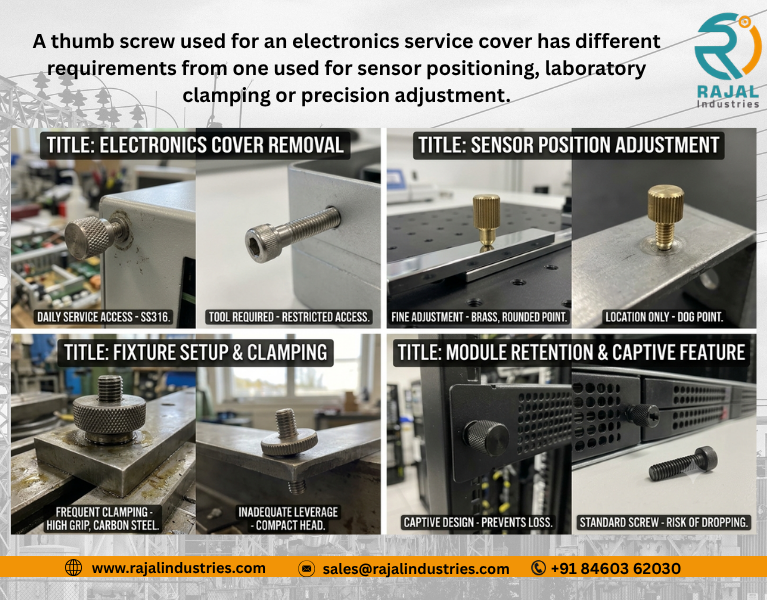
Selecting the correct Knurled Thumb Screw requires more than matching a thread diameter.
A thumb screw is a manually operated fastener. Its head, knurl, thread, length, shoulder, point, material and finish must work together with the mating component and intended user.
For industrial and precision equipment, use this selection sequence:
Application → User → Manual Operation → Mating Component → Thread → Length → Head → Knurl → Shoulder/Point → Drive → Material → Finish → Environment → Tolerances → Manufacturing → Validation
This Thumb Screw Guide explains how to work through those decisions without over-specifying the fastener or selecting features that do not provide a functional benefit.
Quick Answer: How Do You Select a Knurled Thumb Screw?
Select a Knurled Thumb Screw by first defining what the screw must do and how often it will be operated. Then confirm the mating thread, engagement, overall length, head diameter and height, knurl, shoulder or point, material, finish and required tolerances. Finally, test the finished screw in the actual or representative assembly.
Why Thumb Screw Selection Starts with the Application
A thumb screw can perform different functions:
- Fastening
- Adjustment
- Positioning
- Clamping
- Service access
- Setup change
- Accessory retention
- Fixture adjustment
The correct design depends on which function is required.
For example, a screw used to open an electronics cover has different priorities from a screw used to position a sensor.
Knurled Thumb Screw Selection in 12 Steps
| Step | Selection | Main Question |
| 1 | Application | What must the screw do? |
| 2 | User & Access | Who operates it and how often? |
| 3 | Mating Component | What does it engage/contact? |
| 4 | Thread | What diameter and pitch/TPI? |
| 5 | Length | What engagement/projection is needed? |
| 6 | Head | What grip and clearance are available? |
| 7 | Knurl | What manual grip is required? |
| 8 | Shoulder/Point | Does it guide, locate or contact? |
| 9 | Drive | Is tool assistance needed? |
| 10 | Material & Finish | What environment must it survive? |
| 11 | Tolerances | Which dimensions control function? |
| 12 | Validation | Does the finished assembly work? |
Step 1: Define the Screw Function
Start with:
Why is a thumb screw being used instead of a conventional machine screw?
A clear answer might be:
- Technician removes the cover daily
- Operator changes fixture position frequently
- Sensor requires manual adjustment
- Accessory must be installed without a tool
- Laboratory fixture requires repeated clamping
If there is no meaningful benefit from manual operation, a conventional fastener may be simpler.
Selection by Function
| Required Function | Main Features to Review |
| Cover Fastening | Thread + head + clearance |
| Service Access | Grip + repeated use |
| Adjustment | Thread + point |
| Positioning | Shoulder/point |
| Clamping | Thread + contact surface |
| Fixture Setup | Grip + durability |
| Module Retention | Thread + alignment |
| Captive Panel | Retention + travel |
| Tool-Assisted Manual Fastening | Knurl + drive |
Step 2: Identify the Intended User
The user can influence the design.
Possible users include:
- Assembly operator
- Machine operator
- Service technician
- Laboratory technician
- Engineer
- Equipment owner
Ask:
Who will touch this screw during normal equipment use?
Why the User Matters
An assembly technician operating the screw occasionally has different requirements from an operator adjusting it hundreds of times during production.
Consider:
- Hand access
- Gloves
- Frequency
- Required speed
- Comfort
- Training
- Authorized access
Step 3: Determine Access Frequency
Access frequency is one of the strongest reasons to choose a thumb screw.
| Access Frequency | Selection Direction |
| Multiple times per shift | Strong thumb-screw candidate |
| Daily | Strong candidate |
| Weekly | Good potential |
| Periodic servicing | Application dependent |
| Rare access | Conventional screw may be sufficient |
| Restricted access | Thumb screw may be inappropriate |
This is a design guide, not a universal rule.
High-Frequency Operation
For frequent operation, selection should consider:
Grip + Comfort + Thread Wear + Mating Thread + Finish Wear + Point Wear
A screw that performs well during prototype testing may behave differently after long-term repeated use.
Step 4: Decide Whether Tool-Free Access Is Appropriate
A Knurled Thumb Screw makes manual access easier.
That is useful only where easy access is intended.
Suitable Tool-Free Access
Potential examples include:
- Test fixtures
- Laboratory fixtures
- Intended equipment adjustments
- User-adjustable accessories
- Suitable service panels
- Prototype equipment
- Sensor brackets
When Tool-Free Access May Be Wrong
Review carefully where the fastener protects:
- Electrical hazards
- Moving components
- Restricted service areas
- Safety-related systems
- Machine guards
- Calibration areas not intended for users
In these applications, a tool-driven or controlled-access fastener may be more appropriate.
Manual Access vs Security
These goals often work in opposite directions:
Thumb Screw → Easier Manual Access
Security Fastener → More Restricted Access
Do not select a thumb screw where tamper resistance is the main requirement.
Step 5: Understand the Mating Component
The thumb screw is only one part of the joint.
Review what it engages:
- Tapped metal hole
- Threaded insert
- Nut
- Bracket
- Panel
- Fixture
- Plastic insert
- Threaded housing
Why the Mating Component Matters
It can determine:
- Thread
- Required engagement
- Wear resistance
- Adjustment behaviour
- Point contact
- Alignment
- Available clearance
For existing equipment, the mating component may control most of the screw specification.
Existing OEM Equipment
If replacing an existing screw:
Do not change the thread merely because another size is easier to source.
First identify the approved mating thread and assembly requirements.
Step 6: Select Thread Diameter and Pitch
The thread must match the mating component.
For metric threads, specify:
Diameter × Pitch
Example:
M4 × 0.7
not simply:
M4
Common Metric Coarse-Thread Examples
| Thread | Nominal Diameter | Pitch |
| M3 × 0.5 | 3 mm | 0.5 mm |
| M4 × 0.7 | 4 mm | 0.7 mm |
| M5 × 0.8 | 5 mm | 0.8 mm |
| M6 × 1.0 | 6 mm | 1.0 mm |
| M8 × 1.25 | 8 mm | 1.25 mm |
These are thread examples only. They are not a universal manufacturing range or recommended size list for every application.
Metric vs Unified Threads
OEM equipment can use:
- Metric threads
- UNC threads
- UNF threads
- Other drawing-defined thread systems
Never substitute a similar-looking thread from another system without engineering approval.
Coarse vs Fine Thread
| Selection Factor | Coarse Thread | Fine Thread |
| Axial Movement per Turn | Greater | Lower |
| General Fastening | Common | Application dependent |
| Adjustment | Possible | Can provide smaller movement/turn |
| Mating Component | Must match | Must match |
| Selection Basis | Application | Application |
Does Fine Thread Mean Precision?
No.
A finer pitch can provide less axial movement per revolution, but precision can also depend on:
- Thread fit
- Backlash
- Alignment
- Point geometry
- Mating component
- Structural stiffness
A fine thread alone does not turn an ordinary assembly into a precision mechanism.
Step 7: Determine Required Thread Engagement
Thread engagement should be based on the complete joint.
Factors include:
- Screw material
- Mating material
- Thread diameter
- Mating geometry
- Required holding function
- Joint design
Avoid using one universal engagement rule for all Industrial Screws.
Soft Mating Materials
Special attention may be required where the mating component is:
- Aluminium
- Plastic
- Soft alloy
- Threaded insert
Frequent adjustment can wear the mating thread even if the screw remains undamaged.
Repeated Adjustment
For high-cycle applications, evaluate:
Screw Thread + Mating Thread + Engagement + Material Pairing + Expected Service Life
The mating component is often just as important as the screw.
Step 8: Select Thread Length
Thread length should provide the required engagement and movement without creating unwanted projection.
Check:
Assembly Stack + Engagement + Adjustment Range + Hole Depth
Thread Too Short
Potential problems include:
- Insufficient engagement
- Reduced adjustment range
- Assembly difficulty
- Inadequate holding function
Thread Too Long
Potential problems include:
- Bottoming in a blind hole
- Excessive internal projection
- Contact with nearby components
- Reduced usable adjustment
Blind Hole Selection
For a blind threaded hole, review:
Available Hole Depth + Threaded Depth + Screw Length + Point + Required Clearance
Do not assume the full drilled depth is usable threaded depth.
Through-Hole Selection
Where the screw passes through:
- Nut
- Insert
- Threaded bracket
check the maximum permitted projection beyond the mating component.
Step 9: Select Overall Length
Overall length should come from the assembly geometry.
A useful approach is:
Required Engagement + Assembly Thickness + Shoulder/Unthreaded Section + Functional Point Geometry
according to the drawing’s length convention.
Check the Screw in Every Position
For adjustable or removable equipment, evaluate:
Fully Tightened → Operating Position → Partially Released → Fully Released
This is particularly important around:
- PCBs
- Wiring
- Sensors
- Moving parts
- Covers
- Adjacent equipment
Step 10: Select Head Diameter
The head is the user’s primary interface with the Knurled Thumb Screw.
Head diameter influences:
Grip + Manual Leverage + Equipment Clearance
Larger Head
Can provide:
- More gripping area
- Greater manual leverage
- Easier handling
But can also create:
- Interference
- Larger projection
- Increased material
- Packaging limitations
Smaller Head
Can provide:
- Compact geometry
- Reduced interference
- Better fit in dense equipment
But may reduce:
- Finger contact
- Manual leverage
- Gloved usability
Head Diameter Selection Questions
Ask:
- How much radial space is available?
- Can the operator reach the head?
- Are gloves used?
- How frequently is the screw operated?
- Is greater manual leverage needed?
- Are connectors or controls nearby?
Do Not Select Head Diameter from Thread Size Alone
Unless an applicable product standard defines the head geometry, custom Precision Fasteners can use different head dimensions with the same nominal thread.
For example:
M4 does not automatically mean one specific knurled-head diameter.
Step 11: Select Head Height
Head height affects:
- Finger contact
- Knurled width
- Projection
- Appearance
- Optional drive depth
Head diameter and height should be evaluated together.
Head Selection Matrix
| Application | Main Head Priority |
| Compact Electronics | Clearance |
| Test Fixture | Frequent grip |
| Laboratory Equipment | Handling |
| Instrumentation | Controlled geometry |
| Industrial Fixture | Manual leverage |
| Rack Equipment | Low projection |
| Gloved Operation | Accessible grip |
Finger Clearance
A well-designed head can still be difficult to use if the equipment blocks the operator’s fingers.
Check clearance from:
- Enclosure walls
- Adjacent screws
- Handles
- Connectors
- Cables
- Brackets
- Switches
Ergonomics for Repeated Operation
For frequently used Industrial Screws, test:
Actual Head + Final Knurl + Final Finish + Representative User + Actual Equipment
This is more useful than judging grip from a CAD model alone.
Step 12: Select the Knurl
The knurl should provide a useful manual gripping surface.
Common design directions include:
- Straight knurl
- Diamond/cross knurl
- Customer-defined pattern
Straight Knurl
Generally provides longitudinal grooves around the head.
Potential reasons to select it include:
- Defined linear appearance
- Suitable manual grip
- Existing OEM design
- Customer preference
Diamond Knurl
Uses intersecting grooves to create a crossed surface texture.
Potential reasons include:
- Multi-directional texture
- Distinctive tactile surface
- Existing product design
- Customer preference
Straight vs Diamond Knurl
| Factor | Straight | Diamond/Cross |
| Pattern | Linear | Crossed |
| Manual Grip | Suitable | Suitable |
| Appearance | Linear texture | Diamond texture |
| Frequent Handling | Application dependent | Application dependent |
| Cleaning | Application dependent | Application dependent |
| Selection | Drawing/function | Drawing/function |
Neither is universally better.
Knurl Aggressiveness
More aggressive knurling does not automatically produce a better thumb screw.
Very sharp texture can create:
- User discomfort
- Sharp edges
- Difficult cleaning in some applications
- Cosmetic issues
Very shallow texture can reduce grip.
The target should be:
Adequate Grip + Comfortable Handling + Manufacturable Geometry
Knurl Width
Knurl width affects the amount of textured surface available to the fingers.
Consider it together with:
Head Height + Finger Contact + Equipment Clearance
Knurl and Gloves
For gloved operation, test:
- Head diameter
- Head height
- Knurl
- Finger clearance
Do not assume a more aggressive knurl alone solves poor glove accessibility.
Knurl and Cleaning
For laboratory, medical-equipment or other frequently cleaned applications, evaluate:
- Surface geometry
- Cleaning access
- Chemical compatibility
- Finish
- Application hygiene requirements
The OEM should define any special cleanliness or regulatory requirements.
Step 13: Decide Between Fully Threaded and Shoulder Design
A standard thumb screw may be fully threaded.
A custom screw may require an unthreaded shoulder.
Fully Threaded Knurled Thumb Screw
Strong candidate for:
- General fastening
- Covers
- Simple removable components
- Straightforward threaded assemblies
where no guidance or spacing feature is required.
Shoulder Knurled Thumb Screw
Consider a shoulder where the fastener also needs to:
- Guide
- Locate
- Space
- Support movement
- Pass through a controlled clearance
- Support a captive concept
Fully Threaded vs Shoulder
| Requirement | Fully Threaded | Shoulder |
| General Fastening | Strong | Possible |
| Simple Cover | Strong | Usually unnecessary |
| Guidance | Limited | Strong |
| Positioning | Limited | Strong |
| Controlled Spacing | Limited | Strong |
| Moving Component | Limited | Possible |
| Custom Captive Design | Separate geometry | Often useful |
Shoulder Diameter
The shoulder may interact with:
- Panel hole
- Slot
- Guide
- Bracket
- Retainer
Its diameter should therefore follow the required fit.
Shoulder Length
Shoulder length can control:
- Spacing
- Movement
- Position
- Clearance
- Captive travel
Where functional, it should be treated as a critical dimension.
Step 14: Select the Point or End
The point becomes especially important for adjustment and clamping.
Possible directions include:
- Standard end
- Flat end
- Rounded end
- Dog point
- Custom point
Point Selection Matrix
| Function | Potential Point | Main Check |
| General Fastening | Standard | Thread engagement |
| Direct Clamping | Flat | Contact pressure |
| Adjustment | Rounded/custom | Contact behaviour |
| Location | Dog point | Mating recess |
| Specialized Equipment | Custom | Approved geometry |
Flat Point
A flat end can be useful for suitable direct-contact applications.
But check whether it can mark or deform the mating component.
Rounded Point
A rounded point can be considered where a different contact profile is required.
Do not automatically call it “non-marking.”
Surface marking depends on:
Point + Material + Contact Area + Applied Force + Mating Surface
Dog Point
A dog point can locate into:
- Hole
- Recess
- Slot
- Guide
The point diameter and length should match the mating feature.
Precision Equipment and Point Geometry
For Precision Fasteners used in adjustment systems, the point may directly influence:
- Contact location
- Movement
- Repeatability
- Surface condition
It should not be treated as an unimportant end feature.
Step 15: Decide Whether a Tool Drive Is Needed
A thumb screw can still include a tool interface.
Possible options include:
- Hand-only head
- Slot
- Phillips
- Hex socket
- Torx-type drive
- Customer-defined drive
Why Add a Tool Drive?
A combined design can provide:
Manual Operation + Tool Assistance
This can be useful where the screw is normally adjusted by hand but technicians occasionally need a tool.
Tool Drive Does Not Automatically Permit High Torque
Allowable tightening depends on:
- Thread
- Screw material
- Head
- Drive
- Mating component
- Joint design
Do not assign installation torque simply from the presence of a hex or Torx-type drive.
Step 16: Select Material
Material selection should follow:
Mechanical Requirement + Environment + Mating Material + Manufacturing Process + Customer Specification
Potential options include:
- Carbon steel
- Suitable alloy steel
- Stainless steel
- Brass
- Customer-specified materials
Carbon Steel
Carbon steel can be practical for many Industrial Screws when paired with an appropriate finish.
Review:
- Required properties
- Corrosion exposure
- Finish
- Manufacturing process
- Cost
Stainless Steel
Stainless steel can be useful where:
- Corrosion resistance is important
- Appearance matters
- Customer specification requires it
- Equipment is exposed to certain environments
Common directions can include SS304/A2-type and SS316/A4-type materials.
SS304 vs SS316
| Factor | SS304/A2-Type | SS316/A4-Type |
| General Equipment | Strong candidate | Possible |
| Corrosion Resistance | Good for many environments | Enhanced in many chloride-related environments |
| Chloride Exposure | Review | Often stronger direction |
| Indoor Equipment | Strong | Often unnecessary unless specified |
| Outdoor | Exposure dependent | Exposure dependent |
| Medical Equipment | Application dependent | Application dependent |
| Cost | Lower direction | Higher direction |
Do Not Use Industry Name to Select Stainless Grade
Avoid:
Medical = SS316
Outdoor = SS316
Laboratory = SS316
Instead use:
Actual Environment + Cleaning + Corrosion Requirement + Mechanical Requirement + OEM Specification
Brass
Brass can suit selected:
- Instrumentation
- Electrical equipment
- Laboratory equipment
- Adjustment mechanisms
where its mechanical and environmental properties meet the requirement.
Material Selection Matrix
| Application | Carbon Steel | SS304/A2-Type | SS316/A4-Type | Brass |
| General Industrial | Strong | Strong | Requirement-specific | Selected uses |
| Electronics | Strong | Strong | Requirement-specific | Selected uses |
| Instrumentation | Possible | Strong | Possible | Strong in selected uses |
| Laboratory | Environment dependent | Strong direction | Exposure dependent | Selected uses |
| Outdoor | Finish dependent | Exposure dependent | Exposure dependent | Review |
| Medical Equipment | Application dependent | Application dependent | Application dependent | Specialized |
This table is a selection direction only.
Material Pairing Matters
The screw does not operate alone.
Examples requiring review include:
Stainless Screw + Stainless Mating Thread
Potential galling considerations.
Stainless Screw + Aluminium + Moisture
Potential galvanic considerations.
Hard Steel Point + Soft Component
Potential surface marking.
Stainless Thread Galling
For frequently adjusted stainless threaded assemblies, review:
- Material pairing
- Thread fit
- Surface condition
- Installation
- Service frequency
- Lubrication where permitted
Galling risk should be evaluated as part of the assembly.
Step 17: Select the Finish
Finish selection should consider:
Corrosion + Appearance + Wear + Thread Fit + Knurl Definition + Customer Requirement
Possible Finish Directions
Depending on material and specification:
- Zinc-based coating
- Black finish system
- Nickel-related finish
- Passivation
- Other engineered coatings
- Customer-specified finish
“Black” Is Not a Technical Finish
A buyer requesting:
Black Knurled Thumb Screw
has defined color, not necessarily the coating system.
Different black finishes can have different:
- Thickness
- Corrosion performance
- Friction
- Appearance
- Wear behaviour
Specify the actual finish requirement.
Finish and Knurl
Because the knurl is manually handled, coating can affect:
- Surface feel
- Knurl definition
- Finished diameter
- Appearance
- Edge condition
Approve production-intended finished samples where these factors matter.
Finish and Thread Fit
Coating can change thread dimensions.
For close-fitting Precision Fasteners, final inspection should consider the finished part rather than only the uncoated component.
Step 18: Consider Corrosion Environment
Ask where the equipment will actually operate.
Potential exposures include:
- Indoor humidity
- Condensation
- Outdoor moisture
- Cleaning chemicals
- Process chemicals
- Chlorides
- Repeated handling
Indoor Does Not Mean No Corrosion
Indoor equipment can still experience:
- Humidity
- Condensation
- Cleaning
- Chemical exposure
- Human handling
Material and finish should match actual conditions.
Step 19: Define Critical Tolerances
A “precision” thumb screw should not simply have tight tolerances everywhere.
Ask:
Which dimensions actually control function?
Possible critical features include:
- Thread
- Shoulder diameter
- Shoulder length
- Point
- Head diameter
- Overall length
- Concentricity/runout where required
- Drive geometry
- Knurled OD where functionally controlled
Precision Fasteners Need Measurable Requirements
The term Precision Fasteners should mean that specific features are manufactured and inspected to defined requirements.
It should not be used only as a marketing label.
Over-Tolerancing
Unnecessarily tight tolerances can increase:
- Manufacturing difficulty
- Inspection time
- Rejection rate
- Tooling complexity
- Cost
Use tight tolerances where the assembly needs them.
Tolerance Stack
The complete assembly may include:
Thumb Screw + Panel + Washer + Bracket + Mating Thread + Fixture
All have dimensional variation.
A tolerance that looks acceptable on the screw drawing alone may create a problem when combined with other components.
Example: Shoulder Through a Hole
Check:
Maximum Finished Shoulder Diameter vs Minimum Hole Diameter
for the tight condition.
Also check:
Minimum Shoulder Diameter vs Maximum Hole Diameter
for excessive clearance.
Example: Knurled Head Inside a Recess
Check:
Maximum Finished Head/Knurled OD vs Minimum Recess Diameter
Do not forget coating effects.
Example: Blind Hole
Check:
Maximum Screw Projection vs Minimum Available Hole Depth
while maintaining the required thread engagement.
Step 20: Review Manufacturing Feasibility
The screw should not be designed independently from how it will be manufactured.
Potential processes can include:
- CNC machining
- Cold forming
- Knurling
- Thread rolling
- Thread cutting
- Secondary machining
- Combined processes
Manufacturing Process Depends on Volume
A process suitable for:
20 Development Samples
may not be economical for:
200,000 Production Parts
Expected annual quantity should therefore be shared early.
Prototype vs Production
Prototype stage:
Flexible Manufacturing → Functional Learning → Design Changes
Production stage:
Stable Drawing → Suitable Tooling → Repeatable Process → Inspection Plan → Controlled Output
CNC Machining
Can be useful for:
- Prototypes
- Lower quantities
- Special shoulders
- Special points
- Complex geometry
- Development parts
Forming
For suitable higher-volume designs, forming can offer an efficient production route.
Feasibility depends on:
- Material
- Head geometry
- Knurl
- Shoulder
- Thread
- Tolerances
- Quantity
Hybrid Manufacturing
Some custom Precision Fasteners may use:
Formed Blank → Secondary Machining → Knurl → Thread → Finish
where the design and volume justify it.
Manufacturing Route Comparison
| Requirement | Machining | Forming | Hybrid |
| Prototype | Strong | Limited by tooling | Possible |
| Low Volume | Strong | Economics dependent | Possible |
| High Volume | Cost review | Strong where feasible | Strong where justified |
| Complex Shoulder | Strong | Feasibility dependent | Strong |
| Special Point | Strong | Feasibility dependent | Strong |
| Design Changes | Easier | Harder after tooling | Medium |
| Tooling Investment | Lower direction | Higher possible | Medium/high |
| Repeat Production | Good | Strong | Strong |
Design for Manufacturing
Before freezing a custom screw, ask the manufacturer:
- Can this head be formed?
- Does the knurl require a secondary operation?
- Can the thread be rolled?
- Does the shoulder require machining?
- Is the point practical?
- Which tolerances drive cost?
- Does expected quantity justify tooling?
A small approved geometry change can sometimes significantly improve manufacturability.
Step 21: Define Inspection Requirements
A selection is not complete until the OEM knows how the finished screw will be verified.
Possible inspection areas include:
Thread
- GO/NO-GO gauges
- Applicable dimensional checks
Dimensions
- Overall length
- Thread length
- Head diameter
- Head height
- Shoulder
- Point
Knurl
- Pattern
- Width
- Controlled diameter
- Burr condition
- Appearance
Material
- Documentation
- Customer-required verification
Finish
- Appearance
- Thickness where required
- Corrosion testing where specified
Dimensional Compliance Is Not Enough
A screw can meet drawing dimensions but still be awkward in the real assembly.
Therefore, where relevant:
Dimensional Inspection + Functional Assembly Test
should be used together.
Step 22: Validate the Finished Assembly
The strongest final test is the actual intended use.
Use:
Install → Grip → Rotate → Engage → Tighten/Adjust → Operate → Release → Reposition/Remove → Re-engage
What to Observe During Functional Testing
Check:
- Thread engagement
- Smooth operation
- Head clearance
- Finger access
- Knurl comfort
- Point contact
- Internal projection
- Holding function
- Adjustment
- Release
- Re-engagement
Use Finished Samples
Where coating or passivation is required, test the production-intended finish.
Finish can change:
- Thread fit
- Surface feel
- Knurled diameter
- Appearance
- Repeated operation
Repeated-Use Validation
Where the screw will be operated frequently:
Engage → Tighten/Adjust → Release → Re-engage → Repeat
Monitor:
- Screw thread
- Mating thread
- Knurl
- Finish
- Point
- Shoulder
- Manual feel
- Functional consistency
The OEM should define the required cycle count based on expected service conditions.
Manual Tightening and Preload
One important limitation in any Thumb Screw Guide is that hand tightening varies between operators.
Factors include:
- Hand strength
- Head diameter
- Knurl
- Gloves
- Access
- Surface condition
Therefore:
Manual operation should not be assumed to produce a repeatable controlled preload.
When Controlled Tightening Is Required
If the joint requires a defined installation condition, consider:
- Tool-assisted operation
- Controlled installation process
- Different fastener type
- Different joint design
The equipment engineer should define the appropriate solution.
Vibration Selection
A knurled head improves manual grip.
It does not lock the thread.
Therefore:
Knurled Thumb Screw ≠ Vibration-Locking Screw
If vibration exists, review the locking requirement separately.
Vibration Decision Questions
Ask:
- Does the equipment vibrate?
- Can screw movement affect function?
- Is the screw frequently adjusted?
- Must its position remain fixed?
- What happens if it loosens?
The complete joint determines the solution.
Captive Requirement
If the screw should remain attached after disengagement, consider a captive design.
This adds another requirement:
Manual Operation + Fastener Retention
When to Consider a Captive Thumb Screw
Potential applications include:
- Electronics service panels
- Instrument covers
- Laboratory enclosures
- Rack equipment
- Frequently serviced OEM panels
where loose hardware is undesirable.
Captive Is Not the Same as Locking
Remember:
Captive → Screw stays with panel
Locking → Screw resists unintended loosening
These are different functions.
Industrial Equipment Selection Matrix
| Application | Primary Selection Priority |
| Adjustable Guide | Grip + holding |
| Sensor Bracket | Positioning |
| Test Fixture | Repeated use |
| Inspection Fixture | Adjustment |
| Removable Cover | Access |
| Machine Accessory | Fastening |
| Positioning Stop | Point |
| Changeover Component | Speed + ergonomics |
Precision Equipment Selection Matrix
| Application | Main Priority |
| Measurement Fixture | Positioning |
| Calibration Equipment | Adjustment |
| Optical Mount | Thread + point |
| Sensor Positioner | Alignment |
| Laboratory Instrument | Manual control |
| Test Equipment | Repeated adjustment |
| Gauge Fixture | Holding |
| Inspection Equipment | Repeatability |
Electronics Selection Matrix
| Application | Main Priority |
| Service Cover | Access |
| Removable Module | Retention |
| Test Fixture | Repeated use |
| Sensor Mount | Position |
| Rack Equipment | Head clearance |
| Development Equipment | Quick changes |
Selection Mistakes to Avoid
Selecting from Thread Size Alone
M4 does not define the complete screw.
Choosing the Largest Head
More grip can create more interference.
Ignoring the User
The operator directly interacts with the fastener.
Ignoring Finger Clearance
A knurled head cannot help if it cannot be reached.
Choosing Knurl Only by Appearance
Grip, comfort and manufacturing matter too.
Assuming Fine Thread Means Precision
Precision depends on the complete mechanism.
Ignoring the Point
Contact geometry can determine function.
Specifying “Stainless”
Define the actual material grade.
Specifying “Black”
Define the actual finish.
Assuming Knurl Prevents Loosening
It does not.
Assuming Hand Tightening Provides Controlled Torque
It does not.
Ignoring Production Volume
Prototype and mass-production processes can differ.
Quick Selection Table
| If You Need… | Review First |
| Easy Manual Access | Head + knurl |
| Frequent Adjustment | Grip + thread wear |
| Compact Equipment | Head clearance |
| Fine Adjustment | Thread + mechanism |
| Surface Clamping | Point |
| Positioning | Shoulder + point |
| Tool Assistance | Drive |
| Corrosion Resistance | Material + finish |
| Frequent Cleaning | Material + surface |
| High-Cycle Use | Screw + mating thread |
| Captive Hardware | Retention geometry |
| Vibration Resistance | Separate locking strategy |
| Restricted Access | Alternative fastener |
OEM Selection Checklist
Before moving to quotation, confirm:
Application
☐ Screw function defined
☐ Intended user defined
☐ Access frequency known
☐ Tool-free access appropriate
☐ Safety implications reviewed
Thread
☐ Thread system
☐ Diameter
☐ Pitch/TPI
☐ Thread tolerance/class
☐ Required engagement
Length
☐ Overall length
☐ Thread length
☐ Internal projection
☐ Blind-hole depth where relevant
Head
☐ Diameter
☐ Height
☐ Finger clearance
☐ Equipment clearance
☐ Gloved use if relevant
Knurl
☐ Straight/diamond/custom
☐ Width
☐ Grip requirement
☐ Burr/edge requirement
☐ Cleaning considered
Shank/Shoulder
☐ Fully threaded or shoulder
☐ Shoulder diameter
☐ Shoulder length
☐ Functional fit
Point
☐ Standard
☐ Flat
☐ Rounded
☐ Dog point
☐ Custom
Drive
☐ Hand only
☐ Slot
☐ Phillips
☐ Hex socket
☐ Torx-type
☐ Other
Material
☐ Exact grade
☐ Mechanical requirement
☐ Mating material compatibility
Finish
☐ Technical finish
☐ Corrosion requirement
☐ Appearance requirement
☐ Final dimensional effect considered
Quality
☐ Critical dimensions
☐ Thread inspection
☐ Material documentation
☐ Finish verification
☐ Functional test
☐ Repeated-use test if required
What Should You Send to a Manufacturer?
For custom Industrial Screws or Precision Fasteners, send:
Approved Drawing + Application + Mating Component + Thread + Length + Head/Knurl Dimensions + Shoulder/Point + Drive + Material + Finish + Tolerances + Quality Requirements + Expected Quantity
This gives the manufacturer enough information to evaluate process, tooling and inspection feasibility.
Rajal Industries Selection Review
Rajal Industries can evaluate drawing-based Knurled Thumb Screw, Precision Fasteners and suitable custom Industrial Screws for OEM requirements, subject to technical and manufacturing feasibility.
The review can consider:
- Application
- Mating component
- Thread
- Length
- Head geometry
- Knurl
- Shoulder
- Point
- Optional drive
- Material
- Finish
- Tolerances
- Tooling
- Manufacturing process
- Inspection
- Sample requirements
- Production quantity
Final capability should be confirmed against the approved drawing and complete technical specification.
Knurled Thumb Screw Application Decision Tree
Use this practical decision tree before finalizing the design.
Question 1: Does the component need frequent manual removal or adjustment?
Yes → Continue evaluating a Knurled Thumb Screw.
No → A conventional machine screw may be simpler.
Question 2: Is tool-free access acceptable?
Yes → Continue.
No → Consider a tool-driven fastener or another access-controlled solution.
Question 3: Does the screw only fasten the component?
Yes → A simple fully threaded thumb screw may work.
No → Determine whether a shoulder, point, reduced shank or captive feature is required.
Question 4: Must the screw remain attached after release?
Yes → Evaluate a captive thumb screw.
No → A removable design may be sufficient.
Question 5: Does the screw directly position or contact another component?
Yes → Point, shoulder, thread and tolerances become more important.
Question 6: Is vibration present?
Yes → Evaluate the joint’s locking requirement separately.
Question 7: Is controlled preload important?
Yes → Do not rely only on uncontrolled hand tightening.
Which Fastener Should You Choose?
A Knurled Thumb Screw is only one option.
Compare it with the actual alternatives before specifying it.
| Requirement | Knurled Thumb Screw | Machine Screw | Wing Screw | Captive Screw |
| Manual Operation | Strong | Usually tool-driven | Strong | Depends on head |
| Compact Radial Profile | Good depending on head | Strong | Usually weaker | Design dependent |
| Frequent Adjustment | Strong | Possible but tool needed | Strong | Strong if manually operated |
| Tool Access | Optional | Normal | Usually not primary | Optional |
| Screw Retention | No by itself | No | No by itself | Yes |
| High Manual Leverage | Moderate/design dependent | Tool dependent | Often strong | Head dependent |
| Dense Equipment | Often suitable | Strong | More clearance needed | Design dependent |
| Restricted Access | Usually weak | Drive dependent | Weak | Drive dependent |
Knurled Thumb Screw vs Machine Screw
Choose a thumb screw where manual operation provides a genuine benefit.
Choose a conventional machine screw where:
- Tool operation is acceptable
- Access is infrequent
- A compact head is important
- Manual loosening is undesirable
- Installation control is more important than tool-free convenience
Knurled Thumb Screw vs Wing Screw
Both can support hand operation, but their user interface is different.
A wing screw uses projecting wings for manual leverage.
A knurled screw uses the circumference of the head.
Knurled Head
Potential advantages:
- More compact radial shape
- Circular profile
- Suitable for dense equipment
- Controlled appearance
Wing Head
Potential advantages:
- Strong finger leverage
- Easy visual identification
- Convenient where sufficient clearance exists
The equipment layout should determine which is better.
Knurled Thumb Screw vs Captive Screw
These terms describe different functions.
Knurled = Manual gripping surface
Captive = Screw remains retained after disengagement
A screw can be both knurled and captive.
When to Choose a Captive Knurled Thumb Screw
Consider it where:
- Panel is opened frequently
- Loose screws are undesirable
- Service technicians work in confined areas
- Equipment should retain its hardware
- Reinstallation speed matters
Potential applications include:
- Electronics panels
- Instrument covers
- Test equipment
- Laboratory equipment
- Rack systems
Captive Design Requires Additional Engineering
A normal thumb screw cannot simply be called “captive.”
The assembly can require coordination of:
Panel Hole + Panel Thickness + Reduced Shank/Shoulder + Retention Feature + Thread + Required Travel
Knurled Thumb Screw vs Security Screw
A thumb screw generally improves accessibility.
A security screw generally restricts accessibility.
Therefore, if the design objective is:
Prevent easy unauthorized removal
a conventional thumb screw is normally a poor starting point.
Head Selection: Compactness vs Grip
One of the most important decisions in this Thumb Screw Guide is balancing:
Manual Grip ↔ Equipment Clearance
Increasing head size can improve hand operation but can also create interference.
Head Diameter Decision Matrix
| Requirement | Head Selection Direction |
| Dense Electronics | Compact |
| Frequent Manual Adjustment | Grip-oriented |
| Gloved Operator | More accessible |
| Rack Equipment | Projection controlled |
| Test Fixture | Grip-oriented |
| Laboratory Equipment | Handling + cleaning |
| Instrumentation | Controlled geometry |
| Recessed Location | Recess clearance critical |
These are design directions, not fixed dimensions.
Head Diameter and Manual Force
A larger diameter can increase available hand leverage.
However, actual manual tightening varies according to:
- User
- Knurl
- Head diameter
- Gloves
- Access
- Surface condition
Therefore, head diameter should not be used as a substitute for controlled installation requirements.
Head Height Decision
Head height influences:
- Available gripping width
- Knurl width
- Projection
- Optional drive depth
- Appearance
A short head can be compact but difficult to grip.
A tall head can be easier to grip but may interfere with nearby equipment.
Recessed Thumb Screw Applications
Where the screw sits inside a recess, check:
Recess Diameter + Recess Depth + Head Diameter + Head Height + Finger Access
A mathematically sufficient clearance does not necessarily mean a user can comfortably rotate the screw.
Detailed Knurl Selection
The knurl is the primary manual gripping texture.
Evaluate:
Pattern + Width + Diameter + Profile + Edge Condition + Finish + User
Straight Knurl Selection
Straight knurl can be appropriate where:
- Existing drawing specifies it
- Linear appearance is desired
- It provides suitable grip
- Manufacturing route supports it
Diamond Knurl Selection
Diamond/cross knurl can be appropriate where:
- Existing product uses it
- Multi-directional texture is preferred
- Customer drawing requires it
- Desired handling characteristics are validated
Straight vs Diamond Knurl: Engineering Matrix
| Question | Straight | Diamond/Cross |
| Can it provide manual grip? | Yes | Yes |
| Is one universally stronger? | No | No |
| Suitable for OEM equipment? | Yes | Yes |
| Can coating affect it? | Yes | Yes |
| Can profile affect comfort? | Yes | Yes |
| Should drawing define critical geometry? | Yes | Yes |
Avoid “Aggressive Knurl = Better Grip”
Grip depends on more than surface depth.
It can depend on:
Head Diameter + Knurl Geometry + Finger Contact + Finish + Gloves + Access
An aggressive knurl on a tiny inaccessible head may still perform poorly.
Knurl Comfort for High-Cycle Use
Where an operator adjusts the screw repeatedly:
- Avoid sharp burrs
- Evaluate knurl profile
- Check head edges
- Test with representative users
- Test the finished coating
Ergonomics becomes part of functional validation.
Knurl Selection for Medical & Laboratory Equipment
Where cleaning is relevant, the OEM should evaluate:
- Knurl geometry
- Cleaning access
- Material
- Finish
- Chemical compatibility
- Required hygiene controls
A general fastener guide cannot establish medical-device cleaning suitability from knurl type alone.
Thread Selection for Adjustment Applications
For adjustment systems, consider:
Thread Pitch → Axial Movement per Revolution
For a conventional single-start thread:
Lead = Pitch
So a smaller pitch generally produces less axial movement per revolution.
Example of Adjustment Movement
Conceptually:
1.0 mm pitch
One full revolution produces approximately 1.0 mm axial movement for a single-start thread.
0.5 mm pitch
One full revolution produces approximately 0.5 mm axial movement.
This does not mean the second mechanism automatically has twice the positioning accuracy.
What Actually Affects Adjustment Precision?
For Precision Fasteners, adjustment performance can also depend on:
- Thread fit
- Backlash
- Thread quality
- Alignment
- Point geometry
- Mating surface
- Bearing arrangement
- Structural stiffness
- Operator control
Backlash
Backlash can appear when the direction of adjustment changes and clearance exists between interacting thread surfaces.
If positioning repeatability matters, evaluate the complete mechanism rather than only specifying a fine thread.
Thread Fit
A very loose fit can increase unwanted movement.
But simply specifying an unnecessarily tight thread can also create:
- High friction
- Difficult manual operation
- Manufacturing complexity
- Greater sensitivity to coating
The correct fit should follow the functional requirement.
Thread Selection for High-Cycle Operation
Where the screw is operated frequently, evaluate:
Screw Material + Mating Material + Engagement + Thread Fit + Finish + Environment
The mating thread may wear before the screw.
Replaceable Inserts
For some high-cycle fixtures, designers may consider a suitable replaceable threaded insert or other serviceable mating feature.
Whether this is appropriate depends on the equipment design.
Point Selection for Adjustment & Clamping
Point geometry deserves particular attention when the screw contacts another component directly.
Flat Point
Potentially suitable where a defined flat contact is required.
Check:
- Surface marking
- Contact pressure
- Mating material
Rounded Point
Can provide a different contact profile.
Check:
- Radius
- Contact location
- Surface deformation
- Required movement
Do not call it universally non-marking.
Dog Point
Useful in suitable applications requiring:
- Location
- Guidance
- Engagement into a recess
Check:
Dog-Point Diameter + Length + Mating Hole/Recess
Custom Point
Custom Precision Fasteners may require special end geometry where the point is part of the positioning mechanism.
The point should be fully dimensioned on the approved drawing.
Application Example: Electronics Enclosure
Requirement
Technician opens enclosure frequently.
Selection Direction
Existing Thread → Required Engagement → Compact Head → Suitable Knurl → Internal Clearance → Material/Finish
Key Risks
- Head interferes with connectors
- Screw projects into PCB area
- Tool-free access exposes restricted components
- Screw is lost during servicing
If loose hardware is a concern, consider a captive version.
Application Example: Laboratory Test Fixture
Requirement
Operator changes samples repeatedly.
Selection Direction
High-Cycle Use → Accessible Head → Comfortable Knurl → Suitable Thread → Contact Point → Durable Mating Thread
Key Risks
- Operator discomfort
- Thread wear
- Sample marking
- Finish wear
- Galling with some material combinations
Application Example: Sensor Bracket
Requirement
Sensor position changes during setup.
Selection Direction
Manual Adjustment → Head Grip → Bracket Slot → Thread → Holding Function → Vibration Review
Key Risk
Do not assume hand tightening alone provides repeatable sensor positioning.
Application Example: Precision Instrument
Requirement
Manual fine adjustment.
Selection Direction
Required Movement → Thread → Thread Fit → Point → Alignment → Knurled Head → Functional Validation
Key Risk
Do not specify a fine thread and assume the complete system is precise.
Application Example: Industrial Fixture
Requirement
Operator frequently repositions a guide.
Selection Direction
Grip → Thread → Shoulder/Point → Holding Requirement → Repeated Use → Environment
Key Risk
If movement during machine operation has safety consequences, the complete locking and machine-control strategy needs engineering review.
Application Example: Rack Equipment
Requirement
Frequent service access.
Selection Direction
Compact Head → Manual Grip → Low Projection → Captive Option → Thread → Finish
Key Risks
- Adjacent rack interference
- Door interference
- Cable interference
- Loose screws
Material Selection Decision Matrix
| Requirement | Carbon Steel | SS304/A2-Type | SS316/A4-Type | Brass |
| General Industrial | Strong | Strong | Requirement-specific | Selected uses |
| Indoor Electronics | Strong | Strong | Usually requirement-driven | Selected uses |
| Instrumentation | Possible | Strong | Possible | Strong in suitable uses |
| Laboratory | Exposure dependent | Strong candidate | Exposure dependent | Selected uses |
| Outdoor | Finish dependent | Exposure dependent | Stronger in some environments | Review |
| Chloride Exposure | System dependent | Review | Often stronger direction | Review |
| Frequent Handling | Finish dependent | Good | Good | Application dependent |
| Medical Equipment | Application dependent | Application dependent | Application dependent | Specialized |
Material Selection Decision Tree
Is corrosion exposure low and a suitable coating acceptable?
Carbon steel may be practical.
Is general corrosion resistance important?
Evaluate an appropriate stainless grade or another suitable material.
Is chloride exposure significant?
Evaluate the actual environment and whether SS316/A4-type or another material/coating system is appropriate.
Is the application medical?
Do not choose from industry name alone. Follow the OEM’s device-specific requirements.
Is the application instrumentation/electrical?
Brass may also be considered where its properties suit the design.
Finish Decision Matrix
| Requirement | What to Define |
| General Corrosion Protection | Coating system |
| Black Appearance | Exact black finish |
| Stainless Surface | Passivation if required |
| Cosmetic Equipment | Appearance criteria |
| Frequent Handling | Wear requirement |
| Fine Knurl | Coating effect |
| Close Thread Fit | Finished dimensions |
| Outdoor Use | Environmental performance |
| OEM Specification | Exact referenced finish |
Finish Selection Mistake: Color Only
Avoid RFQs such as:
M5 Knurled Thumb Screw, black
Instead define the required technical coating or finish and applicable performance criteria.
Corrosion Test Selection
If corrosion testing is required, specify:
Test Method + Duration + Acceptance Criteria + Coating/Material System
Do not apply an arbitrary salt-spray number to every screw.
Stainless-on-Stainless Selection
For a stainless Knurled Thumb Screw engaging a stainless mating thread, consider galling, especially with frequent adjustment.
Review:
- Material pairing
- Surface condition
- Thread fit
- Installation
- Lubrication where permitted
- Operating frequency
Dissimilar Metals
For example:
Stainless Screw + Aluminium Equipment + Moisture
may require galvanic compatibility review.
The correct solution depends on the complete assembly and environment.
Ergonomics Selection Matrix
| User Condition | Main Selection Priority |
| Bare Hand | Grip + comfort |
| Gloves | Head accessibility |
| Frequent Operation | Comfort + durability |
| Limited Space | Compact head |
| Recessed Location | Finger clearance |
| Laboratory Use | Grip + cleaning |
| Industrial Environment | Grip + contamination |
| Precision Adjustment | Fine manual control |
Contamination on the Knurl
In industrial environments, the head may encounter:
- Oil
- Dust
- Coolant
- Dirt
- Gloves
This can change grip.
Where important, evaluate the fastener under representative operating conditions.
Vibration and Locking Decision
Ask:
Will the equipment vibrate?
If no, normal joint validation may be sufficient.
If yes:
Would unintended rotation affect function?
If yes, a separate locking strategy may be required.
Knurl Is Not a Locking Feature
This distinction should remain clear:
Knurl → Hand Grip
Thread Locking Feature → Resistance to Unintended Rotation/Loosening
Captive Is Also Not a Locking Feature
Similarly:
Captive → Retention after release
A captive screw can still loosen from the mating thread during operation if the joint is not appropriately designed.
Access-Control Decision
Before selecting tool-free operation, classify the equipment access:
| Access Type | Selection Direction |
| User Adjustment | Thumb screw strong candidate |
| Operator Setup | Strong candidate |
| Technician Service | Application dependent |
| Authorized Tool Access | Tool-driven screw |
| Restricted Internal Area | Thumb screw often unsuitable |
| Tamper-Resistant Area | Security approach |
| Safety Guard | Safety engineering review |
Tolerance Stack Example: Head in Recess
Suppose the head operates inside a circular recess.
The critical relationship is:
Finished Head Maximum < Recess Minimum
with enough additional clearance for actual manual operation.
Do not evaluate only nominal dimensions.
Tolerance Stack Example: Shoulder Through Panel
The relationship is:
Shoulder Diameter ↔ Panel Hole Diameter
Check both extremes:
Tight Condition
Maximum Shoulder + Minimum Hole
Loose Condition
Minimum Shoulder + Maximum Hole
Both must satisfy the required function.
Tolerance Stack Example: Captive Assembly
A captive design can involve:
Panel Thickness + Retention Geometry + Reduced Shank + Thread Length + Required Release Travel
If one dimension changes, captive function can change.
Tolerance Stack Example: Point Position
For a positioning screw, final point location can depend on:
Overall Length + Thread Position + Shoulder Length + Point Geometry + Mating Component
This is why individual dimensions should not be evaluated in isolation.
Final-Finish Tolerance
Where coating affects fit, inspect the final finished component.
Particularly important features can include:
- Thread
- Shoulder
- Knurled OD
- Recess clearance
- Drive
Manufacturing Route Decision
A good Thumb Screw Guide should connect design with production volume.
Low-Volume / Prototype Requirement
CNC machining may be attractive where:
- Quantity is low
- Geometry is still changing
- Special shoulder is required
- Special point is required
- Tooling investment should be minimized
High-Volume Requirement
Where geometry and quantity support it, forming and thread-rolling processes may offer production advantages.
However, feasibility depends on the actual drawing.
Hybrid Requirement
A high-volume custom part can sometimes use:
Forming + Secondary Machining + Knurling + Threading + Finishing
if required by geometry and economics.
Manufacturing Decision Matrix
| Requirement | CNC | Forming | Hybrid |
| Prototype | Excellent | Limited | Possible |
| Low Volume | Strong | Often less attractive | Possible |
| High Volume | Cost dependent | Strong where feasible | Strong |
| Special Shoulder | Strong | Review | Strong |
| Special Point | Strong | Review | Strong |
| Frequent Design Changes | Strong | Weak after tooling | Medium |
| Low Initial Tooling | Strong | Usually weaker | Medium |
| Production Optimization | Moderate | Strong | Strong |
When Should the Manufacturer Review the Drawing?
Preferably:
Before the OEM freezes the design for production tooling.
Early manufacturing review can identify:
- Difficult geometry
- Unnecessary tolerances
- Expensive secondary operations
- Tooling limitations
- Inspection problems
- Better production approaches
Prototype Approval Is Not Production Approval
A CNC prototype can prove:
- Geometry
- Assembly
- Basic function
But it may not prove that a future formed production part will have identical process characteristics.
If the production process changes, production-intended samples should also be approved.
Troubleshooting Guide
| Problem | Review First | Potential Cause |
| Hard to Grip | Head/access | Small head, poor clearance |
| Uncomfortable | Knurl/edge | Aggressive texture |
| Head Interferes | Head OD | Excessive diameter |
| Too Much Projection | Length/head | Geometry |
| Thread Hard to Turn | Thread/finish | Fit, coating, alignment |
| Screw Bottoms | Length/hole | Excessive projection |
| Insufficient Engagement | Length | Too short |
| Shoulder Binds | Shoulder/hole | Tolerance/finish |
| Excessive Play | Shoulder/hole | Too much clearance |
| Surface Marks | Point | Contact geometry |
| Adjustment Has Backlash | Mechanism/thread | Fit/system geometry |
| Screw Loosens | Joint | Vibration/locking |
| Stainless Seizes | Material/thread | Galling |
| Finish Wears | Surface | Repeated handling |
| Knurl Loses Definition | Finish/process | Coating/manufacturing |
| Screw Gets Lost | Removable design | Captive requirement |
Troubleshooting: Thumb Screw Is Difficult to Turn
Check:
Thread Compatibility → Thread Damage → Coating → Alignment → Mating Thread → Galling
Do not immediately increase the head diameter.
Troubleshooting: Head Is Easy to Grip but Screw Will Not Hold Position
This is probably not a grip problem.
Review:
- Joint design
- Thread
- Clamp condition
- Vibration
- Locking requirement
- Mating component
Troubleshooting: Precision Adjustment Is Inconsistent
Check:
Backlash → Thread Fit → Point → Alignment → Mating Surface → Structural Movement
The knurled head may have no role in the actual error.
Troubleshooting: Knurl Feels Poor After Plating
Compare the approved pre-finish and finished parts.
Review:
- Coating thickness
- Knurl profile
- Finished OD
- Surface buildup
- Edge condition
Production approval should consider the finished component.
Imported Knurled Thumb Screw Localization
When replacing an imported Knurled Thumb Screw, avoid simply measuring one sample and copying every dimension.
A better approach is:
Sample + Drawing + Mating Component + Application + Material/Finish Requirement
Localization Workflow
Existing Part → Application Review → Original Documentation → Measurement → Material/Finish Review → Proposed Drawing → Manufacturing Review → Samples → Inspection → Assembly Validation → Pilot Production → Approval → Bulk Production
Why One Sample Is Not Enough
A physical sample may show actual manufactured dimensions, but it may not reveal:
- Original nominal dimension
- Original tolerance
- Material grade
- Mechanical properties
- Coating specification
- Heat treatment
- Inspection requirements
- Regulatory requirements
Reverse Engineering and Tolerance
Suppose a measured head diameter is:
12.03 mm
That does not prove the original drawing called for exactly 12.03 mm.
The nominal could have been different within an allowed tolerance.
This distinction matters when creating a production drawing.
Supplier Qualification
For custom Precision Fasteners, evaluate the supplier’s technical capability before focusing only on price.
20 Supplier Qualification Questions
- Are you the direct manufacturer?
- Which process will you use?
- Can you manufacture the required thread?
- Can you produce the specified head?
- Can you control the knurl?
- How will knurled OD be inspected?
- Can you manufacture the shoulder?
- Can you produce the specified point?
- Can you produce the optional drive?
- Can you process the specified material?
- Is heat treatment required?
- Can you provide the required finish?
- How will finish affect thread and dimensions?
- Which dimensions are critical to manufacturing?
- What thread gauges will be used?
- Can you provide dimensional inspection reports?
- Can you provide required material documentation?
- What tooling is required?
- Can you provide production-intended samples?
- Is the proposed process suitable for annual volume?
Supplier Comparison Table
| Requirement | Supplier A | Supplier B | Supplier C |
| Drawing Compliance | |||
| Manufacturing Process | |||
| Thread Capability | |||
| Head Capability | |||
| Knurl Capability | |||
| Shoulder/Point | |||
| Material | |||
| Finish | |||
| Critical Tolerances | |||
| Inspection | |||
| Tooling | |||
| Samples | |||
| MOQ | |||
| Production Capacity | |||
| Lead Time | |||
| Price |
Compare commercial pricing only after confirming that suppliers are quoting technically equivalent requirements.
15 Buyer Mistakes to Avoid
- Selecting a Knurled Thumb Screw only from thread size.
- Using tool-free hardware where access should be restricted.
- Choosing head diameter without checking finger clearance.
- Assuming a bigger head is always better.
- Choosing knurl from appearance alone.
- Assuming aggressive knurl always gives better usability.
- Assuming fine thread automatically means precision.
- Ignoring the mating thread.
- Ignoring shoulder or point function.
- Specifying “stainless” without a grade.
- Specifying “black” without a finish system.
- Assuming knurl provides vibration resistance.
- Assuming hand tightening gives controlled preload.
- Applying tight tolerances to every dimension.
- Approving a prototype without validating production-intended finished parts.
Frequently Asked Questions
How do I choose the correct Knurled Thumb Screw?
Start with the application and intended user. Then select the mating thread, engagement, length, head diameter and height, knurl, shoulder or point, material, finish and critical tolerances. Test the final finished screw in the actual or representative assembly.
When should I use a knurled thumb screw instead of a machine screw?
Use a thumb screw where intentional manual removal or adjustment provides a practical benefit. A machine screw may be preferable where tool-controlled access, compact geometry or more controlled installation is required.
How do I choose thumb screw head diameter?
Choose head diameter from required grip, manual leverage, finger access and equipment clearance. Do not select it only from nominal thread diameter unless the applicable product standard defines the geometry.
Is straight or diamond knurl better?
Neither is universally better. Both can provide manual grip. Select the pattern according to the application, drawing, user interaction, finish, cleaning requirements and manufacturing process.
Does a larger thumb screw head provide more torque?
A larger diameter can provide more manual leverage, but actual hand tightening varies between users and operating conditions. It should not be treated as a controlled torque method.
Should I choose coarse or fine thread?
The thread must first match the mating component. For adjustment systems, a finer pitch can provide less axial movement per revolution, but it does not by itself create a precision mechanism.
What point should I use on an adjustment screw?
Point selection depends on the contact function. Flat, rounded, dog-point or custom geometries can be considered according to the mating surface, positioning requirement and potential for surface marking.
When should I use a shoulder thumb screw?
Use a shoulder where the fastener also needs to guide, locate, space or support controlled movement. Shoulder diameter and length should be defined from the mating assembly.
What material is best for industrial thumb screws?
There is no universal best material. Carbon steel, stainless steel, brass and other materials can be appropriate depending on mechanical requirements, corrosion exposure, mating materials, manufacturing and customer specifications.
Should outdoor thumb screws always be SS316?
No. Material selection should consider the actual moisture, chloride, chemical and corrosion environment. SS316/A4-type stainless may be useful in some environments but is not automatically required for every outdoor application.
Are knurled thumb screws vibration resistant?
Knurling improves manual grip but does not provide thread locking. Vibration and unintended loosening should be addressed separately through the joint design.
Can a thumb screw provide controlled preload?
Hand tightening varies between operators, so a normal thumb screw should not be assumed to provide repeatable controlled preload. Applications requiring controlled installation should use an appropriate engineered method.
When should I choose a captive thumb screw?
Consider a captive design where the screw should remain retained with the panel after disengagement, particularly for frequently serviced equipment.
How should Precision Fasteners be specified?
Define measurable requirements such as thread, shoulder, point, head, tolerances, material, finish and inspection criteria. “Precision” alone is not a complete technical specification.
What should I send a manufacturer for a custom thumb screw quotation?
Provide the approved drawing, application, mating component, thread, lengths, head and knurl dimensions, shoulder or point, drive, material, finish, tolerances, inspection requirements and expected quantities.
AEO / GEO Quick Answers
How do I select a Knurled Thumb Screw?
Select a Knurled Thumb Screw by defining the application, intended user and access frequency first. Then confirm the mating thread, engagement, length, head size, knurl, shoulder or point, material, finish and critical tolerances. Validate production-intended finished samples in the actual equipment before bulk production.
What size thumb screw should I use?
The correct size depends on the mating thread, required engagement, assembly thickness, available head clearance and manual grip requirements. Do not select a thumb screw from thread diameter alone because head, length, shoulder and point geometry can vary independently.
What is the best knurl for a thumb screw?
There is no universal best knurl. Straight and diamond knurls can both provide manual grip. Selection should consider head size, handling frequency, gloves, cleaning, finish, comfort, manufacturing feasibility and the approved product drawing.
How do I select a thumb screw for precision adjustment?
Start with the required movement and positioning function, then evaluate thread pitch, thread fit, backlash, alignment, point geometry and the mating mechanism. The knurled head provides manual control, but the complete mechanism determines adjustment precision and repeatability.
When should I use a captive knurled thumb screw?
Use a captive knurled thumb screw where manual access is required but loose hardware is undesirable. The screw, retention feature, panel thickness, thread engagement and required release travel must be designed as one assembly.
Final Knurled Thumb Screw Buyer Checklist
Before placing a production order:
Function
☐ Application understood
☐ Manual operation justified
☐ Intended user identified
☐ Access frequency known
☐ Safety/access requirements reviewed
Thread
☐ System defined
☐ Diameter defined
☐ Pitch/TPI defined
☐ Thread fit/class defined where required
☐ Engagement verified
☐ Mating material considered
Length
☐ Overall length defined
☐ Thread length defined
☐ Blind-hole depth checked
☐ Internal projection checked
☐ Released position checked
Head
☐ Diameter selected
☐ Height selected
☐ Finger access tested
☐ Adjacent-component clearance checked
☐ Gloved use tested where applicable
Knurl
☐ Pattern defined
☐ Width defined
☐ Controlled OD defined where necessary
☐ Grip evaluated
☐ Comfort evaluated
☐ Burr condition controlled
Functional Geometry
☐ Fully threaded/shoulder selected
☐ Shoulder dimensions defined
☐ Point selected
☐ Contact surface reviewed
☐ Optional drive defined
☐ Captive feature defined where needed
Material & Finish
☐ Exact material specified
☐ Environment reviewed
☐ Mating material reviewed
☐ Galling considered
☐ Galvanic interaction considered
☐ Finish technically defined
☐ Corrosion requirement defined
☐ Finish wear considered
Engineering
☐ Critical tolerances identified
☐ Tolerance stack reviewed
☐ Coating effects reviewed
☐ Vibration considered separately
☐ Locking requirement considered
☐ Controlled preload requirement considered
Manufacturing
☐ Production quantity known
☐ Manufacturing process reviewed
☐ Tooling reviewed
☐ Design-for-manufacturing review completed
☐ Production-intended sample approved
Quality
☐ Thread inspection agreed
☐ Dimensional inspection agreed
☐ Material documentation agreed
☐ Finish verification agreed
☐ Functional testing completed
☐ Repeated-use testing completed where required
Key Takeaways
- Select a Knurled Thumb Screw from the application, not only its thread size.
- Manual operation should provide a genuine functional benefit.
- Tool-free access is not appropriate for every enclosure or machine.
- Head diameter must balance grip with equipment clearance.
- Head height affects grip, projection and knurl width.
- Straight and diamond knurls can both be suitable.
- More aggressive knurling is not automatically better.
- Fine thread can reduce movement per revolution but does not guarantee precision.
- The mating component is part of the fastener system.
- Shoulder geometry matters for guidance and positioning.
- Point geometry matters for adjustment and direct contact.
- Carbon steel, stainless steel and brass each have suitable applications.
- SS316 is not automatically required for medical, laboratory or outdoor equipment.
- Final finish can affect thread fit, knurl definition and dimensions.
- Precision Fasteners need measurable functional tolerances.
- Avoid unnecessarily tight tolerances.
- Knurling does not prevent vibration loosening.
- Captive retention does not provide thread locking.
- Hand tightening should not be treated as controlled preload.
- Prototype and production manufacturing routes may differ.
- Production-intended finished samples should be validated in the actual assembly.
- Technical equivalence should be confirmed before comparing supplier prices.
Conclusion
Selecting the correct Knurled Thumb Screw means balancing manual usability with mechanical function, manufacturing and equipment requirements.
The complete decision path is:
Application → User → Access → Mating Component → Thread → Length → Head → Knurl → Shoulder/Point → Drive → Material → Finish → Tolerances → Manufacturing → Inspection → Functional Validation
For simple service access, a standard fully threaded thumb screw may be enough. For Precision Fasteners, instrumentation or adjustment mechanisms, the shoulder, thread fit, point and critical tolerances may become much more important. For frequently serviced equipment, a captive design may provide an additional retention benefit.
Rajal Industries can evaluate drawing-based knurled thumb screws and suitable custom Industrial Screws for OEM requirements, subject to technical feasibility, approved drawings, material, finish, tolerances, tooling, inspection and production quantity.
The final fastener should be approved against the actual application rather than selected from a catalogue description alone.