
Selecting the correct Carriage Bolt is more than simply choosing the correct diameter and length. For OEM manufacturers, the right bolt affects production efficiency, assembly quality, product safety, maintenance costs and long-term equipment reliability.
Many procurement teams purchase carriage bolts based only on dimensions or price. However, experienced design engineers evaluate several engineering factors before approving a bolt for production. These include the applicable standard, material, property class, square neck dimensions, corrosion resistance, operating environment, installation method and expected service life.
Whether your company manufactures elevators, electrical panels, switchgear, telecom cabinets, transformer accessories, industrial machinery, fabricated steel structures, solar mounting systems or material handling equipment, selecting the correct carriage bolt helps improve product quality while reducing future maintenance issues.
At Rajal Industries, we manufacture Carriage Bolts for OEM manufacturers requiring bulk production from 50,000+ pieces. Our manufacturing supports DIN 603 Carriage Bolts, custom carriage bolts, drawing-based production and long-term OEM supply programmes.
Quick Answer
The best carriage bolt depends on the application, not simply the size.
Before selecting a carriage bolt, OEM buyers should evaluate:
- DIN standard
- Bolt diameter
- Bolt length
- Thread length
- Square neck dimensions
- Material grade
- Property class
- Surface coating
- Corrosion exposure
- Assembly method
- Maintenance requirements
- Production quantity
Selecting the correct combination improves assembly quality, reduces installation time and increases product reliability.
Why Carriage Bolts Are Used Instead of Hex Head Bolts
Many OEM buyers ask why engineers specify Carriage Bolts instead of standard Hex Head Bolts.
The answer depends on the application.
A carriage bolt has two important design features:
- Smooth round head
- Square neck below the head
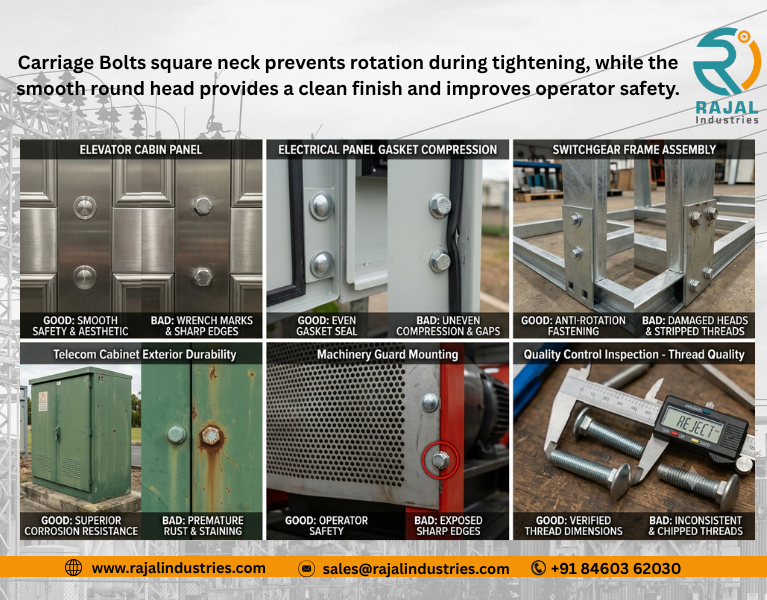
When installed into a matching hole, the square neck locks into the material and prevents the bolt from rotating while tightening the nut.
This provides several practical advantages.
Easier Installation
The installer only needs access to one side of the joint.
Better Appearance
The smooth round head provides a clean finished surface without exposed hexagonal edges.
Improved Operator Safety
The rounded head reduces the chance of clothing, cables or operators catching on exposed fasteners.
Faster Production
Assembly operators spend less time holding the bolt head during tightening.
Better for Sheet Metal Assemblies
The square neck helps maintain bolt position during production.
These advantages make carriage bolts one of the preferred fastening solutions for many fabricated OEM products.
Industries That Commonly Use Carriage Bolts
Although carriage bolts are often associated with timber construction, modern industrial OEM manufacturers use them across many sectors.
Elevator Industry
Carriage bolts are commonly used in:
- Elevator cabin assemblies
- Interior decorative panels
- Door mechanisms
- Guide rail brackets
- Machine frames
- Equipment supports
- Maintenance platforms
The smooth head improves passenger safety while providing a premium finished appearance.
Electrical Panel Industry
Electrical equipment manufacturers frequently use carriage bolts in:
- Main LT Panels
- HT Panels
- PCC Panels
- MCC Panels
- PLC Panels
- Distribution Boards
- Junction Boxes
- Fabricated Enclosures
- Battery Cabinets
- Control Cabinets
The anti-rotation square neck simplifies installation during mass production.
Switchgear Manufacturers
Applications include:
- Equipment frames
- Busbar supports
- Sheet metal fabrication
- Cable support systems
- Protective covers
- Mounting brackets
- Structural assemblies
Industrial Machinery
Carriage bolts are also widely used in:
- Conveyor systems
- Packaging machinery
- Textile machinery
- Food processing equipment
- Agricultural machinery
- Construction equipment
- Material handling systems
- Machine guarding
Telecom & Infrastructure
Typical applications include:
- Outdoor telecom cabinets
- Indoor network racks
- Battery enclosures
- Communication shelters
- Cable management systems
Step 1 – Select the Correct Standard
The first step in selecting a carriage bolt is understanding which manufacturing standard applies to the product.
For metric industrial applications, DIN 603 is the most widely specified standard.
A standard carriage bolt manufactured according to DIN 603 provides:
- Standard head diameter
- Standard square neck dimensions
- Standard thread
- Metric compatibility
- Reliable interchangeability
- Consistent manufacturing dimensions
Using internationally recognised standards helps OEM manufacturers source replacement parts and maintain dimensional consistency across production batches.
Step 2 – Choose the Correct Bolt Diameter
Bolt diameter should always be selected according to engineering calculations.
Using an oversized bolt unnecessarily increases cost and weight.
Using an undersized bolt may reduce joint strength and affect safety.
Typical industrial sizes include:
| Thread Size | Typical Applications |
| M5 | Electrical devices |
| M6 | Control Panels |
| M8 | Electrical Equipment |
| M10 | Elevator Assemblies |
| M12 | Industrial Structures |
| M16 | Heavy Equipment |
| M20 | Structural Fabrication |
The engineering drawing should always specify the final diameter.
Step 3 – Select the Correct Bolt Length
Choosing the correct length is equally important.
The bolt should provide:
- Full nut engagement
- Proper washer seating
- Sufficient thread projection
- Correct clamp length
Selecting a bolt that is too short may reduce thread engagement.
Selecting one that is too long increases cost and may interfere with nearby components.
OEM design teams normally define the required grip length based on the complete joint thickness rather than simply selecting the nearest standard size.
Step 4 – Choose the Right Material
Material selection depends on:
- Mechanical load
- Corrosion resistance
- Operating temperature
- Outdoor exposure
- Product life expectancy
- Industry requirements
Common material options include:
| Material | Recommended Applications |
| Mild Steel | General Engineering |
| High Tensile Steel | Heavy Industrial Equipment |
| SS304 | Electrical Equipment |
| SS316 | Marine & Chemical Industries |
| Alloy Steel | High Strength Machinery |
For outdoor installations, corrosion resistance should receive equal importance as mechanical strength.
Step 5 – Select the Appropriate Property Class
Another important consideration is the bolt property class.
Industrial carriage bolts are commonly supplied in:
- Property Class 4.6
- Property Class 5.6
- Property Class 8.8
- Property Class 10.9 (where applicable)
Higher property classes provide increased mechanical strength but should only be selected when required by engineering calculations.
Choosing the highest available grade does not automatically produce a better assembly.
Instead, OEM engineers balance:
- Load requirements
- Material compatibility
- Safety factor
- Product cost
- Long-term performance
This engineering approach ensures that every fastening point performs reliably throughout the equipment’s service life.
Step 6 – Select the Correct Surface Coating
Choosing the correct surface coating is just as important as selecting the correct material. Many carriage bolts fail because the coating does not match the operating environment rather than because of insufficient strength.
Before selecting a coating, OEM buyers should consider:
- Indoor or outdoor installation
- Humidity levels
- Coastal environment
- Industrial pollution
- Chemical exposure
- Maintenance intervals
- Product life expectancy
Common Coating Options
| Surface Finish | Best For | Advantages |
| Zinc Plated | Indoor equipment | Economical, clean appearance |
| Hot Dip Galvanized (HDG) | Outdoor structures | Excellent corrosion protection |
| Geomet | Industrial & automotive | High corrosion resistance, chromium-free |
| Dacromet | Heavy engineering | Excellent salt spray performance |
| Black Oxide | Indoor machinery | Low reflection, light corrosion protection |
| Phosphate | Industrial applications | Good paint adhesion and lubrication |
| Stainless Steel Finish | Marine & chemical industries | No additional coating required |
For electrical panels, zinc-plated carriage bolts are commonly selected. For outdoor telecom cabinets, solar structures and industrial equipment, HDG or Geomet coatings often provide better long-term protection.
Step 7 – Match the Carriage Bolt to the Application
Selecting the correct carriage bolt also depends on how the product will be used.
| Industry | Recommended Selection Considerations |
| Elevator Manufacturing | Smooth head, vibration resistance, accurate dimensions |
| Electrical Panels | Zinc plated, DIN 603, compact sizes |
| Switchgear | Reliable clamping, corrosion protection |
| Telecom Cabinets | Weather-resistant coating, stainless steel where required |
| Solar Structures | HDG or SS316, long outdoor life |
| Industrial Machinery | High tensile material where required |
| Material Handling Equipment | Wear resistance, proper preload |
| Fabricated Steel Structures | Correct grip length and coating |
Instead of using one specification for every product, experienced OEM manufacturers customise the bolt specification according to the operating environment and product design.
Step 8 – Check Manufacturing Quality Before Approving a Supplier
Even if two suppliers quote the same DIN 603 carriage bolt, the manufacturing quality may differ significantly.
A reliable Carriage Bolt Manufacturer should have control over:
- Cold forging process
- Thread rolling accuracy
- Heat treatment (where applicable)
- Surface coating process
- Dimensional inspection
- Material traceability
- Batch identification
- Packaging quality
These factors directly affect assembly performance and long-term reliability.
Common Procurement Mistakes
Many production issues begin during purchasing rather than manufacturing.
Avoid these common mistakes:
Selecting by Price Alone
The lowest-cost bolt may result in higher rejection rates, slower assembly and increased maintenance costs.
Ignoring Square Neck Dimensions
If the square neck does not match the mating hole, the bolt may rotate during tightening and increase assembly time.
Choosing the Wrong Bolt Length
An incorrect bolt length can reduce thread engagement or interfere with nearby components.
Ignoring Corrosion Requirements
Indoor coatings should not automatically be used for outdoor equipment.
Mixing Different Property Classes
Using different bolt grades within the same assembly can create uneven clamp loads and inconsistent maintenance procedures.
Purchasing Without Reviewing Drawings
Always compare supplier dimensions with the latest engineering drawing before approving production.
Quality Inspection Checklist for OEM Buyers
Before approving a production batch, procurement and quality teams should verify:
| Inspection Item | Verify |
| DIN 603 Dimensions | ✔ |
| Head Diameter | ✔ |
| Head Height | ✔ |
| Square Neck Dimensions | ✔ |
| Bolt Length | ✔ |
| Thread Accuracy | ✔ |
| Thread Pitch | ✔ |
| Material Grade | ✔ |
| Property Class | ✔ |
| Surface Coating | ✔ |
| Visual Finish | ✔ |
| Batch Traceability | ✔ |
| Packaging | ✔ |
A documented inspection process reduces the risk of production delays and field failures.
When Should You Request Custom Carriage Bolts?
Although DIN 603 covers standard carriage bolts, many OEM manufacturers require custom fasteners.
Custom carriage bolts may be required when:
- Standard lengths are unsuitable.
- Special head dimensions are required.
- Custom square neck sizes are specified.
- Non-standard thread lengths are needed.
- Special coatings are required.
- Customer drawings specify unique dimensions.
- Product branding requires customised appearance.
Working with a manufacturer capable of drawing-based production reduces design compromises and helps standardise production.
Why Rajal Industries?
Rajal Industries manufactures Carriage Bolts for industrial OEM manufacturers requiring reliable, repeatable and large-scale production.
Our capabilities include:
- MOQ from 50,000+ pieces
- DIN 603 standard carriage bolts
- Custom carriage bolts as per customer drawings
- Carbon Steel, Alloy Steel, SS304 and SS316
- Zinc, HDG, Geomet, Dacromet and other coating options
- Cold forged manufacturing
- Consistent dimensional accuracy
- Batch traceability
- Long-term supply programmes
- Support for Indian and export OEMs
We primarily serve:
- Elevator manufacturers
- Electrical equipment manufacturers
- Switchgear companies
- Transformer accessory manufacturers
- Telecom cabinet manufacturers
- Solar mounting manufacturers
- Industrial machinery OEMs
- Fabricated structure manufacturers
OEM Buying Checklist Before Sending an RFQ
Before requesting a quotation, confirm:
☐ DIN standard required
☐ Bolt diameter
☐ Bolt length
☐ Thread specification
☐ Square neck dimensions
☐ Material
☐ Property class
☐ Surface coating
☐ Quantity required
☐ Annual consumption
☐ Drawing revision
☐ Inspection requirements
☐ Packaging specification
☐ Delivery schedule
Providing complete technical information helps suppliers quote accurately and reduces delays during production approval.
Key Takeaways
- Carriage bolts should be selected according to engineering requirements, not only price.
- DIN 603 remains the preferred standard for metric carriage bolts.
- Material, coating, bolt length and property class all influence long-term performance.
- The square neck design improves assembly efficiency by preventing bolt rotation.
- Drawing-based carriage bolts are often the best solution for specialised OEM products.
- Consistent manufacturing quality is essential for long-term production programmes.
Frequently Asked Questions
What is the main advantage of a carriage bolt?
The square neck prevents the bolt from rotating during tightening while the smooth head provides a clean finished appearance.
Which industries commonly use carriage bolts?
Elevators, electrical panels, switchgear, telecom cabinets, fabricated structures, machinery, solar structures and industrial OEM equipment.
Is DIN 603 the standard for carriage bolts?
Yes. DIN 603 is one of the most widely recognised standards for metric carriage bolts used in industrial applications.
Which material should I choose?
It depends on the application. Mild steel is suitable for general engineering, while SS304, SS316 or alloy steel may be selected for corrosion resistance or higher strength.
Can carriage bolts be manufactured according to customer drawings?
Yes. Many OEM manufacturers specify custom dimensions, materials or coatings based on engineering drawings.
Which coating is best for outdoor applications?
Hot Dip Galvanized (HDG), Geomet and stainless steel are commonly selected for outdoor environments requiring improved corrosion resistance.
What is the minimum order quantity?
Rajal Industries primarily supports OEM production from 50,000+ pieces, depending on the product and manufacturing process.
Do carriage bolts require special maintenance?
Periodic inspection for corrosion, loosening and coating damage is recommended, especially in outdoor or high-vibration applications.
Can carriage bolts be used with standard hex nuts?
Yes. DIN 603 carriage bolts are generally designed for use with compatible metric hex nuts and washers.
Why should OEM buyers work with a specialised carriage bolt manufacturer?
A specialised manufacturer provides better dimensional consistency, technical support, quality control and long-term production stability.
Conclusion
Selecting the right Carriage Bolt is an engineering and procurement decision that influences production efficiency, assembly quality and product reliability. By evaluating the correct DIN standard, material, property class, coating, dimensions and supplier capability, OEM manufacturers can reduce assembly issues and improve long-term product performance.
For manufacturers of elevators, electrical panels, switchgear, transformer accessories, telecom cabinets, fabricated structures and industrial machinery, partnering with an experienced Carriage Bolt Manufacturer ensures consistent quality, reliable delivery and dependable long-term supply.
If your company requires DIN 603 carriage bolts, custom carriage bolts or drawing-based manufacturing with bulk production from 50,000+ pieces, Rajal Industries can support your next OEM project with engineering-focused fastening solutions.
Related Keywords
Carriage Bolt, Carriage Bolt Manufacturer, Carriage Bolt Supplier, DIN 603 Carriage Bolt, Coach Bolt, Round Head Square Neck Bolt, Industrial Carriage Bolt, Stainless Steel Carriage Bolt, High Tensile Carriage Bolt, DIN 603 Fasteners, Elevator Fasteners, Electrical Panel Fasteners, Switchgear Fasteners, Telecom Cabinet Fasteners, Solar Structure Fasteners, Fabricated Structure Bolts, OEM Fastener Manufacturer, Bulk Bolt Supplier, Custom Carriage Bolt, Drawing-Based Fastener Manufacturer, Industrial Fasteners, Cold Forged Bolts.