
Modern industries require fast, secure and reliable methods for anchoring equipment to concrete. Whether installing power transformers, electrical panels, switchgear, industrial machinery, cable trays, Battery Energy Storage Systems (BESS), steel structures or utility equipment, selecting the correct Expansion Bolt is essential for long-term safety and performance.
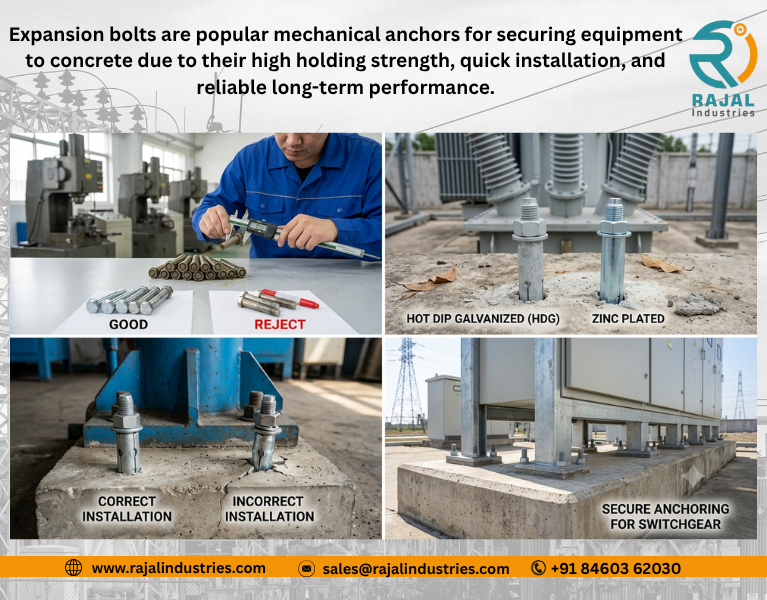
Expansion bolts are among the most widely used mechanical anchoring solutions because they provide high holding strength, quick installation and reliable performance in concrete foundations without requiring cast-in anchor systems.
Procurement engineers, OEM buyers and EPC contractors frequently search for Expansion Bolt Manufacturer, Expansion Anchor Bolt Supplier, Concrete Expansion Bolt, Heavy Duty Expansion Bolt, Industrial Expansion Bolt Manufacturer, and Expansion Bolt India when sourcing fastening solutions for large industrial projects.
At Rajal Industries, we manufacture Expansion Bolts for transformer manufacturers, electrical equipment OEMs, industrial machinery builders, renewable energy companies, EPC contractors and infrastructure projects requiring bulk production from 50,000+ pieces. Our products are manufactured according to customer drawings and project specifications with consistent quality, dimensional accuracy and dependable long-term supply.
Quick Answer
Expansion Bolts are widely used for:
- Power Transformers
- Distribution Transformers
- Electrical Panels
- Switchgear
- Control Panels
- Cable Tray Support Systems
- Industrial Machinery
- Steel Structures
- Battery Energy Storage Systems (BESS)
- EV Charging Stations
- Telecom Infrastructure
- Utility Equipment
- Manufacturing Plants
Selection depends on:
- Thread size
- Anchor diameter
- Anchor length
- Material
- Surface coating
- Concrete strength
- Equipment load
- Installation environment
What is an Expansion Bolt?
An Expansion Bolt is a mechanical anchor designed to secure equipment and structural components to concrete or masonry. When tightened, the expansion sleeve grips the surrounding concrete, creating a strong and reliable mechanical connection.
Expansion bolts are popular because they offer:
- Fast installation
- High holding capacity
- Excellent pull-out resistance
- Reliable vibration performance
- Easy maintenance
- Suitable for retrofit installations
They are commonly selected where equipment needs to be installed after the concrete foundation has already been completed.
Why Industrial OEMs Choose Expansion Bolts
Modern industrial installations demand foundation fasteners that are reliable, easy to install and capable of supporting heavy loads.
Expansion bolts provide:
- Secure equipment anchoring
- Stable foundation fixing
- Better vibration resistance
- Reduced equipment movement
- Faster installation
- Long service life
These advantages make them suitable for a wide range of industrial and electrical applications.
Industries That Use Expansion Bolts
Transformer Manufacturers
Expansion bolts are commonly used for:
- Transformer base fixing
- Foundation mounting
- Outdoor transformer installations
- Compact substations
Reliable anchoring helps maintain equipment alignment throughout its service life.
Electrical Panel Manufacturers
Typical applications include:
- LT Panels
- HT Panels
- PCC Panels
- MCC Panels
- Distribution Boards
- Control Cabinets
Proper anchoring improves equipment safety and installation quality.
Switchgear Manufacturers
Expansion bolts are used for:
- Indoor switchgear
- Outdoor switchgear
- RMU installations
- GIS equipment
- AIS equipment
- Control room equipment
Industrial Machinery Manufacturers
Common applications include:
- CNC machines
- Hydraulic presses
- Compressors
- Pumps
- Packaging equipment
- Material handling systems
Secure anchoring helps minimise machine vibration and improves operating accuracy.
Steel Structure Fabricators
Applications include:
- Base plate fixing
- Pipe support systems
- Utility structures
- Industrial platforms
- Equipment support frames
Renewable Energy Projects
Expansion bolts are widely used for:
- Solar inverter foundations
- Battery Energy Storage Systems (BESS)
- EV charging stations
- Utility equipment
- Outdoor electrical installations
Common Materials Used
Material selection depends on the operating environment and project requirements.
Typical materials include:
| Material | Typical Applications |
| Carbon Steel | General Industrial Equipment |
| High Tensile Steel | Heavy Machinery |
| SS304 | Indoor Corrosion-Resistant Applications |
| SS316 | Marine & Chemical Industries |
Material selection should consider:
- Mechanical strength
- Corrosion resistance
- Equipment load
- Service environment
- Expected operating life
Common Surface Finish Options
Expansion bolts are available with various corrosion-resistant finishes, including:
- Zinc Plated
- Hot Dip Galvanized (HDG)
- Geomet Coating
- Dacromet Coating
- Stainless Steel Finish
The correct finish should always be selected according to the installation environment.
Step 1 – Identify the Equipment
Before selecting an expansion bolt, determine what equipment will be anchored.
Typical applications include:
- Transformers
- Electrical panels
- Switchgear
- Industrial machinery
- Steel structures
- Utility equipment
Different applications require different anchor capacities.
Step 2 – Evaluate the Foundation
Engineers should review:
- Concrete grade
- Foundation thickness
- Edge distance
- Anchor spacing
- Installation location
- Equipment load
The condition of the concrete directly affects anchor performance.
Step 3 – Select the Correct Expansion Bolt Size
Common industrial sizes include:
| Thread Size | Typical Applications |
| M8 | Small Electrical Equipment |
| M10 | Control Panels |
| M12 | Transformers |
| M16 | Heavy Machinery |
| M20 | Industrial Equipment |
| M24 | Steel Structures |
| M30 | Utility Infrastructure |
Final dimensions should always follow engineering calculations and approved project drawings.
Step 4 – Select the Correct Material
Before finalising the specification, verify:
- Material grade
- Corrosion resistance
- Installation environment
- Customer specifications
- Expected service life
The correct material improves safety, durability and long-term foundation performance.
Step 5 – Select the Correct Surface Coating
The durability of an Expansion Bolt depends heavily on selecting the correct surface protection. Industrial foundations are often exposed to moisture, chemicals, temperature changes and outdoor weather, making corrosion resistance an important part of anchor selection.
Before selecting the coating, engineers should evaluate:
- Indoor or outdoor installation
- Humidity
- Rain exposure
- Coastal atmosphere
- Chemical exposure
- Operating temperature
- Expected service life
- Maintenance requirements
The right coating extends the service life of both the anchor bolt and the equipment foundation.
Zinc Plated Expansion Bolts
Recommended for:
- Indoor electrical panels
- Switchgear rooms
- Control cabinets
- Factory machinery
- Dry industrial environments
Advantages:
- Economical
- Smooth surface finish
- Suitable for indoor installations
- Easy maintenance
Hot Dip Galvanized (HDG) Expansion Bolts
Recommended for:
- Outdoor transformers
- Electrical substations
- Steel structures
- Utility infrastructure
- Solar projects
- Telecom towers
Advantages:
- Excellent corrosion resistance
- Long outdoor service life
- Reduced maintenance
- Suitable for severe weather conditions
Geomet & Dacromet Coated Expansion Bolts
Widely used for:
- Battery Energy Storage Systems (BESS)
- EV charging stations
- Renewable energy projects
- Coastal installations
- Heavy industrial environments
Advantages:
- Excellent salt spray resistance
- Uniform coating thickness
- Long-term corrosion protection
- High durability
Stainless Steel Expansion Bolts
Suitable for:
- Food processing plants
- Pharmaceutical facilities
- Chemical industries
- Marine installations
Advantages:
- Excellent corrosion resistance
- Long operating life
- Low maintenance
- Ideal for corrosive environments
Expansion Bolt vs Pin Type Anchor Bolt
Both anchor systems are widely used in industrial projects, but the selection depends on the application and engineering requirements.
| Feature | Expansion Bolt | Pin Type Anchor Bolt |
| Installation | Mechanical Expansion | Pin Driven / Mechanical Locking |
| Installation Speed | Fast | Fast |
| Retrofit Applications | Excellent | Excellent |
| Vibration Resistance | Very Good | Very Good |
| Industrial Equipment | ✔ | ✔ |
| Transformers | ✔ | ✔ |
| Electrical Panels | ✔ | ✔ |
| Steel Structures | ✔ | ✔ |
The final selection should always follow the engineering drawing, equipment manufacturer’s recommendation and project specifications.
Installation Best Practices
Proper installation is essential for achieving the required holding capacity.
Before installation:
- Verify the concrete has reached the required strength.
- Drill holes to the specified diameter and depth.
- Remove dust and debris from the hole.
- Check anchor alignment with the base plate.
- Install the expansion bolt according to the manufacturer’s recommendations.
- Tighten the nut using the recommended torque.
Following these steps helps achieve consistent anchoring performance and long-term reliability.
Common Engineering & Procurement Mistakes
Many installation problems occur because the wrong anchor is selected or installed incorrectly.
Selecting the Wrong Anchor Diameter
Anchor diameter should always be selected according to:
- Equipment weight
- Dynamic loading
- Base plate dimensions
- Engineering calculations
An undersized anchor may reduce the overall safety of the installation.
Ignoring Concrete Quality
Expansion bolts achieve their holding strength through the surrounding concrete.
Always verify:
- Concrete grade
- Concrete thickness
- Edge distance
- Foundation condition
Damaged or weak concrete can significantly reduce anchor performance.
Choosing the Wrong Surface Finish
Indoor coatings should not be used in outdoor substations, transformer yards or corrosive industrial environments.
Always select the coating according to the operating conditions.
Improper Hole Preparation
Before installing an expansion bolt, ensure:
- Correct hole diameter
- Correct drilling depth
- Clean hole
- Proper anchor seating
Incorrect hole preparation may reduce the anchor’s holding capacity.
Buying Only on Price
The lowest-cost expansion bolt may not provide:
- Consistent dimensions
- Reliable material quality
- Proper corrosion protection
- Long-term durability
OEM buyers should also evaluate manufacturing capability, inspection systems, technical support and delivery performance.
Sending Incomplete RFQs
Every enquiry should include:
- Thread size
- Anchor diameter
- Anchor length
- Material
- Surface coating
- Quantity
- Engineering drawing
- Installation environment
Providing complete technical information helps suppliers recommend the correct expansion bolt and prepare accurate quotations.
Quality Inspection Checklist
Before dispatch, expansion bolts should be inspected for:
| Inspection Item | Verify |
| Drawing Compliance | ✔ |
| Thread Size | ✔ |
| Anchor Diameter | ✔ |
| Overall Length | ✔ |
| Expansion Sleeve Dimensions | ✔ |
| Material Grade | ✔ |
| Surface Coating | ✔ |
| Coating Thickness | ✔ |
| Thread Quality | ✔ |
| Dimensional Accuracy | ✔ |
| Visual Inspection | ✔ |
| Batch Traceability | ✔ |
| Material Test Certificate (If Required) | ✔ |
A structured quality inspection process helps ensure reliable installation and consistent product performance.
Why Rajal Industries?
Rajal Industries manufactures Expansion Bolts for transformer manufacturers, electrical equipment OEMs, industrial machinery companies and infrastructure projects requiring dependable, large-scale production.
Our manufacturing capabilities include:
- MOQ from 50,000+ pieces
- Standard & Custom Expansion Bolts
- Manufacturing as per Customer Drawings
- Carbon Steel, High Tensile Steel, SS304 & SS316
- Zinc Plated, Hot Dip Galvanized, Geomet & Dacromet Coatings
- Precision Cold Forging
- CNC Thread Rolling
- Dimensional Inspection
- Batch Traceability
- OEM Packaging
- Long-Term Supply Programmes
- Export Manufacturing Support
We supply:
- Transformer Manufacturers
- Electrical Panel Manufacturers
- Switchgear Manufacturers
- Industrial Machinery OEMs
- Steel Structure Fabricators
- Renewable Energy Companies
- EPC Contractors
- Infrastructure Projects
OEM RFQ Checklist
Before requesting a quotation, include:
☐ Thread Size
☐ Anchor Diameter
☐ Overall Length
☐ Material
☐ Surface Coating
☐ Quantity
☐ Annual Requirement
☐ Engineering Drawing
☐ Concrete Grade (If Applicable)
☐ Installation Environment
☐ Packaging Specification
☐ Delivery Schedule
Providing complete engineering information helps suppliers recommend the correct expansion bolt and prepare accurate commercial quotations.
Key Takeaways
- Expansion bolts are widely used for transformers, switchgear, electrical panels, industrial machinery and steel structures.
- Correct anchor size should always be selected according to equipment load and concrete conditions.
- Surface coating should match the operating environment for maximum corrosion resistance.
- Proper installation and hole preparation improve holding strength and long-term performance.
- Working with an experienced OEM manufacturer ensures consistent quality, engineering support and dependable long-term supply.
Frequently Asked Questions
What is an expansion bolt used for?
An expansion bolt is used to securely fasten equipment, machinery and structural components to concrete foundations using a mechanical expansion mechanism.
Where are expansion bolts commonly used?
They are widely used in transformers, electrical panels, switchgear, industrial machinery, steel structures, solar projects, Battery Energy Storage Systems (BESS), EV charging stations and utility infrastructure.
Which thread sizes are commonly available?
Common industrial sizes include M8, M10, M12, M16, M20, M24 and M30, depending on the application and design requirements.
Which coating is suitable for outdoor installations?
Hot Dip Galvanized (HDG), Geomet and Dacromet coatings are commonly selected because they provide excellent corrosion protection for outdoor environments.
Can Rajal Industries manufacture custom expansion bolts?
Yes. We manufacture standard and drawing-based expansion bolts according to customer drawings, project specifications and OEM requirements.
What is your minimum production quantity?
Rajal Industries primarily manufactures bulk OEM orders from 50,000+ pieces, depending on the product and manufacturing process.
Conclusion
Expansion Bolts provide a fast, reliable and economical solution for anchoring transformers, electrical equipment, industrial machinery and structural components to concrete foundations. Selecting the correct anchor size, material, coating and installation method improves foundation safety, reduces maintenance and supports reliable long-term equipment performance.
For transformer manufacturers, electrical equipment OEMs, industrial machinery builders, EPC contractors and infrastructure companies, partnering with an experienced Expansion Bolt Manufacturer ensures consistent quality, engineering support and dependable long-term supply.
If your company requires Expansion Bolts with bulk production from 50,000+ pieces, Rajal Industries can manufacture according to your engineering drawings, technical specifications and long-term production requirements.
Related Keywords
Expansion Bolt Manufacturer, Expansion Bolt, Expansion Anchor Bolt, Concrete Expansion Bolt, Heavy Duty Expansion Bolt, Mechanical Expansion Bolt, Industrial Expansion Bolt, Foundation Expansion Bolt, Transformer Expansion Bolt, Electrical Panel Expansion Bolt, Steel Structure Expansion Bolt, OEM Expansion Bolt Supplier, Bulk Expansion Bolt Manufacturer, Industrial Fasteners, Concrete Anchoring Solutions.