

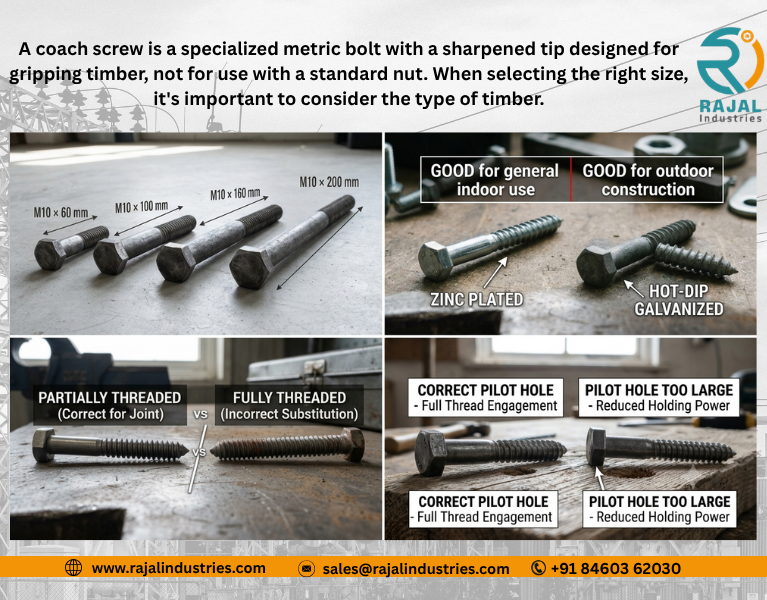
A coach screw is a heavy-duty threaded fastener mainly used for fastening components into timber and other suitable wood-based substrates.
For industrial buyers, selecting a coach screw requires more than choosing a diameter and length.
A proper specification may need to define:
Standard → Diameter → Length → Thread Length → Head Dimensions → Thread Geometry → Material → Finish → Mechanical Requirements
Coach screws are also commonly called lag screws or lag bolts in some markets. Because terminology can vary, technical buyers should purchase using an applicable standard or approved drawing rather than relying only on the product name.
This guide explains the main coach screw dimensions, sizes, materials and specification points that engineers and bulk buyers should understand before requesting quotations.
Quick Answer: What Sizes Do Coach Screws Come In?
Coach screws are manufactured in different metric and imperial sizes depending on the applicable standard and market.
A coach screw size is generally identified using:
Diameter × Length
For example:
M8 × 80 mm
means:
- Nominal diameter: 8 mm
- Nominal length: 80 mm
However, this does not completely define the fastener.
For technical procurement, buyers may also need to specify:
- Standard
- Thread length
- Head dimensions
- Material
- Mechanical requirements
- Surface finish
- Coating
- Quantity
For non-standard or OEM requirements, an approved drawing is recommended.
What Are the Main Coach Screw Dimensions?
The main dimensions of a typical coach screw include:
| Dimension | Description |
| d | Nominal screw diameter |
| L | Nominal screw length |
| b | Threaded length, depending on standard/drawing |
| s | Width across flats of hex head |
| k | Head height |
| Shank Diameter | Unthreaded body diameter where applicable |
| Thread Geometry | Wood-engaging thread profile |
| Point | Geometry at screw end |
The exact symbols and dimensional definitions depend on the applicable standard.
Do not use this table as a manufacturing drawing.
How Is Coach Screw Length Measured?
For a conventional hex-head coach screw, nominal length is generally measured:
From the bearing surface underneath the head to the end of the screw
The hex head itself is normally not included in the nominal screw length.
This is important when comparing:
M10 × 100 mm
with another M10 coach screw.
The “100 mm” generally refers to the length below the head, subject to the applicable product standard.
Coach Screw Diameter
The nominal diameter is one of the most important coach screw dimensions.
It affects:
- Thread size
- Shank size
- Head dimensions
- Pilot-hole requirements
- Timber engagement
- Installation torque
- Joint design
Common commercial metric sizes may include diameters such as:
- M5
- M6
- M8
- M10
- M12
- M16
Availability and dimensional requirements depend on the manufacturer and standard.
Do not assume that every manufacturer produces every diameter and length combination.
Coach Screw Lengths
Coach screws can be manufactured in a wide range of lengths for different timber joints.
Typical requirements can range from relatively short fastening applications to long screws used in heavy timber assemblies.
The required length depends on:
- Attached component thickness
- Washer thickness
- Required penetration
- Timber dimensions
- Joint geometry
- Engineering design
A longer screw is not automatically a stronger or better choice.
Understanding Lag Screw Sizes
In markets where the term lag screw is more common, buyers may encounter imperial sizes.
These can be expressed using:
Diameter × Length
with dimensions in inches.
For example:
3/8″ × 4″
describes a nominal 3/8-inch diameter lag screw with a nominal length of 4 inches.
Metric and imperial products should not be treated as interchangeable merely because their dimensions appear close.
The applicable drawing or standard should control the product.
Metric Coach Screws vs Imperial Lag Screws
| Feature | Metric Coach Screw | Imperial Lag Screw |
| Diameter | mm / metric designation | Inch / fractional designation |
| Length | mm | Inches |
| Head Dimensions | Metric standard | Imperial specification |
| Thread Geometry | Applicable metric specification | Applicable imperial specification |
| Typical Search Term | Coach Screw | Lag Screw / Lag Bolt |
| Substitution | Requires verification | Requires verification |
For international sourcing, always state the measurement system clearly.
What Is DIN 571?
DIN 571 is a widely referenced standard associated with hexagon head wood screws.
These fasteners are commonly sold commercially as:
- Coach Screws
- Lag Screws
- Hex Head Wood Screws
When a buyer requests a DIN 571 coach screw, the purchase specification should still define:
Size + Material + Finish + Quantity + Additional Requirements
A standard does not automatically define every commercial or project requirement.
Is DIN 571 Enough for an RFQ?
Not always.
For example:
DIN 571 M10 × 100
defines much more than simply saying “M10 coach screw,” but a supplier may still need to know:
- Material
- Surface finish
- Coating requirement
- Required testing
- Packaging
- Quantity
- Inspection documentation
A stronger RFQ might state:
DIN 571 M10 × 100 mm coach screw, carbon steel, specified hot-dip galvanized finish, quantity 100,000 pcs. Please confirm dimensional compliance, coating specification, testing and lead time.
This makes quotations easier to compare.
DIN 571 Coach Screw Dimensions
DIN 571 defines dimensional requirements for hexagon head wood screws.
Important dimensional areas include:
- Nominal diameter
- Nominal length
- Thread length
- Head width across flats
- Head height
- Shank
- Point
- Thread form
If exact DIN dimensional values are required for design, inspection or manufacturing, buyers should use the applicable official standard or an approved technical drawing.
Do not manufacture a critical fastener from an internet size chart alone.
Why Coach Screw Dimensions Matter
Small dimensional differences can affect:
- Tool fit
- Bracket clearance
- Washer compatibility
- Pilot-hole selection
- Installation
- Timber engagement
- Joint performance
For example, a project may have a metal bracket with a fixed clearance hole.
If the coach screw shank or head does not match the approved design, the fastener may not install correctly even if the nominal diameter appears correct.
Coach Screw Head Dimensions
Coach screws traditionally use a hexagonal head.
Important head dimensions include:
Width Across Flats
This determines the wrench or socket fit.
Head Height
This affects:
- Tool engagement
- Available clearance
- Finished assembly height
Bearing Surface
The underside of the head transfers load to the washer or connected component.
For repetitive installation, consistent head dimensions help maintain reliable tool engagement.
Why Width Across Flats Matters
Suppose an assembly line uses a dedicated socket.
If head width varies outside the allowed tolerance, operators may experience:
- Poor socket engagement
- Tool slipping
- Head damage
- Installation delays
For bulk timber fasteners, head geometry should therefore be included in dimensional inspection where required by the standard or drawing.
Coach Screw Thread Length
Coach screws may be partially threaded depending on:
- Size
- Length
- Standard
- Customer drawing
The threaded portion engages the timber.
The unthreaded shank, where present, may pass through part of the connected component or joint.
Thread length should therefore be checked when:
- Designing the connection
- Preparing an RFQ
- Inspecting samples
- Comparing suppliers
Two screws with the same diameter and overall length may not necessarily have identical thread lengths if they follow different specifications.
Partially Threaded Coach Screws
A partially threaded coach screw contains:
Head → Unthreaded Shank → Threaded Section → Point
Depending on the joint design, this arrangement may allow the connected component to be drawn toward the timber during tightening.
However, the required shank and thread lengths should follow the approved joint design.
Fully Threaded Coach Screws
Some commercial products may have thread extending over a greater portion of their length.
Do not assume that a fully threaded product can automatically replace a partially threaded coach screw.
Changing thread length can affect:
- Installation
- Clamping behaviour
- Timber engagement
- Joint geometry
Any substitution should be technically reviewed.
Coach Screw Thread Geometry
A coach screw uses a wood-engaging thread rather than a conventional machine thread.
The thread is typically relatively coarse to engage timber.
Important thread characteristics can include:
- Major diameter
- Core diameter
- Pitch
- Thread depth
- Thread profile
- Thread length
The exact geometry should follow the relevant product specification.
Coach Screw Thread vs Machine Screw Thread
| Feature | Coach Screw Thread | Machine Screw Thread |
| Main Substrate | Timber / wood | Nut or tapped component |
| Thread Style | Wood-engaging | Machine thread |
| Typical Pitch | Relatively coarse | Defined machine-thread pitch |
| Mating Component | Timber | Internal machine thread |
| Direct Substitution | No | No |
A coach screw should not be selected simply because its nominal diameter matches a machine bolt.
Coach Screw Point Geometry
The pointed end helps the fastener enter the prepared timber joint.
Point geometry can affect:
- Initial engagement
- Installation
- Alignment
- Manufacturing
The exact point should follow the standard or approved drawing.
For project-critical fasteners, inspect the point rather than treating it as a cosmetic feature.
Coach Screw Shank
The shank is the body between the head and threaded region where an unthreaded section is present.
Important factors include:
- Diameter
- Straightness
- Length
- Surface condition
Shank dimensions can matter where the screw passes through:
- Metal brackets
- Plates
- Timber components
- Washers
Coach Screw Material Options
Material selection should be based on:
- Mechanical requirements
- Environment
- Corrosion exposure
- Manufacturing process
- Customer specification
Common material categories can include:
Carbon Steel
Used for many general industrial and timber applications.
Stainless Steel
Used where suitable corrosion resistance is required.
Customer-Specified Steel
Special applications may require a specific steel grade or mechanical property.
The material should be clearly stated in the RFQ.
Carbon Steel Coach Screws
Carbon steel is commonly used for bulk coach screw production.
Potential benefits can include:
- Manufacturing suitability
- Broad availability
- Ability to use different protective coatings
- Commercial suitability for high-volume applications
However, “carbon steel” alone may not be enough for a controlled engineering specification.
Where necessary, define:
- Material grade
- Mechanical properties
- Heat-treatment condition
- Surface finish
Stainless Steel Coach Screws
Stainless steel may be considered for:
- Outdoor timber structures
- Humid environments
- Coastal conditions
- Corrosion-sensitive equipment
- Certain industrial applications
Possible grades depend on the required specification.
Common commercial stainless designations buyers may encounter include:
- A2 / stainless grades commonly associated with 304-type material
- A4 / stainless grades commonly associated with 316-type material
The exact grade and mechanical requirements should be stated rather than requesting only “SS coach screw.”
Stainless Steel Does Not Mean Corrosion-Proof
Stainless steel offers corrosion resistance, but performance depends on:
- Grade
- Environment
- Chlorides
- Surface condition
- Timber treatment
- Contact with other materials
For aggressive environments, material selection should be reviewed against the actual exposure conditions.
Coach Screw Surface Finishes
Possible surface finishes can include:
- Zinc Plating
- Hot-Dip Galvanizing
- Black or project-specific finishes
- Passivation for suitable stainless steel products
- Customer-Specified Coatings
The correct finish depends on the environment and project specification.
Zinc-Plated Coach Screws
Zinc plating can provide corrosion protection for suitable applications.
When specifying zinc plating, buyers may need to define:
- Coating type
- Coating thickness
- Passivation
- Required corrosion performance
Do not compare two “zinc-plated” quotations unless the coating requirements are equivalent.
Hot-Dip Galvanized Coach Screws
Hot-dip galvanized coach screws may be specified for suitable:
- Outdoor Timber Structures
- Utility Projects
- Infrastructure
- Industrial Construction
- External Equipment
Hot-dip galvanizing generally produces a thicker zinc coating than conventional electroplating.
Because the coating adds material to the fastener surface, dimensional compatibility should be considered.
Why Coating Thickness Matters
Coating can affect:
- Thread geometry
- Head dimensions
- Surface condition
- Washer fit
- Installation behaviour
For high-volume or controlled project applications, buyers should define coating requirements rather than simply requesting “galvanized.”
Coach Screw Materials and Finishes Comparison
| Material / Finish | Typical Consideration | Potential Application |
| Carbon Steel + Zinc | General corrosion protection | Indoor / protected use |
| Carbon Steel + HDG | Stronger outdoor protection | Utility / outdoor projects |
| Stainless Steel | Material-based corrosion resistance | Outdoor / humid applications |
| Custom Coating | Project-specific requirement | OEM / infrastructure |
This is a general sourcing guide only. Final material and coating selection should follow the actual exposure and project specification.
Coach Screws and Treated Timber
Fasteners used with treated timber require additional attention.
Certain timber treatments can create more aggressive corrosion conditions.
Buyers should check compatibility between:
Timber Treatment + Fastener Material + Coating + Environment
For long-life outdoor projects, this can be more important than simply selecting the lowest-cost finish.
Mechanical Requirements for Coach Screws
Depending on the application, buyers may need to specify mechanical properties such as:
- Tensile performance
- Hardness
- Torsional behaviour
- Material properties
- Application-specific testing
Not every coach screw application requires the same testing.
The required tests should follow:
- Applicable standard
- Project specification
- Customer drawing
- Engineering requirements
Should Coach Screws Be Heat Treated?
The answer depends on the:
- Material
- Manufacturing specification
- Required mechanical properties
- Product standard
- Application
Do not automatically request heat treatment because a screw is used in a heavy-duty application.
The required final properties should control the process.
Coach Screw Tolerances
Tolerances are important for repeatable bulk manufacturing.
Potential controlled dimensions include:
- Diameter
- Length
- Thread length
- Head width
- Head height
- Shank
- Thread geometry
- Point
Exact tolerances should come from the applicable standard or customer drawing.
Avoid creating arbitrary tolerances that conflict with a recognized product standard.
Dimensional Inspection of Coach Screws
A typical inspection process may check:
| Inspection | Purpose |
| Diameter | Confirm size |
| Overall Length | Confirm nominal length |
| Thread Length | Verify engagement geometry |
| Head Across Flats | Tool compatibility |
| Head Height | Drawing compliance |
| Shank Diameter | Joint fit |
| Thread Profile | Timber engagement |
| Point | Geometry |
| Straightness | Installation |
| Surface Finish | Coating / appearance |
The inspection method and sampling plan should match the applicable quality requirements.
Coach Screw Material Inspection
For controlled industrial orders, material verification may include:
- Raw-material certificate
- Chemical composition
- Mechanical properties
- Hardness where specified
- Batch traceability
The required documentation should be agreed before production.
Coach Screw Coating Inspection
Depending on the specification, coating inspection may include:
- Visual condition
- Coating thickness
- Adhesion where applicable
- Corrosion testing where specified
- Surface defects
For project procurement, state the required test method and acceptance criteria rather than simply requesting a “salt spray report.”
Corrosion Testing
Corrosion testing can be useful where a project specification requires measurable coating performance.
However, laboratory corrosion tests should not automatically be interpreted as an exact prediction of real outdoor service life.
Actual service performance depends on:
- Environment
- Moisture
- Chemicals
- Timber treatment
- Installation damage
- Maintenance
Use corrosion testing as part of a defined specification.
Coach Screw Weight
Coach screw weight depends on:
- Diameter
- Length
- Head geometry
- Thread length
- Shank geometry
- Material
For bulk procurement, weight can be important for:
- Costing
- Packaging
- Freight
- Container planning
- Pieces per kilogram
Accurate weight should be calculated from the actual drawing or confirmed from production samples.
Pieces per Kilogram
Bulk buyers sometimes purchase or compare timber fasteners using pieces per kilogram.
The relationship is:
Pieces per kg = 1,000 g ÷ Weight per Piece in Grams
For example, if one screw weighs 20 g:
1,000 ÷ 20 = 50 pcs/kg
This is only an example.
Actual coach screw weight should be calculated from the exact product geometry and material.
Why Weight-Based Quotations Need Care
Two coach screws described as:
M10 × 100
may not have identical weight if they differ in:
- Head geometry
- Thread length
- Shank
- Standard
- Material
- Manufacturing tolerances
For high-volume orders, even a small per-piece weight difference can affect the total raw-material requirement.
Coach Screw Size Selection for Timber
The correct size depends on:
- Timber species
- Timber thickness
- Connected component
- Required load
- Edge distance
- Spacing
- Number of fasteners
- Required penetration
- Installation method
Do not select a coach screw only from a generic online size chart.
Structural timber connections should follow an approved engineering design.
Diameter vs Length: Which Matters More?
Both matter, but they affect the joint differently.
Diameter can influence:
- Fastener strength
- Timber engagement
- Installation torque
- Splitting risk
- Required edge distance
Length can influence:
- Penetration
- Engagement
- Joint geometry
- Interference
The correct fastener requires both dimensions to be properly selected.
Coach Screw Specification for Timber-to-Metal Connections
For a typical:
Metal Bracket → Coach Screw → Timber
the buyer should check:
- Bracket thickness
- Clearance-hole diameter
- Washer
- Screw diameter
- Screw length
- Timber penetration
- Head clearance
- Material
- Coating
- Installation requirements
This is particularly important for construction and utility hardware.
Coach Screw Specification for Outdoor Projects
Outdoor applications should consider:
- Moisture
- Rain
- Humidity
- Temperature changes
- Coastal atmosphere
- Treated timber
- Chemical exposure
The specification may therefore need to include:
Material + Coating System + Coating Thickness + Required Corrosion Performance
rather than only the fastener dimensions.
Coach Screw Specification for Solar Projects
Where coach screws are approved for a timber-based solar mounting system, buyers should define:
- Mounting-system drawing
- Timber substrate
- Diameter
- Length
- Washer
- Material
- Finish
- Corrosion requirement
- Installation method
- Required testing
Coach screws are not universal solar fasteners. Their use should follow the approved mounting-system design.
Coach Screw Specification for Utility Projects
Utility buyers may require:
- Standard
- Exact dimensions
- Material
- Mechanical properties
- Coating
- Coating thickness
- Inspection
- Testing
- Batch traceability
- Packaging
For utility projects, supplier compliance should be checked against the actual project specification rather than a general commercial catalogue.
How to Write a Coach Screw Specification
Instead of writing:
Coach Screw M10 × 100
a stronger purchasing description may be:
DIN 571 coach screw, M10 × 100 mm, material and mechanical properties as specified, hot-dip galvanized to approved project coating requirement, supplied with specified washer where required, dimensional and coating inspection reports required.
The final specification should match the project’s approved technical requirements.
Coach Screw Technical RFQ Checklist
Before requesting a quotation, provide:
☐ Product Standard
☐ Technical Drawing, if applicable
☐ Diameter
☐ Overall Length
☐ Thread Length
☐ Shank Requirement
☐ Head Dimensions
☐ Point Requirement
☐ Material Grade
☐ Mechanical Properties
☐ Heat Treatment, if applicable
☐ Surface Finish
☐ Coating Type
☐ Coating Thickness
☐ Corrosion Requirement
☐ Washer Requirement
☐ Required Testing
☐ Inspection Documentation
☐ Sample Quantity
☐ Order Quantity
☐ Annual Quantity
☐ Packaging
☐ Delivery Schedule
Example Bulk Buyer RFQ
We require DIN 571 coach screws for a timber construction project. Please review the attached size schedule and confirm manufacturing capability. Quote with material grade, dimensional standard, surface finish, coating specification, available testing, MOQ, production capacity and lead time. Please also confirm whether samples and dimensional inspection reports can be provided before bulk approval.
This is much stronger than requesting only a price per kilogram.
Why Rajal Industries for Coach Screw Requirements?
Rajal Industries can evaluate bulk and drawing-based coach screw requirements for suitable timber, utility, construction, solar and industrial applications.
Subject to technical feasibility and customer approval, requirements can be evaluated for:
- Coach Screws
- Lag Screws
- Timber Fasteners
- Heavy-Duty Wood Screws
- Hex Head Wood Screws
- DIN 571 Requirements
- Standard Sizes
- Custom Sizes
- Custom Lengths
- Carbon Steel
- Stainless Steel
- Zinc-Plated Finishes
- Hot-Dip Galvanized Finishes
- Customer-Specified Coatings
- Drawing-Based Manufacturing
- Dimensional Inspection
- Material Verification
- Mechanical Testing as Specified
- Coating Inspection
- Batch Traceability
- Bulk Packaging
- Scheduled Project Supply
Final capability should be confirmed against the applicable standard, drawing, size, material, finish, testing requirements and order quantity.
Bulk Buyer Quick Answer
What should be included in a coach screw specification?
A proper coach screw specification should normally identify:
Standard + Diameter + Length + Thread Length + Material + Finish
Depending on the application, also define:
- Head dimensions
- Mechanical requirements
- Washer
- Coating thickness
- Corrosion requirement
- Testing
- Inspection documentation
- Quantity
For custom or project-critical requirements, use an approved technical drawing rather than relying only on a product name.
Coach Screw Size Selection, Technical Comparison & Buyer Guide
Understanding coach screw dimensions is useful, but the final size should always be selected for the actual joint.
Two applications using the same timber thickness may still require different fasteners because of differences in:
- Timber type
- Load direction
- Connected component
- Required penetration
- Edge distance
- Fastener spacing
- Number of screws
- Outdoor exposure
- Installation method
For engineering and procurement teams, the correct approach is:
Application → Joint Design → Required Performance → Coach Screw Size → Material → Finish → Installation
How to Choose the Correct Coach Screw Size
A practical selection process starts with six questions:
- What material is being fastened?
- What type of timber will receive the screw?
- What loads will act on the connection?
- How much timber penetration is required?
- What diameter is permitted by the joint design?
- What corrosion environment will the screw face?
Only after these are known should the final coach screw size be selected.
For structural connections, the project engineer or applicable design standard should determine the final fastener requirements.
Coach Screw Size Selection: Diameter vs Length
Coach screw size is normally expressed as:
Diameter × Length
For example:
M10 × 100 mm
Both dimensions perform different functions.
| Parameter | Main Consideration |
| Diameter | Fastener and connection capacity, timber interaction |
| Length | Required penetration and joint geometry |
| Thread Length | Timber engagement |
| Shank Length | Joint configuration |
| Head Size | Tool and component clearance |
Selecting only the diameter without checking length can result in insufficient engagement.
Selecting only a long screw without checking diameter and timber geometry can also create an unsuitable connection.
How to Select Coach Screw Diameter
Diameter selection can depend on:
- Applied load
- Timber species
- Timber thickness
- Connection type
- Number of fasteners
- Fastener spacing
- Edge distance
- Bracket-hole size
- Engineering requirements
A larger screw may provide different mechanical performance, but increasing diameter can also increase:
- Required installation torque
- Pilot-hole requirement
- Timber splitting risk
- Required clearance
- Material cost
Therefore, avoid selecting the largest available screw without engineering justification.
How to Select Coach Screw Length
The required length should account for:
Connected Component + Washer + Required Timber Penetration
For example, a metal bracket adds thickness between the screw head and timber.
The screw must therefore be long enough to pass through the bracket and washer, where specified, while still achieving the required timber engagement.
However, there is no single penetration rule suitable for every timber connection.
Use the approved joint design.
Why Thread Length Matters
Suppose two suppliers offer the same:
M12 × 120 mm Coach Screw
If their products follow different specifications, the threaded length may not necessarily be identical.
This can affect the joint where:
- Thread location is important
- An unthreaded shank must pass through a component
- The connected members have specific thicknesses
For bulk orders, confirm thread length against the standard or drawing.
Coach Screw Length Measurement
For a typical hex-head coach screw, nominal length is generally measured from:
Under the Head → End of Screw
This means the hex head itself is generally not included in the stated length.
This distinction is important when:
- Inspecting incoming material
- Preparing drawings
- Comparing suppliers
- Calculating required penetration
Always follow the dimensional definition in the applicable standard.
Coach Screw Size for Metal-to-Timber Connections
Metal-to-timber connections are common in:
- Timber Construction
- Utility Structures
- Equipment Mounting
- Industrial Wood Structures
- Selected Solar Mounting Systems
A typical arrangement may be:
Coach Screw Head → Washer → Metal Bracket → Timber
The engineer should consider:
- Bracket thickness
- Bracket-hole diameter
- Washer thickness
- Screw diameter
- Required penetration
- Timber dimensions
- Edge distance
- Spacing
- Installation method
Do not select the screw solely from bracket thickness.
Coach Screw Size for Timber-to-Timber Connections
For timber-to-timber applications, important factors include:
- Thickness of first member
- Thickness of receiving member
- Timber species
- Grain direction
- Fastener diameter
- Required penetration
- Edge distance
- Fastener spacing
- Joint loading
A technically suitable connection should avoid both insufficient engagement and unnecessary penetration.
Edge Distance Matters
Placing a large coach screw too close to the edge or end of a timber member can increase the risk of splitting.
The required distance depends on factors such as:
- Screw diameter
- Timber type
- Grain direction
- Loading
- Applicable timber design requirements
Avoid publishing one universal edge-distance number for all coach screws.
For structural applications, use the applicable engineering standard.
Coach Screw Spacing
When multiple coach screws are used in one joint, spacing can affect connection performance.
Fasteners should not simply be positioned as closely as possible.
Engineering design may need to consider:
- Spacing between screws
- Distance from timber edges
- Distance from timber ends
- Grain direction
- Load direction
- Timber dimensions
The required values depend on the applicable timber design rules.
Pilot Holes and Coach Screw Sizes
Pilot-hole requirements generally change with:
- Coach screw diameter
- Timber density
- Timber species
- Thread geometry
- Joint location
- Installation method
A larger coach screw may require a different pilot hole from a smaller screw.
Hardwood may also require different preparation from softer timber.
Why We Do Not Recommend One Universal Pilot-Hole Chart
Many online guides provide a single table such as:
M6 = X mm pilot hole
M8 = X mm pilot hole
M10 = X mm pilot hole
This can be misleading if timber type and fastener geometry are ignored.
Pilot-hole selection should consider the actual:
Fastener + Timber + Joint + Engineering Requirement
For controlled projects, follow the approved installation specification.
Pilot Hole Too Small
An undersized pilot hole can increase:
- Installation torque
- Timber splitting
- Tool load
- Fastener stress
- Risk of incomplete installation
It can be especially important in dense timber.
Pilot Hole Too Large
An oversized pilot hole may reduce the intended thread engagement.
Possible consequences can include:
- Reduced holding performance
- Poor fastening
- Connection movement
The pilot hole should therefore be sized for the specific joint.
Coach Screw vs Lag Screw Sizes
The terms coach screw and lag screw often describe similar heavy-duty timber fasteners.
The main difference buyers encounter is frequently terminology and measurement system.
Coach Screw Searches
Common in markets using metric sizes:
- M6 × 50
- M8 × 80
- M10 × 100
- M12 × 120
Lag Screw Searches
Buyers may also search imperial dimensions such as:
- 1/4″ Lag Screw
- 5/16″ Lag Screw
- 3/8″ Lag Screw
- 1/2″ Lag Screw
These examples illustrate naming formats, not direct metric-to-imperial equivalents.
Can Metric Coach Screws Replace Imperial Lag Screws?
Not automatically.
A metric screw that appears close to an imperial size can still differ in:
- Diameter
- Head dimensions
- Thread geometry
- Length
- Clearance requirements
- Tool size
For an existing assembly, check the drawing before changing between metric and imperial fasteners.
Metric vs Imperial Coach Screw Procurement
| Procurement Point | Metric | Imperial |
| Diameter | Millimetres / M designation | Fractional inch |
| Length | Millimetres | Inches |
| Head Tooling | Metric socket | Imperial socket |
| Drawing | Metric dimensions | Imperial dimensions |
| Substitution | Requires review | Requires review |
For export customers, state the measurement system clearly in the quotation and drawing.
Coach Screw Material Selection
After size, material is one of the most important specification decisions.
A buyer should consider:
- Required mechanical performance
- Environment
- Moisture
- Corrosion
- Timber treatment
- Expected service conditions
- Project specification
Common options include:
Carbon Steel → Stainless Steel → Customer-Specified Material
Carbon Steel Coach Screws
Carbon steel may be suitable for many:
- Timber Construction Projects
- Industrial Wood Assemblies
- Equipment Mounting
- Indoor Structures
- Protected Applications
Its corrosion protection often comes from an applied coating.
Therefore, specifying only:
Carbon Steel Coach Screw
may be incomplete for an outdoor project.
Stainless Steel Coach Screws
Stainless steel may be selected where suitable corrosion resistance is required.
Common commercial options can include:
- A2 / 304-type stainless steel
- A4 / 316-type stainless steel
The exact material grade should be specified.
A4 or 316-type material may be considered for more demanding environments, but suitability should still be evaluated against actual exposure.
A2 vs A4 Stainless Steel Coach Screws
| Feature | A2 | A4 |
| Common Association | 304-type stainless | 316-type stainless |
| Corrosion Resistance | Good for many environments | Improved resistance in certain aggressive environments |
| Outdoor Use | Application dependent | Application dependent |
| Chloride Exposure | Requires careful review | Generally better resistance than A2, but not immune |
| Cost | Generally lower | Generally higher |
The correct choice should follow the project’s corrosion requirements.
Carbon Steel vs Stainless Steel Coach Screws
| Factor | Coated Carbon Steel | Stainless Steel |
| Corrosion Protection | Mainly coating dependent | Mainly material dependent |
| Cost | Often lower | Often higher |
| Mechanical Properties | Grade dependent | Grade dependent |
| Outdoor Suitability | Coating dependent | Grade/environment dependent |
| Finish Options | Broad | Usually fewer required |
| Selection Basis | Steel + coating | Stainless grade |
Do not select only by cost.
Zinc-Plated vs Hot-Dip Galvanized Coach Screws
For carbon steel timber fasteners, zinc protection can be provided through different processes.
Zinc-Plated Coach Screws
May be considered for suitable:
- Indoor applications
- Protected environments
- General industrial use
Hot-Dip Galvanized Coach Screws
May be considered for suitable:
- Outdoor structures
- Utility projects
- Infrastructure
- Timber construction exposed to weather
The exact coating specification should determine suitability.
Why “Galvanized” Is Not a Complete Specification
A buyer may send:
Need M10 × 100 galvanized coach screws.
But “galvanized” can be too general for controlled procurement.
A better RFQ may define:
- Galvanizing process
- Applicable coating standard
- Required coating thickness
- Corrosion requirements
- Appearance requirements, where relevant
This reduces misunderstandings between buyer and manufacturer.
Material and Finish Selection Matrix
| Environment | Material / Finish to Evaluate |
| Indoor Dry | Coated carbon steel |
| Protected Industrial | Suitable plated steel |
| General Outdoor | HDG or suitable specified coating |
| High Humidity | Enhanced coating or suitable stainless |
| Coastal | Suitable stainless / engineered coating system |
| Treated Timber | Verify compatibility specifically |
| Utility Infrastructure | Follow utility specification |
| Solar Timber Application | Follow mounting and corrosion specification |
This is a selection starting point, not an engineering approval table.
Coach Screws in Treated Timber
Treated timber deserves special attention because some treatments can increase corrosion risk.
Before selecting a fastener, check:
- Timber treatment chemistry
- Moisture exposure
- Fastener material
- Coating
- Expected project life
- Applicable construction specification
This is particularly important for outdoor and utility projects.
Coach Screw Mechanical Properties
Depending on the product specification, buyers may need to control:
- Material strength
- Hardness
- Torsional performance
- Head integrity
- Thread performance
- Application-specific properties
Do not assume that all coach screws of the same dimensions have identical mechanical performance.
Should Buyers Specify a Bolt Property Class?
Be careful.
A coach screw is not simply a conventional metric machine bolt.
Do not automatically apply a bolt property class such as 8.8 unless the applicable product specification, engineering drawing or customer requirement specifically defines the required mechanical properties that way.
The correct mechanical requirement should come from the relevant specification.
Coach Screw Weight and Bulk Procurement
Weight becomes commercially important for large quantities.
Suppose a project requires:
500,000 Coach Screws
Even a difference of:
2 grams per screw
would represent:
1,000 kg
of material across the full quantity.
Therefore, high-volume buyers should verify:
- Drawing weight
- Sample weight
- Pieces per kilogram
- Packing weight
before final commercial approval.
How to Calculate Pieces per Kilogram
If a coach screw weighs:
25 grams per piece
then:
1,000 ÷ 25 = 40 pieces/kg
If the requirement is:
100,000 pieces
the theoretical net fastener weight would be:
100,000 × 25 g = 2,500 kg
Actual packing and commercial weight should be confirmed from the finished product.
Why Actual Weight May Differ from Theoretical Weight
Differences can result from:
- Dimensional tolerances
- Head geometry
- Thread geometry
- Thread length
- Point geometry
- Material density
- Coating
Therefore, theoretical weight is useful for costing but should not automatically replace actual finished-product weight.
Common Coach Screw Specification Mistakes
Mistake 1: Giving Only Diameter and Length
M10 × 100 is not always enough.
Also consider:
- Standard
- Material
- Finish
- Thread length
- Testing
Mistake 2: Writing Only “Galvanized”
Define the actual coating requirement where corrosion performance matters.
Mistake 3: Using Coach Screw and Machine Bolt Interchangeably
Their thread and intended engagement are different.
Mistake 4: Ignoring Thread Length
This can create problems in specific timber and bracket joints.
Mistake 5: Converting Imperial to Metric Without Engineering Review
A close numerical conversion does not guarantee dimensional or functional equivalence.
Mistake 6: Selecting Stainless Steel Without Grade
Specify the required grade rather than writing only:
SS
Mistake 7: Assuming Stainless Steel Cannot Corrode
Material performance depends on the grade and environment.
Mistake 8: Ignoring Treated Timber
Timber treatment can influence fastener corrosion.
Mistake 9: Using Internet Charts as Manufacturing Drawings
Online charts can be useful for initial reference.
For production and inspection, use:
Applicable Standard + Approved Drawing
Mistake 10: Selecting Size Only from Load Weight
Connection design can depend on more than the total weight being supported.
Consider the complete loading and joint arrangement.
Common Dimensional Problems
Bulk buyers should watch for:
Incorrect Overall Length
Can change required penetration.
Incorrect Head Width
Can create socket-fit problems.
Incorrect Thread Length
Can affect the intended joint.
Incorrect Shank Diameter
Can interfere with bracket holes.
Poor Point Geometry
Can affect installation.
Bent Shank
Can create alignment and installation problems.
Inconsistent Thread Geometry
Can affect installation behaviour.
Coach Screw Troubleshooting Table
| Problem | Possible Cause | Check First |
| Screw Will Not Fit Bracket | Diameter / hole | Drawing dimensions |
| Socket Does Not Fit | Head dimension | Across flats |
| Screw Too Short | Length selection | Joint stack-up |
| Difficult Driving | Pilot hole / timber | Installation |
| Timber Splits | Size / spacing / pilot hole | Joint design |
| Screw Breaks | Torque / material | Installation + fastener |
| Early Corrosion | Material / coating | Environment |
| Poor Engagement | Hole / thread / penetration | Joint design |
Incoming Inspection for Coach Screws
For bulk project supply, incoming inspection can include:
☐ Product identification
☐ Standard
☐ Diameter
☐ Overall length
☐ Thread length
☐ Shank diameter
☐ Head across flats
☐ Head height
☐ Point geometry
☐ Visual thread condition
☐ Surface finish
☐ Coating thickness, where specified
☐ Material documentation
☐ Mechanical test documentation
☐ Batch identification
☐ Packaging
The actual inspection plan should follow the customer’s quality requirements.
Supplier Quality Control Plan
A suitable manufacturing control process can include:
Raw Material → Heading/Forming → Thread Formation → Heat Treatment if Specified → Surface Treatment → Dimensional Inspection → Mechanical/Coating Testing → Final Inspection → Packing → Lot Identification
Critical characteristics should be identified from the standard and customer drawing.
Sample Approval Before Bulk Production
For a new custom or project requirement, a practical process is:
Stage 1: Technical Review
Confirm drawing and specification.
Stage 2: Sample Manufacturing
Produce representative samples.
Stage 3: Dimensional Inspection
Check critical dimensions.
Stage 4: Material and Finish Verification
Confirm required properties.
Stage 5: Application Trial
Test the screw in the intended assembly where appropriate.
Stage 6: Approval
Freeze the approved specification before bulk production.
This can reduce avoidable problems after large-volume manufacturing begins.
Coach Screw Inspection Report
A dimensional report may include:
| Characteristic | Specification | Actual | Result |
| Diameter | Drawing / Standard | Measured | Pass/Fail |
| Length | Drawing / Standard | Measured | Pass/Fail |
| Thread Length | Drawing / Standard | Measured | Pass/Fail |
| Head Width | Drawing / Standard | Measured | Pass/Fail |
| Head Height | Drawing / Standard | Measured | Pass/Fail |
| Shank Diameter | Drawing / Standard | Measured | Pass/Fail |
| Point | Drawing / Standard | Checked | Pass/Fail |
| Coating | Specification | Tested | Pass/Fail |
Actual inspection characteristics should match the approved specification.
Documents to Request from a Coach Screw Supplier
Depending on project requirements, buyers may request:
- Approved Drawing
- Material Test Certificate
- Dimensional Inspection Report
- Mechanical Test Report
- Hardness Report
- Coating Thickness Report
- Corrosion Test Report
- Certificate of Conformity
- Batch Traceability
Do not request unnecessary documents simply to make the supplier file larger.
Request the documents needed to verify the actual specification.
Coach Screw Supplier Comparison
| Requirement | Supplier A | Supplier B | Supplier C |
| Manufacturer | |||
| Applicable Standard | |||
| Size Compliance | |||
| Material | |||
| Finish | |||
| Coating Specification | |||
| Testing | |||
| Traceability | |||
| Samples | |||
| MOQ | |||
| Price | |||
| Capacity | |||
| Lead Time | |||
| Packaging |
Compare price only after technical equivalence has been established.
Questions to Ask Before Ordering Coach Screws
- Which product standard will you manufacture against?
- Can you manufacture the exact required diameter and length?
- What will the thread length be?
- What are the head dimensions?
- What material will be used?
- Can you provide material traceability?
- What surface finish is available?
- What coating specification will be followed?
- Can coating thickness be tested?
- What dimensional inspection is performed?
- Which mechanical tests are available?
- Can you manufacture according to our drawing?
- Can you provide pre-production samples?
- What is the MOQ?
- What is your monthly capacity?
- What is the production lead time?
- Can you support project-wise delivery?
- Can you provide batch identification?
- What packaging options are available?
- Which documents will be supplied with each lot?
How to Compare Two Coach Screws
Do not compare only:
M10 × 100 vs M10 × 100
Instead compare:
Standard → Diameter → Length → Thread Length → Head → Material → Finish → Mechanical Requirement → Inspection
Only then can procurement determine whether the products are technically equivalent.
How to Write a Complete Coach Screw RFQ
A strong RFQ could state:
We require coach screws for a timber construction project. Please quote against the attached drawing/size schedule and confirm the applicable standard, dimensions, thread length, material, surface finish, coating specification, available testing, MOQ, monthly production capacity and lead time. Samples and dimensional inspection reports are required before bulk approval.
Then provide a size table:
| Size | Quantity | Material | Finish |
| M8 × Required Length | Buyer Qty | Specified Grade | Specified Finish |
| M10 × Required Length | Buyer Qty | Specified Grade | Specified Finish |
| M12 × Required Length | Buyer Qty | Specified Grade | Specified Finish |
This gives manufacturers enough information to prepare a useful quotation.
Coach Screw Specification Checklist
Before releasing the PO, confirm:
☐ Standard
☐ Drawing revision
☐ Diameter
☐ Overall length
☐ Thread length
☐ Head dimensions
☐ Shank dimensions
☐ Point geometry
☐ Material
☐ Mechanical requirements
☐ Heat treatment, where applicable
☐ Surface finish
☐ Coating specification
☐ Corrosion requirement
☐ Washer, if required
☐ Inspection requirements
☐ Testing requirements
☐ Sample approval
☐ Quantity
☐ Packaging
☐ Lot identification
☐ Delivery schedule
Frequently Asked Questions About Coach Screw Sizes
What is a coach screw?
A coach screw is a heavy-duty threaded fastener mainly designed for fastening into timber. It commonly has a hexagonal head, coarse wood-engaging thread and pointed end.
How are coach screw sizes measured?
Coach screw size is generally stated as nominal diameter × nominal length, such as M10 × 100 mm. For a typical hex-head design, length is generally measured from under the head to the screw end, subject to the applicable standard.
What are common coach screw sizes?
Coach screws are available in multiple diameters and lengths. Common commercial metric diameters can include M6, M8, M10, M12 and larger sizes, but exact availability depends on the applicable standard and manufacturer.
Is a coach screw the same as a lag screw?
Coach screw and lag screw are often commercial terms for similar heavy-duty timber fasteners. The exact specification should still be confirmed.
What does M10 × 100 coach screw mean?
It generally identifies a coach screw with a nominal diameter of 10 mm and nominal length of 100 mm.
What is DIN 571?
DIN 571 is a commonly referenced dimensional standard for hexagon head wood screws.
How is coach screw length measured?
For a conventional hex-head coach screw, nominal length is generally measured from the underside of the head to the end of the screw.
Are coach screws fully threaded?
Many traditional coach screw designs are partially threaded, depending on size and applicable standard. Buyers should confirm the required thread length.
What material are coach screws made from?
Coach screws can be manufactured from suitable carbon steel, stainless steel and other specified materials depending on the application.
What is the difference between zinc-plated and galvanized coach screws?
Both use zinc for corrosion protection, but the coating processes and typical coating thicknesses can differ. Buyers should specify the required coating system rather than relying only on the word “galvanized.”
Which coach screws are suitable for outdoor use?
The material and finish should be selected for the actual outdoor environment. Suitable hot-dip galvanized systems or appropriate stainless grades may be considered depending on project requirements.
Can stainless steel coach screws be used outdoors?
Yes, suitable stainless grades can be used in many outdoor applications. The correct grade depends on the exposure environment.
What is the difference between A2 and A4 coach screws?
A2 is commonly associated with 304-type stainless steel, while A4 is commonly associated with 316-type stainless steel. A4 generally provides improved corrosion resistance in certain aggressive environments.
What size pilot hole should I use for a coach screw?
Pilot-hole size depends on screw geometry, diameter, timber species, timber density and the joint. Follow the applicable engineering or fastener installation guidance rather than one universal chart.
Can I replace an imperial lag screw with a metric coach screw?
Not automatically. Check diameter, length, head dimensions, thread geometry, clearance and joint requirements before substitution.
How do I calculate coach screw pieces per kilogram?
Divide 1,000 grams by the finished weight of one screw in grams.
What dimensions should I inspect on a coach screw?
Depending on the specification, inspect diameter, length, thread length, shank, head dimensions, thread geometry, point and surface finish.
What information should I send to a coach screw supplier?
Send the standard or drawing, size, material, finish, mechanical requirements, testing requirements, quantity and delivery requirements.
Why Rajal Industries for Coach Screw Requirements?
Rajal Industries can evaluate bulk and drawing-based coach screw and timber fastener requirements for suitable industrial and project applications.
Requirements can be reviewed, subject to manufacturing feasibility, for:
- Coach Screws
- Lag Screws
- Hex Head Wood Screws
- Timber Fasteners
- Heavy-Duty Wood Screws
- DIN 571 Requirements
- Metric Sizes
- Drawing-Based Sizes
- Custom Lengths
- Carbon Steel
- Stainless Steel
- Zinc Finishes
- Hot-Dip Galvanized Finishes
- Customer-Specified Coatings
- Dimensional Inspection
- Material Verification
- Mechanical Testing as Specified
- Coating Inspection
- Batch Traceability
- Bulk Packaging
- Scheduled Supply
Final capability should be confirmed against the customer’s approved standard, drawing, material, finish, testing requirements and order quantity.
Key Takeaways
- A coach screw should be specified by more than diameter and length.
- Diameter, length and thread length perform different functions in the joint.
- Coach screw length is generally measured from under the hex head.
- Coach screw and lag screw terminology varies between markets.
- Metric and imperial fasteners should not be substituted without verification.
- DIN 571 is a common reference for hexagon head wood screws.
- Material selection should reflect both mechanical and environmental requirements.
- “Stainless steel” should include the required grade.
- “Galvanized” should include the required coating specification where performance matters.
- Pilot-hole selection depends on the fastener and timber.
- Treated timber requires additional corrosion consideration.
- Weight becomes commercially important for high-volume orders.
- Exact dimensional values should come from the applicable standard or approved drawing.
- Samples should be checked before large custom production where appropriate.
Conclusion
Understanding coach screw sizes and specifications is essential for engineers and procurement teams buying timber fasteners in bulk.
A complete specification should move beyond:
M10 × 100
and define the complete requirement:
Standard → Diameter → Length → Thread Length → Head → Material → Finish → Mechanical Requirement → Testing
For outdoor, solar, timber and utility projects, corrosion requirements also deserve careful attention.
Likewise, buyers should not assume that a metric coach screw, imperial lag screw and modern structural wood screw are automatically interchangeable.
Rajal Industries can evaluate standard and drawing-based coach screw requirements for suitable bulk and project applications based on the customer’s dimensions, material, finish, testing and quantity requirements.