

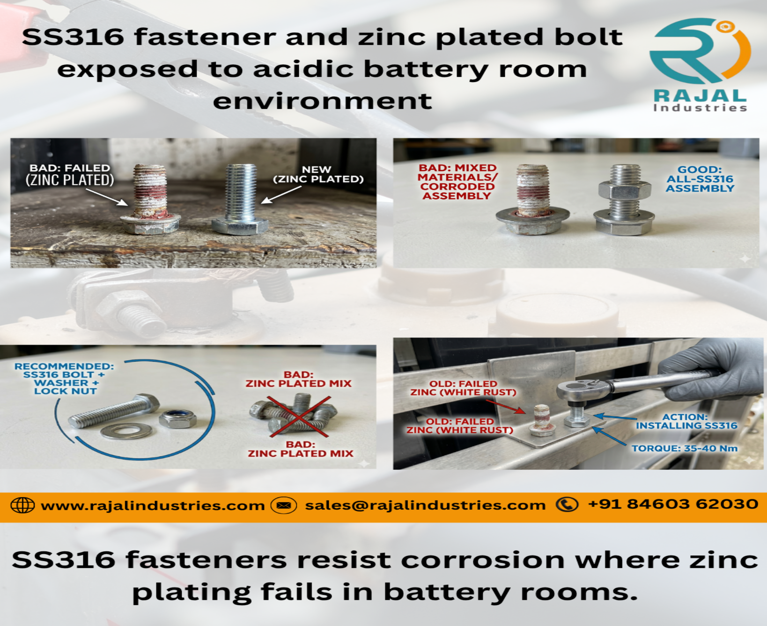
Introduction – Real Site Hook
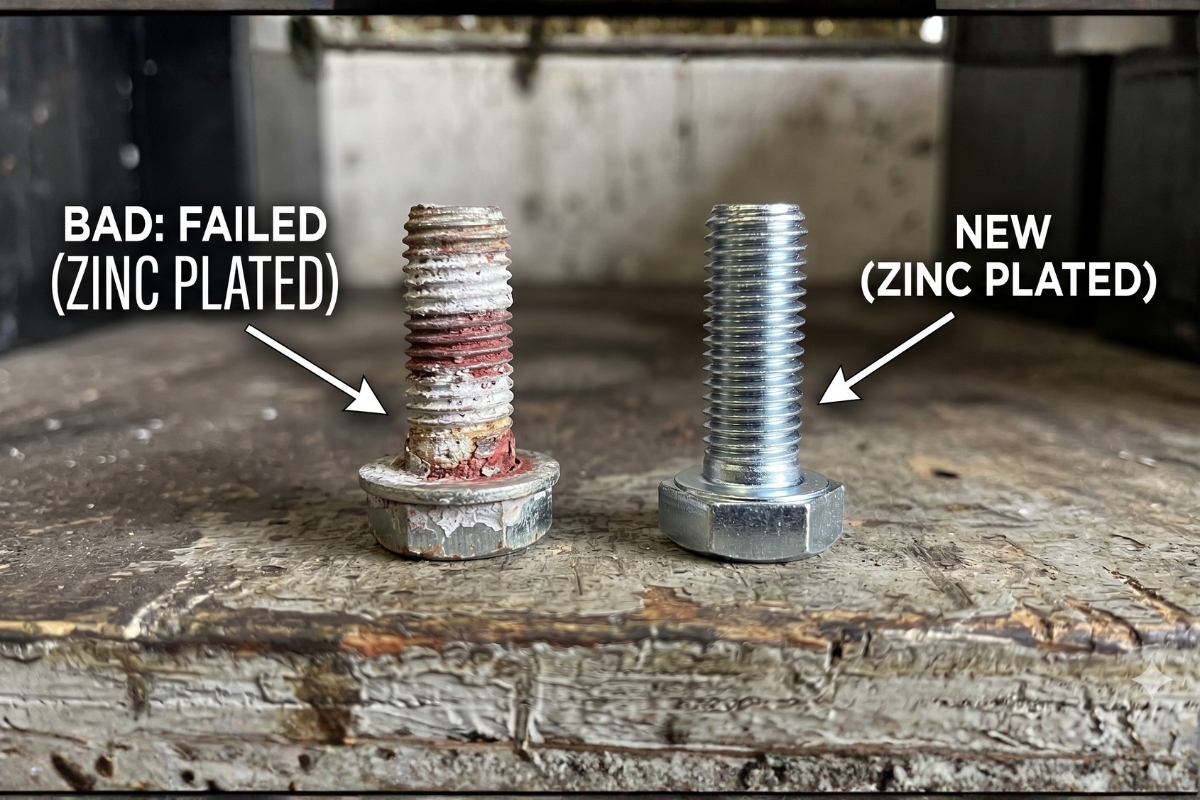
During inspection of a lead-acid battery room, several M10 zinc plated bolts at rack base showed white rust and red corrosion within 14 months of installation. The coating had flaked near the washer interface.
Room condition:
- • Relative humidity: 75–80%
- • Occasional acid vapor presence
- • Temperature fluctuation: 20–45°C
Fastener used: zinc plated M10 hex bolt with flat washer.
This is a typical case requiring proper battery corrosion prevention strategy.
Zinc plating is not designed for acidic environments.
Why Zinc Plated Bolts Fail in Battery Rooms
Zinc plated bolts have:
- • Coating thickness: 8–12 microns
- • Electroplated sacrificial protection
- • Limited lifespan in aggressive environment
In acidic vapor conditions:
Zn + H₂SO₄ (acid vapor) → zinc corrosion reaction
Zinc sacrifices itself to protect steel core.
- • Base steel exposed
- • Red rust begins
- • Cross-section reduces
- • Clamp force drops
Coating is thin and short-life in battery rooms.
Case Study: Corrosion Timeline
Battery room test observation:
Month 3:
- • Slight dullness on zinc surface
Month 6:
- • White rust formation
Month 12:
- • Flaking at washer edge
- • Red rust spots
Month 18:
- • Significant corrosion
- • Reduced torque retention
Zinc coating failed under acidic exposure.
Why SS316 Fasteners Perform Better
SS316 contains:
- • Chromium (corrosion resistance)
- • Nickel (strength and stability)
- • Molybdenum (improves pitting resistance)
Molybdenum content improves resistance to:
- • Chlorides
- • Acidic vapor
- • Industrial humidity
SS316 does not rely on sacrificial coating.
It forms passive chromium oxide layer.
Self-healing protective film prevents corrosion spread.
Corrosion Resistance Comparison
| Parameter | Zinc Plated Bolt | SS316 Fastener |
| Coating Thickness | 8–12 microns | Solid alloy |
| Acid Resistance | Low | High |
| Pitting Resistance | Poor | Excellent |
| Long-Term Life | 1–2 years | 5–10+ years |
| Suitable for Battery Rooms | Limited | Recommended |
For long-term battery corrosion prevention, SS316 is superior.
Mechanical Comparison (M10 Example)
Tensile stress area (M10) ≈ 58 mm²
Typical strengths:
Zinc plated bolt (Grade 8.8 core):
- • Yield strength ≈ 640 MPa
SS316 bolt:
- • Yield strength ≈ 450 MPa
Yield load:
Grade 8.8:
640 × 58 = 37,120 N ≈ 37 kN
SS316:
450 × 58 = 26,100 N ≈ 26 kN
SS316 has lower strength than grade 8.8 but better corrosion resistance.
Selection depends on environment severity.
Recommended Setup for Acidic Battery Rooms
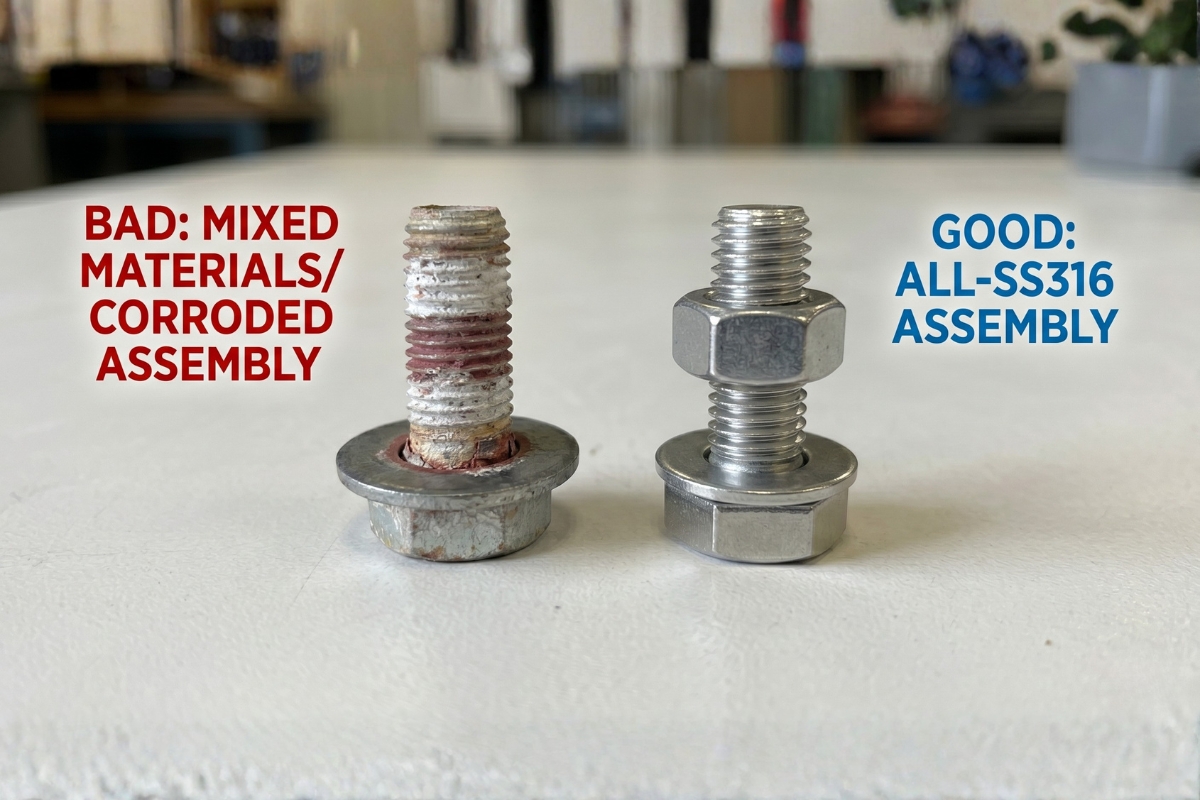
For heavy structural racks in acidic rooms:
- • SS316 M10 Hex Bolt
- • SS316 Flat Washer
- • SS316 Lock Nut
You can review specifications for our
👉 SS316 Fasteners for Battery Room Applications
For structural use:
👉 M10 SS316 Hex Bolt for Corrosive Environments
For proper load distribution:
👉 Stainless Steel Flat Washer M10
Corrosion-resistant stack prevents preload loss.
Torque Recommendation
| Bolt Type | Recommended Torque |
| M10 Grade 8.8 Zinc | 45–50 Nm |
| M10 SS316 | 35–40 Nm |
Stainless torque values lower due to lower yield strength.
Lubrication may be required to prevent galling.
Real Corrosion Test Observation
Salt spray comparison (approximate):
- • Zinc plating: 72–120 hours before red rust
- • HDG: 300–600 hours
- • SS316: No red rust even after 1000+ hours
Battery rooms often simulate mild industrial atmosphere.
SS316 significantly improves lifespan.
Inspection Checklist for Battery Corrosion Prevention
✔ Identify acidic environment
✔ Inspect bolt heads for white rust
✔ Replace zinc bolts with SS316 in critical zones
✔ Avoid mixing stainless with carbon steel
✔ Verify torque after replacement
✔ Use stainless washers and nuts
Corrosion prevention must be material-based.
FAQ
Q1: Why do zinc plated bolts fail in battery rooms?
Because zinc coating is thin and reacts with acidic vapors, leading to rapid corrosion.
Q2: Is SS316 better than zinc plated bolt?
Yes, especially in acidic or humid battery environments.
Q3: Does SS316 have enough strength for battery racks?
Yes for moderate loads. For heavy loads, structural design must be calculated.
Q4: Can HDG bolts be used instead of SS316?
HDG performs better than zinc plating but may still degrade in strong acidic environments.
Q5: Should washers also be stainless?
Yes. Mixing materials may cause galvanic corrosion.
Q6: How long does SS316 last in battery rooms?
Often 5–10+ years depending on exposure severity.
Conclusion
Zinc coating failure is common in acidic battery rooms.
For effective battery corrosion prevention, upgrade to:
- • SS316 fasteners
- • Stainless washers
- • Stainless lock nuts
- • Proper torque control
Material selection determines service life.
Need corrosion-resistant fasteners for your battery facility?
Contact our engineering team for environment-based material selection.
References
ISO 9223 – Corrosion classification of environments
ASTM B117 – Salt spray testing
ISO 3506 – Stainless steel fastener properties
EN 10088 – Stainless steel standards