

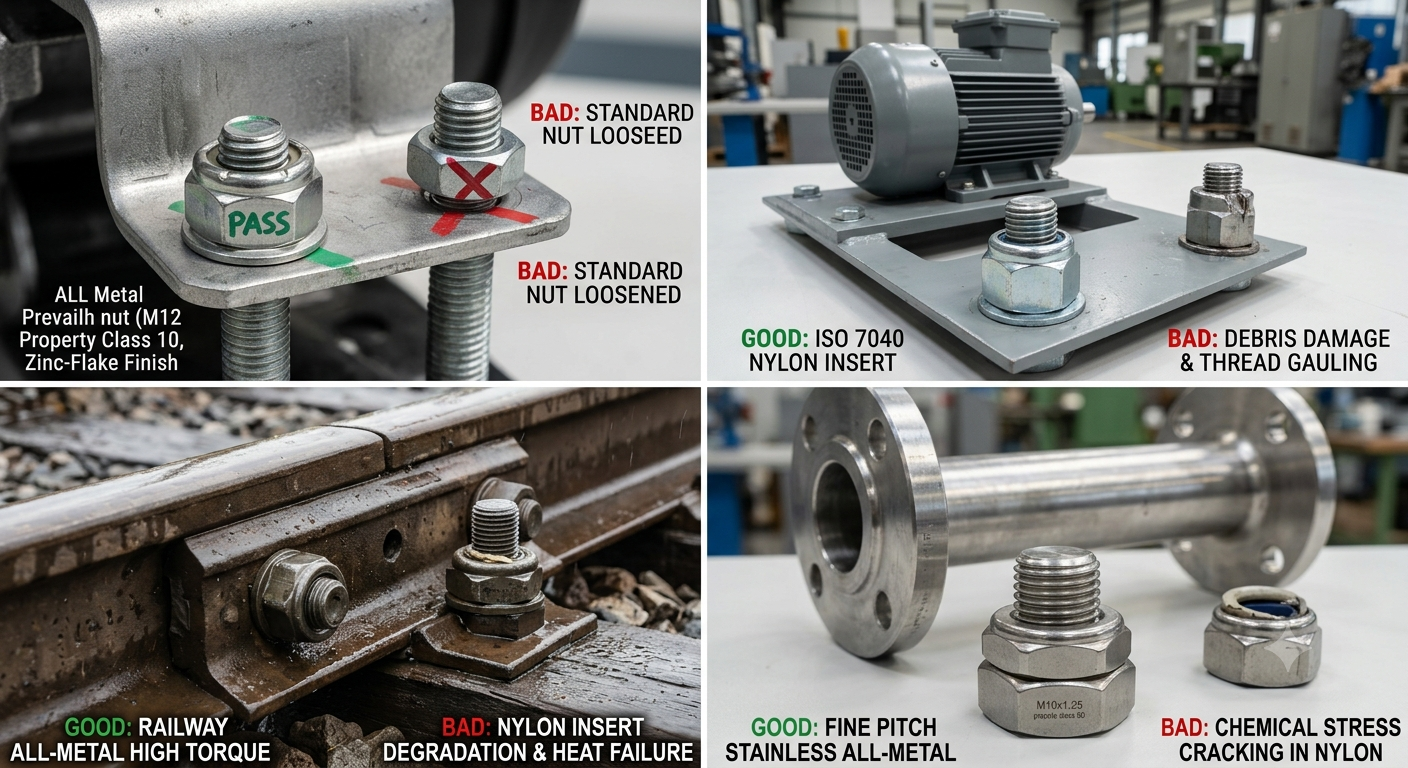
Selecting the correct Lock Nut requires more than choosing a nut that fits the bolt.
For automotive, machinery, railways, automation and industrial equipment, buyers should evaluate the complete joint:
Application → Loosening Risk → Bolt → Thread → Locking Principle → Lock Nut Type → Grade → Material → Temperature → Finish → Prevailing Torque → Installation → Reuse
A locking nut can help resist unintended rotation, but it should not automatically be described as “vibration-proof.”
This Lock Nut Selection Guide explains how to choose the correct locking system for the actual assembly.
Quick Answer: How Do You Select the Correct Lock Nut?
Start with the joint and mating bolt. Identify why loosening is a concern, then confirm diameter, thread, bolt grade, temperature, environment and required locking principle. Choose between an appropriate non-metallic insert or all-metal prevailing-torque nut, then verify the applicable standard, functional performance, finish and installation requirements.
What Is a Lock Nut?
“Lock nut” is a broad commercial term for nuts designed to help resist unintended rotational loosening.
One important standardized category is:
Prevailing-Torque Nut
A prevailing-torque nut creates resistance to rotation through a locking feature rather than relying only on clamp force between the nut bearing surface and joint.
Lock Nut vs Standard Hex Nut
A standard hex nut and a prevailing-torque lock nut do not function in exactly the same way.
| Feature | Standard Hex Nut | Prevailing-Torque Lock Nut |
| Basic Threaded Fastening | Yes | Yes |
| Additional Prevailing-Torque Feature | No | Yes |
| Resistance During Free Rotation | Normal thread friction | Additional resistance |
| Locking Feature | No dedicated prevailing-torque feature | Yes |
| Functional Testing | Standard-dependent | Prevailing-torque testing may apply |
Do not assume a regular hex nut becomes a lock nut simply because it is tightened harder.
What Is Prevailing Torque?
Prevailing torque is the rotational resistance generated by the locking feature while the nut moves along the mating thread.
This resistance can exist before the nut bearing surface fully seats against the joint.
That is different from final tightening torque.
Prevailing Torque vs Tightening Torque
These two terms should not be confused.
Prevailing Torque
Resistance generated by the locking feature during rotation.
Tightening Torque
Applied torque used to develop the required joint condition after seating.
Therefore:
Prevailing Torque ≠ Tightening Torque
and:
Prevailing Torque ≠ Clamp Force
Lock Nut Does Not Mean Vibration-Proof
The keyword Vibration Resistant Nuts should be used carefully.
A prevailing-torque locking feature can help resist unintended nut rotation, but actual joint performance depends on:
- Joint design
- preload
- bolt stiffness
- clamped-part stiffness
- vibration
- transverse movement
- temperature
- surface condition
- installation
Therefore, avoid universal claims such as:
“This nut can never loosen.”
Why Bolted Joints Can Loosen
Loosening can involve factors such as:
- Vibration
- transverse movement
- insufficient preload
- joint settlement
- surface embedding
- thermal cycling
- repeated loading
- installation error
Selecting a lock nut is only one part of controlling the joint.
The Correct Lock Nut Selection Sequence
Use:
Application
↓
Joint Movement / Loosening Risk
↓
Mating Bolt
↓
Diameter & Thread
↓
Bolt Grade
↓
Temperature
↓
Locking Principle
↓
Non-Metallic Insert or All-Metal
↓
Nut Standard
↓
Material / Property Class
↓
Finish
↓
Prevailing-Torque Requirements
↓
Installation
↓
Reuse / Maintenance
Step 1: Identify Why the Joint Needs Locking
Ask:
What problem are we trying to prevent?
Possible concerns include:
- Vibration
- repeated machine cycles
- movement
- transportation shock
- thermal cycling
- maintenance
- nut loss after partial loosening
The locking solution should address the actual joint behaviour.
Step 2: Identify the Mating Bolt or Stud
Before selecting Locking Nuts, confirm:
- Bolt/stud specification
- nominal diameter
- pitch
- thread system
- bolt grade/property class
- material
- finish
A lock nut should not be selected independently from the mating fastener.
Step 3: Match Diameter and Thread
Examples:
M8 × 1.25 Bolt → Compatible M8 × 1.25 Lock Nut
M12 × 1.75 Bolt → Compatible M12 × 1.75 Lock Nut
But thread fit alone does not prove complete compatibility.
The locking nut must also be suitable for the bolt grade, application and operating conditions.
Coarse vs Fine Thread Lock Nuts
Both coarse and fine thread prevailing-torque nut standards exist.
Do not change between them simply because one product is easier to source.
The mating fastener determines the required pitch.
ISO 7040:2025 Non-Metallic Insert Lock Nuts
ISO 7040:2025 is a current standard covering prevailing-torque hexagon regular nuts with a non-metallic insert.
It covers:
- Steel and stainless steel
- Metric coarse pitch threads
- M3 to M39
- Product grades A and B
ISO describes these as regular prevailing-torque nuts with a non-metallic insert.
What Is a Non-Metallic Insert Lock Nut?
This design uses a non-metallic insert to create interference with the mating thread.
As the bolt enters the insert, the locking feature creates additional rotational resistance.
These products are commonly referred to commercially as nylon-insert or Nyloc-type nuts.
For technical specifications, non-metallic insert prevailing-torque nut is the clearer generic description.
Do Not Assume Every Insert Lock Nut Is Identical
Insert lock nuts can differ in:
- Nut style
- dimensions
- thread
- material
- property class
- insert material
- temperature capability
- functional performance
Use the applicable standard and approved product specification.
ISO 7719:2025 All-Metal Regular Lock Nuts
ISO 7719:2025 specifies prevailing-torque all-metal regular hexagon nuts.
It covers:
- Steel and stainless steel
- Metric coarse pitch
- M5 to M39
- Product grades A and B.
The locking feature is produced without a non-metallic insert.
ISO 7042:2025 All-Metal High Lock Nuts
ISO 7042:2025 covers prevailing-torque all-metal high hexagon nuts with:
- Steel and stainless steel
- Metric coarse pitch
- M5 to M39
- Product grades A and B.
Do not confuse a regular all-metal lock nut with a high all-metal lock nut.
Regular vs High Lock Nuts
The terms refer partly to the nut’s dimensional style.
Regular Nut
Based on the applicable regular/style-1 geometry plus the locking feature.
High Nut
Uses the applicable higher/style-2 geometry plus the locking feature.
The required style should be defined by the engineering specification.
Fine-Pitch Non-Metallic Insert Lock Nuts
For fine-pitch applications, ISO 10512:2025 covers regular prevailing-torque hexagon nuts with non-metallic inserts for metric fine-pitch threads from nominal 8 mm to 39 mm, with product grades A and B.
This is important because:
M12 Lock Nut does not fully define the thread.
The pitch must also be known.
Lock Nut Standards Overview
| Standard | Locking Type | Nut Style | Thread |
| ISO 7040:2025 | Non-metallic insert | Regular | Metric coarse |
| ISO 7719:2025 | All-metal | Regular | Metric coarse |
| ISO 7042:2025 | All-metal | High | Metric coarse |
| ISO 10512:2025 | Non-metallic insert | Regular | Metric fine |
| ISO 2320:2015 | Functional properties | All-metal + non-metallic insert | Defined coarse/fine scope |
Use the exact applicable standard rather than simply writing “DIN lock nut” or “ISO lock nut.”
ISO 2320:2015 Functional Properties
ISO 2320:2015 is the key functional-property standard for applicable prevailing-torque steel nuts.
ISO reconfirmed the 2015 edition in 2025, so it remains current.
It covers both:
- All-metal prevailing-torque nuts
- Non-metallic insert prevailing-torque nuts
within its defined dimensional, thread and mechanical-property scope.
ISO 2320 Size Scope
ISO 2320:2015 applies within its defined conditions to:
Coarse pitch: M5 to M39
and:
Fine pitch: M8 × 1 to M39 × 3
among other specified requirements.
This functional-test scope should not be confused with the complete product-size scope of every individual lock-nut standard.
Product Standard vs Functional Standard
This distinction is important.
Product Standard
Defines characteristics of a particular nut design.
Examples:
- ISO 7040
- ISO 7719
- ISO 7042
- ISO 10512
Functional Standard
ISO 2320 addresses functional properties of applicable prevailing-torque steel nuts.
Therefore:
Product Standard ≠ Functional Test Standard
Both may matter in a controlled specification.
How ISO 2320 Tests Prevailing-Torque Nuts
ISO 2320 includes a combined test method for determining:
- Prevailing-torque properties
- Torque/clamp-force properties
under standardized test conditions.
This provides a controlled method for evaluating functional behaviour.
Laboratory Prevailing Torque vs Actual Application
ISO specifically notes that its prevailing-torque values are based on laboratory test conditions and that actual prevailing torque in practical applications can vary.
Therefore:
ISO Test Value ≠ Guaranteed Field Torque in Every Assembly
This is particularly important for automotive and machinery buyers.
Step 4: Select Non-Metallic Insert or All-Metal
This is one of the most important decisions in a Lock Nut Selection Guide.
The choice can depend on:
- Temperature
- application
- bolt grade
- environment
- maintenance
- installation
- required nut style
- approved standard
Non-Metallic Insert Lock Nut
Advantages for suitable applications can include:
- Defined prevailing-torque feature
- common industrial availability
- straightforward identification
- standardized product options
But the insert introduces temperature and material considerations.
All-Metal Lock Nut
All-metal prevailing-torque nuts create their locking action through a controlled metallic locking feature.
They do not rely on a non-metallic insert.
This can make them relevant where the selected insert material would not be suitable for the service conditions.
However:
All-Metal ≠ Automatically Best
The application still controls.
All-Metal vs Non-Metallic Insert Lock Nut
| Selection Factor | Non-Metallic Insert | All-Metal |
| Locking Feature | Insert interference | Metallic feature |
| Non-Metallic Component | Yes | No |
| Temperature Consideration | Important | Important |
| Prevailing Torque | Yes | Yes |
| Reuse Assumption | Must verify | Must verify |
| Functional Standard | ISO 2320 where applicable | ISO 2320 where applicable |
| Best Choice | Application dependent | Application dependent |
Do not select only by price.
Step 5: Check Operating Temperature
Temperature is critical when selecting Industrial Lock Nuts.
ISO 2320 notes application ranges for nuts conforming to its requirements:
- All-metal type: −50°C to +150°C
- Non-metallic insert type: −50°C to +120°C
It also warns that temperature can influence torque/clamp-force and prevailing-torque properties.
Important Temperature Caution
These ISO 2320 notes should not be turned into a universal rule for every commercial lock nut.
The actual product may also depend on:
- Material
- insert material
- coating
- bolt
- environment
- manufacturer specification
Always verify the selected product.
ISO 2320 Test Temperature vs Application Temperature
Another important distinction:
ISO 2320 functional testing is conducted at an ambient temperature range of:
+10°C to +35°C
while the standard separately discusses broader application-temperature ranges.
Therefore:
Laboratory Test Temperature ≠ Full Service Temperature Range
High-Temperature Machinery
For elevated-temperature machinery, do not automatically select a nylon/non-metallic insert nut because it is commonly available.
Evaluate:
- Actual operating temperature
- local fastener temperature
- insert capability
- all-metal alternative
- bolt material
- applicable standard
Low-Temperature Applications
Low-temperature service also requires technical review.
Do not assume every insert, coating or nut material behaves identically at low temperature.
Use the approved product and application specification.
Step 6: Check Bolt Property Class
The mating bolt’s mechanical properties must be compatible with the selected nut.
Depending on the standard, lock-nut property classes can be selected according to applicable ISO 898-2 requirements for steel or ISO 3506-2 for stainless steel. The current ISO 7040 and ISO 7719 product pages explicitly reference these standards for cases requiring other specifications.
Do not select a locking nut based only on its locking feature.
Locking Function Does Not Replace Mechanical Strength
A nut can have a strong prevailing-torque feature and still be mechanically unsuitable for the mating bolt.
Verify separately:
Mechanical Compatibility + Locking Function
Both are required.
Step 7: Select Material
Common standardized product families include:
- Steel
- Stainless steel
The correct material depends on:
- Bolt
- environment
- corrosion
- temperature
- mechanical requirements
- project specification
Steel Lock Nuts
Steel Locking Nuts are widely used in suitable:
- Automotive assemblies
- machinery
- automation
- industrial equipment
- railway equipment
Property class and surface finish still need to be defined.
Stainless Steel Lock Nuts
Stainless lock nuts may be selected for suitable corrosive environments.
But do not specify only:
Stainless Lock Nut
when the application requires controlled:
- Stainless grade
- property class
- thread
- nut standard
- locking type
Stainless Steel Does Not Automatically Mean A4
Stainless fasteners exist in different material groups and grades.
Selection should consider:
- Environment
- mating fastener
- corrosion
- temperature
- mechanical requirements
Do not automatically specify A4/316 for every industrial application.
Step 8: Check Corrosion Environment
Ask whether the lock nut operates in:
- Indoor dry equipment
- outdoor machinery
- humid environment
- road vehicle
- railway equipment
- coastal atmosphere
- chemical environment
Then select an approved material and finish.
Coating and Lock Nut Function
Surface coatings can affect:
- Thread friction
- prevailing torque
- installation torque
- corrosion protection
- fit
For prevailing-torque nuts, coating should be considered part of the functional system.
Do Not Change Coating Without Review
Changing:
Plain → Zinc Plated
or one coating system to another can change functional behaviour.
Where performance is controlled, re-evaluate the nut in its final supplied condition.
Step 9: Understand Prevailing Torque Performance
A lock nut should not simply feel “tight.”
Functional performance should be evaluated using the applicable standard.
Subjective checks such as:
“It feels difficult to turn, so it is good.”
are not sufficient for controlled industrial production.
Too Little Prevailing Torque
Possible concerns include:
- Insufficient locking interference
- damaged insert
- incorrect locking feature
- manufacturing variation
- wrong mating thread
- repeated use
Investigate against the applicable specification.
Too Much Prevailing Torque
Excessive resistance is not automatically better.
It can cause:
- Difficult assembly
- increased tool load
- misleading tightening behaviour
- potential thread issues
- production-line problems
The objective is controlled compliance, not maximum resistance.
Step 10: Consider Reuse
A common question is:
Can a lock nut be reused?
There is no universal yes/no answer for every lock nut and every application.
Prevailing torque can change through repeated installation/removal cycles.
Reuse should follow:
- Applicable standard
- product specification
- measured functional requirements
- OEM procedure
- maintenance policy
Never Assume Unlimited Reuse
A lock nut that still looks visually acceptable may have changed functional performance.
Visual inspection alone cannot prove remaining prevailing torque.
Reuse in Safety-Critical Assemblies
For safety-critical automotive, railway or machinery applications, follow the approved OEM/service procedure.
Do not create a general reuse rule from workshop experience.
Step 11: Consider Installation Speed
This can matter particularly in:
- Automotive assembly
- automated assembly
- high-volume machinery production
The locking feature creates rotational resistance.
Production engineering should consider:
- Tool capacity
- cycle time
- installation speed
- thread condition
- seating detection
- torque strategy
Lock Nut in Automated Assembly
Automation requires consistent:
- Feeding
- orientation
- thread start
- prevailing torque
- final tightening
- detection of abnormal installation
A lock nut suitable for manual maintenance may require additional validation before automated production use.
Step 12: Consider Maintenance
Some assemblies are opened regularly.
Ask:
- How often will the nut be removed?
- Is replacement required after removal?
- Is prevailing torque checked?
- Is field replacement easy?
- Is the nut safety critical?
Maintenance strategy can influence nut selection.
Lock Nut Selection for Automotive Applications
Automotive joints can experience:
- Vibration
- thermal cycling
- repeated loads
- high-volume assembly
- maintenance
- corrosion exposure
Selection should consider both functional locking performance and production requirements.
Automotive Does Not Mean One Lock Nut Type
Different vehicle locations can have different:
- Temperatures
- loads
- environments
- safety requirements
- service procedures
Do not specify one universal lock nut for an entire vehicle.
Lock Nut Selection for Machinery
Machinery can involve:
- Motors
- frames
- guards
- moving mechanisms
- rotating equipment
- adjustment systems
- supports
First determine whether the joint is intended to remain fixed or adjusted periodically.
Lock Nuts for Repeated Machinery Vibration
Where vibration is a concern, investigate the complete joint:
Bolt → Nut → Preload → Joint Stiffness → Movement → Locking Feature
Do not expect the nut alone to correct poor joint design.
Lock Nut Selection for Railways
Railway equipment can involve:
- Vibration
- repeated dynamic loading
- outdoor exposure
- maintenance
- safety-critical assemblies
Use the applicable railway/OEM specification.
Do not claim a generic lock nut is railway-approved unless the required approval and validation exist.
Lock Nut Selection for Automation Equipment
Automation machinery can require:
- Consistent assembly
- predictable functional torque
- repeated motion
- low downtime
- controlled maintenance
Locking performance should be evaluated together with assembly-process capability.
Lock Nut Selection for Industrial Equipment
Industrial equipment can have very different environments.
Examples include:
- Production machinery
- conveyors
- material handling
- pumps
- support equipment
- enclosures
- processing machinery
Select the locking method based on the actual joint.
Lock Nut vs Standard Hex Nut
Use a standard hex nut where the joint design and specification do not require a dedicated prevailing-torque locking feature.
Use a prevailing-torque nut where that locking function is required and validated.
Do not upgrade every joint to a lock nut without engineering review.
Lock Nut vs Nyloc-Type Nut
A Nyloc-type nut is one type of prevailing-torque locking nut using a non-metallic insert.
Therefore:
Nyloc-Type Nut ⊂ Lock Nut Category
but:
Not Every Lock Nut Is a Nyloc-Type Nut
All-metal designs are another major category.
Lock Nut vs Jam Nut
A jam nut uses a different locking arrangement involving nut interaction and joint configuration.
It should not be confused with a prevailing-torque nut.
The selection logic and installation method differ.
Lock Nut vs Chemical Threadlocker
A prevailing-torque nut and liquid threadlocking compound are different locking approaches.
Do not combine or substitute them without considering:
- Joint design
- temperature
- service
- maintenance
- OEM procedure
Lock Nut vs Lock Washer
Lock washers and prevailing-torque nuts use different mechanisms.
Do not assume they provide identical performance.
The approved joint design should determine the locking system.
Common Lock Nut Selection Mistakes
Avoid:
- Selecting only by diameter.
- Ignoring thread pitch.
- Calling every lock nut “Nyloc.”
- Treating all-metal and insert nuts as identical.
- Ignoring temperature.
- Assuming a lock nut is vibration-proof.
- Assuming more prevailing torque is always better.
- Confusing prevailing torque with tightening torque.
- Ignoring bolt grade.
- Changing coating without functional review.
- Assuming unlimited reuse.
- Checking locking performance only by hand feel.
- Ignoring assembly speed.
- Using a regular hex nut where prevailing torque is specified.
- Assuming one lock nut type suits every automotive or railway joint.
Lock Nut Selection Decision Table
| Question | Buyer Should Confirm |
| Why is locking required? | Vibration/movement/service condition |
| What is the mating fastener? | Bolt or stud |
| What size? | Nominal diameter |
| What thread? | Pitch/TPI |
| What bolt grade? | Mechanical compatibility |
| What temperature? | Service condition |
| Which locking type? | Insert or all-metal |
| What nut style? | Regular/high/thin as applicable |
| What standard? | Applicable ISO/OEM standard |
| What material? | Steel/stainless |
| What finish? | Approved coating |
| Functional requirement? | Prevailing torque |
| Reuse? | Standard/OEM procedure |
| Assembly method? | Manual/automated |
| Documentation? | Test/inspection records |
Lock Nut RFQ Checklist
A good RFQ should identify:
☐ Application
☐ Reason locking is required
☐ Mating bolt/stud specification
☐ Bolt grade/property class
☐ Nominal diameter
☐ Pitch
☐ Coarse/fine thread
☐ Lock nut type
☐ Non-metallic insert or all-metal
☐ Nut style
☐ Product standard
☐ Functional standard
☐ Nut property class/grade
☐ Material
☐ Operating temperature
☐ Environment
☐ Finish/coating
☐ Prevailing-torque requirement
☐ Reuse requirement
☐ Installation method
☐ Testing
☐ Documentation
☐ Quantity
Poor Lock Nut RFQ
Need M12 lock nut. Qty 100,000. Send best price.
This does not define:
- Pitch
- locking type
- bolt grade
- standard
- material
- temperature
- finish
- functional performance
Better Lock Nut RFQ
Product: Prevailing-Torque Hexagon Nut
Application: Industrial machinery
Mating Bolt: M12 × 1.75, specification attached
Locking Type: Non-metallic insert
Product Standard: ISO 7040:2025 where applicable
Functional Requirements: ISO 2320:2015 where applicable
Nut Material/Property Class: As engineering specification
Finish: Drawing requirement
Operating Temperature: Application data attached
Quantity: 100,000 pcs
This gives suppliers a measurable technical requirement.
What Is the Best Lock Nut for Vibration?
There is no single best lock nut for every vibrating joint. Select the locking system based on the bolt, joint movement, preload, temperature, environment, assembly method and required prevailing-torque performance.
What Is a Prevailing-Torque Lock Nut?
A prevailing-torque lock nut creates rotational resistance through an engineered locking feature. The resistance exists during thread engagement and is different from the final tightening torque used to establish the joint condition.
What Is the Difference Between All-Metal and Nylon-Insert Lock Nuts?
A non-metallic insert lock nut generates prevailing torque through an insert, while an all-metal lock nut uses a metallic locking feature. Temperature, application, material, maintenance and the applicable standard should determine the selection.
What Standard Covers Lock Nut Prevailing Torque?
ISO 2320:2015 specifies functional properties for applicable prevailing-torque steel nuts, including all-metal and non-metallic insert types. ISO reconfirmed the standard in 2025, so it remains current.
Are Lock Nuts Vibration-Proof?
No lock nut should automatically be described as universally vibration-proof. Actual resistance to loosening depends on the complete bolted joint, including preload, movement, vibration, temperature and installation.
Can Lock Nuts Be Reused?
Reuse depends on the nut design, applicable standard, remaining prevailing-torque performance and OEM or maintenance procedure. Do not assume unlimited reuse based only on visual condition.
Can Non-Metallic Insert Lock Nuts Be Used at High Temperature?
Temperature capability must be checked against the applicable standard and product specification. ISO 2320 notes an application range of −50°C to +120°C for conforming non-metallic insert types, while temperature can affect functional properties.
What Temperature Can All-Metal Lock Nuts Handle?
ISO 2320 notes an application range of −50°C to +150°C for conforming all-metal types within its scope, but the actual selected product, material, coating and application specification must still be checked.
Industrial Buyer Checklist
Before selecting Industrial Lock Nuts, confirm:
☐ Application
☐ Why locking is required
☐ Joint movement/vibration condition
☐ Mating bolt/stud
☐ Bolt standard
☐ Bolt property class/grade
☐ Metric/inch system
☐ Nominal diameter
☐ Pitch/TPI
☐ Thread tolerance/class
☐ Locking principle
☐ Non-metallic insert or all-metal
☐ Regular/high/thin style
☐ Product standard
☐ Functional standard
☐ Nut property class/grade
☐ Material
☐ Operating temperature
☐ Environment
☐ Corrosion requirement
☐ Finish/coating
☐ Prevailing-torque requirement
☐ Tightening method
☐ Assembly speed
☐ Manual/automated installation
☐ Reuse requirement
☐ Maintenance procedure
☐ Functional testing
☐ Dimensional inspection
☐ Thread inspection
☐ Coating inspection
☐ Traceability
☐ Documentation
☐ Quantity
Conclusion: Select the Lock Nut as Part of the Joint
A reliable Lock Nut Selection Guide should not recommend a nut based only on diameter or the word “vibration.”
Use:
Joint → Bolt → Thread → Loosening Risk → Temperature → Locking Type → Nut Standard → Grade → Material → Finish → Prevailing Torque → Installation → Reuse
Remember:
Lock Nut ≠ Vibration-Proof Nut
Prevailing Torque ≠ Tightening Torque
Prevailing Torque ≠ Clamp Force
More Prevailing Torque ≠ Better
All-Metal ≠ Automatically Better
Non-Metallic Insert ≠ Suitable for Every Temperature
Correct Thread Fit ≠ Complete Mechanical Compatibility
First Use ≠ Unlimited Reuse
For automotive, machinery, railway, automation and industrial-equipment applications, the locking feature should be selected and validated as part of the complete bolted joint.
Rajal Industries can evaluate standard and customer drawing-based Lock Nuts, Locking Nuts, Vibration Resistant Nuts and related Industrial Lock Nuts, subject to technical feasibility, manufacturing process, material availability, locking-feature design, functional testing and customer/OEM approval.
Need Help Selecting Lock Nuts for Vibration or Machinery?
Send Rajal Industries:
Application + Bolt Specification + Size/Pitch + Bolt Grade + Locking Type + Temperature + Material + Finish + Functional Testing + Quantity
for technical feasibility and quotation review.