

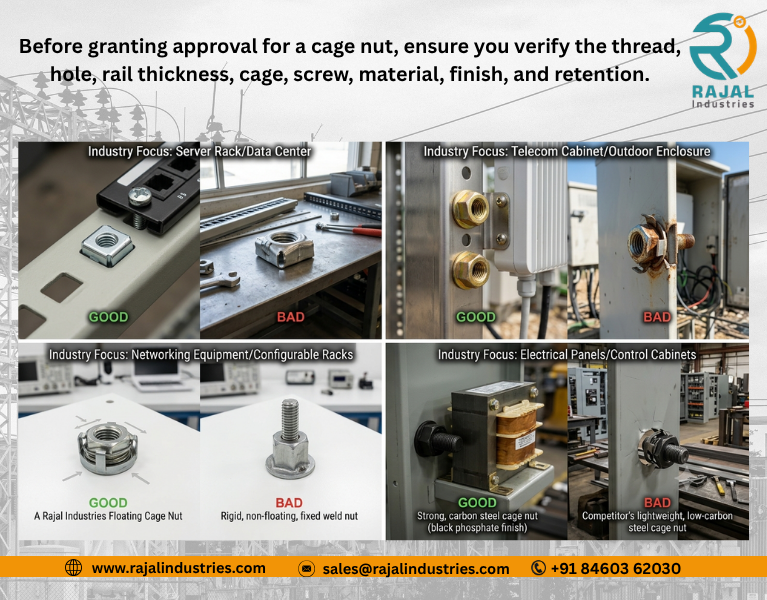
Choosing the right Cage Nut Manufacturer is important for server racks, data centers, telecom cabinets, networking enclosures and electrical panels where equipment must be mounted securely while remaining removable for installation, maintenance or replacement.
A cage nut normally combines a threaded nut with a spring-steel cage or retaining structure. The cage allows the threaded element to be installed into a compatible square or shaped mounting hole without welding a permanent nut directly to the panel.
This makes Server Rack Cage Nuts especially useful for configurable rack and enclosure systems.
However, buyers should not order a cage nut only by thread size.
A better specification sequence is:
Application → Rack/Panel Hole → Sheet Thickness → Cage Nut Design → Thread Size → Screw → Cage Material → Nut Material → Finish → Installation → Load Requirement → Validation
Rajal Industries can evaluate standard and drawing-based cage nut requirements for racks, cabinets, enclosures and industrial panels, subject to technical and manufacturing feasibility.
Quick Answer: What Is a Cage Nut?
A cage nut is a threaded nut retained inside a spring-steel or formed cage that clips into a compatible mounting hole. It creates a removable threaded attachment point without requiring a permanently welded nut. Cage nuts are widely associated with racks, cabinets and configurable equipment mounting systems.
Why Are Cage Nuts Used in Server Racks?
Modern racks need mounting points that are:
- Replaceable
- Configurable
- Serviceable
- Accessible from the front
- Suitable for repeated equipment changes
A fixed threaded hole limits flexibility if the thread becomes damaged.
A cage nut can instead be removed and replaced while the rack structure remains in service.
This is one reason Rack Mount Nuts are useful in server and networking infrastructure.
What Does a Cage Nut Look Like?
A typical cage nut assembly contains two functional elements:
Threaded Nut
Provides the internal thread for the mating screw.
Retaining Cage
Holds the nut and secures the assembly into the rack or panel opening.
Depending on design, the retaining cage can have spring tabs or retaining features that engage the mounting hole.
How Does a Cage Nut Work?
A typical installation sequence is:
Select Mounting Position → Compress/Engage Cage → Insert Into Compatible Hole → Seat Cage → Align Equipment → Insert Screw → Tighten
The exact installation method depends on the cage design.
The cage retains the nut behind the mounting rail or panel while the screw is installed from the equipment side.
Cage Nut vs Standard Hex Nut
| Feature | Cage Nut | Standard Hex Nut |
| Captured in Panel/Rail | Yes | No |
| Loose Nut Handling Behind Panel | Reduced | Usually required |
| Replaceable | Yes | Yes, but requires access |
| Square-Hole Rack Use | Common | Not directly |
| Threaded Attachment | Yes | Yes |
| Server Rack Application | Common | Application dependent |
Cage Nut vs Weld Nut
A cage nut and weld nut both create threaded attachment points, but their installation is very different.
| Feature | Cage Nut | Weld Nut |
| Attachment | Mechanical retention | Welding |
| Heat Required | No | Yes |
| Replaceable | Usually yes | Normally no |
| Rack Reconfiguration | Good | Limited |
| Installation Equipment | Simple tool/manual depending design | Welding equipment |
| Sheet Heat Effect | None from installation | Welding process involved |
For configurable server racks, replaceability can be a major advantage.
Cage Nut vs Rivet Nut
A rivet nut is mechanically deformed into a hole to create a captive internal thread.
A cage nut is retained by its cage rather than being permanently deformed into the panel.
Cage Nut
Useful when replacement and rack configuration are important.
Rivet Nut
Useful when a more permanently installed threaded insert is required.
Neither product is universally better.
Cage Nut vs Self-Clinching Nut
A self-clinching nut is pressed into suitable sheet metal and becomes mechanically locked into the sheet.
A cage nut is installed into a compatible opening and can generally be replaced more easily.
The choice depends on:
- Panel design
- Sheet thickness
- Required load
- Installation access
- Serviceability
- Production method
Main Types of Cage Nuts
Industrial buyers may encounter several cage-nut designs.
1. Square-Hole Cage Nut
Commonly associated with equipment racks and cabinets.
2. Rack Mount Cage Nut
Designed specifically around rack mounting systems.
3. Panel Cage Nut
Used in electrical, electronic or industrial panels.
4. Floating Cage Nut
Allows controlled movement of the threaded element for alignment.
5. Custom Cage Nut
Designed for a customer-specific hole, panel or thread requirement.
The exact geometry should be matched to the receiving structure.
What Is a Server Rack Cage Nut?
A Server Rack Cage Nut is a cage nut designed for mounting equipment or accessories to compatible rack rails.
Typical equipment can include:
- Servers
- Network switches
- Patch panels
- Rack shelves
- Cable-management components
- Power equipment
- Rack accessories
The cage nut provides the threaded interface for the mounting screw.
19-Inch Rack Systems and Cage Nuts
The IEC 60297 family covers mechanical structures for electronic equipment based on the 482.6 mm (19-inch) series. IEC 60297-3-100:2008 specifies basic dimensions for front panels, subracks, chassis, racks and cabinets in this system. (IEC Webstore)
This is useful context for buyers because a cage nut may be part of a 19-inch rack assembly, but IEC 60297-3-100 should not be described as a cage nut product standard. It primarily defines the rack/cabinet mechanical structure and interfaces.
IEC 60297-3-100:2008 official page
Important Standard Distinction for Cage Nut Buyers
A common SEO mistake is to write:
“Cage nuts are manufactured according to IEC 60297.”
That statement is too broad.
A more accurate explanation is:
Cage nuts are commonly used as mounting hardware in rack and cabinet systems that may follow the IEC 60297 482.6 mm (19-inch) mechanical structure.
IEC 60297-3-100 defines basic rack and cabinet dimensions rather than serving as a universal dimensional standard for every cage nut. (IEC Webstore)
1U and Rack Mounting
In rack systems, vertical equipment space is commonly described in rack units or U.
IEC 60297-3-105:2008 specifically addresses dimensions and design aspects for 1U-high chassis mounted in racks or cabinets compliant with IEC 60297-3-100. (IEC Webstore)
The cage nut itself should still be selected according to the mounting rail and hole design.
Why the Rack Hole Is Critical
A cage nut cannot be selected correctly from thread size alone.
The receiving hole is equally important.
Buyers should confirm:
- Hole shape
- Hole dimensions
- Rail/panel thickness
- Cage engagement
- Installation direction
- Required movement
- Screw thread
A cage designed for one square hole may not fit another rail correctly.
Square-Hole Cage Nuts
Square-hole cage nuts are widely associated with server and networking racks.
The spring cage engages the square opening and retains the threaded nut behind the rail.
Potential benefits include:
- Replaceability
- Configurable equipment positioning
- No welding
- No permanent threaded rail required
- Easy field servicing
Are All Server Rack Square Holes the Same?
Do not assume so.
Rack and enclosure designs can vary by:
- Manufacturer
- Rail system
- Hole dimensions
- Sheet thickness
- Cage-nut design
- Application
Therefore, the cage nut should be validated with the actual rack rail or its controlled drawing.
Real-World Rack Example
Current Rittal VX IT rack documentation describes square holes that support cage nuts and metric screws up to M8 in parts of its enclosure system. This demonstrates that cage-nut compatibility is tied to the rack’s specific mounting geometry rather than a universal cage-nut size.
This does not mean every 19-inch rack accepts every thread through M8.
Always verify the specific rack design.
Cage Nut Thread Sizes
Depending on the rack, cabinet or panel design, cage nuts can be produced with different internal threads.
Metric requirements may include sizes such as:
- M5
- M6
- M8
Other systems can use different thread specifications.
The correct thread must match the mating screw.
Why M6 Is Commonly Seen in Rack Hardware
M6 hardware is used in many rack and enclosure systems, but buyers should avoid describing M6 as a universal 19-inch rack requirement.
For example, a current Rittal 19-inch mounting product uses an M6 thread with a 9.5 × 9.5 mm mounting hole and specifies a 1.2–4.5 mm clamping range for that particular design.
Those dimensions belong to that specific product and should not be copied as universal cage nut dimensions.
M5 Cage Nuts
M5 cage nuts can also be used in suitable rack, cabinet and panel systems.
Selection should confirm:
M5 Thread + Cage Geometry + Hole + Panel Thickness + Mating Screw
Do not substitute M5 and M6 simply because both physically fit within a rack environment.
M6 Cage Nuts
M6 is frequently encountered in server rack mounting hardware.
For OEM sourcing, an M6 cage nut specification should still define:
- Thread pitch
- Cage dimensions
- Hole size
- Sheet thickness range
- Material
- Finish
- Mating screw
- Required performance
“M6 cage nut” alone may not fully define the part.
M8 Cage Nuts
M8 cage nuts can be used in rack, cabinet or industrial enclosure systems designed for them.
Because the fastener and mounting geometry are larger, buyers should confirm:
- Rail design
- Hole size
- Cage geometry
- Material thickness
- Load
- Screw
Do not assume an M8 cage nut fits a mounting point designed around M6 hardware.
Metric vs Inch Rack Mount Nuts
Some racks and equipment systems may use inch-series threaded mounting hardware.
Therefore, international OEM buyers should specify the complete thread.
For example:
Metric Thread: M6 × specified pitch
Inch Thread: Exact inch-series designation
Do not force a metric screw into an inch-thread cage nut or vice versa.
Cage Nut Thread Pitch
Thread pitch should be specified whenever necessary.
An incomplete RFQ:
M6 cage nut
A stronger OEM RFQ:
M6 cage nut, thread and cage geometry according to attached drawing, for specified square rack hole and rail thickness.
This reduces assumptions.
Cage Nut Dimensions
Important cage nut dimensions can include:
- Internal thread diameter
- Thread pitch
- Nut body dimensions
- Cage width
- Cage height
- Overall depth
- Spring-tab geometry
- Retaining-feature dimensions
- Compatible hole dimensions
- Compatible sheet/rail thickness
These dimensions work together.
Why Cage Nut Dimensions Are Different From Standard Nut Dimensions
A conventional hex nut mainly needs to match:
- Thread
- Mechanical requirements
- Wrenching geometry
A cage nut must additionally interface with:
- Mounting hole
- Sheet or rail
- Cage retention
- Installation access
This makes the cage geometry functionally important.
Cage Nut and Square Hole Compatibility
The cage must engage the opening without:
- Falling out
- Excessive looseness
- Permanent unwanted deformation
- Difficult installation
- Damage to the rail
The exact fit should be validated using the production rack or panel.
Sheet Thickness Matters
The rack rail or panel thickness affects how the cage engages the mounting opening.
If the cage is not suitable for the material thickness, possible problems include:
- Loose fit
- Poor retention
- Difficult installation
- Cage deformation
- Assembly instability
Therefore, sheet thickness should appear in a professional cage nut RFQ.
Floating Cage Nut Design
Some cage designs allow limited movement of the threaded nut within the retaining cage.
This can help accommodate small positional differences between:
- Equipment mounting hole
- Rack rail
- Screw
But “floating” does not mean unlimited misalignment.
The permitted movement should follow the product design.
Why Floating Alignment Helps
In a rigid fixed-thread system, small hole-position differences can make screw installation difficult.
Controlled float can help the screw find the threaded nut.
Potential benefits include:
- Easier alignment
- Reduced assembly difficulty
- Accommodation of normal positional variation
However, excessive movement can make installation frustrating.
Cage Nut Materials
A cage nut can contain different materials for different functions.
Threaded Nut
Requires suitable thread and mechanical performance.
Cage
Needs enough spring behaviour to engage and retain the nut in the panel.
Depending on the design, these components may use different material specifications.
Spring Steel Cage
A retaining cage commonly relies on spring behaviour.
Important characteristics can include:
- Elasticity
- Retention force
- Formability
- Fatigue behaviour
- Corrosion protection
The exact material should follow the drawing or approved specification.
Cage Nut Surface Finish
Surface finishes can be selected for:
- Corrosion protection
- Appearance
- Environmental requirements
- OEM specification
A current Rittal rack-mounting product, for example, specifies sheet steel with a zinc-plated surface finish.
That is an example, not a universal specification for every cage nut.
Why Coating Matters
The finish can affect:
- Corrosion
- Cage movement
- Spring surfaces
- Thread fit
- Installation
A thick or poorly controlled coating can interfere with small functional clearances.
Cage Nut Mechanical Requirements
A cage nut assembly can experience different loads during:
- Installation
- Equipment support
- Maintenance
- Removal
The buyer may need to consider:
- Thread strength
- Cage retention
- Pull-out/push-through behaviour
- Torque resistance
- Equipment load
- Dynamic environment
Acceptance values should come from the customer specification or validated design.
Do Not Use One Universal Cage Nut Load Rating
A generic statement such as:
M6 cage nut supports X kg
can be misleading.
The real mounting system includes:
Cage Nut + Screw + Rack Rail + Hole + Sheet Thickness + Equipment Mounting Flange + Number of Fasteners + Load Direction
The rack/equipment manufacturer should define allowable loading.
Server Rack Cage Nuts
Server Rack Cage Nuts are commonly relevant to equipment such as:
- Rack servers
- Storage systems
- Network switches
- Rack shelves
- UPS equipment
- Power distribution equipment
- Patch panels
- Cable-management hardware
But equipment weight and mounting instructions must be respected.
Data Center Applications
Data centers use large numbers of configurable racks and cabinets.
Cage nuts can support:
- Server installation
- Network equipment
- Rack accessories
- Cable-management systems
- Power equipment
- Monitoring hardware
Their replaceability can help during equipment upgrades and maintenance.
Why Data Centers Need Replaceable Mounting Hardware
Data-center racks can be reconfigured repeatedly.
Equipment may be:
- Added
- Removed
- Replaced
- Repositioned
If a cage nut is damaged, it can often be replaced without replacing the entire rack rail.
This is a practical maintenance advantage.
Telecom Applications
Telecom cabinets and equipment racks may use cage nuts for:
- Communication equipment
- Network hardware
- Shelves
- Panels
- Cable-management accessories
- Electronic modules
The mounting system should match the telecom enclosure design.
Networking Equipment
Networking racks may hold:
- Switches
- Routers
- Patch panels
- Fibre equipment
- Cable-management accessories
The cage nut provides one possible threaded mounting interface.
Electrical Panel Applications
Cage nuts can also be relevant to suitable:
- Electrical enclosures
- Control cabinets
- Panel structures
- Equipment frames
- Removable internal components
However, not every electrical panel should use cage nuts.
Weld nuts, rivet nuts, self-clinching nuts or tapped holes may be better depending on the design.
Cage Nut vs Other Panel Fasteners
| Requirement | Cage Nut | Rivet Nut | Self-Clinching Nut | Weld Nut |
| Replaceable | High | Low | Low | Low |
| Welding Required | No | No | No | Yes |
| Press Installation | No | Installation tool | Press | Welding equipment |
| Square-Hole Rack Use | Strong fit | Usually different use | Usually different use | Usually different use |
| Field Replacement | Good | Limited | Limited | Difficult |
| Configurability | High | Medium | Low-Medium | Low |
The final choice depends on the assembly.
Rack Mount Nuts and Serviceability
One major advantage of Rack Mount Nuts is serviceability.
If the thread is damaged, the cage nut can often be removed and replaced.
With a permanently threaded rail, damaged threads can require:
- Thread repair
- Larger repair fastener
- Rail replacement
- Other corrective action
Replaceable hardware can reduce maintenance complexity.
Cage Nut Installation
Installation should follow the cage design.
A typical process is:
- Confirm rack position.
- Confirm correct thread size.
- Orient cage correctly.
- Engage one retaining tab.
- Compress or position the second tab.
- Seat the cage fully.
- Align equipment.
- Install correct screw.
- Tighten according to equipment instructions.
Avoid forcing an incompatible cage into the rail.
Cage Nut Installation Tools
Some cage nuts can be installed manually.
For repeated installation, a cage-nut insertion/removal tool may help:
- Compress spring tabs
- Reduce finger injury risk
- Speed installation
- Reduce cage damage
The correct tool depends on cage design.
Common Cage Nut Installation Problems
Potential issues include:
- Wrong cage size
- Wrong square hole
- Cage installed backwards
- Bent spring tab
- Thread misalignment
- Wrong screw
- Cross-threading
- Cage spinning
- Cage falling out
- Damaged coating
Most of these can be prevented through specification and installation control.
Cage Nut Manufacturing Process
A cage nut can require two manufacturing streams.
Nut Component
Possible sequence:
Raw Material → Forming/Machining → Hole Formation → Threading → Heat Treatment if Required → Finish → Inspection
Cage Component
Possible sequence:
Sheet/Strip Material → Stamping → Forming → Spring Features → Heat Treatment if Required → Surface Treatment → Inspection
Then:
Nut + Cage → Assembly → Functional Inspection → Packing
The exact process depends on design and volume.
Why Cage Tooling Matters
The retaining cage is a functional spring component.
Tooling variation can affect:
- Tab position
- Cage width
- Retention
- Nut movement
- Installation force
Therefore, cage dimensions should be controlled during production.
Thread Quality
The nut component must provide a reliable mating thread.
Inspect:
- Diameter
- Pitch
- Thread tolerance
- Damage
- Burrs
- Coating interference
A cage that fits the rack is still unusable if the screw cannot thread correctly.
Cage Retention
The cage should remain in the intended mounting hole during normal installation and service.
Too little retention can cause:
- Falling cage nuts
- Misalignment
- Difficult screw installation
Too much installation force can cause:
- Damaged cage
- Damaged rack coating
- Difficult maintenance
The design needs a controlled balance.
Cage Nut Quality Inspection
A practical inspection plan can include:
Thread
- Size
- Pitch
- Gauging
Nut Body
- Dimensions
- Material
Cage
- Width
- Height
- Spring tabs
- Form
- Retention features
Finish
- Coating
- Appearance
Functional
- Installation in representative hole
- Retention
- Screw assembly
- Removal where required
Why Functional Fit Testing Is Important
A cage nut may pass dimensional inspection but still be difficult to install.
Functional testing using a representative rack rail or gauge can identify:
- Excessive installation force
- Loose fit
- Poor retention
- Limited nut movement
- Alignment problems
For OEM production, this can be highly valuable.
Common Cage Nut Buying Mistakes
Avoid these errors:
- Ordering only by thread size.
- Assuming all M6 cage nuts are identical.
- Ignoring rack hole dimensions.
- Ignoring rail thickness.
- Assuming every 19-inch rack uses the same cage nut.
- Ignoring cage geometry.
- Ignoring spring-tab design.
- Mixing metric and inch threads.
- Ignoring mating screw length.
- Using a generic load rating.
- Ignoring coating.
- Ignoring equipment mounting instructions.
- Selecting only by lowest price.
- Skipping installation trials.
- Not providing the rack-rail drawing to the supplier.
Poor Cage Nut RFQ
Need M6 cage nuts for server rack. Send price.
This leaves important questions unanswered.
Better Cage Nut RFQ
We require M6 cage nuts for a server rack mounting rail. Please review the attached rail and cage nut drawings and confirm thread specification, square-hole compatibility, rail thickness range, cage material, nut material, surface finish, installation method, sample availability, MOQ and annual-volume pricing.
This gives the Cage Nut Supplier enough information to review technical feasibility.
Cage Nut RFQ Checklist
| Parameter | Buyer Should Specify |
| Application | Server rack / panel / cabinet |
| Thread | Exact size and pitch |
| Rack Hole | Shape and dimensions |
| Rail Thickness | Drawing requirement |
| Cage Design | Standard/customer drawing |
| Nut Movement | Fixed/floating as required |
| Nut Material | Specification |
| Cage Material | Specification |
| Finish | Required coating |
| Mating Screw | Full specification |
| Load Requirement | Customer/rack requirement |
| Testing | Required functional tests |
| Documentation | Inspection/material reports |
| Quantity | Order quantity |
| Annual Demand | Forecast |
Questions to Ask a Cage Nut Manufacturer
Before approving a Cage Nut Manufacturer, ask:
- Which cage nut designs can you manufacture?
- Which thread sizes can you support?
- Can you produce M5, M6 or M8 designs where technically feasible?
- Can you manufacture metric and customer-specific threads?
- What square-hole sizes can be evaluated?
- Which rail thicknesses can the design accommodate?
- Can you manufacture floating cage nuts?
- How are spring tabs formed?
- How is cage retention tested?
- How are threads inspected?
- Which materials are available?
- Which coatings can be supplied?
- Can you manufacture from an OEM drawing?
- Can you provide samples for rack-fit trials?
- Can you support high-volume OEM supply?
Cage Nut Supplier Comparison
| Requirement | Supplier A | Supplier B | Supplier C |
| Direct Manufacturer | |||
| Thread Capability | |||
| Cage Stamping/Forming | |||
| Custom Hole Compatibility | |||
| Floating Design | |||
| Material Control | |||
| Coating Control | |||
| Functional Fit Testing | |||
| Thread Inspection | |||
| Traceability | |||
| Capacity | |||
| Lead Time | |||
| Price |
What Is a Cage Nut Used For?
A cage nut creates a removable threaded mounting point in a compatible rack rail, cabinet or panel. It is commonly used for server racks, networking equipment, telecom cabinets and suitable electrical enclosures where equipment needs to be installed, removed or repositioned.
What Size Cage Nut Is Used for Server Racks?
Server rack cage nut size depends on the rack design and equipment specification. M6 is common in many metric rack systems, while M5, M8 and other thread systems can also be used. Always confirm the rack hole, rail thickness and mating screw before ordering.
Are All M6 Cage Nuts the Same?
No. M6 describes the nominal thread diameter, but cage nuts can differ in cage dimensions, compatible square-hole size, rail thickness range, spring geometry, nut movement, material and coating. The actual rack rail should be checked before approval.
Are Cage Nuts Standard for 19-Inch Racks?
Cage nuts are widely used with 19-inch rack systems, but IEC 60297 primarily standardizes the mechanical structure and dimensions of 482.6 mm rack systems rather than defining one universal cage nut. Cage nut compatibility should be checked against the actual mounting rail. (IEC Webstore)
Why Do Server Racks Use Square Holes?
Square-hole mounting rails can accept removable cage-nut hardware, allowing threaded mounting points to be installed where equipment is required. This supports rack configuration, equipment replacement and maintenance without requiring every mounting position to contain a permanent thread.
Can Cage Nuts Be Used in Electrical Panels?
Yes, cage nuts can be used in suitable electrical panels, cabinets and enclosures where removable threaded mounting points are useful. The panel hole, sheet thickness, required load and service conditions must match the selected cage nut design.
Cage Nut or Rivet Nut?
Choose based on the assembly. A cage nut is useful where replaceability and configurable mounting are important. A rivet nut creates a more permanently installed threaded insert. Panel design, access, load, production method and maintenance requirements should determine the choice.
Can Rajal Industries Manufacture Cage Nuts?
Rajal Industries can evaluate Server Rack Cage Nuts, Rack Mount Nuts, cage nut assemblies and custom Panel Fasteners for data-center racks, telecom cabinets, networking enclosures and electrical panels.
Feasibility should be reviewed against:
Drawing + Thread + Rack Hole + Rail Thickness + Cage Design + Materials + Finish + Mating Screw + Required Quantity
Custom manufacturing should proceed only after technical and sample-fit approval.
Conclusion: Cage Nut Selection Starts With the Rack, Not Just the Thread
Choosing a reliable Cage Nut Manufacturer requires more than asking for M5, M6 or M8 nuts.
The correct engineering sequence is:
Rack/Panel → Hole → Sheet Thickness → Cage → Thread → Screw → Material → Finish → Retention → Load → Installation → Validation
For Server Rack Cage Nuts, the cage-to-rail interface is just as important as the threaded connection.
Data centers, telecom systems, networking racks and electrical panels can also benefit from the replaceability and configurable mounting provided by Rack Mount Nuts, but only when the cage is correctly matched to the enclosure.
Rajal Industries can evaluate standard and custom Panel Fasteners and cage nut assemblies for OEM applications, subject to drawing review, technical feasibility and sample validation.