

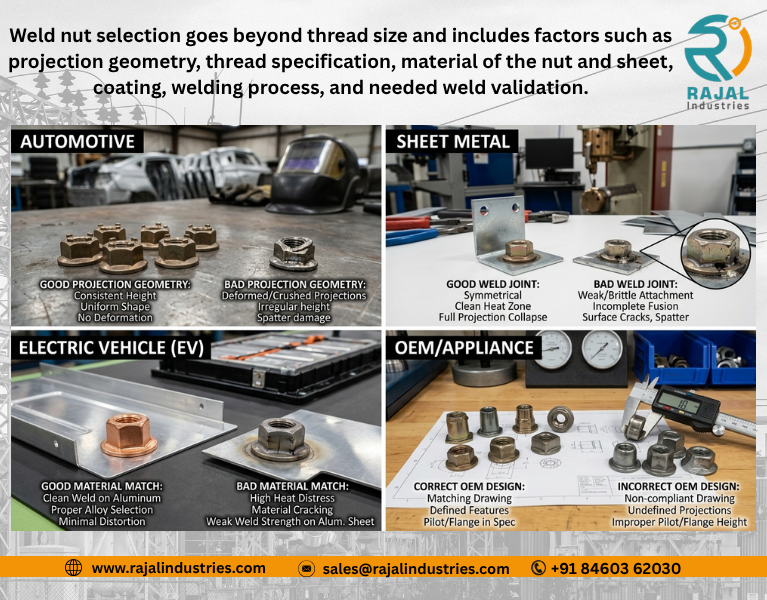
Choosing the right Weld Nut Manufacturer is important when an OEM needs a permanent threaded attachment point on sheet metal, brackets, stampings, panels or fabricated parts.
Weld nuts are widely used in automotive, EV, appliances, electrical equipment and sheet-metal assemblies because they can provide a captive internal thread directly on the component.
However, a weld nut should not be selected only by thread size.
Industrial buyers also need to consider:
Weld Nut Type → Thread → Projection Design → Sheet Thickness → Material → Welding Process → Property Requirement → Coating → Installation Access → Weld Validation
For high-volume OEM production, the quality of the weld interface can be just as important as the nut itself.
Rajal Industries can evaluate suitable standard and drawing-based weld nut requirements for OEM and industrial applications, subject to technical and manufacturing feasibility.
Quick Answer: What Should Buyers Look for in a Weld Nut Manufacturer?
A capable Weld Nut Manufacturer should understand the complete welded joint, not only nut dimensions. Buyers should confirm weld nut type, thread size and pitch, projection geometry, sheet material and thickness, nut material, coating condition, welding method, mating fastener and the required weld-performance testing before approving production.
What Is a Weld Nut?
A weld nut is a threaded nut designed to be permanently attached to another metal component by welding.
The nut is positioned on:
- Sheet metal
- Brackets
- Stampings
- Frames
- Panels
- Fabricated assemblies
and welded into place so that a bolt or screw can later be installed from the opposite side or accessible side.
Why OEMs Use Weld Nuts
Weld nuts are useful when the final assembly needs:
- A permanent threaded attachment point
- One-side bolt installation
- Faster assembly
- Reduced loose hardware
- Repeatable thread location
- High-volume manufacturing
- Integration into stamped or fabricated components
This makes them especially useful in automated OEM production.
Weld Nut vs Standard Hex Nut
A standard hex nut normally remains a separate loose fastener.
A weld nut is designed to become part of the component.
| Feature | Standard Hex Nut | Weld Nut |
| Internal Thread | Yes | Yes |
| Permanent Attachment to Sheet | No | Yes, after welding |
| Welding Feature | No | Yes |
| Captive After Installation | Normally no | Yes |
| Sheet Metal Integration | Limited | Strong |
| High-Volume OEM Assembly | Application dependent | Common use case |
Weld Nut vs Rivet Nut
Both can create a threaded attachment point in sheet metal, but the installation method is very different.
Weld Nut
Installed by welding.
Rivet Nut
Installed mechanically by deforming the rivet nut body in the hole.
A Weld Nut Manufacturer should not describe the two as interchangeable.
The correct choice depends on:
- Sheet material
- Access
- Production volume
- Welding capability
- Heat sensitivity
- Joint requirement
- Service conditions
Weld Nut vs Self-Clinching Nut
A self-clinching nut is pressed mechanically into suitable sheet metal.
A weld nut is attached by welding.
The differences include:
| Factor | Weld Nut | Self-Clinching Nut |
| Installation | Welding | Pressing |
| Heat Input | Yes | No |
| Sheet Preparation | Design dependent | Hole + suitable sheet |
| Production Equipment | Welding system | Press |
| Captive Thread | Yes | Yes |
| Application Selection | Weldable assembly | Clinch-compatible sheet |
Main Types of Weld Nuts
Industrial buyers may encounter several weld nut designs.
Common categories include:
- Projection weld nuts
- Hex weld nuts
- Square weld nuts
- Flange weld nuts
- Round weld nuts
- T-style weld nuts
- Custom drawing-based weld nuts
The correct type depends on the component design and welding process.
What Is a Projection Weld Nut?
A Projection Weld Nut includes raised projections designed to concentrate welding current and pressure at controlled points.
During resistance projection welding, these projections heat and collapse to form the welded attachment between the nut and sheet.
The projection geometry therefore has an important functional role.
Why Projection Geometry Matters
Projection dimensions and consistency can influence:
- Current concentration
- Heat generation
- Weld formation
- Nut position
- Welding consistency
- Strength of the welded attachment
Two nuts may have the same thread and overall size but behave differently during welding if the projection geometry differs.
Projection Weld Nut Manufacturing Quality
For a Projection Weld Nut, a supplier should control:
- Number of projections
- Projection position
- Projection height
- Projection geometry
- Base material
- Flatness
- Thread condition
- Overall dimensions
Projection variation can create unstable welding results.
Resistance Projection Welding Explained
Projection welding is a resistance welding process.
A simplified sequence is:
Nut Positioned → Electrode Force Applied → Current Flows → Projections Heat → Projections Collapse → Weld Forms
Actual welding parameters depend on:
- Nut geometry
- Sheet material
- Sheet thickness
- Coating
- Welding equipment
- Electrode condition
- OEM process window
There is no universal welding current or pressure suitable for every weld nut.
Weld Nut Types for Sheet Metal
Sheet Metal Nuts designed for welding can be used where a threaded attachment point is needed in relatively thin fabricated material.
Potential applications include:
- Automotive body components
- EV enclosures
- Appliance panels
- Electrical cabinets
- Machinery covers
- Fabricated brackets
- Sheet-metal frames
The sheet and nut should be designed as a system.
Hex Weld Nuts
Hex weld nuts provide a hexagonal external body together with weld projections or a weldable flange depending on the design.
Potential benefits include:
- Familiar geometry
- Tooling/positioning options
- Standardized product forms
- Suitable OEM production
The applicable standard or drawing should define the exact geometry.
Flange Weld Nuts
A flange can provide a larger interface area around the nut body.
Depending on the design, projections may be incorporated into or around the flange.
Important buyer considerations include:
- Flange diameter
- Projection design
- Sheet contact
- Clearance
- Weld process
- Surrounding geometry
Square Weld Nuts
Square weld nuts provide a square body geometry and may use multiple weld projections.
They can be useful in applications where the part design or welding fixture is designed around a square nut.
However, square and hex weld nuts should not be substituted purely because the thread is the same.
Round Weld Nuts
Round weld nuts can be used in particular stamping and fabrication designs.
The nut may use:
- Projections
- Flanges
- Locating features
- Customer-specific geometry
These should be selected according to the assembly design.
Standard Weld Nuts vs Custom Weld Nuts
Standard Weld Nut
Suitable when the OEM can use an existing standard geometry.
Custom Weld Nut
May be required when the application needs:
- Special projection geometry
- Special flange dimensions
- Custom nut height
- Special locating feature
- Customer-specific thread
- Special material
- Special coating
- High-volume automated welding compatibility
Custom production should follow an approved drawing.
Current ISO Standard for Hexagon Weld Nuts with Flange
A major international weld-nut standard is ISO 21670:2014, Fasteners — Hexagon weld nuts with flange.
ISO states that this standard covers hexagon weld nuts with flange, including metric coarse threads from M5 to M16 and specified fine-pitch sizes within its scope. The standard was reviewed and confirmed in 2024, so the 2014 edition remains current as of 2026. (ISO)
This is useful for buyers because older references may still point to the withdrawn 2003 edition. (ISO)
Important: ISO 21670:2003 Is Withdrawn
The first edition, ISO 21670:2003, has been withdrawn and replaced by ISO 21670:2014. (ISO)
If an old drawing still references the 2003 edition:
- Do not silently update it.
- Review the customer requirement.
- Compare the controlled dimensions.
- Obtain approval if a standard change is needed.
What ISO 21670 Covers
ISO 21670:2014 addresses hexagon weld nuts with flange.
Within its scope, ISO identifies:
- Metric coarse and specified fine-pitch threads
- Product grade A
- Steel weld nuts
- Defined mechanical and dimensional requirements
ISO also states that weld nuts conforming to the standard are suitable for use with bolts up to property class 10.9 under the conditions defined by the standard. (ISO)
For actual OEM design, final bolt/nut compatibility should still follow the customer specification.
Weld Nut Standards Buyers May Encounter
Depending on the product and customer, weld nuts may be specified through:
- ISO
- DIN
- Automotive OEM standards
- Customer drawings
- Internal company specifications
The exact drawing should control when it contains specific requirements.
Never Assume All Weld Nut Standards Are Equivalent
Two weld nuts can have the same thread size but differ in:
- Nut height
- Width
- Flange dimensions
- Projection geometry
- Projection count
- Locating features
- Mechanical properties
- Welding behaviour
Therefore:
Similar appearance does not prove interchangeability.
Weld Nut Thread Selection
The internal thread should match the mating bolt or screw.
Buyers should confirm:
Thread System + Diameter + Pitch + Tolerance
For example, “M8 weld nut” may still be incomplete if the drawing requires a specific pitch or thread tolerance.
Metric Weld Nuts
Common metric weld-nut requirements can include sizes such as:
- M5
- M6
- M8
- M10
- M12
- M16
depending on the selected product standard and design.
The exact available range depends on the weld nut type.
Coarse vs Fine Thread Weld Nuts
Metric weld nuts can use different thread pitches where permitted by the product specification.
Coarse Thread
Common for many general OEM applications.
Fine Thread
Used where specifically required by the design.
The nominal thread diameter alone does not establish compatibility.
Weld Nut Thread After Welding
An important OEM concern is whether the internal thread remains usable after welding.
Potential causes of post-weld thread problems can include:
- Heat distortion
- Weld spatter
- Misalignment
- Nut deformation
- Incorrect welding setup
Therefore, functional thread checks may be required after the welding process.
Pilot or Locating Features
Some weld nut designs can include geometry intended to help locate the nut relative to the sheet or hole.
This can help with:
- Positioning
- Fixture control
- Automation
- Hole alignment
The locating feature should match the sheet-metal design.
Weld Nut Hole Design
The sheet component may require:
- Clearance hole
- Pilot hole
- Locating hole
- Special stamped feature
The hole should be designed together with the weld nut.
Do not select the sheet hole using a generic online chart without confirming the actual nut design and standard.
Sheet Thickness and Weld Nut Selection
Sheet thickness can influence:
- Weld heat balance
- Projection collapse
- Distortion
- Required weld schedule
- Pull-out behaviour
- Component stiffness
A Weld Nut Supplier should therefore ask for sheet thickness during technical review.
Sheet Material and Weldability
The nut and sheet materials should be suitable for the intended welding process.
Important considerations include:
- Base metal
- Material strength
- Coating
- Surface cleanliness
- Sheet thickness
- Electrical resistance
- Welding process
A nut cannot be selected independently from the sheet material.
Weld Nut Materials
Common material directions may include:
- Low-carbon steel
- Other steel grades defined by standard or drawing
- Stainless steel for suitable applications
- Special customer-specified materials
Material selection should consider:
- Weldability
- Mechanical performance
- Corrosion
- Service environment
- Mating bolt
- OEM specification
Carbon Steel Weld Nuts
Carbon steel is widely used for Automotive Weld Nuts, appliance components and general sheet-metal assemblies.
Advantages can include:
- Good suitability for many resistance-welding processes
- High-volume production capability
- Compatibility with many steel sheet assemblies
The actual grade should follow the product standard or customer drawing.
Stainless Steel Weld Nuts
Stainless steel weld nuts can be considered where corrosion resistance or stainless assembly construction is required.
However, buyers should review:
- Stainless grade
- Sheet material
- Welding process
- Heat effects
- Surface condition
- Corrosion requirement
- Mating fastener
Do not specify stainless steel solely because it appears more corrosion resistant.
Weld Nut Material vs Sheet Material
A critical question is:
What is the nut being welded to?
Possible combinations require different engineering review.
Examples include:
- Steel nut to steel sheet
- Stainless nut to stainless sheet
- Different steel grades
- Coated sheet systems
Not every material combination behaves the same during welding.
Weld Nut Coatings
Surface finish selection requires special care because the nut must be welded.
Possible requirements may include:
- Bare/uncoated welding surface
- Weld-compatible coating
- Post-weld coating
- Customer-approved plated or treated condition
The welding process and coating strategy must be coordinated.
Why Coating Matters for Weld Nuts
A coating can influence:
- Electrical resistance
- Heat generation
- Weld consistency
- Electrode wear
- Fumes
- Surface contamination
- Corrosion performance
Therefore, the supplier should know whether the nut will be welded:
- Before coating
- After coating
- To coated sheet
- To bare sheet
Do Not Treat Weld Nut Coating Like a Standard Hex Nut
A finish that works well on a conventional nut may not automatically be suitable for a weld nut.
The coating strategy should consider:
Welding Process + Nut Material + Sheet Material + Corrosion Requirement
Weld Nut Dimensions Buyers Should Check
Important dimensions can include:
- Thread size
- Thread pitch
- Nut height
- Width across flats
- Flange diameter
- Flange thickness
- Projection height
- Projection location
- Pilot dimensions
- Hole relationship
- Bearing geometry
The applicable drawing or standard should define acceptance.
Projection Height Is a Functional Dimension
For a projection-welded nut, projection geometry is not merely cosmetic.
If projections are:
Too Small
Possible issues can include insufficient localized heating or inconsistent weld formation.
Too Large or Irregular
Possible issues can include unstable collapse, excessive indentation or poor positioning.
The actual acceptance limits should follow the controlled drawing or standard.
Flatness and Weld Nut Performance
If the nut or flange does not seat properly against the sheet before welding, the projections may not contact evenly.
This can lead to:
- Uneven current distribution
- Partial welding
- Nut tilt
- Variable weld strength
Flatness and projection consistency can therefore matter in automated welding.
Weld Nut Positioning
OEM applications often require tight positional control.
Possible issues include:
- Nut shifted from hole
- Nut rotated incorrectly
- Nut tilted
- Nut placed on wrong side
- Wrong nut used in fixture
Automated locating features and poka-yoke fixture design can help reduce these risks.
Welding Process Control
A strong weld nut system depends on both part quality and welding process quality.
Important process variables can include:
- Welding current
- Electrode force
- Weld time
- Electrode geometry
- Electrode wear
- Surface condition
- Projection geometry
- Sheet condition
No universal parameter set applies to every Projection Weld Nut.
Why Welding Parameters Should Not Come From a Generic Chart
An internet welding chart cannot account for every combination of:
- Nut size
- Projection geometry
- Material
- Sheet thickness
- Coating
- Machine
- Electrode
- Production rate
Final parameters should be developed and validated on the actual assembly.
Weld Nut Testing
Depending on the OEM application, testing may include:
- Thread inspection
- Dimensional inspection
- Weld push-out testing
- Weld torque testing
- Peel or destructive evaluation
- Visual weld assessment
- Macro-section examination
- Production-specific functional testing
The required test method should be defined by the customer or validated manufacturing plan.
Push-Out Testing
A push-out test evaluates the force required to separate the welded nut from the sheet in a specified direction.
It can help evaluate weld attachment performance.
However:
There is no single universal push-out value for every weld nut.
Acceptance depends on the nut, sheet and customer requirement.
Torque-Out Testing
Torque-out testing evaluates the resistance of the welded nut to rotation or failure under applied torque.
This can be particularly useful because a weld nut must resist rotation when the mating bolt is installed or removed.
Again, the acceptable value should come from:
- Customer drawing
- OEM specification
- Validated joint requirement
Push-Out vs Torque-Out Test
| Test | Evaluates |
| Push-Out | Resistance to separation from sheet |
| Torque-Out | Resistance to nut rotation/failure |
| Thread Gauge | Internal thread conformity |
| Dimensional Inspection | Geometry |
| Visual Weld Inspection | Surface/weld condition |
A complete validation plan may use more than one method.
Weld Nut Applications in Automotive
Automotive Weld Nuts are widely used where the vehicle or component requires a permanent threaded attachment point.
Potential areas can include:
- Body structures
- Brackets
- Seat-related assemblies
- Underbody components
- Interior structures
- Mounting points
- Sheet-metal modules
Final use always depends on OEM design.
Why Automotive OEMs Use Weld Nuts
Automotive production benefits from:
- Captive threads
- Automated welding
- Repeatable nut location
- High production speed
- Reduced loose hardware during final assembly
However, the process requires strong control because a poorly welded nut can become difficult to repair after body or component assembly progresses.
Automotive Weld Nut Quality Risks
Common risks include:
- Missing nut
- Wrong nut
- Mislocated nut
- Weak weld
- Thread spatter
- Thread distortion
- Projection inconsistency
- Nut rotation during bolt installation
These are both product and process-control concerns.
Weld Nuts for EV Applications
EV manufacturing can use weld nuts in:
- Battery-related structures
- Enclosures
- Brackets
- Body assemblies
- Frames
- Equipment mounts
- Electrical-system housings
However, applications near batteries or high-voltage systems may have additional customer-specific requirements.
Do not assume a general automotive weld nut is automatically approved for battery-critical assemblies.
Weld Nuts for Sheet Metal Fabrication
Sheet-metal manufacturers can use weld nuts where:
- Rear access is limited during final assembly
- Captive threads reduce handling
- Repetitive assembly is required
- Brackets need permanent threaded points
- Panels need removable covers
The nut can be welded during fabrication before painting or final assembly.
Weld Nuts for Appliances
Appliances can use weld nuts in:
- Frames
- Mounting brackets
- Panels
- Motor mounts
- Structural sheet-metal parts
- Internal assemblies
Important considerations can include:
- Sheet thickness
- Coating
- Appearance
- Production speed
- Corrosion protection
Weld Nuts for Electrical Equipment
Electrical equipment may use weld nuts in:
- Cabinets
- Enclosures
- Mounting panels
- Equipment frames
- Electrical boxes
- Support brackets
The design should consider:
- Corrosion protection
- Electrical requirements
- Paint/coating sequence
- Tool access
- Serviceability
Industries That Use Weld Nuts
Common industries include:
Automotive | EV | Sheet Metal | Appliances | Electrical Equipment | Machinery | Fabrication | Industrial Enclosures | Construction Equipment
Each industry can require a different weld nut geometry and validation plan.
Application Matrix
| Industry | Main Buyer Concern |
| Automotive | Weld consistency + automation |
| EV | Structure + controlled OEM requirements |
| Sheet Metal | Sheet thickness + weldability |
| Appliances | Production speed + consistency |
| Electrical Equipment | Coating + positioning |
| Machinery | Strength + serviceability |
| Fabrication | Ease of assembly + repeatability |
Weld Nut vs Loose Nut in OEM Assembly
A weld nut can reduce the need to hold a loose nut during final assembly.
This can improve:
- Accessibility
- Assembly speed
- Automation
- Worker handling
But it adds an earlier manufacturing operation:
Welding + Inspection
Therefore, OEMs should compare total process cost rather than only nut price.
Weld Nut vs Bolt-Welded Stud
Another alternative is a welded stud.
Weld Nut
Provides an internal thread.
Welded Stud
Provides an external thread.
The correct design depends on:
- Assembly direction
- Available space
- Service access
- Component design
- Automation strategy
Weld Nut vs Threaded Hole
A thicker component may sometimes be directly tapped.
Thin sheet often does not provide enough material for a conventional tapped thread.
A weld nut can add a dedicated threaded element without requiring a thick base plate.
The final selection should still follow the design requirement.
Weld Nut Manufacturing Process
A typical high-volume manufacturing route may include:
Raw Material → Forming → Hole Preparation → Threading → Projection/Flange Forming → Heat Treatment if Required → Surface Condition/Coating → Inspection → Packing
The actual route varies by product design.
Cold Forming for Weld Nuts
For suitable high-volume products, cold forming can provide:
- High production efficiency
- Repeatable geometry
- Material utilization
- Consistent nut bodies
Tooling design becomes important, especially where the weld projections are formed as part of the nut.
CNC or Machining for Special Weld Nuts
For low-volume, prototype or specialized geometry, machining may be evaluated where technically and commercially appropriate.
But machining is not automatically the preferred method for high-volume standard weld nuts.
The process should match:
- Quantity
- Geometry
- Material
- Cost target
- Functional requirement
Thread Manufacturing
The internal thread may be formed using a process suitable for the nut design and specification.
The final thread should meet:
- Diameter
- Pitch
- Tolerance
- Functional fit
- Post-welding requirements
Thread Protection During Welding
Weld spatter or heat effects can interfere with the internal thread.
OEM process design may need:
- Controlled weld settings
- Appropriate fixture/electrode design
- Spatter control
- Post-weld inspection
Thread functionality should be verified after welding where required.
Weld Nut Quality Inspection
A robust inspection plan can include:
Incoming Material
- Material verification
- Lot identification
In-Process
- Projection geometry
- Nut dimensions
- Thread
Final Part
- Thread gauge
- External dimensions
- Projection dimensions
- Visual condition
- Coating/surface condition
Weld Validation
Performed on the actual nut-sheet assembly as required.
Why Nut Inspection Alone Cannot Guarantee Weld Quality
A perfectly manufactured weld nut can still produce a poor joint if:
- Welding current is wrong
- Electrode force is wrong
- Sheet is contaminated
- Electrodes are worn
- Sheet coating changes
- Nut is mispositioned
Therefore:
Weld nut quality + welding process quality = final joint quality
What Buyers Should Send to a Weld Nut Manufacturer
For a meaningful quotation, provide:
- Weld nut drawing
- Product standard
- Thread size
- Pitch
- Nut type
- Projection geometry
- Material
- Mechanical requirement
- Finish/coating
- Mating bolt
- Sheet material
- Sheet thickness
- Sheet coating
- Welding method
- Required tests
- Quantity
- Annual demand
This reduces assumptions.
Poor Weld Nut RFQ Example
Need M8 weld nut. Qty 200,000 pcs. Send best price.
This leaves important questions unanswered.
Better Weld Nut RFQ Example
We require M8 projection weld nuts for an automotive sheet-metal assembly. Please quote as per attached drawing and confirm thread specification, nut material, projection geometry, finish, applicable standard, sample lead time, tooling if required, dimensional inspection and annual-volume pricing. Sheet material and welding details can be shared for technical review.
This provides a much stronger starting point.
OEM Weld Nut RFQ Checklist
| Parameter | Buyer Should Specify |
| Weld Nut Type | Projection / flange / square / custom |
| Thread | Metric / inch |
| Size | M6, M8, M10 etc. |
| Pitch | Exact requirement |
| Standard | ISO / drawing / OEM spec |
| Material | Exact requirement |
| Mechanical Requirement | As specified |
| Projection Geometry | Drawing controlled |
| Finish | Weld-compatible requirement |
| Sheet Material | Required |
| Sheet Thickness | Required |
| Sheet Coating | If applicable |
| Welding Method | Resistance projection etc. |
| Weld Test | Push-out / torque-out / specified method |
| Quantity | Order requirement |
| Annual Volume | OEM forecast |
| Documentation | Defined requirement |
Questions to Ask a Weld Nut Supplier
Before approving a Weld Nut Supplier, ask:
- Are you the direct manufacturer?
- Which weld nut designs do you produce?
- Can you manufacture projection weld nuts?
- Which thread sizes can you produce?
- Which standards can you manufacture against?
- How are projections formed and inspected?
- Can custom projection geometry be produced?
- Which materials can be supplied?
- How are internal threads inspected?
- Can you provide dimensional reports?
- Can you support OEM samples?
- Can you support weld trials with the customer’s sheet?
- What is the MOQ?
- Is tooling required?
- What is the sample lead time?
- What is mass-production capacity?
Weld Nut Supplier Comparison
| Requirement | Supplier A | Supplier B | Supplier C |
| Direct Manufacturer | |||
| Projection Weld Nut Capability | |||
| Standard/Drawing Capability | |||
| Thread Inspection | |||
| Projection Inspection | |||
| Material Control | |||
| OEM Sample Support | |||
| Weld Trial Support | |||
| Traceability | |||
| Capacity | |||
| Lead Time | |||
| Price |
Common Weld Nut Buying Mistakes
Avoid:
- Ordering only by thread size.
- Ignoring projection geometry.
- Ignoring sheet thickness.
- Ignoring sheet material.
- Ignoring sheet coating.
- Assuming every weld nut uses the same welding parameters.
- Comparing hex and square weld nuts as identical.
- Ignoring post-weld thread condition.
- Selecting coating without considering welding.
- Testing the nut but not the welded assembly.
- Using generic push-out values from the internet.
- Using generic weld current charts as final process settings.
- Substituting a similar weld nut without approval.
- Ignoring automated positioning requirements.
- Comparing supplier prices before confirming equal specifications.
What Is a Projection Weld Nut?
A Projection Weld Nut is a threaded nut with raised projections designed to concentrate electrical resistance and heat during projection welding. Under controlled current and electrode force, the projections collapse and form the welded attachment between the nut and sheet-metal component.
Why Are Weld Nuts Used in Sheet Metal?
Weld nuts create a permanent captive thread on sheet-metal parts where a conventional tapped thread may not be practical. They can improve assembly access, reduce loose hardware and support automated production in automotive, appliances, electrical equipment and other OEM assemblies.
What Is the Difference Between a Weld Nut and a Rivet Nut?
A weld nut is attached to the parent metal by welding, while a rivet nut is mechanically installed by deforming its body in a prepared hole. Weld nuts are common in weldable high-volume assemblies, while rivet nuts can be useful where welding is unavailable or undesirable.
What Standard Covers Hexagon Weld Nuts With Flange?
ISO 21670:2014 covers hexagon weld nuts with flange within its specified thread and product scope. ISO reviewed and confirmed the standard in 2024, so the 2014 edition remains current as of 2026. (ISO)
Does a Weld Nut Need Special Testing?
The nut itself may require dimensional, thread, material and mechanical inspection, while the welded assembly can require additional validation such as torque-out, push-out or customer-specific weld testing. The exact tests and acceptance limits should follow the OEM drawing or validated process specification.
Can Rajal Industries Manufacture Weld Nuts?
Rajal Industries can evaluate suitable standard and customer drawing-based Projection Weld Nut, hex weld nut and other Sheet Metal Nuts for OEM applications, subject to technical and manufacturing feasibility.
For evaluation, provide:
Drawing + Thread + Material + Projection Geometry + Finish + Sheet Details + Quantity + Testing Requirement
Frequently Asked Questions About Weld Nuts
1. What is a weld nut?
A weld nut is a threaded nut designed to be permanently attached to another metal component by welding.
2. What is a projection weld nut?
It is a weld nut with raised projections that concentrate heat and pressure during resistance projection welding.
3. What industries use weld nuts?
Major users include automotive, EV, appliances, electrical equipment, sheet-metal fabrication and machinery.
4. Can a weld nut replace a rivet nut?
Sometimes, but not automatically. Their installation methods and design requirements are different.
5. Can weld nuts be used on coated sheet?
Potentially yes, but the sheet coating can affect welding behaviour and should be included in process validation.
6. Does sheet thickness affect weld nut performance?
Yes. Sheet thickness influences heat balance, deformation, weld formation and attachment performance.
7. Can welding damage the nut thread?
Improper heat input, distortion, spatter or misalignment can affect thread functionality.
8. How is weld nut strength tested?
Depending on the application, testing can include torque-out, push-out, destructive weld examination and other customer-defined methods.
9. Is projection height important?
Yes. Projection geometry affects electrical and mechanical contact during welding and should be controlled by the drawing or product specification.
10. Can a standard hex nut be used as a weld nut?
A normal hex nut should not be assumed suitable for projection welding. A weld nut is specifically designed for welded attachment.
11. Should weld nuts be coated before welding?
That depends on the nut, coating, welding process and corrosion strategy. Use an approved weld-compatible process.
12. Can Rajal Industries develop custom weld nuts?
Rajal Industries can evaluate standard and drawing-based custom weld nut requirements, subject to technical feasibility, tooling, volume and customer specifications.
Final Weld Nut Buyer Checklist
Before approving a Weld Nut Manufacturer, confirm:
☐ Weld nut type
☐ Projection weld nut / other design
☐ Metric or inch thread
☐ Nominal size
☐ Thread pitch
☐ Product standard
☐ Customer drawing revision
☐ Nut material
☐ Mechanical requirement
☐ Projection geometry
☐ Nut flatness
☐ Pilot/location feature
☐ Surface treatment
☐ Parent sheet material
☐ Sheet thickness
☐ Sheet coating
☐ Welding process
☐ Final assembly coating
☐ Mating bolt
☐ Torque-out requirement
☐ Push-out requirement
☐ Post-weld thread requirement
☐ Feeding/automation requirement
☐ Traceability
☐ Inspection documents
☐ PPAP if applicable
☐ Packaging
☐ Quantity
☐ Annual demand
Conclusion: Weld Nut Selection Must Consider the Complete Welded Joint
Choosing a Weld Nut Manufacturer involves much more than finding a supplier for an M6, M8 or M10 threaded nut.
The buyer should evaluate:
Weld Nut Design → Thread → Projection Geometry → Sheet Material → Sheet Thickness → Surface Condition → Welding Process → Weld Testing → Final Assembly
For automotive, EV, appliances, electrical equipment and other high-volume sheet-metal applications, consistent projection geometry and controlled manufacturing are especially important because the nut and welding process work together.
A technically correct nut can still fail if the welding process is unsuitable, while a stable weld process cannot compensate for an out-of-specification nut.
Rajal Industries can evaluate suitable standard and drawing-based Projection Weld Nut, Automotive Weld Nuts and other welded Sheet Metal Nuts, subject to technical and manufacturing feasibility.