

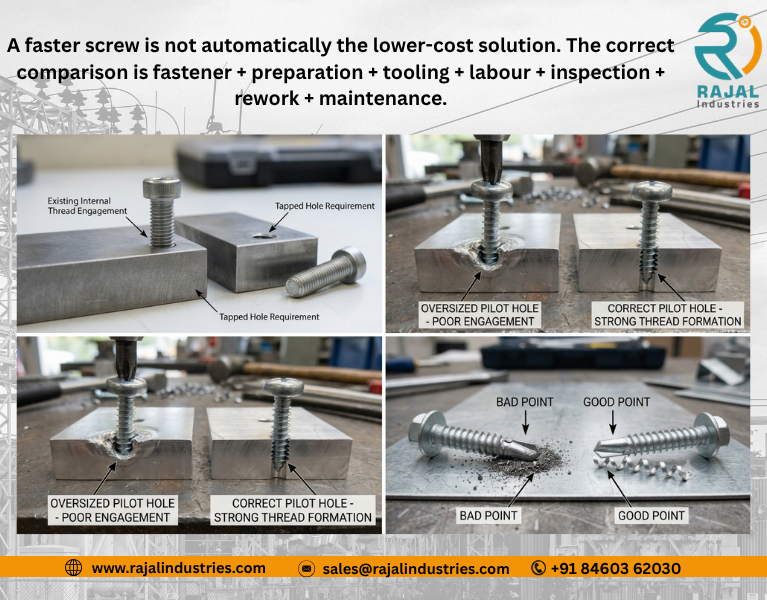
The difference between a Machine Screw vs Self Tapping Screw starts with how each fastener engages the mating component.
A machine screw normally engages an existing internal thread, such as a tapped hole, threaded nut or insert. A self-tapping screw creates or forms its mating thread in a suitable prepared hole. A Self Drilling Screw can drill its own pilot hole in suitable material and then form or engage the thread during installation.
For OEM buyers, the choice should not be based only on which screw installs fastest.
Use:
Assembly Material → Joint Design → Hole Preparation → Thread Requirement → Installation Process → Service Requirement → Production Volume → Validation
This Industrial Screw Comparison explains where each screw type fits and what OEM engineers and procurement teams should verify before approval.
Quick Answer: Machine Screw vs Self Tapping Screw vs Self Drilling Screw
A machine screw generally requires an existing internal thread, a self-tapping screw creates or forms a mating thread in a suitable pre-made hole, and a self-drilling screw combines drilling and fastening in suitable materials. OEM buyers should choose based on substrate, joint design, assembly process, serviceability and required installation control.
The Main Difference in One Table
| Feature | Machine Screw | Self-Tapping Screw | Self-Drilling Screw |
| Existing Internal Thread | Normally required | Usually not | Usually not |
| Pre-Made Hole | Application dependent | Normally yes | Can be eliminated in suitable applications |
| Creates Mating Thread | No | Yes | Yes |
| Drilling Point | No | Usually no | Yes |
| Nut/Insert Possible | Yes | Usually not required | Usually not required |
| Repeated Removal | Often stronger direction | Application dependent | Application dependent |
| Assembly Steps | More preparation possible | Reduced | Can be further reduced |
| Sheet Metal Use | With suitable mating thread | Strong application | Strong application |
| Thick/Threaded Components | Strong | Application dependent | Application dependent |
| Installation Tool | Driver/tool | Driver/tool | Driver/tool |
These are general distinctions. Exact behaviour depends on the screw design, substrate and joint.
The Simplest Way to Understand the Three Screws
Think about the hole before installation.
Machine Screw
Existing Thread → Insert Screw → Tighten
Self-Tapping Screw
Prepared Hole → Screw Creates/Forms Thread → Tighten
Self-Drilling Screw
Screw Drills Hole → Creates/Engages Thread → Tighten
That difference changes:
- Component preparation
- Assembly time
- Tooling
- Joint design
- Serviceability
- Cost structure
- Quality control
Machine Screw vs Self Tapping Screw: Core Difference
The core Machine Screw vs Self Tapping Screw distinction is the mating thread.
A machine screw normally requires a mating internal thread before the screw is installed.
That thread may be in:
- Tapped component
- Nut
- Weld nut
- Clinch nut
- Threaded insert
- Threaded boss
- Other engineered threaded feature
A self-tapping screw is designed to create or form its mating thread in a suitable hole during installation.
What Is a Machine Screw?
A machine screw is a threaded fastener designed to engage a compatible internal thread.
Typical applications can include:
- Electrical panels
- Switchgear
- Electronics
- Transformers
- Machinery
- Instrumentation
- Enclosures
- Appliances
- Automotive assemblies
- Industrial equipment
Typical Machine Screw Joint
A basic assembly can look like:
Machine Screw → Component → Tapped Hole
or:
Machine Screw → Components → Nut
or:
Machine Screw → Panel → Threaded Insert
Why OEMs Choose Machine Screws
Machine screws are strong candidates where the OEM needs:
- Defined mating threads
- Repeated disassembly
- Replaceable fasteners
- Thread standards
- Nuts or inserts
- More controlled threaded joints
- Serviceable assemblies
This does not mean machine screws are automatically better. They solve a different assembly requirement.
Machine Screw Advantages
Potential advantages include:
- Compatible with engineered internal threads
- Wide variety of thread systems
- Suitable for repeated service in appropriate mating threads
- Broad head and drive options
- Can use nuts and threaded inserts
- Useful across many equipment materials
Machine Screw Limitations
Potential limitations can include:
- Tapped hole, nut or insert may be required
- Additional component preparation
- Additional assembly operations
- Potentially more parts
- Cross-threading risk during assembly
- Insert/nut cost where required
What Is a Self-Tapping Screw?
A self-tapping screw creates or forms a mating thread as it is driven into a suitable prepared hole.
This can reduce the need for a separately tapped internal thread.
Typical Self-Tapping Joint
Prepared Hole → Self-Tapping Screw → Thread Creation/Formation → Tightening
The prepared hole is critical.
Its:
- Diameter
- Material
- Thickness
- Geometry
can directly affect installation and joint performance.
Why OEMs Choose Self-Tapping Screws
Potential reasons include:
- Fewer thread-preparation operations
- No separate nut in suitable assemblies
- Faster assembly
- Lower component count
- Suitability for sheet-metal and other engineered applications
- Automated or high-volume assembly potential
Self-Tapping Does Not Mean “Works in Everything”
A self-tapping screw should be matched to:
- Substrate
- Material thickness
- Hole diameter
- Screw thread form
- Installation process
A screw suitable for thin steel may not be suitable for aluminium, plastic or another substrate without engineering review.
Thread-Cutting vs Thread-Forming Concepts
The term self-tapping can cover different thread-generation concepts.
Thread-Cutting Type
Designed to cut material while creating the mating thread.
Thread-Forming Type
Designed to displace/form the mating material rather than primarily cutting it.
The correct choice depends on:
- Material
- Hole
- Assembly
- Required thread
- Installation characteristics
Do not treat all self-tapping screws as technically identical.
What Is a Self Drilling Screw?
A Self Drilling Screw has a drilling point designed to create a hole in suitable material during installation.
It can combine:
Drilling + Thread Creation/Engagement + Fastening
in one installation operation.
Typical Self-Drilling Joint
Material → Drill Point Penetrates → Hole Created → Thread Engages → Joint Tightens
This can remove a separate pre-drilling operation in suitable applications.
Why OEMs Choose Self-Drilling Screws
Potential reasons include:
- Reduced pre-drilling
- Faster installation
- Fewer assembly operations
- Suitable sheet-to-sheet fastening
- Suitable metal-to-metal applications
- Construction and fabrication productivity
Common Self Drilling Screw Applications
Suitable applications can include:
- Roofing
- Cladding
- PEB structures
- Sheet-metal assemblies
- HVAC
- Steel fabrication
- Solar-related assemblies
- Electrical enclosures
- Industrial equipment
The exact screw must match the material stack and application.
Self-Drilling Does Not Mean Unlimited Drilling Capacity
Every drill-point design has practical application limits.
Selection depends on factors such as:
- Material type
- Material hardness
- Total drilling thickness
- Screw diameter
- Drill-point geometry
- Installation speed
- Driver setup
Therefore:
Never select a Self Drilling Screw only because the point looks like a drill.
Pre-Drilling Requirement Comparison
| Screw Type | Typical Hole Preparation |
| Machine Screw into Tapped Hole | Drill + tap or prepared threaded feature |
| Machine Screw with Nut | Clearance hole |
| Machine Screw with Insert | Hole + insert installation |
| Self-Tapping Screw | Suitable pilot/prepared hole |
| Self-Drilling Screw | Can drill its own hole in suitable applications |
This is one of the biggest differences affecting production cost and assembly time.
Machine Screw Assembly Process
A tapped-hole production sequence may include:
Drill Hole → Tap Thread → Clean/Inspect → Position Components → Install Machine Screw
For a nut-based assembly:
Create Clearance Hole → Position Components → Install Screw + Nut → Tighten
Self-Tapping Screw Assembly Process
A typical process can be:
Create Pilot Hole → Position Components → Drive Self-Tapping Screw → Thread Forms/Cuts → Tighten
This can eliminate a separate tapping operation.
Self-Drilling Screw Assembly Process
A typical process can be:
Position Components → Drive Self-Drilling Screw → Drill → Thread → Tighten
In suitable applications, this can remove both separate drilling and tapping operations.
Which Screw Has the Fastest Assembly?
There is no universal answer, but self-drilling screws can reduce preparation steps where their drilling capability matches the material stack.
However, OEMs should compare the complete process:
Part Preparation + Fastener Installation + Tooling + Inspection + Rework + Service
not only driver time.
Assembly-Step Comparison
| Process | Machine Screw | Self-Tapping | Self-Drilling |
| Separate Drilling | Often | Usually | Can be eliminated |
| Separate Tapping | Often for tapped hole | No | No |
| Nut/Insert | Sometimes | Usually no | Usually no |
| Thread Created During Installation | No | Yes | Yes |
| Hole Created During Installation | No | No | Yes |
| Final Tightening | Yes | Yes | Yes |
OEM Selection Rule #1: Start with the Substrate
Before selecting any of these OEM Fasteners, define the material being fastened.
Examples:
- Carbon steel
- Stainless steel
- Aluminium
- Plastic
- Composite
- Cast component
- Sheet metal
- Structural section
The substrate can immediately eliminate unsuitable screw options.
Thin Sheet Metal
Thin sheet often cannot provide the same internal thread engagement as a thick tapped component.
Possible approaches can include:
- Self-tapping screw
- Self-drilling screw
- Machine screw + nut
- Machine screw + threaded insert
- Machine screw + formed/threaded feature
The best solution depends on the assembly.
Thick Metal Component
Where enough material exists for a suitable tapped hole, a machine screw may provide a strong serviceable solution.
But tapping adds manufacturing operations.
OEMs should compare:
Threaded Component Cost + Assembly Requirement + Serviceability
Plastic Components
Self-tapping/thread-forming concepts can be used in suitable engineered plastic assemblies.
However, screw geometry, pilot hole, boss design and plastic material need to be considered together.
Do not use a generic sheet-metal self-tapping screw in plastic without validation.
Aluminium Components
Aluminium can be used with different fastening approaches depending on the design:
- Machine screw into tapped aluminium
- Machine screw into insert
- Suitable thread-forming/tapping screw
- Other engineered fastening system
Repeated service and thread wear deserve attention.
Stainless Steel Sheet
Self-tapping or self-drilling into stainless can require careful review because substrate hardness and drilling/thread-forming conditions can differ significantly from mild steel.
The screw material, point, drill capacity and installation process must be compatible.
OEM Selection Rule #2: Define Material Thickness
Thickness affects:
- Thread engagement
- Drill-point selection
- Pilot-hole requirement
- Pull-out behaviour
- Installation
- Joint stability
A screw selected for 1 mm sheet should not automatically be used for a much thicker stack.
Material Stack-Up
For two-sheet fastening, define:
Top Sheet Thickness + Bottom Sheet Thickness + Gap if Any + Total Drilling Thickness
For self-drilling screws, the drill point must penetrate the relevant stack before proper thread engagement and clamping occur.
Self-Drilling Point Length Matters
The drilling portion needs sufficient clearance through the material stack for the drilling action to complete before full thread engagement.
This is why total drilling thickness is a key RFQ input.
OEM Selection Rule #3: Define Joint Function
Ask what the screw actually needs to do.
Possible functions include:
- Hold a cover
- Join two sheets
- Mount a bracket
- Attach a panel
- Retain an enclosure component
- Join structural/light structural members where designed
- Secure equipment hardware
- Support repeated service
Joint Function Matrix
| Joint Requirement | Strong Candidate Direction |
| Repeated Service | Machine Screw |
| Permanent/Low-Service Sheet Assembly | Self-Tapping / Self-Drilling |
| No Pre-Drilling Desired | Self-Drilling |
| Existing Tapped Hole | Machine Screw |
| Existing Nut/Insert | Machine Screw |
| Prepared Pilot Hole | Self-Tapping |
| Metal-to-Metal Field Installation | Self-Drilling can be strong |
| Plastic Boss | Suitable plastic-specific tapping/forming screw |
| Controlled Threaded Interface | Machine Screw often strong |
These are selection directions, not universal rules.
OEM Selection Rule #4: Consider Repeated Disassembly
This is a major difference.
A machine screw engaging a suitable durable internal thread can often support repeated removal and reinstallation more naturally.
A self-tapping screw relies on the thread created in the substrate.
Repeated removal can affect that formed/cut thread depending on:
- Substrate
- Thickness
- Material
- Thread design
- Installation
- Number of cycles
Serviceability Comparison
| Service Requirement | Machine Screw | Self-Tapping | Self-Drilling |
| Frequent Removal | Strong | Review carefully | Review carefully |
| Occasional Removal | Strong | Possible | Possible |
| Permanent Assembly | Suitable | Strong | Strong |
| Replaceable Nut/Insert | Possible | Usually no | Usually no |
| Thread Repair Options | Multiple | Substrate dependent | Substrate dependent |
Does Self-Tapping Mean Single Use?
Not automatically.
Some self-tapping assemblies can be removed and reinstalled.
But the OEM should not assume unlimited reuse.
Repeated-use capability depends on the complete joint and should be validated if servicing is expected.
Does Self-Drilling Mean Single Use?
Again, not automatically.
However, after the initial hole and thread are created, subsequent reinstallation no longer uses the drill point in the same way.
The integrity of the existing substrate thread becomes important.
OEM Selection Rule #5: Consider Assembly Speed
For high-volume production, seconds matter.
Compare:
Machine Screw
Hole Preparation + Tapping/Insert/Nut + Installation
Self-Tapping Screw
Pilot Hole + Installation
Self-Drilling Screw
Position + Drill/Fasten
This can make self-tapping or self-drilling attractive for suitable production systems.
But Fast Installation Is Not the Same as Lowest Total Cost
The real cost is:
Fastener + Hole Preparation + Nut/Insert + Tooling + Labour + Cycle Time + Inspection + Rework + Maintenance
An inexpensive screw can create an expensive assembly process.
Total Installed Cost
OEM buyers should compare total installed cost, not only price per 1,000 screws.
| Cost Element | Machine | Self-Tapping | Self-Drilling |
| Screw Cost | Compare | Compare | Compare |
| Drilling | Possible | Usually required | Potentially eliminated |
| Tapping | Possible | No | No |
| Nut/Insert | Possible | Usually no | Usually no |
| Installation Time | Compare | Often reduced | Often reduced |
| Tool Wear | Compare | Compare | Drill-point/driver dependent |
| Rework | Application dependent | Application dependent | Application dependent |
| Service Cost | Often favourable | Review | Review |
OEM Selection Rule #6: Consider Installation Equipment
The same screw can behave differently under different installation conditions.
Review:
- Driver type
- RPM
- Torque control
- Axial force
- Bit/socket
- Automation
- Operator consistency
- Access angle
Installation RPM Matters
For self-drilling and self-tapping applications, installation speed can influence:
- Heat
- Drilling performance
- Thread formation
- Tool life
- Fastener performance
The appropriate installation parameters should follow the validated screw/application system.
Do Not Use One Universal Torque Value
Torque depends on:
- Screw size
- Thread
- Material
- Substrate
- Thickness
- Finish
- Joint
- Driver
- Application
Therefore:
A generic internet torque chart should not replace OEM joint validation.
Driving Torque vs Final Tightening
For a self-tapping screw, the driver may experience different stages:
Entry → Thread Formation/Cutting → Seating → Tightening
For a self-drilling screw:
Drilling → Thread Engagement → Seating → Tightening
These stages matter when setting automated assembly equipment.
Installation Window
For production assembly, engineers may need a workable difference between:
Torque Required to Install
and
Torque That Damages/Strips the Joint
A robust application should have sufficient process margin.
The acceptable values must be established through testing of the actual joint.
Common Failure: Stripped Thread
A self-tapping joint can strip if the created substrate thread cannot support the installation or service condition.
Possible contributors include:
- Wrong pilot hole
- Insufficient material thickness
- Wrong screw geometry
- Excessive tightening
- Damaged substrate
- Repeated installation
Common Failure: Screw Does Not Tap Correctly
Possible areas to investigate:
Pilot Hole → Substrate → Screw Thread Form → Hardness → Driver Setup → Alignment
Do not automatically classify the screw as defective before reviewing the complete application.
Common Failure: Self-Drilling Screw Will Not Drill
Check:
- Drill point
- Material hardness
- Total drilling thickness
- Installation speed
- Axial pressure
- Driver power
- Screw/application compatibility
Common Failure: Drill Point Burns
Excessive heat can damage drilling performance.
Review:
RPM + Axial Force + Material + Drill Point + Thickness
The correct installation window should be validated for the actual application.
Common Failure: Screw Spins Without Tightening
Possible causes include:
- Stripped substrate thread
- Oversized pilot hole
- Insufficient engagement
- Excessive installation torque
- Wrong screw/thread design
- Damaged hole
Common Failure: Machine Screw Cross-Threads
Check:
- Thread compatibility
- Alignment
- Starting method
- Thread damage
- Mating-thread condition
- Assembly automation
A machine screw requires correct engagement with the existing thread.
Machine Screw vs Self Tapping Screw for Electrical Panels
Electrical panels can use several fastening approaches depending on the component.
Machine Screw
Strong candidate for:
- Threaded components
- Nuts
- Inserts
- Frequently serviced parts
- Equipment requiring defined reusable threads
Self-Tapping Screw
Strong candidate for suitable:
- Sheet-metal covers
- Brackets
- Internal components
- Production assemblies
Self-Drilling Screw
Can be useful where:
- Suitable sheet/metal stack exists
- Pre-drilling elimination provides value
- Drill-point capability matches the application
Machine Screw vs Self Tapping Screw for Electronics
Electronics equipment often values:
- Compactness
- Serviceability
- Repeatable assembly
- Controlled internal projection
Machine screws are common where durable threaded inserts, bosses or nuts are available.
Self-tapping concepts can be useful in suitable sheet-metal or plastic components.
Self Drilling Screw for HVAC
A Self Drilling Screw can be a strong candidate for suitable:
- Ductwork
- Sheet-metal assemblies
- Equipment housings
- Brackets
because drilling and fastening can occur in one operation.
The screw still needs to match material and thickness.
Self Drilling Screw for Roofing and Cladding
Roofing and cladding are common self-drilling applications.
Selection can additionally involve:
- Washer/sealing system
- Corrosion environment
- Sheet thickness
- Supporting member thickness
- Drill capacity
- Head style
- Installation control
The fastener and sealing system should be selected as an assembly.
Self Drilling Screw for PEB Structures
PEB applications can include fastening:
- Roofing sheets
- Wall cladding
- Secondary components
- Suitable metal accessories
Do not automatically use a generic self-drilling screw for every PEB connection.
Structural connection requirements may call for entirely different fastener systems.
Self Drilling Screw for Solar Applications
Suitable solar-related uses can include:
- Sheet-metal accessories
- Enclosures
- Cable-management components
- Suitable light-gauge metal assemblies
The fastener should not automatically be used for primary structural solar connections without the required engineering design and approval.
Machine Screw vs Self Tapping Screw for Automotive Assemblies
Automotive assemblies can use both depending on:
- Component material
- Service requirements
- Assembly speed
- Automation
- Weight
- Thread strategy
- OEM specification
A high-volume automotive application should follow the approved joint and validated production process rather than a generic screw category recommendation.
Machine Screw vs Self Tapping Screw for Appliances
Appliances may use:
Machine Screws
For:
- Motors
- Threaded brackets
- Serviceable components
- Inserts
Self-Tapping Screws
For:
- Sheet-metal panels
- Plastic housings where suitable
- Internal brackets
- Production assemblies
Self-Drilling Screws
For suitable metal assemblies where drilling during installation provides an advantage.
Industrial Screw Comparison by Application
| Application | Machine Screw | Self-Tapping | Self-Drilling |
| Tapped Machinery Component | Excellent | Usually unnecessary | Usually unnecessary |
| Electrical Panel | Strong | Strong | Application dependent |
| Electronics Enclosure | Strong | Strong | Application dependent |
| Thin Sheet Metal | With nut/insert | Strong | Strong |
| Plastic Boss | With insert/tapped design | Strong with suitable design | Usually not primary |
| HVAC Sheet Metal | Possible | Strong | Strong |
| Roofing | Limited/specialized | Possible | Strong |
| PEB Cladding | Limited | Possible | Strong |
| Instrumentation | Strong | Application dependent | Limited |
| Frequently Serviced Equipment | Strong | Review | Review |
| High-Speed Sheet Assembly | Possible | Strong | Strong |
Which Screw Is Stronger?
There is no correct universal answer.
Strength depends on the complete joint:
Screw Material + Diameter + Thread + Substrate + Engagement + Thickness + Head + Installation + Load Direction
A machine screw is not automatically stronger than a self-tapping screw, and a self-drilling screw is not automatically weaker.
Screw Strength vs Joint Strength
These are different.
A high-strength screw can still produce a weak joint if:
- Substrate is too thin
- Thread strips
- Hole is oversized
- Engagement is insufficient
- Sheet deforms
OEM engineers should evaluate the joint, not only the fastener material.
Pull-Out vs Shear
Two important loading concepts are:
Pull-Out
Load tends to pull the screw out of the mating material.
Shear
Load acts across the fastener/joint.
The relevant performance depends on actual joint geometry and loading.
Do not use a generic pull-out value across different sheet materials and thicknesses.
Head Style Matters Too
After choosing the screw category, OEM buyers still need to choose a suitable head.
Possible options can include:
- Pan head
- Countersunk/flat head
- Button head
- Hex head
- Hex washer/flange head
- Other OEM-specific heads
Pan Head
Can be useful where:
- Low-to-moderate projection is acceptable
- Broad bearing area is useful
- Common tool drives are required
Countersunk Head
Can provide a flush surface where the mating component is properly designed for the countersunk geometry.
Do not use a countersunk screw in an unsuitable flat hole.
Hex / Hex Washer Head
Can provide:
- External wrench/socket drive
- Larger bearing area in suitable designs
- Strong assembly-tool access
Common in many self-tapping and self-drilling applications.
Drive Selection
Potential drives include:
- Slotted
- Phillips
- Pozidriv-type where specified
- Hex
- Hex socket
- Torx-type
- Customer-specific
Drive selection should consider:
Installation Torque + Tool Engagement + Automation + Access + Service
Material Selection
After screw type is selected, define the material.
Possible directions include:
- Carbon steel
- Suitable alloy steel
- Stainless steel
- Customer-specified materials
Do not specify only:
“Steel screw.”
Finish Selection
Possible systems depend on application and material.
Selection should consider:
- Corrosion environment
- Appearance
- Installation
- Friction
- Thread fit
- Customer specifications
Avoid incomplete descriptions such as:
“Silver finish.”
or
“Rust-proof.”
Corrosion Environment
Ask whether the screw will experience:
- Indoor humidity
- Outdoor exposure
- Condensation
- Chemicals
- Chlorides
- Repeated washing
- Temperature cycles
Material and finish should follow actual exposure.
OEM Fastener Selection Matrix
| Question | If Yes | Likely Direction |
| Existing tapped thread? | Yes | Machine Screw |
| Nut/insert already used? | Yes | Machine Screw |
| Need repeated servicing? | Yes | Machine Screw often strong |
| Pilot hole available? | Yes | Self-Tapping can be evaluated |
| Want to eliminate tapping? | Yes | Self-Tapping |
| Want to eliminate pre-drilling? | Yes | Self-Drilling |
| Thin sheet assembly? | Yes | Self-Tapping/Self-Drilling strong candidates |
| Plastic boss? | Yes | Suitable tapping/forming screw |
| Roofing/cladding? | Yes | Self-Drilling often strong |
| Controlled reusable thread? | Yes | Machine Screw often strong |
| Restricted structural connection? | Yes | Follow approved structural design |
The Wrong Way to Select
Do not use:
Fastest Screw → Cheapest Price → Production
Instead use:
Joint Requirement → Substrate → Hole → Thread → Screw → Installation → Testing → Cost
The Right OEM Selection Process
Step 1
Define the application.
Step 2
Identify substrate and thickness.
Step 3
Define joint function and loading.
Step 4
Decide whether a pre-existing internal thread is practical.
Step 5
Determine service/removal frequency.
Step 6
Compare assembly preparation.
Step 7
Select screw category.
Step 8
Select thread, diameter, length, head and drive.
Step 9
Select material and finish.
Step 10
Define installation process.
Step 11
Test actual joint.
Step 12
Compare total installed cost.
Prototype Testing Before OEM Approval
For new OEM Fasteners, test production-intended samples in representative components.
Depending on the application, testing can evaluate:
- Installation behaviour
- Thread formation
- Drilling performance
- Seating
- Strip behaviour
- Removal
- Reinstallation
- Joint strength
- Appearance
- Corrosion requirements
The exact test plan should follow the joint requirements.
Sample Quantity Should Represent Variation
Do not approve an industrial screw from one successful installation.
Testing should account for relevant variation in:
- Sheet thickness
- Hole diameter
- Material
- Coating
- Fastener
- Driver setup
The OEM should define the appropriate validation sample plan.
Manufacturing Defect vs Application Problem
This distinction is important for procurement and quality teams.
If a screw fails during installation, investigate:
Fastener + Hole + Substrate + Driver + Installation + Joint
before concluding that the fastener is defective.
Example: Self-Tapping Screw Strips
Possible causes:
- Screw thread defect
- Oversized pilot hole
- Thin material
- Wrong thread form
- Excessive torque
- Material variation
The failure needs root-cause analysis.
Example: Self-Drilling Screw Fails to Penetrate
Possible causes:
- Drill-point defect
- Material too hard
- Excessive drilling thickness
- Incorrect RPM
- Insufficient axial force
- Wrong screw selection
Again, fastener quality is only one possible cause.
Incoming Inspection
Depending on the screw and OEM specification, incoming inspection can include:
- Dimensions
- Thread
- Head
- Drive
- Point
- Material documentation
- Finish
- Visual condition
For a Self Drilling Screw, drill-point geometry can be functionally important.
Process Inspection
For self-tapping and self-drilling applications, assembly-process monitoring may be as important as incoming screw inspection.
Possible production controls can include:
- Driver settings
- Installation depth
- Seating
- Visual condition
- Process torque data where applicable
- Joint-specific checks
Supplier Qualification
An OEM supplier should understand more than the nominal screw size.
Useful questions include:
- Which screw type is proposed?
- Which thread form is used?
- What substrate is it intended for?
- What thickness range has been considered?
- Is a pilot hole required?
- What pilot-hole specification is recommended?
- What drill-point type is proposed?
- What drilling thickness is intended?
- What material is used?
- What finish is supplied?
- How is the thread inspected?
- How is the point inspected?
- Can production samples be provided?
- Can the supplier review the mating component?
- Can application testing be supported?
What Should an OEM Buyer Send for RFQ?
At minimum:
Drawing + Screw Type + Application + Substrate + Material Thickness + Hole Information + Mating Components + Thread + Diameter + Length + Head + Drive + Material + Finish + Quantity
For self-drilling applications, also provide:
Total Drilling Thickness + Material Stack
Rajal Industries OEM Fastener Review
Rajal Industries can evaluate drawing-based machine screws, suitable self-tapping screws, Self Drilling Screw requirements and other custom OEM Fasteners, subject to technical and manufacturing feasibility.
The review can consider:
- Application
- Substrate
- Material thickness
- Hole requirement
- Thread
- Diameter
- Length
- Head
- Drive
- Point
- Material
- Finish
- Tolerances
- Manufacturing process
- Inspection
- Quantity
Final suitability should be validated against the OEM’s actual mating components, installation process and approved technical requirements.
Advanced Machine Screw vs Self Tapping Screw vs Self Drilling Screw Comparison
The basic difference between these three screw types is simple, but OEM selection becomes more complex once substrate thickness, hole preparation, serviceability, installation speed and production cost are considered.
For a practical Machine Screw vs Self Tapping Screw decision, use:
Joint Function → Substrate → Thickness → Existing Hole/Thread → Service Frequency → Installation Process → Screw Type → Testing → Total Installed Cost
A Self Drilling Screw should be selected only when its drilling and fastening capability matches the actual material stack.
OEM Screw Selection Decision Tree
Use this decision tree before requesting quotations.
1. Does the assembly already have a suitable internal thread?
Yes → Machine Screw is a strong candidate.
The thread may be in:
- Tapped component
- Nut
- Weld nut
- Clinch nut
- Threaded insert
- Threaded boss
No → Continue.
2. Is a prepared pilot hole acceptable?
Yes → Evaluate a Self-Tapping Screw.
No → Continue.
3. Is the material suitable for drilling during installation?
Yes → Evaluate a Self Drilling Screw.
4. Will the assembly be opened repeatedly?
Yes → Machine Screw with a durable mating thread may be the stronger direction.
5. Is assembly speed the main production priority?
Compare self-tapping and self-drilling systems, but calculate total installed cost rather than screw price alone.
Machine Screw vs Self Tapping Screw for Sheet Metal
Sheet metal presents an important design challenge because material thickness limits available thread engagement.
A Machine Screw vs Self Tapping Screw comparison should therefore begin with:
Sheet Material + Sheet Thickness + Hole + Required Joint Function + Service Frequency
Thin Sheet Metal Decision
Potential fastening strategies include:
Machine Screw + Nut
Clearance Hole → Screw → Nut
Machine Screw + Threaded Insert
Prepared Hole → Insert → Machine Screw
Self-Tapping Screw
Pilot Hole → Thread Creation → Tightening
Self-Drilling Screw
Drilling → Thread Engagement → Tightening
Each approach changes the assembly process.
Which Is Better for a Thin Sheet?
There is no universal winner.
| Requirement | Strong Direction |
| Frequent Disassembly | Machine Screw + suitable nut/insert |
| Low Component Count | Self-Tapping |
| No Pilot Drilling | Self-Drilling |
| Replaceable Mating Thread | Machine Screw + nut/insert |
| High-Speed Production | Self-Tapping/Self-Drilling |
| Existing Pilot Hole | Self-Tapping |
| Existing Threaded Feature | Machine Screw |
| Field Metal Assembly | Self-Drilling can be strong |
Sheet Thickness and Thread Engagement
For self-tapping and self-drilling screws, the available substrate thickness influences the amount of thread engagement.
Very thin material can provide limited engagement.
Increasing screw strength alone does not automatically strengthen the joint if the substrate remains the limiting component.
Machine Screw vs Self Tapping Screw for Repeated Service
If equipment is opened frequently, serviceability becomes important.
A machine screw engaging a suitable durable thread is often a strong choice because the mating thread already exists independently of the installation operation.
A self-tapping screw creates its thread in the substrate.
Repeated removal and reinstallation can progressively affect that thread depending on the application.
Repeated Removal Comparison
| Requirement | Machine Screw | Self-Tapping | Self-Drilling |
| Frequent Service | Strong | Application dependent | Application dependent |
| Occasional Removal | Strong | Often possible | Often possible |
| Mating Thread Replaceable | With nut/insert | Usually limited | Usually limited |
| Thread Created on First Installation | No | Yes | Yes |
| Reinstallation Validation | Normal joint requirement | Important | Important |
| High Cycle Service | Strong direction | Careful review | Careful review |
Self-Tapping vs Self-Drilling Screw
These terms are sometimes confused.
A Self Drilling Screw performs a self-tapping/thread-engaging function after drilling, but not every self-tapping screw is self-drilling.
The key distinction is the point.
Self-Tapping Screw
Usually requires:
Existing Pilot/Prepared Hole
Then:
Thread Creation → Seating → Tightening
Self-Drilling Screw
Designed to perform:
Drilling → Thread Engagement → Seating → Tightening
in suitable material.
Self-Tapping vs Self-Drilling Comparison
| Feature | Self-Tapping | Self-Drilling |
| Pilot Hole | Usually required | Can be eliminated |
| Drilling Point | No conventional drill point | Yes |
| Creates/Forms Mating Thread | Yes | Yes |
| Installation Steps | Reduced | Further reduced in suitable application |
| Sheet Metal | Strong | Strong |
| Thick Metal | Design dependent | Drill capacity critical |
| Plastic | Suitable designs available | Usually not primary choice |
| Roofing/Cladding | Possible | Very common direction |
| HVAC | Strong | Strong |
| Point Selection | Thread-entry related | Drilling performance critical |
When Should OEM Buyers Choose Self-Tapping?
A self-tapping screw can be a strong choice where:
- A pilot hole already exists
- Separate tapping should be eliminated
- Material can accept the selected thread form
- High-volume assembly is required
- Separate nuts or inserts are undesirable
- Repeated service is not the dominant requirement
When Should OEM Buyers Choose Self-Drilling?
A Self Drilling Screw can be a strong choice where:
- Metal components need joining
- Separate drilling adds unnecessary labour
- Material thickness is within the screw’s validated drilling capability
- Installation access supports powered driving
- Production or field installation speed matters
When Should OEM Buyers Choose a Machine Screw?
A machine screw can be a strong choice where:
- Internal thread already exists
- Nut or insert is practical
- Equipment requires repeated servicing
- Thread interface needs to remain reusable
- Component is sufficiently thick for tapping
- OEM design already uses a controlled threaded feature
Thread-Forming vs Thread-Cutting Self-Tapping Screws
Self-tapping screws can use different thread-generation methods.
This distinction matters because the substrate responds differently.
Thread-Cutting Concept
A thread-cutting screw removes some mating material while generating the internal thread.
Potential considerations include:
- Material chips
- Substrate
- Hole geometry
- Cutting features
- Assembly cleanliness
Thread-Forming Concept
A thread-forming screw primarily displaces mating material to create the internal thread.
Potential considerations include:
- Material ductility
- Installation torque
- Pilot hole
- Local material deformation
- Boss or sheet geometry
Thread-Forming vs Thread-Cutting
| Factor | Thread-Forming | Thread-Cutting |
| Main Action | Material displacement | Material cutting |
| Chips | Reduced/no conventional cutting chips | Chips may be generated |
| Material Suitability | Ductility important | Application dependent |
| Pilot Hole | Critical | Critical |
| Installation Torque | Must be validated | Must be validated |
| Electronics Cleanliness | Can be useful consideration | Chip control important |
| Reuse | Application dependent | Application dependent |
Why Chips Matter
In some electronics, electrical or precision equipment, loose metallic chips may be undesirable.
They can potentially interfere with:
- Electronics
- Electrical clearances
- Moving components
- Precision mechanisms
The assembly process should therefore consider whether the selected thread-generation method creates debris.
Pilot Hole Engineering
For self-tapping screws, pilot-hole diameter is one of the most important application variables.
Too small and installation may become difficult.
Too large and the created thread may not provide sufficient engagement.
Pilot Hole Too Small
Possible consequences include:
- Excessive installation torque
- Screw damage
- Head/drive damage
- Mating material deformation
- Difficult assembly
- Screw breakage in severe cases
Pilot Hole Too Large
Possible consequences include:
- Reduced thread engagement
- Lower resistance to stripping
- Poor holding
- Screw spinning
- Joint failure
How Should Pilot Hole Diameter Be Selected?
Use the screw manufacturer’s validated application data or the approved OEM joint specification.
Selection depends on:
Screw Geometry + Substrate Material + Thickness + Hole Process + Required Joint Performance
Avoid using one universal pilot-hole percentage for all self-tapping screws.
Hole Quality Matters
The same nominal hole diameter can behave differently depending on:
- Punching
- Drilling
- Laser cutting
- Casting
- Moulding
- Burr condition
- Coating
OEM validation should use production-representative holes.
Punched Sheet Metal Holes
A punched hole can have:
- Entry-side characteristics
- Exit-side burr
- Local deformation
The screw installation direction may therefore matter in some assemblies.
Plastic Pilot Holes
For plastic applications, the boss and pilot hole should be designed together.
Important factors can include:
- Plastic grade
- Boss diameter
- Wall thickness
- Pilot hole
- Screw geometry
- Installation depth
- Repeated service
A general sheet-metal self-tapping recommendation should not be transferred directly to plastic.
Self-Drilling Point Selection
For a Self Drilling Screw, point geometry determines whether the fastener can successfully penetrate the material before thread engagement.
Important inputs include:
- Top material
- Supporting material
- Individual thicknesses
- Total drilling thickness
- Material hardness
- Screw diameter
- Installation equipment
What Is Total Drilling Thickness?
For multiple metal layers:
Total Drilling Thickness = Thickness of Layers the Drill Point Must Penetrate
For example:
Top Sheet + Bottom Member
where both must be drilled during installation.
Gaps and unusual stack geometry should also be communicated to the fastener supplier.
Why Total Drilling Thickness Matters
If the drilling stack exceeds the practical capability of the selected screw:
- Drilling may become slow
- Point may overheat
- Point may fail
- Screw may not penetrate
- Installation consistency may fall
Drill Point Length and Thread Engagement
The drill point needs to complete its drilling action before the threaded section can properly engage and draw the assembly together.
Therefore:
Point Geometry + Material Stack + Thread Position
must be considered together.
Do Not Select Self-Drilling Point from Appearance
Two screws can look similar but have different:
- Drill geometry
- Point length
- Material
- Heat treatment
- Intended drilling capability
Use approved technical requirements.
Self-Drilling into Stainless Steel
Stainless substrates can create demanding drilling conditions.
Review:
- Substrate grade/hardness
- Screw/drill-point material
- Total thickness
- Driver speed
- Axial force
- Heat generation
Testing should use the actual production material.
Installation Process Window
For self-tapping and self-drilling applications, a robust production process should have enough margin between successful installation and joint damage.
Conceptually:
Successful Thread/Drill Formation → Seating → Final Tightening
must occur before:
Thread Strip / Drive Failure / Screw Failure / Substrate Damage
Installation Torque Is Not One Number
Different stages can create different torque behaviour.
For self-tapping:
Entry → Thread Formation/Cutting → Seating → Tightening
For self-drilling:
Drilling → Thread Engagement → Seating → Tightening
Production validation should consider the complete installation cycle.
Seating Torque vs Strip Torque
A useful application-development concept is to understand the relationship between:
Required Seating Condition
and
Joint-Damaging/Strip Condition
A robust assembly needs a practical operating window between acceptable seating and damage.
Exact values should come from joint testing.
Why Generic Torque Charts Can Be Dangerous
The same nominal screw can behave differently in:
- Different steel grades
- Different thicknesses
- Aluminium
- Plastic
- Coated material
- Different pilot holes
Final installation parameters should follow validated application data.
Driver Selection
Review:
- Electric/pneumatic driver
- RPM capability
- Torque control
- Bit/socket engagement
- Axial loading
- Automation compatibility
The driver is part of the fastening system.
Bit and Drive Fit
Poor drive engagement can cause:
- Cam-out
- Recess damage
- Inconsistent installation
- Operator difficulty
- Rework
Drive dimensions and tool condition should be controlled.
Machine Screw Installation
A machine screw normally does not need to create its own mating thread.
This can make the installation torque behaviour more predictable when:
- Threads are compatible
- Threads are clean
- Alignment is correct
- Finish/friction is controlled
However, installation still requires joint-specific engineering.
Cross-Threading Prevention
For machine screws, cross-threading can be reduced through:
- Correct alignment
- Suitable starting geometry
- Correct thread match
- Controlled assembly
- Good mating-thread condition
Automated assembly should be validated using production components.
Joint Failure Modes Comparison
| Failure Mode | Machine Screw | Self-Tapping | Self-Drilling |
| Cross-Threading | Possible | Possible during entry | Possible after drilling |
| Thread Strip | Mating thread | Created substrate thread | Created substrate thread |
| Screw Breakage | Possible | Possible | Possible |
| Drive Damage | Possible | Possible | Possible |
| Hole Oversize | Existing feature issue | Critical | Created by point |
| Drill Failure | N/A | N/A | Critical |
| Chip/Debris Issue | Application dependent | Possible | Drilling debris possible |
| Bottoming | Possible | Possible | Possible |
| Insufficient Engagement | Possible | Possible | Possible |
| Reuse Wear | Thread system dependent | Important | Important |
Failure Analysis: Machine Screw Loosens
Review:
Joint Design → Preload/Installation → Vibration → Mating Thread → Locking Strategy
Do not assume a different head style will solve the problem.
Failure Analysis: Self-Tapping Screw Strips
Review:
Pilot Hole → Thickness → Substrate → Thread Form → Installation Torque → Reuse
Failure Analysis: Self-Drilling Screw Breaks
Review:
Drill Capacity → Substrate Hardness → Thickness → RPM → Axial Force → Screw Properties
Failure Analysis: Screw Does Not Seat Fully
Possible causes across screw types include:
- Wrong length
- Bottoming
- Misalignment
- Material interference
- Thread damage
- Incorrect hole
- Debris
- Driver setup
Application Comparison: Electrical Panels
Electrical panels may use all three screw types.
| Requirement | Possible Direction |
| Frequently Removed Cover | Machine Screw |
| Internal Sheet Bracket | Self-Tapping |
| Suitable Sheet-to-Sheet Assembly | Self-Drilling |
| Threaded Insert | Machine Screw |
| Field-Mounted Metal Accessory | Self-Drilling can be evaluated |
| Sensitive Internal Electronics | Chip/debris control important |
Electrical Safety Consideration
Fastener selection should not compromise:
- Required enclosure protection
- Electrical clearances
- Grounding/bonding requirements
- Access restrictions
- Equipment certification requirements
The responsible OEM should define these requirements.
Application Comparison: HVAC
HVAC equipment commonly uses sheet-metal assemblies.
Potential uses include:
- Duct components
- Covers
- Housings
- Brackets
- Equipment panels
HVAC Selection Matrix
| Requirement | Direction |
| Pilot Hole Already Produced | Self-Tapping |
| Fast Field Installation | Self-Drilling |
| Serviceable Threaded Component | Machine Screw |
| Sheet-to-Sheet Joint | Self-Tapping/Self-Drilling |
| Removable Equipment Panel | Service frequency controls |
Application Comparison: Roofing
A Self Drilling Screw is often a strong candidate for suitable metal roofing because it can combine drilling and fastening.
Selection must also consider:
- Roofing sheet
- Supporting member
- Total drilling thickness
- Washer
- Sealing requirement
- Corrosion environment
- Head
- Installation depth
Roofing Washer System
For weather-exposed roofing, the washer/sealing system can be as important as the screw.
Review:
Fastener + Washer + Roof Sheet + Supporting Member + Installation
Do not evaluate the screw alone.
Overdriving Roofing Screws
Excessive installation can deform or damage the sealing washer.
Underdriving can also prevent the intended sealing condition.
Installation control is therefore important.
Application Comparison: PEB
Pre-engineered building applications can include:
- Roofing
- Cladding
- Flashing
- Light-gauge accessories
- Secondary sheet components
Self-drilling screws can be suitable for many of these applications.
Primary structural connections must follow the approved structural design and specified fastener system.
Application Comparison: Solar
Solar projects can include several very different fastening requirements.
Suitable self-drilling applications may include:
- Sheet-metal accessories
- Cable-management components
- Suitable enclosures
- Light-gauge auxiliary assemblies
Machine screws can be useful in:
- Equipment
- Threaded accessories
- Enclosures
- Serviceable components
Primary structural mounting should follow the approved structural design.
Application Comparison: Automotive
Automotive OEMs can use machine and self-tapping/thread-forming screws depending on the component.
Selection factors include:
- Material
- Weight
- Production speed
- Automation
- Service requirement
- Noise/vibration
- OEM specification
Automotive screw selection should follow validated joint requirements rather than a generic fastener-category preference.
Application Comparison: Appliances
Appliances can contain:
- Sheet metal
- Plastic
- Motors
- Electronics
- Brackets
- Covers
Therefore, several screw types may be used in one product.
Appliance Example
Outer Sheet Panel
Self-tapping may be practical.
Internal Metal Bracket
Self-tapping or machine screw depending on design.
Plastic Housing
Suitable plastic-specific thread-forming/tapping screw.
Motor Mount
Machine screws may be stronger where a defined threaded interface exists.
Production Sheet Assembly
Self-drilling may be evaluated where pre-drilling elimination provides a benefit.
Application Comparison: Industrial Machinery
Machine screws are strong candidates for:
- Tapped components
- Instrumentation
- Controls
- Serviceable covers
- Accessories
Self-tapping screws can be useful for:
- Sheet-metal guards where permitted by design
- Internal panels
- Covers
- Light-gauge components
Self-drilling screws can be useful for suitable fabricated sheet-metal assemblies.
Safety-related guarding and structural joints require specific engineering review.
Material Matrix
| Material/Substrate | Machine Screw | Self-Tapping | Self-Drilling |
| Tapped Steel | Strong | Usually unnecessary | Usually unnecessary |
| Thin Mild Steel Sheet | Nut/insert needed unless threaded feature | Strong | Strong |
| Thick Steel | Strong with tap | Application dependent | Drill capacity critical |
| Aluminium | Strong | Suitable designs | Application dependent |
| Stainless Sheet | Strong with mating thread | Careful review | Careful drill review |
| Plastic | Insert/tapped design | Suitable specialized designs | Usually not primary |
| Composite | Application-specific | Application-specific | Application-specific |
Screw Material and Substrate Are Different Specifications
For example:
Carbon Steel Screw into Aluminium
requires review of both:
- Screw properties
- Aluminium thread/joint behaviour
Similarly:
Stainless Screw into Stainless Sheet
requires consideration of both materials and the fastening process.
Finish Selection Matrix
| Environment | Selection Consideration |
| Indoor Equipment | General corrosion + appearance |
| HVAC | Condensation/environment |
| Outdoor Roofing | Weather exposure |
| Solar | Outdoor environment |
| Coastal | Chlorides |
| Automotive | OEM-defined system |
| Electrical Equipment | Corrosion + electrical requirements |
| Industrial Machinery | Oils, humidity, chemicals |
The exact coating system should be specified rather than using broad terms such as “rust proof.”
Self-Drilling Screw Coating
For a self-drilling application, coating should not be evaluated only for corrosion.
Also consider whether the complete screw manufacturing and finish system maintains:
- Drill-point performance
- Thread function
- Drive function
- Required dimensions
Total Installed Cost Model
OEM procurement teams often compare only unit price.
A better model is:
Total Installed Cost = Fastener + Hole Preparation + Thread Preparation + Additional Hardware + Installation Labour + Tooling + Inspection + Rework + Service Cost
Example Cost Structure
| Cost Element | Machine Screw | Self-Tapping | Self-Drilling |
| Fastener | ✓ | ✓ | ✓ |
| Hole Creation | Often | Yes | Integrated where suitable |
| Tapping | Possible | No | No |
| Nut/Insert | Possible | Usually no | Usually no |
| Driver Operation | ✓ | ✓ | ✓ |
| Tool Wear | ✓ | ✓ | ✓ |
| Inspection | ✓ | ✓ | ✓ |
| Rework | Application | Application | Application |
| Service | Often favourable | Validate | Validate |
Cheapest Screw Can Be the More Expensive Assembly
For example:
A machine screw may have a low unit price but require:
Drilling + Tapping + Cleaning + Installation
A self-drilling screw may cost more per piece but eliminate separate hole preparation.
The opposite can also occur if self-drilling creates:
- High tool wear
- Rework
- Installation inconsistency
- Service problems
Compare the complete production process.
Production Volume Matters
For 100 assemblies, saving one installation operation may have limited financial impact.
For 1,000,000 assemblies, even a small cycle-time reduction can become significant.
However, high volume also increases the importance of:
- Process capability
- Driver control
- Fastener consistency
- Hole consistency
- Automation
- Quality monitoring
OEM Supplier Comparison
Do not compare quotations until suppliers are quoting the same technical requirement.
| Requirement | Supplier A | Supplier B | Supplier C |
| Screw Type | |||
| Thread | |||
| Dimensions | |||
| Point | |||
| Head/Drive | |||
| Material | |||
| Finish | |||
| Pilot Hole Recommendation | |||
| Drill Capacity | |||
| Inspection | |||
| Application Samples | |||
| MOQ | |||
| Lead Time | |||
| Price |
Supplier Qualification Questions
Ask potential suppliers:
- Are you the direct manufacturer?
- Which screw design do you recommend for the application?
- What substrate is the design intended for?
- What material thickness has been considered?
- Is a pilot hole required?
- What pilot-hole condition is recommended?
- Is the screw thread-forming or thread-cutting?
- For self-drilling, what drill-point design is proposed?
- What total drilling thickness is being evaluated?
- What screw material is proposed?
- What heat treatment is required, if applicable?
- What finish is proposed?
- How is thread geometry inspected?
- How is drill-point geometry inspected?
- Can application samples be supplied?
- Can you review our mating components?
- What installation conditions should be validated?
- What tooling is required?
- What production quantity is practical?
- What quality documents can be supplied?
OEM RFQ Checklist
Application
☐ Equipment/product
☐ Joint function
☐ Service frequency
☐ Installation location
☐ Production volume
Substrate
☐ Material
☐ Grade where relevant
☐ Individual thicknesses
☐ Total stack
☐ Coating
☐ Hardness where relevant
Hole
☐ Existing hole?
☐ Pilot-hole diameter
☐ Hole manufacturing process
☐ Existing thread?
☐ Nut/insert?
Screw
☐ Machine / self-tapping / self-drilling
☐ Diameter
☐ Thread
☐ Length
☐ Head
☐ Drive
☐ Point
☐ Material
☐ Finish
Installation
☐ Driver type
☐ Automation/manual
☐ Installation direction
☐ Access limitations
☐ Process validation requirement
Performance
☐ Required joint function
☐ Pull-out requirement if applicable
☐ Shear requirement if applicable
☐ Repeated removal
☐ Vibration
☐ Corrosion
☐ Sealing where applicable
Quality
☐ Drawing
☐ Dimensional report
☐ Material documentation
☐ Finish documentation
☐ Functional test
☐ Application test
☐ Customer-specific inspection
Complete OEM RFQ Example
Subject: RFQ – OEM Screw for Sheet-Metal Assembly
We are evaluating machine screws, self-tapping screws and self-drilling screws for a production assembly.
Please review the attached component drawings and recommend the technically suitable manufacturing option based on:
- Substrate material and grade
- Individual material thicknesses
- Total material stack
- Existing/pilot-hole condition
- Required screw diameter and length
- Head and drive
- Material and finish
- Installation process
- Service/removal requirement
- Environmental conditions
- Expected annual quantity
For a self-tapping option, please advise the suitable pilot-hole requirement.
For a self-drilling option, please confirm the proposed drill-point design and suitability for the stated material stack.
Please quote tooling, samples, MOQ, production lead time and quantity pricing after technical review.
Troubleshooting Matrix
| Problem | Machine | Self-Tapping | Self-Drilling |
| Hard Installation | Thread/alignment | Pilot hole/thread | Drill point/RPM/material |
| Screw Spins | Mating thread | Stripped substrate | Stripped substrate |
| Screw Breaks | Load/installation | Torque/hole | Drilling/torque |
| Head/Drive Damage | Tool/torque | Tool/torque | Tool/torque |
| Loose Joint | Joint design | Thread/joint | Thread/joint |
| Cannot Penetrate | N/A | Pilot hole missing/wrong | Drill capability |
| Excessive Chips | Thread condition | Cutting action | Drilling |
| Poor Reuse | Mating thread | Substrate thread | Substrate thread |
| Corrosion | Material/finish | Material/finish | Material/finish |
15 OEM Buying Mistakes to Avoid
- Comparing screw price instead of installed cost.
- Choosing a Self Drilling Screw without stating material thickness.
- Treating self-tapping and self-drilling as identical.
- Ignoring the pilot hole.
- Using one pilot-hole size for different substrates.
- Ignoring material hardness.
- Assuming self-drilling works through unlimited thickness.
- Ignoring drill-point geometry.
- Using generic installation torque values.
- Ignoring repeated removal requirements.
- Assuming the strongest screw produces the strongest joint.
- Ignoring substrate thread stripping.
- Using a sheet-metal screw in plastic without validation.
- Approving samples without actual mating components.
- Comparing suppliers quoting different screw designs.
Frequently Asked Questions
What is the difference between a machine screw and a self-tapping screw?
In a Machine Screw vs Self Tapping Screw comparison, a machine screw normally engages an existing internal thread, while a self-tapping screw creates or forms a mating thread during installation in a suitable prepared hole.
What is the difference between a self-tapping and self-drilling screw?
A self-tapping screw normally requires a suitable pre-made hole. A self-drilling screw has a drilling point that can create the hole before thread engagement in suitable material.
Is every self-drilling screw also self-tapping?
A self-drilling screw performs drilling followed by thread engagement/creation during installation. However, not every self-tapping screw has the ability to drill its own hole.
Which screw is best for sheet metal?
It depends on sheet thickness, serviceability and production process. Self-tapping and self-drilling screws are strong candidates, while machine screws can be used with suitable nuts, inserts or threaded features.
Which screw is better for repeated removal?
A machine screw engaging a suitable durable internal thread is often a stronger direction for frequently serviced assemblies. Self-tapping and self-drilling joints should be validated for the expected removal cycles.
Does a self-tapping screw require a pilot hole?
Generally, a suitable prepared hole is required unless the specific screw/application design provides another method. Pilot-hole dimensions should follow validated application data.
Does a Self Drilling Screw need a pilot hole?
Its purpose is generally to create its own hole in suitable material, potentially eliminating a separate pilot-drilling operation.
How thick can a self-drilling screw drill?
There is no universal thickness. Capacity depends on screw diameter, drill-point design, screw material, substrate material/hardness and installation conditions.
Can self-tapping screws be reused?
Some applications permit removal and reinstallation, but reuse capability depends on the created substrate thread and should be validated where repeated servicing is expected.
Can self-drilling screws be reused?
They may be removed and reinstalled in some applications, but the existing substrate thread becomes critical after the first installation. Reuse should be validated for the intended joint.
Which screw is stronger?
There is no universal winner. Joint performance depends on screw properties, substrate, thickness, thread engagement, installation and load direction.
Are self-drilling screws suitable for stainless steel?
Some designs may be suitable, but stainless substrates can be demanding. Material grade, hardness, total drilling thickness, drill point and installation conditions should be verified.
Which screw is faster to install?
Self-drilling screws can reduce installation steps by eliminating separate drilling in suitable applications. Self-tapping screws can eliminate tapping. The actual fastest and lowest-cost option depends on the complete production process.
What information should I give a self-drilling screw supplier?
Provide substrate materials, grades where relevant, individual thicknesses, total drilling thickness, screw dimensions, head, drive, material, finish, installation method, environment and required quantity.
How should OEM buyers compare screw suppliers?
Compare suppliers against the same drawing, substrate, hole condition, screw design, material, finish, inspection and application requirements before comparing price.
AEO / GEO Quick Answers
Machine Screw vs Self Tapping Screw: What is the main difference?
The main Machine Screw vs Self Tapping Screw difference is the mating thread. A machine screw normally engages an existing internal thread in a tapped hole, nut or insert. A self-tapping screw creates or forms its mating thread during installation in a suitable prepared hole.
Self-tapping screw vs Self Drilling Screw: Which should I choose?
Choose a self-tapping screw when a suitable pilot hole is already available and you want to eliminate separate tapping. Evaluate a Self Drilling Screw when you also want to eliminate pre-drilling and the screw’s drill point is suitable for the material and total drilling thickness.
Which screw is best for OEM sheet-metal assembly?
For sheet metal, self-tapping and self-drilling screws can reduce component preparation, while machine screws with nuts or inserts can provide a durable reusable thread. The best choice depends on thickness, production speed, service frequency, joint performance and total installed cost.
Are self-drilling screws better than machine screws?
Not universally. Self-drilling screws can reduce installation operations in suitable metal assemblies, while machine screws are often stronger candidates for serviceable joints with existing internal threads. The correct choice depends on the complete OEM assembly.
How should OEM buyers select industrial screws?
OEM buyers should define the substrate, thickness, hole condition, joint function, service frequency and installation process before selecting the screw. Then compare machine, self-tapping and self-drilling options through application testing and total installed cost.
Final Industrial Screw Selection Checklist
Before approving the screw:
☐ Application defined
☐ Joint function defined
☐ Substrate identified
☐ Material grade known where relevant
☐ Thickness measured
☐ Total stack defined
☐ Hole condition defined
☐ Existing thread identified
☐ Service frequency known
☐ Machine screw evaluated
☐ Self-tapping option evaluated
☐ Self-drilling option evaluated
☐ Pilot hole specified where required
☐ Drill capacity verified where required
☐ Thread form defined
☐ Diameter selected
☐ Length selected
☐ Head selected
☐ Drive selected
☐ Point selected
☐ Material specified
☐ Finish specified
☐ Corrosion environment reviewed
☐ Installation equipment defined
☐ Driver settings validated
☐ Thread-strip risk reviewed
☐ Repeated removal tested where required
☐ Joint strength validated where required
☐ Production components used for testing
☐ Supplier capability confirmed
☐ Inspection plan agreed
☐ Total installed cost compared
☐ Production-intended samples approved
Key Takeaways
- The main Machine Screw vs Self Tapping Screw difference is whether an internal mating thread already exists.
- Machine screws normally engage tapped holes, nuts or inserts.
- Self-tapping screws create or form threads in suitable prepared holes.
- A Self Drilling Screw can combine drilling and fastening in suitable materials.
- Self-drilling does not mean unlimited drilling capacity.
- Material and total drilling thickness are critical.
- Pilot-hole diameter strongly affects self-tapping performance.
- Thread-forming and thread-cutting screws are not identical.
- Self-drilling point geometry is a functional feature.
- Machine screws are often strong candidates for frequently serviced assemblies.
- Self-tapping and self-drilling screws can reduce production operations.
- Reuse of substrate-created threads should be validated.
- Screw strength alone does not define joint strength.
- Thin sheet can become the limiting part of the joint.
- Installation torque should come from application validation, not a generic chart.
- Roofing applications should consider the screw and sealing washer together.
- Structural PEB and solar connections should follow the approved structural design.
- OEM buyers should compare total installed cost, not only fastener price.
- Supplier quotations should be technically equivalent before price comparison.
- Final approval should use production-intended screws and representative mating components.
Conclusion
There is no single winner in a Machine Screw vs Self Tapping Screw comparison.
A machine screw is often the stronger direction when the assembly already has a suitable internal thread or requires frequent servicing. A self-tapping screw can eliminate a separate tapping operation by creating or forming its thread in a suitable prepared hole. A Self Drilling Screw can go one step further by combining drilling and fastening where the material and thickness are compatible with the selected drill point.
For OEM buyers, the practical selection sequence is:
Application → Substrate → Thickness → Hole → Thread → Service Requirement → Installation → Screw Type → Material/Finish → Testing → Total Installed Cost
Rajal Industries can evaluate drawing-based machine screws, suitable self-tapping screws, self-drilling screws and other OEM Fasteners, subject to technical feasibility, approved customer requirements, material, finish, manufacturing process, inspection and quantity.
Final screw suitability should be validated using the actual or representative mating components and production installation conditions.