

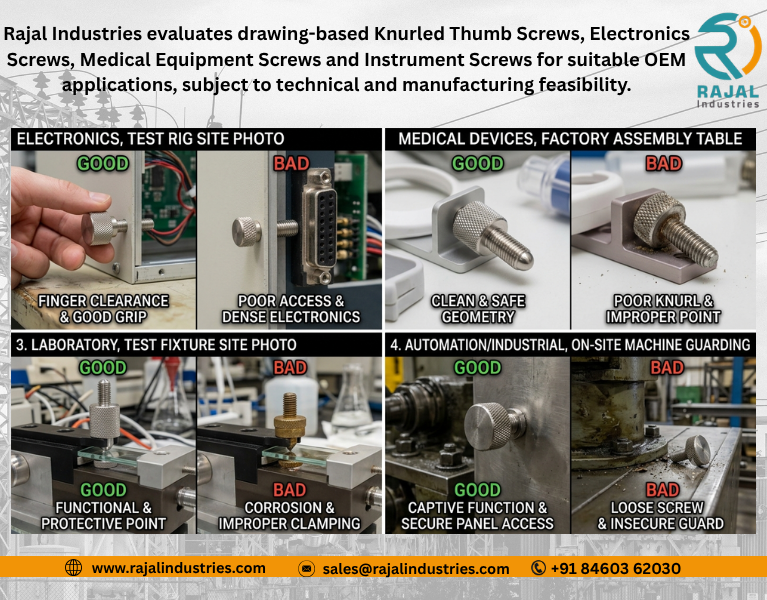
Knurled Thumb Screw Applications are common in equipment where an operator, technician or engineer needs convenient manual fastening, removal, positioning or adjustment.
Unlike a conventional machine screw that is normally operated with a tool, a knurled thumb screw provides a textured head that can be turned by hand where the equipment design permits it.
Typical application areas can include:
- Electronics enclosures
- Instrument covers
- Removable modules
- Medical equipment
- Laboratory instruments
- Test fixtures
- Measurement equipment
- Sensor mounts
- Adjustable brackets
- Optical equipment
- Automation equipment
- Industrial fixtures
The key reason for choosing a thumb screw should be functional:
Manual Access + Adjustment + Repeated Operation + Suitable Joint Requirement
A thumb screw should not be selected simply because tool-free fastening appears convenient.
Quick Answer: Where Are Knurled Thumb Screws Used?
Knurled Thumb Screw Applications include electronics enclosures, medical equipment, laboratory instruments, test fixtures, measurement devices, sensor mounts, adjustable brackets and industrial equipment. They are particularly useful where intentional manual access, repeated adjustment or quick component removal is required and the joint does not depend on uncontrolled hand tightening for critical preload.
What Makes a Knurled Thumb Screw Useful?
The main feature is the manually grippable head.
The knurled surface provides texture around the head so the operator can rotate the screw using fingers.
The basic application sequence is:
Grip → Rotate → Release/Adjust → Service or Position Component → Re-engage → Tighten
This can reduce dependence on a separate hand tool for suitable operations.
Main Functions of Knurled Thumb Screws
| Function | Example Application | Main Design Priority |
| Manual Fastening | Equipment cover | Grip + thread |
| Repeated Access | Electronics enclosure | Serviceability |
| Adjustment | Instrument | Thread + point |
| Positioning | Sensor bracket | Shoulder/point |
| Clamping | Test fixture | Contact geometry |
| Retention | Accessory mount | Thread engagement |
| Setup Change | Laboratory fixture | Repeated operation |
| Captive Access | Service panel | Grip + retention |
| Tool-Assisted Access | Equipment cover | Knurl + drive |
Why OEMs Use Knurled Thumb Screws
A thumb screw can be useful where the OEM wants to reduce the number of steps required during:
- Setup
- Adjustment
- Inspection
- Calibration
- Maintenance
- Module replacement
- Accessory installation
- Routine servicing
For suitable equipment, this can make the user interaction more practical.
Thumb Screw vs Conventional Screw in an Application
| Requirement | Knurled Thumb Screw | Conventional Tool-Driven Screw |
| Manual Operation | Strong | Limited |
| Frequent Adjustment | Strong | Tool required |
| Tool-Free Service | Possible | Usually no |
| Compact Head | Design dependent | Often easier |
| Controlled Tool Tightening | Optional | Strong |
| Restricted Access | Usually weaker | Stronger |
| High Manual Convenience | Strong | Lower |
| Tamper Resistance | Usually low | Drive dependent |
This does not mean thumb screws are better than conventional screws.
They solve a different application problem.
Application Selection Model
Before using a thumb screw, follow:
Equipment → User → Function → Access Frequency → Thread → Head Clearance → Knurl → Shoulder/Point → Material → Finish → Validation
This prevents selection based only on appearance.
The Five Questions to Ask First
Before approving any of these Knurled Thumb Screw Applications, ask:
- Why must the screw be operated by hand?
- How frequently will it be operated?
- Who will operate it?
- What happens if it is tightened too little or too much?
- Is unrestricted tool-free access appropriate?
These questions can eliminate unsuitable applications early.
Where Knurled Thumb Screws May Not Be Appropriate
A conventional or different engineered fastener may be preferable where:
- Controlled preload is critical
- Tool-free access creates a safety risk
- Unauthorized access must be restricted
- Head projection creates interference
- Structural loading controls the fastener selection
- Manual tightening is insufficient for the joint
- Machine guarding requires controlled access
- The fastener must not be easily loosened by users
Manual Access Is a Design Decision
The ability to loosen a screw by hand is not always an advantage.
For a test fixture, it can be highly useful.
For an electrical safety cover, moving machine guard or restricted-access enclosure, it may be inappropriate.
Therefore:
Tool-free convenience must be evaluated against safety and access-control requirements.
Knurled Thumb Screw Applications in Electronics
Electronics is one of the strongest application groups for manually operated screws because many products require periodic:
- Service
- Inspection
- Setup
- Adjustment
- Module replacement
- Testing
Suitable Electronics Screws can help provide access without requiring a separate tool for every operation.
Electronics Application Matrix
| Electronics Application | Thumb Screw Function | Main Engineering Check |
| Equipment Cover | Manual removal | Head clearance |
| Instrument Enclosure | Service access | Internal projection |
| Removable Module | Retention/removal | Thread + alignment |
| Test Equipment | Adjustment/access | Repeated use |
| Sensor Assembly | Positioning | Shoulder/point |
| Electronics Fixture | Clamping | Contact geometry |
| Rack Equipment | Service | Projection |
| Control Equipment | Access | Safety |
| Development Fixture | Repeated setup | Durability |
| Prototype Equipment | Fast changes | Geometry |
Electronics Enclosures
A knurled thumb screw can be considered for a removable electronics enclosure where users or technicians intentionally need repeated access.
Possible examples include:
- Instrument covers
- Test-equipment covers
- Development systems
- Access panels
- Removable electronics modules
Why Thumb Screws Can Help in Electronics Enclosures
Consider a technician who regularly opens a test instrument.
With conventional screws:
Find Tool → Loosen Screws → Remove Cover → Service → Reinstall → Tighten with Tool
With a suitable thumb screw:
Grip → Loosen → Remove/Open → Service → Re-engage → Hand Tighten
This can simplify repeated service where manual fastening is appropriate.
Internal Clearance Is Critical
An Electronics Screw must be checked both outside and inside the enclosure.
Inside the product, the screw may be close to:
- PCB assemblies
- Wiring
- Connectors
- Terminals
- Batteries
- Sensors
- Fans
- Displays
- Internal brackets
Tightened and Released Positions
Do not check only the installed position.
Review:
Fully Tightened → Partially Released → Fully Released
where applicable.
A screw that clears the PCB while tightened could interfere with another component while being loosened.
Head Clearance in Electronics
Outside the enclosure, check:
- Connectors
- Switches
- Buttons
- Cables
- Adjacent screws
- Display bezels
- Handles
- Rack rails
A larger knurled head can improve grip but can also interfere with nearby equipment.
Electronics Equipment with Dense Controls
In compact equipment, the operator may have very little space to grip the screw.
Selection should therefore consider:
Head Diameter + Head Height + Knurl + Finger Clearance
A strong knurl cannot solve poor physical access.
Electronics Rack Equipment
Rack-mounted equipment can include:
- Network devices
- Test instruments
- Power equipment
- Monitoring systems
- Industrial computers
- Control equipment
Thumb screws can be useful for suitable removable panels, modules or accessories.
Rack Equipment Projection
Head projection deserves special attention.
A large thumb-screw head may interfere with:
- Adjacent rack units
- Doors
- Cable management
- Handles
- Nearby equipment
The final equipment layout should control the design.
Removable Electronics Modules
A removable module can benefit from manually operated hardware where frequent installation or removal is expected.
Possible priorities include:
Alignment + Grip + Thread Engagement + Repeated Use
If the screw also guides the module, a shoulder or other defined geometry may be required.
Captive Thumb Screws in Electronics
If technicians repeatedly remove a panel, losing the screw can become inconvenient.
A captive thumb screw can combine:
Manual Grip + Panel Retention
This is different from a normal removable thumb screw.
A captive design requires additional retention and panel geometry.
Standard vs Captive Electronics Screw
| Requirement | Standard Thumb Screw | Captive Thumb Screw |
| Manual Grip | Yes | Yes |
| Fully Removable | Usually | Designed to remain retained |
| Panel Retention | No | Yes |
| Frequent Service | Suitable | Often strong |
| Loose Hardware Control | Limited | Stronger |
| Panel Geometry | Simpler | More important |
Captive Does Not Mean Tool-Free
A captive screw can have:
- Knurled manual head
- Tool-operated head
- Combination head
Captivity describes retention.
It does not define how the screw is operated.
Electronics Test Equipment
Test and measurement equipment often requires repeated interaction.
Suitable applications can include:
- Access covers
- Test fixtures
- Adjustable brackets
- Instrument mounts
- Removable modules
- Probe fixtures
- Sensor holders
Electronics Test Fixture Example
Imagine a fixture where the operator changes the test sample many times during a shift.
A suitable thumb screw can provide:
Loosen → Reposition → Tighten → Test → Repeat
In this type of application, repeated manual operation is the main reason for using the fastener.
Electronics Fixture Selection Priorities
For repeated test-fixture adjustment, check:
- Thread durability
- Mating-thread durability
- Head grip
- Point/contact geometry
- Adjustment range
- Surface marking
- Repeated-use behaviour
Electronics Screws and Surface Contact
If the screw clamps directly against:
- PCB material
- Aluminium
- Plastic
- Painted surface
- Sensor body
- Precision component
the point geometry needs attention.
A standard threaded end may not always be appropriate for direct clamping.
Knurled Thumb Screws in Medical Devices and Equipment
Medical Equipment Screws require careful application definition because “medical device” covers a very wide range of products.
A thumb screw can potentially be used in suitable:
- Medical equipment enclosures
- Diagnostic equipment
- Laboratory medical equipment
- Equipment accessories
- Adjustable mounts
- Instrument fixtures
- Equipment stands
- Service panels
But the application must be evaluated individually.
Medical Device vs Medical Equipment Application
Do not treat every screw used by a medical-industry company as having the same requirements.
A screw can be:
- External equipment hardware
- Internal mechanical hardware
- Service hardware
- Adjustment hardware
- Accessory hardware
- Patient-contact component
These applications can have very different requirements.
Medical Equipment Application Matrix
| Application | Potential Function | Important Review |
| Equipment Cover | Service access | Cleaning + access |
| Diagnostic Equipment | Adjustment | Precision/function |
| Instrument Fixture | Positioning | Shoulder/point |
| Accessory Mount | Manual fastening | Repeated use |
| Laboratory Device | Setup | Material/environment |
| Equipment Stand | Adjustment | Holding function |
| Sensor Mount | Positioning | Geometry |
| Service Panel | Access | Safety |
| Patient-Contact Area | Specialized | OEM regulatory requirements |
Medical Equipment Enclosures
A manually operated screw can be useful on suitable covers that authorized operators or service technicians need to access regularly.
However, the OEM should first determine whether tool-free access is permitted.
Medical Equipment Safety Boundary
A thumb screw should not be introduced merely to make servicing easier where the cover protects:
- Electrical hazards
- Moving components
- Controlled internal areas
- Safety-critical systems
The medical-device/equipment designer should define the access requirement.
Medical Equipment Cleaning
Some medical and diagnostic equipment undergoes frequent cleaning.
For a knurled screw, evaluate:
Knurl Geometry + Material + Finish + Cleaning Process + Chemical Exposure
The textured head that improves grip can also create more complex surface geometry than a smooth head.
Whether that matters depends on the actual equipment and cleaning requirements.
Cleaning Does Not Automatically Ban Knurling
A knurled head may still be suitable.
But the OEM should evaluate:
- Cleaning accessibility
- Soil/residue retention
- Chemical compatibility
- Surface finish
- Frequency of cleaning
The actual device requirements should control the decision.
Medical Equipment Material Selection
Avoid the shortcut:
Medical Equipment Screws = SS316
The material should instead follow:
Application → Environment → Cleaning → Contact Requirement → Corrosion → Mechanical Requirement → OEM Specification
SS304/A2-type, SS316/A4-type or another material may be suitable depending on the actual requirement.
Patient Contact Requires Separate Review
A screw being made from stainless steel does not automatically make it suitable for patient contact.
Where direct or indirect patient contact exists, the OEM should define applicable:
- Material requirements
- Biological evaluation requirements
- Surface requirements
- Cleaning/sterilization requirements
- Traceability
- Regulatory requirements
Medical Equipment Adjustment Applications
Suitable thumb screws can be used in equipment where a technician or operator adjusts:
- Brackets
- Guides
- Fixtures
- Sensors
- Accessories
- Supports
The fastener may perform more than simple fastening.
Adjustment Screw Geometry
For an adjustment application, consider:
Head → Thread → Shoulder → Point → Mating Component
The point and thread can directly affect the adjustment behaviour.
Medical Equipment Accessories
Potential applications can include manually installed or adjusted accessories.
Selection priorities may include:
- Easy operation
- Repeatable attachment
- Correct thread
- Adequate grip
- Appropriate material
- Surface condition
- Repeated-use durability
Medical Equipment Screws and Tool-Free Access
Tool-free access can be desirable for:
- User-adjustable accessories
- Intended setup operations
- Suitable removable components
It may be undesirable for:
- Restricted service areas
- Electrical hazard covers
- Internal calibration areas
- Safety-related assemblies
Medical Equipment Application Rule
Use:
Intended User + Intended Access + Required Function + Risk + Environment
before deciding whether a thumb screw is appropriate.
Knurled Thumb Screw Applications in Laboratory Equipment
Laboratory equipment often requires:
- Setup changes
- Fixture adjustment
- Sample positioning
- Sensor movement
- Instrument access
- Repeated experimental configuration
These are strong potential use cases for manually operated Knurled Fasteners.
Laboratory Application Matrix
| Laboratory Application | Function | Selection Priority |
| Sample Holder | Positioning | Point + grip |
| Instrument Cover | Access | Service frequency |
| Test Fixture | Clamping | Contact geometry |
| Sensor Mount | Positioning | Shoulder/point |
| Adjustable Guide | Adjustment | Thread |
| Equipment Accessory | Fastening | Repeated use |
| Optical Fixture | Positioning | Precision geometry |
| Development Rig | Setup change | Convenience |
| Measurement Stand | Adjustment | Holding function |
| Laboratory Enclosure | Access | Environment |
Laboratory Test Fixtures
Test fixtures are particularly suitable for evaluating thumb screws because operators may repeatedly:
Open → Load Sample → Position → Clamp → Test → Release → Repeat
In this application, speed and repeatability of manual operation can matter more than conventional tool-driven fastening.
Sample Holder Applications
Where a screw holds a sample, check the contact point.
The sample may be:
- Metal
- Plastic
- Glass
- Composite
- Coated
- Delicate
A point that works for a steel fixture may damage a softer test sample.
Surface Protection in Laboratory Fixtures
Do not automatically describe a rounded or flat point as “non-marking.”
Whether the surface is marked depends on:
Point Geometry + Material + Contact Area + Tightening Force + Sample Material
Functional testing is preferable.
Laboratory Instrument Covers
Instrument covers may require repeated access for:
- Setup
- Maintenance
- Cleaning
- Sensor replacement
- Calibration
A knurled thumb screw can be suitable where manual access is intentionally permitted.
Chemical Exposure in Laboratories
Laboratory equipment can encounter:
- Cleaning chemicals
- Reagents
- Humidity
- Condensation
- Process chemicals
Material should therefore be selected from actual exposure rather than simply choosing stainless steel because the product is used in a laboratory.
Knurl and Laboratory Cleaning
For frequently cleaned laboratory equipment, consider whether the knurl is:
- Accessible for cleaning
- Compatible with cleaning chemicals
- Suitable for the required hygiene level
- Comfortable for repeated use
Again, the specific equipment requirement controls.
Knurled Thumb Screws in Test Equipment
Test equipment can include:
- Electrical test fixtures
- Mechanical test fixtures
- Measurement systems
- Calibration equipment
- Prototype rigs
- Inspection equipment
- Production test stations
Manual adjustment can be frequent.
Test Equipment Application Sequence
A common sequence is:
Load → Position → Clamp/Adjust → Test → Release → Repeat
A thumb screw can reduce tool handling during this cycle.
Test Fixture Selection Priorities
Repeated Use + Grip + Thread Durability + Point Geometry + Positioning + Mating Component
These factors often matter more than cosmetic appearance.
Production Test Stations
Where a fixture is used repeatedly in production, consider:
- Number of operations per shift
- Operator comfort
- Thread wear
- Point wear
- Mating-component wear
- Adjustment speed
- Replacement procedure
A screw that works well during ten prototype cycles may behave differently during long-term production use.
Repeated-Use Validation
For frequently operated test equipment:
Install → Adjust → Tighten → Release → Re-engage → Repeat
Monitor:
- Thread condition
- Mating thread
- Knurl
- Finish
- Point
- Manual feel
- Functional consistency
The required cycle count should come from the OEM’s expected use and validation plan.
Knurled Thumb Screws in Measurement Equipment
Suitable Instrument Screws can be used in:
- Measuring fixtures
- Sensor positioning systems
- Inspection equipment
- Calibration fixtures
- Gauge stands
- Adjustable brackets
The screw may function as a fastener, adjuster or positioning component.
Instrument Screw Applications
| Instrument Application | Function | Critical Feature |
| Sensor Positioning | Adjustment | Thread + point |
| Gauge Stand | Clamping | Holding function |
| Calibration Fixture | Positioning | Geometry |
| Instrument Cover | Access | Head clearance |
| Optical Mount | Adjustment | Thread/point |
| Measurement Bracket | Positioning | Shoulder |
| Inspection Fixture | Repeated adjustment | Durability |
Precision Adjustment Does Not Depend on Knurl Alone
The knurl helps the operator rotate the screw.
Adjustment performance can depend on:
- Thread pitch
- Thread fit
- Backlash
- Point geometry
- Alignment
- Mating component
- Structural stiffness
Therefore:
Knurled Head ≠ Precision Adjustment
The complete mechanism determines precision.
Fine Thread in Instrument Applications
A finer pitch produces less axial movement per complete revolution than a coarser pitch of the same nominal diameter.
This can be useful in suitable adjustment mechanisms.
However, the thread should be selected from the complete adjustment requirement.
Instrument Screw Point Geometry
Where the screw positions a component, point geometry can affect:
- Contact location
- Repeatability
- Surface marking
- Alignment
Potential options may include:
- Flat
- Rounded
- Dog point
- Customer-specific geometry
Knurled Thumb Screws in Optical Equipment
Optical and imaging equipment can require frequent manual adjustment of:
- Mounts
- Brackets
- Guides
- Fixtures
- Covers
A knurled Instrument Screw can provide a convenient manual interface.
Optical Equipment Caution
Do not assume that a thumb screw itself provides precision positioning.
The complete mechanism may require control of:
- Thread quality
- Backlash
- Alignment
- Contact point
- Structural stability
The screw is only one component of the system.
Knurled Thumb Screws in Automation Equipment
Automation equipment can use manually adjustable fasteners for:
- Sensor brackets
- Guides
- Stops
- Fixtures
- Changeover components
- Inspection stations
- Machine accessories
Automation Changeover
A suitable thumb screw can help where operators frequently change:
- Product size
- Guide position
- Sensor position
- Fixture position
Typical sequence:
Loosen → Reposition → Align → Tighten → Resume Operation
Automation Safety
Manual convenience should not override machinery safety.
Before using a thumb screw near automated equipment, review:
- Operator access
- Machine state during adjustment
- Guarding
- Interlocks
- Moving components
- Lockout/isolation procedures where applicable
Machine Guarding Caution
A manually removable fastener should not automatically be used for a machine guard.
Guarding requirements may control whether access requires:
- A tool
- An interlock
- Another engineered protective measure
The machine designer should make this decision.
Industrial Fixture Applications
Knurled thumb screws can also be useful in:
- Assembly fixtures
- Inspection fixtures
- Welding fixtures where appropriate
- Positioning fixtures
- Light-duty clamping arrangements
- Tooling accessories
The specific loads and environment should be reviewed.
Knurled Thumb Screw as a Clamp
When a thumb screw directly clamps a component, the design should consider:
Manual Force → Thread → Point → Contact Surface → Required Holding Function
Do not assume hand tightening provides a consistent clamp force between different operators.
Manual Tightening Variation
Manual tightening can vary with:
- Operator
- Hand strength
- Head diameter
- Knurl
- Gloves
- Access
- Surface condition
If controlled preload is important, the joint may require a different installation method or fastener design.
Knurl Does Not Prevent Loosening
One important application distinction is:
Knurl improves grip. It does not lock the thread.
For vibrating equipment, evaluate loosening separately.
Vibration in Electronics and Test Equipment
Where vibration exists, consider:
Joint Requirement → Clamp Condition → Thread → Mating Material → Installation → Locking Strategy
Do not use a knurled head as the vibration-control feature.
Thumb Screw vs Captive Screw vs Security Screw
These functions are different.
| Fastener Feature | Main Purpose |
| Knurled Thumb Screw | Manual operation |
| Captive Screw | Fastener retention |
| Security Screw | Access resistance |
| Locking Feature | Loosening resistance |
A custom design can sometimes combine more than one function, but each should be specified separately.
Example: Electronics Service Panel
Requirement:
Manual Operation + Screw Must Not Be Lost
Potential direction:
Knurled Captive Screw
Example: Restricted Electronics Panel
Requirement:
Authorized Tool Access
A conventional security or tool-driven fastener may be more appropriate than a thumb screw.
Example: Vibrating Test Fixture
Requirement:
Manual Adjustment + Position Must Remain Stable
The design may require a separate locking strategy in addition to the knurled manual interface.
Standard vs Custom Thumb Screw by Application
| Application | Standard Part May Work | Custom Part May Be Needed |
| Simple Cover | Often | Special clearance |
| Test Fixture | Possible | Point/shoulder |
| Sensor Mount | Possible | Positioning geometry |
| Medical Equipment | Possible | OEM-specific requirements |
| Laboratory Fixture | Possible | Contact geometry |
| Instrument Adjustment | Possible | Precision geometry |
| Captive Panel | Product dependent | Retention design |
| Dense Electronics | Possible | Special compact head |
Application Environment Matters
The same Knurled Thumb Screw Applications can require different materials depending on where the equipment operates.
Consider:
- Indoor controlled environment
- Outdoor environment
- Humidity
- Condensation
- Cleaning
- Chemicals
- Chlorides
- Temperature
- Repeated handling
Application-Based Material Direction
| Environment | Material/Finish Review |
| Indoor Electronics | Corrosion + appearance |
| Laboratory | Chemical/cleaning exposure |
| Medical Equipment | OEM-defined environment |
| Outdoor Instrument | Moisture + contaminants |
| Industrial Test Fixture | Wear + environment |
| Frequent Handling | Finish durability |
| Chloride Exposure | Stainless/coating system review |
There is no universal material choice based only on industry name.
SS304 vs SS316 by Application
SS304/A2-type can be suitable for many general environments.
SS316/A4-type can be evaluated where enhanced resistance to certain chloride-containing environments is useful.
But:
Outdoor ≠ Automatically SS316
Laboratory ≠ Automatically SS316
Medical ≠ Automatically SS316
The actual exposure and specification should decide.
Carbon Steel in Electronics and Industrial Equipment
Carbon steel with a suitable finish can be practical for many indoor industrial and electronics applications.
Selection should consider:
- Required mechanical properties
- Corrosion environment
- Appearance
- Finish
- Mating material
Brass in Instruments and Laboratory Equipment
Brass can be useful in selected instrument or electrical applications where its particular properties are suitable.
It should not be selected solely for appearance.
Mechanical and environmental suitability still need review.
Application-Based Finish Selection
Finish selection should consider:
Environment + Material + Appearance + Repeated Handling + Functional Clearance
For example, a finish on a frequently handled knurled head may need evaluation for both corrosion performance and wear.
Coating and Manual Grip
Coating can affect:
- Knurl definition
- Surface feel
- Finished diameter
- Appearance
Where manual feel matters, evaluate production-intended finished samples.
Application-Based Head Selection
| Application | Head Priority |
| Compact Electronics | Low interference |
| Medical Equipment | Intended access + cleaning |
| Laboratory Fixture | Grip |
| Test Equipment | Repeated operation |
| Instrument | Controlled geometry |
| Gloved Industrial Use | Accessibility |
| Rack Equipment | Low projection |
| Captive Panel | Grip + retention geometry |
Application-Based Point Selection
| Application | Point Priority |
| Equipment Cover | Standard fastening |
| Sensor Positioning | Location |
| Test Fixture | Contact |
| Sample Holder | Surface protection |
| Instrument Adjustment | Controlled contact |
| Guide | Positioning |
| Clamp | Holding function |
Service Frequency Matrix
| Access Frequency | Thumb Screw Suitability | Main Review |
| Multiple Times per Shift | Strong potential | Wear + ergonomics |
| Daily | Strong potential | Repeated use |
| Weekly | Good potential | Convenience |
| Occasional | Application dependent | Benefit vs complexity |
| Rare | Conventional screw may suffice | Need for thumb head |
| Restricted Access | Often unsuitable | Access control |
This is a design guide, not a universal rule.
Application Selection Checklist
Before approving a knurled thumb screw:
☐ Manual operation is intentional
☐ Intended user is identified
☐ Access frequency is known
☐ Tool-free access is acceptable
☐ Thread matches mating component
☐ Required engagement is defined
☐ Head fits available space
☐ Fingers can reach the head
☐ Knurl suits expected handling
☐ Internal projection is safe
☐ Shoulder is defined if required
☐ Point suits contact surface
☐ Material suits environment
☐ Finish suits exposure
☐ Repeated handling considered
☐ Vibration reviewed separately
☐ Controlled preload is not being assumed
☐ Safety requirements reviewed
☐ Functional assembly test planned
12 Application Mistakes to Avoid
1. Using a Thumb Screw Everywhere
Manual access must provide a real benefit.
2. Assuming Tool-Free Is Always Better
Some equipment should require controlled access.
3. Ignoring Internal Projection
The screw may contact electronics or moving parts.
4. Selecting the Largest Head Possible
A large head can interfere with adjacent components.
5. Ignoring Finger Clearance
A knurled head is useless if the user cannot grip it.
6. Assuming Knurl Provides Locking
It does not.
7. Assuming Hand Tightening Gives Controlled Preload
It does not.
8. Ignoring Point Geometry
The screw can damage the component it contacts.
9. Choosing Material Only from Industry Name
“Medical,” “laboratory” or “outdoor” does not define one material.
10. Ignoring Cleaning Requirements
Important for suitable laboratory and medical-equipment applications.
11. Testing Only a Loose Screw
Test the screw in the actual assembly.
12. Ignoring Repeated Use
Frequent adjustment can affect the screw and mating component.
Functional Application Validation
For a typical application:
Install → Grip → Rotate → Engage → Tighten/Adjust → Operate Equipment → Loosen → Reposition/Remove → Re-engage
Monitor:
- Grip
- Thread
- Clearance
- Point contact
- Mating component
- Finish
- Manual feel
- Functional result
Test the Finished Screw
Where coating or passivation is required, functional validation should use production-intended finished samples.
Finish can affect:
- Thread fit
- Knurled feel
- Dimensions
- Appearance
- Repeated operation
OEM Application Approval
A useful approval sequence is:
Drawing → Sample → Dimensional Inspection → Material/Finish Verification → Assembly Test → Repeated-Use Test if Required → OEM Approval → Production
What Should an OEM Send to a Manufacturer?
For application review, provide:
Approved Drawing + Application + Mating Component + Thread + Head/Knurl Geometry + Shoulder/Point + Material + Finish + Functional Requirement + Quantity
This allows the manufacturer to evaluate the actual requirement rather than only quote from a thread size.
Rajal Industries Application Review
Rajal Industries can evaluate drawing-based Knurled Thumb Screws, Electronics Screws, Medical Equipment Screws and suitable Instrument Screws for OEM applications, subject to technical and manufacturing feasibility.
The review can consider:
- Application
- Thread
- Head dimensions
- Knurl
- Shoulder
- Point
- Optional drive
- Material
- Finish
- Tolerances
- Manufacturing process
- Inspection
- Expected quantity
Application-specific safety, medical-device, regulatory or certification requirements should be defined and approved by the responsible OEM.
Detailed Electronics Application Cases
Electronics equipment can have very different access and service requirements.
The main question is:
Does manual operation improve the intended service or adjustment process without creating an access, clearance or safety problem?
Application Case 1: Electronics Service Cover
Requirement
A technician periodically removes an equipment cover for inspection or maintenance.
Potential Thumb Screw Function
Manual Removal + Reinstallation
Important Checks
- Thread engagement
- Head clearance
- Finger access
- Internal screw projection
- Adjacent connectors
- Service frequency
- Tool-free access suitability
A knurled thumb screw can be practical if the cover is intentionally service-accessible.
Application Case 2: Removable Electronics Module
A module may need to be removed for:
- Replacement
- Testing
- Configuration
- Maintenance
- Inspection
Potential requirements include:
Manual Grip + Alignment + Repeated Engagement + Hardware Retention
If loose screws are undesirable, a captive thumb screw may be more suitable than a fully removable design.
Application Case 3: Electronics Test Fixture
A production or development fixture may be adjusted repeatedly.
Typical workflow:
Load Component → Position → Tighten → Test → Release → Remove → Repeat
Here, the benefit is not simply tool-free fastening.
It is reducing repetitive tool handling during the test cycle.
Application Case 4: Sensor Mount
A sensor bracket may require manual positioning.
The thumb screw can potentially provide:
- Position adjustment
- Temporary clamping
- Repeated repositioning
Important features may include:
Thread + Head Grip + Shoulder + Point + Contact Surface
Sensor Positioning Caution
If precise sensor position matters, do not assume the thumb screw alone controls accuracy.
Position can also depend on:
- Bracket geometry
- Slot clearance
- Thread backlash
- Point contact
- Alignment
- Structural stiffness
Application Case 5: Rack-Mounted Electronics
Suitable Electronics Screws can support service access on rack-mounted equipment.
However, rack systems can be densely packed.
Check:
- Front-panel projection
- Adjacent rack units
- Doors
- Cable routing
- Handles
- Connectors
- Rails
A head that provides excellent grip can still be too large for the equipment.
Application Case 6: Electronics Development Equipment
Prototype and development systems often require frequent changes.
A thumb screw can simplify:
- Opening covers
- Changing modules
- Moving fixtures
- Repositioning sensors
- Testing alternate configurations
This is a strong potential application because access frequency is high.
Electronics Application Decision Matrix
| Requirement | Thumb Screw Direction |
| Frequent service access | Strong potential |
| Frequent adjustment | Strong potential |
| Removable module | Strong potential |
| Loose hardware undesirable | Consider captive design |
| Very limited head space | Review carefully |
| Controlled preload required | Review alternative/tool drive |
| Restricted access | Often unsuitable |
| Safety cover | OEM safety review required |
| High vibration | Separate locking review |
| Rarely opened cover | Benefit may be limited |
Knurled Thumb Screw Applications in Test Equipment
Test equipment is one of the most practical areas for manually operated fasteners because configuration changes can happen frequently.
Examples include:
- Electrical test fixtures
- Mechanical test fixtures
- Product inspection fixtures
- Calibration rigs
- Prototype fixtures
- Sensor test systems
- Production test stations
- Laboratory test assemblies
Production Test Fixture Example
Consider a fixture used to test multiple components every hour.
The operator may repeatedly:
Release Fixture → Load Part → Position → Tighten → Test → Release
Using a separate wrench or screwdriver for every cycle may add unnecessary handling.
A suitable knurled thumb screw can simplify the operation.
High-Cycle Test Fixtures
High-frequency operation changes the engineering priorities.
Instead of checking only initial fit, evaluate:
- Thread wear
- Mating-thread wear
- Knurl wear
- Finish wear
- Point wear
- Operator comfort
- Adjustment consistency
Replaceable Mating Threads
If a test fixture is expected to experience very frequent adjustment, the designer may also need to consider the durability and serviceability of the mating thread.
The thumb screw is only half of the threaded system.
Operator Ergonomics
For repeated manual operation, consider:
Head Diameter + Head Height + Knurl + Finger Clearance + Gloves + Frequency
A design that feels acceptable after three operations may become uncomfortable during hundreds of repeated operations.
Manual Grip vs Excessive Knurl
More aggressive knurling is not automatically better.
An overly sharp knurl can create discomfort during frequent handling.
The design should balance:
Grip ↔ Comfort
Gloved Test Operations
If the operator wears:
- Work gloves
- Laboratory gloves
- Protective gloves
test the final head geometry with the actual intended operating condition.
Do not assume bare-hand performance will be identical.
Medical Equipment Application Decision Process
For Medical Equipment Screws, begin with the equipment function rather than the industry label.
Use:
Location → Intended User → Access Requirement → Contact → Cleaning → Environment → Material → Functional Requirement
Medical Application Classification
A useful initial classification is:
Category A: External Equipment Hardware
Examples:
- Equipment covers
- Stands
- Accessory brackets
Category B: Adjustment Hardware
Examples:
- Adjustable mounts
- Fixtures
- Positioning components
Category C: Internal Service Hardware
Accessible primarily during maintenance.
Category D: Patient-Contact or Special Controlled Area
Requires OEM-defined application-specific review.
These categories should not automatically receive the same specification.
Medical Equipment Cover
For a suitable external equipment cover, a thumb screw may provide convenient access.
Before using one, ask:
- Who should open the cover?
- How frequently?
- Does access expose a hazard?
- Is a tool supposed to be required?
- How is the equipment cleaned?
- Is the screw likely to be lost?
Medical Equipment Accessory Mount
Accessories can require repeated installation and removal.
A thumb screw may help where the operator needs to:
Position → Engage → Tighten → Use → Release → Remove
The screw’s head and thread should support the intended frequency of operation.
Medical Equipment Adjustment Assembly
Suitable adjustment assemblies can use a knurled screw to move or retain:
- Brackets
- Guides
- Sensors
- Supports
- Accessories
Where the screw directly contacts another component, point geometry becomes important.
Medical Equipment Cleaning Matrix
| Condition | Main Fastener Review |
| Occasional Wiping | Material + finish |
| Frequent Cleaning | Finish + knurl + chemical exposure |
| Wet Environment | Corrosion + drainage |
| Chemical Cleaning | Material compatibility |
| Controlled Hygiene Requirement | OEM-defined requirements |
| Patient-Contact Area | Device-specific requirements |
| Sterilization Exposure | OEM-defined material/process validation |
A general blog should not assign one material or finish to all these conditions.
Knurled Surface and Cleaning
Knurling creates textured geometry.
For frequently cleaned equipment, consider whether the selected surface:
- Can be adequately cleaned
- Withstands the cleaning process
- Retains acceptable appearance
- Remains comfortable to operate
The medical-equipment OEM should define the acceptance requirements.
Medical Equipment Screw Traceability
Some projects may require additional documentation or traceability.
Possible customer requirements can include:
- Material documentation
- Lot identification
- Inspection reports
- Finish documentation
- Customer-specific quality records
The required documentation should be stated in the RFQ and drawing package.
Medical Device Claims Should Be Application-Specific
A manufacturer should avoid making a blanket statement such as:
“This thumb screw is medical grade.”
Instead, the OEM should specify the applicable:
Material + Finish + Drawing + Quality + Regulatory Requirements
and approve the finished component for its intended device.
Laboratory Equipment Application Cases
Laboratory environments can range from simple dry test benches to equipment exposed to chemicals or frequent cleaning.
Therefore, “laboratory screw” does not define one material or geometry.
Laboratory Sample Holder
A thumb screw can be useful for manually positioning or holding a sample.
The point can contact the sample directly.
Review:
Point Shape + Contact Area + Sample Material + Required Holding Force
Delicate Samples
For glass, plastic, coated or otherwise sensitive components, a conventional point may create unwanted marks or damage.
Functional testing with representative samples is important.
Laboratory Sensor Mount
A sensor may need frequent repositioning during experiments.
A thumb screw can support:
Loosen → Reposition → Align → Tighten
A shoulder or special point may be useful depending on the bracket design.
Laboratory Instrument Cover
Suitable covers may use thumb screws where technicians require repeated access.
Selection priorities include:
- Grip
- Head clearance
- Material
- Finish
- Cleaning
- Screw retention
For frequently removed screws, captive retention may also be worth evaluating.
Laboratory Application Matrix
| Application | Manual Function | Critical Review |
| Sample Holder | Clamp/position | Contact surface |
| Sensor Mount | Position | Alignment |
| Instrument Cover | Access | Clearance |
| Test Fixture | Repeated clamp | Wear |
| Calibration Rig | Adjustment | Repeatability |
| Optical Fixture | Position | Thread/point |
| Equipment Stand | Adjust | Holding |
| Development Rig | Change setup | Convenience |
Instrument Screw Applications
Suitable Instrument Screws can provide manual control in:
- Measurement systems
- Gauge fixtures
- Calibration equipment
- Optical mounts
- Sensor positioning
- Inspection equipment
- Laboratory instruments
These applications can require more attention to movement and positioning than a simple equipment cover.
Adjustment Resolution
For threaded adjustment, axial movement per revolution is related to thread lead.
For a conventional single-start thread, lead equals pitch.
Therefore, a smaller pitch generally produces less axial movement per revolution than a larger pitch of the same basic thread configuration.
But adjustment accuracy depends on more than pitch.
Factors Affecting Adjustment Performance
These can include:
- Thread fit
- Backlash
- Alignment
- Point geometry
- Mating component
- Structural stiffness
- Operator technique
Therefore:
Fine Thread ≠ Complete Precision System
Optical Equipment Applications
Optical and imaging systems can use manually operated fasteners for suitable:
- Mounts
- Fixtures
- Brackets
- Covers
- Positioning assemblies
The knurled head provides the user interface.
It does not itself guarantee optical positioning accuracy.
Optical Fixture Example
A manually adjustable mount may use:
Knurled Head → Specified Thread → Functional Point → Mating Surface
The OEM should evaluate:
- Backlash
- Contact geometry
- Adjustment range
- Stability
- Repeatability
Instrument Screw vs Ordinary Thumb Screw
| Requirement | General Thumb Screw | Instrument Screw |
| Manual Grip | Important | Important |
| Simple Fastening | Common | Possible |
| Positioning | Possible | Often important |
| Point Geometry | Sometimes | Often important |
| Shoulder | Optional | Can be important |
| Thread Movement | Secondary | Can be critical |
| Tight Tolerances | Function dependent | Function dependent |
| Assembly Validation | Important | Particularly important |
Automation Equipment Applications
Automation systems can require manual adjustment during:
- Setup
- Changeover
- Maintenance
- Sensor positioning
- Fixture adjustment
Potential Knurled Thumb Screw Applications include:
- Guide rails
- Sensor brackets
- Stops
- Inspection fixtures
- Changeover tooling
- Machine accessories
Changeover Applications
A typical changeover process may be:
Stop Equipment → Release Screw → Move Guide → Set Position → Tighten → Verify → Restart
A thumb screw can reduce tool handling.
It does not replace the required machine-safety procedure.
Automation Positioning
If the screw holds a sensor or guide in a precise position, check whether hand tightening provides sufficient holding consistency.
The design may require:
- Positive locating feature
- Locking feature
- Stop
- Scale
- Secondary clamp
depending on the application.
Industrial Machinery Applications
Suitable uses can include:
- Inspection fixtures
- Adjustable guides
- Tooling accessories
- Removable covers
- Sensor brackets
- Positioning stops
- Light-duty adjustment mechanisms
Load-Critical Applications
Do not replace an engineered structural bolt with a thumb screw merely because the thread is compatible.
Structural joints can depend on:
- Strength
- Clamp load
- Fatigue
- Preload
- Vibration
- Safety factors
The approved machine design should control fastener selection.
Guarding Applications
Manual removal may conflict with the safety function of a guard.
Where guarding is involved, the machine designer should determine the appropriate access and fastening arrangement under the applicable machine-safety requirements.
Captive Knurled Thumb Screw Applications
Captive designs are particularly relevant where equipment is serviced repeatedly and loose hardware is undesirable.
Potential uses include:
- Electronics panels
- Instrument covers
- Rack equipment
- Laboratory enclosures
- Test equipment
- Suitable medical-equipment panels
Why Add Captive Retention?
A normal thumb screw provides:
Manual Operation
A captive thumb screw can provide:
Manual Operation + Hardware Retention
This can reduce the chance of the screw becoming separated from the panel during servicing.
Captive Application Decision Matrix
| Requirement | Normal Thumb Screw | Captive Thumb Screw |
| Manual Access | Strong | Strong |
| Screw Must Be Fully Removed | Strong | Usually not |
| Loose Hardware Undesirable | Weak | Strong |
| Frequent Service | Good | Strong |
| Panel Retention | No | Yes |
| Additional Panel Geometry | Minimal | Required |
| Captive Travel | No | Critical |
Captive Travel
The screw must disengage from the mating thread sufficiently for the panel to open or move while still remaining retained.
This requires coordination between:
Thread Length + Reduced Shank/Shoulder + Retention Feature + Panel Thickness + Required Travel
There is no universal captive-travel dimension.
Captive Does Not Mean Vibration Resistant
These are separate functions.
Captive = remains attached when released
Vibration Resistance = resistance to unwanted loosening during operation
One does not automatically provide the other.
Thumb Screw + Tool Drive Applications
Some equipment benefits from both manual and tool-assisted operation.
Potential combinations include:
- Knurled + slot
- Knurled + hex socket
- Knurled + Phillips
- Knurled + Torx-type drive
Why Combine Manual and Tool Operation?
Possible reason:
Hand Adjust Normally → Use Tool When Additional Controlled Operation Is Required
However, allowable tool torque must still follow the approved joint design.
Thumb Screw + Security Requirement
A conventional thumb screw intentionally makes access easier.
A security fastener intentionally makes unauthorized removal more difficult.
These goals can conflict.
If restricted access is important, a normal thumb screw may not be appropriate.
Thumb Screw + Locking Requirement
A manually adjustable assembly may also require resistance to unwanted movement.
Possible locking strategies depend on the complete joint and should be separately engineered.
Do not assume the knurled head provides locking.
Application Ergonomics
Because users directly interact with the screw, ergonomics deserves more attention than with many conventional fasteners.
Review:
- Head diameter
- Head height
- Knurl
- Edge condition
- Finger clearance
- Access direction
- Gloves
- Operation frequency
Ergonomic Validation
A practical test is:
Representative User + Finished Screw + Actual Equipment + Intended Operating Procedure
This can reveal problems that a dimensional drawing alone does not show.
Edge and Burr Control
A manually handled screw should be checked for:
- Sharp burrs
- Damaged knurl
- Sharp head edges
- Coating defects
These can affect both handling and appearance.
Repeated-Use Engineering
Frequent manual operation affects more than the screw.
Evaluate:
Screw Thread + Mating Thread + Knurl + Point + Finish + Assembly
Repeated-Use Failure Modes
Potential issues can include:
- Thread wear
- Mating-thread wear
- Finish wear
- Reduced grip
- Point wear
- Increasing play
- Galling
- Surface marking
- Loosening
No Universal Cycle-Life Number
The required number of operating cycles depends on:
- Equipment life
- Service frequency
- Application
- Materials
- Mating thread
- Environment
The OEM should define the required validation target.
Cleaning and Material Compatibility
For laboratory and medical equipment, cleaning can be an important application requirement.
Review:
Cleaning Agent + Concentration + Exposure Time + Temperature + Frequency + Screw Material + Finish
Do not select material only from a general industry label.
Corrosion Is an Assembly-Level Issue
A screw may contact:
- Aluminium
- Stainless steel
- Carbon steel
- Brass
- Plastic
- Coated materials
In moisture or chemical exposure, compatibility between these materials may matter.
Stainless-on-Stainless Threads
Frequently adjusted stainless threaded assemblies may require galling consideration.
Review:
- Material pairing
- Thread fit
- Surface condition
- Lubrication where permitted
- Installation
- Frequency of adjustment
Galvanic Considerations
Where dissimilar conductive metals are exposed to an electrolyte, galvanic interaction can occur.
For example:
Stainless Fastener + Aluminium Assembly + Moisture
should be reviewed as a complete material system.
Finish Wear from Repeated Handling
A visible thumb screw can experience frequent:
- Finger contact
- Tool contact
- Cleaning
- Adjustment
If cosmetic appearance matters throughout equipment life, finish durability should be considered.
Vibration Application Matrix
| Application Condition | Engineering Direction |
| No Meaningful Vibration | Conventional joint review |
| Light Equipment Vibration | Verify joint |
| Repeated Machine Vibration | Locking strategy review |
| Adjustment Must Remain Fixed | Position-retention review |
| High Consequence of Loosening | Engineering validation required |
Do not use knurl type as the vibration-control decision.
Access-Control Matrix
| Access Requirement | Thumb Screw Suitability |
| Frequent User Adjustment | Strong |
| Frequent Technician Access | Strong |
| Occasional Service | Application dependent |
| Authorized Tool Access Only | Usually weak |
| Safety-Critical Cover | Careful review |
| Tamper-Resistant Requirement | Normal thumb screw usually unsuitable |
| Publicly Accessible Equipment | Access-control review |
Application Troubleshooting Guide
| Problem | Likely Cause | What to Review |
| Difficult to Grip | Poor head/access | Head + clearance |
| Uncomfortable to Use | Aggressive knurl/burr | Knurl + edge |
| Screw Interferes | Excessive dimensions | Head/length |
| Internal Component Contact | Excessive projection | Length |
| Screw Bottoms | Hole/length mismatch | Engagement |
| Surface Marking | Point/contact pressure | Point |
| Poor Position Repeatability | Mechanism | Thread + alignment |
| Screw Becomes Loose | Joint/vibration | Locking strategy |
| Thread Wears | High cycling | Materials + engagement |
| Stainless Seizes | Galling | Material/thread |
| Finish Wears | Repeated handling | Coating |
| Hard to Clean | Geometry/environment | Knurl + process |
| Screw Gets Lost | Fully removable design | Captive option |
| Tool-Free Access Is Unsafe | Wrong application | Access strategy |
| Head Hits Adjacent Equipment | Poor clearance | Head OD/projection |
Troubleshooting: Poor Grip
Check in this order:
Finger Clearance → Head Diameter → Head Height → Knurl → Finish
Do not immediately redesign the knurl.
Troubleshooting: Screw Loosens
Ask:
- Is sufficient joint condition being achieved?
- Is manual tightening appropriate?
- Is vibration present?
- Is a locking function required?
- Is the mating thread suitable?
The problem may not be a screw-manufacturing defect.
Troubleshooting: Poor Adjustment Repeatability
For Instrument Screws, check:
- Thread fit
- Backlash
- Point
- Alignment
- Mating surface
- Bracket stiffness
Changing only the knurled head will not solve a mechanism problem.
Troubleshooting: Difficult Cleaning
Review:
- Knurl geometry
- Head transitions
- Material
- Finish
- Cleaning process
For regulated or controlled equipment, the OEM should establish the required validation.
Imported Thumb Screw Localization
OEMs sometimes need to replace an imported Electronics Screw, Medical Equipment Screw or Instrument Screw with a locally manufactured equivalent.
Start with more than a physical sample.
Recommended Localization Package
Provide:
Existing Screw + Approved Drawing + Mating Component + Application + Material Requirement + Finish Requirement + Quality Documents + Annual Quantity
What Can Be Determined from a Sample?
A sample can help evaluate:
- Thread
- Overall geometry
- Head
- Knurl
- Shoulder
- Point
- Drive
- Assembly fit
What Cannot Reliably Be Determined from One Sample?
A sample alone may not establish:
- Original nominal dimensions
- Original tolerances
- Exact material specification
- Mechanical requirements
- Heat treatment
- Coating specification
- Regulatory requirements
- Inspection plan
- Intended service life
The OEM drawing and specification should take priority where available.
Localization Workflow
Existing Part → Documentation → Application Review → Measurement → Material/Finish Verification → Drawing Review → Manufacturing Feasibility → Samples → Inspection → Assembly Test → Repeated-Use Test if Required → Pilot Lot → Approval → Production
Supplier Qualification for Application-Based Fasteners
A supplier should understand why the screw has its geometry.
Ask:
- What is the proposed manufacturing process?
- Which features are critical?
- Can the required knurl be controlled?
- Can the shoulder/point be manufactured?
- Can the required material and finish be supplied?
- Can finished parts be inspected?
- Can samples be tested in the mating assembly?
- Can repeat production maintain the approved geometry?
Supplier Qualification Matrix
| Capability | Priority |
| Drawing Review | High |
| Application Understanding | High |
| Thread Control | High |
| Head/Knurl Control | High |
| Shoulder/Point Capability | Application dependent |
| Material Control | High |
| Finish Control | High |
| Dimensional Inspection | High |
| Functional Testing | High |
| Documentation | Customer dependent |
| Sample Development | High |
| Production Capacity | Commercial |
| Tooling | Custom projects |
| Lead Time | Commercial |
| Price | After technical compliance |
Complete Application RFQ Checklist
Application
☐ Equipment type
☐ Screw function
☐ Intended user
☐ Access frequency
☐ Manual/tool operation
☐ Safety/access requirement
Assembly
☐ Mating component
☐ Panel/bracket drawing
☐ Internal clearance
☐ External clearance
☐ Adjustment range
Screw
☐ Thread
☐ Length
☐ Head diameter
☐ Head height
☐ Knurl
☐ Shoulder
☐ Point
☐ Drive
☐ Captive feature if required
Environment
☐ Indoor/outdoor
☐ Humidity
☐ Chemical exposure
☐ Cleaning
☐ Chlorides
☐ Temperature
☐ Vibration
Material & Finish
☐ Material grade
☐ Mechanical requirement
☐ Finish
☐ Corrosion requirement
☐ Cosmetic requirement
Quality
☐ Critical dimensions
☐ Thread inspection
☐ Material documentation
☐ Finish verification
☐ Functional test
☐ Repeated-use requirement
☐ Customer-specific documentation
Commercial
☐ Prototype quantity
☐ Sample quantity
☐ Pilot quantity
☐ MOQ
☐ First order
☐ Annual demand
☐ Packaging
☐ Delivery location
15 Application Mistakes to Avoid
- Choosing a thumb screw only because it is tool-free.
- Ignoring who is supposed to access the equipment.
- Using thumb screws on restricted covers without review.
- Ignoring finger clearance.
- Making the head unnecessarily large.
- Ignoring internal screw projection.
- Assuming knurling prevents loosening.
- Assuming manual tightening produces controlled preload.
- Ignoring the mating thread during high-cycle use.
- Ignoring point geometry in clamping applications.
- Assuming medical equipment always requires SS316.
- Ignoring cleaning compatibility.
- Assuming a fine thread alone creates precision adjustment.
- Testing only the loose screw instead of the assembly.
- Localizing an imported screw from sample dimensions alone.
Frequently Asked Questions
Where are knurled thumb screws commonly used?
Knurled Thumb Screw Applications include suitable electronics enclosures, medical equipment, laboratory instruments, test fixtures, measurement equipment, sensor mounts, optical equipment, automation systems and industrial fixtures where intentional manual access or adjustment is useful.
Why are knurled thumb screws used in electronics?
They can simplify periodic service, module removal, fixture adjustment and other intended manual operations. Head clearance, internal projection and access-control requirements should still be checked.
Can thumb screws be used in medical devices?
They can be used in suitable medical-device or medical-equipment assemblies, but the responsible OEM must define the applicable material, cleaning, patient-contact, quality and regulatory requirements.
Are knurled screws suitable for laboratory equipment?
Yes, they can be useful for sample holders, fixtures, instrument covers, sensor mounts and adjustable laboratory equipment where manual operation is intended.
What are Instrument Screws used for?
Suitable Instrument Screws can be used for manual fastening, adjustment, positioning and clamping in measurement, calibration, optical and test equipment.
Can a thumb screw be used for precision adjustment?
It can be part of a precision adjustment mechanism, but accuracy also depends on thread fit, backlash, point geometry, alignment, mating components and structural stiffness.
Are fine-thread thumb screws more precise?
A finer pitch can provide less axial movement per revolution, but this alone does not guarantee a precise adjustment system.
Are knurled thumb screws suitable for vibrating equipment?
Potentially, but knurling itself does not prevent loosening. Vibration and locking requirements should be engineered separately.
Can a thumb screw be captive?
Yes. A captive thumb screw combines manual operation with a retention system designed to keep the screw attached to a panel after thread disengagement.
Why use captive thumb screws in electronics?
They can be useful on frequently serviced panels where loose hardware is undesirable.
Are thumb screws suitable for machine guards?
Not automatically. Machine guarding can have specific safety and access requirements, so the equipment designer should determine the appropriate fastening arrangement.
What material is best for Medical Equipment Screws?
There is no single best material. Selection depends on the equipment location, mechanical requirements, cleaning, corrosion exposure, patient contact where applicable and the OEM specification.
Can stainless thumb screws gall?
Stainless threaded assemblies can be susceptible to galling under certain conditions, particularly with repeated stainless-on-stainless operation. Material pairing, thread fit and installation should be reviewed.
How should thumb screws be tested for repeated use?
Test production-intended screws in the actual or representative assembly through repeated tightening, adjustment and release while monitoring threads, knurl, finish, point, mating components and functional consistency.
What information should an OEM send when sourcing custom thumb screws?
Send the approved drawing, application, mating assembly, thread, head and knurl geometry, shoulder or point, material, finish, tolerances, environmental requirements, quality requirements and expected quantity.
AEO / GEO Quick Answers
What are the main Knurled Thumb Screw Applications?
Knurled Thumb Screw Applications include electronics enclosures, test fixtures, medical equipment, laboratory instruments, sensor mounts, measurement equipment and industrial adjustment systems. They are most useful where intentional manual access, repeated adjustment or quick component removal provides a practical advantage.
Why use knurled thumb screws in electronics?
Knurled thumb screws can simplify repeated electronics servicing, module removal and fixture adjustment by allowing manual operation. The OEM should still verify head clearance, internal projection, thread engagement, access control and equipment safety.
Can knurled thumb screws be used in medical equipment?
Yes, suitable Medical Equipment Screws can use knurled heads for intended manual access or adjustment. Material, cleaning, corrosion, patient-contact, traceability and regulatory requirements must be defined for the specific equipment rather than assumed from the medical application alone.
Are knurled thumb screws good for test fixtures?
They can be particularly useful in test fixtures that require repeated loading, positioning, clamping or adjustment. High-cycle applications should also evaluate thread wear, mating-thread durability, operator comfort, point wear and finish durability.
When should a captive thumb screw be used?
Consider a captive thumb screw when a panel requires frequent manual access but the fastener should remain attached after disengagement. The design must coordinate the screw, retention feature, panel geometry, thread and required captive travel.
Final Application Selection Checklist
Before approving a thumb screw for an OEM application:
☐ Manual operation provides a real benefit
☐ Intended user identified
☐ Access frequency defined
☐ Tool-free access permitted
☐ Safety requirements reviewed
☐ Mating thread confirmed
☐ Thread engagement confirmed
☐ Overall length checked
☐ Internal projection checked
☐ Head diameter fits equipment
☐ Head height is suitable
☐ Finger access verified
☐ Gloved operation checked if relevant
☐ Knurl provides suitable handling
☐ Burr/edge condition considered
☐ Shoulder function defined
☐ Point matches contact function
☐ Surface marking considered
☐ Captive retention evaluated if needed
☐ Material matches environment
☐ Cleaning exposure considered
☐ Finish matches corrosion requirement
☐ Dissimilar-metal compatibility reviewed
☐ Galling considered where relevant
☐ Vibration reviewed separately
☐ Locking requirement reviewed separately
☐ Manual tightening is appropriate
☐ Repeated-use requirement defined
☐ Finished sample tested
☐ Actual/representative assembly tested
☐ Quality documentation agreed
☐ OEM approval completed before production
Key Takeaways
- Knurled Thumb Screw Applications should be selected from function, not appearance.
- Electronics is a strong application area where repeated service or adjustment is required.
- Suitable Electronics Screws should be checked for both external and internal clearance.
- Medical equipment requires application-specific review rather than a generic “medical grade” assumption.
- Medical Equipment Screws do not automatically require SS316.
- Laboratory fixtures can benefit from rapid manual setup and adjustment.
- Test equipment may require high-cycle thread and finish validation.
- Suitable Instrument Screws can support positioning and adjustment.
- Fine thread alone does not create a precision mechanism.
- Point geometry matters where the screw directly contacts another component.
- Knurl improves grip but does not provide vibration resistance.
- Manual tightening does not guarantee controlled preload.
- Captive thumb screws add retention, not locking.
- Tool-free access may be inappropriate for restricted or safety-related covers.
- Cleaning and chemical exposure should be considered for laboratory and medical equipment.
- Stainless-on-stainless assemblies may require galling review.
- Repeated operation affects both the screw and mating thread.
- Functional testing should use production-intended finished parts.
- Imported-part localization should use drawings and application information, not only a sample.
Conclusion
The most suitable Knurled Thumb Screw Applications are those where manual operation solves a genuine equipment problem.
For electronics, this may mean faster service access or module replacement. For medical equipment, it may mean intended adjustment or accessory installation. In laboratory and test equipment, it may mean repeated fixture changes. For Instrument Screws, the requirement may involve controlled positioning or adjustment.
The application should therefore be evaluated through:
User → Function → Access Frequency → Thread → Head/Knurl → Shoulder/Point → Material → Environment → Safety → Repeated Use → Validation
Rajal Industries can evaluate drawing-based knurled thumb screws, Electronics Screws, suitable Medical Equipment Screws and Instrument Screws for OEM applications, subject to technical feasibility, approved drawings, material, finish, tolerances, tooling, quality requirements and production quantity.
Application-specific medical, safety, regulatory or certification requirements should remain under the responsible OEM’s approved specification and validation process.