

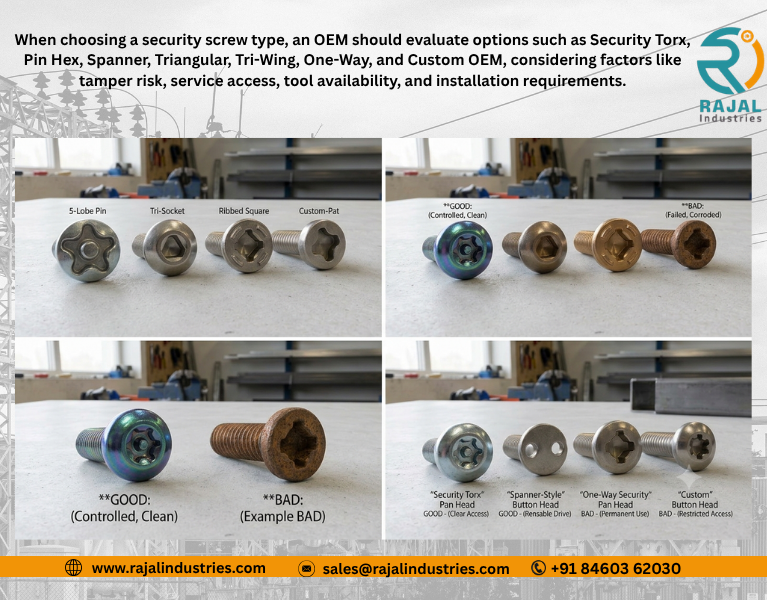
A Security Screw is designed to make unauthorized removal more difficult than with a standard screw by using a specialized drive, restricted-access geometry or other tamper-resistant feature.
However, choosing the correct fastener requires more than selecting an unusual recess.
A complete specification should define:
Drive + Head + Thread + Length + Material + Mechanical Properties + Finish + Matching Tool + Application + Inspection
Different Security Screw Types can behave very differently during installation, servicing and long-term use.
This guide explains the main technical factors OEMs should review before selecting Tamper Resistant Screws for industrial equipment, electrical panels, railway equipment, public infrastructure and other controlled-access applications.
Quick Answer: What Are the Main Security Screw Types?
Common security screw categories include designs using:
- Security Torx-type drives
- Pin hex drives
- Spanner-style drives
- Triangular drives
- Tri-wing or similar specialty drives
- One-way drives
- Custom OEM security profiles
The best type depends on the required level of tamper resistance, authorized service access, tool availability, material, head style, installation method and application.
What Makes a Screw a Security Screw?
The main difference is usually the drive.
A conventional screw may use:
- Phillips
- Slotted
- Hex
- Standard Torx
A Security Screw instead uses a less-common or restricted-access drive geometry.
The objective is usually:
Reduce Unauthorized Tool Access
rather than:
Make Removal Impossible
That distinction is important.
Security Screw vs Tamper Resistant Screw
These terms are often used interchangeably.
Tamper Resistant Screws are designed to make unauthorized removal more difficult.
The phrase “tamper proof” is also common in commercial use, but it should not be interpreted as guaranteeing that removal is impossible.
A determined user with enough time, access and specialized tools may still remove many fasteners.
Main Security Screw Categories
A practical classification is:
| Category | Main Feature | Typical Use Direction |
| Reusable Security Screw | Specialized removable drive | Serviceable equipment |
| Pin-Type Security Screw | Central pin + matching bit | Panels/enclosures |
| Spanner-Type Screw | Restricted two-point engagement | Public equipment |
| One-Way Screw | Easy installation, difficult removal | Permanent-type assembly |
| Custom Security Screw | OEM-specific drive | Controlled tool access |
| Security Self-Tapping Screw | Security drive + self-tapping thread | Sheet-metal assemblies |
| Security Machine Screw | Security drive + machine thread | Tapped hole/nut/insert |
The exact product geometry should follow the applicable drawing or specification.
Security Torx-Type Screws
A security Torx-type screw usually uses a star-shaped internal drive with an added center pin or feature.
A matching security bit is required.
Potential advantages include:
- Good tool engagement
- Suitable for reusable service access
- Compatible with powered installation in suitable designs
- Familiar installation method for many technicians
Potential limitation:
Security Torx-type bits are commercially available.
Therefore, these screws usually provide tamper resistance rather than highly restricted access.
Security Torx-Type Drive Features
Important dimensions can include:
- Recess size
- Recess depth
- Center pin diameter
- Center pin height
- Concentricity
- Head thickness around the recess
Poor control can affect bit engagement.
Standard Torx vs Security Torx-Type
| Feature | Standard Torx | Security Torx-Type |
| Star Drive | Yes | Yes |
| Center Security Feature | No | Usually yes |
| Standard Torx Bit | Fits | Normally blocked |
| Matching Security Bit | Not required | Required |
| Tamper Resistance | Basic | Increased |
The exact drive geometry should be defined by the applicable specification or drawing.
Pin Hex Security Screws
A pin hex security screw uses an internal hex geometry with a central pin.
The matching bit requires a corresponding hole.
This prevents ordinary hex keys or standard hex bits from engaging correctly.
Pin Hex Design Factors
Important controls include:
- Hex dimensions
- Recess depth
- Center pin diameter
- Pin height
- Pin position
- Concentricity
- Tool fit
A damaged pin can make the screw difficult to install or remove even for authorized users.
Spanner Security Screws
Spanner-style screws use two holes or two engagement features rather than a conventional recess.
Potential advantages include:
- Uncommon drive geometry
- Reduced compatibility with common tools
- Clear visual difference from ordinary screws
Potential applications can include suitable:
- Public equipment
- Signage
- Enclosures
- Fixtures
Spanner Drive Considerations
Check:
- Hole spacing
- Hole diameter
- Engagement depth
- Head diameter
- Required installation torque
- Tool strength
- Repeated servicing
This drive may be less suitable where high installation loads are required unless the geometry is specifically designed for them.
Triangular Security Drives
Triangular drive profiles use a triangular recess or external engagement geometry.
These can be found in certain:
- Equipment enclosures
- Public-access products
- Utility-related applications
- Specialized OEM products
Their security level depends heavily on tool availability.
Tri-Wing and Similar Specialty Drives
Tri-wing and related drive concepts use non-standard multi-lobe geometry.
These may be used in selected electronic, appliance or OEM applications.
Important considerations include:
- Drive size
- Tool availability
- Installation torque
- Serviceability
- Head strength
A specialty drive should not be selected only because it looks unusual.
One-Way Security Screws
One-way screws are designed so installation is relatively straightforward but conventional reverse removal is difficult.
They can be useful for:
- Permanent signs
- Public fixtures
- Certain anti-vandal applications
- Assemblies not intended for normal maintenance
However, they can be difficult to service.
One-Way Screw Limitation
Before selecting one-way screws, ask:
Will this component ever need to be removed?
If the answer is yes, a reusable security design may be more practical.
Reusable Security Screws
Reusable security screws allow authorized users to install and remove the fastener using the matching tool.
These can be appropriate for:
- Electrical enclosures
- Railway equipment panels
- Telecom cabinets
- Machinery covers
- Maintenance-access panels
The matching tool becomes part of the maintenance system.
Custom Security Screw Types
Custom Security Screw Types can be developed when standard security drives do not provide enough control.
Possible custom features include:
- Unique recess
- Modified pin arrangement
- Custom lobe pattern
- Proprietary head geometry
- Controlled driver bit
- Customer marking
Custom designs should have a clear engineering or security purpose.
Custom Does Not Mean Impossible to Copy
A custom drive can make unauthorized access more difficult, but it should not be described as impossible to reproduce.
Security also depends on:
- Tool distribution
- Physical access
- Head exposure
- Component design
- Alternative removal routes
Security Drive Selection Matrix
| Drive Style | Serviceability | Tool Availability | Security Direction |
| Security Torx-Type | Good | Relatively available | General tamper resistance |
| Pin Hex | Good | Specialized but obtainable | Controlled access |
| Spanner | Moderate | Less common | Public equipment |
| Triangle | Moderate | Application dependent | Specialized access |
| Tri-Wing/Related | Good to moderate | Specialized | OEM/equipment |
| One-Way | Poor | Removal difficult | Permanent-type use |
| Custom OEM | Designed as required | Controlled | Higher access control |
This is a practical comparison, not a certified security ranking.
Security Screw Head Types
A security drive can be combined with different head styles.
Possible examples include:
- Pan head
- Button head
- Countersunk head
- Raised countersunk head
- Cylindrical head
- Low-profile head
- Specialty/custom head
The correct head depends on the application.
Pan Head Security Screws
Pan head designs can provide:
- Relatively broad bearing surface
- Adequate space for internal security drives
- Common industrial appearance
They may be considered for suitable panels and enclosures.
Button Head Security Screws
Button heads provide a rounded low-profile appearance.
Potential uses include:
- Public-facing equipment
- Railway interiors
- Enclosures
- Machinery panels
The lower head height can limit available recess depth, so drive strength should be reviewed.
Countersunk Security Screws
Countersunk security screws sit flush or nearly flush when installed into a matching countersink.
Potential applications can include:
- Public equipment
- Metal panels
- Transportation interiors
- Enclosures
Important dimensions include:
- Head angle
- Head diameter
- Recess depth
- Countersink geometry
The screw head and mating countersink must match.
Raised Countersunk Security Screws
Raised countersunk heads combine a countersunk seating surface with a slightly raised top profile.
They may be selected where appearance and seating geometry are both important.
The exact dimensions should follow the drawing or applicable standard.
Low-Profile Security Heads
Low-profile heads can reduce gripping access around the screw.
However, lower head height may reduce available drive depth.
This creates a trade-off between:
Low External Profile ↔ Strong Tool Engagement
Security Screw Thread Types
The drive provides tamper resistance.
The thread provides the actual fastening function.
Do not confuse the two.
A security screw can use:
- Metric machine thread
- Unified machine thread
- Self-tapping thread
- Other customer-specified thread forms
Machine-Thread Security Screws
Machine-thread Industrial Screws can be used with:
- Tapped holes
- Nuts
- Threaded inserts
- Other defined internal threads
Important thread details can include:
- Diameter
- Pitch
- Thread class/tolerance
- Thread length
- Thread standard
Metric Security Screws
A metric security screw specification may include:
M Diameter × Pitch × Length
For example:
M5 × 0.8 × 16
But this alone is not a complete security screw specification.
You still need:
Head + Security Drive + Material + Properties + Finish
Unified Thread Security Screws
For US or other applications using Unified threads, the drawing may specify:
- UNC
- UNF
- Other required thread series
The manufacturer should follow the customer’s drawing and applicable thread specification.
Self-Tapping Security Screws
Some designs combine:
Security Drive + Self-Tapping Thread
These can be used in suitable:
- Sheet-metal panels
- Enclosures
- Equipment housings
- Industrial assemblies
The self-tapping side of the application still requires review of:
- Mating material
- Thickness
- Pilot hole
- Thread geometry
- Point
- Installation
Security Screw vs Self-Drilling Security Screw
Do not use these terms interchangeably.
Self-Tapping Security Screw
Develops its mating thread in a suitable hole/material.
Self-Drilling Security Screw
Would additionally require a drill-point feature capable of producing the hole in the intended material.
A standard self-tapping security screw should not automatically be assumed to drill its own hole.
Security Screw Diameter
Nominal diameter influences:
- Thread size
- Head dimensions
- Drive space
- Required hole
- Joint performance
Selection should follow the actual application rather than simply choosing the largest available diameter.
Security Screw Length
Length should provide sufficient engagement without creating interference.
Check:
- Component stack
- Thread engagement
- Internal clearance
- Point or end geometry
- Service requirements
In electrical and electronic equipment, excessive length can interfere with internal components.
How Is Screw Length Measured?
Length measurement depends on head style.
For many non-countersunk screws, nominal length is measured from beneath the head.
For countersunk screws, measurement conventions can differ because the head is intended to sit in the countersink.
Always follow the applicable drawing or standard.
Security Drive Size
Security drive size should be large enough to support:
- Required installation
- Tool life
- Authorized removal
but must also fit within:
- Head diameter
- Head height
- Recess wall thickness
This becomes particularly important in small Industrial Screws.
Small Security Screws
Small security screws can be challenging because limited head size must accommodate:
- Drive geometry
- Center pin where applicable
- Required recess depth
- Adequate wall thickness
Manufacturing feasibility should be reviewed before finalizing a highly complex drive in a very small head.
Material Selection for Security Screws
The most common material categories can include:
- Carbon steel
- Alloy steel where required
- Stainless steel
- Customer-specified material
The correct material depends on the full specification.
Carbon Steel Security Screws
Carbon steel can provide suitable manufacturing and mechanical options for many industrial applications.
A complete requirement should specify:
- Material or approved grade
- Mechanical properties
- Heat treatment where required
- Surface finish
Do not use only “mild steel” as an OEM specification if controlled properties are important.
Alloy Steel Security Screws
Alloy steel may be specified where a particular mechanical-property system is required.
However, alloy steel should not be selected simply because it sounds stronger.
Use the customer drawing and applicable mechanical requirements.
Stainless Steel Security Screws
Stainless steel can be useful where corrosion resistance is important.
Potential grades can include suitable:
- 304 / A2-type
- 316 / A4-type
- Other specified grades
The actual grade should be selected based on environment and customer requirements.
SS304 Security Screws
SS304-type material can be suitable for many:
- Indoor industrial applications
- General equipment
- Electrical enclosures
- Public equipment
where the defined corrosion environment permits it.
SS316 Security Screws
SS316-type material can be considered for more demanding environments, particularly where chloride exposure is important.
Potential examples include:
- Coastal equipment
- Marine-adjacent infrastructure
- Some chemical environments
But SS316 is not automatically required for every outdoor application.
Stainless Steel Security Screws and Galling
Where stainless screws engage stainless mating threads, galling can become a consideration.
Potential factors include:
- Material combination
- Surface condition
- Installation speed
- Lubrication strategy where approved
- Thread fit
The joint should be evaluated where repeated service is required.
Material Comparison
| Material | Main Advantage | Main Consideration |
| Carbon Steel | Cost/mechanical flexibility | Needs suitable corrosion protection |
| Alloy Steel | Specific mechanical performance | Application-specific |
| SS304/A2-Type | General corrosion resistance | Environment dependent |
| SS316/A4-Type | Improved resistance in certain environments | Higher cost |
| Custom Material | Meets special requirement | Availability/manufacturability |
Mechanical Properties
Security is not a substitute for mechanical performance.
A Security Screw may still need controlled:
- Tensile properties
- Hardness
- Toughness
- Torsional performance
- Thread performance
- Head strength
The exact requirements depend on material, thread type and application.
Drive Strength
The security recess must withstand the intended installation and removal process.
Weak drive geometry can lead to:
- Rounding
- Cam-out
- Pin damage
- Tool wear
- Failed removal
Drive strength depends on both design and material condition.
Head Strength
Head design should provide enough material around the security recess.
A very deep or wide security recess in a small head can reduce remaining head material.
This is especially important for:
- Small diameter screws
- Low-profile heads
- High installation requirements
Heat Treatment
Some carbon or alloy steel screw designs may require heat treatment to achieve specified properties.
Important controls can include:
- Surface hardness
- Core properties
- Toughness
- Distortion
- Cracking
The exact heat-treatment requirement should follow the product specification.
Higher Hardness Is Not Always Better
Excessive hardness can increase brittleness.
Too little hardness can cause:
- Drive deformation
- Thread damage
- Poor performance
The target should be the specified property range.
Surface Finish Options
Possible finishes can include:
- Zinc-based systems
- Black finishes
- Engineered corrosion-resistant coatings
- Passivation for suitable stainless products
- Customer-specific coatings
The final finish should be defined by performance requirements.
Zinc-Finished Security Screws
Zinc-based finishes are common on carbon-steel industrial screws.
But a complete coating specification may need to define:
- Coating system
- Thickness
- Appearance
- Corrosion requirement
- Friction requirement where applicable
Do not rely only on the word “zinc.”
Black Security Screws
A black appearance can be produced using different finishing systems.
Therefore:
Black Colour ≠ Defined Corrosion Performance
Specify the actual finishing system and required performance.
Passivated Stainless Security Screws
Passivation may be specified for suitable stainless-steel screws.
The exact treatment should follow the approved process and customer specification.
Coating Thickness and Drive Geometry
Security recesses can contain small functional details.
Coating buildup can affect:
- Recess width
- Pin clearance
- Bit engagement
- Tool fit
Therefore, final dimensional and tool-fit approval should consider the finished screw.
Corrosion Requirements
Instead of specifying:
“Rust-proof security screw”
define:
- Material
- Coating
- Test requirement where applicable
- Acceptance criteria
- Service environment
This produces a much clearer industrial specification.
Indoor Security Screws
For indoor equipment, selection can prioritize:
- Required mechanical properties
- Appearance
- Basic corrosion protection
- Tool fit
- Serviceability
But humid or chemically active indoor environments may require higher corrosion protection.
Outdoor Security Screws
Outdoor use can expose screws to:
- Rain
- Humidity
- Condensation
- Pollution
- Temperature changes
Material and finish should follow the defined exposure conditions.
Coastal Security Screws
Coastal environments can introduce chloride exposure.
Evaluate:
- Stainless grade
- Coated steel options
- Mating material
- Galvanic interaction
- Customer corrosion requirement
Do not select solely from the word “coastal.”
Security Screw Specifications
A complete industrial specification can include:
| Category | Required Information |
| Diameter | Nominal screw size |
| Thread | Type/pitch/tolerance |
| Length | Nominal length |
| Head | Style and dimensions |
| Drive | Security profile |
| Drive Size | Defined geometry |
| Recess Depth | Controlled dimension |
| Pin | Diameter/height if applicable |
| Material | Grade/specification |
| Mechanical | Required properties |
| Heat Treatment | If required |
| Finish | Coating/passivation |
| Corrosion | Defined requirement |
| Tool | Matching driver |
| Inspection | Dimensional/functional |
| Packaging | Customer requirement |
Complete Security Screw Designation Example
A weak specification:
M5 × 16 Security Screw, Stainless
A stronger specification would define:
M5 × 0.8 × 16 + Button Head + Specified Security Drive + Controlled Drive Size + SS304 + Approved Finish/Passivation + Matching Tool + Drawing Revision
This example is illustrative only.
The customer’s controlled drawing should define the final product.
Security Screw Drawing Requirements
A drawing may need to show:
- Nominal diameter
- Pitch
- Thread length
- Overall/nominal length
- Head diameter
- Head height
- Security-drive geometry
- Drive depth
- Pin geometry
- Head angle where countersunk
- Material
- Finish
- Tolerances
- Marking
- Inspection requirements
Matching Tool Specification
For reusable Tamper Resistant Screws, the tool should not be treated as an afterthought.
The tool specification may include:
- Drive geometry
- Part number
- Material
- Fit
- Revision
- Handle/bit format
- Required durability
- Packaging/distribution
For custom drives, both screw and bit drawings should be controlled.
Screw-to-Bit Fit
The screw and bit must engage with enough:
- Depth
- Contact
- Alignment
- Clearance
to install and remove the screw reliably.
Too tight can cause:
- Difficult bit entry
- Jamming
- Coating damage
Too loose can cause:
- Slipping
- Drive damage
- Rapid tool wear
Security Drive Tolerances
Drive tolerances can be particularly important because small deviations directly affect tool fit.
Critical dimensions may include:
- Width across drive features
- Depth
- Pin diameter
- Pin position
- Concentricity
Tolerance values should come from the approved design or applicable specification.
Inspection Requirements
A security screw inspection plan can include:
Dimensional Inspection
- Diameter
- Thread
- Length
- Head
- Drive
- Pin
- Recess depth
Material Verification
Confirm required material.
Mechanical Testing
As specified by the drawing/product requirement.
Surface Finish
Check coating or passivation requirements.
Functional Testing
Confirm screw-to-tool engagement and installation.
Tool-Fit Testing
A useful functional sequence is:
Bit Entry → Full Engagement → Installation → Removal Where Required
This can identify issues that dimensional inspection alone may miss.
Security Screw Production Flow
A typical manufacturing sequence can be:
Raw Material → Wire Preparation → Heading → Security Drive Forming → Thread Production → Heat Treatment Where Required → Surface Finish → Inspection → Tool-Fit Test → Packaging
The exact sequence varies by product design.
Security Drive Forming Quality
Potential drive defects include:
- Incomplete recess
- Rounded profile
- Shallow depth
- Off-center drive
- Damaged pin
- Burrs
- Cracks
- Distortion
These can directly affect authorized tool use.
Thread Quality
Inspect:
- Major diameter
- Pitch
- Thread profile
- Thread length
- Burrs
- Damage
A good security drive does not compensate for a bad thread.
Head Quality
Head inspection can include:
- Diameter
- Height
- Profile
- Concentricity
- Countersink angle where applicable
- Surface condition
This is especially important where the head is visible in public-facing equipment.
Appearance Requirements
Public infrastructure and equipment may require a controlled visual finish.
Possible requirements can include:
- Smooth head
- Defined colour
- No excessive tool marks
- Consistent coating
- Marking requirements
Appearance should be specified separately from security performance.
Marking
Custom Industrial Screws may include:
- Manufacturer marking
- Customer marking
- Grade marking where applicable
- Part identification
Marking feasibility depends on:
- Head size
- Drive geometry
- Manufacturing process
Do not overcrowd a small security screw head.
Security Screw Packaging
Packaging can matter because specialized heads and pins may be susceptible to:
- Impact damage
- Coating damage
- Mixed parts
- Contamination
OEM packaging requirements may include:
- Lot separation
- Labels
- Part number
- Quantity
- Traceability
- Matching bits where supplied
Small Security Screw Manufacturing Challenges
Smaller screws create tighter relationships between:
Head Size + Drive Size + Pin + Recess Depth + Material Strength
This can make custom development more difficult.
Before finalizing a small custom drive, confirm manufacturing feasibility.
Large Security Screw Considerations
Larger security screws may provide more room for drive geometry, but applications can require greater installation loads.
Therefore, evaluate:
- Drive strength
- Tool strength
- Head strength
- Thread
- Material properties
Custom vs Standard Security Screw
Standard Security Screw
Best where:
- Existing drive meets security requirement
- Standard dimensions fit
- Tool availability is acceptable
- Faster sourcing is important
Custom Security Screw
Consider where:
- Unique access control is required
- Existing drive is unsuitable
- Custom head is required
- OEM marking is needed
- Imported part localization is required
When Not to Customize
Avoid custom security geometry if:
- A standard drive meets the real requirement
- Service tools must be easily replaceable
- Quantity is very low
- Development cost cannot be justified
- Security benefit is minimal
Customization should solve a real problem.
Supplier Technical Review
Before ordering custom Security Screw Types, the manufacturer should review:
Drawing → Material → Drive Geometry → Tool → Thread → Head → Finish → Testing → Quantity
This helps identify manufacturing risks early.
Rajal Industries: Security Screw Technical Review
Rajal Industries can evaluate standard and drawing-based Security Screw requirements for suitable industrial OEM applications.
Depending on technical feasibility and customer specifications, requirements can be reviewed for:
- Tamper Resistant Screws
- Custom Security Screws
- Security Screw Types
- Security Torx-Type Screws
- Pin-Hex Security Screws
- Suitable Specialty Drive Screws
- Machine-Thread Security Screws
- Suitable Self-Tapping Security Screws
- Button-Head Security Screws
- Countersunk Security Screws
- Industrial Screws
- Metric Threads
- Customer-Specified Unified Threads
- Custom Head Geometry
- Custom Drive Geometry
- Carbon Steel
- Suitable Alloy Steel
- Stainless Steel
- Customer-Specified Finishes
- Matching Driver Requirements
- Dimensional Inspection
- Material Verification
- Specified Mechanical Testing
- Tool-Fit Testing
- Sample Development
- Tooling
- Pilot Production
- Bulk OEM Supply
Final capability should be confirmed against the approved drawing, drive geometry, tool requirement, material, mechanical properties, finish, testing requirements and production quantity.
Bulk Buyer Quick Answer
What information should I send for a Security Screw quotation?
Send:
Drawing + Security Drive + Head + Thread + Diameter + Length + Material + Mechanical Properties + Finish + Matching Tool + Application + Testing + Quantity
For custom or imported-part localization projects, also send:
Existing Sample + Matching Driver
where available.
How to Select Security Screw Types, Drives, Materials & Specifications
After identifying the available Security Screw designs in Part 1, the next step is matching the drive, head, thread, material, finish and matching tool to the actual application.
For industrial OEM projects, use this selection path:
Application → Security Requirement → Service Access → Drive → Head → Thread → Size → Material → Mechanical Properties → Finish → Matching Tool → Installation → Testing → Approval
A specialized drive alone does not create a complete security-fastener specification.
Security Screw Selection Decision Tree
Step 1: What are you trying to prevent?
Casual Tampering → A commercially available tamper-resistant drive may be sufficient.
Unauthorized Public Access → Evaluate a specialized security drive.
Component Theft → Evaluate the complete anti-theft assembly, not only the screw.
Restricted Maintenance Access → Consider controlled tool availability or a custom drive.
↓
Step 2: Must the screw be removed during normal service?
Yes → Choose a reusable security drive.
No → One-way or difficult-removal designs may be evaluated.
↓
Step 3: What thread is required?
Tapped Hole / Nut / Insert → Machine-thread security screw.
Suitable Sheet-Metal Application → Self-tapping security design may be evaluated.
↓
Step 4: What environment applies?
Indoor / Humid / Outdoor / Coastal / Industrial
↓
Step 5: How will it be installed?
Manual / Powered / Production-Line Installation
↓
Step 6: Validate the complete system.
Finished Screw + Matching Tool + Actual Joint + Installation Process + Authorized Removal
Choosing Between Security Screw Types
The best Security Screw Types are those that provide enough tamper resistance without creating unnecessary manufacturing or maintenance problems.
| Requirement | Drive Direction to Evaluate | Main Concern |
| General Equipment | Security Torx-type / similar | Tool availability |
| Electrical Panel | Reusable security drive | Maintenance |
| Public Enclosure | Specialized drive | Unauthorized access |
| Public Signage | Spanner/other suitable security drive | Outdoor exposure |
| Railway Equipment | Customer-approved reusable drive | Service + vibration |
| Permanent Fixture | One-way concept | Future removal |
| High-Control OEM Product | Custom drive | Tool management |
| Small Electronic Equipment | Compact specialty drive | Head strength |
This is an engineering-selection guide, not a security ranking.
Security Torx-Type vs Pin Hex
Both can make conventional-tool access more difficult, but their geometry and tooling differ.
| Factor | Security Torx-Type | Pin Hex |
| Internal Drive | Multi-lobe/star-type | Hex with center pin |
| Center Feature | Common | Common |
| Reusable | Yes | Yes |
| Powered Assembly | Can be suitable | Can be suitable |
| Tool Availability | Often relatively easy | Specialized but available |
| Pin Control | Important | Important |
| OEM Service | Practical | Practical |
Neither should be described as impossible to remove.
Security Torx-Type vs Standard Torx
A conventional Torx drive is primarily an installation-drive geometry.
A security Torx-type design adds a feature intended to prevent engagement with the corresponding ordinary bit.
This means:
Standard Torx → Common Tool Access
Security Torx-Type → Matching Security Tool Required
However, commercially available security tools reduce the level of access restriction.
Spanner vs Pin-Type Security Screws
Spanner-style drives can provide less-common tool engagement, while pin-type designs often provide more conventional powered-tool handling.
Selection should consider:
- Installation requirement
- Required torque
- Head diameter
- Tool availability
- Service frequency
- Public accessibility
Do not choose solely by appearance.
One-Way vs Reusable Security Screw
This is one of the most important decisions.
One-Way
Best evaluated when:
- Assembly is intended to remain closed
- Removal is rarely expected
- Difficult removal is acceptable
Reusable
Best evaluated when:
- Maintenance is expected
- Components require inspection
- Equipment needs repair
- Authorized technicians need access
One-Way vs Reusable Comparison
| Factor | One-Way | Reusable Security Drive |
| Installation | Relatively straightforward | Matching tool |
| Authorized Removal | Difficult | Practical with tool |
| Regular Maintenance | Poor fit | Better fit |
| Tool Management | Installation focused | Installation + service |
| Permanent Installation | Potentially suitable | Also possible |
| Long-Term Repair | More difficult | Easier |
For infrastructure with a long service life, future maintenance deserves serious consideration.
Head Style and Security Drive Compatibility
Not every drive works equally well with every head.
The available head volume must accommodate:
Drive Width + Drive Depth + Required Wall Thickness
A large, deep security recess inside a very small low-profile head can create manufacturing or mechanical challenges.
Pan Head + Security Drive
A pan head can provide useful internal volume for many security recesses.
Potential benefits:
- Good recess depth
- Broader bearing surface
- Suitable for many equipment applications
The exact head geometry should still follow the approved design.
Button Head + Security Drive
Button heads offer a lower-profile appearance but can provide less vertical space for the recess.
Check:
- Head height
- Drive depth
- Remaining material
- Required installation load
Countersunk Head + Security Drive
A countersunk Security Screw may be useful when a flush surface is required.
Control:
- Countersink angle
- Head diameter
- Head height
- Drive depth
- Mating countersink
Do not assume all countersunk security screws use the same head angle.
Low-Profile Security Screw Design
A low external profile can make gripping the outside of the head more difficult.
But reducing head height can also reduce:
- Recess depth
- Material around the drive
- Tool engagement
The security benefit should therefore be balanced against installation reliability.
Small Security Screw Design
Small security screws require particular care.
As screw diameter decreases, the available head volume also decreases.
Yet the designer may still need:
- Security lobes
- Center pin
- Recess depth
- Adequate wall thickness
This can create a difficult geometry.
Small Screw Design Rule
Do not start with:
“We need this exact complex security drive in an M3 screw.”
Start with:
“What security geometry can be manufactured reliably within the available M3 head and still provide acceptable tool engagement?”
Manufacturing feasibility should influence the design.
Why Very Small Center Pins Can Be Challenging
A small center pin can be sensitive to:
- Forming variation
- Damage
- Coating buildup
- Tool misalignment
- Handling
If the pin is a critical security feature, both dimensional and functional inspection become important.
Large Security Screws
Larger heads provide more space for security geometry, but larger screws can also require greater installation forces.
Evaluate:
Drive Strength + Tool Strength + Head Strength + Thread Requirement + Installation
A large recess is not automatically strong enough for every installation condition.
Machine Thread vs Self-Tapping Security Screw
Machine-Thread Security Screw
Use with a defined internal thread such as:
- Tapped component
- Nut
- Threaded insert
Self-Tapping Security Screw
Can develop a mating thread in a suitable material/hole when specifically designed and validated for that application.
Selection Matrix: Machine Thread vs Self-Tapping
| Factor | Machine Thread | Self-Tapping |
| Mating Thread | Pre-existing | Developed during installation |
| Tapped Hole | Typically required | Not necessarily |
| Pilot Hole | Application dependent | Critical |
| Repeated Service | Often more suitable | Must be evaluated |
| Sheet-Metal Assembly | Possible with nut/insert | Can be suitable |
| Installation Behaviour | Tightening-focused | Tapping + seating |
Self-Tapping Security Screw Selection
For a self-tapping Security Screw, specify both:
Security System
- Drive
- Head
- Matching tool
Self-Tapping System
- Thread
- Point
- Mating material
- Material thickness
- Pilot hole
Ignoring either side can produce a fastener that is secure but does not assemble correctly.
Pilot Hole for Security Self-Tapping Screws
Do not select the pilot hole based only on nominal diameter.
It can depend on:
- Thread
- Point
- Mating material
- Hardness
- Thickness
- Hole process
Too small can increase tapping resistance.
Too large can reduce engagement.
Use the approved product/application specification and functional testing.
Material Selection Decision Matrix
| Application Condition | Material Direction to Evaluate |
| General Indoor Equipment | Suitable coated carbon steel |
| Defined Higher Mechanical Requirement | Specified steel/property system |
| General Corrosion Resistance | Stainless or suitable coated steel |
| Outdoor Infrastructure | Environment-specific material/coating |
| Chloride Exposure | Suitable stainless/coating system review |
| Customer-Mandated Material | Follow drawing |
| Specialized Application | Engineering review |
Carbon Steel or Stainless Steel?
This should be decided from:
Mechanical Performance + Corrosion + Environment + Thread Function + Cost + Customer Specification
Not simply:
“Stainless is better.”
Carbon Steel Security Screws
Carbon steel can be a practical option for many Industrial Screws where:
- Required mechanical properties can be achieved
- Suitable corrosion protection is specified
- Environment permits it
The material and finish should be considered together.
Stainless Security Screws
Stainless can be useful where corrosion resistance is important.
But selection should consider:
- Grade
- Mating material
- Thread
- Installation
- Galling risk
- Environment
SS304 vs SS316 Decision
SS304/A2-Type
Can be suitable for many general industrial and indoor applications.
SS316/A4-Type
May be considered where the environment presents more demanding chloride-related corrosion exposure.
The final choice should follow actual exposure and specification.
Do Not Select SS316 Only Because It Is Outdoor
“Outdoor” can describe very different environments:
- Sheltered urban equipment
- Industrial plant
- Coastal installation
- Roadside equipment
- High-humidity environment
Define the exposure before selecting the material.
Galvanic Corrosion Considerations
Different metals can interact when electrically connected in the presence of an electrolyte.
For example:
Stainless Screw + Aluminium Component + Moisture
may require review.
Consider:
- Screw material
- Mating material
- Coating
- Environment
- Isolation where required
Coating Selection Matrix
| Requirement | What to Define |
| Indoor General | Finish + appearance |
| Humidity | Corrosion requirement |
| Outdoor | Defined coating system |
| Coastal | Chloride/environment review |
| Public Equipment | Corrosion + appearance |
| Railway Equipment | Customer/OEM specification |
| Electrical Equipment | Corrosion + functional requirements |
Coating Can Affect the Security Drive
Security recesses can contain small features.
Coating buildup can reduce:
- Clearance
- Pin space
- Bit entry
- Engagement depth
Therefore:
Uncoated Sample Fit ≠ Guaranteed Finished Screw Fit
Final-Finish Validation
Where practical, approve:
Production-Intended Screw + Production-Intended Finish + Production-Intended Driver
This is especially important for small or detailed security drives.
Matching Tool Selection
The tool is a functional part of reusable Tamper Resistant Screws.
A complete system should define:
- Tool profile
- Size
- Part number
- Revision
- Material
- Bit/driver format
- Fit
- Replacement process
Screw-to-Tool Fit
Tool fit should provide enough clearance for reliable entry without excessive looseness.
Too Tight
Possible issues:
- Bit does not enter
- Bit jams
- Coating scratches
- Difficult production
Too Loose
Possible issues:
- Slipping
- Drive deformation
- Poor torque transfer
- Tool wear
Security Drive Tolerances
A custom drive drawing may control:
- Recess width
- Recess depth
- Pin diameter
- Pin height
- Pin position
- Concentricity
Do not invent tolerances from a generic security-screw chart.
Use the approved drive design and validated tooling.
Drive Depth
Insufficient depth can reduce tool engagement.
Excessive depth can reduce remaining head material.
The correct drive depth balances:
Tool Engagement ↔ Head Integrity
Center Pin Tolerance
For pin-based designs, the center pin must fit inside the corresponding tool opening.
If the pin is:
Too Large → Tool may not fit.
Too Small → Security geometry and tool guidance may be affected.
Off-Center → Tool engagement may become difficult.
Installation Testing
A practical validation sequence is:
Tool Entry → Full Engagement → Installation → Seating → Authorized Removal
Where repeated service is expected, additional removal/reinstallation testing may be appropriate.
Powered Installation
For production-line installation, evaluate:
- Driver
- Bit
- Alignment
- Speed
- Installation setting
- Tool wear
- Drive condition after installation
A security screw designed only for slow manual installation may not automatically suit high-volume powered assembly.
Tool Life
Tool life depends on:
- Drive design
- Screw material
- Bit material
- Fit
- Installation load
- Alignment
- Production conditions
There is no universal number of installations that every security bit should survive.
Define and validate tool-life expectations for the actual application.
Repeated Removal
Where maintenance requires repeated access, evaluate:
Install → Remove → Inspect → Reinstall
Possible degradation includes:
- Recess wear
- Pin damage
- Tool wear
- Thread wear
- Coating damage
The acceptable number of service cycles depends on the application.
Security Drive Failure Analysis
When the drive fails, investigate four areas:
1. Screw Geometry
Recess, pin, head and dimensions.
2. Screw Material
Mechanical properties and heat treatment where applicable.
3. Driver
Correct size, geometry, wear and condition.
4. Installation
Alignment, speed and setting.
This prevents automatically blaming the screw or tool.
Security Screw Troubleshooting Table
| Problem | First Check | Then Check |
| Bit Will Not Enter | Drive dimensions | Coating |
| Bit Is Loose | Recess/tool dimensions | Tool wear |
| Bit Slips | Engagement depth | Alignment |
| Drive Rounds | Tool fit | Installation |
| Center Pin Breaks | Pin geometry | Tool alignment |
| Head Cracks | Drive/head geometry | Material/properties |
| Screw Breaks | Joint/installation | Screw properties |
| Removal Difficult | Drive condition | Corrosion |
| Tool Wears Quickly | Screw-to-tool fit | Installation |
| Coating Damaged | Tool contact | Finish |
| Lot Fit Changes | Drive dimensions | Process control |
Drive Rounding
Possible causes include:
- Incorrect bit
- Insufficient engagement
- Excessive installation
- Poor alignment
- Recess variation
- Tool wear
- Material/property issue
Do not simply make the recess deeper without reviewing head strength.
Center Pin Damage
Pin damage can occur during:
- Manufacturing
- Coating
- Handling
- Tool insertion
- Misaligned installation
Inspect the pin before deciding whether the root cause is material or geometry.
Head Cracking
A security recess removes material from the head.
Possible contributors to cracking include:
- Excessive recess depth
- Insufficient surrounding material
- Material condition
- Manufacturing defects
- Excessive installation
Head and drive should be engineered together.
Corrosion-Related Removal Problems
A screw may install perfectly but become difficult to remove years later because of:
- Corrosion
- Contamination
- Thread condition
- Environmental exposure
For serviceable infrastructure, long-term removal requirements should be considered during material and finish selection.
Manufacturing Process Control
A typical process for suitable security screws may include:
Raw Material → Heading → Security Drive Forming → Thread Production → Heat Treatment Where Required → Finish → Dimensional Inspection → Tool-Fit Test → Final Inspection → Packaging
The exact route depends on screw design.
Critical Manufacturing Features
For Tamper Resistant Screws, important characteristics can include:
- Head diameter
- Head height
- Drive geometry
- Drive depth
- Center pin
- Thread
- Length
- Material
- Finish
For custom products, identify critical-to-function dimensions on the approved drawing.
Drive Forming
The drive-forming operation must consistently reproduce the intended geometry.
Possible defects include:
- Incomplete forming
- Shallow recess
- Rounded features
- Off-center drive
- Damaged pin
- Burrs
Functional tool-fit testing can supplement dimensional inspection.
Thread Production
Thread inspection can cover:
- Diameter
- Pitch
- Profile
- Thread length
- Damage
- Burrs
For machine threads, appropriate gauges may be used according to the applicable specification.
Heat-Treatment Control
Where heat treatment is required, verify the properties specified for the product.
Do not use “hard enough for security screw” as a technical specification.
Security resistance and mechanical properties are separate requirements.
Surface-Finish Control
Inspect:
- Finish type
- Appearance
- Coating condition
- Required thickness where specified
- Corrosion-test requirements where specified
- Drive buildup
A coating that passes appearance inspection can still create tool-fit problems.
Security Screw Quality Control Plan
| Stage | Control |
| Raw Material | Material verification |
| Heading | Head dimensions |
| Drive Forming | Security geometry |
| Threading | Thread dimensions |
| Heat Treatment | Specified properties |
| Coating | Finish requirement |
| Dimensional Inspection | Drawing compliance |
| Tool-Fit Test | Driver engagement |
| Functional Test | Installation/removal |
| Packaging | Part/lot identification |
Functional Testing vs Dimensional Inspection
Both are useful.
Dimensional Inspection Answers:
Does the part match the drawing?
Functional Testing Answers:
Does the screw work correctly with the intended tool and assembly?
For a security fastener, both questions matter.
Sample Approval Process
For custom Security Screw Types:
Drawing Review → Manufacturing Review → Tooling → Samples → Dimensional Inspection → Material/Finish Verification → Tool-Fit Test → Installation Test → Authorized Removal Test → Approval
Final-Finish Samples
Do not approve only unfinished heading samples where final coating may affect the drive.
Where possible, final approval should include production-intended:
Material + Heat Treatment + Finish + Tool
Pilot Lot
For high-volume OEM production:
Approved Samples → Pilot Lot → Production Trial → Mass Production
A pilot lot can identify process variation that may not appear in a small development sample.
Pilot-Lot Checks
Review:
☐ Head consistency
☐ Drive dimensions
☐ Drive depth
☐ Center pin
☐ Thread
☐ Length
☐ Material
☐ Mechanical properties
☐ Finish
☐ Tool fit
☐ Installation
☐ Authorized removal
☐ Packaging
☐ Traceability
Manufacturer Qualification
When sourcing custom security fasteners, ask:
- Can you review a detailed drawing?
- Have you manufactured similar drive geometries?
- Can you develop heading/recess tooling?
- Can you support matching driver development?
- How is the drive measured?
- Is functional tool-fit testing available?
- How is raw material controlled?
- How is thread quality controlled?
- How is heat treatment controlled where required?
- How is coating controlled?
- Can you provide final-finish samples?
- Can you support a pilot lot?
- Is batch traceability available?
- What inspection documents can be supplied?
- What is the production capacity?
Manufacturer vs Trader
For a standard catalogue screw, a distributor may be sufficient for some purchasing requirements.
For a custom OEM security fastener, understand who controls:
- Tooling
- Heading
- Drive forming
- Threading
- Heat treatment
- Coating
- Inspection
- Driver supply
Some operations can legitimately be outsourced.
The key is controlled manufacturing and traceability.
Localizing an Imported Security Screw
Localization can be useful where an OEM currently imports a specialized screw and wants a domestic manufacturing source.
A strong technical package includes:
Approved Drawing + Existing Screw + Matching Bit + Material Specification + Finish Specification + Application Requirements
Do Not Reverse Engineer from Sample Alone
A sample can provide dimensional information but may not reveal:
- Original tolerance
- Material specification
- Heat treatment
- Mechanical properties
- Coating specification
- Revision
- Functional requirements
The approved drawing and specification should remain the preferred basis.
Localization Process
Existing Part → Drawing Review → Sample Measurement → Material/Finish Confirmation → Drive & Tool Review → Manufacturing Feasibility → Tooling → Samples → Functional Validation → Pilot Lot → Production Approval
OEM Supplier Comparison
| Factor | Supplier A | Supplier B | Supplier C |
| Drawing Compliance | Compare | Compare | Compare |
| Drive Capability | Compare | Compare | Compare |
| Matching Tool | Compare | Compare | Compare |
| Material | Compare | Compare | Compare |
| Mechanical Properties | Compare | Compare | Compare |
| Finish | Compare | Compare | Compare |
| Inspection | Compare | Compare | Compare |
| Tool-Fit Testing | Compare | Compare | Compare |
| Pilot Lot | Compare | Compare | Compare |
| Traceability | Compare | Compare | Compare |
| MOQ | Compare | Compare | Compare |
| Capacity | Compare | Compare | Compare |
| Lead Time | Compare | Compare | Compare |
| Price | Compare Last | Compare Last | Compare Last |
First establish technical equivalence.
Then compare commercial terms.
Complete Security Screw RFQ Checklist
Application
☐ Industry
☐ Component
☐ Security objective
☐ Public accessibility
☐ Service requirement
Screw Geometry
☐ Diameter
☐ Thread
☐ Length
☐ Head type
☐ Head diameter
☐ Head height
☐ Security drive
☐ Drive size
☐ Drive depth
☐ Pin geometry
☐ Drawing/revision
Material
☐ Material grade
☐ Mechanical properties
☐ Heat treatment
Surface
☐ Finish
☐ Coating specification
☐ Corrosion requirement
☐ Appearance
Tool
☐ Matching driver
☐ Tool drawing
☐ Tool part number
☐ Installation requirement
☐ Removal requirement
Quality
☐ Dimensional report
☐ Material certificate
☐ Mechanical tests
☐ Coating report
☐ Tool-fit test
☐ Functional test
☐ Traceability
Commercial
☐ Sample quantity
☐ Pilot quantity
☐ MOQ
☐ First order
☐ Annual quantity
☐ Packaging
☐ Delivery location
Example OEM RFQ
We require a custom Security Screw for an industrial equipment enclosure. Please review the attached drawing and matching driver requirement. The specification includes a controlled security drive, machine thread, material, mechanical properties and surface finish. Please confirm manufacturing and tooling feasibility, final-finish samples, tool-fit testing, MOQ, production capacity and bulk lead time.
Frequently Asked Questions
What is a Security Screw?
A Security Screw uses a specialized drive or fastening feature intended to make unauthorized removal more difficult than with a conventional screw. The exact design should also meet the application’s mechanical, corrosion, installation and service requirements.
What are the main Security Screw Types?
Common categories include security Torx-type, pin hex, spanner, triangular, specialty multi-lobe, one-way and custom OEM security drives. Security drives can also be combined with machine or self-tapping threads.
What are Tamper Resistant Screws?
Tamper Resistant Screws use specialized drive geometry or other features to discourage unauthorized removal. They generally require a matching tool but should not be assumed impossible to remove.
Which security screw type is best?
There is no universal best type. Select based on tampering risk, authorized service access, tool availability, installation requirement, head geometry and environment.
Are security Torx-type screws reusable?
They can generally support authorized removal with the correct matching tool where the complete screw and joint are designed for service.
Are one-way security screws reusable?
They are designed to make normal reverse removal difficult, so they are generally less practical for regularly serviced equipment.
Can security screws use normal machine threads?
Yes. A specialized security drive can be combined with a suitable metric, Unified or other customer-specified machine thread.
Can a Security Screw be self-tapping?
Yes, suitable security drives can be combined with self-tapping thread designs. The mating material, thickness and pilot hole still require engineering review.
What material is best for security screws?
There is no universal best material. Carbon steel, alloy steel and stainless steel can all be appropriate depending on mechanical properties, corrosion, manufacturing requirements and customer specifications.
Is SS316 always better than SS304?
No. SS316 can provide improved resistance in certain chloride-containing environments, but it is not automatically necessary for every application.
Does coating affect a security drive?
Yes. Coating buildup can affect recess dimensions, pin clearance and bit engagement, particularly in small security drives.
Should the matching bit be included in the specification?
For custom or controlled security drives, yes. Screw and driver geometry should be reviewed together.
Why does a security screw bit slip?
Possible causes include incorrect tool size, insufficient drive engagement, recess variation, excessive installation, misalignment or tool wear.
Should security screws be functionally tested?
For custom and application-sensitive OEM requirements, functional screw-to-tool and installation testing can supplement dimensional inspection.
Can an imported security screw be manufactured locally?
Potentially, subject to manufacturing feasibility, tooling, material, finish and quantity. An approved drawing, existing sample and matching tool provide a stronger localization package than a sample alone.
AEO Quick Answers
What are the most common Security Screw Types?
Common Security Screw Types include security Torx-type, pin hex, spanner, triangular, specialty multi-lobe, one-way and custom OEM drives. The right type depends on tamper resistance, authorized service access, tool availability, installation requirements and the application’s environment.
How do I choose a Security Screw?
Choose a Security Screw by defining the security objective first. Then select the drive, service strategy, head, thread, size, material, mechanical properties, finish and matching tool. Validate the finished screw with the intended driver and actual or representative assembly before production approval.
What is the difference between a Security Screw and a normal screw?
The primary difference is normally the drive or access feature. A security screw uses specialized geometry intended to make unauthorized tool engagement more difficult, while conventional screws commonly use widely available drives such as Phillips, hex or standard Torx.
What specification should I send for custom Tamper Resistant Screws?
Send the approved drawing, drive geometry, head, thread, diameter, length, material, mechanical properties, finish, matching driver requirement, application, testing requirements and expected quantity. For localization, also provide the approved existing sample and driver where available.
Should I use standard or custom security screws?
Use a standard security drive when it provides sufficient access control and serviceability. Consider a custom design when a standard drive cannot meet the required tool-control, geometry or OEM requirements and the added tooling and maintenance complexity can be justified.
Final Technical Checklist
Before approving a Security Screw, confirm:
Geometry
☐ Diameter
☐ Length
☐ Thread
☐ Head
☐ Drive profile
☐ Drive depth
☐ Center pin where applicable
Material
☐ Grade
☐ Mechanical properties
☐ Heat treatment where required
Finish
☐ Coating/passivation
☐ Corrosion requirement
☐ Appearance
☐ Final-finish drive fit
Matching Tool
☐ Correct profile
☐ Tool part number
☐ Revision
☐ Engagement
☐ Installation
☐ Authorized removal
☐ Tool-life requirement where applicable
Application
☐ Security objective
☐ Mating component
☐ Environment
☐ Installation process
☐ Service frequency
Approval
☐ Drawing
☐ Samples
☐ Dimensional report
☐ Material verification
☐ Mechanical testing where specified
☐ Tool-fit testing
☐ Functional test
☐ Pilot lot where appropriate
☐ Traceability
Key Takeaways
- A Security Screw is a complete engineered fastener, not simply an unusual recess.
- Different Security Screw Types provide different balances of tamper resistance and serviceability.
- Common security drives generally deter unauthorized access rather than make removal impossible.
- One-way screws require careful maintenance planning.
- Custom security drives should be developed with their matching tools.
- Head geometry limits available security-drive size and depth.
- Small security screws require careful drive/manufacturing feasibility review.
- Machine-thread and self-tapping security screws serve different mating conditions.
- Security requirements do not replace mechanical requirements.
- Carbon steel and stainless steel should be selected from the application.
- SS316 is not automatically necessary outdoors.
- Coating can affect security-drive fit.
- Screw and bit tolerances must work together.
- Final-finish samples are preferable for tool-fit approval.
- Functional testing complements dimensional inspection.
- Reusable designs should be tested for authorized removal where required.
- Supplier technical capability should be established before comparing price.
- Imported-part localization should use drawings, specifications, samples and matching tools where available.
Conclusion
A complete Security Screw specification should connect three systems:
Fastener + Security Drive + Authorized Tool
The technical selection should then account for:
Head + Thread + Material + Mechanical Properties + Finish + Application + Installation + Testing
For industrial OEMs, electrical equipment, railway equipment and public infrastructure, this approach provides a stronger basis for selecting Tamper Resistant Screws than choosing a fastener simply because its drive looks difficult to remove.
Rajal Industries can evaluate drawing-based Security Screw Types and custom Industrial Screws for suitable OEM applications, subject to manufacturing feasibility, required tooling, customer specifications and production quantity.