

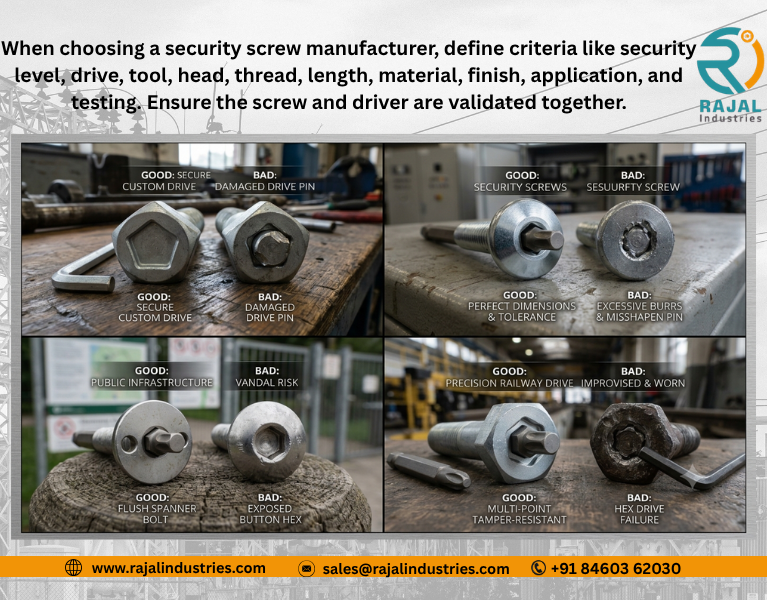
Choosing the right Security Screw Manufacturer is important when a fastener must do more than simply hold two components together.
Security screws are designed to make unauthorized removal, casual tampering or theft more difficult by using specialized drive geometries or fastening designs.
Depending on the application, Tamper Proof Screws, Security Fasteners and Anti Theft Screws may be considered for:
- Railway equipment
- Electrical panels
- Public infrastructure
- Utility equipment
- Telecom equipment
- Public-access enclosures
- Transportation systems
- Industrial machinery
- Outdoor equipment
- OEM products requiring controlled access
For custom OEM projects, the security drive should be selected together with the screw material, head geometry, thread, finish, mating component, installation process and authorized service-tool strategy.
Quick Answer: What Is a Security Screw?
A security screw is a fastener designed to make unauthorized removal or tampering more difficult than with a conventional screw.
Instead of a common drive such as a standard Phillips or hex drive, the screw may use a specialized drive geometry that requires a matching tool.
However, no screw should be described as absolutely tamper-proof or theft-proof.
A better engineering objective is:
Increase Removal Difficulty + Control Tool Access + Maintain Required Joint Performance
What Should a Security Screw Manufacturer Control?
A capable Security Screw Manufacturer should understand more than the unusual drive shape.
For custom OEM requirements, important characteristics can include:
| Feature | Why It Matters |
| Security Drive | Controls tool engagement |
| Drive Dimensions | Affects authorized tool fit |
| Head Geometry | Controls seating and access |
| Thread | Matches mating component |
| Screw Length | Controls engagement |
| Material | Affects mechanical/corrosion performance |
| Mechanical Properties | Supports joint requirements |
| Surface Finish | Provides required protection |
| Tool Design | Enables authorized installation/service |
| Tolerances | Supports repeatable drive fit |
| Inspection | Confirms production consistency |
| Traceability | Supports OEM quality control |
A visually unusual recess alone does not make a technically controlled security fastener.
Security Screw vs Standard Screw
| Feature | Standard Screw | Security Screw |
| Drive | Common | Specialized or restricted-access |
| Removal Tool | Widely available | Matching tool normally required |
| Tamper Resistance | Basic | Increased |
| Unauthorized Removal | Easier | More difficult |
| Service Tool Planning | Usually simple | Important |
| Drive Inspection | Important | Particularly important |
| OEM Customization | Possible | Often useful |
The exact security level depends on the drive design, tool availability, installation and application.
Tamper Resistant vs Tamper Proof
The phrase Tamper Proof Screws is widely used commercially.
Technically, however, “tamper resistant” is often a safer description because determined removal may still be possible with sufficient access, time or specialized tools.
Therefore, OEMs should define the actual requirement:
- Discourage casual removal
- Reduce unauthorized access
- Require a specialized service tool
- Make opportunistic component theft more difficult
- Control maintenance access
This is more useful than simply asking for a “100% tamper-proof screw.”
Security Screw vs Anti-Theft Screw
The terms overlap, but the intended application can differ.
Security Screw
Primarily focuses on restricting or discouraging unauthorized removal or access.
Anti Theft Screw
Often selected where unauthorized fastener removal could enable theft of:
- Panels
- Covers
- Components
- Equipment
- Public assets
In either case, the complete assembly should be evaluated.
How Security Screws Work
The basic principle is:
Non-Standard Drive + Matching Tool + Controlled Geometry
Some designs add further resistance through:
- Drive features that are difficult to engage with common tools
- Pin features
- Unusual recess geometry
- One-way installation concepts
- Custom or proprietary drive profiles
The right choice depends on how the equipment will be installed and serviced.
Common Security Screw Drive Concepts
Security fasteners can use several drive approaches.
Examples include:
- Pin-in drive designs
- Security Torx-type drives
- Pin hex designs
- Spanner-style drives
- Triangular drives
- Tri-wing or similar specialized geometries
- One-way drives
- Custom OEM drive profiles
Availability and exact geometry vary between manufacturers and specifications.
For custom OEM programs, the approved drawing should define the actual recess.
Security Torx-Type Screws
A security Torx-type design generally adds a center feature that prevents use of a conventional matching Torx bit.
A corresponding security bit is required.
Potential applications can include:
- Equipment covers
- Public-access products
- Electrical enclosures
- Transportation equipment
However, commonly available security bits may still be obtainable by unauthorized users.
Therefore, the required security level should be considered before selecting the drive.
Pin Hex Security Screws
Pin hex designs can use a central pin with a corresponding tool.
They may be considered where a conventional hex socket should not provide direct access.
Important controls include:
- Recess dimensions
- Pin dimensions
- Pin position
- Tool fit
- Material condition
Poor dimensional control can make authorized installation difficult.
Spanner-Style Security Screws
Some security screws use two-hole or specialized spanner-style engagement.
Potential advantages can include:
- Uncommon tool engagement
- Visible differentiation from standard screws
Selection should consider:
- Required installation torque
- Head size
- Tool strength
- Repeated servicing
One-Way Security Screws
One-way designs can be installed using a conventional or specialized installation method but are intentionally difficult to remove using the same drive.
These can be useful where removal is not expected during normal service.
However, they can create challenges for:
- Maintenance
- Repair
- Product disassembly
- Component replacement
Use one-way designs only where the service strategy permits them.
Custom Security Drive
For higher-control OEM applications, a customer may consider a custom drive profile.
Potential reasons include:
- Reduced compatibility with common tools
- Controlled service-tool distribution
- Product differentiation
- Application-specific requirements
But custom drives can require:
- Dedicated tooling
- Custom driver bits
- Development cost
- Higher MOQ
- Tool management
- Replacement-tool planning
Custom does not automatically mean impossible to copy.
Security Level Should Match the Risk
Not every application requires the most unusual security drive.
A practical approach is:
Low Tamper Risk
Goal: discourage casual access.
Medium Tamper Risk
Goal: require a specialized tool.
Higher-Control Requirement
Goal: restrict tool availability and use a less common/custom geometry.
The final security strategy should consider the complete product, not only the screw.
Why the Tool Is Part of the Security System
For Security Fasteners, the screw and driver should be treated as a pair:
Security Screw ↔ Authorized Tool
A custom screw without a reliable tool strategy can create problems for the legitimate user.
Authorized Tool Considerations
Before finalizing the screw, ask:
- Who installs it?
- Who services it?
- How many tools are required?
- Will tools be supplied with every product?
- Are tools restricted to service technicians?
- Can replacement tools be supplied?
- Is the tool durable enough for production use?
- How will tool revisions be controlled?
This is especially important for infrastructure and OEM equipment with long service lives.
Why Drive Fit Matters
Poor drive-to-tool fit can create:
- Tool slipping
- Drive damage
- Installation inconsistency
- Premature tool wear
- Difficulty during maintenance
Security should not come at the cost of unreliable authorized installation.
Security Screw Manufacturing Requirements
A custom security screw may require control of:
Raw Material → Head Forming → Security Drive Forming → Threading → Heat Treatment Where Required → Surface Finish → Inspection → Functional Tool-Fit Testing → Packaging
The exact manufacturing route depends on the design.
Head Forming
Security-drive features are normally located in the screw head.
The manufacturer may need to control:
- Head diameter
- Head height
- Head profile
- Recess position
- Drive depth
- Drive orientation where relevant
- Concentricity
Poor head control can affect both appearance and tool engagement.
Security Drive Forming
The drive feature is one of the most important characteristics.
Potential quality issues include:
- Shallow recess
- Excessive depth
- Rounded features
- Deformed geometry
- Off-center drive
- Damaged pin
- Burrs
For custom Tamper Proof Screws, the drive should be treated as a functional feature, not merely a cosmetic dimension.
Security Drive + Tool Development
For custom designs, screw development should ideally consider both parts together:
Screw Drive Drawing + Driver Bit Drawing
Then validate:
Tool Engagement → Installation → Removal Where Intended → Tool Durability
This is especially important when the security geometry is unique.
Thread Selection
Security screws can use different thread systems depending on the application.
Examples can include suitable:
- Metric machine threads
- Unified threads
- Self-tapping threads
- Other customer-specified threads
The security feature describes the drive, not the thread.
Machine-Thread Security Screws
Machine-thread designs can be suitable where the mating component contains:
- Tapped hole
- Nut
- Threaded insert
- Other defined internal thread
The screw should match the approved thread specification.
Self-Tapping Security Screws
Some applications may combine:
Security Drive + Self-Tapping Thread
These can be considered for suitable sheet-metal or other engineered assemblies.
However, the mating material, thickness, pilot hole and self-tapping geometry still need application validation.
Security Screw Head Types
Security drives can potentially be combined with different head styles depending on design and manufacturing feasibility.
Possible examples include:
- Button head
- Pan head
- Countersunk head
- Raised countersunk head
- Cylindrical or specialty head
- Custom OEM head
The correct head depends on the assembly.
Countersunk Security Screws
Countersunk designs may be useful where a flush or low-profile surface is required.
Applications can include suitable:
- Public equipment
- Panels
- Covers
- Enclosures
- Transport equipment
The countersink angle and head geometry must match the mating component.
Button-Head Security Screws
Button-head designs can provide a low-profile rounded head.
They may be considered where:
- Appearance matters
- A projecting conventional hex head is undesirable
- Specialized internal security drive is required
Head strength and drive depth should still be evaluated for the intended installation.
Material Selection for Security Screws
Material should be selected according to:
Mechanical Requirement + Environment + Corrosion + Manufacturing Feasibility + Customer Specification
Potential material categories can include:
- Carbon steel
- Alloy steel where specified
- Stainless steel
- Customer-specified materials
Carbon Steel Security Screws
Carbon steel can be suitable for many indoor or coated industrial applications.
The complete specification may need to define:
- Material grade
- Mechanical properties
- Heat treatment where applicable
- Surface finish
Do not specify only:
“MS security screw.”
That description may be insufficient for a controlled OEM part.
Stainless Steel Security Screws
Stainless steel may be considered for:
- Outdoor equipment
- Public infrastructure
- Utility equipment
- Certain railway equipment
- Corrosive environments
Common engineering choices may include suitable 304/A2-type or 316/A4-type requirements, depending on the application.
The final grade should follow the environment and customer specification.
SS304 vs SS316 for Security Fasteners
| Factor | SS304 / A2-Type | SS316 / A4-Type |
| General Corrosion Resistance | Good | Generally improved in certain environments |
| Chloride Exposure | More limited | Generally better |
| Cost | Usually lower | Usually higher |
| Indoor Equipment | Common | Often unnecessary unless specified |
| Outdoor Use | Application dependent | Application dependent |
| Coastal Environment | Careful review | Often considered |
| Final Selection | Environment/specification | Environment/specification |
Do not automatically specify SS316 simply because the screw is used outdoors.
Surface Finish Selection
For steel Security Fasteners, possible finishes may include:
- Zinc-based coatings
- Black finishes
- Engineered corrosion-resistant coatings
- Customer-specified finishes
For suitable stainless products, passivation may be specified.
The exact finish should follow:
Environment + Corrosion Requirement + Appearance + Friction + Customer Specification
Coating and Security Drive Fit
Coating thickness can affect a small or detailed security recess.
Excessive buildup may cause:
- Poor bit entry
- Tight tool fit
- Incomplete engagement
- Tool wear
- Drive damage
Therefore, tool-fit testing should preferably be performed after the final production finish.
Security Screws for Railways
Railway systems contain many components exposed to:
- Public access
- Vibration
- Weather
- Maintenance activity
- Long service periods
Suitable Security Fasteners may be considered for selected:
- Equipment covers
- Panels
- Enclosures
- Passenger-accessible equipment
- Signage
- Electrical equipment
- Interior fixtures
- External equipment housings
The exact fastener must follow the railway authority, OEM or approved engineering specification.
Important Railway Limitation
Do not assume a general-purpose security screw is automatically suitable for:
- Structural railway connections
- Track fastening
- Safety-critical vehicle assemblies
- Braking systems
- Other regulated safety-critical applications
Those applications can require specialized standards, approvals, testing and controlled fastener systems.
The security drive alone does not establish railway suitability.
Railway Passenger-Area Applications
In publicly accessible passenger areas, unauthorized removal of screws can create:
- Equipment damage
- Missing panels
- Vandalism
- Maintenance issues
Potential suitable applications can include selected:
- Interior covers
- Signage
- Equipment housings
- Access panels
- Public-facing fixtures
The actual component design should determine the required security level.
Railway Electrical Equipment
Security screws may also be considered for suitable:
- Electrical cabinets
- Control enclosures
- Equipment covers
- Communication housings
Important factors include:
- Authorized maintenance access
- Corrosion
- Vibration
- Tool control
- Electrical clearance
- Traceability
Security Screws for Electrical Panels
Electrical panels can require controlled access for safety, equipment protection or maintenance management.
Potential applications include:
- Panel covers
- Enclosures
- Internal access covers
- Control cabinets
- Metering equipment
- Outdoor electrical boxes
A security screw can make unauthorized removal more difficult.
Electrical Panel Safety
A security fastener is not a replacement for:
- Electrical interlocks
- Locks
- Access-control procedures
- Safety labels
- Required enclosure design
It should be considered one element of the overall access-control strategy.
Security Screws for Meter Boxes
Utility meter enclosures can be exposed to public access.
Suitable Anti Theft Screws or tamper-resistant fasteners may help discourage unauthorized enclosure opening.
However, utilities may have specific:
- Fastener designs
- Sealing systems
- Tool requirements
- Tamper indicators
- Regulations
Follow the utility’s approved specification.
Security Screws for Public Infrastructure
Public infrastructure can include:
- Street equipment
- Public signage
- Utility cabinets
- Public lighting equipment
- Transportation infrastructure
- Information displays
- Outdoor enclosures
- Public-access fixtures
These assets can face:
- Vandalism
- Unauthorized access
- Component theft
- Weather exposure
Security fasteners can be one part of the protection strategy.
Public Signage
Potential applications can include:
- Sign mounting
- Information boards
- Directional signs
- Equipment identification panels
Where theft or unauthorized removal is a concern, a less common drive may discourage casual removal.
Public Lighting Equipment
Potential applications can include selected:
- Access covers
- Electrical housings
- Control boxes
- Equipment panels
Outdoor exposure makes corrosion selection important.
Utility Cabinets
Utility cabinets can contain:
- Electrical equipment
- Communication equipment
- Controls
- Metering components
Security screws can supplement other enclosure-access measures where the design permits.
Telecom Equipment
Potential applications can include:
- Outdoor telecom cabinets
- Equipment covers
- Communication enclosures
- Public-facing telecom hardware
Important considerations include:
Security + Corrosion + Service Access + Tool Availability
EV Charging & Public Electrical Equipment
Publicly accessible electrical equipment may require controlled access to internal components.
Potential applications can include selected:
- Access panels
- Equipment covers
- Non-structural enclosure components
However, the complete equipment must follow the applicable electrical, safety and product requirements.
The fastener itself does not create compliance.
Security Screws for Industrial Machinery
Industrial equipment may use security screws where access should be limited to authorized personnel.
Potential applications include:
- Control covers
- Equipment panels
- Calibration covers
- Sensor housings
- Protected adjustment points
- Machine enclosures
For safety-related guards, follow the machine’s approved safety design and applicable requirements.
Anti Theft Screws for Equipment
Anti Theft Screws can be useful when removing the fastener could enable removal of a valuable component.
Potential examples can include:
- Public equipment
- Electronics housings
- Outdoor components
- Transportation equipment
- Utility assets
However, the entire component should be evaluated for alternate removal paths.
A highly secure screw provides limited benefit if the component can easily be removed another way.
Security Is a System, Not Just a Screw
A useful security review considers:
Fastener + Component + Tool Access + Physical Access + Service Process + Alternative Removal Methods
This prevents overestimating the protection provided by a specialized screw.
Selecting the Right Security Level
A practical selection matrix is:
| Application | Security Objective | Possible Direction |
| Indoor OEM Equipment | Discourage casual opening | Less-common security drive |
| Public Panel | Reduce unauthorized access | Specialized drive |
| Utility Cabinet | Controlled service access | Customer-approved drive/tool |
| Public Infrastructure | Vandal resistance | Robust security system |
| Valuable Component | Theft deterrence | Anti-theft design review |
| High-Control OEM Product | Restricted tool access | Custom drive may be evaluated |
This table is conceptual. Final selection should follow the actual risk assessment.
Security Screw Drive Selection Checklist
Before selecting a drive, ask:
- Who is the unauthorized user?
- What level of tampering is expected?
- How accessible is the screw?
- Is the drive tool commonly available?
- Who needs authorized access?
- How frequently is service required?
- What installation torque is required?
- Is powered installation needed?
- Is automated installation needed?
- Can the drive be manufactured consistently?
- Can the tool be inspected?
- How will replacement tools be controlled?
Tool Availability vs Security
There is an important trade-off:
Common Tool = Easier Service but Lower Access Control
Uncommon/Custom Tool = Better Access Control but More Service Complexity
OEMs should choose the balance that suits their product.
One-Way vs Reusable Security Screws
| Requirement | One-Way Type | Reusable Security Drive |
| Installation | Designed for installation | Specialized tool |
| Normal Removal | Intentionally difficult | Possible with authorized tool |
| Maintenance | Difficult | More practical |
| Serviceable Equipment | Often less suitable | Often more suitable |
| Permanent-Type Assembly | Can be considered | Can also be used |
| Tool Management | Installation-focused | Installation + service |
Custom Security Screws for OEMs
Custom development may be appropriate when an OEM requires:
- Unique security drive
- Special head geometry
- Modified dimensions
- Special thread
- Customer marking
- Controlled driver tool
- Specific material
- Specific coating
But customization should have a clear purpose.
Custom Security Screw Development Process
A practical process is:
Application Review → Security Requirement → Drawing → Drive/Tool Design → Manufacturing Feasibility → Tooling → Samples → Dimensional Inspection → Tool-Fit Test → Functional Assembly Test → Customer Approval
For high-volume production:
Approved Samples → Pilot Lot → Production Validation → Bulk Manufacturing
What Should Be on a Security Screw Drawing?
A custom drawing may define:
- Screw diameter
- Thread
- Length
- Head type
- Head diameter
- Head height
- Security drive geometry
- Drive depth
- Pin geometry where applicable
- Material
- Mechanical properties
- Surface finish
- Tolerances
- Marking
- Inspection requirements
The driver tool should also be controlled where the drive is custom.
Security Drive Inspection
Inspection may include:
- Visual condition
- Recess dimensions
- Drive depth
- Pin geometry
- Concentricity
- Tool engagement
- Installation test
For specialized drives, functional tool fit can be as important as dimensional measurement.
Driver Tool Testing
A useful test can evaluate:
Tool Entry → Engagement → Installation → Removal Where Intended → Repeated Tool Use
The required number of tool cycles should follow the customer’s application and validation plan.
Do not invent a universal tool-life requirement.
Why Sample Approval Matters
A security screw can pass basic dimensional checks but still have:
- Poor tool engagement
- Drive deformation
- Coating interference
- Difficult installation
- Premature tool wear
Functional sample testing helps identify these problems before mass production.
Production Consistency
For high-volume Security Fasteners, the manufacturer should consistently control:
- Head
- Drive
- Thread
- Length
- Material
- Mechanical properties
- Finish
- Tool fit
The challenge is not making one good security screw.
It is repeatedly manufacturing the approved geometry across production lots.
Quality Control Flow
A typical quality approach can include:
Raw Material → Forming → Security Drive → Thread → Heat Treatment Where Required → Finish → Dimensional Inspection → Tool-Fit Test → Final Inspection → Packaging → Traceability
The exact control plan should follow the fastener design and customer requirements.
Batch Traceability
For industrial OEM requirements, traceability can help connect finished parts with:
- Raw material
- Production lot
- Heat-treatment batch where applicable
- Coating batch
- Inspection records
The exact level should follow the customer’s quality requirements.
Documentation for OEM Security Fasteners
Depending on the project, buyers may request:
- Material certificate
- Dimensional report
- Mechanical test report
- Coating report
- Inspection report
- Sample approval report
- Traceability information
Documentation requirements should be agreed before production.
Manufacturer vs General Fastener Supplier
For a custom project, the key question is not only:
“Do you sell security screws?”
Ask:
“Can you manufacture and control our exact security drive, head, thread, material, finish and matching tool requirement?”
This separates catalogue sourcing from true OEM development capability.
Security Screw Manufacturer Evaluation
A buyer can evaluate:
| Capability | What to Check |
| Drawing Review | Can supplier understand custom geometry? |
| Forming | Can required head be produced? |
| Security Drive | Can recess be controlled? |
| Threading | Can required thread be produced? |
| Tooling | Can custom tooling be developed? |
| Driver Tool | Can matching tool be supported? |
| Material | Can specified material be sourced? |
| Heat Treatment | Can required properties be controlled? |
| Coating | Can finish be controlled? |
| Inspection | Can critical dimensions be measured? |
| Functional Test | Can screw/bit fit be tested? |
| Traceability | Can production lots be controlled? |
| Capacity | Can required volume be supported? |
Rajal Industries: Security Screw Manufacturing Review
Rajal Industries can evaluate standard and drawing-based Security Screw Manufacturer requirements for suitable industrial OEM applications.
Depending on technical feasibility, customer specifications and required tooling, requirements can be reviewed for:
- Tamper Proof Screws
- Security Fasteners
- Anti Theft Screws
- Custom Security Screws
- Security Drive Screws
- Machine-Thread Security Screws
- Suitable Self-Tapping Security Screws
- Button-Head Security Screws
- Countersunk Security Screws
- Custom Head Designs
- Custom Drive Profiles
- Customer-Specified Threads
- Carbon Steel
- Suitable Alloy Steel Requirements
- Stainless Steel Requirements
- Customer-Specified Finishes
- Matching Driver/Bit Requirements
- Dimensional Inspection
- Material Verification
- Specified Mechanical Testing
- Tool-Fit Testing
- Sample Development
- Custom Tooling
- Pilot Production
- Batch Traceability
- Bulk OEM Supply
Final manufacturing capability should be confirmed against the approved screw drawing, security-drive geometry, matching tool requirement, material, mechanical properties, finish, tolerances, testing and quantity.
Important Capability Positioning
For specialized or proprietary security-drive requirements, Rajal Industries should not claim that every security profile is already available.
A safer OEM position is:
Share your existing screw, drawing or required security-drive concept. Rajal Industries can review manufacturing and tooling feasibility for the screw and matching driver requirement.
This is stronger than promising an unsupported security system.
Bulk Buyer Quick Answer
What should I send to a Security Screw Manufacturer?
For a custom security screw, send:
Drawing + Application + Security Requirement + Drive Geometry + Head + Thread + Length + Material + Mechanical Properties + Finish + Matching Tool Requirement + Quantity
If replacing an imported or existing security screw, also provide an approved sample where available.
The drawing should remain the primary dimensional reference.
OEM RFQ Checklist
Before requesting a quotation, prepare:
☐ Application
☐ Industry
☐ Part number
☐ Drawing
☐ Drawing revision
☐ Existing sample where available
☐ Security objective
☐ Drive type
☐ Drive dimensions
☐ Matching tool requirement
☐ Head type
☐ Head dimensions
☐ Thread
☐ Length
☐ Material
☐ Mechanical properties
☐ Heat treatment where required
☐ Finish
☐ Corrosion requirement
☐ Installation method
☐ Removal/service requirement
☐ Inspection requirements
☐ Testing requirements
☐ Sample quantity
☐ Pilot quantity
☐ First order quantity
☐ Monthly demand
☐ Annual demand
☐ Packaging
☐ Delivery location
Example Security Screw RFQ
We require custom security screws for an industrial/public-access equipment assembly. Please review the attached drawing and existing sample. The requirement includes a specialized security drive and matching installation/service bit. Please confirm manufacturing and tooling feasibility, material and finish capability, sample development, tool-fit testing, MOQ, production capacity and bulk lead time.
Common Buyer Mistakes
Mistake 1: Asking Only for “Tamper-Proof Screw”
This does not define the actual drive or security objective.
Mistake 2: Selecting the Most Unusual Drive
An unusual drive can create service problems without meaningfully improving the complete product security.
Mistake 3: Forgetting the Matching Tool
The screw and tool should be developed together.
Mistake 4: Ignoring Authorized Maintenance
Service technicians still need reliable access.
Mistake 5: Selecting Material Only for Security
The screw must also meet mechanical and environmental requirements.
Mistake 6: Ignoring Coating Buildup in the Drive
This can affect bit engagement.
Mistake 7: Calling Every Security Screw Theft-Proof
Security fasteners generally increase resistance or deter unauthorized removal; they do not guarantee that removal is impossible.
Mistake 8: Approving Only the Screw
For a custom system, approve the matching tool as well.
Security Screw Selection Formula
A practical specification can be summarized as:
Security Level + Drive + Tool + Head + Thread + Length + Material + Properties + Finish + Application + Testing
Security Screw Selection Decision Tree
Step 1: Why is security required?
Casual Tampering → Consider a less-common security drive.
Public Access → Consider a specialized tamper-resistant drive and controlled service tool.
Component Theft → Evaluate the complete anti-theft assembly.
Restricted Maintenance → Consider controlled or custom tool access.
↓
Step 2: Does the equipment require regular servicing?
Yes → Prefer a reusable security drive that authorized technicians can remove.
No / Permanent-Type Assembly → A one-way concept may be evaluated.
↓
Step 3: What environment will the screw face?
Indoor → Material/finish based on normal service conditions.
Outdoor → Define corrosion performance.
Coastal/Industrial → Review material and coating more carefully.
↓
Step 4: How will screws be installed?
Manual / Powered / Production Line
↓
Step 5: Is a standard security drive sufficient?
Yes → Avoid unnecessary customization.
No → Evaluate a custom drive and matching tool.
↓
Step 6: Validate
Screw + Driver + Actual Assembly + Final Finish + Service Method
Security Level Selection Matrix
| Requirement | Security Objective | Drive Direction to Evaluate |
| Indoor Equipment | Discourage casual opening | Less-common drive |
| Public Equipment | Reduce unauthorized access | Specialized security drive |
| Electrical Cabinet | Controlled maintenance | Reusable security drive |
| Utility Equipment | Restrict casual access | Customer-approved system |
| Public Infrastructure | Vandal resistance | Specialized/custom system |
| Valuable Component | Theft deterrence | Anti-theft system review |
| Permanent-Type Assembly | Difficult removal | One-way concept |
| Controlled OEM Equipment | Restricted tool access | Custom profile may be evaluated |
There is no universal “security rating” that can be assigned simply from the screw’s appearance.
Selecting Tamper Proof Screws
The commercial term Tamper Proof Screws is widely used, but buyers should first define what level of tampering they are trying to resist.
Ask:
- Is the equipment publicly accessible?
- Is casual vandalism the concern?
- Is component theft the concern?
- Does authorized maintenance need access?
- How often will the screw be removed?
- How easily can the security tool be obtained?
- Can the component be removed another way?
This provides a much better specification than simply asking for “the most secure screw.”
Common Security Drive vs Custom Drive
Common Security Drive
Potential advantages:
- Easier sourcing
- Lower development cost
- Easier tool replacement
- Faster implementation
Potential limitation:
Matching bits may be commercially available.
Custom Security Drive
Potential advantages:
- Less common tool access
- Controlled service-tool distribution
- OEM-specific geometry
Potential disadvantages:
- Tooling cost
- Development time
- Higher MOQ may apply
- Replacement-tool management
- Custom tool requirement
A custom drive should be used where the additional control justifies the complexity.
Security Drive Comparison
| Drive Concept | Removal Difficulty | Serviceability | Tool Availability | Typical Direction |
| Security Torx-Type | Increased vs standard Torx | Good with matching tool | Relatively accessible | General tamper resistance |
| Pin Hex | Increased vs standard hex | Good | Specialized but obtainable | Equipment/enclosures |
| Spanner-Type | Increased | Moderate | Specialized | Public equipment |
| One-Way | High normal removal difficulty | Low | Removal can be difficult | Permanent-type installation |
| Custom OEM Drive | Application dependent | Controlled | Restricted by design | Higher-control OEM use |
This is a conceptual comparison, not a certified security ranking.
Security Torx-Type Selection
Security Torx-type fasteners can be practical where buyers want:
- Familiar powered installation
- Specialized bit engagement
- Reusable access
- Easier maintenance than one-way designs
However, security Torx bits are commercially available.
Therefore, they are better understood as:
Tamper Resistant
rather than impossible to remove.
Pin Hex Selection
Pin hex designs can be considered where conventional hex-bit access should be restricted.
Control:
- Hex recess geometry
- Center pin
- Pin position
- Drive depth
- Matching bit
A damaged or off-center pin can prevent legitimate tool engagement.
Spanner-Type Selection
Spanner-style drives can discourage removal with common screwdrivers.
Check:
- Head diameter
- Hole/recess spacing
- Tool engagement depth
- Installation requirement
- Required service life
For higher installation loads, confirm that both screw and tool geometry are suitable.
One-Way Security Screws
One-way screws are useful only when difficult removal is acceptable.
Before choosing one, ask:
What happens when this product needs repair five years later?
Potential advantages:
- Difficult conventional removal
- Useful for selected permanent-type installations
Potential disadvantages:
- Maintenance difficulty
- Replacement difficulty
- Higher service cost
- Destructive removal may sometimes be necessary
For serviceable railway, electrical or industrial equipment, a reusable security drive may often be more practical.
Custom Security Drive Selection
A custom drive may be evaluated where the OEM wants stronger control over tool availability.
The development should treat:
Security Screw + Driver Bit
as one system.
Control both drawings.
Custom Drive Development
A practical sequence is:
Security Requirement → Drive Concept → Screw Drawing → Bit Drawing → Tooling Feasibility → Prototype/Samples → Tool-Fit Testing → Assembly Testing → Approval
Do not manufacture thousands of screws before proving that the production-intended tool engages correctly.
How Secure Is a Custom Drive?
Custom geometry can make casual access more difficult, but it should not be marketed as impossible to defeat.
The real security level also depends on:
- Physical access
- Head exposure
- Tool availability
- Component design
- Alternative removal methods
- Attacker effort
- Service strategy
Security is a system.
Security Screws for Railways
Railway applications need careful classification.
Potential suitable uses can include selected:
- Passenger-area panels
- Signage
- Equipment covers
- Electrical enclosures
- Communication equipment
- Interior fixtures
- Public-access components
The railway authority, rolling-stock OEM or equipment manufacturer should control the approved specification.
Railway Passenger Areas
Passenger-accessible areas can experience:
- Vandalism
- Unauthorized opening
- Missing fasteners
- Panel damage
Security Fasteners may help discourage casual access to selected fixtures and equipment.
However, maintenance teams still require practical authorized access.
Railway Equipment Covers
For suitable non-structural equipment covers, consider:
Security + Vibration + Corrosion + Service Access
A highly secure one-way screw may be inappropriate if technicians need regular access.
Railway Outdoor Exposure
Exterior railway equipment can face:
- Rain
- Humidity
- Temperature changes
- Industrial pollution
- Other location-specific exposure
Material and coating should follow the approved railway/OEM environmental specification.
Railway Vibration
A security drive does not automatically provide vibration resistance.
The drive primarily controls tool access.
Vibration behaviour depends on:
Joint Design + Thread + Clamp Condition + Mating Component + Installation + Approved Locking Method
Keep the two requirements separate:
Tamper Resistance ≠ Vibration Resistance
Railway Safety-Critical Limitation
A general security screw should not automatically be proposed for:
- Track fastening
- Structural railway connections
- Brake systems
- Bogie safety-critical connections
- Other regulated safety-critical joints
These can require specialized engineering standards, qualification and approvals.
The fact that a fastener is “security type” does not establish suitability.
Electrical Panel Security Screws
Electrical panels can benefit from restricted fastener access where unauthorized opening should be discouraged.
Potential applications include:
- Panel covers
- Access covers
- Control cabinets
- Electrical enclosures
- Meter boxes
- Public-facing electrical equipment
Security Screw Is Not an Electrical Safety System
A security screw should complement, not replace, appropriate:
- Locks
- Interlocks
- Enclosure design
- Warning systems
- Access procedures
Electrical safety must follow the applicable equipment requirements.
Electrical Panel Serviceability
Ask:
Who is allowed to open the panel?
If qualified technicians need frequent access, a reusable drive with controlled tools may be more practical than a one-way screw.
Electrical Clearance
Also check:
- Screw length
- Internal protrusion
- Wiring clearance
- Terminal clearance
- Busbar clearance
- Component clearance
Security geometry does not remove normal fastener-design requirements.
Utility Meter Equipment
Suitable Tamper Proof Screws can help discourage unauthorized access to certain meter or utility enclosures.
But utilities may already define:
- Approved fasteners
- Sealing arrangements
- Tamper indicators
- Special tools
- Access procedures
The supplier should follow the customer’s controlled specification.
Public Infrastructure Security Fasteners
Public infrastructure is one of the clearest use cases for Security Fasteners because equipment may be accessible around the clock.
Potential applications can include:
- Public signage
- Utility cabinets
- Street equipment
- Information displays
- Lighting equipment
- Transportation infrastructure
- Outdoor electrical enclosures
- Public fixtures
Anti Theft Screws for Public Equipment
Where component theft is the concern, evaluate more than the screw.
Ask:
If the security screw cannot be removed, can the component still be stolen another way?
Potential alternate paths can include:
- Breaking the surrounding component
- Removing another accessible fastener
- Sliding the component from its mount
- Accessing the rear side
A good Anti Theft Screws strategy should therefore be part of the complete product design.
Public Signage
Security fasteners may help reduce casual removal of:
- Information boards
- Direction signs
- Identification plates
- Public notices
For outdoor signs, corrosion resistance should also be specified.
Street & Outdoor Equipment
Outdoor public equipment can combine:
Tampering + Weather + Long Service Life
This means the fastener must satisfy both security and environmental requirements.
Do not sacrifice corrosion performance simply to obtain a specialized drive.
Telecom Cabinets
For outdoor telecom equipment, consider:
- Unauthorized access
- Service technician access
- Corrosion
- Tool control
- Replacement-tool availability
- Long-term maintenance
A reusable specialized drive can be more practical than a permanent one-way solution where regular servicing is required.
EV Charging Equipment
Public EV charging equipment can contain electrical and electronic systems requiring controlled access.
Security screws may be considered for suitable non-structural enclosure and access components where permitted by the product design.
However, the equipment’s applicable electrical and product-safety requirements remain controlling.
Selecting Anti Theft Screws
An anti-theft fastener strategy should consider three questions:
1. What is being protected?
A cover, panel, electronic module, sign, fixture or valuable component?
2. Who is the likely unauthorized user?
Casual vandal, opportunistic thief or someone with specialized tools?
3. What access does authorized service require?
Daily, monthly, annually or essentially never?
These answers help determine whether the application needs a standard security drive, a less-common profile or a custom solution.
Anti-Theft Design Hierarchy
A useful approach is:
Reduce Physical Access → Protect Fastener Head → Use Security Drive → Control Tool → Protect Alternate Removal Paths
The screw should support the product’s security design rather than carry the entire responsibility.
Head Accessibility
A recessed or shielded screw location can sometimes increase removal difficulty because there is less physical access around the head.
Head accessibility should therefore be considered alongside drive geometry.
Any such design must still allow reliable authorized installation and maintenance.
Security Fastener Material Selection
Security requirements do not replace material requirements.
Use:
Mechanical Requirement + Environment + Corrosion + Manufacturing Feasibility + Customer Specification
Carbon Steel vs Stainless Security Screws
| Factor | Coated Carbon Steel | Stainless Steel |
| Mechanical Options | Specification dependent | Grade dependent |
| Corrosion | Depends heavily on coating | Material provides inherent resistance |
| Outdoor Use | Possible with suitable system | Often considered |
| Cost | Often lower | Generally higher |
| Security Drive Formability | Design dependent | Design dependent |
| Final Choice | Application/specification | Application/specification |
SS304 vs SS316
SS316 should not automatically replace SS304 simply because an application is outside.
Review:
- Chloride exposure
- Industrial environment
- Mating component
- Service life
- Customer requirements
- Cost
For severe environments, the complete corrosion system should be reviewed.
Galvanic Compatibility
Public infrastructure often combines different materials.
For example:
Stainless Security Screw + Aluminium Panel + Moisture
can require galvanic-corrosion evaluation.
Material selection should consider both the screw and mating component.
Surface Finish & Security Drive
The coating system should satisfy:
- Corrosion
- Appearance
- Friction
- Drive fit
Detailed security recesses can be sensitive to excessive coating buildup.
Final-Finish Tool Testing
Tool-fit testing should preferably use the screw after the final production-intended finish.
Check:
Bit Entry → Full Engagement → Installation → Removal Where Required
This can reveal coating-related interference.
Security Screw Installation
Security screws may be installed using:
- Manual tools
- Powered tools
- Controlled production equipment
The drive and tool must support the required process.
Manual Installation
For manual installation, consider:
- Tool ergonomics
- Drive engagement
- Access
- Required installation effort
- Technician training
A very complex security drive that is difficult for authorized technicians to use may not be a good design.
Powered Installation
For production use, check:
- Bit engagement
- Driver alignment
- Tool speed
- Installation setting
- Tool wear
- Drive deformation
Security recess geometry should remain consistent across production lots.
Installation vs Removal
A reusable security screw must perform in both directions:
Installation → Service Life → Authorized Removal
Testing only installation may miss service problems.
Tool Durability
For OEM production, one matching bit may install many screws.
Tool durability should therefore be evaluated based on the actual:
- Drive geometry
- Screw material
- Finish
- Installation conditions
- Production requirement
Do not assign a universal number of cycles without testing.
Security Drive Failure Troubleshooting
| Problem | Possible Cause | First Check |
| Bit Won’t Enter | Coating/recess | Drive dimensions |
| Bit Fits Loosely | Oversized recess/tool wear | Screw + bit |
| Bit Slips | Poor engagement | Drive depth |
| Pin Breaks | Geometry/tool issue | Pin + bit |
| Drive Deforms | Material/installation | Screw properties |
| Head Breaks | Excessive installation | Joint + properties |
| Tool Wears Quickly | Fit/material | Screw/bit interface |
| Screw Won’t Remove | Drive damage/corrosion | Tool engagement |
| Coating Chips | Tool contact/finish | Coating + bit |
| Lot-to-Lot Fit Changes | Process variation | Dimensional control |
Problem: Driver Bit Does Not Fit
Investigate:
- Correct bit revision
- Security recess dimensions
- Recess depth
- Pin position where applicable
- Coating buildup
- Burrs
- Tool wear
Do not force an incorrect tool into the recess.
Problem: Security Drive Rounds Out
Possible contributors include:
- Incomplete tool engagement
- Incorrect tool
- Excessive installation
- Poor recess geometry
- Material/property issue
- Misalignment
The root cause should be established before modifying the screw.
Problem: Center Pin Breaks
For pin-based drives, investigate:
- Pin dimensions
- Pin concentricity
- Bit geometry
- Bit alignment
- Manufacturing damage
- Installation process
The pin is a functional security feature and should be controlled accordingly.
Problem: Authorized Removal Is Difficult
Check:
- Corrosion
- Drive damage
- Tool wear
- Coating
- Installation condition
- Service environment
Security resistance should not unintentionally prevent required maintenance.
Custom Tool Control
For a custom security system, define:
- Tool part number
- Drawing revision
- Tool supplier
- Tool material
- Inspection method
- Replacement process
- Distribution method
This creates a more controlled system than supplying an unidentified bit with every order.
Screw & Tool Revision Control
If the screw drive changes, the tool may also need to change.
Therefore:
Screw Revision ↔ Tool Revision
should be reviewed together.
This is especially important for long-life OEM and infrastructure projects.
Tool Distribution Strategy
Depending on the application, tools may be supplied to:
- Factory production
- Authorized installers
- Service centers
- Maintenance contractors
- End customers
The distribution strategy affects the practical security level.
Localization of Imported Security Screws
OEMs sometimes need to localize an existing imported security fastener.
A good starting package is:
Approved Drawing + Existing Screw Sample + Matching Tool + Material Specification + Finish Specification + Application Information
Why Sample-Only Reverse Engineering Is Risky
A physical sample can help understand geometry, but it may not reveal:
- Original tolerances
- Exact material grade
- Mechanical requirements
- Heat treatment
- Coating specification
- Critical dimensions
- Revision status
Use the approved drawing/specification wherever possible.
Imported Screw Localization Process
A practical process is:
Existing Drawing/Sample → Technical Review → Material/Finish Confirmation → Screw & Tool Measurement → Manufacturing Feasibility → Tooling → Samples → Inspection → Functional Trial → Customer Approval
Custom Security Screw Sample Approval
Review:
☐ Drawing revision
☐ Diameter
☐ Thread
☐ Length
☐ Head geometry
☐ Security drive
☐ Drive depth
☐ Pin geometry if applicable
☐ Material
☐ Mechanical properties
☐ Finish
☐ Matching tool
☐ Tool fit
☐ Installation
☐ Authorized removal
☐ Appearance
☐ Corrosion requirement
☐ Packaging
Pilot Lot Before Bulk Production
For high-volume or custom security projects, consider:
Approved Samples → Pilot Lot → Production Trial → Bulk Production
The pilot stage can help confirm:
- Drive consistency
- Tool fit
- Thread consistency
- Finish
- Installation behaviour
- Production repeatability
Supplier Qualification for Security Screws
A buyer should evaluate more than whether the supplier shows security screws in a catalogue.
Important capabilities include:
- Drawing review
- Custom forming
- Security-drive forming
- Thread manufacturing
- Tooling development
- Matching driver support
- Material control
- Heat-treatment control where applicable
- Coating control
- Dimensional inspection
- Drive inspection
- Functional tool-fit testing
- Sample development
- Pilot production
- Traceability
- Bulk production capacity
- Corrective-action support
- Packaging control
Supplier Comparison Table
| Factor | Supplier A | Supplier B | Supplier C |
| Drawing Compliance | Check | Check | Check |
| Security Drive Capability | Check | Check | Check |
| Matching Tool | Check | Check | Check |
| Material | Check | Check | Check |
| Mechanical Properties | Check | Check | Check |
| Finish | Check | Check | Check |
| Tool-Fit Testing | Check | Check | Check |
| Traceability | Check | Check | Check |
| Sample Support | Compare | Compare | Compare |
| Custom Tooling | Compare | Compare | Compare |
| MOQ | Compare | Compare | Compare |
| Capacity | Compare | Compare | Compare |
| Lead Time | Compare | Compare | Compare |
| Price | Compare Last | Compare Last | Compare Last |
Establish technical equivalence before comparing unit prices.
Questions to Ask a Security Screw Manufacturer
Manufacturing
- Have you produced similar security drives?
- Can you manufacture our exact recess geometry?
- Can you develop custom tooling?
- Which processes are performed in-house?
- How are subcontracted processes controlled?
Tool
- Can you support the matching driver?
- Can the tool be controlled by drawing?
- How is screw-to-tool fit tested?
Quality
- How is the drive inspected?
- How is material verified?
- How are mechanical properties controlled?
- How is coating controlled?
- Is lot traceability available?
Commercial
- Tooling cost?
- MOQ?
- Sample lead time?
- Pilot-lot lead time?
- Bulk lead time?
- Monthly capacity?
Complete OEM RFQ Checklist
For a custom security-fastener RFQ, provide:
☐ Product/application
☐ Industry
☐ Part number
☐ Drawing
☐ Drawing revision
☐ Existing sample where available
☐ Security objective
☐ Required drive
☐ Drive dimensions
☐ Pin details where applicable
☐ Head style
☐ Head dimensions
☐ Thread
☐ Length
☐ Material
☐ Mechanical properties
☐ Heat treatment where applicable
☐ Finish
☐ Corrosion requirement
☐ Matching driver requirement
☐ Tool drawing if available
☐ Installation method
☐ Authorized removal requirement
☐ Service frequency
☐ Inspection requirements
☐ Functional testing
☐ Documentation
☐ Traceability
☐ Sample quantity
☐ Pilot quantity
☐ First order quantity
☐ Monthly quantity
☐ Annual quantity
☐ Packaging
☐ Delivery destination
Frequently Asked Questions
What is a security screw?
A security screw uses a specialized drive or fastening design intended to make unauthorized removal more difficult than with a conventional fastener.
What are Tamper Proof Screws?
Tamper Proof Screws is a common commercial term for screws designed to resist unauthorized removal. “Tamper resistant” is often more technically accurate because determined removal may still be possible.
What is the difference between a security screw and an anti-theft screw?
A security screw generally restricts unauthorized removal or access. Anti Theft Screws are often selected specifically to make theft of a component or asset more difficult. The concepts can overlap.
Which security screw is the most secure?
There is no universally “most secure” screw. Security depends on drive geometry, tool availability, head access, component design and the expected tampering risk.
Are security Torx screws tamper-proof?
They make removal with an ordinary Torx bit more difficult, but matching security bits are commercially available. They should generally be considered tamper-resistant rather than impossible to remove.
Are one-way security screws removable?
They are intentionally difficult to remove using the normal installation method. This can make them unsuitable for equipment requiring regular maintenance.
Can security screws be reused?
Reusable security-drive designs can be removed and reinstalled where the overall joint permits it. One-way designs are intended for difficult removal.
Can security screws be used outdoors?
Yes, suitable designs can be used outdoors when material and finish meet the required environmental and corrosion specification.
Are stainless security screws better?
Not automatically. Stainless steel may improve corrosion resistance, but the correct grade depends on the application, environment, mechanical requirements and customer specification.
Can a manufacturer make a custom security drive?
Custom security-drive development may be possible subject to geometry, tooling, material, quantity and manufacturing feasibility. The matching driver should be developed and validated with the screw.
Do custom security screws need custom bits?
If the drive is genuinely custom, a matching driver or bit is normally required.
Should the bit be tested with the finished screw?
Yes. Final coating and manufacturing variation can affect drive fit, so tool engagement should preferably be validated using production-intended finished screws.
Are security screws suitable for railway equipment?
They can be considered for suitable approved railway equipment, covers, enclosures and passenger-accessible components. Safety-critical and structural railway joints require their own engineering standards and approvals.
Can security screws be used in electrical panels?
They can be considered for suitable access covers and enclosures, but they do not replace locks, interlocks or other required electrical safety measures.
Can security screws stop theft completely?
No fastener should be represented as guaranteeing theft prevention. Security fasteners can increase removal difficulty and help deter unauthorized access as part of a broader security design.
AEO Quick Answers
What should I look for in a Security Screw Manufacturer?
A Security Screw Manufacturer should be able to review the screw drawing, security-drive geometry, matching tool, head, thread, material, mechanical properties, finish and testing requirements. For custom OEM projects, screw-to-tool fit and production consistency are particularly important.
How do I select Tamper Proof Screws?
Select Tamper Proof Screws by first defining the tampering risk and authorized service requirement. Then choose the drive, head, thread, material, finish and matching tool. Validate installation and authorized removal using the production-intended screw and tool.
What are Anti Theft Screws used for?
Anti Theft Screws can be used in suitable public equipment, infrastructure, enclosures, transportation equipment and other assemblies where making unauthorized component removal more difficult is desirable. They should form part of the complete anti-theft design.
What is the best security screw for public infrastructure?
The best security screw depends on public accessibility, expected tampering, service frequency, tool availability, environment and corrosion requirements. A reusable specialized drive may suit serviceable equipment, while other designs may suit more permanent installations.
Should I use a custom security screw?
Consider a custom security screw when commercially available drives do not provide the required access control or OEM-specific geometry. Custom designs add tooling, tool-management, MOQ and service considerations, so customization should have a clear benefit.
Final Buyer Checklist
Security Requirement
☐ Tampering risk
☐ Theft risk
☐ Public accessibility
☐ Required security level
☐ Alternative removal paths
Authorized Access
☐ Installer
☐ Maintenance team
☐ Service frequency
☐ Tool distribution
☐ Replacement-tool strategy
Screw
☐ Head
☐ Security drive
☐ Drive depth
☐ Pin geometry where applicable
☐ Thread
☐ Length
☐ Material
☐ Mechanical properties
☐ Finish
Matching Tool
☐ Tool geometry
☐ Tool part number
☐ Revision
☐ Engagement
☐ Installation test
☐ Removal test where required
☐ Tool durability validation
Production
☐ Samples
☐ Final-finish samples
☐ Dimensional inspection
☐ Tool-fit testing
☐ Pilot lot
☐ Traceability
☐ Packaging
☐ Production capacity
Key Takeaways
- A security screw should increase unauthorized-removal difficulty without making legitimate installation unreliable.
- Tamper Proof Screws are better understood technically as tamper-resistant in many applications.
- The most unusual drive is not automatically the best choice.
- Security Torx-type and other commercially available drives can still have widely available tools.
- One-way screws can create maintenance problems.
- Reusable security drives are generally more practical where regular servicing is required.
- A custom security drive should be developed together with its matching tool.
- Security drive dimensions are functional characteristics.
- Coating buildup can affect tool engagement.
- Test the production-intended finished screw with the intended driver.
- Railway applications should distinguish general equipment fasteners from safety-critical fasteners.
- A security drive does not provide vibration resistance by itself.
- Electrical-panel security screws do not replace electrical safety systems.
- Anti Theft Screws should form part of the complete product security strategy.
- Material and corrosion requirements remain important for public infrastructure.
- Custom tool distribution affects practical security.
- An existing sample alone is not a complete OEM specification.
- Pilot lots can help validate production consistency.
- Supplier technical capability should be established before comparing price.
Conclusion
Choosing the correct security fastener requires balancing:
Tamper Resistance + Authorized Access + Mechanical Performance + Corrosion + Manufacturing + Serviceability
A capable Security Screw Manufacturer should therefore understand both the fastener and its matching tool.
For railway equipment, electrical panels, public infrastructure, utility equipment and industrial OEM applications, buyers should define:
Security Requirement → Drive → Tool → Head → Thread → Material → Finish → Installation → Service → Testing
Rajal Industries can evaluate drawing-based Tamper Proof Screws, Security Fasteners and Anti Theft Screws for suitable industrial OEM applications, subject to technical feasibility, customer specifications, required tooling and application approval.