

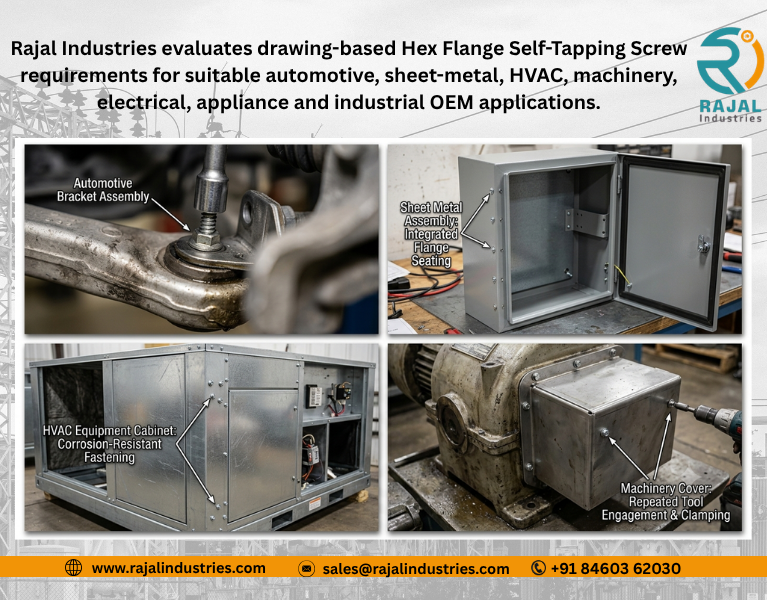
Hex Flange Self Tapping Screw Applications are common in suitable assemblies where manufacturers need an external hex drive, an integrated bearing surface and a screw capable of developing a mating thread during installation.
Depending on the exact screw design, these fasteners can be considered for:
- Automotive components
- Sheet-metal assemblies
- HVAC equipment
- Industrial machinery
- Electrical equipment
- Appliances
- Equipment enclosures
- Fabricated products
- General industrial OEM assemblies
However, application suitability depends on much more than the screw name.
A reliable engineering approach is:
Application → Mating Material → Thickness → Pilot Hole → Thread & Point → Head/Flange → Material → Finish → Installation → Validation
Quick Answer: Where Are Hex Flange Self-Tapping Screws Used?
Hex flange self-tapping screws can be used in suitable automotive, sheet-metal, HVAC, electrical, appliance and industrial machinery assemblies.
Typical applications can include:
- Panels
- Covers
- Brackets
- Housings
- Enclosures
- Cabinets
- Guards
- Frames
The integrated flange provides a wider under-head bearing surface, while the self-tapping feature allows the screw to develop a mating thread in an appropriate material and hole.
The exact screw must be matched to the actual joint.
Why Are Hex Flange Self-Tapping Screws Used in OEM Assembly?
The design combines:
Hex Drive + Integrated Flange + Self-Tapping Thread
This can offer practical assembly advantages in suitable applications.
Potential benefits include:
- External tool engagement
- Powered installation
- Integrated bearing surface
- Reduced separate washer handling where approved
- Efficient assembly
- Suitability for high-volume production
- Convenient installation in sheet-metal products
These benefits are application dependent.
A flange does not automatically eliminate every washer, and a self-tapping screw does not automatically work in every material.
Main Hex Flange Self Tapping Screw Applications
| Industry | Potential Applications | Important Selection Factor |
| Automotive | Brackets, panels, covers, housings | Material + hole + coating |
| Sheet Metal | Panels, frames, enclosures | Thickness + pilot hole |
| HVAC | Cabinets, covers, brackets | Sheet + corrosion |
| Machinery | Guards, covers, panels | Vibration + service |
| Electrical | Cabinets, enclosures, brackets | Clearance + finish |
| Appliances | Panels, frames, covers | High-volume consistency |
| Fabrication | Sheet assemblies, housings | Hole + thread |
| Industrial Equipment | Covers, brackets, enclosures | Joint requirements |
The final application should follow the OEM drawing and engineering approval.
Automotive Screws: Where Are They Used?
Suitable Automotive Screws may be used in selected:
- Sheet-metal brackets
- Covers
- Panels
- Housings
- Interior supporting components
- Electrical/electronic enclosures
- Equipment mounting components
- Non-critical fabricated assemblies
The exact use depends on the vehicle manufacturer or Tier supplier’s specification.
A screw approved for one automotive component should not automatically be used in another without review.
Why Automotive OEMs May Use Hex Flange Self-Tapping Screws
Automotive production often requires:
- High assembly speed
- Repeatable tool engagement
- Controlled dimensions
- Defined surface finishes
- Batch consistency
- Traceability
- Automated or powered installation
A hex head can work with appropriate sockets or nut setters, while the integrated flange provides a wider bearing surface.
The self-tapping feature can also reduce the need for a conventional pre-tapped machine thread in suitable joints.
Automotive Sheet-Metal Brackets
Brackets are one potential application for Automotive Screws.
Examples can include suitable:
- Supporting brackets
- Equipment brackets
- Electrical mounting brackets
- Interior brackets
- Cover brackets
Important variables include:
Bracket Material + Thickness + Hole Diameter + Screw Thread + Point + Installation
Functional testing should use the actual or representative bracket material.
Automotive Panels & Covers
Hex flange self-tapping screws can be considered for selected panels and covers where the design allows self-tapping fastening.
Important checks include:
- Sheet thickness
- Hole diameter
- Flange diameter
- Available clearance
- Surface finish
- Removal/service requirement
The screw should seat correctly without excessive sheet distortion.
Automotive Interior Assemblies
Potential applications may include selected:
- Interior brackets
- Supporting sheet-metal parts
- Equipment covers
- Housings
- Mounting components
For interior applications, designers may also consider:
- Head clearance
- Appearance
- Tool access
- Noise/vibration
- Serviceability
The actual OEM specification should control final fastener selection.
Automotive Electrical & Electronic Housings
Suitable self-tapping screws may be considered for:
- Module covers
- Electrical housings
- Metal enclosures
- Supporting brackets
- Equipment covers
Screw length becomes especially important when electrical or electronic components are located behind the fastening surface.
An excessively long screw could interfere with:
- Wiring
- Connectors
- PCB-related components
- Sensors
- Other internal parts
Internal clearance should therefore be verified.
Automotive Under-Hood or Exposed Applications
Applications exposed to:
- Moisture
- Temperature changes
- Road contaminants
- Chemicals
- Other environmental conditions
may require more carefully defined material and coating systems.
Do not assume a standard zinc finish is suitable for every automotive environment.
Follow the customer’s approved corrosion specification.
Automotive Application Checklist
Before approving a screw, verify:
- Component function
- Mating material
- Material thickness
- Pilot hole
- Thread type
- Point
- Screw length
- Head geometry
- Flange diameter
- Material
- Mechanical properties
- Heat treatment
- Surface finish
- Corrosion requirement
- Installation tool
- Functional test
- Traceability requirements
Why High-Volume Automotive Production Needs Consistency
Consider an illustrative production line installing:
200,000 screws per month
If only 0.25% create an assembly problem:
200,000 × 0.25% = 500 problematic installations
This is only an example, not a claimed defect rate.
It shows why automotive OEMs care about consistent:
- Head geometry
- Flange dimensions
- Thread
- Point
- Mechanical properties
- Coating
- Installation behaviour
Sheet Metal Screws: Major Application Area
Sheet Metal Screws are used across many industrial products because sheet-metal construction is common in:
- Automotive
- HVAC
- Electrical equipment
- Appliances
- Machinery
- Enclosures
- Cabinets
- Fabricated equipment
Self-tapping designs can reduce the need for a separately tapped machine thread where the joint is engineered for self-tapping installation.
Sheet-Metal Panel Applications
Potential applications include:
- Side panels
- Access panels
- Covers
- Equipment skins
- Protective panels
- Cabinet panels
Important considerations include:
Sheet Thickness + Hole Size + Flange Seating + Installation Setting
Sheet-Metal Bracket Applications
Brackets can connect or support:
- Panels
- Housings
- Electrical components
- Covers
- Equipment assemblies
For thin brackets, thread engagement should be carefully evaluated.
The flange should also fit the available bearing area.
Sheet-Metal Enclosures
Hex flange Sheet Metal Screws can be considered for suitable:
- Industrial enclosures
- Electrical boxes
- Equipment cabinets
- Machine housings
- Control enclosures
Potential advantages include convenient external hex installation and a wider integrated bearing surface.
Thin Sheet Applications
Thin sheet creates a particular challenge because only limited material is available to form the mating thread.
Potential failure modes include:
- Hole stripping
- Material distortion
- Low retention
- Over-tightening
The correct screw should be validated for the actual sheet thickness.
Why Bigger Is Not Always Better in Thin Sheet
Using a larger screw does not automatically solve low retention.
A larger screw can also require:
- Larger pilot hole
- More material displacement
- Higher tapping torque
- Larger flange
- More installation force
The complete joint should be evaluated.
Multi-Layer Sheet-Metal Assemblies
Some applications involve two or more sheet layers.
Check:
- Total stack thickness
- Individual layer thickness
- Hole alignment
- Which layer develops the mating thread
- Screw length
- Point clearance
- Flange seating
Do not select the screw from total stack thickness alone.
Punched Sheet-Metal Holes
High-volume production frequently uses punched holes.
Hole characteristics can include:
- Burrs
- Taper
- Punch/die variation
- Edge deformation
These can influence self-tapping behaviour.
Production validation should ideally use production-representative holes.
Drilled Sheet-Metal Holes
Drilled holes can vary due to:
- Drill wear
- Drill diameter
- Burr formation
- Misalignment
Again, nominal hole diameter alone may not describe the complete hole condition.
HVAC Fasteners: Where Are They Used?
Suitable HVAC Fasteners can be used in:
- HVAC cabinets
- Equipment covers
- Sheet-metal panels
- Brackets
- Housings
- Air-handling equipment
- Ventilation equipment
- Equipment frames
The exact screw depends on the material, thickness, hole and environmental conditions.
Why Hex-Driven Screws Are Useful in HVAC Assembly
HVAC manufacturing often involves substantial sheet-metal assembly.
External hex drives can support:
- Manual socket installation
- Nut-setter installation
- Powered assembly
- Production-line fastening
The integrated flange can provide a wider bearing surface where the joint design requires it.
HVAC Cabinet Applications
Potential applications include:
- Side panels
- Top covers
- Access covers
- Internal brackets
- Equipment housings
Important considerations include:
- Sheet thickness
- Screw length
- Tool access
- Service requirements
- Corrosion exposure
HVAC Access Panels
Access panels may be removed during:
- Inspection
- Maintenance
- Cleaning
- Component replacement
Where repeated removal is expected, engineers should validate whether the selected self-tapping joint provides acceptable service life.
Self-tapping fasteners should not automatically be assumed to support unlimited removal and reinsertion.
Outdoor HVAC Equipment
Outdoor HVAC applications can face:
- Rain
- Humidity
- Condensation
- Temperature variation
- Pollutants
- Coastal exposure in some locations
The finish should therefore be selected according to the required environment and corrosion specification.
HVAC Fasteners & Corrosion
A finish should not be selected simply because it looks similar to another coating.
For example:
Silver Appearance ≠ Defined Corrosion Performance
Specify the actual:
- Material
- Coating system
- Coating requirement
- Applicable corrosion test
- Acceptance criteria
where required.
HVAC Application Checklist
For HVAC Fasteners, verify:
☐ Indoor or outdoor use
☐ Sheet material
☐ Sheet thickness
☐ Pilot hole
☐ Screw diameter
☐ Thread/point
☐ Screw length
☐ Flange size
☐ Tool access
☐ Surface finish
☐ Corrosion requirement
☐ Service/removal frequency
Hex Flange Self-Tapping Screws in Industrial Machinery
Industrial machinery can contain:
- Guards
- Covers
- Panels
- Brackets
- Electrical enclosures
- Control cabinets
- Equipment housings
Self-tapping screws can be appropriate for selected non-critical sheet-metal fastening applications.
Machine Guard Applications
Machine guards often need:
- Reliable attachment
- Convenient installation
- Maintenance access
- Controlled head profile
Hex flange screws can provide external tool engagement and a wider bearing area.
However, guard fastening must comply with the machine’s safety design and applicable requirements.
Machinery Covers & Panels
Potential applications include:
- Side covers
- Inspection covers
- Protective panels
- Sheet-metal housings
For removable panels, service frequency should be considered.
Repeated removal can affect the mating thread developed in thin sheet.
Machinery Brackets
For suitable machinery brackets, check:
- Bracket material
- Thickness
- Joint load
- Vibration
- Hole
- Screw properties
Do not use a general-purpose self-tapping screw for a structurally critical joint without engineering approval.
Vibration in Machinery Applications
A common misconception is:
“Self-tapping screws will not loosen because they make their own thread.”
This should not be assumed.
Vibration resistance depends on the complete joint, including:
- Clamp condition
- Joint geometry
- Mating material
- Thread
- Installation
- Approved locking method where required
The self-tapping feature alone does not guarantee vibration resistance.
Electrical Equipment Applications
Suitable hex flange self-tapping screws can be considered for:
- Electrical panels
- Control cabinets
- Equipment enclosures
- Internal brackets
- Covers
- Sheet-metal housings
Important considerations include:
- Internal clearance
- Surface finish
- Sheet thickness
- Hole condition
- Tool access
Electrical functions such as grounding or bonding require separate engineering consideration and should not be assumed from the flange alone.
Electrical Panel Applications
Potential fastening points can include:
- Covers
- Internal sheet-metal brackets
- Side panels
- Equipment housings
If the screw is part of a protective electrical bonding or grounding arrangement, the complete connection must meet the applicable electrical requirements.
Do not assume an ordinary coated screw automatically provides a compliant electrical connection.
Control Cabinet Applications
Control cabinets can contain:
- Wiring
- Terminals
- Relays
- Electronic equipment
- Power components
Screw length should therefore be checked carefully to prevent interference behind the fastening surface.
Appliance Applications
Suitable Sheet Metal Screws can also be used in appliances and professional equipment.
Potential applications include:
- Covers
- Panels
- Frames
- Internal brackets
- Equipment housings
High-volume appliance manufacturing can make screw consistency important for production efficiency.
Why Appliance Manufacturers Care About Assembly Speed
A fastener may be installed thousands of times per production shift.
Small problems such as:
- Poor starting
- High tapping torque
- Tool slipping
- Flange distortion
- Feeder jams
can accumulate into meaningful production delays.
The screw should therefore be evaluated as part of the manufacturing process, not only as an individual component.
Industrial Enclosure Applications
Hex flange self-tapping screws may be used for suitable:
- Equipment enclosures
- Machine cabinets
- Electrical housings
- Control boxes
- Fabricated cabinets
Important factors include:
Material + Sheet Thickness + Hole + Finish + Tool Access + Service Requirement
General Fabrication Applications
Fabricators may use these fasteners for suitable:
- Sheet assemblies
- Panels
- Brackets
- Covers
- Housings
However, custom fabricated equipment can vary significantly.
The fastener should be selected from the actual joint rather than using one standard screw for every fabricated component.
Application Selection by Industry
| Industry | Main Selection Priority |
| Automotive | Consistency + coating + traceability |
| Sheet Metal | Thickness + pilot hole |
| HVAC | Sheet + environment + service |
| Machinery | Joint + vibration + maintenance |
| Electrical | Clearance + finish + application |
| Appliances | High-volume assembly |
| Enclosures | Fit + corrosion + access |
| Fabrication | Material + hole + thread |
Application Selection by Environment
Indoor Dry Environment
Focus may include:
- Functional fit
- Basic corrosion requirement
- Cost
- Assembly efficiency
Humid Environment
Increase attention to:
- Material
- Coating
- condensation exposure
Outdoor Environment
Evaluate:
- Rain
- Humidity
- Temperature
- Pollutants
- Required corrosion performance
Coastal Environment
Chloride exposure can require a more careful material and coating review.
Do not select solely from the words “stainless” or “zinc.”
Carbon Steel Applications
Carbon steel self-tapping screws can be suitable for many:
- Automotive
- HVAC
- Appliance
- Electrical
- Industrial
applications where the specified mechanical properties and coating meet the requirement.
Material, heat treatment and finish should be treated as a system.
Stainless Steel Applications
Stainless steel may be considered where corrosion resistance is important.
Potential applications can include suitable:
- Outdoor equipment
- Food-related equipment
- Laboratory equipment
- Industrial equipment
- Coastal installations
However, actual grade, self-tapping performance, galling risk and mating material should be reviewed.
Do not assume SS316 is automatically required for every outdoor application.
Why Material Selection Depends on the Application
The best screw material is not simply the most expensive material.
Selection should consider:
Mechanical Requirement + Self-Tapping Function + Environment + Mating Material + Cost
A technically appropriate carbon-steel screw with the correct coating may be preferable in one application, while stainless steel may be more appropriate in another.
Surface Finish by Application
| Application | Finish Consideration |
| Automotive | OEM corrosion/friction specification |
| Indoor Machinery | Required corrosion + appearance |
| HVAC Indoor | Environment-specific |
| HVAC Outdoor | Increased corrosion consideration |
| Electrical Cabinet | Environment + appearance |
| Appliance | Appearance + corrosion |
| Outdoor Equipment | Defined environmental protection |
Do not assign a universal coating based only on industry.
Application and Installation Method
The same screw can behave differently under:
- Hand installation
- Powered installation
- Semi-automatic installation
- Fully automated assembly
Therefore, application approval should include the intended installation process.
Manual Assembly Applications
For manual assembly, check:
- Tool access
- Correct socket
- Alignment
- Operator variability
- Installation control
The hex head can provide convenient external tool engagement.
Powered Assembly Applications
Powered installation can increase production speed.
Check:
- Driver speed
- Socket fit
- Alignment
- Installation setting
- Tool wear
High speed should not be assumed suitable without validation.
Automated Assembly Applications
Automotive and appliance manufacturers may use automatic screw-feeding systems.
The screw then needs to pass through:
Feeding → Orientation → Delivery → Tool Engagement → Hole Entry → Tapping → Seating
Important screw characteristics can include:
- Head consistency
- Flange diameter
- Screw straightness
- Point geometry
- Thread consistency
- Burr control
- Surface condition
Why Production Testing Matters
A self-tapping screw may look dimensionally correct but behave differently during installation.
Application testing can identify:
- High tapping torque
- Poor starting
- Misalignment
- Thread stripping
- Screw breakage
- Poor flange seating
- Tool problems
This is why OEM validation should include the actual joint wherever practical.
Application Testing Sequence
A practical validation sequence is:
Approved Screw → Actual Mating Material → Production Hole → Final Finish → Production Tool → Installation Trial → Functional Evaluation
For high-volume applications, a pilot lot can provide additional confidence before mass production.
When Hex Flange Self-Tapping Screws May Not Be Suitable
These screws should not automatically be selected when the joint requires:
- A reusable machine thread
- A nut-and-bolt arrangement
- A threaded insert
- A specific structural bolted connection
- A specialized safety-critical fastening system
- A different head/drive geometry
Fastener selection should follow the engineering requirement, not convenience alone.
Common Application Mistakes
Using the Same Screw for Different Sheet Thicknesses
Performance can change with thickness.
Changing Pilot-Hole Diameter Without Revalidation
This can change tapping and stripping behaviour.
Changing Material Grade
Different material properties can affect thread formation.
Changing Coating
Friction and corrosion performance can change.
Assuming the Flange Replaces Every Washer
It may not.
Assuming Self-Tapping Means Self-Drilling
It does not.
Assuming the Screw Is Automatically Vibration Resistant
It is not.
Ignoring Service Requirements
Repeated removal can affect the formed mating thread.
Application-Based OEM Specification
Instead of requesting:
Hex self-tapping screw for sheet metal
a stronger specification includes:
Hex flange self-tapping screw for the defined OEM assembly, manufactured to the approved drawing with specified thread, point, head/flange geometry, material, mechanical properties and finish, and validated using the specified mating material, thickness and pilot-hole condition.
This reduces ambiguity between engineering, purchasing and the supplier.
Hex Flange Self-Tapping Screw Applications at Rajal Industries
Rajal Industries can evaluate drawing-based Hex Flange Self Tapping Screw Applications for suitable OEM requirements in:
- Automotive components
- Sheet-metal assemblies
- HVAC equipment
- Industrial machinery
- Electrical equipment
- Appliances
- Equipment enclosures
- Fabricated components
- General industrial equipment
Depending on technical feasibility and customer specifications, requirements can be reviewed for:
- Automotive Screws
- Sheet Metal Screws
- HVAC Fasteners
- Hex Flange Self-Tapping Screws
- Hex Washer Head Screws
- Industrial Screws
- Standard and Custom Sizes
- Custom Head/Flange Geometry
- Customer-Specified Threads and Points
- Carbon Steel
- Suitable Alloy Steel Requirements
- Suitable Stainless Steel Requirements
- Customer-Specified Finishes
- Dimensional Inspection
- Material Verification
- Specified Mechanical Testing
- Functional Installation Testing
- Batch Traceability
- Sample Development
- Pilot Production
- Bulk OEM Supply
Final manufacturing feasibility should be confirmed against the approved drawing, mating material, thickness, pilot hole, material, mechanical properties, finish, testing requirements and production quantity.
Bulk Buyer Quick Answer
Which industries use hex flange self-tapping screws?
Common Hex Flange Self Tapping Screw Applications include suitable automotive, sheet-metal, HVAC, electrical, appliance, machinery and industrial-equipment assemblies.
Typical fastening points can include:
Brackets + Panels + Covers + Housings + Enclosures + Cabinets + Guards
However, the screw must be selected for the actual mating material, thickness, pilot hole, environment and installation process.
Application Selection Matrix
| Application | Main Requirement | Key Risk | What to Validate |
| Automotive Bracket | Consistent installation | Torque variation | Hole + thread |
| Automotive Cover | Seating and finish | Sheet distortion | Flange + setting |
| Sheet-Metal Panel | Thread engagement | Stripping | Thickness + hole |
| HVAC Cabinet | Assembly + corrosion | Environmental exposure | Finish + joint |
| HVAC Access Panel | Serviceability | Thread degradation | Removal cycles |
| Machine Guard | Secure attachment | Vibration/service | Complete joint |
| Machinery Cover | Repeatable fastening | Loosening | Installation |
| Electrical Enclosure | Clearance | Internal interference | Screw length |
| Appliance Panel | High-volume assembly | Production variation | Screw consistency |
| Industrial Cabinet | Fit + environment | Corrosion | Material + finish |
Automotive Screw Selection
For suitable Automotive Screws, start with the component itself.
Ask:
- What does the component do?
- What material is being fastened?
- What is its thickness?
- How is the hole produced?
- Is the assembly exposed to moisture or chemicals?
- Is installation manual or automated?
- Will the screw be removed during servicing?
- Does the OEM specify coating, testing or traceability?
The answers determine the appropriate fastener specification.
Automotive OEM vs Tier-Supplier Requirements
Automotive fastener requirements can flow through several levels:
Vehicle OEM → Tier-1 → Tier-2 → Fastener Manufacturer
The fastener supplier should therefore work from the controlled specification rather than assuming a general automotive screw is acceptable.
Important documents can include:
- Approved drawing
- Material specification
- Finish specification
- Inspection requirements
- Testing requirements
- Packaging requirements
- Customer-specific quality requirements
Automotive Bracket Example
Consider a self-tapping screw used to attach a sheet-metal bracket.
The fastener should not be selected only as:
5 mm Automotive Screw
Instead, engineering should define:
Bracket Material → Thickness → Hole → Screw Thread → Point → Length → Flange → Coating → Installation
If bracket thickness changes, the screw application should be reviewed.
Automotive Housing Example
For a metal housing, additional considerations can include:
- Internal clearance
- Wiring
- Electronic components
- Screw protrusion
- Surface appearance
- Corrosion exposure
A screw can fit dimensionally and still be unsuitable because it extends too far inside the housing.
Automotive Powered Assembly
High-volume automotive production frequently relies on controlled powered installation.
Important variables can include:
- Socket/nut-setter fit
- Driver alignment
- Speed
- Installation setting
- Screw starting
- Tapping behaviour
- Flange seating
The screw and assembly tool should be validated together.
Automotive Automated Assembly
Where screws are automatically fed, the fastener must also work with the feeding system.
Important characteristics can include:
Head Geometry + Flange Diameter + Length + Straightness + Point + Surface Condition
A screw that installs correctly by hand may still create problems in automated feeding.
Why Small Variations Matter at High Volume
Imagine an OEM installs:
1,000,000 screws per year
At an illustrative installation-problem rate of only 0.1%:
1,000,000 × 0.1% = 1,000 problematic installations
This does not represent Rajal Industries or any customer’s actual defect rate.
It simply demonstrates why high-volume OEMs value repeatable fastener geometry and installation performance.
Automotive Corrosion Selection
Do not choose automotive coating only from appearance.
The requirement may depend on whether the screw is used in:
- Interior equipment
- Protected enclosure
- Under-hood environment
- Exterior equipment
- Moisture-exposed area
Follow the OEM’s coating and corrosion specification.
Automotive Application Approval Checklist
Before production approval, verify:
☐ Drawing revision
☐ Application
☐ Mating material
☐ Thickness
☐ Pilot hole
☐ Hole tolerance
☐ Thread
☐ Point
☐ Screw length
☐ Hex dimensions
☐ Flange geometry
☐ Material
☐ Mechanical properties
☐ Heat treatment
☐ Coating
☐ Corrosion requirement
☐ Installation process
☐ Functional performance
☐ Documentation
☐ Traceability
Sheet Metal Screws: Selection by Thickness
The relationship between Sheet Metal Screws and sheet thickness is critical.
Thin Sheet
Potential problems:
- Limited thread engagement
- Stripping
- Deformation
- Low retention
Thicker Sheet
Potential problems:
- Higher tapping resistance
- Increased installation torque
- Point/thread suitability
There is no single screw that should automatically be used across every thickness.
Sheet Thickness + Hole + Thread
These three variables work together:
Sheet Thickness ↔ Pilot Hole ↔ Screw Thread
Changing one can affect the others.
For example, increasing the hole diameter may reduce tapping resistance but can also reduce thread engagement.
Therefore, hole changes should be validated rather than made only to make installation easier.
Sheet-Metal Hole Tolerance
It is not enough to test only the nominal pilot-hole diameter.
Production holes have variation.
If the approved hole is defined as:
Nominal Diameter ± Tolerance
functional testing should consider the expected production range where required by the validation plan.
This helps determine whether the joint remains stable under normal manufacturing variation.
Punched-Hole Applications
For punched sheet metal, inspect:
- Actual diameter
- Burr
- Taper
- Edge condition
- Hole distortion
The screw may enter differently from opposite sides of a punched hole.
This should be considered when the application is sensitive to installation direction.
Laser-Cut Sheet Metal
Laser cutting may be used in fabricated equipment.
Hole condition can differ from punched or drilled holes.
Possible factors include:
- Edge condition
- Heat-affected surface
- Dimensional variation
The actual production hole should be evaluated when the fastening performance is important.
Sheet-Metal Panel Selection
For panels and covers, check:
Thickness + Hole + Flange Diameter + Screw Length + Tool Access
The flange should seat correctly without causing unacceptable panel deformation.
Sheet-Metal Bracket Selection
For brackets, additional factors can include:
- Joint load
- Material hardness
- Vibration
- Clearance
- Installation direction
A screw suitable for a lightweight cover may not be suitable for a loaded bracket.
Multi-Layer Sheet Metal
Suppose the screw passes through two sheets before developing its main mating thread.
Do not select from:
Total Thickness Only
Instead, understand:
- Thickness of each layer
- Clearance-hole layer
- Thread-forming layer
- Hole alignment
- Available engagement
The joint configuration matters.
HVAC Fastener Selection
For HVAC Fasteners, first classify the application:
Indoor / Outdoor / Serviceable / Permanent-Type Assembly
Then evaluate the sheet-metal joint.
Indoor HVAC Applications
Potential applications include:
- Cabinets
- Internal brackets
- Equipment covers
- Panels
- Housings
Selection can focus on:
- Assembly efficiency
- Sheet thickness
- Hole
- Thread
- Tool access
- Required corrosion protection
Outdoor HVAC Applications
Outdoor HVAC equipment introduces environmental considerations.
Potential exposure includes:
- Rain
- Humidity
- Condensation
- Temperature cycling
- Industrial pollutants
- Chlorides in some locations
Material and coating should therefore be selected according to the specified environment.
Coastal HVAC Applications
Coastal conditions can increase chloride exposure.
However, do not automatically specify:
SS316 for every coastal HVAC screw
Selection should consider:
- Exposure severity
- Component material
- Required service life
- Fastener function
- Customer specification
- Corrosion testing
- Cost
The correct solution may vary by equipment design.
HVAC Access Panels & Serviceability
Access panels may be removed repeatedly.
A self-tapping screw develops its mating thread directly in the material, so repeated removal and reinsertion can affect the joint.
Where frequent servicing is expected, validate:
- Removal cycles
- Reinsertion
- Thread condition
- Retention
If frequent service is critical, another fastening system may sometimes be more appropriate.
HVAC Cabinet Example
A practical selection sequence is:
Cabinet Sheet → Thickness → Pilot Hole → Screw Thread → Length → Hex/Flange → Finish → Installation
If the equipment is outdoor:
+ Environmental/Corrosion Requirement
HVAC Fastener Failure: Early Rust
If HVAC Fasteners show premature corrosion, investigate:
- Actual environment
- Base material
- Coating specification
- Coating thickness/condition
- Installation damage
- Storage
- Contact with mating materials
Do not judge corrosion performance from coating colour alone.
Machinery Application Selection
Industrial machinery introduces additional factors such as:
- Vibration
- Maintenance
- Repeated access
- Oil or chemical exposure
- Higher operating temperatures
- Safety requirements
A self-tapping screw should therefore be used only where appropriate for the specific joint.
Machine Guards
Machine guards can be safety-related components.
The fastening method should comply with the equipment design and applicable safety requirements.
A general-purpose self-tapping screw should not automatically be selected merely because installation is convenient.
Machine Covers
Suitable applications may include:
- Protective covers
- Side panels
- Equipment skins
- Inspection panels
For removable covers, evaluate serviceability.
Machinery Brackets
For loaded brackets, the engineer should determine whether a self-tapping joint is appropriate at all.
Depending on the application, another fastening system such as a machine screw, bolt/nut or threaded insert may be more suitable.
Vibration: Important Limitation
A Hex Flange Self Tapping Screw is not automatically vibration-proof.
Vibration behaviour depends on:
Joint Design + Clamp Condition + Thread Engagement + Mating Material + Installation + Locking Strategy
Where vibration resistance is important, use the approved engineering solution and appropriate testing.
Electrical Equipment Applications
Potential applications include:
- Control cabinets
- Electrical panels
- Equipment enclosures
- Internal brackets
- Covers
- Sheet-metal housings
Important considerations include:
- Screw length
- Internal clearance
- Tool access
- Finish
- Sheet thickness
- Hole
- Serviceability
Electrical Clearance
A screw installed into an enclosure may protrude internally.
Always check clearance to:
- Conductors
- Terminals
- PCBs
- Busbars
- Connectors
- Other components
The fastening design should satisfy the applicable electrical equipment requirements.
Grounding & Bonding
Do not assume that an ordinary flange screw automatically creates a compliant grounding or bonding connection.
Coatings, paint, contact surfaces and joint design can influence electrical continuity.
Where grounding or bonding is required, follow the applicable electrical design and approved connection method.
Appliance Applications
Appliance manufacturers may use Sheet Metal Screws for suitable:
- Panels
- Frames
- Covers
- Brackets
- Housings
High production volumes make consistency important.
Appliance Assembly-Line Priorities
Important characteristics can include:
- Easy starting
- Stable tapping behaviour
- Tool engagement
- Correct flange seating
- Automatic feeding
- Consistent finish
A small fastener problem multiplied across thousands of products can affect productivity.
Industrial Enclosures
For industrial cabinets and enclosures, evaluate:
- Indoor/outdoor location
- Sheet material
- Thickness
- Hole
- Internal clearance
- Service frequency
- Finish
If the enclosure requires a particular environmental rating, the complete enclosure design should be validated. The screw alone does not establish the enclosure rating.
Application Selection by Service Frequency
| Service Requirement | Important Consideration |
| Installed Once | Initial tapping + retention |
| Occasional Removal | Reinsertion performance |
| Frequent Removal | Thread durability |
| High-Service Access | Consider alternative fastening system |
This is often overlooked when selecting self-tapping screws.
Application Selection by Installation Method
| Installation | Main Fastener Concern |
| Manual | Tool fit + operator access |
| Powered | Torque/speed + alignment |
| Semi-Automatic | Consistency + feeding |
| Fully Automated | Geometry + feeding + process stability |
Application Selection by Environment
| Environment | Main Consideration |
| Indoor Dry | Basic corrosion + function |
| Humid | Moisture resistance |
| Outdoor | Defined corrosion protection |
| Coastal | Chloride exposure |
| Industrial | Chemicals/pollutants |
| High Temperature | Material/coating suitability |
Avoid selecting a material or coating from this table alone. The customer specification should control the final choice.
Carbon Steel vs Stainless by Application
Carbon Steel
Can be suitable where:
- Required tapping properties can be achieved
- Approved coating provides required protection
- Customer specification permits it
Stainless Steel
Can be considered where:
- Corrosion resistance is important
- The grade suits the environment
- Self-tapping performance is validated
- Customer specification permits it
The most corrosion-resistant-looking option is not automatically the best engineering solution.
Application Failure Analysis
When a fastener fails, separate the problem into four areas:
Screw
- Dimensions
- Thread
- Point
- Material
- Heat treatment
- Coating
Mating Component
- Material
- Thickness
- Hole
- Burrs
- Geometry
Installation
- Tool
- Speed
- Alignment
- Setting
Environment
- Corrosion
- Temperature
- Vibration
- Service conditions
This avoids incorrectly blaming the screw before investigating the complete joint.
Application Troubleshooting Matrix
| Problem | Possible Cause | First Check |
| Won’t Start | Hole/point/alignment | Pilot hole |
| High Tapping Torque | Small hole/hard material | Hole + material |
| Low Tapping Torque | Oversized hole | Hole diameter |
| Screw Breaks | Torque/properties/hole | Installation |
| Hole Strips | Thin sheet/large hole | Joint geometry |
| Flange Won’t Seat | Burr/distortion | Mating surface |
| Head Damages | Tool mismatch | Socket |
| Screw Loosens | Joint/vibration | Complete joint |
| Early Corrosion | Finish/environment | Specification |
| Feeder Jam | Geometry/straightness | Screw + feeder |
Problem: Screw Breakage
Do not immediately conclude:
Fastener material is defective.
Check:
Pilot Hole → Mating Material → Alignment → Installation Setting → Screw Properties
A manufacturing defect is one possibility, but it is not the only one.
Problem: Hole Stripping
Common investigation areas include:
- Hole diameter
- Sheet thickness
- Thread design
- Installation setting
- Material condition
Changing to a harder screw may not solve a stripped mating thread.
Problem: Flange Damages the Sheet
Possible causes can include:
- Excessive installation
- Thin/soft material
- Inappropriate flange geometry
- Component design
- Burrs
Evaluate the complete joint.
Problem: Screw Loosens in Service
Investigate:
- Joint design
- Thread engagement
- Clamp condition
- Vibration
- Installation process
- Service conditions
Do not assume the self-tapping thread itself provides a locking feature.
Sample Approval for Application-Specific Screws
A practical process is:
Drawing Review → Application Review → Samples → Dimensional Inspection → Material/Finish Verification → Installation Trial → Functional Evaluation → Approval
For larger OEM programs:
Approved Sample → Pilot Lot → Production Trial → Mass Production
Why Final-Finish Samples Matter
Testing an unfinished screw and later applying a different coating can change:
- Friction
- Thread dimensions
- Tapping behaviour
- Seating
Where practical, final approval should use the production-intended finish.
Production-Representative Testing
For the strongest validation, use:
Production Screw + Production Finish + Production Material + Production Hole + Production Tool
This is more informative than testing a screw in an unrelated laboratory coupon.
Pilot-Lot Approval
A pilot lot can help evaluate whether the supplier can reproduce:
- Head geometry
- Flange
- Thread
- Point
- Mechanical properties
- Coating
- Functional behaviour
at production scale.
Supplier Qualification for Application-Based Screws
Evaluate the supplier’s ability to understand both:
Fastener Manufacturing + Customer Application
Important areas include:
- Drawing review
- Application review
- Similar product experience
- Material control
- Cold heading
- Head/flange forming
- Thread production
- Point production
- Heat-treatment control
- Coating control
- Dimensional inspection
- Functional testing
- Documentation
- Traceability
- Sample development
- Pilot production
- Bulk capacity
- Corrective-action support
Questions to Ask the Supplier
Technical
- Have you manufactured a similar screw?
- Which thread/point design will be used?
- Can you control our custom flange?
- What mating material do you recommend testing?
Quality
- How will the thread and point be inspected?
- How is heat treatment controlled?
- How is coating controlled?
- Can you perform functional installation trials?
- What traceability is available?
Commercial
- MOQ?
- Tooling cost?
- Sample lead time?
- Bulk lead time?
- Monthly capacity?
Complete Application RFQ Checklist
For accurate sourcing, provide:
☐ Product name
☐ Part number
☐ Application
☐ Industry
☐ Approved drawing
☐ Drawing revision
☐ Applicable standard
☐ Screw diameter
☐ Length
☐ Thread type
☐ Point
☐ Hex dimensions
☐ Flange dimensions
☐ Material
☐ Mechanical properties
☐ Heat treatment
☐ Finish/coating
☐ Mating material
☐ Material grade
☐ Material thickness
☐ Pilot-hole diameter
☐ Hole tolerance
☐ Hole manufacturing method
☐ Installation method
☐ Installation tool
☐ Environmental conditions
☐ Service/removal requirement
☐ Testing requirements
☐ Documentation requirements
☐ Sample quantity
☐ Pilot quantity
☐ First order quantity
☐ Monthly demand
☐ Annual demand
☐ Packaging
☐ Delivery location
Frequently Asked Questions
Where are hex flange self-tapping screws commonly used?
Common Hex Flange Self Tapping Screw Applications include suitable automotive brackets and panels, sheet-metal assemblies, HVAC cabinets, industrial machinery covers, electrical enclosures, appliances and fabricated equipment.
Why use a hex flange self-tapping screw in sheet metal?
The screw combines external hex tool engagement, an integrated bearing surface and a self-tapping thread. This can simplify suitable sheet-metal assembly where the joint is designed for self-tapping installation.
Are hex flange self-tapping screws used in automotive applications?
Yes. Suitable Automotive Screws may be used for selected brackets, panels, covers, housings and other approved assemblies. The exact fastener must meet the OEM or Tier supplier’s specification.
Can self-tapping screws be used in thin sheet metal?
Yes, in suitable designs, but thin sheet provides limited material for thread engagement. Screw geometry, pilot hole, sheet thickness and installation setting should be validated.
What screws are used for HVAC sheet metal?
Different HVAC Fasteners are used depending on the equipment and joint. Hex flange self-tapping screws can be suitable for certain cabinets, panels, covers and brackets when matched to the sheet and hole.
Can hex flange self-tapping screws be used outdoors?
They can be used in suitable outdoor applications when the material and coating meet the required environmental and corrosion specification.
Are self-tapping screws vibration resistant?
Not automatically. Vibration performance depends on the complete joint, installation and any required locking strategy.
Can the same screw be used for different sheet thicknesses?
Possibly, but it should not be assumed. Changes in thickness can alter thread engagement and tapping behaviour.
Can self-tapping screws be removed and reused?
That depends on the mating material and joint. Repeated removal can affect the formed thread, especially in thin sheet.
Can these screws be used in electrical enclosures?
Yes, for suitable fastening applications. Internal clearance, electrical requirements, material, finish and enclosure design must still be considered.
Can stainless steel self-tapping screws be used in HVAC equipment?
They can be considered for suitable applications, but grade, environment, mating material, tapping performance and customer requirements should be evaluated.
Should automotive screws be tested in the actual component?
For application-critical or high-volume OEM programs, testing in actual or representative production material and holes can provide valuable validation.
AEO Quick Answers
What are the main Hex Flange Self Tapping Screw Applications?
Hex Flange Self Tapping Screw Applications include suitable automotive brackets and panels, sheet-metal enclosures, HVAC cabinets, machinery covers, electrical equipment, appliances and industrial housings. The screw should be matched to the mating material, thickness, pilot hole, environment and installation process.
Why are self-tapping screws used in automotive sheet metal?
Automotive Screws with self-tapping threads can create or develop a mating thread in a suitable prepared hole, while a hex drive supports powered installation and the flange provides a wider bearing surface. Final selection must follow the OEM-approved joint specification.
Are hex flange screws suitable for HVAC equipment?
Hex flange self-tapping screws can be suitable HVAC Fasteners for selected cabinets, panels, covers and brackets. Indoor or outdoor exposure, sheet thickness, pilot hole, corrosion requirements and serviceability should be considered before approval.
What should I check before using a self-tapping screw in sheet metal?
Check the sheet material, thickness, pilot-hole diameter, thread and point design, screw length, head/flange geometry, material, coating and installation method. Functional testing should use production-representative components where possible.
Can one self-tapping screw work in every sheet-metal application?
No. Different materials, thicknesses, hole conditions and installation processes can change tapping and retention behaviour. Each materially different joint should be evaluated against its engineering requirements.
Final Buyer Checklist
Before approving an application, confirm:
APPLICATION
☐ Automotive / HVAC / machinery / electrical / other
☐ Function of the joint
☐ Service requirements
☐ Environmental exposure
MATING COMPONENT
☐ Material
☐ Grade
☐ Thickness
☐ Pilot hole
☐ Hole tolerance
☐ Hole process
FASTENER
☐ Diameter
☐ Length
☐ Thread
☐ Point
☐ Hex head
☐ Flange
☐ Material
☐ Mechanical properties
☐ Finish
PRODUCTION
☐ Installation tool
☐ Installation validation
☐ Functional test
☐ Samples
☐ Pilot lot
☐ Inspection plan
☐ Traceability
☐ Packaging
Key Takeaways
- Hex Flange Self Tapping Screw Applications should be selected around the complete joint.
- Automotive applications require particular attention to repeatability, finish and production control.
- Automotive Screws should follow the OEM or Tier supplier specification.
- Sheet thickness, pilot hole and thread geometry work together.
- Thin sheet needs careful stripping and retention evaluation.
- Production hole condition can influence performance.
- HVAC Fasteners should be selected according to indoor/outdoor environment and service requirements.
- Repeated removal can affect a self-tapped mating thread.
- Machinery vibration requires joint-level evaluation.
- Self-tapping does not automatically mean vibration resistant.
- Electrical clearance and electrical functions need separate consideration.
- An integrated flange does not automatically provide electrical bonding.
- Coating should be selected by performance, not appearance.
- Final-finish screws should preferably be used for application validation.
- Automated assembly requires consistent screw geometry.
- Functional testing complements dimensional inspection.
- High-volume OEM programs can benefit from pilot-lot validation.
Conclusion
The most suitable Hex Flange Self Tapping Screw Applications are those where the fastener, mating component and assembly process are engineered together.
These screws can be considered for suitable:
Automotive → Sheet Metal → HVAC → Machinery → Electrical → Appliance → Industrial Equipment
applications.
However, industry alone does not determine the correct fastener.
The final selection should follow:
Application → Material → Thickness → Hole → Thread & Point → Screw Geometry → Material & Finish → Installation → Validation
Rajal Industries can evaluate drawing-based hex flange self-tapping screw requirements for suitable automotive, sheet-metal, HVAC, machinery and industrial OEM applications, subject to customer specifications and technical feasibility.