

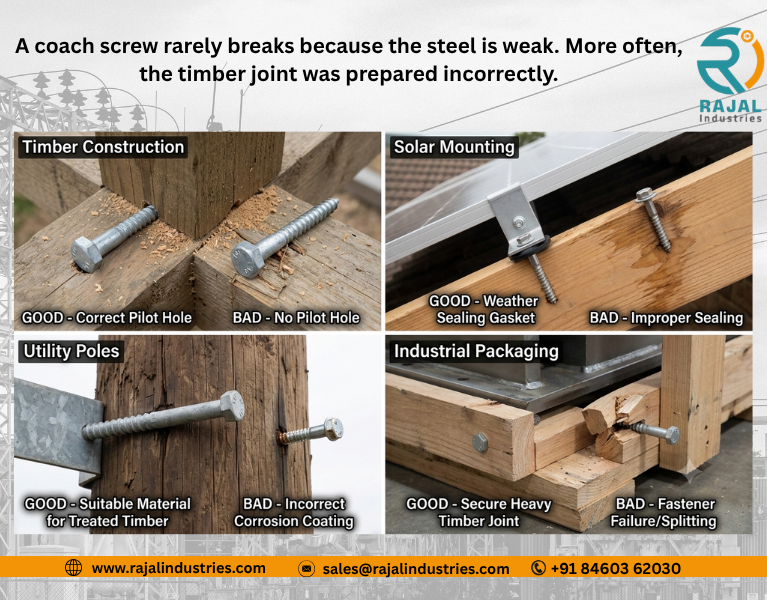
Coach screw applications are mainly associated with heavy-duty fastening into timber and suitable wood-based structural members.
A typical coach screw combines:
- Hexagonal head
- Strong shank
- Coarse wood-engaging thread
- Pointed end
- Partial threading in many traditional designs
This makes coach screws useful where brackets, plates, equipment or other components need to be secured to timber.
Common applications can include:
Timber Structures → Metal-to-Timber Connections → Construction → Utility Timber Poles → Outdoor Structures → Selected Timber-Based Solar Mounting
However, coach screws are not universal structural fasteners.
The correct fastener depends on the:
Substrate + Joint + Load + Environment + Engineering Specification
For project buyers, the important question is therefore not simply:
“Where can coach screws be used?”
It is:
“Is a coach screw technically suitable and approved for this specific connection?”
Quick Answer: What Are Coach Screws Used For?
Coach screws are heavy-duty timber screws commonly used for fastening components into wood.
Typical uses can include:
- Timber framing
- Wooden beams and posts
- Metal brackets to timber
- Timber-to-timber connections
- Outdoor wooden structures
- Construction hardware
- Wooden utility structures
- Equipment mounting to timber
- Selected timber-based solar mounting systems
For structural applications, screw size, penetration, spacing, edge distance and installation should follow the approved engineering design.
Why Coach Screws Are Used for Timber Fastening
Coach screws provide a combination of:
Coarse Wood-Engaging Thread
The thread engages directly with timber.
Hexagonal Head
Allows installation using a wrench, socket or suitable powered tool.
Larger Sizes
Coach screws are commonly available in sizes suitable for heavier timber fastening than many general-purpose wood screws.
Direct Timber Engagement
They generally do not require a nut when fastening directly into suitable timber.
These characteristics explain why coach screws remain common construction screws for certain traditional and industrial timber connections.
Main Coach Screw Applications
Coach screws can be considered for suitable applications across several sectors.
| Application | Typical Connection |
| Timber Construction | Timber-to-timber |
| Structural Hardware | Metal-to-timber |
| Wooden Frames | Timber-to-timber |
| Brackets | Metal bracket-to-timber |
| Outdoor Structures | Hardware-to-timber |
| Utility Structures | Hardware-to-timber pole |
| Solar Mounting | Mounting hardware-to-timber |
| Industrial Equipment | Equipment/bracket-to-timber |
| Wooden Supports | Hardware-to-wood |
| Construction Projects | Various approved timber joints |
Suitability depends on the actual engineering specification.
Coach Screws for Timber Structures
Timber structures are one of the most important coach screw applications.
Potential uses include:
- Timber frames
- Beams
- Posts
- Wooden supports
- Bracing hardware
- Metal plates
- Structural brackets
- Heavy wooden assemblies
A coach screw can create a direct connection into timber without requiring access to the opposite side for a nut.
This can be useful where the rear side of the timber member is:
- Inaccessible
- Enclosed
- Difficult to reach
However, accessibility alone should not determine the fastener.
The connection must still meet the required engineering performance.
Coach Screws for Timber-to-Timber Connections
Coach screws may be used in suitable timber-to-timber connections.
Examples can include:
- Timber members
- Wooden supports
- Framing components
- Heavy wooden assemblies
- Reinforcement connections
Important design factors include:
- Timber species
- Timber density
- Member thickness
- Screw diameter
- Screw length
- Required penetration
- Edge distance
- End distance
- Screw spacing
- Number of fasteners
- Load direction
For structural timber, these values should come from the applicable engineering design.
Coach Screws for Metal-to-Timber Connections
Metal-to-timber fastening is another important use of timber screws.
A common joint can look like:
Coach Screw Head → Washer → Metal Bracket → Timber
Potential components include:
- Steel brackets
- Mounting plates
- Structural connectors
- Equipment brackets
- Support plates
- Construction hardware
The coach screw passes through a clearance hole in the metal component and engages with the timber.
What Matters in Metal-to-Timber Fastening?
Before selecting a coach screw, check:
- Metal component thickness
- Clearance-hole diameter
- Washer requirement
- Timber dimensions
- Required screw penetration
- Screw diameter
- Head clearance
- Edge distance
- Installation method
- Corrosion environment
A screw that fits the timber may still be unsuitable if it does not correctly fit the bracket or washer.
Coach Screws for Timber Beams
Coach screws may be specified for suitable connections involving timber beams.
Potential uses can include:
- Bracket attachment
- Plate attachment
- Support hardware
- Secondary structural components
- Reinforcement hardware
The beam should not be drilled or fastened based only on a general screw-size chart.
Structural requirements may control:
- Screw position
- Number of screws
- Spacing
- Edge distance
- Penetration
- Pilot-hole dimensions
Coach Screws for Timber Posts
Timber posts may require hardware such as:
- Brackets
- Plates
- Supports
- Mounting components
- Equipment attachments
Coach screws can be suitable where the approved connection requires direct engagement into timber.
Outdoor posts also require careful corrosion consideration.
Coach Screws for Wooden Frames
Coach screws may be used in heavy wooden frames where stronger fastening is required than a light-duty general wood screw can provide.
Possible applications include:
- Industrial wooden frames
- Support structures
- Construction frames
- Outdoor wooden assemblies
- Equipment-support structures
Final screw selection should follow the connection design.
Coach Screws for Structural Brackets
Structural and heavy-duty brackets often create a:
Steel-to-Timber Connection
Coach screws may be used where specified to attach the bracket to timber.
Important checks include:
- Bracket-hole diameter
- Screw head
- Washer
- Screw shank
- Timber penetration
- Number of screws
- Spacing
If a proprietary bracket system specifies an approved fastener, follow that specification rather than substituting a generic coach screw.
Coach Screws for Construction
Coach screws can be used as construction screws for suitable heavy-duty timber fastening.
Potential construction applications include:
- Timber structures
- Wooden frameworks
- Structural brackets
- Outdoor structures
- Equipment supports
- Heavy wood assemblies
- Temporary or permanent timber works where approved
The term “construction screw” is broad.
Not every construction screw is a coach screw, and not every coach screw is suitable for every construction application.
Coach Screws for Residential Construction
Possible uses in suitable residential timber construction can include:
- Timber framing components
- Structural brackets
- Heavy timber attachments
- Outdoor wooden structures
- Equipment mounting
Local building requirements and structural specifications should control the final fastener.
Coach Screws for Industrial Construction
Industrial construction can involve heavier and more repetitive timber fastening.
Applications may include:
- Equipment supports
- Temporary timber structures
- Industrial wooden frames
- Heavy packaging structures
- Timber platforms
- Bracket mounting
Industrial buyers may also require:
- Bulk quantities
- Batch traceability
- Dimensional reports
- Material certificates
- Controlled coatings
- Project-wise packaging
Coach Screws for Outdoor Construction
Outdoor applications expose fasteners to more demanding conditions.
Possible structures include:
- Timber frames
- Wooden supports
- Outdoor platforms
- Equipment structures
- Utility installations
- Infrastructure components
Fastener selection should consider:
Rain + Humidity + Timber Treatment + Chemicals + Coastal Exposure + Expected Service Life
The correct material or coating can be as important as the screw dimensions.
Coach Screws for Solar Mounting
Coach screws can be relevant solar fasteners where a solar mounting system is connected to a suitable timber substrate.
This can occur in certain:
- Timber roof structures
- Wooden roof members
- Timber-supported solar mounting systems
- Auxiliary solar equipment installations
A typical connection may involve:
Solar Mounting Hardware → Coach Screw → Timber Structural Member
However, coach screws should not be presented as a general fastener for all solar installations.
Coach Screws Are Not Universal Solar Fasteners
Utility-scale ground-mounted solar plants generally use many other types of fasteners depending on the mounting structure.
These may include:
- Hex bolts
- Flange bolts
- U-bolts
- Structural bolts
- Threaded rods
- Anchor fasteners
- Self-drilling screws
- Specialized module mounting hardware
Coach screws are mainly relevant where the approved connection involves a timber substrate.
This distinction is important for accurate technical content and buyer trust.
Coach Screws for Rooftop Solar Mounting
Certain rooftop solar mounting systems may require fastening into structural timber.
A simplified connection may involve:
Solar Bracket / Roof Attachment → Coach Screw → Timber Rafter
Important requirements can include:
- Correct structural member
- Screw diameter
- Screw length
- Required penetration
- Washer or sealing arrangement
- Corrosion resistance
- Installation method
- Mounting-system approval
The solar mounting-system manufacturer’s installation instructions should be followed.
Solar Mounting Fastener Selection
For a timber-based solar mounting application, procurement teams should confirm:
☐ Mounting-system drawing
☐ Roof construction
☐ Timber substrate
☐ Coach screw diameter
☐ Coach screw length
☐ Required penetration
☐ Material grade
☐ Surface finish
☐ Washer requirement
☐ Sealing requirement
☐ Corrosion requirement
☐ Installation method
☐ Required testing
The complete mounting connection should be reviewed rather than purchasing a screw separately from the system requirements.
Why Corrosion Matters for Solar Fasteners
Solar systems are generally expected to remain outdoors for long periods.
Fasteners may experience:
- Rain
- Condensation
- High humidity
- Temperature cycles
- Coastal atmosphere
- Industrial pollution
Therefore, solar fasteners should be selected with long-term environmental exposure in mind.
Possible coach screw materials or finishes may include, depending on the specification:
- Suitable galvanized carbon steel
- Stainless steel
- Project-specified corrosion-protection systems
Final selection should follow the mounting-system and project requirements.
Coach Screws for Utility Poles
Coach screws can be used in suitable applications involving wooden utility poles where permitted by the utility specification.
Potential uses may include attaching:
- Brackets
- Supports
- Hardware
- Mounting plates
- Accessories
- Equipment-support components
The screw engages directly with the timber pole.
Utility requirements can vary significantly, so the project specification should always control the product.
Coach Screws for Electrical Utility Projects
Potential applications can exist in:
- Power distribution infrastructure
- Wooden pole hardware
- Outdoor electrical structures
- Utility equipment mounting
- Support hardware
Utility buyers may place greater emphasis on:
- Dimensional compliance
- Material
- Mechanical performance
- Galvanizing
- Coating thickness
- Traceability
- Inspection documentation
These requirements should be agreed before production.
Coach Screws for Telecom Utility Structures
Where telecom equipment is mounted on suitable wooden structures, coach screws may be considered for approved:
- Brackets
- Mounting plates
- Supports
- Auxiliary equipment
Outdoor corrosion exposure and loading should be reviewed before selecting the fastener.
Coach Screws for Wooden Utility Poles
Wooden poles can vary in:
- Timber species
- Density
- Treatment
- Moisture
- Diameter
- Condition
These differences can influence fastening behaviour.
Do not assume one installation method or pilot-hole size is suitable for every utility pole.
Follow the applicable utility installation requirements.
Coach Screws and Treated Utility Poles
Utility poles may use preservative-treated timber.
This creates an important fastener-selection issue.
The buyer should evaluate compatibility between:
Timber Treatment → Fastener Material → Coating → Outdoor Environment
Certain environments and timber treatments can increase corrosion risk.
The approved utility specification should determine the fastener system.
Coach Screws for Infrastructure Projects
Suitable applications may include:
- Timber infrastructure
- Outdoor equipment supports
- Utility structures
- Heavy wooden assemblies
- Construction hardware
- Mounting brackets
Infrastructure buyers may require additional controls such as:
- Approved vendor status
- Material certification
- Coating reports
- Third-party inspection
- Lot traceability
- Project-specific packaging
These should be included in the RFQ.
Coach Screws for Industrial Equipment Mounting
Coach screws may be used where industrial equipment or components are mounted to a suitable timber base or structure.
Possible examples include:
- Brackets
- Guards
- Supports
- Equipment bases
- Mounting plates
The fastener should be selected according to:
- Equipment load
- Vibration
- Timber substrate
- Joint geometry
- Service environment
For vibration-sensitive equipment, the complete joint should be evaluated rather than assuming a coach screw alone provides loosening resistance.
Coach Screws for Wooden Equipment Bases
Heavy equipment may sometimes use timber skids or bases for:
- Transport
- Packaging
- Temporary support
- Industrial handling
Coach screws can be used for suitable heavy-duty connections in these wooden assemblies.
This can be relevant to:
- Machinery manufacturers
- Export packaging companies
- Heavy equipment companies
- Industrial fabrication companies
For transport packaging, consider the dynamic loads that may occur during handling and shipment.
Coach Screws for Industrial Packaging
Heavy wooden packaging may use timber fasteners for:
- Wooden crates
- Machinery bases
- Export boxes
- Heavy skids
- Equipment supports
Coach screws can provide removable heavy-duty fastening in suitable designs.
Potential buyer industries include:
- Heavy machinery
- Electrical equipment
- Transformers
- Industrial motors
- Pumps
- Compressors
- Capital equipment
The packaging engineer should select the actual fastener requirement.
Coach Screws for Agricultural Structures
Potential timber-based agricultural applications can include:
- Wooden sheds
- Equipment structures
- Timber supports
- Fencing structures
- Agricultural equipment mounting
Outdoor moisture, chemicals and treated timber can influence corrosion requirements.
Coach Screws for Marine and Coastal Timber Structures
Coastal environments can be highly corrosive.
Potential applications may include suitable:
- Coastal timber structures
- Outdoor wooden equipment
- Timber platforms
- Marine-adjacent construction
Fastener material should be selected carefully.
A general zinc-plated carbon steel screw should not automatically be assumed suitable for aggressive coastal exposure.
Coach Screws for Furniture: Are They Suitable?
Coach screws can be used in some heavy-duty furniture or industrial wooden assemblies, but they are usually not the first choice for ordinary furniture.
Furniture commonly uses other fasteners such as:
- Confirmat screws
- Chipboard screws
- Wood screws
- Machine screws
- Inserts
- Connector bolts
Coach screws are more relevant where the connection requires heavier timber fastening.
Coach Screws for PEB Structures
This needs an important distinction.
Conventional PEB structures are mainly steel.
Their primary fastening systems commonly use:
- Structural bolts
- High-strength bolts
- Self-drilling screws
- Anchor bolts
- Other steel-construction fasteners
A coach screw would generally only be relevant where a specific timber component forms part of the connection.
Therefore, it should not be marketed as a primary PEB fastener.
Coach Screws for Steel Fabrication
Coach screws are not primarily designed for direct thread engagement into structural steel.
If a fabricated steel bracket needs to be attached to timber, however, the connection becomes:
Steel Fabrication → Coach Screw → Timber
That is a valid metal-to-timber application.
For steel-to-steel joints, use the fastener specified for the steel connection.
Coach Screws for HVAC Equipment
Coach screws may be used where suitable HVAC:
- Brackets
- Supports
- Auxiliary components
are mounted to timber.
But many HVAC systems use concrete, masonry or steel substrates.
The substrate determines whether a coach screw is appropriate.
Coach Screws for Electrical Equipment
Potential timber-based applications may involve:
- Electrical brackets
- Mounting boards
- Support structures
- Utility equipment
Again, the screw is appropriate only when the receiving substrate and approved design are suitable for wood-thread engagement.
Coach Screw Application by Industry
| Industry | Potential Coach Screw Application |
| Timber Construction | Structural timber connections |
| Construction | Heavy timber fastening |
| Solar | Timber-based mounting |
| Utility | Hardware on timber poles |
| Electrical Infrastructure | Timber support hardware |
| Telecom | Equipment on wooden structures |
| Industrial Machinery | Equipment-to-timber mounting |
| Export Packaging | Heavy wooden crates/skids |
| Agriculture | Outdoor timber structures |
| Outdoor Infrastructure | Timber hardware |
| Marine / Coastal | Suitable engineered timber connections |
| Furniture | Selected heavy-duty applications |
This table identifies possible applications, not automatic approval for every project.
Where Coach Screws Should Not Be Used Automatically
Coach screws should not automatically replace:
- Structural bolts in steel joints
- Anchor bolts in concrete
- Self-drilling screws in sheet metal
- Machine screws in tapped components
- Specialized structural wood screws
- Certified proprietary mounting fasteners
Fastener selection must match the substrate and joint design.
This is especially important when a project is governed by an approved engineering specification.
Coach Screw Application Selection Matrix
| Substrate / Joint | Coach Screw? | Key Requirement |
| Timber → Timber | Potentially suitable | Engineering design |
| Metal Bracket → Timber | Common suitable application | Penetration + bracket |
| Solar Bracket → Timber | Application dependent | Mounting-system approval |
| Hardware → Wooden Utility Pole | Application dependent | Utility specification |
| Steel → Steel | Generally not appropriate | Use specified steel fastener |
| Component → Concrete | Not directly | Suitable anchor system |
| Sheet Metal → Steel | Generally not appropriate | Suitable metal fastener |
| Machine Part → Tapped Hole | No | Machine screw/bolt |
| Equipment → Timber | Potentially suitable | Load + joint design |
Why Application Matters More Than Product Name
A buyer may search Google for:
- Timber Screws
- Construction Screws
- Solar Fasteners
- Utility Fasteners
- Heavy Duty Wood Screws
These searches describe a need, not necessarily one exact product.
The procurement process should move from:
Application Search → Joint Requirement → Fastener Type → Technical Specification → Supplier
This is especially important for industrial and project procurement.
What Buyers Should Tell a Coach Screw Supplier
A supplier should know:
- Application
- Industry
- Substrate
- Joint type
- Standard or drawing
- Diameter
- Length
- Material
- Finish
- Required testing
- Project quantity
- Delivery schedule
For example:
Application: metal solar mounting bracket to structural timber. Please review the attached mounting drawing and quote the specified coach screw with required material, coating, dimensions, testing and project quantity.
This is much better than:
Need solar coach screws.
Application-Based RFQ Checklist
Before requesting a quotation, provide:
☐ Industry
☐ Application
☐ Substrate
☐ Joint Type
☐ Technical Drawing
☐ Applicable Standard
☐ Diameter
☐ Length
☐ Thread Length
☐ Head Requirement
☐ Washer Requirement
☐ Material
☐ Surface Finish
☐ Corrosion Requirement
☐ Mechanical Requirement
☐ Required Testing
☐ Documentation
☐ Sample Quantity
☐ Project Quantity
☐ Annual Requirement
☐ Packaging
☐ Delivery Schedule
Why Rajal Industries for Coach Screw Applications?
Rajal Industries can evaluate bulk and drawing-based coach screw requirements for suitable:
- Timber Construction
- Metal-to-Timber Connections
- Wooden Structures
- Construction Projects
- Utility Timber Structures
- Selected Solar Mounting Applications
- Electrical Infrastructure
- Outdoor Structures
- Industrial Equipment Mounting
- Heavy Wooden Packaging
- OEM Applications
Requirements can be evaluated, subject to technical feasibility and customer approval, for:
- Coach Screws
- Lag Screws
- Timber Screws
- Heavy-Duty Wood Screws
- DIN 571 Requirements
- Carbon Steel
- Stainless Steel
- Zinc-Plated Finishes
- Hot-Dip Galvanized Finishes
- Customer-Specified Coatings
- Custom Dimensions
- Drawing-Based Manufacturing
- Dimensional Inspection
- Material Verification
- Mechanical Testing as Specified
- Coating Inspection
- Batch Traceability
- Bulk Packaging
- Scheduled Project Supply
Final manufacturing capability should be confirmed against the customer’s approved drawing, dimensions, material, coating, testing requirements and quantity.
Bulk Buyer Quick Answer
Where are coach screws commonly used?
Coach screw applications mainly involve heavy-duty fastening into timber.
Common uses include:
Timber Structures + Metal Brackets to Timber + Construction + Wooden Utility Structures + Outdoor Timber Assemblies + Selected Timber-Based Solar Mounting
The fastener should be selected according to the actual substrate, joint load, timber type, environmental exposure and engineering specification.
Coach screws should not automatically replace fasteners designed for steel, concrete or proprietary structural mounting systems.
How to Select Coach Screws for Timber, Solar, Utility & Construction Applications
The correct coach screw application depends on the complete connection, not only the screw size.
A coach screw that works well for a timber bracket may not be suitable for a solar roof attachment, utility pole or outdoor construction project.
For industrial buyers, a practical selection process is:
Application → Substrate → Joint → Load → Size → Material → Coating → Installation → Inspection
This approach helps procurement teams avoid selecting a fastener only because it is commonly sold as a “timber screw” or “construction screw.”
Coach Screw Selection by Application
The first step is identifying exactly where the fastener will be installed.
| Application | Main Factors to Check |
| Timber Structure | Load, timber, penetration, spacing |
| Metal Bracket to Timber | Bracket hole, washer, penetration |
| Solar Mounting to Timber | Mounting approval, corrosion, sealing |
| Wooden Utility Pole | Utility specification, timber treatment |
| Outdoor Construction | Corrosion, moisture, service life |
| Equipment to Timber | Load, vibration, joint geometry |
| Heavy Wooden Packaging | Transport loads, removability |
| Agricultural Structure | Moisture, chemicals, timber condition |
The final specification should come from the approved project requirements.
Coach Screw Applications in Timber Structures
Timber construction is one of the main areas where coach screws may be used.
Typical connections include:
- Timber to timber
- Steel bracket to timber
- Steel plate to timber
- Equipment support to timber
- Heavy wooden framing
- Outdoor timber structures
The main engineering considerations are:
Diameter + Length + Penetration + Timber Type + Edge Distance + Spacing + Number of Fasteners
Choosing Coach Screws for Timber-to-Timber Connections
For a timber-to-timber joint, buyers and engineers should first understand the complete connection.
Consider:
- Thickness of the first timber member
- Thickness of the receiving timber
- Timber species
- Timber density
- Grain direction
- Applied loading
- Number of fasteners
- Screw spacing
- Edge and end distances
- Required penetration
Avoid selecting a coach screw simply by looking at the total thickness of the two timber members.
The joint design determines the required fastener.
Choosing Coach Screws for Metal-to-Timber Connections
Metal-to-timber fastening is another common coach screw application.
A typical connection may be:
Hex Head → Washer → Steel Bracket → Timber
The screw must work correctly with both materials.
Check:
- Steel bracket thickness
- Clearance-hole diameter
- Washer dimensions
- Screw diameter
- Screw length
- Thread location
- Timber penetration
- Head clearance
- Installation method
For high-volume projects, bracket and fastener drawings should be checked together before ordering.
Why Washer Selection Matters
A washer may be specified under the coach screw head to provide a larger bearing area.
This can help where required by the connection design.
The washer specification may include:
- Inside diameter
- Outside diameter
- Thickness
- Material
- Finish
- Applicable standard
The washer and screw should also have suitable material and coating compatibility.
Coach Screw Applications in Solar Mounting
Coach screws may be used as solar fasteners where an approved mounting system connects to structural timber.
One example is a suitable rooftop solar attachment where the fixing enters a timber rafter or another approved timber structural member.
A simplified connection can be:
Solar Attachment → Sealing Arrangement → Coach Screw → Structural Timber
However, the complete mounting-system instructions must be followed.
What Solar EPC Buyers Should Check
For timber-based solar mounting, procurement teams should confirm:
- Approved mounting-system design
- Roof type
- Structural timber location
- Coach screw diameter
- Coach screw length
- Required penetration
- Washer requirement
- Material grade
- Corrosion protection
- Sealing arrangement
- Installation method
- Required documentation
This is particularly important because a rooftop connection must deal with both structural and weather-exposure requirements.
Solar Fastener Corrosion Requirements
Solar installations can remain exposed outdoors for many years.
Fasteners may experience:
- Rain
- Humidity
- Condensation
- Temperature cycling
- Industrial pollution
- Coastal atmosphere
- Water around roof penetrations
Therefore, corrosion resistance should be part of the original fastener specification.
Depending on the approved system, buyers may evaluate:
- Hot-dip galvanized carbon steel
- Suitable stainless steel
- Project-specific corrosion-protection systems
Do not select a coating only because it has the lowest purchase price.
Solar Roof Sealing Is a Separate Requirement
A corrosion-resistant coach screw does not automatically make a roof penetration watertight.
The mounting system may require:
- Flashing
- Sealing components
- Gaskets
- Approved installation procedures
These should be treated as part of the roof-mounting system.
Fastener selection and waterproofing are related, but they are not the same requirement.
Coach Screws for Ground-Mounted Solar Projects
Coach screws are generally not the main fastener used throughout a conventional steel ground-mounted solar structure.
Such projects can use products including:
- Hex bolts
- Flange bolts
- U-bolts
- Structural fasteners
- Anchor fasteners
- Threaded rods
- Self-drilling screws
A coach screw becomes relevant only where the approved connection involves a suitable timber substrate.
This distinction prevents buyers from treating all solar fasteners as interchangeable.
Coach Screw Applications in Utility Poles
Wooden utility poles can require fastening of approved hardware such as:
- Brackets
- Supports
- Plates
- Equipment hardware
- Accessories
A coach screw may be used where the utility design specifically permits direct fastening into the timber pole.
Utility procurement should normally begin with the project or utility specification.
Utility Pole Fastener Selection
Important factors can include:
Pole Material → Timber Treatment → Hardware → Load → Screw Size → Coating → Installation
Wooden utility poles can differ significantly in:
- Timber species
- Density
- Preservative treatment
- Moisture
- Age
- Condition
Because of these differences, one installation rule should not automatically be applied to every pole.
Why Timber Treatment Matters in Utility Applications
Preservative-treated timber can create additional corrosion concerns.
The buyer should check compatibility between:
Timber Treatment + Fastener Material + Coating + Outdoor Exposure
This is especially important for utility infrastructure where the expected service period can be long.
Where the utility specification defines an approved fastener material or coating, that requirement should take priority.
Hot-Dip Galvanized Coach Screws for Utility Applications
Hot-dip galvanizing may be specified for suitable outdoor utility applications.
Buyers should not simply write:
“HDG Coach Screw”
where controlled corrosion performance is required.
The specification may need to identify:
- Applicable coating requirement
- Coating thickness
- Inspection
- Testing
- Acceptance criteria
This helps manufacturers and buyers work to the same requirement.
Stainless Steel Coach Screws for Outdoor Projects
Stainless steel may be considered where the environment requires suitable corrosion resistance.
Common commercial material descriptions include:
- A2 / 304-type stainless
- A4 / 316-type stainless
The exact grade should be confirmed.
A4-type stainless can offer improved corrosion resistance over A2 in certain environments, but neither should be described as universally corrosion-proof.
Coach Screw Applications in Construction
Construction screws cover a very broad product category.
Coach screws represent only one type of fastener used in construction.
They may be relevant for:
- Timber frames
- Wooden supports
- Metal brackets attached to timber
- Outdoor wooden structures
- Heavy timber assemblies
- Selected equipment supports
They are generally not direct replacements for fasteners designed for concrete, masonry or steel-to-steel connections.
Coach Screw vs Anchor Bolt in Construction
| Feature | Coach Screw | Anchor Bolt / Anchor |
| Typical Base Material | Timber | Concrete / masonry, depending on anchor |
| Engagement | Wood-engaging thread | Anchor mechanism |
| Common Head | Hex | Various |
| Nut Required | Usually no for direct timber engagement | Depends on system |
| Direct Substitution | No | No |
If the base material is concrete, a conventional coach screw should not simply be used instead of the specified anchoring system.
Coach Screw vs Structural Bolt
| Feature | Coach Screw | Structural Bolt |
| Typical Connection | Into timber | Structural steel joints |
| Thread Engagement | Timber | Nut / threaded system |
| Typical Application | Timber fastening | Steel construction |
| Point | Commonly pointed | Usually not wood-screw point |
| Direct Replacement | No | No |
This is particularly important for construction and PEB buyers.
Coach Screw vs Self-Drilling Screw
A self-drilling screw is designed to drill its own hole into suitable metal or other specified substrates.
A traditional coach screw is primarily designed for engagement into timber.
Therefore:
Coach Screw → Timber
Self-Drilling Screw → Suitable Sheet/Metal Application
Their uses should not be mixed simply because both products are called construction screws.
Coach Screw vs Structural Wood Screw
Modern structural wood screws can look very different from traditional coach screws.
| Feature | Coach Screw | Structural Wood Screw |
| Traditional Head | Hex | Multiple designs |
| Thread | Coarse timber thread | Engineered product-specific thread |
| Drive | Wrench/socket | Various drive systems |
| Pilot Hole | Application dependent | Product/application dependent |
| Product Design | Traditional standardized/drawing-based | Often proprietary |
| Substitution | Requires review | Requires review |
If a structural drawing specifies a proprietary structural wood screw, do not automatically replace it with a coach screw of similar diameter.
Coach Screw vs General Wood Screw
General wood screws are commonly used for lighter or medium-duty wood fastening.
Coach screws are generally associated with heavier timber fastening.
Potential differences include:
- Diameter
- Length
- Head
- Drive
- Thread
- Installation method
- Application load
The term timber screws can cover several product families, so procurement should always check the actual technical requirement.
Coach Screws for Heavy Wooden Packaging
Industrial machinery and capital equipment may be transported using:
- Wooden crates
- Heavy skids
- Timber bases
- Export boxes
Coach screws may be useful for suitable heavy-duty and removable connections.
Industries can include:
- Transformer manufacturers
- Motor manufacturers
- Pump manufacturers
- Compressor manufacturers
- Machine-tool manufacturers
- Heavy engineering companies
Packaging engineers should consider transport and handling loads, not only static weight.
Coach Screws for Transformer & Electrical Equipment Packaging
Large electrical equipment may require strong export packaging.
Possible timber fastening applications can include:
- Equipment base frames
- Wooden supports
- Crate reinforcement
- Removable panels
- Heavy-duty brackets
This can create a useful industrial demand segment for bulk timber screws, even where coach screws are not used inside the electrical equipment itself.
Coach Screws for Machinery & Equipment
Industrial machinery may involve timber during:
- Export packaging
- Transportation
- Temporary installation
- Equipment support
- Storage
Coach screws may therefore be purchased by industrial OEMs for secondary timber applications.
This is different from using the coach screw directly inside a machine assembly.
The application should be described accurately.
Coach Screws for Agricultural Structures
Outdoor agricultural structures can include suitable:
- Timber sheds
- Wooden supports
- Fencing systems
- Equipment supports
- Storage structures
Important considerations include:
- Rain
- Humidity
- Chemicals
- Fertilizer exposure
- Treated timber
- Soil-related moisture
Material and coating selection should match the actual environment.
Coach Screws for Coastal Construction
Coastal applications require careful corrosion planning.
Possible exposure can include:
- High humidity
- Salt-containing atmosphere
- Moisture
- Temperature changes
A basic indoor coating should not automatically be specified for these conditions.
Material and finish should follow the required corrosion category and project specification.
Coach Screws for Temporary Construction
Temporary does not automatically mean low-load.
Coach screws may be used in suitable temporary timber works, but designers should still consider:
- Applied loads
- Repeated use
- Installation
- Removal
- Timber damage
- Fastener condition
A used fastener should not automatically be reused in a critical connection without approval.
Coach Screws for Maintenance & Repair
Maintenance teams may encounter existing coach screws in:
- Timber structures
- Utility installations
- Outdoor equipment
- Wooden supports
- Brackets
Before replacing an old fastener, confirm:
- Original specification
- Diameter
- Length
- Material
- Coating
- Condition of timber
- Reason for replacement
Replacing a corroded screw with an identical material without understanding the corrosion cause may repeat the same problem.
Application-Based Material Selection
| Application | Main Material/Finish Concern |
| Indoor Timber | General corrosion protection |
| Outdoor Timber | Weather exposure |
| Solar Rooftop | Long-term outdoor corrosion |
| Wooden Utility Pole | Treatment + outdoor exposure |
| Coastal Timber | Chloride exposure |
| Agricultural Structure | Moisture + chemicals |
| Export Packaging | Storage/shipping conditions |
| Industrial Equipment | Environment + load |
| Temporary Construction | Exposure + reuse considerations |
Final selection should follow the approved project specification.
Application-Based Coach Screw Size Selection
The correct size should come from the connection design.
Timber Structure
Check:
Load + Timber + Penetration + Edge Distance + Spacing
Solar Mounting
Check:
Mounting System + Timber Member + Penetration + Corrosion + Sealing
Utility Pole
Check:
Utility Specification + Pole + Hardware + Coating
Construction
Check:
Substrate + Joint + Load + Environment
This is more reliable than choosing a screw from an application name alone.
Common Coach Screw Application Failures
1. Timber Splitting
Possible causes include:
- Incorrect screw size
- Insufficient edge distance
- Incorrect spacing
- Pilot-hole problem
- Dense timber
- Installation issue
Check First
Timber + Screw Diameter + Pilot Hole + Position
2. Coach Screw Breaks During Installation
Possible causes can include:
- Excessive installation torque
- Incorrect pilot hole
- Dense timber
- Misalignment
- Material or manufacturing issue
Check First
Pilot Hole + Tool + Timber + Screw
Do not immediately assume the raw material is defective.
3. Screw Pulls Out of Timber
Possible contributing factors include:
- Insufficient penetration
- Incorrect screw diameter
- Oversized pilot hole
- Damaged timber
- Incorrect joint design
- Excessive applied load
The complete connection should be investigated.
4. Timber Cracks Around the Screw
Possible causes include:
- Fastener too close to timber edge
- Fasteners too close together
- Pilot-hole issue
- Oversized fastener
- Timber condition
Structural timber connections should follow required spacing and edge distances.
5. Bracket Becomes Loose
Possible causes may include:
- Incorrect screw length
- Poor timber engagement
- Timber movement
- Installation problem
- Incorrect joint design
A larger coach screw should not automatically be used as the solution.
6. Early Corrosion
Possible causes include:
- Wrong coating
- Insufficient coating
- Coating damage
- Aggressive environment
- Treated timber
- Material incompatibility
Check the original corrosion specification before replacing the fastener.
7. Solar Roof Connection Leaks
The problem may not be the coach screw itself.
Possible causes can include:
- Incorrect flashing
- Damaged sealing component
- Wrong installation location
- Poor sealing
- Installation error
Roof waterproofing should follow the approved mounting system.
8. Utility Pole Fastener Deterioration
Possible causes can include:
- Outdoor exposure
- Timber treatment
- Coating damage
- Incorrect material
- Long service exposure
Utility maintenance teams should evaluate both the fastener and the surrounding timber.
Coach Screw Application Troubleshooting Table
| Problem | Possible Cause | First Check |
| Timber Splitting | Size / spacing | Joint design |
| Difficult Installation | Pilot hole / timber | Installation |
| Screw Breakage | Torque / material | Tool + fastener |
| Pull-Out | Poor engagement | Penetration + timber |
| Loose Bracket | Joint / installation | Complete connection |
| Early Corrosion | Material / finish | Environment |
| Solar Roof Leak | Sealing system | Mounting installation |
| Utility Fastener Corrosion | Treatment / environment | Material + coating |
Common Engineering Mistakes
Mistake 1: Selecting by Application Name Only
“Solar screw” or “construction screw” does not define the fastener.
Mistake 2: Assuming Bigger Means Better
A larger diameter can also increase splitting and installation concerns.
Mistake 3: Ignoring the Substrate
Coach screws are primarily timber-engaging fasteners.
Mistake 4: Ignoring Timber Treatment
Treated timber can affect corrosion requirements.
Mistake 5: Ignoring Edge Distance
Fastener position can be as important as fastener size.
Mistake 6: Using One Pilot-Hole Size for Every Timber Type
Installation requirements can change with timber density and fastener geometry.
Mistake 7: Substituting a Proprietary Structural Screw
Do not replace an approved structural wood screw with a conventional coach screw without engineering approval.
Common Procurement Mistakes
Asking for “Solar Coach Screw”
This does not provide enough technical information.
Asking Only for Price
The lowest-priced product may have a different material, coating or dimensional specification.
Not Sending the Application Drawing
For project requirements, the assembly drawing can help the supplier understand the connection.
Ignoring Coating Specification
Especially risky for outdoor, solar and utility applications.
Ordering Bulk Before Sample Approval
For new or custom requirements, samples can help verify fit and installation before mass production.
Application-Based Quality Inspection
Depending on the project, coach screw inspection can include:
| Inspection | Why It Matters |
| Diameter | Joint and hole compatibility |
| Length | Required penetration |
| Thread Length | Timber engagement |
| Head Dimensions | Tool compatibility |
| Shank | Bracket clearance |
| Point Geometry | Installation |
| Material | Specification compliance |
| Mechanical Properties | Project requirement |
| Coating Thickness | Corrosion protection |
| Visual Finish | Surface condition |
| Traceability | Project control |
Inspection requirements should be agreed before manufacturing.
Documents Project Buyers May Require
Depending on the project specification:
- Approved Drawing
- Material Test Certificate
- Dimensional Inspection Report
- Mechanical Test Report
- Hardness Report
- Coating Thickness Report
- Corrosion Test Report
- Certificate of Conformity
- Batch Traceability
Solar, utility and infrastructure customers may have different documentation requirements.
Sample Approval Process
For new project applications, consider:
Drawing Review → Sample Production → Dimensional Inspection → Material/Coating Verification → Application Trial → Customer Approval → Bulk Production
For application trials, use the actual or representative:
- Timber
- Bracket
- Washer
- Installation tool
where practical.
This provides more useful information than checking the screw visually.
Application-Based Supplier Comparison
| Requirement | Supplier A | Supplier B | Supplier C |
| Actual Manufacturer | |||
| Application Understanding | |||
| Standard Compliance | |||
| Custom Sizes | |||
| Material Options | |||
| Outdoor Coatings | |||
| Dimensional Inspection | |||
| Mechanical Testing | |||
| Coating Testing | |||
| Traceability | |||
| Sample Support | |||
| MOQ | |||
| Production Capacity | |||
| Lead Time | |||
| Price |
Compare the price only after confirming technical equivalence.
How to Send an Application-Based RFQ
Instead of:
Please quote coach screws for construction.
Use:
We require coach screws for fastening steel brackets to structural timber. Please review the attached application drawing and quote according to the specified size, material, coating and quantity. Confirm dimensional standard, available testing, sample lead time, production capacity and bulk delivery schedule.
For a solar application, clearly mention that the fastener is for a timber-based mounting connection.
For utility applications, attach the applicable utility specification where available.
Frequently Asked Questions About Coach Screw Applications
What are the main coach screw applications?
Coach screw applications mainly include heavy-duty fastening into timber, such as timber structures, metal brackets to timber, outdoor wooden structures, utility timber poles and selected timber-based solar mounting systems.
Are coach screws used in timber construction?
Yes. Coach screws can be used in suitable timber-to-timber and metal-to-timber connections where permitted by the structural design.
Can coach screws be used for solar mounting?
Yes, in selected solar mounting systems where approved hardware is fixed into structural timber. They are not universal solar fasteners.
Are coach screws used in ground-mounted solar structures?
They are generally not the primary fastener for conventional steel ground-mounted structures. Other bolts, anchors and steel fasteners are normally used according to the mounting design.
Can coach screws be used on wooden utility poles?
They may be used for suitable hardware attachments where permitted by the applicable utility specification.
Are coach screws suitable for outdoor construction?
They can be, provided the material and corrosion-protection system are suitable for the environment.
Can coach screws be used with treated timber?
Potentially, but the fastener material and coating should be compatible with the timber treatment and service environment.
Are coach screws suitable for coastal applications?
The correct corrosion-resistant material or coating must be selected for the actual coastal exposure. A standard indoor finish should not automatically be used.
Can coach screws be used in steel structures?
Coach screws are not primarily intended for steel-to-steel fastening. They may be used where a steel bracket is being fastened to timber.
Can coach screws be used in concrete?
A conventional coach screw is not a direct replacement for a concrete anchoring system. Use the approved anchor specified for the substrate.
Are coach screws used in PEB buildings?
They are not normally a primary PEB steel-structure fastener. Their use would generally be limited to a specific timber component if one exists in the design.
Can coach screws be used for industrial machinery?
They may be used where equipment or brackets are attached to suitable timber, or in heavy wooden machinery packaging.
Are coach screws used for export packaging?
They can be used in suitable heavy wooden crates, skids and machinery bases where the packaging design requires them.
What coating should be used for outdoor coach screws?
The coating should be selected according to environmental exposure, timber treatment and project specification. Hot-dip galvanized or suitable stainless options may be considered depending on requirements.
How do I choose a coach screw for a timber structure?
Consider the joint load, timber type, screw diameter, length, penetration, edge distance, spacing, material, coating and installation requirements.
Why Rajal Industries for Coach Screw Applications?
Rajal Industries can evaluate bulk and drawing-based coach screw requirements for suitable industrial and project applications, including:
- Timber Structures
- Timber-to-Timber Connections
- Metal-to-Timber Connections
- Construction Projects
- Wooden Utility Structures
- Selected Solar Mounting Applications
- Electrical Infrastructure
- Outdoor Timber Structures
- Industrial Equipment Mounting
- Heavy Wooden Packaging
- OEM Requirements
Subject to technical feasibility and customer specifications, requirements can be evaluated for:
- Coach Screws
- Lag Screws
- Timber Screws
- Heavy-Duty Wood Screws
- DIN 571 Requirements
- Standard Sizes
- Custom Sizes
- Carbon Steel
- Stainless Steel
- Zinc-Plated Finishes
- Hot-Dip Galvanized Finishes
- Customer-Specified Coatings
- Drawing-Based Manufacturing
- Dimensional Inspection
- Material Verification
- Mechanical Testing as Specified
- Coating Inspection
- Batch Traceability
- Bulk Packaging
- Scheduled Supply
Final capability should be confirmed against the customer’s approved drawing, standard, dimensions, material, coating, testing requirements and quantity.
Key Takeaways
- Coach screw applications are mainly based around timber fastening.
- Timber-to-timber and metal-to-timber are two important connection types.
- Coach screws can be used in selected timber-based solar mounting systems.
- They are not universal solar fasteners.
- Wooden utility poles can use coach screws where approved by the utility specification.
- Timber treatment can affect corrosion requirements.
- Outdoor construction requires suitable material and coating selection.
- Coach screws should not replace concrete anchors or structural steel bolts.
- Traditional coach screws and proprietary structural wood screws should not be substituted without approval.
- Solar roof sealing must be considered separately from fastener corrosion resistance.
- Heavy wooden packaging can be an important industrial application.
- Diameter and length alone do not define whether a screw is suitable.
- Application drawings should be shared for project-specific sourcing.
- Sample and application trials can reduce risk before bulk production.
Conclusion
The most important thing to understand about coach screw applications is that the receiving substrate and joint design determine whether the fastener is suitable.
Coach screws are primarily used for heavy-duty timber fastening, including:
Timber Structures → Metal-to-Timber Connections → Construction → Wooden Utility Structures → Selected Timber-Based Solar Mounting
For outdoor projects, buyers should also evaluate material, coating, timber treatment and environmental exposure.
A coach screw should not automatically be used simply because a project involves construction, solar or utility infrastructure. Steel, concrete and proprietary mounting systems often require completely different fasteners.
For industrial procurement, the best approach is:
Application → Drawing → Fastener Specification → Sample Approval → Inspection → Bulk Production
Rajal Industries can evaluate standard and custom coach screw requirements based on application drawings, dimensions, material, finish, testing and bulk quantity requirements.