

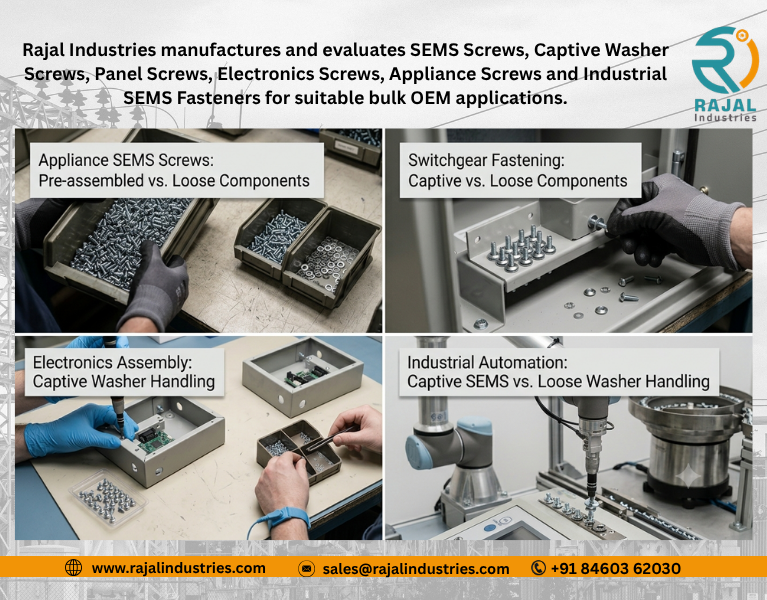
SEMS screw applications are common in OEM assemblies where a screw and washer are required together and production teams want to reduce separate washer handling.
A SEMS screw combines a screw with one or more captive washers into a single pre-assembled fastener.
Instead of an assembly worker handling:
Screw + Separate Washer
the production line handles:
Pre-Assembled SEMS Screw
This makes SEMS screws useful for repetitive assembly in:
- Electrical Panels
- Switchgear
- Electronics
- Home Appliances
- HVAC Equipment
- Telecom Equipment
- Battery & BESS Equipment
- UPS & Inverters
- Industrial Machinery
- Automotive Components
- Control Equipment
- Contract Manufacturing
However, the correct SEMS fastener depends on the actual joint.
OEM engineers should select the screw thread, length, head, drive, washer configuration, material and surface finish according to the product design rather than selecting a generic SEMS screw.
Quick Answer: Where Are SEMS Screws Used?
SEMS screws are used in suitable assemblies where the design requires both a screw and washer.
Common SEMS screw applications include:
- Electrical panel assemblies
- Switchgear cabinets
- Electronic enclosures
- Power supplies
- Home appliances
- HVAC equipment
- Telecom cabinets
- Battery cabinets
- UPS and inverter systems
- Industrial machinery
- Control equipment
- Automotive components
Their main production advantage is that the washer remains captive on the screw, reducing the need to handle the washer as a separate component.
Why Do OEMs Use SEMS Screws?
The main reason is not simply fastening.
It is assembly efficiency.
Consider an OEM fastening point that requires:
1 Screw + 1 Washer
Using conventional components means the production process must manage both items separately.
A SEMS fastener combines them into one assembly.
This can help reduce:
- Separate washer handling
- Loose-component picking
- Missing washers
- Kitting complexity
- Line-side component management
- Assembly steps
For high-volume production, these small improvements can become important.
Why SEMS Screw Applications Are Strong in OEM Manufacturing
SEMS screws are especially relevant where manufacturers repeat the same fastening operation thousands or millions of times.
Consider a manufacturer producing:
300,000 products per year
If each product requires six screw-and-washer fastening points:
300,000 × 6 = 1,800,000 fastening points per year
With separate components, production needs to manage:
1,800,000 Screws + 1,800,000 Loose Washers
With SEMS fasteners, operators or feeding systems handle:
1,800,000 Pre-Assembled Screw-and-Washer Units
The washer still exists, but it does not need to be picked as a separate component during normal assembly.
This is why OEM buyers should compare:
Fastener Cost + Assembly Time + Handling + Inventory + Errors + Rework
rather than screw price alone.
Major SEMS Screw Applications by Industry
| Industry | Typical Application Areas | Why SEMS May Be Considered |
| Electrical Panels | Covers, brackets, internal assemblies | Reduced washer handling |
| Switchgear | Cabinets, components, mounting | Repeatable assembly |
| Electronics | Enclosures, power units, controls | Small-part management |
| Appliances | Internal parts, covers, brackets | High-volume assembly |
| HVAC | Panels, controls, components | Production efficiency |
| Telecom | Cabinets, racks, equipment | Repeatable fastening |
| Battery / BESS | Cabinets, controls, power equipment | Assembly simplification |
| UPS / Inverters | Enclosures, electrical assemblies | Captive washer handling |
| Industrial Machinery | Covers, brackets, controls | Equipment assembly |
| Automotive Components | Modules, brackets, electrical parts | Controlled production |
| Contract Manufacturing | Multiple OEM assemblies | Kitting simplification |
The final fastener should always follow the OEM drawing and application requirements.
SEMS Screws for Electrical Panels
Electrical panels can contain a large number of repetitive fastening points.
Potential applications for panel screws with captive washers include:
- Panel Covers
- Internal Brackets
- Mounting Components
- Electrical Devices
- Control Components
- Terminal Assemblies
- Equipment Supports
- Cabinet Components
Where the joint already requires a washer, a SEMS configuration may simplify assembly.
Important selection factors include:
- Thread size
- Thread pitch
- Screw length
- Head type
- Drive type
- Washer configuration
- Material
- Surface finish
- Installation torque
Why Electrical Panel Manufacturers Use Captive Washer Screws
An electrical panel manufacturer may repeatedly install screws into:
- Weld Nuts
- Clinch Nuts
- Threaded Inserts
- Tapped Holes
- Standard Nuts
If every fastening point also requires a washer, operators must handle an additional component.
A captive washer screw can combine these components before they reach the assembly line.
This can be especially useful for manufacturers producing the same panel design in large quantities.
SEMS Screws for Switchgear
Switchgear manufacturers can have demanding requirements for consistency because the same assemblies may be produced repeatedly.
Potential SEMS applications include:
- Switchgear Cabinets
- Internal Mounting Brackets
- Covers
- Control Components
- Electrical Assemblies
- Equipment Supports
For these applications, buyers may focus on:
Thread Fit + Washer Retention + Drive Quality + Finish + Dimensional Consistency
The correct washer type should follow the joint requirement.
SEMS Screws for Control Panels
Control panels combine mechanical and electrical components within one enclosure.
Potential SEMS applications include:
- Internal Component Mounting
- Covers
- Brackets
- Equipment Supports
- Electrical Assemblies
- Control Hardware
A pre-assembled screw-and-washer fastener can help reduce loose components during repetitive production.
For high-volume panel manufacturers, this can also simplify line-side inventory.
SEMS Screws for Electronics
Electronics screws can be small, but their production impact can be large when annual volumes are high.
Potential SEMS applications include:
- Electronic Enclosures
- Power Supply Units
- Industrial Electronics
- Control Units
- Communication Devices
- Electronic Cabinets
- Equipment Housings
Electronics OEMs may require tighter control of:
- Small thread sizes
- Head dimensions
- Drive geometry
- Washer dimensions
- Surface finish
- Assembly torque
- Dimensional consistency
Why SEMS Screws Can Help Electronics Assembly
Electronics production often involves many small components.
Handling a tiny screw and a tiny washer separately can increase:
- Picking steps
- Component loss
- Kitting complexity
- Assembly time
Combining the washer with the screw can simplify the fastening operation.
This becomes more valuable when the same operation is repeated across hundreds of thousands of products.
SEMS Screws for Electronic Enclosures
Electronic equipment commonly uses enclosures to protect:
- Circuit Boards
- Power Electronics
- Control Components
- Communication Hardware
- Electrical Connections
Where a washer is specified, SEMS screws may be considered for:
- Covers
- Mounting Brackets
- Internal Supports
- Equipment Panels
The screw length and washer OD must be selected carefully where internal clearance is limited.
SEMS Screws for Power Supply Equipment
Power supply manufacturers may use repetitive screw-and-washer assemblies in:
- Housings
- Covers
- Internal Brackets
- Electrical Components
- Mounting Assemblies
Important buyer requirements may include:
- Thread fit
- Washer retention
- Controlled dimensions
- Surface finish
- Installation torque
- Batch consistency
If the joint has an electrical function, the complete assembly should be validated by the equipment manufacturer.
SEMS Screws for Home Appliances
Appliance screws represent an important high-volume fastener market.
Potential applications can include:
- Washing Machines
- Refrigerators
- Air Conditioners
- Water Heaters
- Kitchen Appliances
- Commercial Appliances
- Electrical Appliances
An appliance can contain many fastening points, and production may run into hundreds of thousands or millions of units.
This makes assembly efficiency important.
SEMS Screws in Washing Machines
Possible fastening areas can include:
- Internal Brackets
- Electrical Components
- Control Assemblies
- Covers
- Equipment Supports
The actual fastener must be selected according to:
- Material being fastened
- Joint thickness
- Mating thread
- Environment
- Required washer function
Moisture and corrosion exposure should also be considered where applicable.
SEMS Screws in Refrigerators
Refrigerator manufacturing involves:
- Electrical Components
- Internal Equipment
- Covers
- Brackets
- Control Systems
- Mechanical Assemblies
For repetitive screw-and-washer joints, a captive washer design can reduce separate component handling.
The required coating should be selected according to the environment and OEM specification.
SEMS Screws for Air Conditioners
Air-conditioning equipment combines:
- Sheet Metal
- Electrical Equipment
- Electronic Controls
- Motors
- Internal Brackets
- Covers
This creates multiple possible fastening requirements.
SEMS screws may be considered where the joint requires a machine screw and washer combination.
Important factors include:
- Vibration
- Humidity
- Corrosion
- Assembly torque
- Service access
- Washer function
SEMS Screws for HVAC Equipment
HVAC equipment manufacturers can use many different fastener types within one product.
Possible SEMS applications include:
- Control Boxes
- Electrical Assemblies
- Equipment Panels
- Brackets
- Internal Components
- Covers
SEMS screws should not automatically replace self-tapping or self-drilling screws.
They are most relevant where the joint uses a machine-threaded fastening point and requires a washer.
SEMS Screws for Telecom Equipment
Telecom equipment can require large quantities of relatively small fasteners.
Potential applications include:
- Telecom Cabinets
- Equipment Racks
- Communication Hardware
- Electronic Enclosures
- Power Equipment
- Control Systems
Important selection factors include:
- Available clearance
- Screw head
- Drive
- Washer OD
- Surface finish
- Corrosion exposure
- Electrical requirements
SEMS Screws for Telecom Cabinets
Cabinets may contain:
- Electronic Equipment
- Power Components
- Brackets
- Covers
- Mounting Hardware
- Control Components
A captive washer configuration can help where washers are already required by the design.
For outdoor telecom cabinets, environmental and corrosion requirements become especially important.
SEMS Screws for Battery Equipment
Battery-related equipment can contain many electrical and mechanical assemblies.
Potential applications include:
- Battery Cabinets
- Battery Racks
- Control Equipment
- Electrical Enclosures
- Internal Brackets
- Power Components
The fastener specification should account for the actual mechanical and electrical requirements of the assembly.
SEMS Screws for BESS Equipment
Battery Energy Storage Systems combine:
- Battery Modules
- Electrical Cabinets
- Power Conversion Equipment
- Control Systems
- Monitoring Equipment
- Mechanical Enclosures
Potential SEMS screw applications can exist in suitable auxiliary, enclosure and equipment assemblies where a captive washer is required.
However, the term “BESS fastener” covers many different fastening conditions.
The engineering team should define each joint separately.
SEMS Screws for UPS Systems
UPS equipment can contain:
- Power Electronics
- Electrical Cabinets
- Internal Supports
- Covers
- Control Equipment
- Brackets
Where machine screws and washers are required, a SEMS assembly can simplify repetitive production.
Important considerations include:
- Thread
- Screw length
- Washer type
- Installation torque
- Finish
- Service environment
SEMS Screws for Inverters
Inverter manufacturers may use SEMS screws in suitable:
- Electrical Enclosures
- Control Assemblies
- Power Electronics Housings
- Internal Brackets
- Covers
For solar and industrial inverter OEMs, annual production volume can make assembly efficiency commercially important.
SEMS Screws for Industrial Machinery
Industrial machinery can contain many screw-and-washer fastening points.
Potential applications include:
- Machine Covers
- Control Cabinets
- Equipment Panels
- Mounting Brackets
- Electrical Boxes
- Internal Components
The correct fastener depends on:
- Joint load
- Thread engagement
- Installation torque
- Vibration
- Service environment
- Maintenance requirements
SEMS Screws for Machine Covers & Panels
Machine covers and access panels may need to be installed efficiently during manufacturing.
Where a machine screw and washer are specified, SEMS screws can reduce loose-component handling.
For frequently serviced panels, engineers should also consider:
- Repeated removal
- Thread durability
- Washer condition
- Tool access
The fastener should be selected for the complete service cycle.
SEMS Screws for Automotive Components
Automotive component manufacturers often operate high-volume assembly lines.
Potential SEMS applications may include suitable:
- Electrical Modules
- Equipment Housings
- Brackets
- Control Components
- Interior Assemblies
- Auxiliary Equipment
The exact requirements can be much stricter than general industrial applications.
Depending on the customer, buyers may require:
- Material certification
- Dimensional reports
- Mechanical testing
- Coating validation
- Corrosion testing
- Lot traceability
- PPAP-related documentation
These requirements should be agreed before production.
SEMS Screws for Contract Manufacturing
Contract manufacturers may assemble products for several OEM customers.
Potential sectors include:
- Electronics
- Electrical Equipment
- Appliances
- Telecom
- Industrial Equipment
- Energy Equipment
A captive washer fastener can simplify:
- Kitting
- Workstation inventory
- Component picking
- Assembly instructions
- Production control
This can be especially useful for stable, repeat-production programs.
SEMS Screw Applications by Washer Type
| SEMS Configuration | Potential Application |
| Screw + Plain Washer | Panels, electronics, appliances |
| Screw + Spring Washer | Drawing-specific equipment joints |
| Screw + Plain + Spring Washer | Electrical and industrial assemblies |
| Screw + Toothed Washer | Application-specific electrical/equipment joints |
| Custom Washer SEMS | OEM-specific products |
The washer configuration must match the required joint function.
Plain Washer SEMS Screw Applications
A captive plain washer can be useful where the joint requires:
- Increased bearing area
- Load distribution
- Surface protection
- A specified washer under the screw head
Potential industries include:
- Electrical
- Electronics
- Appliances
- Telecom
- Machinery
The washer OD and thickness should match the joint.
Spring Washer SEMS Screw Applications
A spring washer may be specified for certain OEM joints.
Potential sectors include:
- Electrical Equipment
- Industrial Machinery
- Appliances
- Control Equipment
However, a spring washer should not automatically be treated as a universal vibration or loosening solution.
The complete joint should be validated by engineering.
Double-Washer SEMS Screw Applications
A double-washer arrangement may contain:
Screw + Spring Washer + Plain Washer
This can be useful where the approved design already requires both washers.
The main production advantage is that all components arrive as one captive assembly.
This can reduce the risk of:
- Missing one washer
- Incorrect loose-component picking
- Additional handling
Toothed Washer SEMS Screw Applications
Some assemblies may use a captive toothed washer for a specific mechanical or electrical function.
Potential application areas can include:
- Electrical Equipment
- Control Systems
- Electronic Equipment
- Industrial Assemblies
The washer geometry, material, surface finish and mating surface should be evaluated together.
Do not assume a toothed washer provides the required electrical contact or locking performance without application validation.
Selecting SEMS Screws by Industry
The industry name alone should never determine the fastener.
Instead, use this process:
Step 1: Identify the Joint
What components are being fastened?
Step 2: Identify the Mating Thread
Is the screw entering:
- Nut?
- Tapped hole?
- Weld nut?
- Clinch nut?
- Threaded insert?
Step 3: Determine Why the Washer Is Required
Is it needed for:
- Bearing area?
- Surface protection?
- Application-specific locking?
- Electrical function?
- Another requirement?
Step 4: Define Screw Geometry
Specify:
- Diameter
- Pitch
- Length
- Head
- Drive
Step 5: Define Materials & Finish
Match them to the mechanical and environmental conditions.
Step 6: Validate the Assembly
Test production samples in the actual joint.
This is more reliable than selecting a generic “electronics screw” or “panel screw” from an industry name alone.
Application Selection Table for OEM Buyers
| Buyer Requirement | SEMS Feature to Review |
| High-volume assembly | Pre-assembled washer |
| Limited installation space | Head + washer OD |
| Automated assembly | Feeding geometry + drive |
| Electrical equipment | Joint + finish + washer function |
| Humid environment | Material + coating |
| Repeated servicing | Thread + washer durability |
| High installation torque | Material + head + drive |
| Small electronics | Dimensions + drive accuracy |
| Washer omission problem | Captive retention |
| Two washers required | Double-washer configuration |
Can SEMS Screws Reduce Assembly Time?
Potentially, yes.
The main time saving comes from removing the need to separately pick and position a washer.
However, the actual saving depends on:
- Current assembly process
- Manual vs automated installation
- Fastener feeding
- Washer handling
- Production volume
- Operator cycle
- Product design
OEMs should measure the actual assembly cycle before and after changing the fastener.
This produces a better business case than relying on a general percentage claim.
Total Cost Example for an OEM Buyer
Suppose two sourcing options are available.
Option A
Standard Screw + Loose Washer
The piece price may be lower.
But the OEM also has:
- Separate washer purchasing
- Separate inventory
- Separate bins
- Washer picking
- Kitting
- Installation handling
- Missing-washer risk
Option B
SEMS Screw
The fastener price may be higher because the washer is included and additional manufacturing is required.
But some assembly and handling costs can be reduced.
The buyer should compare:
Total Installed Cost
Purchase Cost + Inventory Cost + Handling + Labour + Errors + Rework
For a high-volume OEM, this is more useful than comparing only the screw price.
What OEM Buyers Should Send to a SEMS Screw Supplier
For an application-based enquiry, provide:
- Product application
- Technical drawing
- Thread diameter
- Thread pitch
- Screw length
- Head type
- Drive
- Washer configuration
- Washer dimensions
- Screw material
- Washer material
- Surface finish
- Mechanical requirements
- Installation torque
- Mating component
- Testing requirements
- Monthly requirement
- Annual requirement
This allows the supplier to evaluate the actual application rather than quote a generic fastener.
Example OEM RFQ
Instead of:
Need SEMS screws for electrical panels.
Send:
Requirement: SEMS screws for electrical panel production. M4 × 0.7 thread, pan head, cross recess, captive plain + spring washer configuration, carbon steel with specified zinc finish. Please review the attached drawing and confirm manufacturing feasibility, washer retention control, testing capability, MOQ and monthly production capacity. Estimated annual requirement: 1,000,000 pcs.
A drawing should remain the controlling technical document.
Why Rajal Industries for OEM SEMS Screw Requirements?
Rajal Industries can evaluate bulk and drawing-based SEMS fastener requirements for suitable OEM applications.
Subject to technical feasibility and customer approval, requirements can be evaluated for:
- SEMS Screws
- Captive Washer Screws
- Panel Screws
- Electronics Screws
- Appliance Screws
- Industrial Screws
- Plain Washer SEMS
- Spring Washer SEMS
- Double-Washer SEMS
- Custom Washer Configurations
- Different Head Types
- Different Drive Types
- Carbon Steel
- Stainless Steel
- Surface Finishes
- Drawing-Based Manufacturing
- Dimensional Inspection
- Thread Inspection
- Washer Retention Inspection
- Mechanical Testing as Specified
- Batch Traceability
- OEM Packaging
- Scheduled Bulk Supply
Potential OEM sectors include:
- Electrical Panels
- Switchgear
- Electronics
- Appliances
- HVAC
- Telecom
- Battery / BESS
- UPS / Inverters
- Industrial Machinery
- Automotive Components
- Contract Manufacturing
Final manufacturing capability should always be confirmed against the customer’s drawing, washer configuration, materials, testing requirements and expected order quantity.
Bulk Buyer Quick Answer
Which industries commonly use SEMS screws?
Suitable SEMS screw applications can be found in electrical panels, switchgear, electronics, appliances, HVAC equipment, telecom equipment, industrial machinery, energy equipment and other high-volume OEM assemblies.
SEMS screws are especially useful where the joint already requires a screw and washer and reducing separate washer handling provides production value.
How to Select SEMS Screws for Different Applications
The correct SEMS screw applications depend on the joint, not only on the industry.
For example, two electrical panel manufacturers may use completely different SEMS screws because their:
- Panel thickness
- Mating threads
- Assembly torque
- Washer requirements
- Surface finishes
- Production methods
are different.
A practical selection process should consider:
Application → Joint → Thread → Head & Drive → Washer → Material → Finish → Testing
This approach is more reliable than choosing a fastener only because it is commonly used in a particular industry.
SEMS Screw Selection by Application
| Application | Important Selection Factors | Possible SEMS Configuration |
| Electrical Panels | Thread, washer, finish, torque | Plain or specified washer |
| Switchgear | Retention, drive, coating | Drawing-based SEMS |
| Electronics | Small size, drive accuracy, clearance | Compact SEMS |
| Appliances | Assembly speed, volume, corrosion | OEM-specific SEMS |
| HVAC | Environment, vibration, coating | Application-specific |
| Telecom | Clearance, corrosion, electrical needs | Drawing-based SEMS |
| BESS / UPS | Mechanical + electrical requirements | OEM-specific |
| Machinery | Strength, torque, service conditions | Industrial SEMS |
| Automotive | Testing, traceability, process control | Customer-specific |
The exact fastener should always follow the approved OEM drawing.
Electrical Panel Screws: What Should Buyers Check?
When selecting panel screws, first identify how the screw will be installed.
The mating component may be:
- Tapped Hole
- Weld Nut
- Clinch Nut
- Threaded Insert
- Standard Nut
Then define:
- Thread diameter
- Pitch
- Engagement
- Screw length
- Head
- Drive
- Washer configuration
- Material
- Finish
- Installation torque
Where a washer is required at every fastening point, a captive SEMS arrangement may simplify production.
Which SEMS Washer Is Suitable for Electrical Panels?
There is no single washer that is correct for every panel application.
Plain Washer
May be specified where additional bearing area or surface protection is required.
Spring Washer
May be used where the approved joint design specifies it.
Plain + Spring Washer
May be used where both washers are required by the drawing.
Toothed Washer
May be specified for particular mechanical or electrical joint requirements.
The electrical panel manufacturer should define the required function rather than asking the supplier to select a washer only from general industry practice.
Electronics Screws: What Should OEMs Check?
Small electronics screws require attention to dimensions because available space can be limited.
Important parameters include:
- Thread diameter
- Thread pitch
- Head diameter
- Head height
- Drive size
- Washer OD
- Washer thickness
- Overall length
- Surface finish
For automated electronics production, buyers should also check:
- Feeder compatibility
- Driver engagement
- Screw orientation
- Washer movement
- Installation torque
A small dimensional change can affect the assembly process.
SEMS Screws for High-Volume Electronics Production
Consider an electronics OEM producing:
800,000 units per year
If every unit requires four screw-and-washer assemblies:
800,000 × 4 = 3,200,000 fastening points
Using separate components means production manages:
3.2 million screws + 3.2 million washers
Using SEMS fasteners means the line handles:
3.2 million pre-assembled fasteners
This does not mean SEMS automatically saves money.
The OEM should compare:
SEMS Cost vs Screw + Washer + Handling + Assembly + Error Cost
At millions of fastening points, even small cycle-time improvements may become commercially meaningful.
Appliance Screws: What Should Buyers Check?
High-volume appliance production can place different demands on appliance screws.
Buyers should consider:
- Production quantity
- Installation speed
- Thread consistency
- Washer retention
- Drive quality
- Corrosion exposure
- Coating
- Automated assembly
- Supplier capacity
The required fastener can vary considerably between different locations within the same appliance.
SEMS Screws for Appliance Assembly
A washing machine, refrigerator or air conditioner may contain several different fastening conditions.
For example:
Electrical Control Assembly
→ SEMS machine screw may be suitable if a captive washer is required.
Thin Sheet Metal Joint
→ Another screw type may be more appropriate.
Plastic Component
→ Thread-forming requirements may be different.
Structural Assembly
→ Higher mechanical requirements may apply.
This is why OEM buyers should avoid specifying one generic “appliance screw” for every joint.
Electrical vs Electronics vs Appliance SEMS Screws
| Factor | Electrical Panels | Electronics | Appliances |
| Typical Size | Application dependent | Often smaller | Small to medium |
| Washer Requirement | Joint dependent | Joint dependent | Joint dependent |
| Clearance | Moderate to limited | Often limited | Varies |
| Assembly Volume | Medium to high | High | High |
| Automation | Common | Common | Common |
| Corrosion Requirement | Environment based | Usually application based | Environment based |
| Drive Accuracy | Important | Very important | Important |
| Cost Pressure | High | High | Very high |
| Supplier Capacity | Important | Important | Very important |
These are general sourcing considerations. The approved product design remains the final authority.
SEMS Screws for Automated OEM Assembly
Automation is one of the important reasons buyers may evaluate SEMS fasteners.
A conventional assembly may require separate feeding of:
Screw + Washer
A SEMS fastener can potentially reduce this to:
One Pre-Assembled Fastener
However, being captive does not automatically make a SEMS screw automation-friendly.
What Should Be Checked for Automatic Screw Feeding?
Before mass production, check:
Head Geometry
The head must work with the feeding and driving system.
Washer OD
A large washer can affect orientation or movement through a feeder.
Washer Movement
Excessive movement may affect feeding behaviour.
Overall Length
The length-to-head relationship can affect orientation.
Drive Recess
Consistent drive geometry helps powered installation.
Thread
The thread must engage the mating component consistently.
Installation Torque
The driver should be set according to the actual joint requirement.
Best Practice for Automated Assembly Trials
Do not approve a high-volume SEMS screw based only on dimensional inspection.
Test:
Actual SEMS Screw + Actual Feeder + Actual Driver + Actual Mating Component
Check:
- Feeding
- Orientation
- Bit engagement
- Thread starting
- Installation
- Torque
- Washer seating
- Cycle time
This can identify production problems before full-scale supply.
SEMS Screw vs Loose Washer for OEM Production
| Cost / Process Factor | SEMS Screw | Loose Screw + Washer |
| Screw Cost | Included | Separate |
| Washer Cost | Included | Separate |
| Washer Assembly | Pre-assembled | At production line |
| Separate Washer Inventory | Reduced | Required |
| Washer Picking | Reduced | Required |
| Missing Washer Risk | Reduced | Process dependent |
| Kitting Complexity | Lower in suitable applications | Higher |
| Automated Feeding | Potentially simpler | May need separate feeding |
| Unit Fastener Price | Often higher | Often lower |
| Total Installed Cost | Application dependent | Application dependent |
This is why procurement teams should avoid comparing only piece prices.
Calculate Total Installed Fastener Cost
A useful OEM calculation is:
Conventional Assembly
Screw Price + Washer Price + Washer Handling + Kitting + Installation Labour + Error/Rework Cost
SEMS Assembly
SEMS Screw Price + Installation Cost
This is a simplified model, but it encourages buyers to look beyond purchase price.
The actual calculation should use the factory’s own labour, automation, scrap and cycle-time data.
When SEMS Screws May Provide the Most Value
SEMS fasteners can be worth evaluating when:
- Production volume is high
- Every fastening point requires a washer
- The same configuration repeats frequently
- Operators manually handle washers
- Missing washers cause quality problems
- Kitting is complex
- Automated assembly is used
- Line cycle time is important
When SEMS Screws May Not Be Necessary
A SEMS fastener is not automatically the best solution.
A conventional screw may be more practical when:
- No washer is required
- Production quantity is very low
- Washer configurations change frequently
- The washer needs to be installed separately
- The joint uses a different fastening system
- The extra SEMS manufacturing cost provides little production benefit
Fastener selection should follow the application economics and engineering requirement.
Common SEMS Screw Application Problems
1. Washer Falls Off During Handling
Possible causes:
- Incorrect washer ID
- Insufficient retention
- Thread dimensional variation
- Manufacturing-process issue
Solution
Review:
Washer ID + Screw Blank + Finished Thread + Retention Method
Retention should be checked before bulk approval.
2. Washer Jams on the Screw
Possible causes:
- Washer ID too small
- Burrs
- Excessive coating
- Washer deformation
- Incorrect clearance
Solution
Check the required washer movement against the approved drawing.
3. Screw Does Not Enter the Mating Thread
Possible causes:
- Wrong pitch
- Thread tolerance issue
- Thread damage
- Coating buildup
- Incorrect mating component
Solution
Check:
Thread Specification + GO/NO-GO Gauge + Actual Mating Part
4. Driver Bit Slips During Production
Possible causes:
- Incorrect bit
- Poor drive geometry
- Tool wear
- Misalignment
- Excessive torque
Solution
Check the drive dimensions and test using the actual production tool.
5. SEMS Screw Jams in Automatic Feeder
Possible causes:
- Washer OD
- Washer movement
- Head geometry
- Screw proportions
- Feeder incompatibility
Solution
Conduct a feeder trial using production-intent samples.
6. Washer Is Missing
A missing washer defeats the basic purpose of a SEMS fastener.
Possible causes:
- Manufacturing defect
- Retention failure
- Handling damage
- Process-control failure
Solution
Include washer presence and retention in the supplier’s inspection plan.
7. Wrong Washer Combination
For example, the drawing requires:
Spring Washer + Plain Washer
but the supplied product contains only:
Plain Washer
Solution
Control:
- Washer type
- Quantity
- Sequence
- Dimensions
against the approved drawing.
8. Washer Deforms During Tightening
Possible causes:
- Incorrect material
- Insufficient thickness
- Excessive load
- Incorrect washer geometry
- Joint-design issue
Solution
Review both washer specification and installation conditions.
9. Early Corrosion
Possible causes:
- Incorrect coating
- Insufficient corrosion performance
- Coating damage
- Environmental mismatch
- Poor storage
Solution
Specify the required coating and measurable corrosion performance where applicable.
SEMS Screw Application Troubleshooting Table
| Problem | Possible Cause | First Check |
| Washer Falls Off | Retention | Washer ID + thread |
| Washer Jammed | Clearance | Washer movement |
| Wrong Washer | Assembly control | Drawing |
| Thread Too Tight | Tolerance / coating | Thread gauge |
| Bit Slips | Drive geometry | Bit engagement |
| Feeder Jam | Fastener geometry | Production trial |
| Screw Breakage | Torque / material | Mechanical test |
| Washer Deforms | Material / thickness | Washer specification |
| Corrosion | Finish | Coating requirement |
Common Engineering Mistakes
Mistake 1: Choosing by Industry Name
“Electronics screw” or “panel screw” is not a complete technical specification.
Always define the actual joint.
Mistake 2: Selecting SEMS Only to Save Assembly Time
Assembly efficiency is useful, but the fastener must first meet the mechanical and functional requirements.
Engineering comes before process savings.
Mistake 3: Ignoring Washer Function
Do not specify a spring, plain or toothed washer without knowing why it is required.
Mistake 4: Assuming Spring Washers Always Prevent Loosening
No single washer design should be assumed to prevent loosening in every joint.
The complete fastening system should be validated.
Mistake 5: Ignoring Coating Thickness
Coating can affect:
- Thread fit
- Washer movement
- Drive dimensions
This is particularly important on small electronics screws.
Mistake 6: Not Testing the Actual Assembly
A screw can pass dimensional inspection but still create problems during production.
Test it in the actual:
Part + Tool + Torque + Assembly Process
Common Procurement Mistakes
Buying Only by Price
The cheapest screw is not always the lowest-cost assembly.
Compare:
Fastener + Inventory + Handling + Labour + Rework
Asking for “Standard SEMS Screw” Without a Drawing
There are many possible combinations.
Provide:
- Thread
- Length
- Head
- Drive
- Washer
- Material
- Finish
A drawing is strongly recommended for OEM production.
Comparing Different Supplier Specifications
Supplier A may quote one washer.
Supplier B may quote two washers.
Supplier C may quote another coating.
The prices cannot be compared fairly.
Use one common RFQ specification.
OEM Application Quality Checklist
Before approving a SEMS screw for production, check:
| Check | Requirement |
| Application | Confirmed |
| Approved Drawing | Available |
| Thread Diameter | Verified |
| Thread Pitch | Verified |
| Thread Fit | Verified |
| Screw Length | Verified |
| Head Dimensions | Verified |
| Drive Recess | Verified |
| Washer Type | Correct |
| Washer Quantity | Correct |
| Washer Sequence | Correct |
| Washer OD | Verified |
| Washer ID | Verified |
| Washer Thickness | Verified |
| Washer Retention | Checked |
| Washer Movement | Checked |
| Screw Material | Verified |
| Washer Material | Verified |
| Mechanical Properties | As specified |
| Surface Finish | Verified |
| Coating Thickness | As specified |
| Corrosion Test | As required |
| Installation Torque | Validated |
| Actual Assembly Trial | Completed |
| Feeder Trial | If applicable |
| Batch Traceability | As required |
OEM RFQ Checklist for SEMS Screw Applications
Send your supplier:
☐ Application / Product
☐ Technical Drawing
☐ Thread Diameter
☐ Thread Pitch
☐ Thread Tolerance
☐ Screw Length
☐ Head Type
☐ Drive Type
☐ Washer Type
☐ Washer Quantity
☐ Washer Sequence
☐ Washer OD
☐ Washer ID
☐ Washer Thickness
☐ Screw Material
☐ Washer Material
☐ Mechanical Requirements
☐ Surface Finish
☐ Coating Requirement
☐ Corrosion Requirement
☐ Mating Component
☐ Installation Torque
☐ Required Tests
☐ Automation Details, if applicable
☐ Sample Quantity
☐ Trial Quantity
☐ Monthly Consumption
☐ Annual Consumption
☐ Packaging
☐ Delivery Schedule
Questions to Ask a SEMS Screw Manufacturer
Before approving a supplier for OEM production, ask:
- Are you the actual manufacturer?
- Which SEMS screw sizes can you manufacture?
- Which washer combinations can you produce?
- Can you manufacture from our drawing?
- Can you produce single and double-washer SEMS screws?
- Which screw materials can you process?
- Which washer materials can you process?
- Which head and drive types are available?
- How do you control washer retention?
- How do you inspect washer movement?
- How do you prevent missing washers?
- How do you control washer sequence?
- How are threads inspected?
- Which thread gauges are used?
- How is drive geometry inspected?
- Which coatings can you provide?
- Can coating thickness be controlled?
- Can corrosion testing be provided where required?
- Can mechanical testing be provided?
- Can you test screws with our mating component?
- Can you support automated feeder trials?
- Can you provide dimensional inspection reports?
- Is lot traceability available?
- Can customer-specific quality documentation be supported?
- What is your MOQ?
- What is your monthly production capacity?
- Can you support scheduled deliveries?
- Can you support custom OEM packaging?
Why Rajal Industries for OEM SEMS Screw Applications?
Rajal Industries can evaluate drawing-based SEMS fastener requirements for suitable bulk OEM applications.
Subject to technical feasibility and customer approval, requirements can be evaluated for:
- SEMS Screws
- Electronics Screws
- Appliance Screws
- Panel Screws
- Captive Washer Screws
- Industrial Screws
- Plain Washer SEMS
- Spring Washer SEMS
- Double-Washer SEMS
- Custom Washer Configurations
- Custom Head & Drive Types
- Carbon Steel
- Stainless Steel
- Surface Finishes
- Dimensional Inspection
- Thread Inspection
- Washer Retention Inspection
- Mechanical Testing as Specified
- OEM Packaging
- Scheduled Bulk Supply
Key target industries include:
- Electrical Panels
- Switchgear
- Electronics
- Appliances
- HVAC
- Telecom
- Battery / BESS
- UPS & Inverters
- Industrial Machinery
- Automotive Components
- Contract Manufacturing
Final capability should be confirmed against the customer’s technical drawing, materials, washer configuration, finish, quality requirements and expected production quantity.
Frequently Asked Questions About SEMS Screw Applications
Where are SEMS screws commonly used?
Common SEMS screw applications include electrical panels, switchgear, electronics, appliances, HVAC equipment, telecom equipment and industrial machinery where the design requires a screw and captive washer.
Why are SEMS screws used in electrical panels?
They can reduce separate washer handling where the panel design requires both a machine screw and washer.
Are SEMS screws used in electronics?
Yes. Suitable SEMS screws can be used in electronic enclosures, power supplies, control units and other assemblies requiring captive washers.
What are electronics screws?
Electronics screws are fasteners used in electronic equipment and assemblies. The term does not define one specific screw standard, so buyers should specify thread, size, head, drive, material and finish.
Are SEMS screws used in home appliances?
Yes. SEMS screws can be used in suitable washing machine, refrigerator, air-conditioner and other appliance assemblies.
What are appliance screws?
Appliance screws are fasteners selected for appliance assemblies. Depending on the joint, these may include machine screws, SEMS screws, tapping screws and other fastener types.
What are panel screws?
Panel screws are screws used to secure panels, covers, brackets or components. A SEMS panel screw may include one or more captive washers where required.
Can SEMS screws be used in switchgear?
Yes, where the switchgear design requires a screw-and-washer combination and the selected SEMS fastener meets the engineering requirements.
Can SEMS screws be used in BESS equipment?
They may be used in suitable BESS cabinet, control and equipment assemblies. Each mechanical and electrical joint should be evaluated individually.
Can SEMS screws be used in telecom cabinets?
Yes, provided the screw, washer, coating and joint meet the equipment requirements.
Are SEMS screws suitable for industrial machinery?
Yes. They can be considered for suitable covers, brackets, panels, control cabinets and other machine assemblies.
Can SEMS screws reduce assembly time?
They can reduce separate washer handling. Actual cycle-time savings depend on the production process and should be measured by the OEM.
Are SEMS screws suitable for automatic assembly?
They can be, but the fastener should be tested with the actual feeder, driver and mating component before mass production.
Which washer should I use for an electrical panel SEMS screw?
There is no universal choice. Plain, spring, toothed or other washers should be selected according to the joint’s engineering requirements.
Is a spring washer always needed?
No. A spring washer should only be used when required by the joint design or specification.
What should I send when requesting SEMS screws for an OEM application?
Send the technical drawing, application, thread, length, head, drive, washer configuration, materials, finish, required testing and annual quantity.
AEO Quick Answers
What are the main SEMS screw applications?
SEMS screws are commonly used in electrical panels, switchgear, electronics, appliances, HVAC, telecom and industrial equipment where a screw and washer are required together. The captive washer can reduce separate component handling during repetitive OEM assembly.
Why do electronics manufacturers use SEMS screws?
Electronics manufacturers may use SEMS screws to combine a screw and washer into one pre-assembled fastener, helping simplify small-component handling in repetitive production.
Why do appliance manufacturers use SEMS screws?
Appliance manufacturers may use SEMS screws where the product requires a machine screw and washer at the same fastening point. Captive washers can simplify high-volume assembly and kitting.
Are SEMS screws better than standard screws?
Not for every application. SEMS screws are most useful when the joint already requires a washer and pre-assembly provides a production advantage.
Key Takeaways
- SEMS screw applications are strongest where a screw and washer are required together.
- Electrical panels, electronics and appliances are important OEM application areas.
- SEMS screws can reduce separate washer handling.
- High-volume production increases the potential value of pre-assembled fasteners.
- The correct SEMS screw depends on the joint, not only the industry.
- Washer type should be selected according to its required function.
- Electronics applications may require tight dimensional and drive control.
- Appliance OEMs should consider total installed cost, not only piece price.
- Automatic assembly requires feeder and driver trials.
- Surface finish should match the operating environment.
- OEM buyers should test samples in the actual mating component.
- The approved technical drawing should control mass production.
Conclusion
The main value of SEMS screw applications is the combination of fastening and assembly efficiency.
In electrical panels, electronics, appliances and industrial equipment, a captive washer can eliminate the need to separately handle a washer at every applicable fastening point.
For large OEM production volumes, buyers should evaluate:
Fastener Cost + Washer Handling + Assembly Time + Inventory + Quality Errors + Rework
However, assembly efficiency should never replace proper engineering.
The correct SEMS screw must still match the:
Joint + Thread + Head + Drive + Washer + Material + Finish + Torque + Environment
Rajal Industries can evaluate bulk, drawing-based SEMS screw requirements for electrical, electronics, appliance and industrial OEM applications based on customer specifications and annual production quantities.