

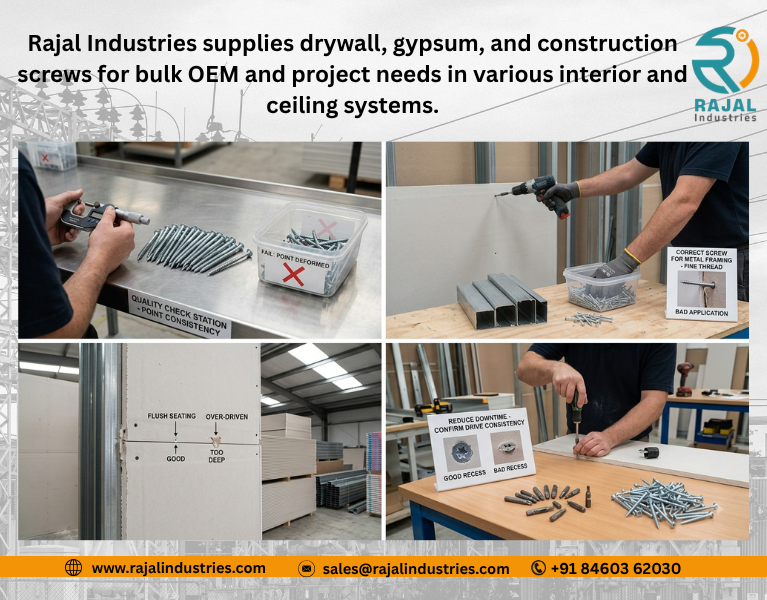
Finding the right drywall screw manufacturer is important for construction companies, drywall system suppliers, gypsum board companies, ceiling contractors and building-product distributors that require reliable fasteners in bulk.
Drywall screws are commonly used to fasten gypsum board and similar panels to suitable supporting framing. Depending on the application, the framing may include wood or light-gauge metal sections.
However, professional buyers need to evaluate more than screw diameter and length.
Important factors can include:
- Thread type
- Screw diameter
- Screw length
- Head geometry
- Drive recess
- Point design
- Material
- Heat treatment
- Surface finish
- Corrosion requirement
- Supporting frame material
- Board thickness
- Installation equipment
- Required testing
For large construction projects and repetitive production, inconsistent screws can cause installation problems across thousands of fastening points.
This guide explains what bulk buyers should check when sourcing gypsum screws, drywall fasteners and construction screws from a manufacturer.
Quick Answer: What Should You Check When Buying Drywall Screws?
Before ordering drywall screws in bulk, confirm:
- Board type and thickness
- Supporting frame material
- Screw diameter
- Screw length
- Fine or coarse thread
- Head type
- Drive type
- Point design
- Material
- Heat treatment
- Surface finish
- Corrosion requirement
- Installation method
- Required testing
- Order quantity and annual demand
The correct screw depends on the complete fastening system, not only the product name.
What Is a Drywall Screw?
A drywall screw is a threaded fastener commonly used for installing gypsum board or drywall panels onto suitable framing.
Typical applications include:
- Gypsum Board Installation
- Drywall Partitions
- Interior Wall Systems
- Suspended Ceiling Systems
- False Ceilings
- Light-Gauge Framing Systems
- Interior Construction
- Prefabricated Interior Systems
Depending on the application, drywall screws can be produced with different:
- Diameters
- Lengths
- Thread configurations
- Points
- Head geometries
- Surface finishes
The correct design should match the board, framing material and installation conditions.
Why Drywall Screw Quality Matters
A drywall screw may look like a simple product, but large projects can consume very high quantities.
Poor fastener consistency can create problems such as:
- Difficult starting
- Screw breakage
- Driver-bit slipping
- Head damage
- Incorrect head seating
- Thread stripping
- Slower installation
- Rework
- Fastener rejection
For contractors and OEM buyers, the cost of a screw should therefore be considered together with installation performance and consistency.
Drywall Screw Applications
Common applications include:
| Application | Typical Fastening Requirement |
| Drywall Partitions | Gypsum board to suitable framing |
| False Ceilings | Board and ceiling-system fastening |
| Interior Walls | Gypsum board installation |
| Metal Stud Systems | Board to light-gauge metal framing |
| Wood Framing | Board to suitable wooden framing |
| Commercial Interiors | Repetitive drywall installation |
| Prefabricated Interiors | Standardized fastening |
| Office Fit-Out | Partition and ceiling systems |
| Retail Interiors | Drywall and ceiling installation |
| Hospitality Projects | Interior wall and ceiling systems |
The screw specification should be selected according to the actual system rather than assuming one drywall screw is suitable for every application.
Major Industries That Use Drywall Screws
Keep this section short on the final WordPress page while still covering the main bulk markets.
Major users include:
- Construction Companies
- Drywall Contractors
- Gypsum Board Companies
- Ceiling-System Contractors
- Interior Fit-Out Companies
- Commercial Building Contractors
- Prefabricated Building Companies
- Modular Construction Companies
- Building Product Manufacturers
- Construction Material Distributors
- Hardware Distributors
For an OEM-focused SEO strategy, the strongest targets are large drywall-system suppliers, construction-product companies, prefab manufacturers, distributors and project procurement teams rather than individual retail users.
Drywall Screws for Gypsum Board
One of the primary drywall screw applications is fixing gypsum board to a supporting frame.
The correct fastener depends on factors such as:
- Gypsum board thickness
- Number of board layers
- Framing material
- Framing thickness
- Required penetration
- Installation method
- Applicable system specification
A screw suitable for wood framing may not be the same design selected for light-gauge metal framing.
Drywall Screws for Metal Stud Framing
Drywall and partition systems often use metal studs or channels.
For these applications, buyers should consider:
- Metal thickness
- Screw point
- Thread configuration
- Screw diameter
- Required penetration
- Installation torque
- Drive recess
- Screw length
The screw needs to penetrate the specified framing and provide reliable fastening without unnecessary installation difficulty.
Drywall Screws for Wood Framing
Where gypsum board is installed onto suitable wood framing, a different thread configuration may be preferred.
Important factors include:
- Wood type
- Board thickness
- Required penetration
- Screw diameter
- Thread pitch
- Screw length
- Installation method
Coarse-thread drywall screws are commonly associated with suitable wood-framing applications, while the exact product should still follow the drywall-system specification.
Fine Thread vs Coarse Thread Drywall Screws
One of the most common buyer questions is:
What is the difference between fine-thread and coarse-thread drywall screws?
| Feature | Fine Thread | Coarse Thread |
| Thread Pitch | Finer | Coarser |
| Common Association | Suitable metal framing applications | Suitable wood framing applications |
| Thread Frequency | More threads per length | Fewer, deeper threads |
| Final Selection | Frame dependent | Frame dependent |
This is a general distinction.
The correct gypsum screw should always be selected according to the actual framing material, thickness and approved construction system.
Fine Thread Drywall Screws
Fine-thread screws are commonly associated with suitable light-gauge metal framing applications.
The finer thread can be useful when fastening gypsum board to specified metal sections.
Buyers should confirm:
- Metal thickness
- Screw diameter
- Screw length
- Point type
- Thread geometry
- Required penetration
For construction projects, the approved system specification should take priority over a general product description.
Coarse Thread Drywall Screws
Coarse-thread drywall screws are commonly associated with suitable wood-framing applications.
Their deeper thread geometry can provide engagement in wood-based framing.
Selection should consider:
- Wood substrate
- Screw length
- Board thickness
- Required penetration
- Thread design
- Installation conditions
A coarse-thread screw should not automatically be selected merely because it is being used with a gypsum board. The supporting substrate matters.
Drywall Screw Head Design
Drywall screws commonly use a head geometry designed to seat into the board surface.
A widely recognized design is the bugle head.
The head geometry is important because poor seating can affect:
- Board surface
- Paper facing
- Installation depth
- Finished appearance
- Joint preparation
The objective is controlled seating without unnecessary damage to the board surface.
What Is a Bugle Head Drywall Screw?
A bugle head uses a curved transition between the screw shank and head.
This design is commonly associated with drywall fastening.
Potential benefits include:
- Controlled seating
- Suitable load distribution at the board surface
- Compatibility with drywall installation
- Reduced sharp transition beneath the head
The exact dimensions should follow the approved product specification.
Why Head Seating Matters
If the screw head remains too high:
- Finishing may become difficult
- Joint compound application may be affected
- The surface may not finish correctly
If the screw is driven too deeply:
- Board facing may be damaged
- Local holding may be reduced
- The screw may lose effective support from the board surface
Installation depth is therefore an important part of drywall fastening.
Drive Types for Drywall Screws
A cross-recess drive is widely used for drywall fasteners.
The drive system should provide:
- Reliable bit engagement
- Consistent torque transfer
- Fast installation
- Repeatable seating
- Compatibility with powered screwdrivers
For bulk construction work, drive-recess consistency can directly affect installer productivity.
Why Drive Recess Quality Matters
Imagine a contractor installing hundreds of thousands of screws across a large commercial project.
Even a small percentage of poor recesses can cause:
- Bit slipping
- Damaged screw heads
- Wasted screws
- Slower installation
- Increased bit consumption
- Worker frustration
- Rework
For this reason, drive-recess dimensions should be treated as an important quality characteristic.
Drywall Screw Point Types
Point design depends on the application.
Common categories can include:
Sharp Point
Commonly used where the screw needs to start quickly in a suitable substrate.
Drilling-Type Point
Certain metal-framing applications may require a screw capable of penetrating a specified metal thickness.
The correct point should be selected according to the framing material and its thickness.
Why Point Geometry Matters
The screw point affects:
- Starting behaviour
- Penetration
- Installation speed
- Required driving force
- Alignment
- Thread engagement
An inconsistent point can create problems during repetitive powered installation.
Common Drywall Screw Sizes
Drywall screws are available in multiple diameters and lengths.
The required size depends on:
- Board thickness
- Number of board layers
- Supporting frame
- Required penetration
- Project specification
Rather than selecting a screw from a generic size chart alone, construction buyers should follow the approved drywall or ceiling-system requirements.
How to Select Drywall Screw Length
The screw needs enough length to:
- Pass through the gypsum board
- Enter the supporting framing
- Provide the required penetration
However, unnecessarily increasing length can increase:
- Installation time
- Driving resistance
- Material use
- Risk of interference behind the framing
The required screw length should therefore be selected from the complete assembly.
Drywall Screws for Single-Layer Board
For a single-layer drywall assembly, screw length depends on:
- Board thickness
- Framing material
- Required penetration
- Approved system
A standard screw length should not be assumed without checking these factors.
Drywall Screws for Double-Layer Board
Multi-layer gypsum systems require additional consideration because the screw must pass through more board material before engaging the supporting frame.
Check:
- Total board thickness
- Framing material
- Required penetration
- Screw diameter
- Screw length
- Installation equipment
The approved wall or ceiling system should define the final fastening requirement.
Materials Used for Drywall Screws
Carbon steel is widely used for drywall screws.
Material selection should support:
- Cold forming
- Thread formation
- Heat treatment
- Required mechanical performance
- Surface finishing
- Installation performance
The exact material should follow the applicable specification or customer drawing.
Why Heat Treatment Matters
Heat treatment is an important manufacturing stage for many construction screws.
It can influence:
- Screw strength
- Torsional performance
- Point performance
- Thread durability
- Installation reliability
Poor heat-treatment control can contribute to:
- Screw breakage
- Brittle failure
- Point deformation
- Poor installation performance
For bulk procurement, buyers should evaluate whether the manufacturer controls heat treatment and relevant mechanical properties.
Surface Finishes for Drywall Screws
Common finish categories may include:
- Black Phosphate
- Grey Phosphate
- Zinc-Based Finishes
- Customer-Specified Coatings
The correct finish depends on:
- Application
- Exposure conditions
- Corrosion requirement
- Project specification
Finish selection should not be based only on appearance.
Black Phosphate Drywall Screws
Black phosphate is widely associated with drywall fasteners.
It provides the familiar dark appearance seen on many drywall screws.
However, buyers should not assume that every black screw provides the same corrosion resistance.
For projects with defined corrosion requirements, specify:
- Coating system
- Required performance
- Applicable test
- Acceptance criteria
Corrosion Resistance: An Important Buyer Question
Drywall fasteners are often used in interior construction, but environmental conditions can vary.
Consider:
- Indoor humidity
- Storage before installation
- Coastal conditions
- Moisture exposure
- Building environment
- Project specifications
Where corrosion resistance is important, the required performance should be defined rather than relying only on the coating name.
Drywall Screws for Ceiling Systems
Drywall and gypsum screws can be used in suitable ceiling assemblies depending on the approved ceiling-system design.
Applications may include:
- False Ceilings
- Suspended Ceiling Systems
- Gypsum Ceiling Boards
- Interior Ceiling Panels
- Commercial Ceiling Systems
Ceiling applications require particular attention because the fastening system is overhead.
The fastener must follow the approved ceiling-system specification and installation requirements.
Drywall Screws for Interior Fit-Out Projects
Large interior projects can consume significant quantities of fasteners.
Typical projects include:
- Offices
- Hotels
- Hospitals
- Retail Spaces
- Shopping Centres
- Educational Buildings
- Commercial Buildings
- Residential Developments
For project buyers, important procurement factors include:
- Consistent quality
- Bulk availability
- Packaging
- Batch identification
- Delivery schedule
- Project-specific specifications
Drywall Screws for Prefabricated & Modular Construction
Prefab and modular construction can require highly repeatable fastening processes.
Fastener buyers may prioritize:
- Dimensional consistency
- Drive engagement
- Installation speed
- Controlled heat treatment
- Repeat batch quality
- Packaging consistency
- Scheduled supply
This makes prefab and modular construction an attractive OEM market for a capable drywall screw manufacturer.
What Bulk Buyers Should Specify
Instead of sending:
Need drywall screws. Send your best price.
A professional RFQ should provide:
- Screw diameter
- Screw length
- Fine or coarse thread
- Head type
- Drive type
- Point design
- Material
- Heat treatment requirement
- Surface finish
- Gypsum board thickness
- Supporting frame material
- Frame thickness
- Required testing
- Quantity
- Monthly or annual consumption
- Packaging requirement
This allows suppliers to quote the same technical product.
Example of a Better Drywall Screw RFQ
Requirement: drywall screws for gypsum board installation onto light-gauge metal framing. Please quote according to our approved drawing/specification. Confirm screw diameter, length, thread type, point design, material, heat treatment, surface finish, available test documentation, MOQ and production capacity. Estimated monthly requirement: 500,000 pcs.
This is much stronger than requesting only “drywall screws” because it tells the manufacturer both the application and commercial volume.
What Should You Test Before Bulk Approval?
Before approving a new supplier, buyers should consider checking:
- Dimensions
- Thread geometry
- Head geometry
- Drive recess
- Point consistency
- Material
- Heat treatment
- Hardness, where specified
- Surface finish
- Coating performance, where required
- Torsional performance
- Installation performance
For an application trial, use:
Actual Drywall Board + Actual Framing + Proposed Screw + Driver Bit + Production Installation Tool
This can reveal practical installation issues before mass procurement.
Why OEM Buyers Should Test Installation Performance
A screw may pass dimensional inspection but still create problems during installation.
A practical trial can identify:
- Slow starting
- Poor metal penetration
- Driver slipping
- Screw breakage
- Incorrect head seating
- Board-facing damage
- Excessive driving torque
For a large contractor or building-product manufacturer, finding these problems before placing a high-volume order can prevent costly site issues.
Manufacturer vs Trader: Why It Matters for Bulk Buyers
For small standard orders, buyers may purchase through distributors.
For large OEM or project requirements, working directly with a capable manufacturer can provide advantages such as:
- Drawing-based manufacturing
- Specification control
- Custom sizes
- Thread configuration control
- Material control
- Heat-treatment control
- Coating selection
- Batch inspection
- OEM packaging
- Production planning
- Repeat supply
This becomes particularly important where the buyer needs a defined product rather than a general hardware-store drywall screw.
What to Look for in a Drywall Screw Manufacturer
When evaluating a drywall screw manufacturer, buyers should check:
- Manufacturing capability
- Available diameter and length range
- Thread-forming capability
- Head and drive tooling
- Heat-treatment control
- Surface-finishing options
- Dimensional inspection
- Mechanical testing capability
- Batch traceability
- Production capacity
- Packaging capability
- Repeat-order consistency
The lowest quotation does not necessarily represent the lowest total project cost.
Why Rajal Industries for Bulk Drywall Screw Requirements?
Rajal Industries manufactures fasteners for industrial and OEM requirements.
Subject to technical review, approved specifications and manufacturing feasibility, drywall screw requirements can be evaluated for:
- Bulk OEM Supply
- Drawing-Based Requirements
- Different Screw Dimensions
- Fine and Coarse Thread Requirements
- Head and Drive Requirements
- Point Configurations
- Material Requirements
- Heat Treatment
- Surface Finishing
- Dimensional Inspection
- Mechanical Testing as Specified
- Batch Traceability
- OEM Packaging
- Scheduled Production Supply
Potential customers include:
- Construction Product Manufacturers
- Drywall System Companies
- Gypsum Board Companies
- Ceiling-System Companies
- Prefabricated Building Manufacturers
- Modular Construction Companies
- Interior Product Manufacturers
- Construction Material Distributors
- Hardware Distributors
- Project Procurement Companies
Final manufacturing capability should always be confirmed against the customer’s drawing, specification, dimensions, material, finish, testing requirements and expected order volume.
Buying drywall screws in bulk? Send Rajal Industries your screw size or drawing, gypsum board application, framing material, required finish, monthly consumption and annual quantity for technical review and OEM quotation.
How to Select the Right Drywall Screw
Selecting the correct drywall screw starts with the complete fastening application.
Before choosing a screw, identify:
- Gypsum board type
- Board thickness
- Number of board layers
- Supporting frame material
- Frame thickness
- Required penetration
- Thread type
- Screw diameter
- Screw length
- Point design
- Head and drive
- Surface finish
- Installation method
- Applicable project or system specification
For large construction projects, the approved wall or ceiling system should always take priority over a general screw recommendation.
Drywall Screw Selection Guide
| Application | Main Selection Factors |
| Gypsum Board to Wood | Coarse thread, penetration, screw length |
| Gypsum Board to Light Metal | Fine thread, metal thickness, point |
| Multiple Board Layers | Total board thickness + required penetration |
| False Ceiling | Approved ceiling system, board and framing |
| Interior Partition | Board thickness, stud material, installation |
| Prefabricated Systems | Repeatability, installation speed |
| Commercial Interiors | Quality consistency, bulk availability |
| OEM Building Products | Drawing, testing and batch consistency |
This provides a starting point only. The final screw must match the approved construction system.
Fine Thread or Coarse Thread: Which Drywall Screw Should You Choose?
One of the most common questions buyers ask is:
Should I use fine-thread or coarse-thread drywall screws?
The supporting frame is one of the main factors.
Fine Thread
Fine-thread gypsum screws are commonly associated with suitable light-gauge metal framing.
Coarse Thread
Coarse-thread screws are commonly associated with suitable wood framing.
| Factor | Fine Thread | Coarse Thread |
| Thread Pitch | Fine | Coarse |
| Common Substrate | Light-gauge metal | Wood |
| Threads per Length | Higher | Lower |
| Thread Depth | Relatively finer | Relatively deeper |
| Final Selection | Metal/application dependent | Wood/application dependent |
Do not select only from this general rule. Frame thickness and the approved system specification still matter.
How to Select Drywall Screws for Metal Studs
When gypsum board is attached to metal studs, consider:
- Metal thickness
- Board thickness
- Number of layers
- Screw diameter
- Screw length
- Thread design
- Point type
- Required penetration
- Installation torque
For suitable light-gauge framing, a sharp-point fine-thread screw may be appropriate.
For thicker metal, a different point or self-drilling screw design may be required.
The exact selection should follow the approved drywall-system specification.
How to Select Drywall Screws for Wood Framing
For wood framing, buyers should evaluate:
- Wood substrate
- Gypsum board thickness
- Screw length
- Required penetration
- Screw diameter
- Thread geometry
- Installation depth
Coarse-thread drywall screws are commonly associated with suitable wood-framing applications.
However, the screw must still meet the requirements of the specific construction system.
Drywall Screw Length Selection
The required screw length depends on the complete assembly.
Think of the fastening stack as:
Board Thickness + Additional Layers + Required Frame Penetration
Do not select length only because it is a common market size.
For example, two projects using the same gypsum board thickness may require different screws because:
- One uses wood framing
- One uses metal studs
- One has multiple board layers
- One follows a different approved system
Single-Layer vs Double-Layer Drywall
Single-Layer System
Consider:
- Board thickness
- Framing
- Required penetration
- Screw spacing
- Approved system requirements
Double-Layer System
The fastener must pass through additional board thickness before properly engaging the frame.
Therefore, check:
- Combined board thickness
- Screw length
- Supporting frame
- Required penetration
- Installation equipment
- System specification
Do not simply reuse the screw selected for a single-layer system.
Why Installation Depth Matters
Correct screw depth is critical in drywall installation.
The head normally needs to seat correctly without unnecessarily damaging the board facing.
Screw Too Shallow
Possible problems include:
- Head remains above surface
- Finishing becomes difficult
- Joint compound application may be affected
- Uneven finished surface
Screw Too Deep
Possible problems include:
- Paper facing damage
- Local board damage
- Reduced support around the screw head
- Poor installation quality
Installation depth should therefore be controlled rather than relying only on operator judgement.
Why Drywall Screw Guns Are Used
Powered drywall installation equipment can help provide:
- Faster installation
- More consistent depth
- Repeatable driving
- Reduced operator variation
For large contractors and prefab manufacturers, installation equipment and screw design should work together.
A high-quality screw can still perform poorly if the driver bit, depth setting or installation tool is incorrect.
Drywall Screw Failure: Common Problems & Causes
1. Drywall Screw Breaks During Installation
Possible causes include:
- Excessive installation torque
- Incorrect screw for framing
- Poor heat treatment
- Material inconsistency
- Insufficient core strength
- Incorrect point
- Installation misalignment
If repeated breakage occurs, inspect both the screw and installation process.
2. Screw Does Not Penetrate Metal Stud
Possible causes include:
- Metal section thicker than expected
- Incorrect point design
- Incorrect screw type
- Damaged point
- Insufficient installation force
- Incorrect driver speed or technique
The solution may require a different screw design rather than simply applying more force.
3. Screw Spins Without Tightening
Possible causes include:
- Thread stripping
- Incorrect screw-to-frame combination
- Damaged framing
- Over-driving
- Incorrect installation
The joint should be inspected before continuing installation.
4. Screw Head Remains Above the Board
Possible causes include:
- Insufficient driving depth
- Poor head geometry
- Incorrect tool setting
- Installation resistance
- Improper screw selection
This can create problems during surface finishing.
5. Screw Tears Through the Board Facing
Possible causes include:
- Excessive driving depth
- Excessive torque
- Incorrect head geometry
- Poor installation control
This is why head geometry and installation depth are important for drywall systems.
6. Driver Bit Slips From the Screw
Possible causes include:
- Incorrect bit
- Worn bit
- Poor recess dimensions
- Misalignment
- Excessive torque
- Inconsistent screw recess
For high-volume projects, drive-recess quality can directly affect installation productivity.
7. Screw Shows Early Corrosion
Possible causes may include:
- Unsuitable coating
- High humidity
- Improper storage
- Moisture exposure
- Incorrect environmental specification
The coating should be selected according to the expected service and storage environment.
Drywall Screw vs Self-Tapping Screw
These terms should not automatically be treated as interchangeable.
| Feature | Drywall Screw | Self-Tapping Screw |
| Main Application | Gypsum board / drywall systems | Metal, plastic and other suitable substrates |
| Typical Head | Often bugle head | Multiple head styles |
| Gypsum Board | Primary application | Application dependent |
| Metal Framing | Suitable designs available | Common applications |
| Thread | Drywall application specific | Application/substrate specific |
| Construction Use | Very Common | Very Common |
The correct fastener depends on the actual joint.
Drywall Screw vs Self-Drilling Screw
A self-drilling screw includes a drilling-type point designed for suitable metal applications.
| Feature | Drywall Screw | Self-Drilling Screw |
| Gypsum Board | Primary application | Not necessarily primary |
| Light Metal Framing | Suitable drywall designs | Common |
| Drilling Point | Product dependent | Yes |
| Pre-Drilling | Application dependent | Often eliminated in suitable applications |
| Roofing / PEB | Not primary use | Very Common |
| Drywall Systems | Very Common | Application dependent |
For thicker metal framing, the point design becomes particularly important.
Drywall Screw vs Chipboard Screw
Although both products may appear similar in some designs, their intended applications are different.
| Feature | Drywall Screw | Chipboard Screw |
| Main Application | Gypsum board | Furniture / engineered wood |
| Drywall Systems | Very Common | Not primary application |
| MDF Furniture | Not primary application | Common |
| Particle Board | Not primary application | Very Common |
| Typical Head | Bugle head common | Countersunk common |
| Selection Basis | Board + framing system | Wood board + furniture joint |
Using a drywall screw simply because it looks similar to a furniture screw can lead to poor application results.
Common Procurement Mistakes
Buying Only by Size
An RFQ such as:
Need 3.5 × 35 mm drywall screws.
may still be incomplete.
Also provide:
- Thread type
- Head
- Drive
- Point
- Material
- Finish
- Board thickness
- Frame material
- Frame thickness
- Application
This helps ensure that suppliers quote comparable products.
Choosing Only the Lowest Price
For a project consuming millions of construction screws, even a small defect rate can create significant hidden costs.
These may include:
- Installation delays
- Screw rejection
- Bit replacement
- Rework
- Labour cost
- Site complaints
- Project delays
Procurement teams should evaluate installation consistency as well as unit price.
Not Identifying the Framing Material
This is one of the most important RFQ mistakes.
“Drywall screw” alone does not tell the supplier whether the board will be fastened to:
- Wood
- Light-gauge steel
- Another approved framing system
Always specify the substrate.
Ignoring Metal Thickness
When fastening to metal framing, thickness can affect the required:
- Point
- Thread
- Screw design
- Installation performance
A screw that works well in one metal thickness may not be suitable for another.
Not Testing Before a Large Project
Before ordering very high quantities, test samples using:
Actual Board + Actual Framing + Screw + Driver Bit + Installation Tool
This can identify practical problems before they reach the construction site.
Quality Inspection Checklist for Drywall Screws
| Inspection Item | Typical Check |
| Approved Drawing / Specification | ✓ |
| Screw Diameter | ✓ |
| Overall Length | ✓ |
| Core Diameter | ✓ |
| Thread Pitch | ✓ |
| Thread Geometry | ✓ |
| Thread Length | ✓ |
| Point Geometry | ✓ |
| Head Diameter | ✓ |
| Head Height / Profile | ✓ |
| Drive Recess | ✓ |
| Material | ✓ |
| Heat Treatment | ✓ |
| Hardness | As Specified |
| Surface Finish | ✓ |
| Coating Requirement | As Specified |
| Visual Appearance | ✓ |
| Driver-Bit Fit | ✓ |
| Torsional Performance | As Required |
| Installation Test | ✓ |
| Corrosion Test | As Required |
| Batch Traceability | ✓ |
The actual inspection plan should follow the applicable standard, customer drawing or approved construction-system specification.
Bulk Drywall Screw RFQ Checklist
When requesting a quotation from a drywall screw manufacturer, provide:
☐ Screw Diameter
☐ Screw Length
☐ Fine / Coarse Thread
☐ Thread Specification
☐ Head Type
☐ Drive Type & Size
☐ Point Design
☐ Material
☐ Heat Treatment Requirement
☐ Surface Finish
☐ Corrosion Requirement
☐ Gypsum Board Type
☐ Board Thickness
☐ Number of Board Layers
☐ Supporting Frame Material
☐ Metal Frame Thickness, if applicable
☐ Required Penetration
☐ Applicable Standard / Drawing
☐ Required Testing
☐ Sample Quantity
☐ Initial Order Quantity
☐ Monthly Consumption
☐ Annual Consumption
☐ Packaging Requirement
☐ Delivery Schedule
A detailed RFQ helps reduce technical misunderstandings and makes supplier quotations easier to compare.
Questions to Ask a Drywall Screw Manufacturer
Before approving a bulk supplier, ask:
- Are you the actual manufacturer?
- Which drywall screw sizes can you manufacture?
- Do you manufacture fine and coarse thread screws?
- Which point designs are available?
- Can you manufacture according to our drawing?
- Which material grades are available?
- How is heat treatment controlled?
- How is hardness tested?
- How do you inspect thread geometry?
- How do you control drive-recess dimensions?
- Which surface finishes are available?
- Can you provide coating or corrosion test reports where required?
- Can you perform torsional testing?
- Can samples be tested with our framing system?
- Is batch traceability available?
- What is your MOQ?
- What is your monthly production capacity?
- Can you support scheduled project deliveries?
- Can you provide customized OEM packaging?
- Which inspection documents can you provide with shipments?
These questions help bulk buyers compare manufacturing capability rather than only quoted price.
Why Rajal Industries for Bulk Drywall Screws?
Rajal Industries manufactures fasteners for bulk industrial and OEM requirements.
Subject to technical feasibility and customer approval, requirements can be evaluated for:
- Drywall Screws
- Gypsum Screws
- Construction Screws
- Fine Thread Screws
- Coarse Thread Screws
- Custom Drawing-Based Screws
- Different Point Configurations
- Bulk OEM Production
- Cold Forming
- Thread Rolling
- Controlled Heat Treatment
- Surface Finishing
- Dimensional Inspection
- Mechanical Testing as Specified
- Application Testing as Required
- Batch Traceability
- OEM Packaging
- Scheduled Bulk Supply
Potential customers include:
- Drywall System Companies
- Gypsum Board Companies
- Ceiling-System Manufacturers
- Construction Product Manufacturers
- Interior Fit-Out Companies
- Prefabricated Building Manufacturers
- Modular Construction Companies
- Construction Material Distributors
- Hardware Distributors
- Project Procurement Companies
Custom requirements should be reviewed against the customer’s drawing, screw dimensions, thread, point, material, finish, test requirements and expected production volume.
Bulk Buyer Quick Answer
What information should I send when buying drywall screws in bulk?
Send:
Screw size or drawing + gypsum board thickness + framing material + frame thickness + thread type + point + finish + quantity.
For OEM or project procurement, also provide:
- Number of board layers
- Applicable specification
- Required tests
- Monthly consumption
- Annual requirement
- Delivery schedule
This gives the manufacturer enough information to evaluate technical feasibility and commercial supply.
Frequently Asked Questions About Drywall Screws
What is a drywall screw?
A drywall screw is a threaded fastener commonly used to attach gypsum board or drywall panels to suitable wood or metal framing.
What are gypsum screws used for?
Gypsum screws are commonly used in drywall partitions, interior wall systems, false ceilings and other approved gypsum-board assemblies.
What is the difference between fine-thread and coarse-thread drywall screws?
Fine-thread drywall screws are commonly associated with suitable light-gauge metal framing, while coarse-thread screws are commonly associated with suitable wood framing. Final selection depends on the actual system.
Which drywall screws are used for metal studs?
The correct screw depends on metal thickness, board thickness, thread design, point and required penetration. Suitable fine-thread designs are commonly used with light-gauge metal framing.
Which drywall screws are used for wood framing?
Coarse-thread drywall screws are commonly associated with suitable wood-framing applications.
What is a bugle head screw?
A bugle head has a curved transition beneath the head and is commonly used on drywall screws to support controlled seating into the board surface.
Why are drywall screws black?
Many drywall screws use a black phosphate finish. The color itself should not be treated as proof of a specific corrosion-resistance level.
Are drywall screws corrosion resistant?
Corrosion resistance depends on the material and coating system. Buyers with defined corrosion requirements should specify the required performance and test method.
Can drywall screws be used for ceilings?
Suitable screws can be used in approved gypsum ceiling systems. The fastener should follow the ceiling-system specification and installation requirements.
Can drywall screws be used for MDF?
Drywall screws should not automatically be selected for MDF furniture simply because they look similar to wood screws. A fastener intended and validated for the MDF joint should be used.
Are drywall screws self-tapping?
Terminology varies by product design and market. Buyers should specify the required thread, point, substrate and application instead of relying only on the term “self-tapping.”
What is the difference between drywall screws and self-drilling screws?
Self-drilling screws have a drilling-type point intended to drill into suitable metal during installation. Not every drywall screw is a self-drilling screw.
How do I choose drywall screw length?
Consider the gypsum-board thickness, number of layers, supporting frame and required penetration. Follow the approved construction-system specification.
Why do drywall screws break?
Possible causes include excessive installation torque, incorrect screw selection, material or heat-treatment problems, insufficient core strength or unsuitable installation conditions.
Why do drywall screw heads damage gypsum board?
Over-driving, excessive torque, unsuitable head geometry or incorrect tool settings can damage the board facing.
What should I check before buying drywall screws in bulk?
Check the dimensions, thread, head, drive, point, material, heat treatment, finish, framing compatibility, installation performance, testing and supplier production capability.
Can drywall screws be manufactured to an OEM drawing?
Yes. Custom requirements can be evaluated according to the drawing, dimensions, thread design, point, material, finish, testing requirements and production volume.
Key Takeaways
- A drywall screw manufacturer should be evaluated for manufacturing consistency, heat-treatment control, drive quality and bulk production capability.
- Drywall screw selection depends on both the gypsum board and supporting framing.
- Fine-thread screws are commonly associated with suitable light-gauge metal framing.
- Coarse-thread screws are commonly associated with suitable wood framing.
- Metal thickness can affect point and screw selection.
- Bugle-head geometry and installation depth are important for correct board seating.
- A drywall screw should not automatically be substituted for a chipboard, self-tapping or self-drilling screw.
- Coating should be selected according to actual corrosion requirements.
- High-volume buyers should test screws with their actual board, framing and installation equipment.
- OEM RFQs should include application details, monthly consumption and annual demand.
Conclusion
Choosing the right drywall screw manufacturer is important for drywall system companies, gypsum board manufacturers, construction-product companies, ceiling contractors, prefab manufacturers and bulk distributors.
The correct fastener should be selected according to the gypsum board thickness, number of layers, framing material, metal thickness, screw diameter, length, thread type, point design, head geometry, drive recess, material, heat treatment and surface finish.
For high-volume projects, buyers should go beyond dimensional inspection and test the proposed screw using the actual:
Gypsum Board + Framing + Screw + Driver Bit + Installation Tool
This can identify installation problems before thousands or millions of fasteners reach the project site.
Rajal Industries can evaluate standard and custom drywall, gypsum and construction screw requirements for bulk OEM supply based on customer drawings, specifications, applications and expected production volumes.