

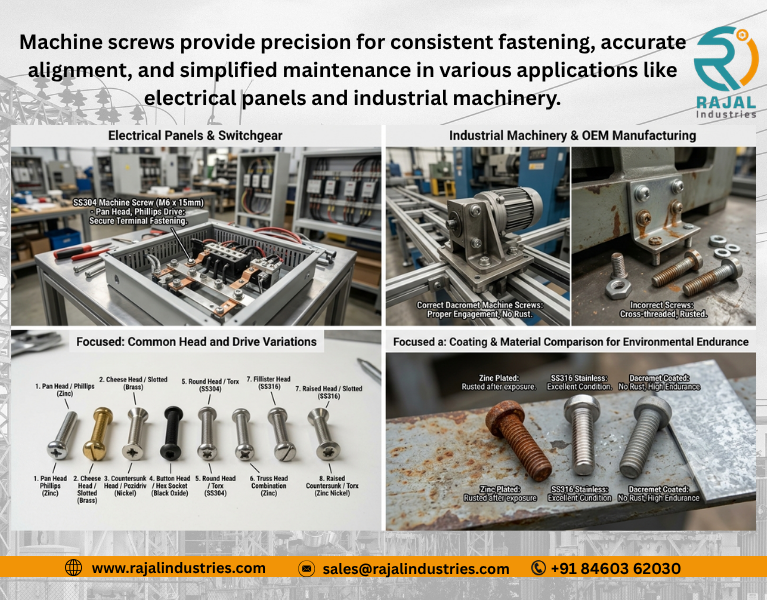
Machine screws are among the most commonly used precision fasteners in industrial manufacturing. They are widely used in electrical panels, switchgear, transformers, industrial machinery, automation systems, telecom equipment, elevator systems and heavy engineering equipment, where strong, accurate and repeatable fastening is essential.
Unlike self-tapping screws, machine screws are designed for pre-threaded holes, threaded inserts or nuts. This allows equipment to be assembled and disassembled multiple times without damaging the threads, making machine screws the preferred choice for OEM manufacturers and industrial maintenance.
Today, engineers and procurement teams search online using terms such as Machine Screw Manufacturer, Machine Screw Supplier, Machine Screw Manufacturer in India, OEM Machine Screw, Industrial Machine Screws, Stainless Steel Machine Screws and Custom Machine Screws when sourcing reliable fasteners for bulk production.
At Rajal Industries, we manufacture standard and custom machine screws according to customer drawings, international standards and OEM specifications. We primarily supply bulk production orders starting from 50,000 pieces for electrical equipment manufacturers, switchgear companies, transformer OEMs, industrial machinery manufacturers and export customers.
Quick Answer
If you are looking for a Machine Screw Manufacturer in India, consider the following before placing an order:
- Thread size
- Thread pitch
- Screw length
- Head style
- Drive type
- Material grade
- Surface coating
- Applicable DIN or ISO standard
- Quantity requirement
- OEM drawing or specification
Selecting the correct machine screw improves assembly quality, maintenance efficiency and long-term equipment reliability.
What is a Machine Screw?
A machine screw is a fully or partially threaded precision fastener designed to be installed into:
- Threaded holes
- Tapped components
- Threaded inserts
- Nuts
Unlike self-tapping or self-drilling screws, machine screws do not create their own threads. They are manufactured with precise threads that match standard metric or imperial thread profiles, providing a secure and repeatable fastening solution.
Machine screws are available in different:
- Head styles
- Drive types
- Materials
- Surface finishes
- Strength grades
- Thread sizes
This flexibility makes them suitable for thousands of industrial applications.
Why OEM Manufacturers Choose Machine Screws
Machine screws remain one of the most widely used industrial fasteners because they offer several advantages over other screw types.
Precision Fastening
Machine screws provide accurate alignment and consistent clamping force, making them suitable for precision assemblies.
Easy Maintenance
Since they are used with pre-threaded holes or nuts, components can be removed and reinstalled multiple times without damaging the assembly.
Excellent Interchangeability
Machine screws manufactured according to DIN, ISO and ANSI standards can be easily replaced during equipment maintenance.
Suitable for Automated Assembly
Machine screws are widely used on automated production lines because of their dimensional accuracy and consistent thread quality.
Available in Multiple Configurations
OEM buyers can choose from:
- Different head styles
- Multiple drive types
- Various thread sizes
- Carbon steel
- Stainless steel
- Brass
- Custom finishes
This allows manufacturers to select the most suitable screw for every application.
Industries Using Machine Screws
Machine screws are used across almost every industrial sector where precision fastening is required.
Major industries include:
- Electrical Panels
- Switchgear
- Transformer Manufacturing
- Elevator Systems
- Industrial Machinery
- Automation Equipment
- Telecom Equipment
- Data Centers
- Railway Equipment
- HVAC Systems
- Solar Equipment
- Battery Energy Storage Systems (BESS)
- Generator Manufacturing
- Electronic Enclosures
- Material Handling Equipment
- Steel Fabrication
- Process Equipment
- Renewable Energy Equipment
These industries rely on machine screws for reliable fastening, easy maintenance and long service life.
Common Machine Screw Head Types
Different applications require different head designs.
The most common machine screw heads include:
- Pan Head
- Cheese Head
- Countersunk Head
- Raised Countersunk Head
- Button Head
- Round Head
- Truss Head
- Fillister Head
Head selection depends on:
- Installation space
- Appearance
- Load distribution
- Customer drawings
- Industry standards
Common Drive Types
Machine screws are manufactured with various drive systems.
Popular options include:
- Phillips
- Slotted
- Pozidriv
- Torx
- Hex Socket
- Combination Drive
- Security Torx
The drive type should match:
- Assembly method
- Required torque
- Maintenance requirements
- Production equipment
Common Materials
Machine screws are manufactured in different materials depending on the application.
| Material | Typical Applications |
| Low Carbon Steel | General Industrial Equipment |
| Medium Carbon Steel | Industrial Machinery |
| Alloy Steel | Heavy Engineering |
| Stainless Steel SS304 | Electrical Equipment |
| Stainless Steel SS316 | Marine & Chemical Industries |
| Brass | Electrical & Electronic Components |
| Aluminium | Lightweight Equipment |
Material selection should consider:
- Mechanical strength
- Corrosion resistance
- Electrical conductivity
- Operating environment
- Expected service life
Common Machine Screw Standards
Machine screws are commonly manufactured according to recognised international standards.
Some widely used standards include:
- DIN 84
- DIN 85
- DIN 7985
- DIN 965
- DIN 966
- ISO Standards
- ANSI / ASME Standards
Using standard specifications helps ensure compatibility, easy replacement and consistent product quality.
How to Choose the Right Machine Screw
Selecting the correct machine screw requires more than simply choosing the thread size.
Step 1 – Understand the Application
Identify:
- Indoor or outdoor use
- Static or dynamic loading
- Electrical or mechanical application
- Maintenance frequency
- Environmental conditions
Step 2 – Select the Thread Size
Verify:
- Thread diameter
- Thread pitch
- Thread length
- Nut compatibility
- Thread engagement
Always follow the engineering drawing or customer specification.
Step 3 – Select the Correct Head Style
Choose the head style based on:
- Installation space
- Flush mounting requirements
- Clamping area
- Appearance
- Tool accessibility
Step 4 – Select the Right Material
The material should match:
- Required strength
- Corrosion resistance
- Industry standards
- Operating environment
- Customer specifications
Selecting the correct material improves product life and reduces maintenance costs.
Step 5 – Choose the Right Drive Type
The drive type affects installation speed and serviceability.
Common choices include:
- Phillips
- Torx
- Hex Socket
- Slotted
- Pozidriv
Select the drive based on the assembly process and maintenance requirements.
Step 6 – Select the Correct Surface Coating
Choosing the correct surface coating is just as important as selecting the right material. Machine screws used in electrical, industrial and outdoor applications are exposed to moisture, dust, vibration and chemicals. The right finish improves corrosion resistance, appearance and service life.
Before selecting a coating, consider:
- Indoor or outdoor installation
- Humidity and moisture
- Chemical exposure
- Coastal environment
- Operating temperature
- Electrical application
- Required service life
- Customer specifications
Zinc Plated Machine Screws
Recommended for:
- Electrical Panels
- Switchgear
- Control Panels
- Industrial Machinery
- Indoor Equipment
Advantages
- Cost-effective
- Good indoor corrosion resistance
- Bright finish
- Widely available
- Suitable for general industrial use
Zinc Nickel Machine Screws
Recommended for:
- Industrial OEM Equipment
- Automotive Components
- Outdoor Electrical Cabinets
- High Humidity Applications
Advantages
- Higher corrosion resistance
- Longer service life
- Better wear resistance
- Suitable for demanding environments
Black Oxide Machine Screws
Recommended for:
- Machine Tools
- Precision Equipment
- Industrial Machinery
- Automation Equipment
Advantages
- Black appearance
- Low light reflection
- Suitable for indoor applications
- Good dimensional accuracy
Nickel Plated Machine Screws
Commonly used in:
- Electrical Components
- Electronics
- Decorative Equipment
- Instrumentation
Advantages
- Attractive finish
- Good corrosion resistance
- Better surface hardness
- Suitable for precision assemblies
Stainless Steel Machine Screws
Recommended for:
- Food Processing Equipment
- Pharmaceutical Machinery
- Marine Applications
- Chemical Plants
- Outdoor Installations
Advantages
- Excellent corrosion resistance
- Long service life
- Low maintenance
- Hygienic finish
Dacromet / Zinc Flake Machine Screws
Suitable for:
- Renewable Energy Projects
- Heavy Engineering
- Automotive OEMs
- Outdoor Equipment
Advantages
- Excellent corrosion protection
- High salt spray resistance
- Long operating life
- Suitable for harsh environments
Machine Screw vs Self-Tapping Screw
Although both are widely used, they are designed for different applications.
| Feature | Machine Screw | Self-Tapping Screw |
| Requires Pre-Threaded Hole | ✔ | ✘ |
| Creates Own Thread | ✘ | ✔ |
| Suitable for Repeated Assembly | ✔ | Limited |
| Electrical Panels | ✔ | ✔ |
| Precision Equipment | ✔ | Limited |
| Plastic Components | Limited | ✔ |
| Sheet Metal | Limited | ✔ |
Choose a machine screw when the assembly requires repeated maintenance and precise threaded fastening.
Machine Screw vs Self-Drilling Screw
| Feature | Machine Screw | Self-Drilling Screw |
| Pilot Hole Required | ✔ | Usually No |
| Threaded Hole Required | ✔ | ✘ |
| Precision Assembly | ✔ | Moderate |
| Roofing Applications | ✘ | ✔ |
| Industrial Machinery | ✔ | Limited |
| Steel Structures | Limited | ✔ |
Each fastener serves a different purpose. Selection should always depend on the application.
Common Engineering & Procurement Mistakes
Many fastening issues occur because buyers focus only on price or thread diameter.
Selecting Only by Thread Size
Always verify:
- Thread pitch
- Screw length
- Head style
- Drive type
- Material
- Surface coating
Choosing the Wrong Material
Material should match:
- Mechanical load
- Corrosion exposure
- Operating environment
- Industry requirements
Ignoring Surface Finish
Selecting an unsuitable coating may lead to:
- Rust
- Reduced service life
- Increased maintenance
- Premature replacement
Choosing the Wrong Head Style
Different applications require different head designs.
For example:
- Pan Head
- Countersunk Head
- Cheese Head
- Button Head
- Truss Head
Always follow the engineering drawing.
Sending Incomplete RFQs
To receive an accurate quotation, provide:
- Thread Size
- Thread Pitch
- Screw Length
- Head Style
- Drive Type
- Material
- Surface Finish
- Standard (DIN / ISO / ANSI)
- Quantity
- Annual Requirement
- Drawing (if available)
Complete information helps suppliers recommend the correct machine screw and reduces procurement delays.
Quality Inspection Checklist
Before dispatch, machine screws should be inspected for:
| Inspection Item | Verify |
| Drawing Compliance | ✔ |
| Thread Size | ✔ |
| Thread Pitch | ✔ |
| Screw Length | ✔ |
| Head Dimensions | ✔ |
| Drive Recess | ✔ |
| Material Grade | ✔ |
| Surface Coating | ✔ |
| Coating Thickness | ✔ |
| Mechanical Properties | ✔ |
| Dimensional Accuracy | ✔ |
| Visual Inspection | ✔ |
| Batch Traceability | ✔ |
| Material Test Certificate (If Required) | ✔ |
A structured quality inspection helps ensure consistent fastening performance and reliable OEM supply.
Why Rajal Industries?
Rajal Industries is a Machine Screw Manufacturer in India supplying standard and custom machine screws for OEM manufacturers across multiple industries.
Our manufacturing capabilities include:
- MOQ from 50,000+ Pieces
- Standard & Custom Machine Screws
- Manufacturing as per Customer Drawings
- Carbon Steel, Alloy Steel, SS304, SS316 & Brass
- Zinc, Zinc Nickel, Black Oxide, Nickel & Dacromet Finishes
- Precision Cold Forging
- CNC Machining
- Thread Rolling
- Controlled Heat Treatment
- Mechanical Property Testing
- Dimensional Inspection
- Batch Traceability
- OEM Packaging
- PPAP Support (When Required)
- RMTC & Material Test Certificates
- Export Supply Programmes
We supply to:
- Electrical Panel Manufacturers
- Switchgear Manufacturers
- Transformer Manufacturers
- Elevator Manufacturers
- Industrial Machinery OEMs
- Automation Equipment Companies
- Telecom Equipment Manufacturers
- Data Center Infrastructure Companies
- Renewable Energy Equipment Manufacturers
OEM RFQ Checklist
Before requesting a quotation, include:
☐ Thread Size
☐ Thread Pitch
☐ Screw Length
☐ Head Style
☐ Drive Type
☐ Material Grade
☐ Surface Finish
☐ Standard (DIN / ISO / ANSI)
☐ Quantity
☐ Annual Requirement
☐ Engineering Drawing (If Available)
☐ Packaging Requirement
☐ Delivery Schedule
Providing complete technical information enables faster quotations and accurate product selection.
Key Takeaways
- Machine screws are designed for pre-threaded holes and precision assemblies.
- They are widely used in electrical panels, switchgear, transformers, industrial machinery and automation equipment.
- Selecting the correct material, coating and standard improves long-term performance.
- Following DIN, ISO or ANSI standards ensures compatibility and easier maintenance.
- Working with an experienced OEM manufacturer helps ensure consistent quality and reliable long-term supply.
Frequently Asked Questions
What is a machine screw?
A machine screw is a precision threaded fastener designed for use with threaded holes, threaded inserts or nuts. It is widely used in industrial and electrical equipment.
Where are machine screws commonly used?
Machine screws are used in electrical panels, switchgear, transformers, industrial machinery, elevators, automation equipment, telecom systems, data centers and electronic enclosures.
Which materials are available for machine screws?
Machine screws are commonly manufactured in carbon steel, alloy steel, stainless steel (SS304 & SS316), brass and aluminium depending on the application.
Which standards are commonly used?
Common standards include DIN 84, DIN 85, DIN 7985, DIN 965, DIN 966, ISO standards and ANSI/ASME standards.
Can Rajal Industries manufacture custom machine screws?
Yes. We manufacture standard and custom machine screws according to customer drawings, OEM specifications and international standards.
What is your minimum production quantity?
Rajal Industries primarily manufactures bulk OEM orders from 50,000+ pieces, depending on the product type and manufacturing process.
Conclusion
Choosing the right Machine Screw Manufacturer is just as important as selecting the correct fastener. High-quality machine screws improve assembly accuracy, simplify maintenance and increase the reliability of electrical, industrial and engineering equipment.
For electrical panel manufacturers, switchgear companies, transformer OEMs, industrial machinery manufacturers, automation companies and heavy engineering businesses, Rajal Industries offers precision manufacturing, consistent quality and dependable long-term supply.
If your business requires standard or custom machine screws with production quantities starting from 50,000 pieces, our engineering team can manufacture according to your drawings, international standards and OEM requirements.