

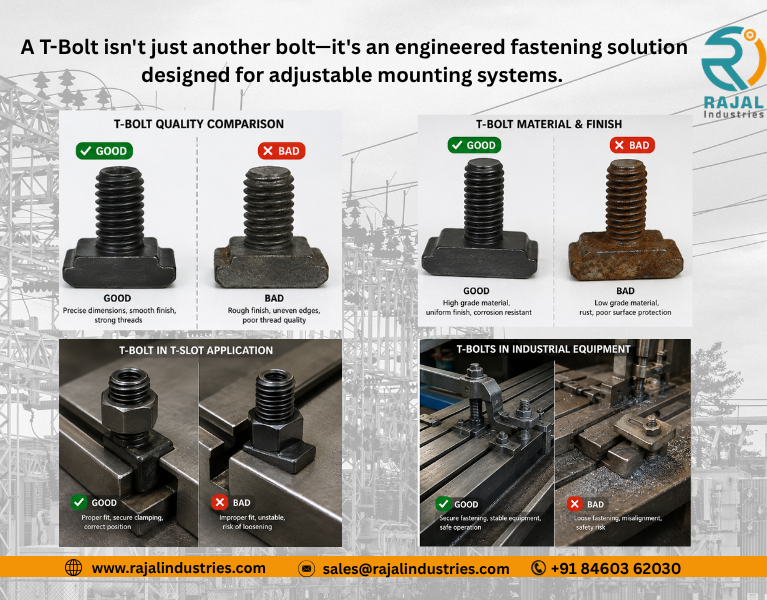
Industrial equipment often requires fastening systems that can be installed into T-slots, machine beds, guide rails, structural profiles and adjustable mounting channels while providing high strength and easy positioning. One of the most reliable fastening solutions for these applications is the T-Bolt.
Unlike conventional hex bolts, a T-Bolt features a specially designed T-shaped head that slides into a matching slot or channel. Once positioned, it can be tightened with a nut to create a strong and secure connection while allowing easy adjustment during assembly. This design makes T-bolts ideal for machine tools, industrial equipment, structural framing, conveyor systems and elevator applications.
Every month, procurement engineers and OEM buyers search for T Bolt Manufacturer, T Slot Bolt Manufacturer, Industrial T Bolt Supplier, Elevator T Bolt, Machine Table T Bolt, DIN T Bolt, and Heavy Duty T Bolt while sourcing fastening solutions for industrial production.
At Rajal Industries, we manufacture standard and custom T-Bolts for elevator manufacturers, industrial machinery OEMs, conveyor manufacturers, automation companies, structural fabrication companies and heavy equipment manufacturers requiring bulk production from 50,000+ pieces. Our products are manufactured according to customer drawings, recognised industry standards and OEM specifications.
Quick Answer
T-Bolts are widely used for:
- Elevator Systems
- Guide Rail Installations
- Machine Tools
- CNC Machines
- T-Slot Tables
- Aluminium Profile Systems
- Conveyor Equipment
- Industrial Automation
- Structural Framing
- Material Handling Equipment
- Heavy Machinery
- Manufacturing Fixtures
OEM manufacturers choose T-Bolts because they provide:
- Secure T-slot fastening
- Adjustable positioning
- High mechanical strength
- Fast installation
- Easy maintenance
- Reliable clamping performance
- Suitable for repeated assembly and adjustment.
What is a T-Bolt?
A T-Bolt is a threaded fastener with a T-shaped head designed to fit into a T-slot or channel. Once inserted into the slot, the bolt can slide to the required position before being tightened with a matching nut.
Unlike ordinary bolts, the head of a T-bolt is designed to lock inside the slot, preventing rotation during tightening and providing a secure, adjustable connection.
Why Industrial OEMs Choose T-Bolts
Industrial manufacturers use T-bolts because they simplify assembly while providing reliable fastening.
Key advantages include:
- Adjustable positioning
- Strong clamping force
- Easy installation
- Fast equipment assembly
- High load capacity
- Reusable fastening
- Reduced installation time
These features make T-bolts particularly valuable in modular equipment and machinery where components may need periodic adjustment.
Industries Using T-Bolts
Elevator Manufacturing
T-bolts are commonly used for:
- Guide rail fixing
- Support brackets
- Structural mounting
- Installation frames
- Equipment supports
- Maintenance assemblies
Accurate positioning helps improve installation efficiency and long-term system reliability.
Industrial Machinery
Applications include:
- CNC machines
- Machine beds
- Milling machines
- Drilling machines
- Manufacturing equipment
- Industrial presses
T-slot fastening allows components to be repositioned during machine setup.
Aluminium Profile Systems
Widely used for:
- Modular machine frames
- Automation systems
- Workstations
- Industrial enclosures
- Conveyor structures
- Assembly lines
T-bolts provide flexible fastening within aluminium extrusion systems.
Conveyor & Material Handling Equipment
Applications include:
- Conveyor frames
- Guide rails
- Belt supports
- Roller assemblies
- Transfer systems
- Handling equipment
Adjustable fastening simplifies installation and future modifications.
Structural Fabrication
Used for:
- Steel frameworks
- Support structures
- Equipment platforms
- Pipe support systems
- Industrial fabrication
Industrial Automation
Common applications include:
- Robotic systems
- Fixture assemblies
- Sensor mounting
- Machine guarding
- Production equipment
- Automation lines
Common Types of T-Bolts
Different industrial applications require different T-bolt designs.
Common types include:
- Standard T-Bolts
- T-Slot Bolts
- Hammer Head Bolts
- Channel T-Bolts
- Heavy Duty T-Bolts
- Stainless Steel T-Bolts
- Custom OEM T-Bolts
The final selection depends on:
- Slot dimensions
- Load requirements
- Material
- Installation method
- Customer specifications.
Common Materials
Material selection depends on mechanical loading and environmental conditions.
| Material | Typical Applications |
| Carbon Steel | General Industrial Equipment |
| High Tensile Steel | Heavy Machinery |
| Alloy Steel | Structural Applications |
| SS304 | Food & Pharmaceutical Equipment |
| SS316 | Marine & Chemical Industries |
Material selection should consider:
- Tensile strength
- Shear strength
- Corrosion resistance
- Operating environment
- Expected service life
Step 1 – Determine the Application
Before selecting a T-bolt, engineers should determine:
- Equipment type
- Slot dimensions
- Load requirements
- Static loading
- Dynamic loading
- Installation environment
These factors determine the required bolt design and specifications.
Step 2 – Verify the T-Slot Dimensions
The bolt head must match:
- Slot width
- Slot depth
- Channel profile
- Equipment drawing
- Manufacturing tolerance
Incorrect head dimensions may prevent proper installation or reduce holding strength.
Step 3 – Select the Correct Thread Size
Thread size should match:
- Engineering drawing
- Load calculations
- Nut specification
- Component thickness
- OEM requirements
Selecting the correct thread size improves fastening reliability and structural performance.
Step 4 – Select the Correct Material
Material selection should consider:
- Mechanical strength
- Corrosion exposure
- Operating environment
- Customer specifications
- Expected service life
The correct material improves durability, load-carrying capacity and long-term equipment reliability.
Step 5 – Select the Correct Surface Coating
The service life of a T-Bolt depends not only on its material but also on selecting the appropriate surface protection. Industrial equipment often operates in environments exposed to moisture, vibration, chemicals and varying temperatures, making corrosion resistance an important consideration.
Before selecting a coating, evaluate:
- Indoor or outdoor installation
- Humidity
- Chemical exposure
- Coastal atmosphere
- Operating temperature
- Maintenance schedule
- Expected service life
- Industry requirements
Selecting the right surface finish helps improve durability, maintain clamping performance and reduce maintenance costs.
Zinc Plated T-Bolts
Recommended for:
- Indoor machinery
- Elevator systems
- Manufacturing equipment
- Industrial automation
- Machine tools
Advantages:
- Economical
- Good indoor corrosion resistance
- Smooth surface finish
- Easy maintenance
Hot Dip Galvanized (HDG) T-Bolts
Suitable for:
- Outdoor steel structures
- Infrastructure projects
- Utility equipment
- Heavy structural applications
Advantages:
- Excellent corrosion resistance
- Long outdoor service life
- Suitable for harsh weather conditions
- Reduced maintenance
Black Oxide T-Bolts
Commonly used for:
- Machine tools
- CNC equipment
- Industrial fixtures
- Manufacturing machinery
Advantages:
- Uniform appearance
- Light corrosion protection
- Suitable for indoor industrial environments
Stainless Steel T-Bolts
Recommended for:
- Food processing plants
- Pharmaceutical industries
- Marine equipment
- Chemical processing plants
- Cleanroom equipment
Advantages:
- Excellent corrosion resistance
- Hygienic surface
- Long operating life
- Low maintenance
T-Bolt Installation Best Practices
Proper installation ensures maximum clamping force and long-term reliability.
Follow these steps:
Step 1 – Insert the T-Bolt
Slide the T-shaped head into the matching T-slot or channel.
Step 2 – Position the Bolt
Move the bolt to the required location according to the engineering drawing or installation layout.
Step 3 – Align the Components
Position the component so that all mounting holes align correctly with the T-bolts.
Step 4 – Tighten the Fastener
Install the matching washer and nut, then tighten to the specified torque.
Correct tightening helps achieve secure clamping while preventing damage to the slot or bolt.
Step 5 – Final Inspection
Verify:
- Bolt alignment
- Full seating of the T-head
- Proper tightening
- Component positioning
- No visible damage
- Correct installation
T-Bolt vs Hex Bolt
Although both are threaded fasteners, they serve different purposes.
| Feature | T-Bolt | Hex Bolt |
| T-Slot Installation | ✔ | ✘ |
| Adjustable Position | ✔ | Limited |
| Prevents Head Rotation | ✔ | Requires Tool Holding |
| Machine Table Applications | ✔ | Limited |
| Aluminium Profile Systems | ✔ | Limited |
| Structural Fastening | ✔ | ✔ |
| Easy Repositioning | ✔ | ✘ |
T-bolts are preferred whenever components must be mounted inside T-slots or adjustable channel systems.
Common Engineering & Procurement Mistakes
Many installation problems result from selecting the wrong T-bolt rather than manufacturing defects.
Selecting the Wrong Head Size
The T-head must match:
- Slot width
- Slot depth
- Profile dimensions
- Equipment drawing
Incorrect head dimensions may prevent proper engagement.
Choosing the Wrong Thread Size
Thread size should match:
- Engineering calculations
- Load requirements
- Nut specification
- OEM standards
Selecting an undersized bolt may reduce joint strength.
Ignoring Material Selection
Material should match:
- Mechanical loading
- Operating environment
- Corrosion exposure
- Customer specifications
Using the Wrong Surface Coating
Indoor and outdoor environments require different levels of corrosion protection.
Selecting an unsuitable coating may reduce service life and increase maintenance costs.
Sending Incomplete RFQs
Every enquiry should include:
- T-bolt type
- Head dimensions
- Thread size
- Material
- Surface coating
- Quantity
- Annual requirement
- Engineering drawing
- Slot dimensions
Providing complete technical information enables suppliers to recommend the correct product and prepare accurate quotations.
Quality Inspection Checklist
Before dispatch, T-bolts should be inspected for:
| Inspection Item | Verify |
| Drawing Compliance | ✔ |
| Head Dimensions | ✔ |
| Thread Size | ✔ |
| Thread Length | ✔ |
| Material Grade | ✔ |
| Surface Coating | ✔ |
| Coating Thickness | ✔ |
| Thread Quality | ✔ |
| Dimensional Accuracy | ✔ |
| Mechanical Properties | ✔ |
| Visual Inspection | ✔ |
| Batch Traceability | ✔ |
| Material Test Certificate (If Required) | ✔ |
A structured inspection process helps ensure reliable fastening performance and consistent product quality.
Why Rajal Industries?
Rajal Industries manufactures Standard and Custom T-Bolts for industrial OEMs requiring dependable, high-volume production.
Our manufacturing capabilities include:
- MOQ from 50,000+ pieces
- Standard & Custom T-Bolts
- Manufacturing as per Customer Drawings
- Carbon Steel, Alloy Steel, High Tensile Steel, SS304 & SS316
- Zinc Plated, HDG, Black Oxide & Stainless Steel Finishes
- Precision Cold Forging
- CNC Machining & Thread Rolling
- Controlled Heat Treatment
- Mechanical Property Verification
- Dimensional Inspection
- Batch Traceability
- OEM Packaging
- Long-Term Supply Programmes
- Export Manufacturing Support
We supply:
- Elevator Manufacturers
- Industrial Machinery OEMs
- Automation Equipment Manufacturers
- Conveyor System Companies
- Material Handling Equipment Manufacturers
- Steel Fabricators
- EPC Contractors
- Industrial Infrastructure Projects
OEM RFQ Checklist
Before requesting a quotation, include:
☐ T-Bolt Type
☐ Head Dimensions
☐ Thread Size
☐ Material
☐ Surface Coating
☐ Quantity
☐ Annual Requirement
☐ Engineering Drawing
☐ T-Slot Dimensions
☐ Packaging Specification
☐ Delivery Schedule
Providing complete technical information enables suppliers to recommend the correct T-bolt and prepare accurate commercial quotations.
Key Takeaways
- T-bolts are designed specifically for T-slot systems and adjustable industrial assemblies.
- Correct head dimensions, thread size and slot compatibility are essential for reliable fastening.
- Material and surface coating should match the operating environment.
- Proper installation and inspection improve long-term performance and reduce maintenance.
- Working with an experienced OEM manufacturer ensures consistent quality, engineering support and dependable long-term supply.
Frequently Asked Questions
What is a T-bolt?
A T-bolt is a threaded fastener with a T-shaped head designed to fit into T-slots or channels, allowing adjustable positioning before tightening.
Where are T-bolts commonly used?
They are widely used in elevator systems, CNC machines, machine tables, aluminium profile systems, conveyor equipment, industrial automation and structural framing.
What is the advantage of a T-bolt over a hex bolt?
A T-bolt can slide inside a T-slot for easy positioning and its head is designed to resist rotation during tightening, making it ideal for adjustable mounting systems.
Which material is best for outdoor applications?
For many outdoor industrial applications, alloy steel T-bolts with Hot Dip Galvanized (HDG) coating provide excellent corrosion resistance. For highly corrosive environments, SS316 stainless steel may be more suitable depending on the application.
Can Rajal Industries manufacture custom T-bolts?
Yes. We manufacture standard and drawing-based T-bolts according to customer drawings, technical specifications and OEM requirements.
What is your minimum production quantity?
Rajal Industries primarily manufactures bulk OEM orders from 50,000+ pieces, depending on the product design, dimensions and manufacturing process.
Conclusion
T-Bolts are an essential fastening solution for elevator systems, machine tools, aluminium profile structures, conveyor systems, industrial automation and heavy machinery where adjustable positioning and secure clamping are required. Selecting the correct head dimensions, thread size, material and surface coating ensures reliable performance, easier installation and long service life.
For elevator manufacturers, industrial machinery OEMs, automation companies, conveyor manufacturers, steel fabricators and EPC contractors, partnering with an experienced T-Bolt Manufacturer ensures consistent product quality, engineering support and dependable long-term supply.
If your company requires T-Bolts with bulk production from 50,000+ pieces, Rajal Industries can manufacture according to your engineering drawings, technical specifications and long-term production programmes.
Related Keywords
T Bolt Manufacturer, T-Bolt, T Slot Bolt, Machine Table T Bolt, Elevator T Bolt, Industrial T Bolt, Hammer Head Bolt, Channel T Bolt, Heavy Duty T Bolt, Stainless Steel T Bolt, T Slot Fasteners, OEM T Bolt Manufacturer, Bulk T Bolt Supplier, Industrial Fasteners.