

One of the most common questions asked by engineers, procurement teams and OEM buyers is:
Should we use an HSFG Bolt or a High Tensile Bolt?
Although these fasteners may appear similar, they are designed for different engineering purposes. Choosing the wrong bolt type can affect joint performance, structural safety, installation quality and long-term reliability.
Many buyers search for HSFG Bolt vs High Tensile Bolt, Difference Between HSFG and High Tensile Bolt, HSFG Bolt Applications, High Tensile Hex Bolt, and Structural Bolt Comparison when designing new products or sourcing fasteners for large industrial projects.
At Rajal Industries, we manufacture both HSFG Bolts and High Tensile Hex Bolts for OEM manufacturers requiring bulk production from 50,000+ pieces. We supply transformer manufacturers, structural steel fabricators, elevator OEMs, industrial machinery manufacturers and EPC contractors with standard and drawing-based fastening solutions.
Quick Answer
Although both are high-strength fasteners, they are designed for different purposes.
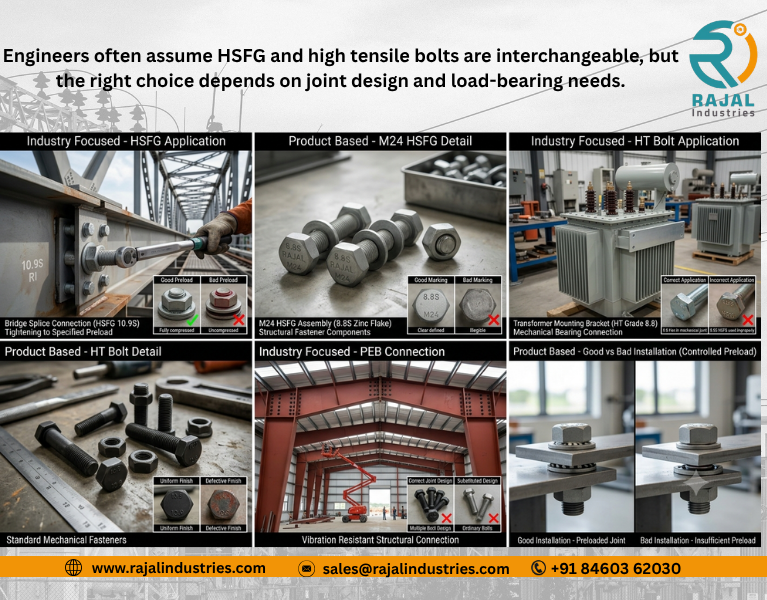
HSFG Bolts are mainly used in slip-resistant structural steel connections, where the load is transferred through friction created by controlled bolt preload.
High Tensile Hex Bolts are generally used in industrial machinery, transformers, elevators, electrical equipment and mechanical assemblies, where the bolt carries tensile and shear loads according to the joint design.
The correct choice depends on:
- Joint type
- Load transfer method
- Applicable standard
- Installation method
- Required preload
- Operating environment
- Engineering calculations
What is an HSFG Bolt?
HSFG stands for High Strength Friction Grip.
These bolts are specifically designed for structural steel connections that require controlled preload. After tightening, the bolt clamps the connected steel plates together so the load is transferred through friction rather than allowing movement between the plates.
HSFG bolts are commonly used in:
- Bridges
- Steel Structures
- Pre-Engineered Buildings (PEB)
- Transmission Towers
- Substations
- Wind Energy Projects
- Heavy Industrial Plants
Their primary objective is to create a stable, slip-resistant structural connection.
What is a High Tensile Bolt?
A High Tensile Bolt is a high-strength mechanical fastener manufactured for industrial equipment where strong, durable bolted joints are required.
These bolts are commonly used in:
- Power Transformers
- Elevators
- Electrical Panels
- Switchgear
- Industrial Machinery
- Battery Energy Storage Systems (BESS)
- EV Charging Infrastructure
- Process Equipment
Unlike HSFG bolts, they are selected according to mechanical strength, bolt size, material, property class and engineering design.
Key Difference Between HSFG Bolts and High Tensile Bolts
Although both are high-strength fasteners, their working principles are different.
| Feature | HSFG Bolt | High Tensile Bolt |
| Primary Purpose | Slip-Resistant Structural Connection | Mechanical Fastening |
| Load Transfer | Friction Between Plates | Bearing, Shear & Tension |
| Controlled Preload | Mandatory | Depends on Design |
| Typical Industries | Structural Steel | Industrial Equipment |
| Installation Method | Controlled Tightening | Standard Engineering Practice |
| Common Standards | IS 3757, DIN 6914, EN 14399 | DIN 931, DIN 933, ISO 4014, ISO 4017 |
Understanding this difference helps engineers choose the correct fastening system for each application.
Where HSFG Bolts Are Used
HSFG bolts are primarily selected for structural steel projects where preventing joint slip is critical.
Typical applications include:
Structural Steel Buildings
Used for:
- Beam connections
- Column splices
- Roof trusses
- Structural frames
Pre-Engineered Buildings (PEB)
Applications include:
- Portal frames
- Crane beams
- Primary structures
- Roof connections
Bridges
Common uses:
- Main girders
- Cross girders
- Structural splice joints
- Steel deck connections
Power Infrastructure
Applications include:
- Switchyard structures
- Transmission towers
- Gantry structures
- Transformer support structures
Renewable Energy
Used in:
- Wind towers
- Solar structures
- Utility steelwork
Where High Tensile Bolts Are Used
High tensile bolts are preferred for mechanical assemblies that require high clamp force and reliable fastening.
Transformer Manufacturing
Applications include:
- Tank assembly
- Radiator mounting
- Conservator supports
- Structural frames
Elevator Manufacturing
Used for:
- Guide rail brackets
- Machine frames
- Counterweight structures
- Motor supports
Electrical Equipment
Applications include:
- Electrical panels
- Switchgear
- Bus duct systems
- Control cabinets
Heavy Industrial Machinery
Common uses:
- CNC machines
- Hydraulic presses
- Compressors
- Pumps
- Material handling equipment
Battery Energy Storage Systems (BESS)
Applications include:
- Battery enclosures
- Cooling systems
- Structural frames
- Equipment mounting
Step 1 – Identify the Joint Type
Before selecting either fastener, engineers should first understand the joint.
Ask these questions:
- Is this a structural steel connection?
- Is joint slip acceptable?
- Is the bolt carrying shear loads?
- Is controlled preload required?
- Is this an equipment assembly?
The answers usually determine whether an HSFG bolt or a standard high tensile bolt is the better choice.
Step 2 – Understand the Load Transfer Method
This is one of the biggest differences between the two fasteners.
HSFG Bolt
Load is transferred through:
- Friction
- Controlled preload
- Clamping force
High Tensile Bolt
Load is generally transferred through:
- Bolt tension
- Bearing
- Shear
- Mechanical fastening
Understanding the load path is essential for selecting the correct fastener.
Step 3 – Check the Applicable Standard
Always verify the engineering drawing before procurement.
Typical HSFG standards:
- IS 3757
- DIN 6914
- EN 14399
Typical High Tensile Bolt standards:
- DIN 931
- DIN 933
- ISO 4014
- ISO 4017
- IS 1364
Following the specified standard ensures compatibility with the design and project requirements.
Step 4 – Compare Installation Methods
One of the biggest differences between HSFG Bolts and High Tensile Bolts is how they are installed.
HSFG Bolts
HSFG bolts require controlled tightening to achieve the specified preload. Common tightening methods include:
- Calibrated torque method
- Turn-of-nut method
- Tension control method (where specified)
- Hydraulic tightening (for special applications)
Proper installation ensures the joint develops the required friction force to resist slip.
High Tensile Bolts
High tensile bolts are installed according to the equipment design and recommended tightening torque.
They are commonly used in:
- Machinery assembly
- Transformer manufacturing
- Elevator equipment
- Electrical panels
- Industrial equipment
The tightening method depends on:
- Bolt size
- Property class
- Joint design
- Equipment manufacturer requirements
Step 5 – Select the Correct Surface Coating
The operating environment should determine the coating selection.
Before selecting the finish, evaluate:
- Indoor or outdoor installation
- Humidity
- Chemical exposure
- Coastal atmosphere
- Operating temperature
- Required service life
Zinc Plated
Recommended for:
- Indoor electrical equipment
- Control panels
- Factory machinery
Advantages:
- Economical
- Good appearance
- Suitable for dry environments
Hot Dip Galvanized (HDG)
Recommended for:
- Structural steel
- Transmission towers
- Outdoor substations
- Bridges
- Transformer yards
- Solar structures
Advantages:
- Excellent corrosion resistance
- Long outdoor service life
- Lower maintenance
Black Oxide
Commonly used for:
- Industrial machinery
- Mechanical assemblies
- Indoor equipment
Advantages:
- Uniform finish
- Good dimensional accuracy
- Suitable where corrosion exposure is limited
Geomet & Dacromet Coatings
Suitable for:
- Renewable energy projects
- Telecom infrastructure
- Heavy industrial equipment
- Outdoor electrical installations
Advantages:
- High salt spray resistance
- Long service life
- Uniform coating thickness
Cost & Maintenance Comparison
The purchase price should never be the only selection factor.
| Comparison | HSFG Bolt | High Tensile Bolt |
| Initial Cost | Higher | Lower |
| Installation Cost | Higher | Lower |
| Installation Accuracy | Critical | Important |
| Structural Performance | Excellent | Excellent for Mechanical Joints |
| Maintenance | Low when installed correctly | Depends on Application |
| Typical Service Life | Long | Long |
Selecting the correct fastener during the design stage often reduces maintenance and replacement costs over the life of the equipment.
Which Bolt Should OEM Buyers Choose?
Choose HSFG Bolts when your project involves:
✔ Steel structures
✔ Bridges
✔ Pre-Engineered Buildings (PEB)
✔ Transmission towers
✔ Utility infrastructure
✔ Slip-critical structural connections
Choose High Tensile Bolts when manufacturing:
✔ Elevators
✔ Electrical panels
✔ Switchgear
✔ Heavy industrial machinery
✔ Battery Energy Storage Systems (BESS)
✔ Mechanical equipment
The final decision should always follow the engineering drawing, structural calculations and applicable standards.
Common Engineering & Procurement Mistakes
Many buyers confuse HSFG bolts with ordinary high tensile bolts because both are manufactured from high-strength steel.
Assuming They Are Interchangeable
Although both are high-strength fasteners, they are designed for different connection types and should not be substituted without engineering approval.
Ignoring Installation Requirements
An HSFG bolt installed without achieving the specified preload may not provide the intended slip-resistant performance.
Selecting the Wrong Standard
Always verify whether the drawing specifies:
- IS 3757
- DIN 6914
- EN 14399
- DIN 931
- DIN 933
- ISO 4014
- ISO 4017
Using the wrong standard can lead to dimensional and performance differences.
Choosing Only by Price
The lowest-cost fastener may not provide the required documentation, mechanical properties or dimensional consistency.
OEM buyers should evaluate:
- Manufacturing capability
- Quality systems
- Inspection procedures
- Batch traceability
- Long-term supply capability
Sending Incomplete RFQs
Every enquiry should clearly mention:
- Bolt type
- Applicable standard
- Thread size
- Bolt length
- Property class
- Surface coating
- Quantity
- Engineering drawing
Complete technical details improve quotation accuracy and reduce manufacturing delays.
Quality Inspection Checklist
Before approving production, quality teams should verify:
| Inspection Item | Verify |
| Drawing Compliance | ✔ |
| Applicable Standard | ✔ |
| Thread Size | ✔ |
| Bolt Length | ✔ |
| Property Class | ✔ |
| Material Grade | ✔ |
| Heat Treatment | ✔ |
| Surface Coating | ✔ |
| Thread Accuracy | ✔ |
| Mechanical Properties | ✔ |
| Nut & Washer Compatibility | ✔ |
| Visual Inspection | ✔ |
| Batch Traceability | ✔ |
| Test Certificates (If Required) | ✔ |
Following a structured inspection process helps ensure consistent quality across every production batch.
Why Rajal Industries?
Rajal Industries manufactures both HSFG Bolts and High Tensile Hex Bolts for OEM manufacturers, structural fabricators and EPC contractors requiring dependable, large-scale production.
Our manufacturing capabilities include:
- MOQ from 50,000+ pieces
- HSFG Bolts & High Tensile Hex Bolts
- Property Classes 8.8, 10.9, 12.9, 8.8S & 10.9S
- Manufacturing as per DIN, ISO, IS, EN & Customer Drawings
- Precision Cold Forging
- CNC Thread Rolling
- Controlled Heat Treatment
- Zinc Plated, Hot Dip Galvanized, Black Oxide, Geomet & Dacromet Coatings
- Batch Traceability
- OEM Packaging
- Long-Term Supply Programmes
- Export Manufacturing Support
We supply:
- Transformer Manufacturers
- Structural Steel Fabricators
- PEB Manufacturers
- Elevator Manufacturers
- Electrical Panel Manufacturers
- EPC Contractors
- Renewable Energy Companies
- Heavy Engineering Companies
OEM & EPC RFQ Checklist
Before requesting a quotation, include:
☐ Bolt Type (HSFG / High Tensile)
☐ Applicable Standard
☐ Thread Size
☐ Bolt Length
☐ Property Class
☐ Surface Coating
☐ Nut & Washer Requirement
☐ Quantity
☐ Annual Requirement
☐ Engineering Drawing
☐ Inspection Requirements
☐ Packaging Specification
☐ Delivery Schedule
Providing complete project information allows suppliers to recommend the correct fastening solution and prepare accurate quotations.
Key Takeaways
- HSFG bolts and high tensile bolts are both high-strength fasteners but serve different engineering purposes.
- HSFG bolts are designed for slip-resistant structural steel connections using controlled preload.
- High tensile bolts are commonly used in transformers, elevators, machinery and industrial equipment where the joint is designed to carry mechanical loads.
- Installation methods, standards and inspection requirements differ between the two.
- Selecting the correct bolt type improves safety, reliability and long-term equipment performance.
- Partnering with an experienced manufacturer ensures consistent quality and dependable long-term supply.
Frequently Asked Questions
What is the main difference between an HSFG bolt and a high tensile bolt?
The main difference is the load transfer method. HSFG bolts transfer load through friction created by controlled preload, while high tensile bolts are generally designed to carry tensile, shear and bearing loads according to the joint design.
Are HSFG bolts high tensile bolts?
Yes. HSFG bolts are manufactured from high-strength materials, but they are specifically designed for friction grip structural connections and follow dedicated structural standards.
Can HSFG bolts replace ordinary high tensile bolts?
Not automatically. The correct bolt should always follow the engineering drawing and structural design requirements.
Which industries use HSFG bolts?
HSFG bolts are widely used in bridges, structural steel, PEB projects, substations, transmission towers, wind energy projects and heavy industrial structures.
Which industries use high tensile bolts?
High tensile bolts are commonly used in transformer manufacturing, elevators, electrical panels, switchgear, heavy machinery and industrial equipment.
Can Rajal Industries manufacture both types?
Yes. Rajal Industries manufactures both HSFG bolts and high tensile hex bolts according to customer drawings, recognised standards and OEM specifications.
What is your minimum production quantity?
Rajal Industries primarily manufactures bulk OEM orders from 50,000+ pieces, depending on the product and manufacturing process.
Conclusion
Although HSFG Bolts and High Tensile Bolts are both high-strength fasteners, they are designed for different engineering applications. HSFG bolts are the preferred choice for slip-resistant structural steel connections, while high tensile bolts are widely used in transformers, elevators, electrical equipment and industrial machinery.
Understanding the differences in load transfer, installation method, standards, property class and application helps OEM buyers select the correct fastening solution for safe, reliable and long-lasting performance.
If your company requires HSFG Bolts or High Tensile Hex Bolts with bulk production from 50,000+ pieces, Rajal Industries can manufacture according to your engineering drawings, international standards and long-term supply requirements.
Related Keywords
HSFG Bolt, HSFG Bolt vs High Tensile Bolt, High Strength Friction Grip Bolt, Difference Between HSFG and High Tensile Bolt, HSFG Fastener, Structural Bolt, High Tensile Hex Bolt, Structural Steel Fasteners, IS 3757 HSFG Bolt, DIN 6914 Bolt, Grade 8.8 Bolt, Grade 10.9 Bolt, PEB Fasteners, Bridge Fasteners, Transformer High Tensile Bolt, OEM Fastener Manufacturer, Bulk Structural Bolt Supplier.