

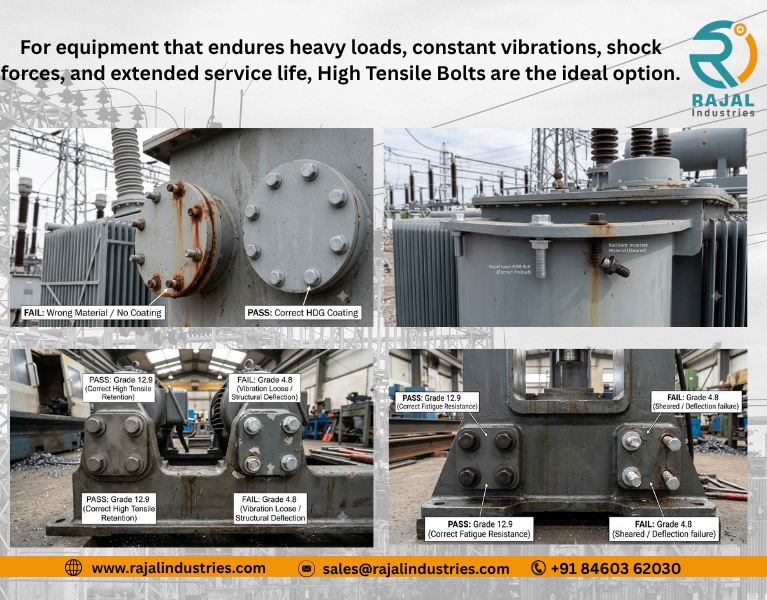
Every industrial machine depends on hundreds of fasteners, but not every joint requires the same level of strength. In applications where equipment operates under heavy loads, continuous vibration, shock forces and long service life, High Tensile Bolts are the preferred choice.
From power transformers installed in electrical substations to elevator systems operating thousands of times every day, high tensile bolts help maintain structural integrity, improve joint reliability and reduce maintenance throughout the equipment’s operating life.
OEM buyers frequently search for High Tensile Bolt Applications, High Tensile Bolt Uses, Transformer High Tensile Bolt, Elevator High Tensile Bolt, Industrial High Tensile Bolt and High Strength Hex Bolt when selecting fasteners for new product development or long-term production.
At Rajal Industries, we manufacture High Tensile Hex Bolts for OEM manufacturers requiring bulk production from 50,000+ pieces. We support transformer manufacturers, elevator companies, electrical equipment OEMs, industrial machinery builders and EPC contractors with standard and drawing-based manufacturing.
Quick Answer
High tensile bolts are widely used in:
- Power Transformers
- Distribution Transformers
- Elevators
- Switchgear
- Electrical Panels
- Steel Structures
- Heavy Machinery
- Battery Energy Storage Systems (BESS)
- EV Charging Infrastructure
- Telecom Equipment
- Renewable Energy Projects
The correct bolt should be selected according to:
- Property class
- Thread size
- Bolt length
- Material
- Surface coating
- Joint design
- Operating environment
- Engineering specifications
Why High Tensile Bolts Are Used in Industrial Equipment
Modern industrial equipment operates under demanding conditions.
Bolted joints may experience:
- Heavy static loads
- Continuous vibration
- Dynamic loading
- Thermal expansion
- Shock loading
- Fatigue cycles
- Outdoor weather exposure
High tensile bolts provide:
- Higher clamp force
- Better preload retention
- Improved fatigue resistance
- Greater vibration resistance
- Longer service life
- Improved equipment safety
These advantages help reduce maintenance and improve long-term reliability.
High Tensile Bolts Used in Power Transformers
Power transformers are among the most demanding industrial applications for high tensile bolts.
Typical applications include:
Transformer Tank Assembly
High tensile bolts secure:
- Main tank sections
- Cover plates
- Structural joints
- Inspection covers
Strong clamp force helps maintain gasket compression and reduces the possibility of oil leakage.
Radiator Mounting
Radiator assemblies experience:
- Oil circulation
- Temperature changes
- Transportation vibration
High tensile bolts help maintain secure joints throughout the transformer’s service life.
Conservator Supports
High tensile bolts are used for:
- Conservator brackets
- Pipe supports
- Structural mounting
- Auxiliary assemblies
Reliable fastening reduces movement during transportation and operation.
Base Frame Assembly
The transformer base frame supports the complete equipment weight during:
- Transportation
- Installation
- Operation
- Maintenance
High tensile bolts provide dependable structural performance throughout these stages.
High Tensile Bolts Used in Elevator Manufacturing
Elevator systems perform thousands of operating cycles every month.
Fasteners must withstand:
- Continuous vibration
- Repeated loading
- Dynamic movement
- Structural stress
Common applications include:
Machine Frame Assembly
Used to secure:
- Drive machines
- Gearboxes
- Motors
- Structural supports
Guide Rail Brackets
Guide rail systems require accurate alignment and reliable fastening to ensure smooth elevator movement.
Counterweight Structures
High tensile bolts secure:
- Counterweight frames
- Structural members
- Support brackets
Proper fastening improves operational safety and reduces maintenance.
Elevator Structural Frames
Applications include:
- Support structures
- Mounting brackets
- Equipment frames
- Machine room assemblies
High Tensile Bolts Used in Electrical Panels & Switchgear
Electrical equipment manufacturers widely use high tensile bolts for:
- Structural framework
- Equipment mounting
- Bus duct structures
- Panel base frames
- Cable support assemblies
Using high tensile fasteners helps maintain joint integrity during transportation and long-term operation.
High Tensile Bolts Used in Heavy Industrial Machinery
Industrial machinery experiences high mechanical loads and continuous operation.
Typical applications include:
- CNC machines
- Hydraulic presses
- Compressors
- Pumps
- Material handling equipment
- Mining equipment
- Industrial processing machines
High tensile bolts help maintain structural stability even under demanding operating conditions.
High Tensile Bolts Used in Steel Structures
Structural steel projects commonly specify high tensile bolts for:
- Industrial buildings
- Pipe racks
- Equipment platforms
- Heavy support frames
- Mezzanine floors
- Utility structures
These applications require consistent preload and long-term structural performance.
High Tensile Bolts Used in Battery Energy Storage Systems (BESS)
BESS installations combine electrical equipment with structural steel and battery enclosures.
High tensile bolts are commonly used for:
- Battery rack structures
- Enclosure assembly
- Cooling system supports
- Structural frames
- Equipment mounting
As battery storage projects continue to grow, reliable fastening solutions become increasingly important.
High Tensile Bolts Used in EV Charging Infrastructure
EV charging systems require durable fasteners for:
- Charging cabinet assembly
- Structural supports
- Pole-mounted equipment
- Foundation structures
- Outdoor enclosures
Outdoor installations generally require corrosion-resistant coatings for long service life.
Step 1 – Identify the Application
Before selecting a high tensile bolt, engineers should identify where it will be used.
Typical applications include:
- Structural assembly
- Equipment mounting
- Pressure-containing joints
- Heavy machinery
- Electrical equipment
- Steel structures
- Outdoor infrastructure
Each application has different strength and corrosion protection requirements.
Step 2 – Determine the Load Requirement
Engineering teams should evaluate:
- Static load
- Dynamic load
- Vibration
- Fatigue loading
- Shock loading
- Safety factor
The selected bolt should safely withstand these operating conditions throughout the equipment’s expected service life.
Step 3 – Select the Correct Property Class
The most common property classes include:
- Grade 8.8
- Grade 10.9
- Grade 12.9
For many transformer manufacturers, elevator OEMs and electrical equipment companies, Grade 8.8 High Tensile Bolts provide an excellent balance of strength, reliability and cost.
Higher grades should only be selected where engineering calculations require additional load capacity.
Step 4 – Select the Correct Surface Coating
Selecting the correct surface coating is essential for extending the service life of High Tensile Bolts. The coating should always be chosen according to the operating environment rather than using the same finish for every application.
Before selecting a coating, engineers should evaluate:
- Indoor or outdoor installation
- Humidity
- Rain exposure
- Coastal atmosphere
- Chemical exposure
- Operating temperature
- Maintenance schedule
- Expected equipment life
Proper corrosion protection improves reliability, reduces maintenance and lowers life-cycle costs.
Zinc Plated High Tensile Bolts
Recommended for:
- Indoor electrical panels
- Switchgear
- Control cabinets
- Factory machinery
- Dry industrial environments
Advantages:
- Economical
- Smooth surface finish
- Suitable for indoor applications
- Easy availability
Hot Dip Galvanized (HDG) High Tensile Bolts
Commonly used for:
- Outdoor transformers
- Substations
- Steel structures
- Solar mounting systems
- Telecom towers
- Utility infrastructure
Advantages:
- Excellent corrosion resistance
- Long outdoor service life
- Lower maintenance
- Suitable for harsh weather conditions
Black Oxide High Tensile Bolts
Recommended for:
- Industrial machinery
- CNC machines
- Machine tools
- Mechanical equipment
Advantages:
- Uniform appearance
- Good dimensional accuracy
- Suitable for indoor engineering applications
Geomet & Dacromet Coated High Tensile Bolts
Widely used in:
- Renewable energy projects
- Heavy industrial equipment
- Outdoor electrical installations
- Telecom infrastructure
Advantages:
- Excellent corrosion resistance
- High salt spray performance
- Uniform coating thickness
- Long service life
Industry-Wise Bolt Selection Guide
Different industries have different fastening requirements.
| Industry | Recommended Property Class | Typical Coating |
| Transformer Manufacturing | Grade 8.8 | HDG / Zinc |
| Elevator Manufacturing | Grade 8.8 / 10.9 | Zinc / Black Oxide |
| Electrical Panels | Grade 8.8 | Zinc |
| Switchgear | Grade 8.8 | Zinc |
| Steel Structures | Grade 8.8 / 10.9 | HDG |
| Heavy Machinery | Grade 10.9 | Black Oxide / Geomet |
| Solar Structures | Grade 8.8 | HDG / Geomet |
| BESS | Grade 8.8 | Geomet / HDG |
| Telecom Infrastructure | Grade 8.8 | HDG |
The final selection should always follow the engineering drawing, design calculations and customer specifications.
Common Application Mistakes
Many field failures are caused by incorrect bolt selection rather than manufacturing defects.
Selecting the Wrong Property Class
Choosing Grade 8.8 where Grade 10.9 is required may reduce joint strength.
Selecting Grade 12.9 where Grade 8.8 is sufficient only increases cost without improving performance.
Ignoring Corrosion Protection
Bolts installed outdoors should always have coatings suitable for long-term exposure to weather and moisture.
Reusing High Tensile Bolts
Bolts that have been subjected to high preload, overload or visible damage should be inspected before reuse.
For critical applications, follow the equipment manufacturer’s maintenance guidelines.
Incorrect Tightening Torque
Too little tightening may allow the joint to loosen.
Excessive tightening may overstress the bolt or damage the threads.
Always follow the specified tightening torque.
Mixing Different Bolt Grades
Using different property classes within the same structural joint can lead to uneven load distribution and inconsistent performance.
Ordering Without Complete Technical Details
Every RFQ should include:
- Bolt standard
- Thread size
- Bolt length
- Property class
- Material
- Surface coating
- Quantity
- Engineering drawing
Complete technical information reduces quotation errors and manufacturing delays.
Quality Inspection Checklist
Before dispatching high tensile bolts, quality teams should verify:
| Inspection Item | Verify |
| Drawing Compliance | ✔ |
| Thread Size | ✔ |
| Bolt Length | ✔ |
| Across Flats | ✔ |
| Head Height | ✔ |
| Thread Accuracy | ✔ |
| Material Grade | ✔ |
| Property Class | ✔ |
| Heat Treatment | ✔ |
| Surface Coating | ✔ |
| Coating Thickness | ✔ |
| Mechanical Properties | ✔ |
| Visual Inspection | ✔ |
| Batch Traceability | ✔ |
| Material Test Certificate (If Required) | ✔ |
A structured quality inspection process helps improve assembly consistency and long-term product reliability.
Why Rajal Industries?
Rajal Industries manufactures High Tensile Hex Bolts for industrial OEMs requiring reliable, high-volume production.
Our manufacturing capabilities include:
- MOQ from 50,000+ pieces
- Grade 8.8, Grade 10.9 & Grade 12.9 High Tensile Hex Bolts
- DIN, ISO, IS & Drawing-Based Manufacturing
- Medium Carbon Steel, Alloy Steel, SS304 & SS316
- Zinc Plated, Hot Dip Galvanized, Black Oxide, Geomet & Dacromet Coatings
- Precision Cold Forging
- CNC Thread Rolling
- Controlled Heat Treatment
- Dimensional Inspection
- Batch Traceability
- OEM Packaging
- Long-Term Supply Programmes
- Export Manufacturing Support
We supply:
- Transformer Manufacturers
- Elevator Manufacturers
- Electrical Panel Manufacturers
- Switchgear Manufacturers
- Steel Structure Manufacturers
- Renewable Energy Companies
- Industrial Machinery Manufacturers
- EPC Contractors
OEM RFQ Checklist
Before requesting a quotation, include:
☐ Applicable standard (DIN / ISO / IS)
☐ Thread size
☐ Bolt length
☐ Property class
☐ Material
☐ Surface coating
☐ Quantity
☐ Annual requirement
☐ Engineering drawing
☐ Inspection requirements
☐ Packaging specification
☐ Delivery schedule
Providing complete engineering information helps suppliers recommend the correct high tensile bolt and prepare accurate commercial quotations.
Key Takeaways
- High tensile bolts are widely used in transformers, elevators, electrical equipment, steel structures and heavy machinery.
- Grade 8.8 is the preferred choice for many OEM applications because it offers an excellent balance of strength and cost.
- Surface coating should always match the operating environment.
- Correct tightening, proper property class selection and quality inspection improve long-term joint reliability.
- Working with an experienced OEM manufacturer ensures consistent quality, engineering support and dependable long-term supply.
Frequently Asked Questions
Where are high tensile bolts commonly used?
They are widely used in transformers, elevators, switchgear, electrical panels, steel structures, industrial machinery, renewable energy projects and heavy engineering equipment.
Which grade is commonly used for transformer manufacturing?
Grade 8.8 High Tensile Bolts are commonly specified for transformer tanks, radiators, base frames and structural assemblies.
Which bolt grade is used in elevators?
Both Grade 8.8 and Grade 10.9 are commonly used depending on the application and design requirements.
Which coating is suitable for outdoor transformer installations?
Hot Dip Galvanized (HDG), Geomet or Dacromet coatings are commonly selected because they provide excellent corrosion resistance.
Can Rajal Industries manufacture custom high tensile bolts?
Yes. We manufacture standard and drawing-based high tensile hex bolts according to customer drawings, international standards and OEM specifications.
What industries do you supply?
We supply transformer manufacturers, elevator OEMs, electrical panel manufacturers, switchgear companies, renewable energy companies, steel structure fabricators, industrial machinery manufacturers and EPC contractors.
What is your minimum production quantity?
Rajal Industries primarily manufactures bulk OEM orders from 50,000+ pieces, depending on the product and manufacturing process.
Conclusion
High Tensile Bolts are essential fastening components in transformers, elevators, heavy machinery and industrial equipment where strength, safety and long-term reliability are critical. Selecting the correct property class, material, dimensions and surface coating helps improve structural performance, reduce maintenance and increase equipment life.
For transformer manufacturers, elevator OEMs, electrical equipment manufacturers, steel structure companies and industrial machinery builders, partnering with an experienced High Tensile Bolt Manufacturer ensures consistent quality, engineering support and dependable long-term supply.
If your company requires Grade 8.8, 10.9 or 12.9 High Tensile Bolts with bulk production from 50,000+ pieces, Rajal Industries can manufacture according to your engineering drawings, international standards and long-term production requirements.
Related Keywords
High Tensile Bolt, High Tensile Bolt Applications, High Tensile Bolt Uses, High Tensile Hex Bolt, Grade 8.8 Bolt, Grade 10.9 Bolt, Grade 12.9 Bolt, Transformer High Tensile Bolt, Elevator High Tensile Bolt, Heavy Duty Hex Bolt, Industrial High Tensile Bolt, Steel Structure Bolt, High Strength Hex Bolt, OEM Fastener Manufacturer, Bulk Bolt Supplier, Drawing-Based Bolt Manufacturer, Industrial Fasteners, Heavy Equipment Fasteners.