
When engineers, EPC contractors and procurement teams search for “Anchor Bolt vs Expansion Bolt“, they usually want to know which fastener is suitable for their project. Although both are designed to secure equipment to concrete, they are not interchangeable. Choosing the wrong fastener can reduce structural strength, increase maintenance costs and create installation problems.
This decision becomes even more important for transformer manufacturers, electrical panel manufacturers, switchgear OEMs, telecom cabinet manufacturers, Battery Energy Storage System (BESS) companies, EV charger manufacturers and industrial machinery builders, where equipment must remain securely fixed for many years.
At Rajal Industries, we manufacture Anchor Bolts for OEM manufacturers and EPC contractors requiring bulk production from 50,000+ pieces. While expansion bolts are mainly used for retrofit and maintenance work, anchor bolts remain the preferred solution for new industrial foundations and heavy equipment installations.
Quick Answer
The difference is simple.
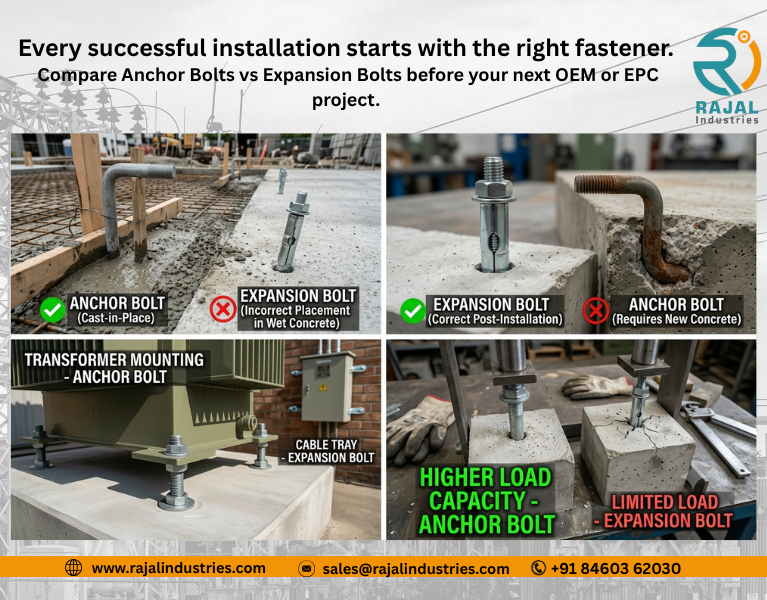
Anchor Bolts are installed during concrete casting and become a permanent part of the foundation.
Expansion Bolts are installed after the concrete has hardened by drilling holes into the concrete.
In most new transformer foundations, switchyards, industrial machinery, steel structures and infrastructure projects, Anchor Bolts are the preferred engineering solution because they provide higher load capacity and long-term structural reliability.
Expansion bolts are generally selected for:
- Retrofit work
- Maintenance projects
- Light to medium equipment
- Existing concrete structures
- Equipment replacement
What is an Anchor Bolt?
An Anchor Bolt is a threaded fastener embedded into concrete during foundation construction.
Its main purpose is to transfer loads safely from the equipment into the reinforced concrete foundation.
Anchor bolts resist:
- Tensile loads
- Shear loads
- Uplift forces
- Dynamic vibration
- Wind loading
- Equipment movement
Because they become part of the concrete foundation, they provide excellent long-term structural performance.
What is an Expansion Bolt?
An Expansion Bolt is a mechanical fastener installed after concrete has fully cured.
A hole is drilled into the concrete, and the expansion mechanism grips the concrete as the bolt is tightened.
Expansion bolts are commonly used for:
- Existing buildings
- Maintenance work
- Equipment replacement
- Cable tray supports
- Pipe supports
- Wall-mounted equipment
- Light machinery
Unlike anchor bolts, they do not require fresh concrete during installation.
Anchor Bolt vs Expansion Bolt – Key Differences
| Feature | Anchor Bolt | Expansion Bolt |
| Installation | Cast into concrete | Installed after concrete curing |
| Foundation Type | New foundations | Existing concrete |
| Load Capacity | Very High | Medium to High (depends on type) |
| Heavy Equipment | Excellent | Limited |
| Retrofit Projects | Not Ideal | Excellent |
| Transformer Foundations | Preferred | Rarely Used |
| Steel Structures | Preferred | Limited Applications |
| Service Life | Very Long | Depends on installation and environment |
| OEM Production | Common | Less Common |
For heavy electrical equipment and industrial foundations, anchor bolts generally offer greater structural reliability.
Where Anchor Bolts Are Used
Anchor bolts are commonly specified in:
Transformer Foundations
- Power Transformers
- Distribution Transformers
- Compact Substations
- Package Substations
Electrical Infrastructure
- Switchyards
- GIS & AIS Switchgear
- Bus Duct Systems
- Electrical Equipment Foundations
Industrial Equipment
- Compressors
- Pumps
- CNC Machines
- Press Machines
- Heavy Machinery
- Conveyor Systems
Structural Applications
- Steel Columns
- Pipe Racks
- Industrial Buildings
- Telecom Towers
- Solar Structures
- Wind Energy Projects
Anchor bolts are normally selected wherever high structural loads and long equipment life are expected.
Where Expansion Bolts Are Used
Expansion bolts are generally used where new concrete foundations are not available.
Typical applications include:
- Cable tray installation
- Electrical panel mounting
- Pipe support brackets
- HVAC equipment
- Lighting structures
- Wall-mounted control panels
- Existing concrete floors
- Retrofit machinery
For light and medium-duty applications, expansion bolts provide a practical installation solution.
Why Transformer Manufacturers Prefer Anchor Bolts
Transformer manufacturers rarely use expansion bolts for securing the main transformer foundation.
Instead, they generally specify cast-in-place anchor bolts because they offer:
- Higher pull-out resistance
- Better load distribution
- Improved long-term stability
- Reliable alignment
- Longer service life
- Better performance under vibration
- Greater structural safety
For utility and industrial transformer installations expected to operate for decades, cast-in-place anchor bolts remain the preferred choice.
Step 1 – Consider the Project Stage
The first question every OEM buyer should ask is:
Is this a new foundation or an existing concrete structure?
Choose Anchor Bolts If:
- New concrete foundation is being constructed.
- Heavy equipment is being installed.
- Long service life is required.
- High structural loads are expected.
- Engineering drawings specify cast-in bolts.
Choose Expansion Bolts If:
- Existing concrete cannot be modified.
- Equipment is being retrofitted.
- Maintenance work is being carried out.
- Foundation has already been completed.
- Light to medium equipment is being installed.
Selecting the correct fastener at the beginning of the project helps avoid unnecessary modifications and reduces installation costs.
Step 2 – Compare Load Requirements
Before selecting either fastener, engineering teams should evaluate:
- Equipment weight
- Static load
- Dynamic load
- Vibration
- Wind loading
- Seismic requirements
- Concrete strength
- Safety factor
In most heavy industrial applications, these calculations favour anchor bolts because they provide greater structural capacity.
Step 3 – Consider Installation & Maintenance
From a maintenance perspective:
Anchor Bolts
- Installed once during construction.
- Suitable for long-term installations.
- Minimal maintenance when properly designed.
Expansion Bolts
- Easier to install in existing structures.
- Faster for repair and retrofit work.
- Convenient where concrete cannot be recast.
The final decision should always balance engineering performance with installation requirements.
Load Capacity Comparison
One of the biggest differences between an Anchor Bolt and an Expansion Bolt is the amount of load each fastening system can safely support.
Although the exact load depends on the bolt size, concrete grade, embedment depth and installation quality, cast-in-place anchor bolts generally provide higher structural capacity because they become part of the concrete foundation.
| Feature | Anchor Bolt | Expansion Bolt |
| Tensile Load Capacity | Excellent | Medium to High |
| Shear Load Capacity | Excellent | Medium |
| Dynamic Load Resistance | Excellent | Good |
| Vibration Resistance | Excellent | Moderate |
| Heavy Equipment | Highly Recommended | Limited |
| Long-Term Structural Stability | Excellent | Good for Suitable Applications |
For power transformers, industrial machinery, steel structures and utility projects, engineering consultants generally specify anchor bolts because of their superior structural performance.
Life Cycle Cost Comparison
Many buyers compare only the purchase price.
However, experienced OEM procurement teams evaluate the total life cycle cost.
| Comparison | Anchor Bolt | Expansion Bolt |
| Initial Installation | During foundation construction | After concrete curing |
| Initial Cost | Slightly Higher | Lower |
| Long-Term Reliability | Excellent | Good |
| Maintenance Requirement | Very Low | May Require Inspection |
| Suitable Equipment Life | 20–35+ Years | Depends on Application |
For long-life industrial equipment, selecting the correct fastener often reduces maintenance costs throughout the equipment’s service life.
Corrosion Protection
Both anchor bolts and expansion bolts should be protected according to the operating environment.
Zinc Plated
Recommended for:
- Indoor electrical equipment
- Dry industrial environments
- Factory installations
Hot Dip Galvanized (HDG)
Preferred for:
- Outdoor transformers
- Utility substations
- Solar structures
- Steel structures
- Telecom towers
HDG provides excellent long-term corrosion resistance and is widely specified for infrastructure projects.
Stainless Steel
Suitable for:
- Coastal areas
- Marine projects
- Chemical industries
- Water treatment plants
- Food processing facilities
Geomet & Dacromet
Commonly specified for:
- Renewable energy projects
- Utility infrastructure
- Heavy industrial environments
These coatings provide high corrosion resistance and long service life.
Which Fastener Should OEM Buyers Choose?
The answer depends on the project.
Choose Anchor Bolts When:
✔ Constructing a new concrete foundation
✔ Installing transformers
✔ Installing heavy machinery
✔ Building substations
✔ Erecting steel structures
✔ Long service life is required
✔ Equipment generates vibration
✔ Large structural loads are expected
Choose Expansion Bolts When:
✔ Existing concrete is already available
✔ Equipment is being retrofitted
✔ Light or medium equipment is installed
✔ Maintenance projects are involved
✔ New concrete casting is not possible
✔ Installation speed is important
For most OEM manufacturing and EPC projects involving new installations, anchor bolts remain the preferred engineering solution.
Common Procurement Mistakes
Many fastening problems begin before installation.
Avoid these common mistakes.
Selecting Only by Price
The least expensive fastener may increase installation time, maintenance costs and future repair expenses.
Ignoring Foundation Drawings
Anchor bolts should always match:
- Bolt layout
- Base plate holes
- Foundation dimensions
- Structural calculations
Choosing the Wrong Fastener
Expansion bolts should not replace cast-in anchor bolts where heavy structural loads are involved unless approved by the project engineer.
Ignoring Corrosion Conditions
Outdoor utility installations require different corrosion protection than indoor electrical rooms.
Ordering Without Complete Specifications
Every RFQ should clearly mention:
- Bolt type
- Diameter
- Length
- Material
- Property class
- Surface coating
- Quantity
- Engineering drawing
Complete information reduces quotation errors and manufacturing delays.
Quality Inspection Checklist
Before approving bulk production, verify:
| Inspection Item | Verify |
| Drawing Compliance | ✔ |
| Bolt Type | ✔ |
| Diameter | ✔ |
| Overall Length | ✔ |
| Thread Accuracy | ✔ |
| Material Grade | ✔ |
| Property Class | ✔ |
| Surface Coating | ✔ |
| Coating Thickness | ✔ |
| Visual Finish | ✔ |
| Batch Traceability | ✔ |
| Packaging | ✔ |
| Material Test Certificate (If Required) | ✔ |
A structured inspection process improves installation quality and reduces site issues.
Why Rajal Industries?
Rajal Industries manufactures Anchor Bolts for OEM manufacturers, EPC contractors and infrastructure projects requiring dependable, high-volume production.
Our capabilities include:
- MOQ from 50,000+ pieces
- L-Type Anchor Bolts
- J-Type Anchor Bolts
- Plate Anchor Bolts
- Straight Anchor Bolts
- Custom Drawing-Based Manufacturing
- Carbon Steel, High Tensile Steel, Alloy Steel, SS304 & SS316
- Property Classes 4.6, 5.6, 8.8 & 10.9
- Hot Dip Galvanized, Zinc Plated, Geomet & Dacromet Coatings
- CNC Thread Rolling
- Batch Traceability
- OEM Packaging
- Long-Term Supply Programmes
- Export Manufacturing Support
We support:
- Transformer Manufacturers
- Electrical Panel Manufacturers
- Switchgear Manufacturers
- EPC Contractors
- Steel Structure Manufacturers
- Renewable Energy Companies
- Industrial Machinery OEMs
- Infrastructure Developers
OEM RFQ Checklist
Before sending an enquiry, confirm:
☐ Anchor bolt or expansion bolt required
☐ Applicable drawing or standard
☐ Thread size
☐ Overall length
☐ Material
☐ Property class
☐ Surface coating
☐ Quantity
☐ Annual consumption
☐ Inspection requirements
☐ Packaging details
☐ Delivery schedule
Providing complete technical information allows suppliers to quote accurately and recommend the most suitable fastening solution.
Key Takeaways
- Anchor bolts and expansion bolts serve different engineering purposes.
- Anchor bolts are designed for new concrete foundations and heavy-duty structural applications.
- Expansion bolts are ideal for retrofit work and existing concrete structures.
- Heavy transformers, substations and industrial machinery generally require cast-in anchor bolts.
- The correct fastener should always be selected based on engineering calculations, not only installation convenience.
- Working with an experienced OEM fastener manufacturer improves product quality, installation efficiency and long-term project reliability.
Frequently Asked Questions
What is the difference between an anchor bolt and an expansion bolt?
An anchor bolt is embedded into fresh concrete during foundation construction, while an expansion bolt is installed into hardened concrete by drilling a hole and expanding inside it.
Which is better for transformer foundations?
For new transformer foundations, anchor bolts are generally the preferred solution because they provide higher load capacity and long-term structural reliability.
Can expansion bolts replace anchor bolts?
Expansion bolts may be suitable for some retrofit or light-duty applications, but they should not replace cast-in anchor bolts for heavy structural equipment unless approved by the project engineer.
Which fastener has higher load capacity?
In most applications, properly designed cast-in anchor bolts provide higher tensile and shear capacity than expansion bolts.
Which coating is recommended for outdoor projects?
Hot Dip Galvanized (HDG), Geomet or stainless steel are commonly selected depending on the service environment.
Can Rajal Industries manufacture custom anchor bolts?
Yes. We manufacture standard and drawing-based anchor bolts for OEM manufacturers and EPC contractors.
What industries use anchor bolts?
Transformer manufacturers, switchgear manufacturers, electrical panel manufacturers, EPC contractors, renewable energy companies, industrial machinery manufacturers and infrastructure developers.
What is your minimum production quantity?
Rajal Industries primarily manufactures bulk OEM and EPC orders from 50,000+ pieces, depending on the product and manufacturing process.
Conclusion
Both Anchor Bolts and Expansion Bolts are important concrete fastening solutions, but they are designed for different applications. Anchor bolts are the preferred choice for new transformer foundations, substations, industrial machinery and heavy structural installations because they offer higher load capacity, better long-term stability and greater structural reliability. Expansion bolts are better suited for retrofit work, maintenance projects and existing concrete structures where new foundations are not practical.
For OEM manufacturers, EPC contractors and infrastructure companies, selecting the correct fastening system during the design stage reduces installation issues, improves equipment reliability and lowers maintenance costs throughout the project’s life.
If your company requires standard or custom anchor bolts with bulk production from 50,000+ pieces, Rajal Industries can support your engineering, procurement and long-term manufacturing requirements.
Related Keywords
Anchor Bolt vs Expansion Bolt, Anchor Bolt, Expansion Bolt, Foundation Anchor Bolt, Mechanical Anchor Bolt, Heavy Duty Anchor Bolt, Transformer Anchor Bolt, Concrete Anchor Bolt, Cast-in Anchor Bolt, Expansion Fastener, Industrial Anchor Bolt, High Tensile Anchor Bolt, Hot Dip Galvanized Anchor Bolt, Structural Anchor Bolt, OEM Fastener Manufacturer, EPC Fasteners, Bulk Anchor Bolt Supplier, Drawing-Based Anchor Bolt Manufacturer, Industrial Foundation Fasteners.