
Introduction – The EV Charger Was New, But the Rust Was Already Appearing
An EV charging station operator conducted a routine inspection of a DC fast charging site.
The chargers were installed only:
14–18 Months Earlier
At first glance, everything appeared normal.
The chargers were operating.
The screens were functional.
The charging cables were in good condition.
However, maintenance engineers noticed something unexpected.
Rust was visible around:
- Cabinet Screws
- Door Hinges
- Grounding Bolts
- Mounting Hardware
- Access Panels
The chargers were relatively new.
The corrosion wasn’t.
This problem is becoming increasingly common in:
- DC Fast Chargers
- AC Charging Stations
- Public Charging Infrastructure
- Highway Charging Networks
- Fleet Charging Stations
- Commercial EV Charging Hubs
Many charger manufacturers invest heavily in electronics and software but underestimate the importance of corrosion-resistant fasteners.
Unfortunately, the environment never ignores them.
Quick Answer
Why do EV charger fasteners rust so quickly?
EV charger fasteners usually corrode because of rain, humidity, condensation, coastal exposure, galvanic corrosion, poor material selection, damaged coatings, and incorrect fastener specifications.
Why EV Charging Stations Are Harsh Environments
Outdoor EV chargers operate 24/7.
Unlike indoor electrical equipment, they face:
- Rain
- Humidity
- UV Exposure
- Dust
- Pollution
- Condensation
- Coastal Salt Air
- Temperature Fluctuations
Every fastener becomes part of the charger’s weather protection system.
When corrosion starts, the enclosure itself becomes vulnerable.
Where Fasteners Are Used in EV Chargers
A typical EV charger contains hundreds of fasteners.
Common applications include:
Charger Cabinet Assembly
- M4 Machine Screws
- M5 Machine Screws
- Captive Screws
- Self-Tapping Screws
Structural Mounting
- M8 Bolts
- M10 Bolts
- Anchor Bolts
- Foundation Bolts
Electrical Systems
- Grounding Bolts
- Busbar Bolts
- Copper Terminal Bolts
Access Panels
- Captive Fasteners
- Security Screws
- Panel Screws
A single DC fast charger may contain:
200–600 Fasteners
depending on design.
Failure #1 – Using Indoor Fasteners Outdoors
One of the most common mistakes.
Many charger manufacturers use fasteners originally developed for:
- Indoor Control Panels
- Electrical Cabinets
- Distribution Boards
These fasteners may perform well indoors.
Outdoors, they often fail much sooner.
Common problems include:
- Surface Rust
- Coating Breakdown
- Thread Corrosion
- Washer Corrosion
Outdoor environments require dedicated corrosion-resistant fasteners.
Failure #2 – SS304 Is Not Always Enough
Many EV charger OEMs specify:
SS304 Fasteners
because they provide excellent value and corrosion resistance.
However, in aggressive environments:
- Coastal Areas
- Ports
- Chemical Zones
- Industrial Areas
SS304 can develop:
- Tea Staining
- Surface Corrosion
- Pitting Corrosion
within a relatively short period.
SS304 vs SS316 Fasteners
| Parameter | SS304 Fasteners | SS316 Fasteners |
| Corrosion Resistance | High | Very High |
| Salt Resistance | Moderate | Excellent |
| Coastal Performance | Good | Excellent |
| Outdoor Life | Good | Excellent |
| Cost | Lower | Higher |
Many public charging networks now specify SS316 fasteners near coastal regions.
Failure #3 – Corrosion Under Washers
One of the most overlooked problems.
Rust often starts beneath:
These areas trap:
- Water
- Salt
- Dirt
- Pollution
By the time rust becomes visible, corrosion is often well advanced.
Failure #4 – Galvanic Corrosion
Modern EV chargers contain multiple materials:
- Stainless Steel Fasteners
- Aluminum Enclosures
- Copper Busbars
- Galvanized Structures
When moisture enters the system:
Different metals react electrochemically.
This creates:
Galvanic Corrosion
The fastener often becomes the first visible casualty.
Real EV Charger Field Example
A charging infrastructure company inspected:
120 Public Chargers
after two years of operation.
Common findings:
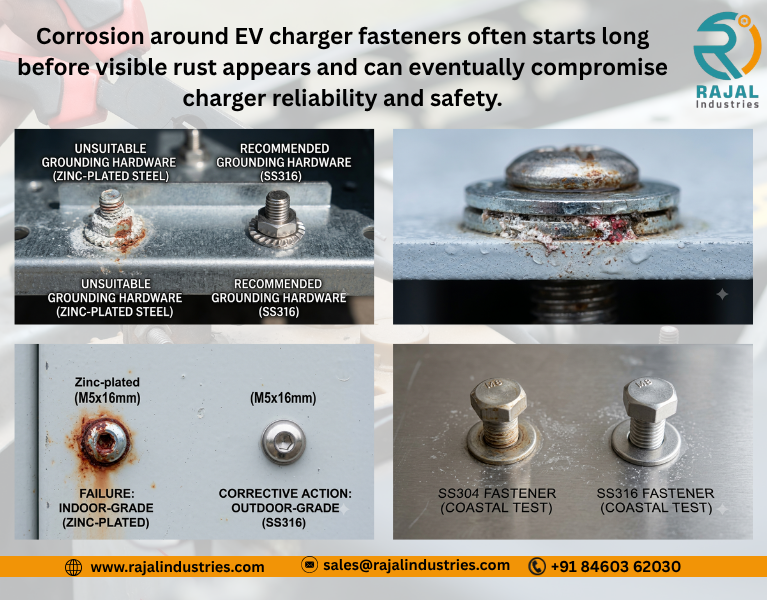
- Corroded M5 Cabinet Screws
- Rust Around Door Hinges
- Grounding Hardware Deterioration
- Washer Corrosion
- Thread Damage
Original Hardware:
- SS304 Screws
- Zinc-Plated Washers
- Standard Grounding Hardware
Corrective Action:
✔ SS316 Washers
✔ Improved Grounding Components
✔ Better Sealing Design
Result:
Significant reduction in corrosion-related maintenance.
Failure #5 – Condensation Inside Charger Cabinets
Many people assume rain is the main cause.
Often it isn’t.
The real issue is:
Internal Condensation
Daily cycle:
Warm Air Enters
↓
Temperature Drops
↓
Moisture Condenses
↓
Water Forms Around Fasteners
↓
Corrosion Begins
This process can repeat every day for years.
Failure #6 – Grounding Hardware Corrosion
Grounding systems are critical safety components.
Common hardware includes:
- Grounding Bolts
- Serrated Washers
- Ground Lugs
- Earth Connections
Corrosion increases resistance and can compromise:
- Safety
- Fault Protection
- Surge Protection
Grounding hardware should never be treated as standard hardware.
Failure #7 – Damaged Coatings During Installation
Many plated fasteners lose protection during assembly.
Common causes:
- Over-Tightening
- Tool Slippage
- Improper Installation
- Thread Damage
Once the coating is damaged:
Corrosion often starts immediately.
Why Rust Is More Than a Cosmetic Issue
Many operators ignore early corrosion because:
“The Charger Still Works”
However, corrosion can cause:
- Preload Loss
- Water Ingress
- Grounding Problems
- Door Seal Failure
- Thread Damage
- Increased Maintenance Costs
Eventually:
The charger becomes more expensive to maintain.
Fasteners Most Commonly Used in EV Charging Stations
Large EV charger manufacturers regularly purchase:
Cabinet Fasteners
- M4 Machine Screws
- M5 Machine Screws
- Captive Screws
- Security Screws
- Self-Tapping Screws
Structural Fasteners
- M8 Bolts
- M10 Bolts
- Anchor Bolts
- Foundation Bolts
Stainless Steel Hardware
- SS304 Screws
- SS304 Bolts
- SS304 Washers
- SS316 Screws
- SS316 Bolts
- SS316 Washers
Electrical Hardware
- Grounding Bolts
- Busbar Bolts
- Copper Terminal Bolts
- Serrated Washers
These are among the most searched EV charger fasteners used by OEMs worldwide.
What Leading EV Charger OEMs Are Doing
Modern charger manufacturers increasingly focus on:
✔ Stainless Steel Standardization
✔ Corrosion Testing
✔ Salt Spray Validation
✔ Grounding Reliability
✔ Improved Sealing Systems
✔ Captive Fasteners
✔ Reduced Maintenance Requirements
The objective is simple:
10+ Years of Outdoor Service Life
Industries Most Affected
This issue commonly impacts:
- EV Charger Manufacturers
- DC Fast Charger Manufacturers
- AC Charger Manufacturers
- Charging Station Integrators
- EV Infrastructure Developers
- Fleet Charging Operators
- Utility Charging Networks
- Renewable Energy EPC Companies
Inspection Checklist
Before charger deployment:
✔ Verify fastener material
✔ Check washer specifications
✔ Review corrosion resistance
✔ Evaluate grounding hardware
✔ Inspect sealing systems
✔ Assess galvanic corrosion risks
✔ Verify coating quality
✔ Review environmental conditions
✔ Conduct salt spray testing if required
Key Takeaways
- Outdoor EV charging stations expose fasteners to severe environmental conditions.
- SS304 is not always sufficient for coastal and industrial environments.
- Corrosion often starts beneath washers and inside joints.
- Condensation is a major hidden cause of rust.
- Grounding hardware requires special corrosion protection.
- Galvanic corrosion is frequently overlooked during design.
- Proper fastener selection significantly improves charger reliability.
FAQ
Why do EV charger screws rust so quickly?
Rain, humidity, salt exposure, condensation, and poor material selection are the most common causes.
Are SS304 fasteners suitable for EV chargers?
SS304 works well in many locations, but coastal and highly corrosive environments often require SS316 hardware.
What fasteners are commonly used in EV chargers?
M4 machine screws, M5 machine screws, captive screws, grounding bolts, anchor bolts, busbar bolts, and stainless steel hardware.
Why does corrosion occur under washers?
Washers trap moisture, dirt, and contaminants, creating ideal conditions for hidden corrosion.
What is galvanic corrosion?
Galvanic corrosion occurs when dissimilar metals interact in the presence of moisture, accelerating corrosion.
Why are grounding bolts important in EV chargers?
Grounding bolts help ensure electrical safety, fault protection, and reliable charger operation.
Which stainless steel is better for outdoor chargers?
SS316 generally provides better corrosion resistance than SS304, particularly in coastal environments.
Which industries face this issue most often?
EV charger manufacturers, charging station operators, EV infrastructure developers, and utility charging networks.
Conclusion
Fasteners are some of the smallest components inside an EV charging station.
Yet they are among the first components exposed to the environment every day.
When corrosion begins, reliability, safety, maintenance costs, and enclosure performance can all be affected.
For EV charger manufacturers, charging station integrators, and EV infrastructure developers, selecting the right fasteners is not just a hardware decision.
It is a lifecycle reliability decision.