

Introduction – The Battery Pack May Cost ₹5 Lakhs, But It Depends on ₹5 Fasteners
When people think about EV battery manufacturing, they usually focus on:
- Battery Cells
- Battery Modules
- BMS Systems
- Thermal Management
- Battery Chemistry
- Charging Technology
Very few people think about fasteners.
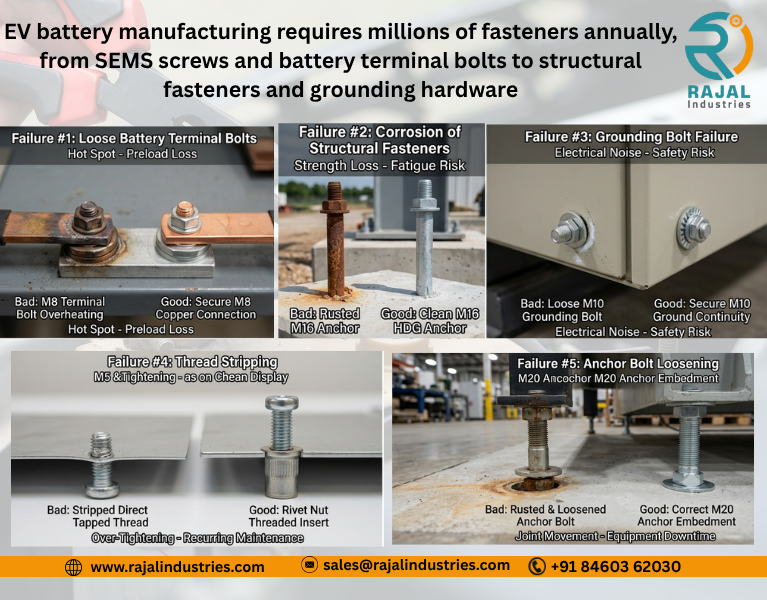
Yet every EV battery pack contains hundreds of bolts, screws, nuts, washers, and grounding components.
A single EV battery pack may use:
300–1,500 Fasteners
A battery production line manufacturing 100,000 battery packs annually may consume:
Millions of Fasteners Every Year
This is why EV battery manufacturers, battery module manufacturers, battery tray manufacturers, battery enclosure manufacturers, and BESS integrators buy certain fasteners repeatedly in very large quantities.
Let’s look at the 12 most commonly purchased battery OEM fasteners.
Quick Answer
Which fasteners do EV battery manufacturers buy most frequently?
The most commonly purchased battery OEM fasteners include SEMS screws, M4 screws, M5 screws, M6 bolts, M8 bolts, battery terminal bolts, grounding bolts, flange bolts, captive screws, rivet nuts, threaded inserts, and structural fasteners.
Why Fastener Standardization Matters in EV Manufacturing
Leading EV manufacturers try to reduce fastener variety.
Instead of purchasing:
100 Different Fasteners
many OEMs reduce the list to:
20–30 Core Fasteners
Benefits include:
✔ Lower inventory cost
✔ Faster assembly
✔ Easier procurement
✔ Better automation
✔ Simplified maintenance
✔ Improved supplier management
Fastener #1 – M4 SEMS Screws
One of the highest-volume fasteners in battery manufacturing.
SEMS screws combine:
- Screw
- Washer
- Locking Washer
into a single assembly.
Applications:
- Battery Module Covers
- BMS Mounting
- Sensor Brackets
- Control Boards
- Electronics
Benefits:
✔ Faster Assembly
✔ Reduced Missing Parts
✔ Automation Friendly
✔ Lower Labor Cost
Common Types:
- M4 SEMS Screw
- M4 Phillips SEMS Screw
- M4 Torx SEMS Screw
- Stainless Steel SEMS Screw
Fastener #2 – M5 Machine Screws
Widely used for:
- Battery Cabinets
- Battery Covers
- Control Panels
- Cooling Assemblies
Common Variants:
- Phillips Head Screws
- Torx Screws
- Captive Screws
- Stainless Steel Screws
M5 screws are among the most searched battery fasteners globally.
Fastener #3 – M6 Battery Bolts
One of the most important battery fasteners.
Applications:
- Module Connections
- Structural Mounting
- Busbar Assemblies
- Electrical Connections
Common Types:
- Flange Bolts
- Hex Bolts
- Socket Head Cap Screws
Fastener #4 – M8 Structural Bolts
Used in:
- Battery Trays
- Battery Frames
- Battery Racks
- Battery Enclosures
Common Specifications:
- Grade 8.8 Bolts
- Grade 10.9 Bolts
- Flange Bolts
These are among the highest-volume structural fasteners in EV manufacturing.
Fastener #5 – Battery Terminal Bolts
Battery terminal connections require specialized hardware.
Common Types:
- M6 Terminal Bolts
- M8 Copper Terminal Bolts
- Tin-Plated Copper Bolts
Applications:
- Busbar Connections
- Battery Terminals
- Power Distribution Systems
These fasteners directly affect electrical performance.
Fastener #6 – Grounding Bolts
Every battery pack requires grounding.
Common Hardware:
- M6 Grounding Bolts
- M8 Grounding Bolts
- Serrated Washers
- Ground Lugs
Applications:
- Battery Enclosures
- Battery Cabinets
- Battery Trays
- Grounding Systems
Fastener #7 – Flange Bolts
Flange bolts are preferred by many OEMs because they eliminate separate washers.
Applications:
- Structural Assemblies
- Battery Frames
- Cooling Systems
- Brackets
Common Sizes:
- M6 Flange Bolts
- M8 Flange Bolts
- M10 Flange Bolts
Benefits:
✔ Faster Assembly
✔ Better Load Distribution
✔ Reduced Component Count
Fastener #8 – Captive Screws
Captive screws are becoming increasingly popular.
Applications:
- Battery Covers
- Service Panels
- Electrical Access Panels
Benefits:
✔ Fast Maintenance
✔ No Lost Hardware
✔ Better Serviceability
✔ Improved Safety
Fastener #9 – Rivet Nuts
Battery enclosures often use thin sheet metal.
Rivet nuts provide strong threads without welding.
Applications:
- Battery Cabinets
- Enclosures
- Control Boxes
- Battery Covers
Common Sizes:
- M4 Rivet Nuts
- M5 Rivet Nuts
- M6 Rivet Nuts
Fastener #10 – Threaded Inserts
Widely used in:
- Plastic Battery Components
- Composite Structures
- Lightweight Assemblies
Benefits:
✔ Durable Threads
✔ Improved Service Life
✔ Better Maintenance Performance
Common Types:
- Brass Inserts
- Stainless Steel Inserts
- Heat-Set Inserts
Fastener #11 – Structural Washers
Often overlooked but extremely important.
Applications:
- Battery Racks
- Battery Trays
- Structural Assemblies
- Anchor Bolt Systems
Common Types:
- Flat Washers
- Structural Washers
- Belleville Washers
- Nord-Lock Washers
These components help maintain clamp force.
Fastener #12 – Anchor Bolts
Used throughout EV battery manufacturing facilities.
Applications:
- Equipment Foundations
- Formation Machines
- Battery Production Lines
- Container Installations
Common Products:
- M16 Anchor Bolts
- M20 Anchor Bolts
- M24 Anchor Bolts
- Chemical Anchors
- Foundation Bolts
A large battery factory may consume tens of thousands of anchor bolts.
Typical Fastener Consumption Per Battery Pack
The numbers often surprise engineers.
A typical EV battery pack may contain:
| Fastener Type | Approx. Quantity |
| M4 SEMS Screws | 100–400 |
| M5 Machine Screws | 50–200 |
| M6 Bolts | 20–100 |
| M8 Structural Bolts | 10–50 |
| Terminal Bolts | 10–40 |
| Grounding Hardware | 5–20 |
| Rivet Nuts | 20–100 |
| Captive Screws | 10–50 |
Total:
300–1,500 Fasteners Per Battery Pack
What OEM Purchasing Teams Actually Look For
Price is important.
But major EV battery manufacturers also evaluate:
✔ PPAP Capability
✔ IATF Compliance
✔ Material Traceability
✔ Batch Consistency
✔ Torque Performance
✔ Corrosion Resistance
✔ Automated Assembly Compatibility
✔ Global Supply Capacity
This is why many OEMs prefer long-term fastener suppliers rather than spot purchases.
Why SEMS Screws Are Growing Fastest
SEMS screws continue gaining popularity because they:
- Reduce assembly time
- Reduce labor costs
- Improve automation
- Prevent missing washers
- Improve quality consistency
Many EV battery manufacturers are converting standard screw assemblies into SEMS screw systems.
Fasteners Most Frequently Purchased by EV Battery Manufacturers
Large OEMs regularly source:
Battery Fasteners
- M4 SEMS Screws
- M5 Machine Screws
- M6 Battery Bolts
- M8 Structural Bolts
Electrical Hardware
- M8 Copper Terminal Bolts
- Grounding Bolts
- Serrated Washers
Structural Hardware
- Grade 8.8 Bolts
- Grade 10.9 Bolts
- Flange Bolts
- Structural Washers
Enclosure Hardware
- Captive Screws
- Rivet Nuts
- Threaded Inserts
These are among the most searched and procured battery OEM fasteners globally.
Industries Buying These Fasteners
These products are widely used by:
- EV Battery Manufacturers
- Battery Module Manufacturers
- Battery Pack Manufacturers
- Battery Tray Manufacturers
- Battery Cabinet Manufacturers
- Battery Enclosure Manufacturers
- BESS Integrators
- Energy Storage Equipment OEMs
- Telecom Battery Manufacturers
- EV Charger Manufacturers
Inspection Checklist for OEM Buyers
Before approving a fastener supplier:
✔ Verify material certificates
✔ Review coating specifications
✔ Confirm dimensional tolerances
✔ Check torque performance
✔ Validate corrosion resistance
✔ Review packaging standards
✔ Confirm production capacity
✔ Verify export experience
✔ Review PPAP support capability
Key Takeaways
- EV battery packs contain hundreds of fasteners.
- M4 SEMS screws are among the highest-volume battery fasteners.
- M6 and M8 fasteners dominate structural battery applications.
- Captive screws and rivet nuts are increasingly popular.
- Grounding hardware remains a critical safety component.
- Standardization helps OEMs reduce costs and complexity.
- Large EV battery manufacturers purchase millions of fasteners annually.
FAQ
What are the most common fasteners used in EV batteries?
M4 SEMS screws, M5 machine screws, M6 battery bolts, M8 structural bolts, terminal bolts, grounding bolts, captive screws, and rivet nuts are among the most common.
Why are SEMS screws popular in battery manufacturing?
SEMS screws combine a screw and washer assembly into one component, reducing assembly time and improving automation efficiency.
What bolt grades are commonly used in battery packs?
Grade 8.8 and Grade 10.9 bolts are commonly used for structural applications.
Why do battery manufacturers use captive screws?
Captive screws prevent hardware loss during maintenance and improve serviceability.
What are rivet nuts used for in battery enclosures?
Rivet nuts provide strong threads in thin sheet metal structures without requiring welding.
Which fasteners are used in battery terminals?
M6 terminal bolts, M8 copper terminal bolts, busbar bolts, Belleville washers, and lock nuts.
How many fasteners are used in a typical EV battery pack?
Most battery packs contain between 300 and 1,500 fasteners depending on design complexity.
What do OEM buyers look for in a fastener supplier?
Quality consistency, production capacity, traceability, PPAP support, corrosion resistance, and automated assembly compatibility.
Conclusion
Battery technology gets most of the attention.
But fasteners quietly hold the entire system together.
From M4 SEMS screws and M6 battery bolts to M8 structural fasteners, grounding hardware, captive screws, and rivet nuts, these components play a major role in battery safety, reliability, manufacturability, and service life.
For EV battery manufacturers, battery module OEMs, battery tray manufacturers, and BESS integrators, understanding which fasteners dominate production is essential for procurement planning and long-term supplier development.