

Introduction – The Machines Were Expensive. The Failures Were Cheap.
A large lithium battery manufacturing facility conducted an internal reliability review.
The objective was simple:
Identify the most common causes of maintenance-related downtime
Engineers expected to find issues related to:
- Automation Systems
- PLC Networks
- Battery Formation Equipment
- Cell Assembly Lines
- Laser Welding Machines
- Cooling Systems
Instead, the maintenance records revealed a surprising trend.
Many recurring problems originated from components costing less than ₹50.
The culprit?
Fasteners.
Loose bolts.
Corroded screws.
Failed anchor bolts.
Damaged grounding hardware.
Worn terminal connections.
These small failures repeatedly caused:
- Equipment downtime
- Production interruptions
- Safety concerns
- Quality issues
- Maintenance costs
Across lithium battery manufacturing plants, EV battery factories, battery module production facilities, battery cabinet manufacturing plants, and BESS assembly operations, the same fastener failures appear again and again.
Quick Answer
What are the most common battery fastener failures?
The most common battery fastener failures include loosening due to vibration, corrosion, terminal bolt overheating, grounding failures, anchor bolt issues, thread stripping, and preload loss caused by thermal expansion.
Why Fasteners Are Critical in Battery Manufacturing
Modern battery factories contain thousands of mechanical joints.
Fasteners are used in:
Battery Production Equipment
- Assembly Machines
- Formation Systems
- Laser Welding Stations
- Testing Equipment
Battery Products
- Battery Modules
- Battery Packs
- Battery Racks
- Battery Cabinets
- Battery Enclosures
Facility Infrastructure
- Anchor Bolts
- Structural Supports
- Cable Trays
- Grounding Systems
When these fasteners fail, production reliability suffers.
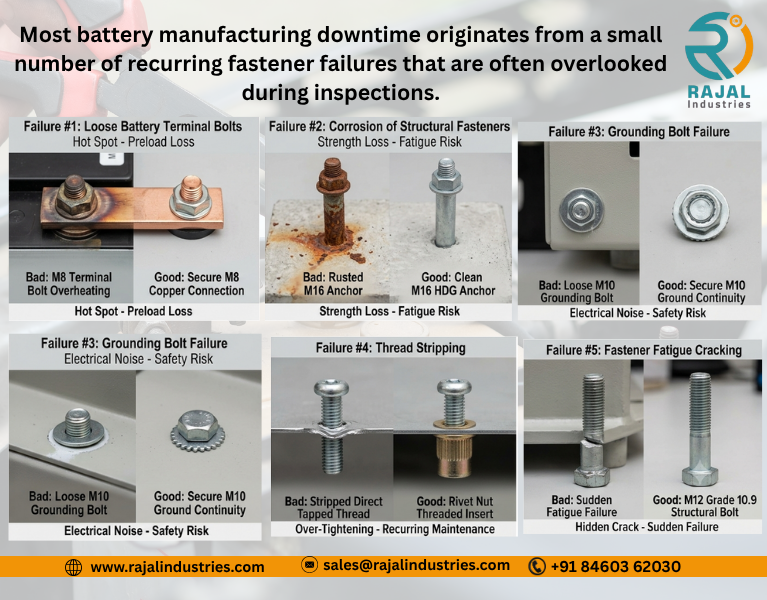
Failure #1 – Loose Battery Terminal Bolts
This is one of the most expensive failures.
Common hardware involved:
- M6 Battery Bolts
- M8 Copper Terminal Bolts
- M10 Terminal Hardware
- Busbar Fasteners
Symptoms include:
- Hot Spots
- Voltage Drop
- Power Loss
- Terminal Heating
Root Causes:
✔ Copper Creep
✔ Thermal Expansion
✔ Improper Torque
✔ Vibration
✔ Poor Washer Selection
Many OEMs now use:
- Belleville Washers
- Nord-Lock Washers
- Flange Bolts
to reduce loosening.
Failure #2 – Corrosion of Structural Fasteners
Battery plants often expose hardware to:
- Humidity
- Cleaning Chemicals
- Electrolyte Vapors
- Condensation
Commonly affected fasteners:
- M8 Hex Bolts
- M10 Hex Bolts
- Threaded Rods
- Anchor Bolts
- Machine Screws
Corrosion reduces:
- Strength
- Clamp Force
- Fatigue Life
Many OEMs upgrade from:
Zinc-Plated Bolts
to:
SS304 Fasteners
or
SS316 Fasteners
in critical areas.
Failure #3 – Grounding Bolt Failure
Grounding systems are often ignored until problems appear.
Typical components include:
- Grounding Bolts
- Copper Ground Lugs
- Serrated Washers
- Grounding Busbars
Common causes:
- Corrosion
- Missing Serrated Washers
- Loose Connections
- Paint Under Contact Areas
Consequences:
- Electrical Noise
- Equipment Errors
- Safety Risks
- Ground Continuity Problems
A single loose M10 grounding bolt can affect an entire production line.
Failure #4 – Thread Stripping
Thread stripping is extremely common in:
- Battery Cabinets
- Control Panels
- Battery Enclosures
- Equipment Covers
Typical hardware:
- M4 Machine Screws
- M5 Machine Screws
- Self-Tapping Screws
- Rivet Nuts
Root causes:
✔ Over-Tightening
✔ Thin Sheet Metal
✔ Repeated Maintenance
✔ Cross-Threading
Many manufacturers solve this by using:
- Rivet Nuts
- Cage Nuts
- Threaded Inserts
instead of direct tapping.
Failure #5 – Anchor Bolt Loosening
Battery factories contain heavy equipment.
Examples:
- Formation Machines
- Battery Testing Equipment
- Containerized BESS Systems
- HVAC Units
Common fasteners:
- M16 Anchor Bolts
- M20 Anchor Bolts
- M24 Anchor Bolts
- Chemical Anchors
- Foundation Bolts
Common issues:
- Preload Loss
- Vibration
- Improper Embedment
- Missing Structural Washers
Anchor bolt failures often remain hidden until major equipment movement occurs.
Failure #6 – Fastener Fatigue Cracking
One of the most misunderstood failures.
Many engineers focus on strength.
The real issue is:
Fatigue
Affected hardware includes:
- Grade 8.8 Bolts
- Grade 10.9 Bolts
- Structural Fasteners
- Battery Tray Bolts
Fatigue develops because of:
- Repeated Loading
- Thermal Expansion
- Vibration
- Dynamic Forces
The bolt may appear perfect until sudden failure occurs.
Failure #7 – Preload Loss Due to Thermal Expansion
This issue is becoming increasingly important in:
- EV Battery Packs
- Battery Modules
- BESS Containers
Common fasteners:
- M6 Battery Bolts
- M8 Structural Bolts
- M10 Flange Bolts
- Lock Nuts
The problem:
Battery systems continuously heat and cool.
This creates:
- Expansion
- Contraction
- Expansion
- Contraction
Over thousands of cycles:
Clamp force decreases.
Eventually:
- Joint movement starts
- Fasteners loosen
- Failures develop
Real Maintenance Audit Example
A battery manufacturing facility reviewed:
12 Months of Maintenance Records
Results showed:
| Failure Type | Approximate Occurrence |
| Loose Terminal Bolts | 22% |
| Corrosion Issues | 18% |
| Grounding Problems | 15% |
| Thread Stripping | 13% |
| Anchor Bolt Issues | 11% |
| Fatigue Failures | 10% |
| Thermal Expansion Issues | 11% |
More than half of all maintenance issues involved fasteners.
The Most Common Fasteners Used in Battery Manufacturing Plants
Large battery manufacturers typically consume:
Structural Fasteners
- M8 Grade 8.8 Bolts
- M10 Grade 8.8 Bolts
- M12 Grade 8.8 Bolts
- M10 Grade 10.9 Bolts
- M12 Grade 10.9 Bolts
- Flange Bolts
- Structural Bolts
Battery Fasteners
- M4 Battery Bolts
- M5 Battery Bolts
- M6 Battery Bolts
- M8 Copper Terminal Bolts
- Busbar Fasteners
Grounding Hardware
- Grounding Bolts
- Serrated Washers
- Copper Ground Lugs
- Grounding Straps
Enclosure Hardware
- Machine Screws
- Captive Screws
- Rivet Nuts
- Cage Nuts
- Self-Tapping Screws
Foundation Hardware
- Anchor Bolts
- Chemical Anchors
- Threaded Rods
- Structural Washers
These keywords are heavily searched by battery manufacturers, maintenance teams, and OEM purchasing departments.
Why OEM Maintenance Teams Focus on Fasteners
Leading battery manufacturers increasingly track:
✔ Torque Retention
✔ Corrosion Rates
✔ Grounding Integrity
✔ Anchor Bolt Condition
✔ Terminal Temperatures
✔ Washer Performance
✔ Fastener Replacement Cycles
The reason is simple:
A ₹20 fastener can stop a ₹20 crore production line.
Industries Most Affected
These failures commonly impact:
- Lithium Battery Pack Manufacturers
- EV Battery Manufacturers
- Battery Cell Manufacturers
- Battery Module Manufacturers
- Battery Rack Manufacturers
- Battery Cabinet Manufacturers
- BESS Integrators
- Energy Storage Equipment OEMs
- Telecom Battery Manufacturers
Inspection Checklist
During maintenance inspections:
✔ Check terminal bolt temperatures
✔ Verify grounding continuity
✔ Inspect corrosion
✔ Review anchor bolt condition
✔ Verify structural bolt torque
✔ Inspect washers
✔ Review fatigue-prone locations
✔ Check thermal expansion effects
✔ Verify lock nut condition
✔ Inspect threaded inserts and rivet nuts
Key Takeaways
- Most battery manufacturing fastener failures are predictable.
- Loose terminal bolts remain one of the most expensive issues.
- Corrosion is a leading cause of structural fastener failure.
- Grounding hardware failures often remain hidden.
- Thread stripping creates recurring maintenance costs.
- Anchor bolt issues can affect major equipment.
- Thermal expansion and fatigue are growing concerns in modern battery systems.
FAQ
What is the most common battery fastener failure?
Loose battery terminal bolts are among the most frequently reported failures because they can cause heating, voltage drop, and power loss.
Why do battery fasteners corrode?
Humidity, condensation, electrolyte vapors, cleaning chemicals, and coating damage are common causes.
Which bolt sizes are most common in battery manufacturing?
M4, M5, M6, M8, M10, and M12 fasteners are widely used across battery equipment and products.
Why are grounding bolts important?
Grounding bolts provide electrical safety and equipment protection by maintaining a reliable path to ground.
What causes thread stripping?
Over-tightening, poor thread engagement, thin sheet metal, and repeated maintenance cycles are the most common causes.
Why do anchor bolts fail?
Improper installation, preload loss, corrosion, vibration, and insufficient embedment depth are common reasons.
How does thermal expansion affect fasteners?
Repeated heating and cooling cycles gradually reduce clamp force, increasing the risk of loosening and fatigue failures.
Which fasteners are commonly used in battery plants?
Battery bolts, copper terminal bolts, structural bolts, anchor bolts, machine screws, captive screws, rivet nuts, cage nuts, grounding bolts, and threaded rods.
Conclusion
Battery manufacturers invest millions in automation, robotics, and quality systems.
Yet many recurring failures originate from the simplest components in the factory.
Fasteners.
The good news is that most fastener failures are preventable through better selection, proper installation, routine inspection, and proactive maintenance.
For lithium battery manufacturers, EV battery OEMs, battery cabinet manufacturers, battery rack manufacturers, and BESS integrators, improving fastener reliability is often one of the fastest ways to improve overall equipment reliability.