

Introduction – The Production Line Stopped, But No One Could Find the Fault
A lithium battery manufacturing plant experienced an unexpected shutdown.
The maintenance team checked:
- Battery Formation Equipment
- Cell Assembly Lines
- PLC Systems
- Power Distribution Panels
- Battery Testing Stations
Everything appeared normal.
No breakers had tripped.
No motors had failed.
No major equipment fault was visible.
Yet production stopped repeatedly.
After several hours of troubleshooting, engineers discovered the root cause.
A single grounding connection had failed.
The failed component was not a transformer.
It was not a battery cell.
It was not a control system.
It was a simple grounding bolt assembly worth less than ₹20.
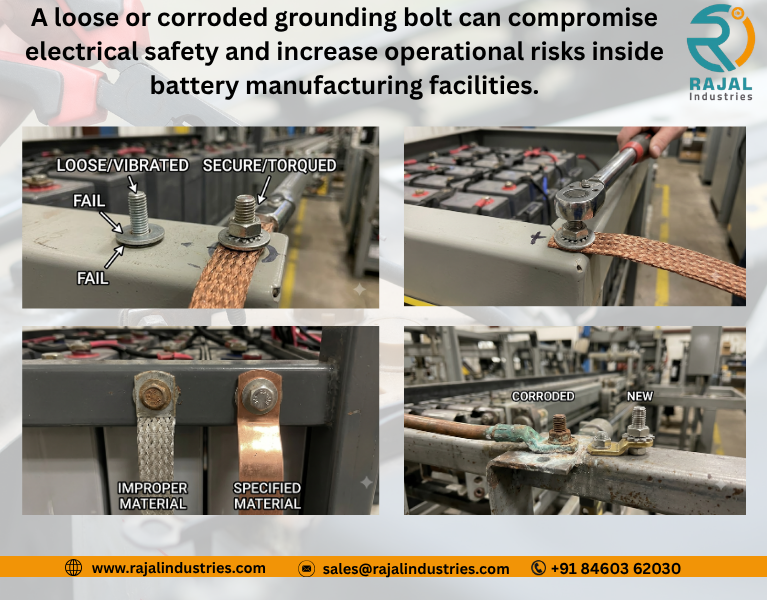
The grounding bolt had gradually loosened over time.
Resistance increased.
Electrical noise increased.
Ground continuity became unreliable.
Eventually, equipment performance was affected.
The production loss cost thousands of times more than the hardware itself.
This situation occurs more often than many battery manufacturers realize.
Quick Answer
Why do grounding bolts fail inside battery plants?
Grounding bolts typically fail due to vibration, corrosion, improper torque, missing serrated washers, oxidation, poor contact surfaces, thermal cycling, or incorrect grounding hardware selection.
Why Grounding Systems Are Critical in Battery Manufacturing
Modern battery factories contain:
- Automated Assembly Equipment
- Robotic Systems
- Laser Welding Machines
- Formation Equipment
- High-Power Charging Systems
- Battery Testing Equipment
- PLC Control Systems
- Sensitive Electronic Devices
All of these systems depend on reliable grounding.
A poor grounding connection can create:
- Electrical Noise
- Equipment Malfunctions
- Communication Errors
- Safety Hazards
- Fire Risks
- Equipment Damage
What Is Battery Grounding Hardware?
Battery grounding hardware includes the fasteners and components used to create reliable electrical grounding connections.
Common grounding hardware includes:
Grounding Bolts
- M6 Grounding Bolts
- M8 Grounding Bolts
- M10 Grounding Bolts
- M12 Grounding Bolts
Grounding Components
- Copper Ground Lugs
- Grounding Straps
- Earth Bars
- Grounding Busbars
Locking Hardware
- Serrated Washers
- Star Washers
- Spring Washers
- Lock Nuts
Fasteners
- SS304 Bolts
- SS316 Bolts
- Brass Grounding Bolts
- Copper-Plated Bolts
- Hex Nuts
- Threaded Rods
Among these, M8 and M10 grounding bolt assemblies are the most commonly used in battery manufacturing facilities.
Why Grounding Bolt Failures Are Difficult to Detect
Most grounding failures develop slowly.
Unlike a broken wire, the connection does not fail instantly.
The failure process usually follows this pattern:
Stage 1
Slight loosening
↓
Stage 2
Increased resistance
↓
Stage 3
Reduced grounding efficiency
↓
Stage 4
Electrical interference
↓
Stage 5
Equipment malfunction
↓
Stage 6
Safety risk
Because the bolt remains physically connected, the problem often goes unnoticed.
Failure #1 – Missing Serrated Washers
One of the most common grounding mistakes.
Many installers use:
- Bolt
- Flat Washer
- Nut
and assume the connection is adequate.
However, painted surfaces create resistance.
A serrated washer is designed to:
✔ Penetrate paint
✔ Break oxidation layers
✔ Create metal-to-metal contact
Without a serrated washer:
Grounding performance may be compromised from day one.
Failure #2 – Corrosion Around Grounding Connections
Battery manufacturing facilities often experience:
- Humidity
- Condensation
- Chemical Vapors
- Cleaning Chemicals
These conditions accelerate corrosion.
Common signs include:
- Rust around bolts
- White corrosion deposits
- Oxidized copper lugs
- Corroded washers
As corrosion increases:
Resistance increases.
Grounding performance decreases.
Failure #3 – Improper Torque
A loose grounding bolt is a serious problem.
However:
An over-tightened grounding bolt can also cause issues.
Excessive torque may:
- Damage threads
- Distort lugs
- Reduce contact area
Both under-tightening and over-tightening reduce reliability.
Failure #4 – Thermal Cycling
Battery plants contain equipment that continuously heats and cools.
Examples include:
- Battery Formation Systems
- Charging Equipment
- Power Electronics
- Busbar Systems
Repeated thermal expansion and contraction gradually reduce preload.
Eventually the grounding connection becomes loose.
Failure #5 – Vibration
Many battery manufacturing systems generate vibration.
Sources include:
- Conveyors
- Motors
- Compressors
- Pumps
- Cooling Equipment
Over time:
Vibration causes preload loss.
The grounding bolt gradually loosens.
Failure #6 – Wrong Fastener Material
Many plants use standard zinc-plated hardware for grounding.
While inexpensive, zinc-plated bolts may not always provide optimal long-term performance.
Many OEMs now specify:
Preferred Grounding Materials
- SS304 Grounding Bolts
- SS316 Grounding Bolts
- Brass Grounding Bolts
- Copper-Plated Grounding Bolts
depending on the application.
Real Battery Plant Example
A battery module assembly facility experienced repeated PLC communication issues.
Investigation focused on:
- Software
- Network Systems
- Power Supplies
No faults were found.
Eventually engineers inspected grounding connections.
They discovered:
- M10 Grounding Bolt
- Flat Washer Only
- Painted Mounting Surface
Result:
Poor grounding continuity.
Corrective action:
✔ Installed serrated washer
✔ Cleaned contact surfaces
✔ Re-torqued hardware
✔ Added inspection procedure
The communication issue disappeared.
Why Grounding Resistance Matters
Assume:
Grounding Resistance:
0.05 Ohm
Fault Current:
100 Amps
Heat Generated:
P = I²R
P = 100² × 0.05
= 500 Watts
Now assume corrosion increases resistance to:
0.10 Ohm
Heat Generated:
P = 100² × 0.10
= 1000 Watts
Heat doubles.
A small increase in resistance can create a major safety issue.
Grounding Bolt vs Standard Hex Bolt
| Parameter | Grounding Bolt Assembly | Standard Bolt Assembly |
| Electrical Contact | Excellent | Moderate |
| Grounding Reliability | High | Medium |
| Paint Penetration | High | Low |
| Safety Performance | High | Medium |
| OEM Preference | Preferred | Limited |
This is why dedicated grounding hardware is increasingly specified by battery OEMs.
Fasteners Commonly Used in Battery Grounding Systems
Large battery manufacturers regularly purchase:
Grounding Fasteners
- M6 Grounding Bolts
- M8 Grounding Bolts
- M10 Grounding Bolts
- M12 Grounding Bolts
Grounding Hardware
- Copper Ground Lugs
- Earth Bars
- Copper Busbars
- Grounding Straps
Locking Components
- Serrated Washers
- Star Washers
- Spring Washers
- Lock Nuts
Structural Grounding Hardware
- Threaded Rods
- Hex Nuts
- SS304 Fasteners
- SS316 Fasteners
These are among the most searched grounding fasteners used in lithium battery manufacturing plants.
Why Battery Factories Face Higher Grounding Risks
Compared with conventional factories, battery plants contain:
✔ Higher electrical loads
✔ Sensitive electronics
✔ Automated systems
✔ Extensive busbar networks
✔ High-current charging equipment
As a result, grounding quality becomes even more important.
Industries Most Affected
Grounding bolt failures commonly impact:
- Lithium Battery Pack Manufacturers
- EV Battery Manufacturers
- Battery Cell Manufacturers
- Battery Module Manufacturers
- Battery Rack Manufacturers
- Battery Cabinet Manufacturers
- BESS Integrators
- Telecom Battery Manufacturers
- Energy Storage Equipment OEMs
Inspection Checklist
Before approving grounding systems:
✔ Verify grounding bolt torque
✔ Inspect serrated washer installation
✔ Check metal-to-metal contact
✔ Inspect corrosion
✔ Verify continuity measurements
✔ Review grounding lug condition
✔ Check vibration-prone locations
✔ Review maintenance schedules
Typical Grounding Hardware Consumption
A medium-sized battery manufacturing facility may consume annually:
- 50,000+ Grounding Bolts
- 100,000+ Serrated Washers
- 50,000+ Copper Ground Lugs
- 100,000+ Hex Nuts
- 50,000+ Threaded Rod Assemblies
- Thousands of grounding straps and busbar connections
Even a small failure rate can affect hundreds of grounding points.
Key Takeaways
- Grounding bolt failures often remain hidden until equipment problems appear.
- Missing serrated washers are a common root cause.
- Corrosion increases resistance and reduces grounding effectiveness.
- Thermal cycling and vibration gradually reduce preload.
- Proper grounding hardware improves reliability and safety.
- Battery plants have higher grounding requirements than many traditional factories.
- Regular inspection is critical for long-term performance.
FAQ
What is a grounding bolt?
A grounding bolt is a fastener used to connect grounding conductors, lugs, busbars, and earth systems to electrical equipment.
Why are serrated washers important in grounding systems?
Serrated washers penetrate paint and oxidation layers, creating reliable metal-to-metal electrical contact.
Can a loose grounding bolt affect production equipment?
Yes. Poor grounding can cause electrical noise, communication problems, equipment malfunctions, and safety issues.
Which grounding bolt sizes are commonly used?
M6, M8, M10, and M12 grounding bolts are widely used in battery manufacturing facilities.
What materials are commonly used for grounding hardware?
SS304, SS316, brass, copper-plated steel, and copper grounding components are commonly used.
How does corrosion affect grounding performance?
Corrosion increases electrical resistance, reducing grounding effectiveness and potentially increasing heat generation.
Which industries face grounding hardware issues most often?
Lithium battery manufacturers, EV battery manufacturers, battery module manufacturers, BESS integrators, and energy storage equipment OEMs.
How can OEMs reduce grounding bolt failures?
By using proper grounding hardware, serrated washers, correct torque procedures, corrosion-resistant materials, and regular inspections.
Conclusion
Grounding bolts are rarely the most expensive components inside a battery plant.
But they are often among the most important.
A loose grounding connection can create electrical noise, equipment instability, safety risks, and expensive downtime long before the actual cause is discovered.
For lithium battery manufacturers, battery module OEMs, EV battery manufacturers, and BESS integrators, grounding hardware should be treated as a critical engineering component rather than a standard fastener.