

Introduction – The Bolt Passed Every Test Until the Battery Entered Real Service
An EV battery manufacturer was investigating unexpected warranty claims.
The battery packs passed:
✔ Vibration Testing
✔ Torque Validation
✔ Thermal Cycling Tests
✔ Final Quality Inspection
Everything appeared normal.
However, after several months of vehicle operation, engineers discovered:
- Cracked M8 Bolts
- Loose Battery Modules
- Distorted Module Frames
- Increased Internal Vibration
- Damaged Battery Mounting Brackets
Initially, engineers suspected:
- Poor bolt quality
- Incorrect torque
- Manufacturing defects
The actual cause was far more complex.
The battery modules were expanding and contracting during operation.
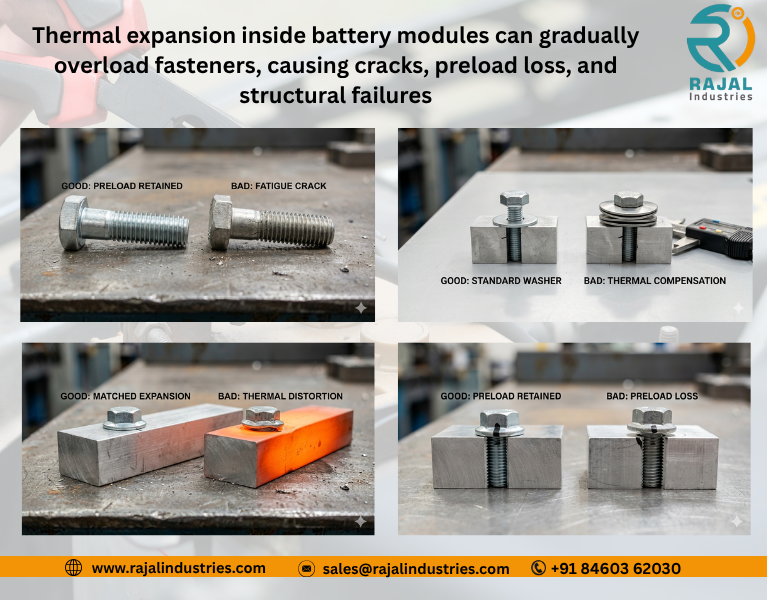
Over thousands of charging and discharging cycles, thermal expansion gradually overloaded the fastening system.
The fasteners did not fail immediately.
They failed slowly.
And by the time visible damage appeared, the problem had already existed for months.
Today, this issue is becoming increasingly common in:
- EV Battery Manufacturing
- Lithium Battery Pack Manufacturing
- Battery Module Production
- Battery Rack Manufacturing
- Battery Cabinet Manufacturing
- BESS Container Systems
- Telecom Battery Systems
- Industrial Energy Storage Projects
Quick Answer
Why does battery module expansion damage fasteners?
Battery modules continuously expand and contract due to temperature changes during charging and discharging. This movement creates stress on bolts, nuts, washers, threaded inserts, and structural joints. Over time, preload loss, fatigue cracking, and fastener failure can occur.
What Is Battery Module Expansion?
Every battery generates heat.
During operation:
- Cells heat up
- Module frames expand
- Busbars expand
- Battery enclosures expand
During cooling:
- Components contract
This process repeats thousands of times throughout the battery’s life.
Even small dimensional changes can create significant forces inside a tightly constrained assembly.
Why Battery Systems Experience Thermal Expansion
Sources of temperature variation include:
Charging Cycles
Fast charging generates heat rapidly.
Discharging Cycles
High current loads increase temperature.
Environmental Conditions
Outdoor temperatures may vary from:
- -20°C
- To +60°C
Internal Cell Heating
Individual lithium cells may operate significantly hotter than surrounding structures.
As temperatures change, materials expand at different rates.
Common Battery Module Fasteners Used by OEMs
Battery manufacturers commonly use:
Battery Bolts
- M4 Battery Bolts
- M5 Battery Bolts
- M6 Battery Bolts
- M8 Battery Bolts
- M10 Structural Bolts
Structural Fasteners
- Grade 8.8 Hex Bolts
- Grade 10.9 Hex Bolts
- Flange Bolts
- Socket Head Cap Screws
- Hex Socket Screws
Locking Hardware
- Nylock Nuts
- Prevailing Torque Nuts
- All-Metal Lock Nuts
Washers
- Flat Washers
- Belleville Washers
- Spring Washers
- Nord-Lock Washers
- Structural Washers
Threaded Components
- Threaded Inserts
- Threaded Rods
- Rivet Nuts
- Weld Nuts
These are among the most searched battery module fasteners used by EV battery manufacturers and BESS integrators.
Why OEMs Often Miss Thermal Expansion Problems
Most validation focuses on:
✔ Static Strength
✔ Torque Verification
✔ Vibration Resistance
✔ Corrosion Testing
However, thermal expansion behaves differently.
The joint may appear perfect during assembly.
The issue develops gradually over years of operation.
This makes thermal expansion one of the most overlooked causes of battery fastener failure.
Failure Mechanism #1 – Preload Loss
This is the most common problem.
A bolt is tightened to the correct torque.
The joint initially performs well.
However:
- Expansion occurs
- Material settles
- Clamp force changes
Over time:
Preload decreases
Once preload drops, vibration and movement begin.
Failure Mechanism #2 – Fatigue Cracking
Many battery bolts fail due to fatigue rather than overload.
The bolt experiences:
- Expansion Stress
- Contraction Stress
- Expansion Stress
- Contraction Stress
Repeated thousands of times.
Eventually:
Small cracks begin forming.
The bolt appears normal until final failure occurs.
Failure Mechanism #3 – Differential Material Expansion
Battery assemblies often combine:
- Aluminum Frames
- Steel Fasteners
- Copper Busbars
- Stainless Hardware
Each material expands differently.
Example:
Aluminum expands significantly more than steel.
This mismatch creates internal stress.
The fastener absorbs much of that stress.
Aluminum vs Steel Expansion
| Material | Thermal Expansion Rate |
| Aluminum | High |
| Copper | Medium-High |
| Stainless Steel | Medium |
| Carbon Steel | Lower |
This difference becomes important in battery structures.
Real EV Battery Example
An EV battery manufacturer experienced recurring bolt failures.
Application:
- Aluminum Battery Module Frame
- M8 Grade 8.8 Bolt
- Flat Washer
Symptoms:
- Bolt loosening
- Cracked fasteners
- Module movement
Investigation revealed:
Thermal expansion mismatch
Corrective action:
- Belleville washers added
- Joint redesigned
- Expansion allowances incorporated
Failure rate dropped significantly.
Why Flat Washers Are Often Not Enough
Many OEMs rely on:
Flat Washers Only
Flat washers help distribute load.
However, they do not compensate effectively for thermal expansion.
As temperature changes:
Clamp force still fluctuates.
Belleville Washers vs Flat Washers
| Parameter | Flat Washer | Belleville Washer |
| Load Distribution | Good | Good |
| Preload Retention | Low | Excellent |
| Thermal Expansion Compensation | Low | High |
| Battery Industry Usage | Common | Growing |
| BESS Applications | Common | Preferred |
This is why many advanced battery designs now use Belleville washer stacks.
Battery Module Load Example
Assume:
Module Length:
1,000 mm
Material:
Aluminum
Temperature Change:
50°C
Thermal growth:
Approximately:
1.15 mm
That movement may seem small.
However, when constrained by rigid fasteners, substantial stresses develop.
Across thousands of cycles, these stresses can damage:
- Bolts
- Threaded Inserts
- Busbar Connections
- Module Frames
Why Fastener Cracks Usually Start at Threads
Most battery bolt failures occur near:
First Engaged Thread
Reasons:
- Highest stress concentration
- Fatigue loading
- Expansion-induced stress
This is why thread design and preload management are critical.
Grade 8.8 vs Grade 10.9 for Battery Modules
| Parameter | Grade 8.8 Bolt | Grade 10.9 Bolt |
| Strength | High | Very High |
| Preload Capacity | High | Higher |
| Fatigue Performance | Good | Excellent |
| Battery Structures | Common | Critical Applications |
| Cost | Lower | Higher |
The strongest bolt is not always the best solution.
Joint design matters more than bolt strength alone.
Fasteners Commonly Used in EV Battery Modules
Large EV battery manufacturers frequently purchase:
Battery Bolts
- M4 Battery Bolts
- M5 Battery Bolts
- M6 Battery Bolts
- M8 Battery Bolts
- M10 Structural Bolts
Locking Systems
- Nylock Nuts
- All-Metal Lock Nuts
- Prevailing Torque Nuts
Washers
- Belleville Washers
- Flat Washers
- Spring Washers
- Nord-Lock Washers
Structural Hardware
- Threaded Inserts
- Threaded Rods
- Flange Bolts
- Socket Head Cap Screws
These are among the highest-volume battery module fasteners used across EV and energy storage manufacturing.
Industries Most Affected
Thermal expansion-related fastener failures commonly impact:
- EV Battery Manufacturers
- Lithium Battery Pack Manufacturers
- Battery Module Manufacturers
- Battery Rack Manufacturers
- Battery Cabinet Manufacturers
- Battery Enclosure Manufacturers
- BESS Integrators
- Energy Storage Equipment Manufacturers
Inspection Checklist
Before battery pack approval:
✔ Review thermal expansion analysis
✔ Verify preload requirements
✔ Evaluate material combinations
✔ Inspect washer selection
✔ Review fatigue calculations
✔ Check thread engagement
✔ Validate thermal cycling performance
✔ Analyze long-term preload retention
Key Takeaways
- Battery modules continuously expand and contract during operation.
- Thermal expansion can cause preload loss and fatigue failures.
- Aluminum structures create additional stress due to higher expansion rates.
- Flat washers often provide limited protection against expansion-related preload loss.
- Belleville washers help maintain clamp force.
- Most fastener cracks begin at thread roots.
- Thermal expansion is one of the most overlooked causes of battery module fastener failures.
FAQ
What causes battery module fasteners to crack?
Most cracks occur due to fatigue caused by thermal expansion, preload loss, vibration, and repeated temperature cycling.
Why does thermal expansion affect battery bolts?
Battery components expand and contract during operation. This movement creates cyclic stress that can gradually damage fasteners.
Which bolt sizes are commonly used in battery modules?
M4, M5, M6, M8, and M10 bolts are among the most commonly used battery module fasteners.
Are Belleville washers better than flat washers?
For thermal expansion applications, Belleville washers often provide better preload retention and stress compensation.
Can thermal expansion loosen battery bolts?
Yes. Expansion and contraction cycles can gradually reduce clamp force and lead to loosening.
Which materials create the biggest expansion mismatch?
Aluminum structures combined with steel fasteners are a common source of expansion-related stress.
What fasteners are commonly used in EV battery packs?
Battery bolts, flange bolts, socket head cap screws, lock nuts, Belleville washers, threaded inserts, and structural fasteners.
How can OEMs reduce thermal expansion failures?
By designing for movement, selecting proper washers, controlling preload, validating thermal cycling, and using suitable fastener systems.
Conclusion
Battery module failures are not always caused by electrical problems.
Sometimes the issue begins with a simple bolt.
As EV battery packs and energy storage systems become larger and more powerful, thermal expansion is becoming one of the most important mechanical design challenges.
For EV battery manufacturers, battery module OEMs, battery enclosure manufacturers, and BESS integrators, understanding thermal expansion is essential for preventing long-term fastener failures.