

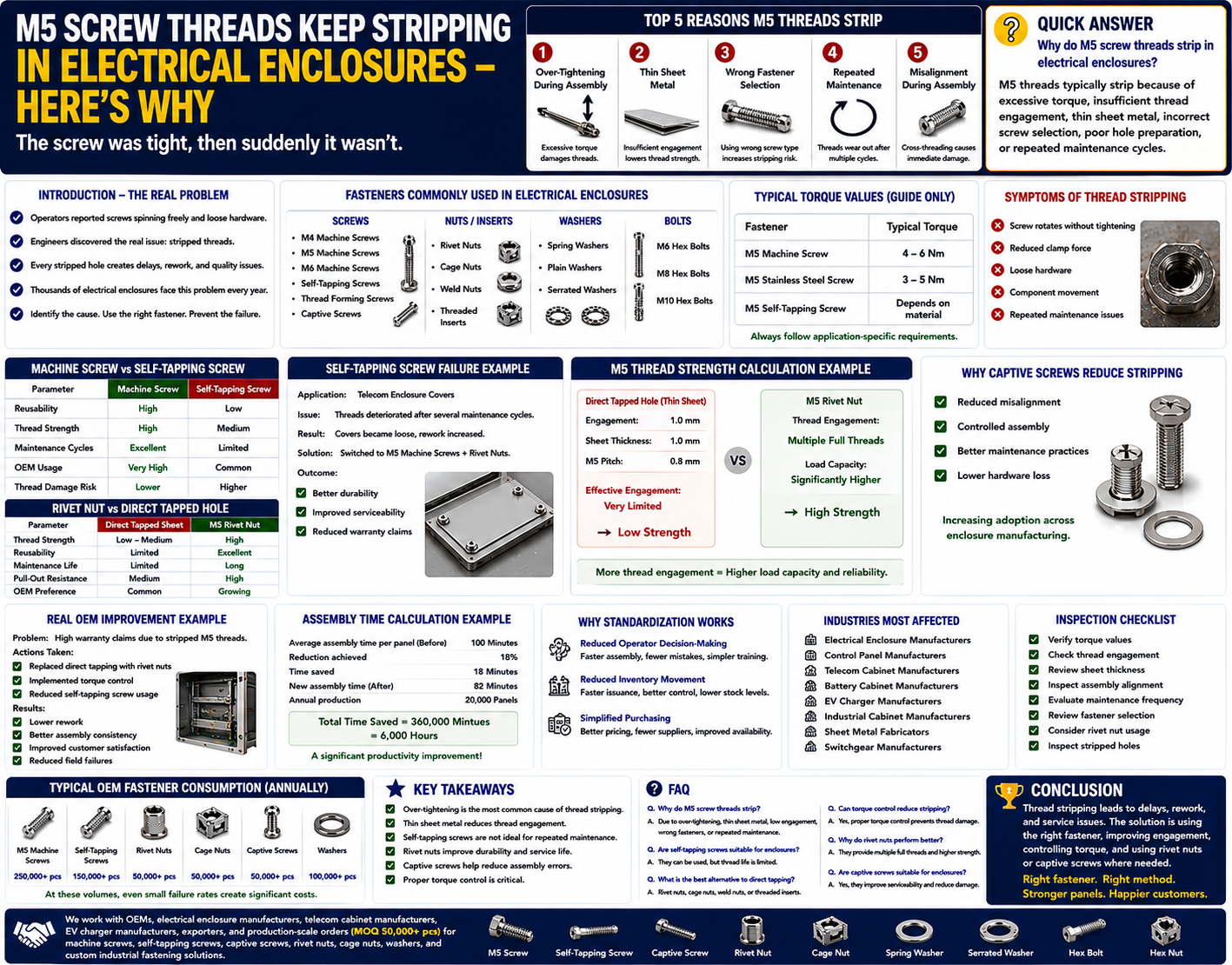
Introduction – The Screw Was Tight, Then Suddenly It Wasn’t
An electrical enclosure manufacturer received repeated complaints from the assembly department.
Operators reported:
- Screws spinning freely
- Loose mounting hardware
- Rework during assembly
- Difficulty securing components
At first, engineers suspected poor operator training.
However, after examining several failed parts, the real issue became clear.
The M5 screw was not failing.
The threads inside the enclosure were stripping.
Every stripped hole created:
- Production delays
- Rework costs
- Quality concerns
- Customer dissatisfaction
This problem affects thousands of electrical enclosures every year.
And surprisingly, many manufacturers continue making the same mistakes.
Quick Answer
Why do M5 screw threads strip in electrical enclosures?
M5 threads typically strip because of excessive torque, insufficient thread engagement, thin sheet metal, incorrect screw selection, poor hole preparation, or repeated maintenance cycles.
What Is Thread Stripping?
Thread stripping occurs when the internal or external threads become damaged and can no longer properly hold load.
Common symptoms include:
- Screw rotates without tightening
- Reduced clamp force
- Loose hardware
- Component movement
- Repeated maintenance issues
Once thread stripping occurs, the connection usually loses its structural integrity.
Fasteners Commonly Used in Electrical Enclosures
Electrical enclosure manufacturers commonly use:
Screws
- M4 Machine Screws
- M5 Machine Screws
- M6 Machine Screws
- Self-Tapping Screws
- Thread Forming Screws
- Captive Screws
Threaded Hardware
- Rivet Nuts
- Cage Nuts
- Weld Nuts
- Threaded Inserts
Locking Components
Among these, M5 Machine Screws are one of the most widely used panel fasteners.
Why M5 Threads Strip So Frequently
1. Over-Tightening During Assembly
This is the most common cause.
Many operators assume:
“Tighter is better.”
In reality:
Excessive torque damages threads.
Once thread deformation starts, holding strength decreases rapidly.
Typical Torque Values
| Fastener | Typical Torque |
| M5 Machine Screw | 4–6 Nm |
| M5 Stainless Steel Screw | 3–5 Nm |
| M5 Self-Tapping Screw | Depends on material |
Always follow application-specific requirements.
2. Thin Sheet Metal
Many electrical enclosures use:
- 0.8 mm sheet
- 1.0 mm sheet
- 1.2 mm sheet
These thicknesses often provide limited thread engagement.
Insufficient engagement means:
- Lower thread strength
- Higher stripping risk
3. Wrong Fastener Selection
Many OEMs use self-tapping screws where machine screws would be more suitable.
Others use machine screws directly into thin sheet metal.
Better alternatives may include:
- Rivet Nuts
- Cage Nuts
- Weld Nuts
- Threaded Inserts
4. Repeated Maintenance
Control panels and electrical enclosures are frequently opened.
Every removal and reinstallation cycle creates wear.
After hundreds of cycles:
- Thread quality deteriorates
- Holding strength decreases
This is why many OEMs prefer captive screw systems.
5. Misalignment During Assembly
Cross-threading creates immediate damage.
Common causes:
- Manual assembly
- Poor fixture alignment
- Operator error
Even minor thread damage can significantly reduce load capacity.
Machine Screw vs Self-Tapping Screw
Which Is Better?
| Parameter | Machine Screw | Self-Tapping Screw |
| Reusability | High | Low |
| Thread Strength | High | Medium |
| Maintenance Cycles | Excellent | Limited |
| OEM Usage | Very High | Common |
| Thread Damage Risk | Lower | Higher |
For frequently serviced enclosures, machine screws are often preferred.
Self-Tapping Screw Failure Example
A telecom enclosure manufacturer used self-tapping screws for removable covers.
After several maintenance cycles:
- Threads deteriorated
- Covers became loose
- Rework increased
The OEM switched to:
- M5 Machine Screws
- Rivet Nuts
Results:
✔ Better durability
✔ Improved serviceability
✔ Reduced warranty claims
M5 Thread Strength Calculation Example
Assume:
Thread Engagement:
1.0 mm
Sheet Thickness:
1.0 mm
M5 Thread Pitch:
0.8 mm
Effective thread engagement:
Very limited.
Now compare with:
M5 Rivet Nut
Thread engagement:
Multiple full threads
Load capacity increases significantly.
This explains why rivet nuts are commonly used in production environments.
Rivet Nut vs Direct Tapped Hole
| Parameter | Direct Tapped Sheet | M5 Rivet Nut |
| Thread Strength | Low-Medium | High |
| Reusability | Limited | Excellent |
| Maintenance Life | Limited | Long |
| Pull-Out Resistance | Medium | High |
| OEM Preference | Common | Growing |
Many enclosure manufacturers now standardize rivet nuts for service access points.
Why Captive Screws Reduce Thread Stripping
Captive screw systems help because:
✔ Reduced misalignment
✔ Controlled assembly
✔ Better maintenance practices
✔ Lower hardware loss
This is why adoption is increasing across enclosure manufacturing.
Industries Most Affected
Thread stripping issues frequently affect:
- Electrical Enclosure Manufacturers
- Control Panel Manufacturers
- Telecom Cabinet Manufacturers
- Battery Cabinet Manufacturers
- EV Charger Manufacturers
- Industrial Cabinet Manufacturers
- Sheet Metal Fabricators
- Switchgear Manufacturers
Inspection Checklist
Before production approval:
✔ Verify torque values
✔ Check thread engagement
✔ Review sheet thickness
✔ Inspect assembly alignment
✔ Evaluate maintenance frequency
✔ Review fastener selection
✔ Consider rivet nut usage
✔ Inspect stripped holes
Typical OEM Fastener Consumption
A medium-sized enclosure manufacturer may consume annually:
- 250,000+ M5 Machine Screws
- 150,000+ Self-Tapping Screws
- 50,000+ Rivet Nuts
- 50,000+ Cage Nuts
- 50,000+ Captive Screws
- 100,000+ Washers
At these volumes, even small failure rates create significant costs.
Real OEM Improvement Example
One electrical enclosure OEM analyzed warranty claims.
Top issue:
Stripped M5 threads.
Corrective actions:
- Replaced direct tapping with rivet nuts
- Implemented torque control
- Reduced self-tapping screw usage
Results:
✔ Lower rework
✔ Better assembly consistency
✔ Improved customer satisfaction
✔ Reduced field failures
Key Takeaways
- Over-tightening is the most common cause of thread stripping.
- Thin sheet metal reduces thread engagement.
- Self-tapping screws are not ideal for repeated maintenance.
- Rivet nuts improve durability and service life.
- Captive screws help reduce assembly errors.
- Proper torque control is critical.
FAQ
Why do M5 screw threads strip?
Most stripping occurs due to excessive torque, insufficient thread engagement, thin sheet metal, or repeated maintenance cycles.
Are self-tapping screws suitable for electrical enclosures?
They can be effective for certain applications, but repeated removal and installation often reduces thread life.
What is the best alternative to direct tapping?
Many OEMs use rivet nuts, cage nuts, weld nuts, or threaded inserts for stronger threads.
Can torque control reduce stripping?
Yes. Proper torque control is one of the most effective ways to prevent thread damage.
Why do rivet nuts perform better?
Rivet nuts provide multiple full threads and better load distribution than thin sheet metal threads.
Are captive screws suitable for electrical enclosures?
Yes. Captive screws improve serviceability and reduce maintenance-related thread damage.
Which industries commonly face thread stripping problems?
Electrical enclosure manufacturers, telecom cabinet manufacturers, EV charger manufacturers, battery cabinet manufacturers, and control panel OEMs.
How can OEMs prevent thread stripping?
By improving thread engagement, selecting proper fasteners, controlling torque, and using rivet nuts where necessary.
Conclusion
Thread stripping may seem like a small issue.
However, at OEM production volumes, a single stripped thread can create:
- Assembly delays
- Rework costs
- Service complaints
- Customer dissatisfaction
The solution is not simply tightening screws more carefully.
The solution is selecting the right fastening system.
For electrical enclosure manufacturers, control panel OEMs, telecom cabinet manufacturers, and EV charger manufacturers, proper use of machine screws, self-tapping screws, rivet nuts, captive screws, and threaded inserts is critical for long-term reliability.