
Introduction – The Cheapest Part Caused the Most Expensive Failure
An industrial facility experienced an unexpected shutdown.
The LT panel was only two years old.
The MCC panels were functioning properly.
Protective relays appeared normal.
No major electrical component had failed.
The maintenance team spent hours searching for the cause.
Eventually, the problem was traced to a single grounding connection.
Not a transformer.
Not a breaker.
Not a PLC.
A simple M10 grounding bolt had gradually loosened.
The cost of the failed bolt?
Less than ₹5.
The cost of downtime?
Several lakhs.
This situation is more common than many engineers realize.
Grounding hardware failures occur regularly in:
- LT Panels
- HT Panels
- MCC Panels
- PCC Panels
- Control Panels
- Switchgear Systems
- EV Charger Infrastructure
- Battery Energy Storage Systems (BESS)
Yet grounding bolts are often ignored during inspections.
Quick Answer
Why are grounding bolts important?
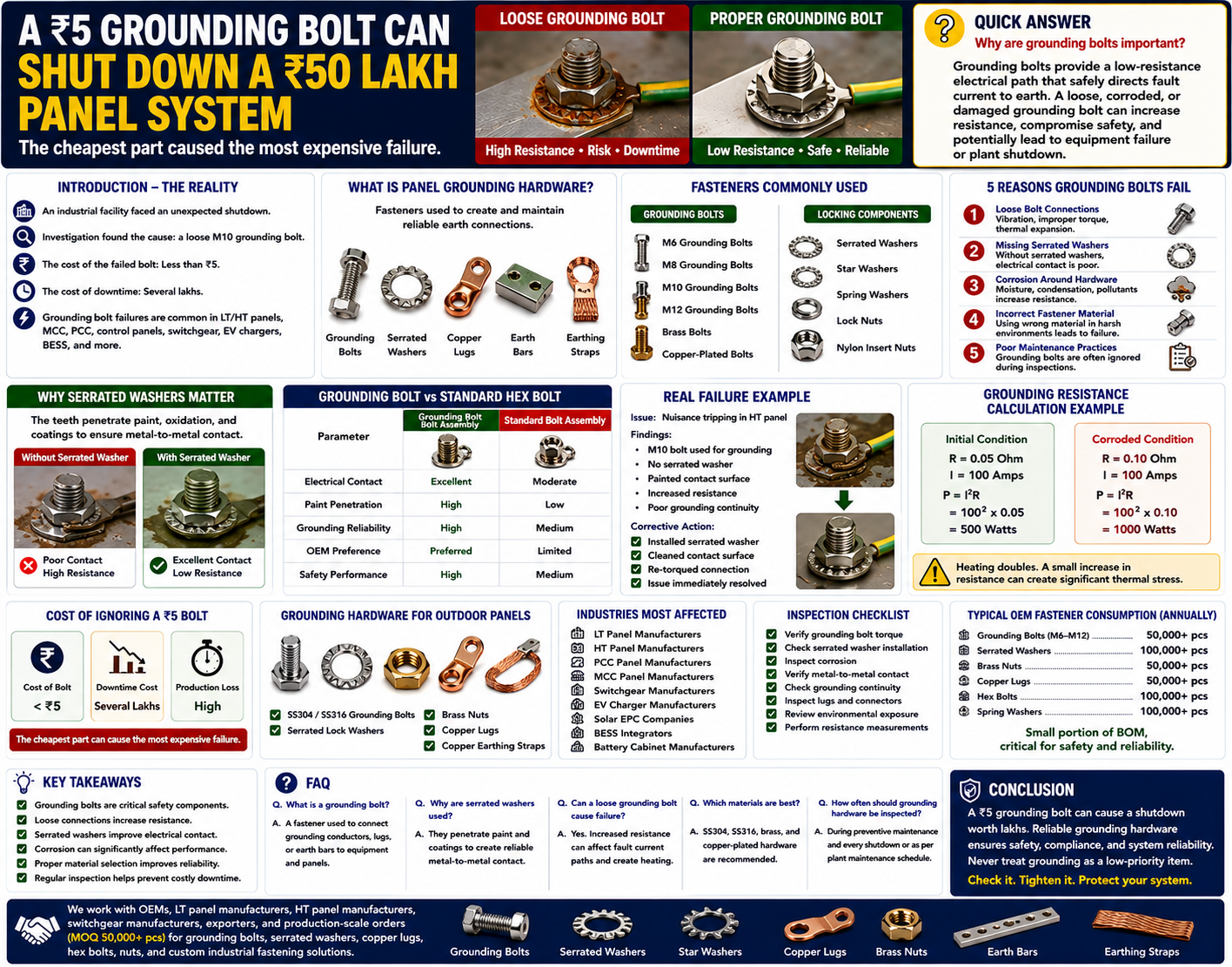
Grounding bolts provide a low-resistance electrical path that safely directs fault current to earth. A loose, corroded, or damaged grounding bolt can increase resistance, compromise safety, and potentially lead to equipment failure or plant shutdown.
What Is Panel Grounding Hardware?
Panel grounding hardware consists of the fasteners used to create and maintain reliable earth connections.
Common grounding fasteners include:
- Grounding Bolts
- Hex Bolts
- Hex Nuts
- Serrated Washers
- Star Washers
- Spring Washers
- Copper Lugs
- Brass Grounding Hardware
- Earthing Clamps
- Threaded Rods
Among these, grounding bolts and serrated washers play the most critical role.
Why Grounding Connections Fail
Most failures do not happen immediately.
They develop gradually through:
- Vibration
- Corrosion
- Thermal cycling
- Improper assembly
- Poor maintenance
By the time the problem becomes visible, the damage may already be significant.
Fasteners Commonly Used in Grounding Systems
LT and HT panel manufacturers commonly use:
Grounding Hardware
- M6 Grounding Bolts
- M8 Grounding Bolts
- M10 Grounding Bolts
- M12 Grounding Bolts
- Brass Bolts
- Copper-Plated Bolts
Locking Components
- Serrated Washers
- Star Washers
- Spring Washers
- Lock Nuts
- Nylon Insert Nuts
Earthing Components
- Copper Lugs
- Earth Bars
- Busbars
- Earthing Straps
5 Reasons Grounding Bolts Fail
1. Loose Bolt Connections
The most common failure.
A grounding bolt loses preload due to:
- Vibration
- Improper torque
- Thermal expansion
The connection remains physically attached but electrical resistance increases.
2. Missing Serrated Washers
Many grounding failures occur because serrated washers were omitted.
Serrated washers:
✔ Break paint layers
✔ Improve electrical contact
✔ Maintain conductivity
Without them, resistance often increases.
3. Corrosion Around Grounding Hardware
Outdoor environments expose grounding hardware to:
- Moisture
- Condensation
- Industrial pollutants
Corrosion gradually increases resistance.
This is especially common in:
- Outdoor Panels
- EV Chargers
- Solar Installations
- BESS Projects
4. Incorrect Fastener Material
Some installations use standard zinc-plated bolts in harsh environments.
Better alternatives include:
- SS304 Bolts
- SS316 Bolts
- Brass Grounding Bolts
- Copper-Plated Hardware
Material selection directly impacts reliability.
5. Poor Maintenance Practices
Many maintenance teams inspect:
- Breakers
- Relays
- Busbars
But grounding bolts are rarely checked.
As a result, failures remain hidden.
Why Serrated Washers Matter
A serrated washer is often more important than the bolt itself.
The teeth penetrate:
- Paint
- Oxidation
- Surface coatings
This creates a reliable metal-to-metal connection.
Without a serrated washer:
Electrical continuity may be compromised even if the bolt is tight.
Grounding Bolt vs Standard Hex Bolt
| Parameter | Grounding Bolt Assembly | Standard Bolt Assembly |
| Electrical Contact | Excellent | Moderate |
| Paint Penetration | High | Low |
| Grounding Reliability | High | Medium |
| OEM Preference | Preferred | Limited |
| Safety Performance | High | Medium |
Real Failure Example
An HT panel manufacturer investigated repeated nuisance tripping.
Inspection revealed:
- Grounding lug attached using M10 bolt
- No serrated washer
- Painted contact surface
Results:
- Increased resistance
- Poor grounding continuity
- Intermittent protection issues
Corrective action:
- Installed serrated washer
- Cleaned contact surface
- Re-torqued connection
The issue was immediately resolved.
Grounding Resistance Calculation Example
Assume:
Grounding Connection Resistance:
0.05 Ohm
Fault Current:
100 Amps
Power Dissipation:
P = I²R
P = 100² × 0.05
P = 500 Watts
Now assume corrosion increases resistance to:
0.10 Ohm
Power Dissipation:
P = 100² × 0.10
P = 1000 Watts
The heating doubles.
A small increase in resistance can create significant thermal stress.
Grounding Hardware for Outdoor Panels
Many OEMs specify:
Preferred Components
- SS304 Grounding Bolts
- SS316 Grounding Bolts
- Serrated Lock Washers
- Brass Nuts
- Copper Lugs
- Copper Earthing Straps
These components improve long-term reliability.
Industries Most Affected
Grounding hardware failures commonly impact:
- LT Panel Manufacturers
- HT Panel Manufacturers
- PCC Panel Manufacturers
- MCC Panel Manufacturers
- Switchgear Manufacturers
- EV Charger Manufacturers
- Solar EPC Companies
- BESS Integrators
- Battery Cabinet Manufacturers
Inspection Checklist
Before dispatch or maintenance:
✔ Verify grounding bolt torque
✔ Check serrated washer installation
✔ Inspect corrosion
✔ Verify metal-to-metal contact
✔ Check grounding continuity
✔ Inspect lugs and connectors
✔ Review environmental exposure
✔ Perform resistance measurements
Typical OEM Fastener Consumption
A medium-sized panel OEM may consume annually:
- 50,000+ Grounding Bolts
- 100,000+ Serrated Washers
- 50,000+ Brass Nuts
- 50,000+ Copper Lugs
- 100,000+ Hex Bolts
- 100,000+ Spring Washers
Grounding hardware may represent a small portion of the BOM, but it plays a critical role in safety and reliability.
Key Takeaways
- Grounding bolts are critical safety components.
- Loose grounding connections increase resistance.
- Serrated washers improve electrical contact.
- Corrosion can significantly affect grounding performance.
- Proper material selection improves long-term reliability.
- Regular inspection helps prevent costly downtime.
FAQ
What is a grounding bolt?
A grounding bolt is a fastener used to connect grounding conductors, lugs, or earth bars to electrical equipment and panels.
Why are serrated washers used in grounding connections?
Serrated washers penetrate paint and surface coatings to create reliable metal-to-metal electrical contact.
Can a loose grounding bolt cause equipment failure?
Yes. Increased resistance can affect fault current paths, create heating, and compromise electrical safety.
Which materials are best for grounding hardware?
SS304, SS316, brass, and copper-plated hardware are commonly used depending on the environment and application.
How often should grounding hardware be inspected?
Grounding systems should be inspected periodically during preventive maintenance and shutdown schedules.
Why do grounding connections corrode?
Moisture, humidity, chemicals, and environmental exposure can attack grounding hardware over time.
Which industries use grounding bolts extensively?
LT panel manufacturers, HT panel manufacturers, switchgear manufacturers, EV charger OEMs, solar EPC companies, and BESS integrators.
Can a serrated washer improve grounding performance?
Yes. It improves electrical contact by penetrating coatings and maintaining conductivity.
Conclusion
The most expensive panel failure is not always caused by the most expensive component.
Sometimes a ₹5 grounding bolt can create a problem worth lakhs.
Grounding hardware is often overlooked because it is simple, inexpensive, and hidden from view.
However, proper grounding bolts, serrated washers, copper lugs, and reliable fastening methods are essential for safety, compliance, and long-term system reliability.
For LT panel manufacturers, HT panel manufacturers, switchgear OEMs, EV charger manufacturers, and BESS integrators, grounding hardware should never be treated as a low-priority item.