

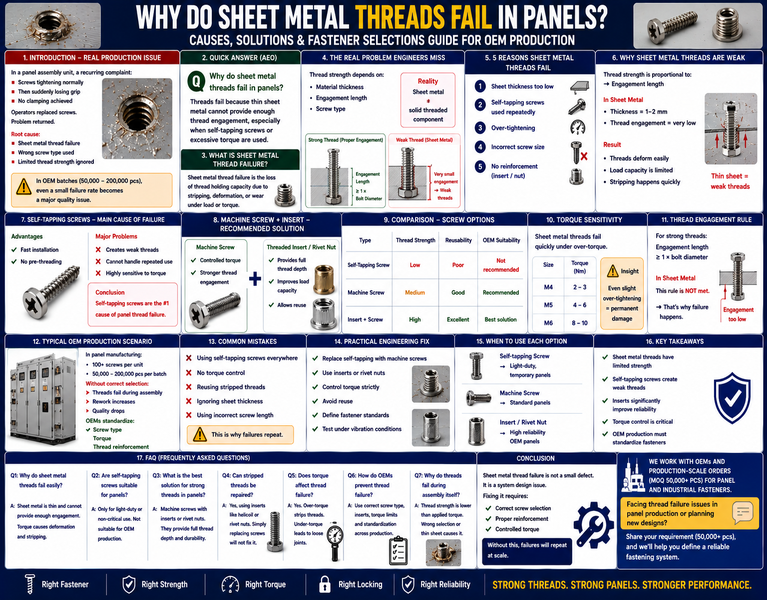
Introduction – Real Production Issue
In a panel assembly unit, a recurring complaint:
👉 Screws tightening normally
👉 Then suddenly losing grip
👉 No clamping achieved
Operators replaced screws.
Problem returned.
Root cause:
👉 Sheet metal thread failure
👉 Wrong screw type used
👉 Limited thread strength ignored
This is not random.
It is a design-level mistake repeated in production.
In OEM batches (50,000–200,000 pcs), even a small failure rate becomes a major quality issue.
Quick Answer
Why do sheet metal threads fail in panels?
Threads fail because thin sheet metal cannot provide enough thread engagement, especially when self-tapping screws or excessive torque are used.
What is Sheet Metal Thread Failure?
Sheet metal thread failure is the loss of thread holding capacity due to stripping, deformation, or wear under load or torque.
The Real Problem Engineers Miss
Thread strength depends on:
👉 Material thickness
👉 Engagement length
👉 Screw type
Reality
Sheet metal ≠ solid threaded component
5 Reasons Sheet Metal Threads Fail
- Sheet thickness too low
- Self-tapping screws used repeatedly
- Over-tightening
- Incorrect screw size
- No reinforcement (insert/nut)
Why Sheet Metal Threads Are Weak
Thread strength is proportional to:
👉 Engagement length
In Sheet Metal
- Thickness = 1–2 mm
- Thread engagement = very low
Result
- Threads deform easily
- Load capacity is limited
- Stripping happens quickly
Self-Tapping Screws – Main Cause of Failure
Advantages
✔ Fast installation
✔ No pre-threading
Major Problems
- Creates weak threads
- Cannot handle repeated use
- Highly sensitive to torque
👉 Conclusion
Self-tapping screws are the #1 cause of panel thread failure
Machine Screw + Insert – Recommended Solution
Machine Screw
✔ Controlled torque
✔ Stronger thread engagement
Threaded Insert / Rivet Nut
✔ Provides full thread depth
✔ Improves load capacity
✔ Allows reuse
Comparison – Screw Options
| Type | Thread Strength | Reusability | OEM Suitability |
| Self-Tapping Screw | Low | Poor | Not recommended |
| Machine Screw | Medium | Good | Recommended |
| Insert + Screw | High | Excellent | Best solution |
Torque Sensitivity
Sheet metal threads fail quickly under over-torque.
Typical Torque Range
| Size | Torque |
| M4 | 2–3 Nm |
| M5 | 4–6 Nm |
| M6 | 8–10 Nm |
Insight
Even slight over-tightening = permanent damage
Thread Engagement Rule
For strong threads:
👉 Engagement length ≥ 1 × bolt diameter
In Sheet Metal
This rule is NOT met
👉 That’s why failure happens
Typical OEM Production Scenario
In panel manufacturing:
- 100+ screws per unit
- 50,000–200,000 pcs per batch
Without correct selection:
👉 Threads fail during assembly
👉 Rework increases
👉 Quality drops
OEMs standardize:
✔ Screw type
✔ Torque
✔ Thread reinforcement
Common Mistakes
- Using self-tapping screws everywhere
- No torque control
- Reusing stripped threads
- Ignoring sheet thickness
- Using incorrect screw length
👉 This is why failures repeat.
Practical Engineering Fix
To eliminate thread failure:
✔ Replace self-tapping with machine screws
✔ Use inserts or rivet nuts
✔ Control torque strictly
✔ Avoid reuse
✔ Define fastener standards
When to Use Each Option
✔ Self-tapping → light-duty, temporary panels
✔ Machine screw → standard panels
✔ Insert/rivet nut → high reliability OEM panels
Key Takeaways
• Sheet metal threads have limited strength
• Self-tapping screws create weak threads
• Inserts significantly improve reliability
• Torque control is critical
• OEM production must standardize fasteners
FAQ
Q1: Why do sheet metal threads fail easily?
Sheet metal is thin and cannot provide enough thread engagement for strong load holding. When torque is applied, the material deforms instead of holding the thread shape. This leads to stripping and loss of clamping force.
Q2: Are self-tapping screws suitable for panels?
Self-tapping screws are suitable only for light-duty or non-critical applications. In OEM production, they create weak threads and cannot handle repeated assembly. Over time, they become a major source of failures.
Q3: What is the best solution for strong threads in panels?
Using machine screws with threaded inserts or rivet nuts provides better thread strength and durability. These solutions allow proper torque application and repeated use. They are the standard approach in high-reliability OEM systems.
Q4: Can stripped threads be repaired?
Yes, but only using inserts like helicoil or rivet nuts. Simply replacing the screw will not restore thread strength. In production, repairing threads is costly and should be avoided through correct design.
Q5: Does torque affect thread failure?
Yes, torque directly affects thread integrity. Over-tightening damages threads permanently, while under-tightening leads to loose joints. Controlled torque is essential for consistent performance.
Q6: How do OEMs prevent thread failure in panels?
OEMs avoid self-tapping screws in critical areas, use inserts for reinforcement, and define torque limits for every fastener. They also standardize fastener types across production. This ensures consistency and reduces failure rates.
Q7: Why do threads fail during assembly itself?
Because the thread strength is lower than the applied torque during installation. This happens when screw type, size, or material is not matched with sheet thickness. It is a design and selection mistake, not an operator issue.
Conclusion
Sheet metal thread failure is not a small defect.
It is a system design issue.
Fixing it requires:
✔ Correct screw selection
✔ Proper reinforcement
✔ Controlled torque
Without this, failures will repeat at scale.
👉 We work with OEMs and production-scale orders (MOQ 50,000+ pcs) for panel and industrial fasteners.Facing thread failure issues in panel production or planning new designs?
Share your requirement (50,000+ pcs), and we’ll help you define a reliable fastening system.