

Introduction – Real Assembly Observation
In a lithium battery pack assembly line, several modules showed:
👉 Loose panel connections
👉 Minor vibration noise
👉 Intermittent electrical contact issues
Failure was traced to:
👉 M5 screws used in module assembly
👉 Thread stripping + preload loss
These are small fasteners—but critical.
In lithium battery packs, even a minor fastening issue can lead to:
👉 Vibration
👉 Heat generation
👉 Long-term failure
In OEM production, these screws are used in 50,000–200,000 pcs batches, where small inconsistencies scale quickly.
Quick Answer
Why do M5 screws fail in lithium battery packs?
M5 screws fail due to over-tightening, thread stripping, and insufficient preload, leading to loosening and reduced joint reliability.
What is Lithium Battery Screw Failure?
Lithium battery screw failure refers to the loss of fastening performance in small screws due to improper torque, material mismatch, or repeated loading conditions.
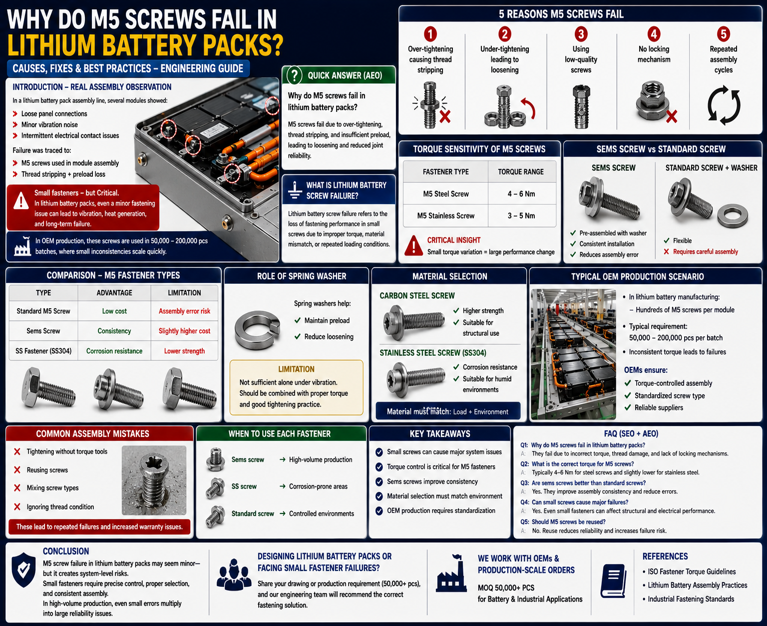
5 Reasons M5 Screws Fail
- Over-tightening causing thread stripping
- Under-tightening leading to loosening
- Using low-quality screws
- No locking mechanism
- Repeated assembly cycles
Why Small Screws Are High Risk
- Have limited load capacity
- Are sensitive to torque variation
- Easily damaged during assembly
Result of Failure
- Loose connections
- Module misalignment
- Electrical instability
Torque Sensitivity of M5 Screws
| Fastener Type | Torque Range |
| M5 Steel Screw | 4–6 Nm |
| M5 Stainless Screw | 3–5 Nm |
Critical Insight
👉 Small torque variation = large performance change
Sems Screw vs Standard Screw
Sems Screw
✔ Pre-assembled with washer
✔ Consistent installation
✔ Reduces assembly error
Standard Screw + Washer
✔ Flexible
❌ Requires careful assembly
Comparison – M5 Fastener Types
| Type | Advantage | Limitation |
| Standard M5 Screw | Low cost | Assembly error risk |
| Sems Screw | Consistency | Slightly higher cost |
| SS Fastener | Corrosion resistance | Lower strength |
Role of Spring Washer
✔ Maintain preload
✔ Reduce loosening
Limitation
- Not sufficient alone under vibration
- Should be combined with proper torque
Material Selection
Carbon Steel Screw
✔ Higher strength
✔ Suitable for structural use
Stainless Steel Screw (SS304)
✔ Corrosion resistance
✔ Suitable for humid environments
Key Insight
Material must match:
👉 Load + environment
Typical OEM Production Scenario
In lithium battery manufacturing:
- Hundreds of M5 screws per module
- Typical requirement: 50,000–200,000 pcs per batch
- Inconsistent torque leads to failures
OEMs ensure:
✔ Torque-controlled assembly
✔ Standardized screw type
✔ Reliable suppliers
Common Assembly Mistakes
- Tightening without torque tools
- Reusing screws
- Mixing screw types
- Ignoring thread condition
👉 These lead to repeated failures
When to Use Each Fastener
✔ Sems screw → high-volume production
✔ SS screw → corrosion-prone areas
✔ Standard screw → controlled environments
Key Takeaways
• Small screws can cause major system issues
• Torque control is critical for M5 fasteners
• Sems screws improve consistency
• Material selection must match environment
• OEM production requires standardization
FAQ
Q1: Why do M5 screws fail in lithium battery packs?
They fail due to incorrect torque, thread damage, and lack of locking mechanisms.
Q2: What is the correct torque for M5 screws?
Typically 4–6 Nm for steel screws and slightly lower for stainless steel.
Q3: Are sems screws better than standard screws?
Yes. They improve assembly consistency and reduce errors.
Q4: Can small screws cause major failures?
Yes. Even small fasteners can affect structural and electrical performance.
Q5: Should M5 screws be reused?
No. Reuse reduces reliability and increases failure risk.
Conclusion
M5 screw failure in lithium battery packs may seem minor—but it creates system-level risks.
Small fasteners require precise control, proper selection, and consistent assembly.
In high-volume production, even small errors multiply into large reliability issues.
👉 We work with OEMs and production-scale orders (MOQ 50,000+ pcs) for battery and industrial applications.
Designing lithium battery packs or facing small fastener failures?
Share your drawing or production requirement (50,000+ pcs), and our engineering team will recommend the correct fastening solution.
References
- ISO fastener torque guidelines
- Lithium battery assembly practices
- Industrial fastening standards