
Introduction
In a battery manufacturing plant, different assemblies require different fasteners:
👉 Battery racks
👉 Control panels
👉 Terminal connections
👉 Structural frames
In one facility audit, failures were traced to:
- Mixed fastener materials
- Inconsistent torque
- Wrong coating selection
Result:
👉 Corrosion in some areas
👉 Loosening in others
👉 Assembly inconsistency
In OEM production, fasteners are not small components—they are system-critical elements used in 50,000–200,000 pcs batches, where standardization is essential.
Quick Answer
How should fasteners be selected for battery manufacturing plants?
Fasteners should be selected based on application load, environment, corrosion exposure, and assembly requirements, with standardized sizes (M6–M12) and materials like SS304 or HDG for reliability.
What is Battery Fastener Selection?
Battery fastener selection is the process of choosing the correct size, material, coating, and type of fastener for specific applications within battery manufacturing systems.
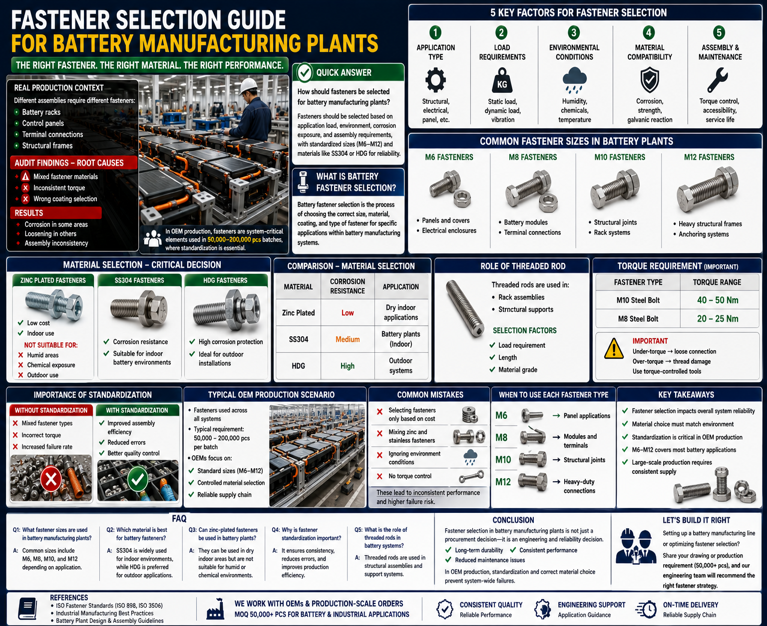
5 Key Factors for Fastener Selection
- Application type (structural, electrical, panel)
- Load requirements
- Environmental conditions (humidity, chemicals)
- Material compatibility
- Assembly and maintenance needs
Common Fastener Sizes in Battery Plants
M6 Fasteners
- Panels and covers
- Electrical enclosures
M8 Fasteners
- Battery modules
- Terminal connections
M10 Fasteners
- Structural joints
- Rack systems
M12 Fasteners
- Heavy structural frames
- Anchoring systems
Material Selection – Critical Decision
Zinc Plated Fasteners
✔ Low cost
✔ Indoor use
Not suitable for:
- Humid areas
- Chemical exposure
SS304 Fasteners
✔ Corrosion resistance
✔ Suitable for indoor battery environments
HDG Fasteners
✔ High corrosion protection
✔ Outdoor installations
Comparison – Material Selection
| Material | Corrosion Resistance | Application |
| Zinc Plated | Low | Dry indoor |
| SS304 | Medium | Battery plants |
| HDG | High | Outdoor systems |
Role of Threaded Rod
Threaded rods are used in:
- Rack assemblies
- Structural supports
Selection Factors
✔ Load requirement
✔ Length
✔ Material grade
Importance of Standardization in OEM Production
In large-scale manufacturing:
- Multiple teams handle assembly
- Different components require consistency
Without Standardization
❌ Mixed fastener types
❌ Incorrect torque
❌ Increased failure rate
With Standardization
✔ Improved assembly efficiency
✔ Reduced errors
✔ Better quality control
Typical OEM Production Scenario
In battery manufacturing plants:
- Fasteners used across all systems
- Typical requirement: 50,000–200,000 pcs per batch
OEMs focus on:
✔ Standard sizes (M6–M12)
✔ Controlled material selection
✔ Reliable supply chain
Common Mistakes
- Selecting fasteners only based on cost
- Mixing zinc and stainless fasteners
- Ignoring environment conditions
- No torque control
👉 These lead to inconsistent performance
When to Use Each Fastener Type
✔ M6 → panel applications
✔ M8 → modules and terminals
✔ M10 → structural joints
✔ M12 → heavy-duty connections
Key Takeaways
• Fastener selection impacts overall system reliability
• Material choice must match environment
• Standardization is critical in OEM production
• M6–M12 covers most battery applications
• Large-scale production requires consistent supply
FAQ
Q1: What fastener sizes are used in battery manufacturing plants?
Common sizes include M6, M8, M10, and M12 depending on application type.
Q2: Which material is best for battery fasteners?
SS304 is widely used for indoor environments, while HDG is preferred for outdoor applications.
Q3: Can zinc-plated fasteners be used in battery plants?
They can be used in dry indoor areas but are not suitable for humid or chemical environments.
Q4: Why is fastener standardization important?
It ensures consistency, reduces errors, and improves production efficiency.
Q5: What is the role of threaded rods in battery systems?
Threaded rods are used in structural assemblies and support systems.
Conclusion
Fastener selection in battery manufacturing plants is not just a procurement decision—it is an engineering and reliability decision.
Correct selection ensures:
✔ Long-term durability
✔ Consistent performance
✔ Reduced maintenance issues
In OEM production, standardization and correct material choice prevent system-wide failures.
👉 We work with OEMs and production-scale orders (MOQ 50,000+ pcs) for battery and industrial applications.
Setting up a battery manufacturing line or optimizing fastener selection?
Share your drawing or production requirement (50,000+ pcs), and our engineering team will recommend the right fastener strategy.
References
- ISO fastener standards
- Industrial manufacturing practices
- Battery plant design guidelines