

Introduction – Real Plant Observation
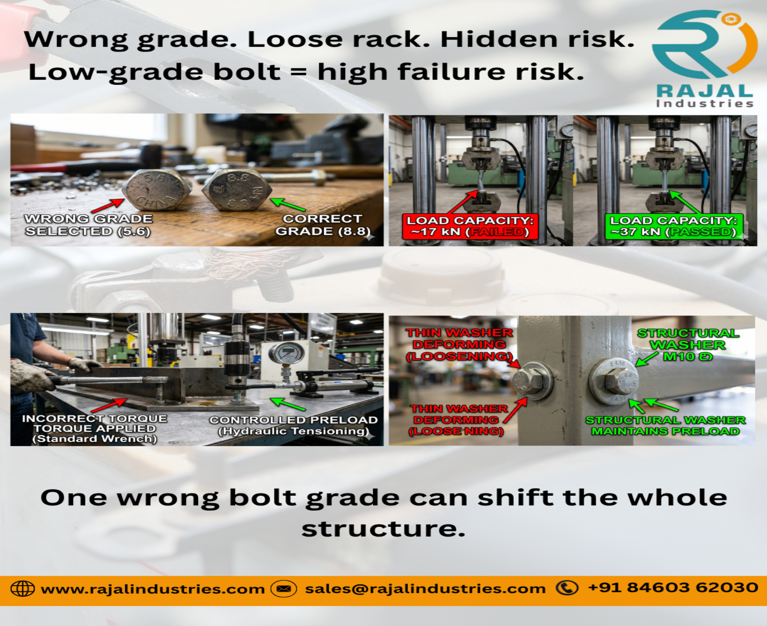
During inspection of a battery manufacturing facility, multiple rack joints showed loose M10 bolts and visible frame misalignment. No corrosion, no vibration damage—yet failure occurred.
Root cause:
👉 Wrong bolt grade selection (5.6 used instead of 8.8/10.9)
👉 Insufficient preload
👉 Load not properly transferred
Battery racks carry static + dynamic loads, and in large production plants, failure is not immediate—it builds slowly.
In OEM environments, these racks are assembled in 50,000–200,000 fastener production batches, where even a small grade mismatch can lead to system-level instability.
Quick Answer
What causes battery rack fastener failure in manufacturing plants?
Failure occurs when incorrect bolt grades are used, reducing load capacity and preload. This leads to loosening, misalignment, and structural instability in battery rack systems.
What is Battery Rack Fastener Failure?
Battery rack fastener failure refers to the loss of structural integrity in rack assemblies due to insufficient bolt strength, incorrect preload, or poor load distribution.
5 Reasons Battery Rack Fasteners Fail
- Using low-grade bolts (5.6 instead of 8.8 or 10.9)
- Incorrect torque during assembly
- Lack of structural washers
- Uneven load distribution across joints
- Reuse of fasteners during maintenance
Grade Selection – Why It Matters
Battery racks are not light structures.
They carry:
- Battery module weight
- Dynamic load during handling
- Vibration from nearby equipment
If bolt grade is too low:
👉 Yield strength is insufficient
👉 Bolt stretches under load
👉 Preload reduces
👉 Joint becomes loose
Load Calculation
For M10 bolts:
Grade 8.8:
- Yield strength = 640 MPa
- Tensile area ≈ 58 mm²
👉 Load capacity = 640 × 58 = 37,120 N (~37 kN)
Grade 10.9:
- Yield strength = 900 MPa
👉 Load capacity = 900 × 58 = 52,200 N (~52 kN)
Insight
Using grade 5.6 (~300 MPa) reduces capacity by more than 50%.
Grade 8.8 vs 10.9 – Quick Comparison
| Parameter | Grade 8.8 | Grade 10.9 |
| Strength | Medium | High |
| Application | Standard racks | Heavy-duty racks |
| Cost | Lower | Higher |
| Load capacity | ~37 kN | ~52 kN |
Role of Structural Washer
Flat washers are often used incorrectly.
Problem:
❌ They deform under load
❌ Lose clamp force
Correct Solution
👉 Use M10 structural washers
Benefits:
✔ Better load distribution
✔ Maintains preload
✔ Prevents bolt sinking
Correct OEM Fastener Setup
Recommended configuration:
- M10 hex bolt (Grade 8.8 or 10.9)
- Structural washer
- Lock nut
- Controlled torque application
When to Use Each Grade
✔ Use Grade 8.8 → Standard battery racks
✔ Use Grade 10.9 → Heavy racks / high load areas
Typical OEM Production Scenario
In battery manufacturing plants:
- Large racks use thousands of fasteners
- Typical requirement: 50,000–200,000 pcs
- Batch consistency is critical
OEMs focus on:
✔ Grade consistency
✔ Torque control
✔ Supplier reliability
Common Assembly Mistakes
- Using mixed bolt grades
- No torque measurement
- Reusing fasteners
- Using thin washers
👉 These lead to gradual failure—not immediate breakdown
Key Takeaways
• Bolt grade directly affects rack stability
• Grade 8.8 and 10.9 are minimum for OEM use
• Structural washers improve load distribution
• Preload loss leads to joint failure
FAQ
Q1: What is the best bolt grade for battery racks?
Grade 8.8 is suitable for standard racks, while Grade 10.9 is recommended for heavy-load applications requiring higher strength and durability.
Q2: Why do battery rack bolts loosen over time?
Bolts loosen due to insufficient preload, wrong grade selection, and lack of locking mechanisms or structural washers.
Q3: Can low-grade bolts cause rack misalignment?
Yes. Low-grade bolts stretch under load, reducing preload and causing structural misalignment.
Q4: Are structural washers necessary in battery racks?
Yes. Structural washers help distribute load and maintain clamp force, preventing bolt loosening.
Q5: Can fasteners be reused in battery racks?
Reuse is not recommended, especially in OEM applications, as it reduces reliability and increases failure risk.
Conclusion
Battery rack fastener failure is not random—it is usually the result of incorrect grade selection and poor load handling.
In high-volume manufacturing environments, even small mistakes scale into large structural risks.
👉 We work with OEMs and production-scale orders (MOQ 50,000+ pcs) for battery and industrial applications.
Planning a battery manufacturing project or facing rack stability issues?
Share your drawing or production requirement (50,000+ pcs), and our engineering team will recommend the correct fastener grade and configuration.
References
- ISO 898-1 – Mechanical properties of fasteners
- Industrial rack design practices
- Load calculation standards