

Introduction – Real Site Hook
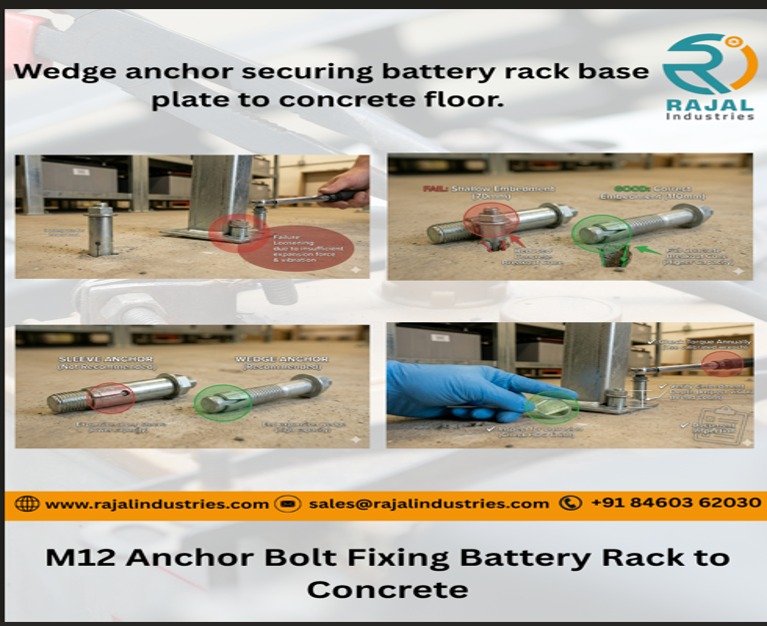
During inspection of an industrial battery room, a technician noticed that one battery rack had tilted slightly forward. The floor was level. The rack frame was intact. But two M12 base anchors were loose.
Measured torque: 35 Nm.
Original torque: 80 Nm.
Anchor type: sleeve anchor.
Environment: vibration from nearby HVAC equipment.
This is a common issue with battery rack anchors.
Rack tilting is not always caused by overload.
It often begins with improper anchor selection.
Why Battery Rack Anchors Are Critical
Battery racks carry:
- • Dead weight of batteries
- • Dynamic load during maintenance
- • Seismic forces
- • Vibration
Base anchors must resist:
- • Shear load
- • Tension load
- • Pull-out force
- • Fatigue
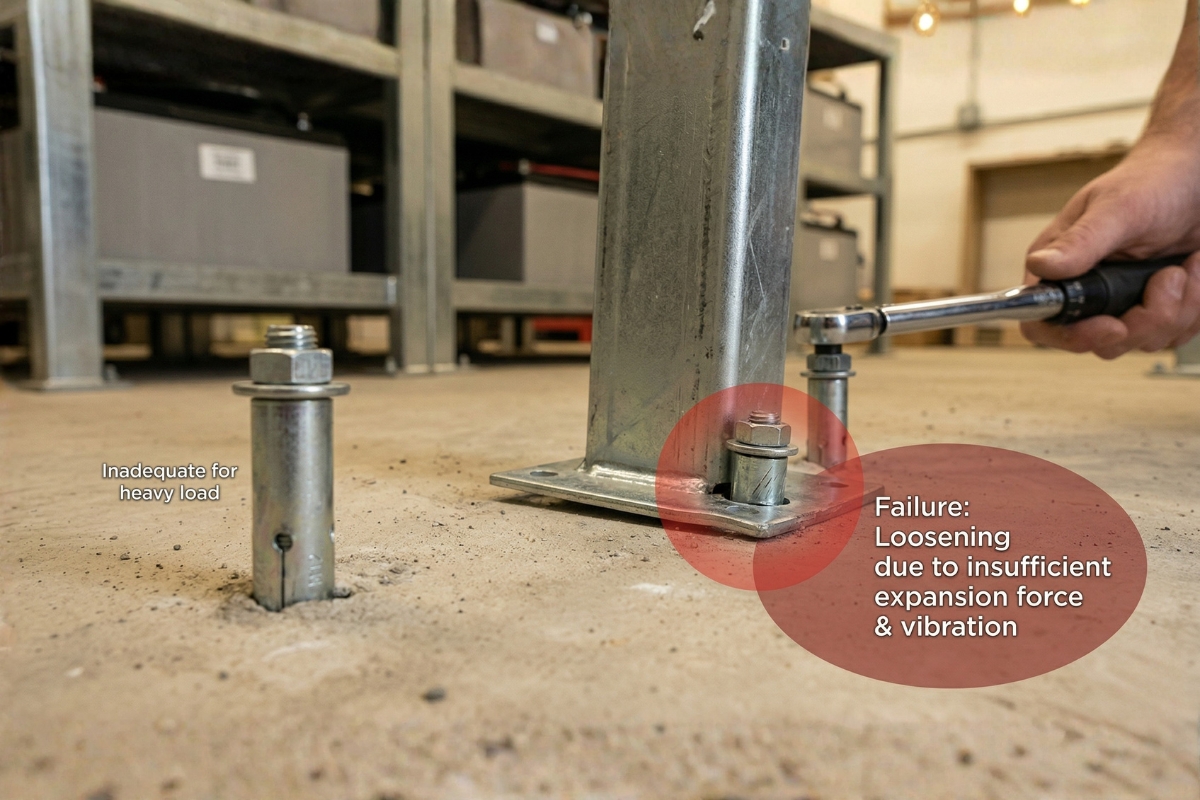
If anchors loosen, rack shifts.
If rack shifts, load redistributes unevenly.
Cracking and instability follow.
Case Study: Sleeve Anchor Failure in Rack Base
Findings:
- • M12 sleeve anchor used
- • Embedment depth: 70 mm
- • No structural washer
- • Zinc-plated bolt
- • Concrete grade C20
After 1 year:
- • Sleeve expansion weakened
- • Bolt rotated under load
- • Base plate gap visible
Problem was not bolt size.
Problem was anchor type and embedment.
Wedge Anchor vs Sleeve Anchor – Key Difference
Wedge Anchor:
- • Expansion at bottom
- • Higher pull-out resistance
- • Better for heavy loads
- • Requires solid concrete
Sleeve Anchor:
- • Expansion along sleeve
- • Moderate load capacity
- • Easier installation
- • Suitable for light-duty applications
For heavy battery racks, wedge anchor is preferred.
Load Capacity Comparison (M12 Anchors)
Typical values (approximate, depend on concrete grade):
M12 Sleeve Anchor:
Tensile capacity ≈ 15–20 kN
M12 Wedge Anchor:
Tensile capacity ≈ 25–35 kN
Wedge anchors provide significantly higher pull-out resistance.
In seismic or vibration-prone battery rooms, wedge anchors are safer.
Correct Anchor Setup for Battery Rack Base
Recommended configuration:
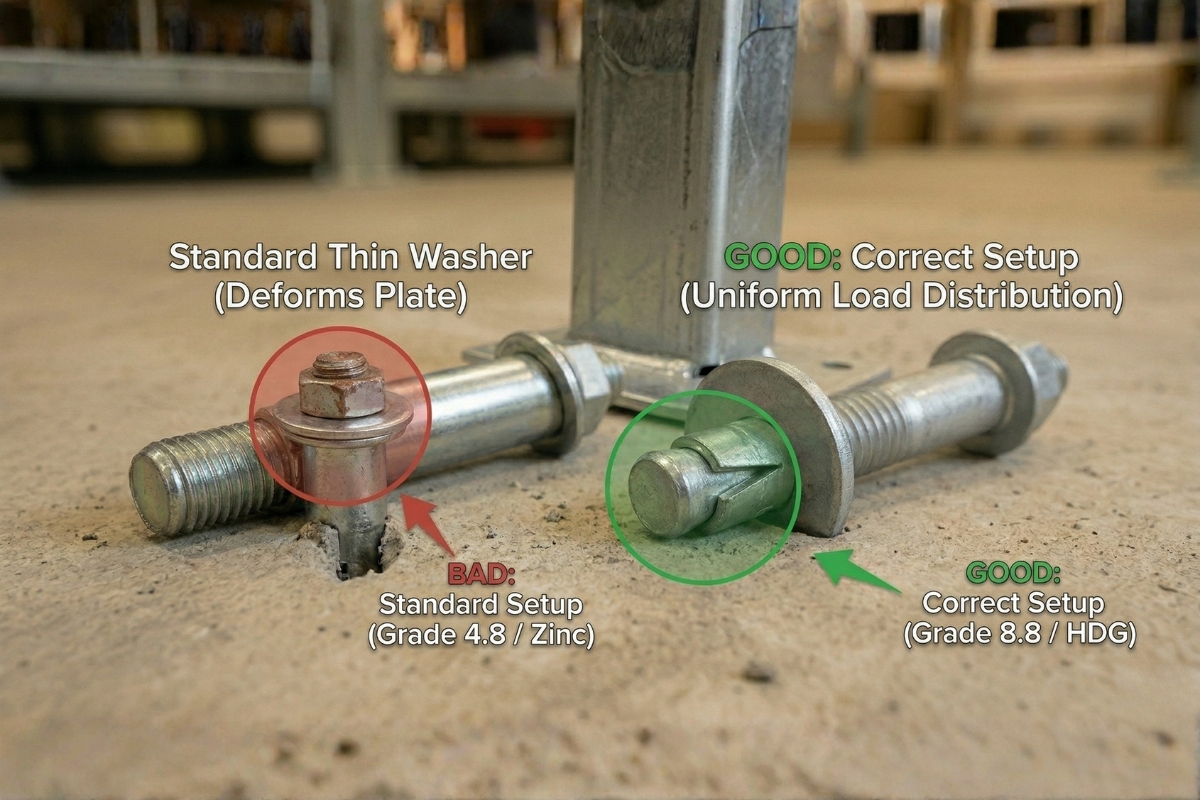
- • M12 HDG Wedge Anchor
- • Embedment depth ≥ 90–110 mm
- • Structural washer M12
- • Lock nut
- • Correct torque (70–85 Nm for grade 8.8)
You can review specifications for our
👉 M12 Wedge Anchor for Battery Rack Anchoring
For corrosion-prone areas use:
👉 HDG Fasteners for Concrete Anchoring Applications
Structural washer ensures uniform clamp force at base plate.
Embedment Depth Importance
Embedment depth affects:
- • Pull-out resistance
- • Shear strength
- • Concrete breakout resistance
For M12 wedge anchor:
Recommended embedment: 90–120 mm
Shallow embedment increases failure risk.
Always verify concrete strength before installation.
Torque Recommendation Table
| Anchor Type | Recommended Torque |
| M12 Sleeve Anchor | 50–65 Nm |
| M12 Wedge Anchor | 70–85 Nm |
Under-torque reduces expansion.
Over-torque damages concrete.
Proper torque ensures correct expansion pressure.
Comparison Table: Sleeve vs Wedge Anchor
| Parameter | Sleeve Anchor | Wedge Anchor |
| Load Capacity | Moderate | High |
| Suitable for Heavy Rack | Limited | Yes |
| Vibration Resistance | Moderate | High |
| Embedment Depth Requirement | Lower | Higher |
| Recommended for Battery Rack | Not Ideal | Recommended |
For structural battery rack anchoring, wedge anchors are safer.
Inspection Checklist for Battery Rack Anchors
✔ Check torque annually
✔ Inspect base plate gap
✔ Verify embedment depth
✔ Inspect for corrosion
✔ Replace sleeve anchors in heavy-duty racks
✔ Use HDG fasteners in humid areas
Anchor inspection must be part of rack maintenance plan.
FAQ
Q1: Why do battery rack anchors loosen over time?
Vibration, insufficient torque, shallow embedment, and low-grade anchors can cause preload loss.
Q2: Is sleeve anchor suitable for heavy battery racks?
Sleeve anchors are better for light-duty loads. For structural racks, wedge anchors are recommended.
Q3: What is the best anchor bolt for battery rack base?
M12 HDG wedge anchor with structural washer and proper embedment depth provides reliable anchoring.
Q4: How deep should M12 anchor bolt be embedded?
Typically 90–120 mm depending on concrete grade and load requirements.
Q5: Does corrosion affect anchor strength?
Yes. Corrosion reduces cross-section and preload retention.
Q6: Should structural washer be used with anchors?
Yes. Structural washers distribute load and prevent base plate embedding.
Conclusion
Battery rack anchors are structural safety components.
Using the wrong anchor type can lead to rack tilting and instability.
Upgrade to:
- • M12 HDG wedge anchors
- • Proper embedment depth
- • Structural washers
- • Correct torque control
Ensures long-term rack stability.
Need evaluation of your battery rack anchoring system?
Contact our engineering team for load-based anchor selection.
References
ACI 318 – Concrete anchor design
EN 1992 – Concrete structures
ISO 898-1 – Mechanical properties of bolts
ASTM A153 – Hot dip galvanizing specification