

Introduction – Real Site Hook
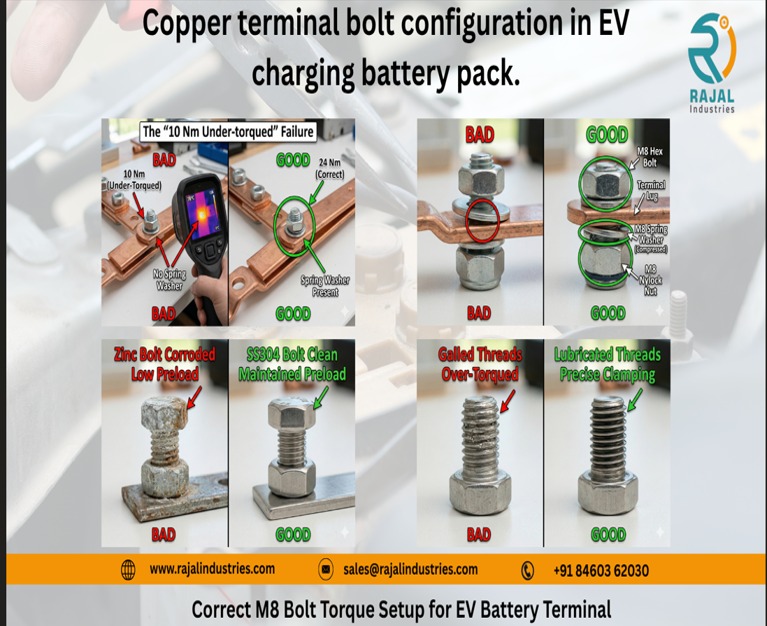
During inspection of an EV charging station battery pack, thermal camera showed 78°C at one terminal joint. The cable size was correct. The copper lug was clean. The busbar thickness was adequate.
The problem was simple.
The M8 hex bolt securing the terminal was tightened to only 10 Nm instead of required 22–25 Nm. A spring washer was missing. The nut had slight backing off.
This is a common EV battery terminal issue.
Terminal heating is not always caused by electrical overload.
It is often caused by incorrect fastener torque and poor bolt selection.
Why EV Battery Terminal Issue Causes Overheating
Battery terminals carry:
- • High DC current
- • Rapid load variation
- • Charging surge
- • Thermal expansion cycles
If M8 bolt preload reduces:
- • Contact resistance increases
- • Voltage drop increases
- • Heat generation increases
- • Oxidation accelerates
Even a small increase in resistance can produce dangerous heat.
Heating at the terminal leads to:
- • Insulation damage
- • Cable melting
- • Fire risk
Fastener selection directly impacts electrical safety.
Case Study: Loose M8 Terminal Bolt in EV Charger
Measured values:
Rated current: 200A
Measured temperature: 78°C
Torque measured: 10 Nm
After tightening to 24 Nm:
Temperature reduced to 42°C under same load.
Root cause:
- • Low torque
- • No spring washer
- • Zinc-plated bolt in humid cabinet
The EV battery terminal issue was mechanical, not electrical.
Correct M8 Bolt Selection for EV Battery Terminals
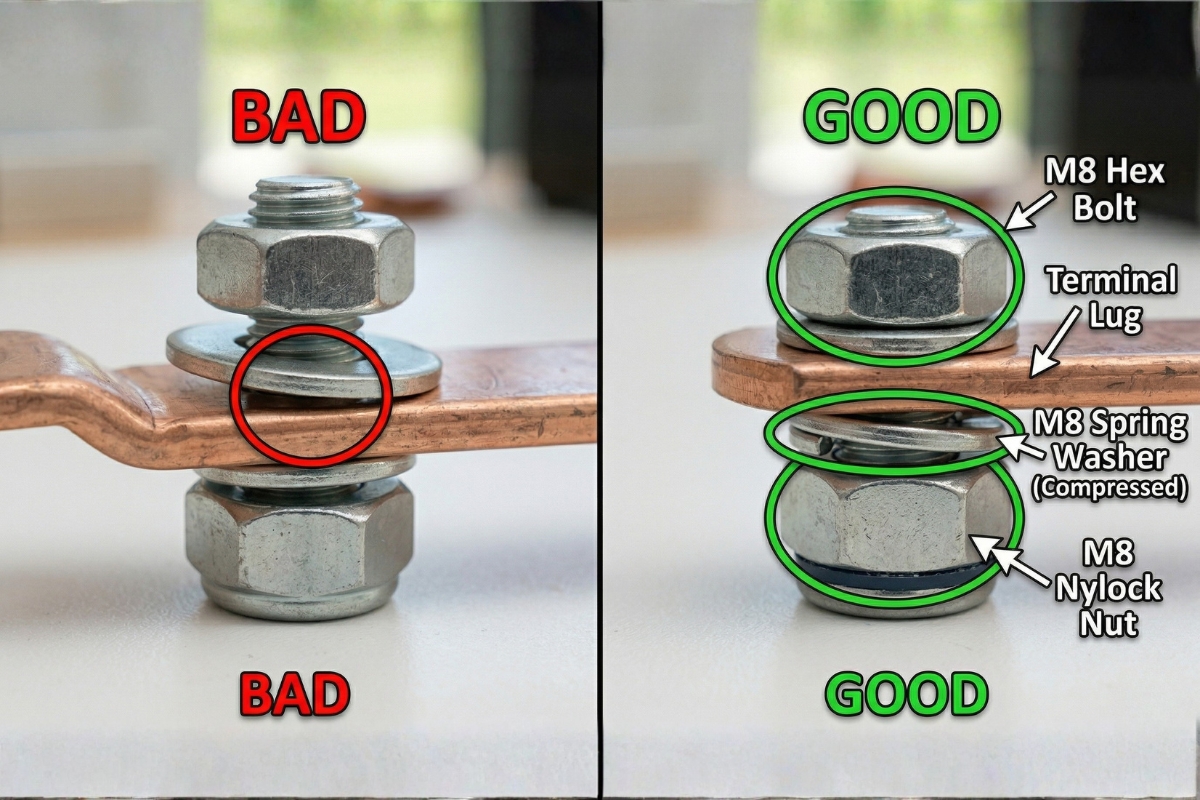
Recommended setup:
- • M8 Copper Terminal Bolt (for high conductivity applications)
OR - • M8 SS304 Hex Bolt (for corrosion-prone environments)
- • M8 spring washer
- • M8 nylock nut
- Clean contact surface
You can review full specifications for our
👉 M8 Hex Bolt for EV Battery Terminal Applications
For corrosion-prone enclosures, use
👉 SS304 M8 Bolts for Electrical Terminal Connections
To maintain preload under vibration, use
👉 M8 Nylock Nuts for EV Battery Systems
Proper fastener stack prevents loosening and overheating.
Contact Resistance & Heat Calculation
Power loss formula:
P = I² × R
If contact resistance increases from 0.0005 ohm to 0.002 ohm:
At 200A:
P = 200² × 0.002
P = 40,000 × 0.002
P = 80 watts
80 watts heat at a single joint is enough to raise temperature above safe limits.
Low preload increases resistance.
Correct torque reduces resistance.
Torque Recommendation for M8 Terminal Bolts
| Bolt Type | Recommended Torque |
| M8 Zinc Plated | 18–22 Nm |
| M8 SS304 | 20–25 Nm |
| M8 Copper Bolt | 18–22 Nm |
Important:
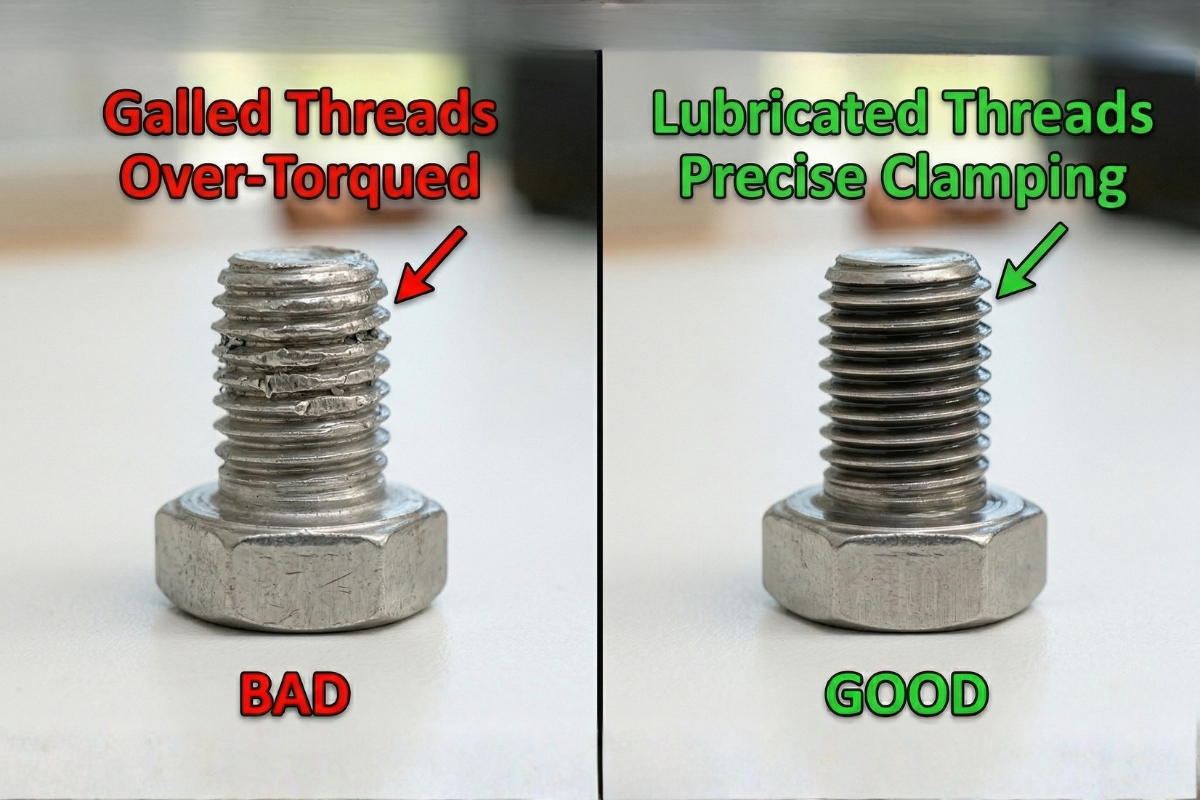
- • Clean threads before tightening
- • Do not over-tighten copper bolts
- • Use torque wrench
Under-torque increases heat.
Over-torque damages threads.
Role of Spring Washer & Nylock Nut
Spring washer:
- • Maintains tension
- • Reduces loosening
- • Compensates thermal expansion
Nylock nut:
- • Prevents vibration loosening
- • Maintains clamp force
In EV charging battery packs, vibration and temperature variation are constant.
Proper locking system is critical.
Comparison: Zinc vs Stainless vs Copper Bolt
| Parameter | Zinc Bolt | SS304 Bolt |
| Copper Bolt | Conductivity | Moderate |
| Corrosion Resistance | Moderate | High |
| Heat Stability | Moderate | High |
| EV Terminal Suitability | Limited | Recommended |
Copper bolts improve conductivity but must be protected against over-torque.
Inspection Checklist for EV Battery Terminal Fasteners
✔ Check torque every 6 months
✔ Inspect discoloration around lug
✔ Use thermal imaging
✔ Replace loose spring washers
✔ Replace damaged nylock nuts
✔ Clean oxidation before tightening
Preventive inspection avoids fire risk.
FAQ
Q1: Why does an EV battery terminal issue cause heating?
Loose M8 bolts increase contact resistance. Increased resistance generates heat under high current load.
Q2: What is the correct torque for M8 EV battery terminal bolt?
Typically 20–25 Nm for stainless bolts. Exact value depends on material and thread condition.
Q3: Should copper terminal bolts be used in EV battery packs?
Copper bolts provide excellent conductivity but must be torqued carefully to avoid thread damage.
Q4: Is a spring washer necessary in EV terminal joints?
Yes. Spring washers maintain preload and reduce loosening under vibration and thermal cycles.
Q5: Can overheating occur even if cable size is correct?
Yes. Loose fasteners can cause overheating even when conductor size is adequate.
Q6: How often should EV battery terminals be inspected?
Every 6–12 months depending on load conditions.
Conclusion
Most EV battery terminal issues are not electrical faults.
They are mechanical fastener problems.
Using:
- • Proper M8 hex bolt or copper terminal bolt
- • Correct torque
- • Spring washer
- • Nylock nut
- • Corrosion-resistant material
Prevents overheating and fire risk.
Need evaluation of your EV battery terminal fastener setup?
Contact our engineering team for load-specific torque and bolt recommendation.
References
IEC 61851 – EV charging system requirements
ISO 898-1 – Mechanical properties of fasteners
NFPA 70 – Electrical safety guidelines
IEEE Std 837 – Permanent connections used in grounding