

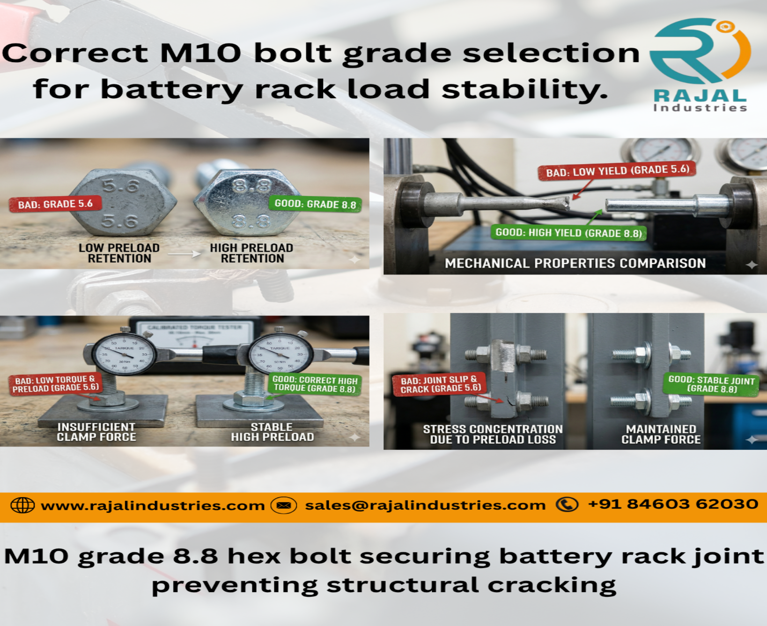
Introduction – Real Site Hook
During inspection of a lithium battery rack structure in a telecom installation, visible cracks were found at two vertical joint plates. The bolts were intact. The plates were aligned. But the joint had shifted.
Measured torque: 32 Nm.
Bolt size: M10.
Bolt grade: 5.6.
The rack carried 720 kg of battery modules.
The issue was not bolt size.
The issue was battery rack bolt grade selection.
Using the wrong grade can cause preload loss, joint slip, and eventual cracking.
Why Battery Rack Bolt Grade Matters
Battery racks experience :
- • Static weight
- • Vibration
- • Handling stress
- • Thermal expansion
- • Maintenance load
Bolts must maintain preload under these conditions.
If bolt grade is too low:
- • Bolt stretches excessively
- • Clamp force reduces
- • Joint slips
- • Stress concentrates at plate edge
- • Crack develops
This is how rack joints fail slowly.
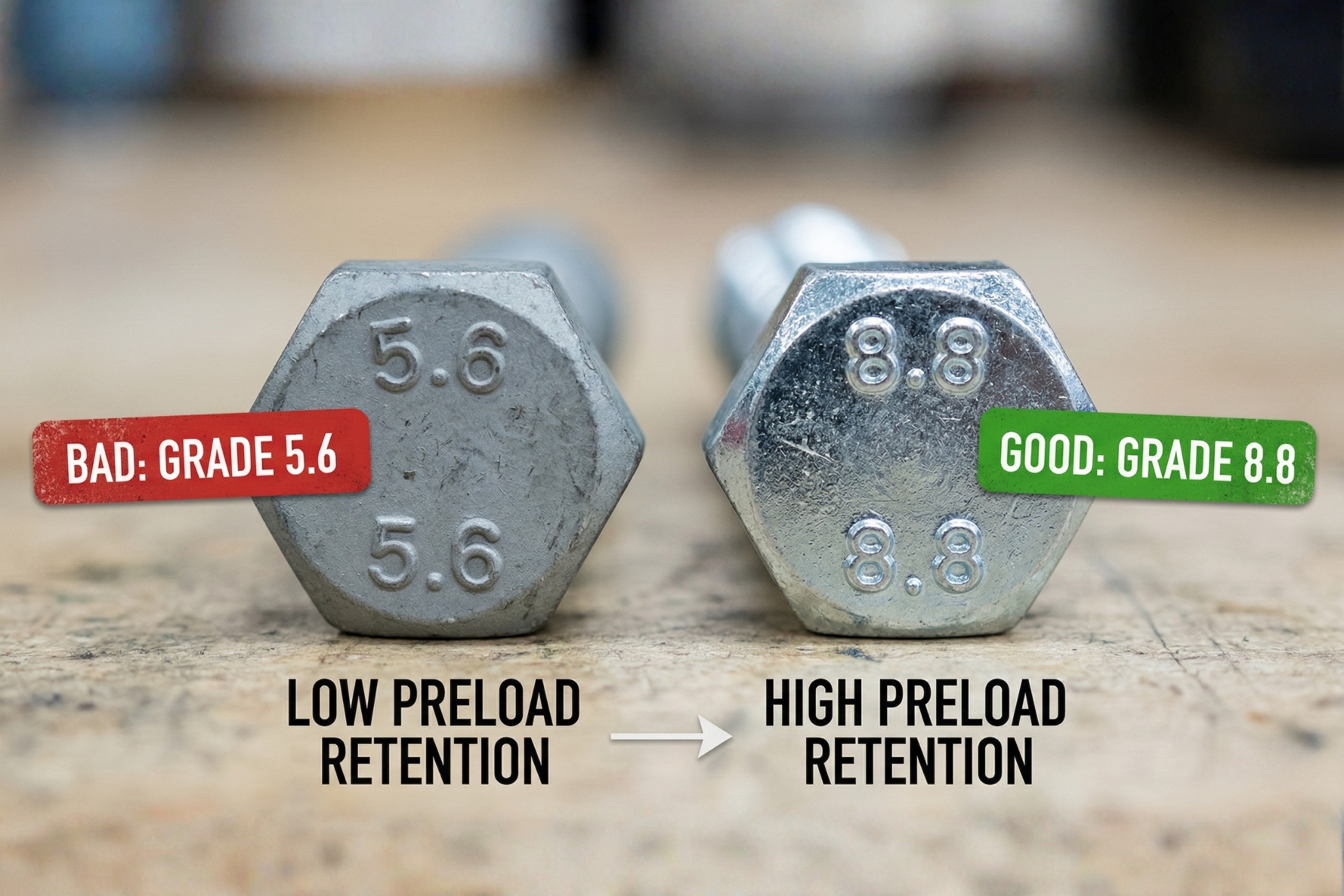
Grade 5.6 vs 8.8 Mechanical Comparison
According to ISO 898-1:
Grade 5.6:
- • Ultimate tensile strength = 500 MPa
- • Yield strength = 300 MPa
Grade 8.8:
- • Ultimate tensile strength = 800 MPa
- • Yield strength = 640 MPa
Difference is significant.
Higher yield strength means better preload retention.
Load Capacity Calculation for M10 Bolt
Tensile stress area (M10 coarse) ≈ 58 mm²
Grade 5.6:
Yield load = 300 × 58 = 17,400 N
≈ 17.4 kN
Grade 8.8:
Yield load = 640 × 58 = 37,120 N
≈ 37.1 kN
Grade 8.8 provides more than double yield capacity compared to 5.6.
In structural joints like battery racks, that difference determines long-term stability.
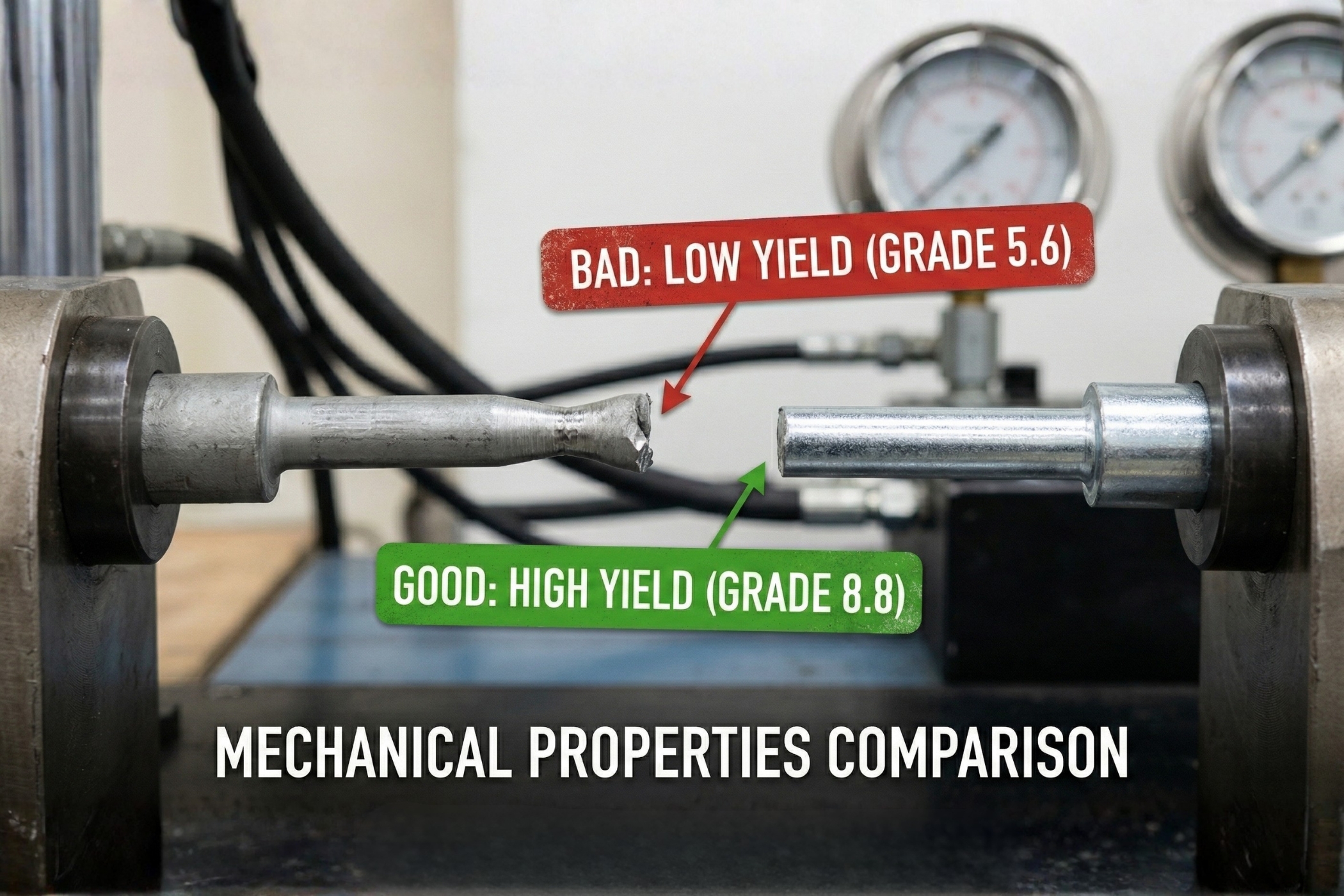
Case Study: Rack Joint Slip Leading to Crack
Findings at site:
- • M10 grade 5.6 hex bolts used
- • No structural washer
- • Torque applied = 30–35 Nm
- • Load exceeded 80% of bolt yield capacity
Result:
- • Bolt elongated
- • Preload dropped
- • Joint slipped
- • Crack developed at plate edge
If grade 8.8 bolts had been used, preload would have remained stable.
Correct Bolt Setup for Battery Rack Structures
Recommended configuration:
- • M10 Grade 8.8 Hex Bolt
- • Heavy-duty structural washer M10
- • M10 lock nut
- • Correct torque application
You can review specifications for our
👉 M10 Grade 8.8 Hex Bolts for Battery Rack Applications
For higher load structures, use
👉 M10 Structural Washers for Load Distribution
For vertical bracing, consider
👉 M10 Threaded Rod Grade 8.8 for Structural Reinforcement
Why Structural Washer Is Critical
Structural washer:
- • Prevents embedding into plate
- • Maintains uniform clamp load
- • Reduces stress concentration
- • Improves joint stiffness
Flat washers are often too thin for structural racks.
Without proper washer, even grade 8.8 bolt can lose preload.
Torque Recommendation for M10 Bolts
| Bolt Grade | Recommended Torque |
| M10 Grade 5.6 | 25–30 Nm |
| M10 Grade 8.8 | 45–50 Nm |
Higher torque allows higher clamp force in grade 8.8.
Insufficient torque reduces preload.
Excessive torque risks thread damage.
Torque must match grade.
Comparison Table: 5.6 vs 8.8 in Battery Rack Use
| Parameter | Grade 5.6 | Grade 8.8 |
| Yield Strength | 300 MPa | 640 MPa |
| Suitable for Structural Rack | No | Yes |
| Preload Retention | Low | High |
| Crack Risk | High | Low |
| Recommended for Battery Racks | Not Preferred | Recommended |
Inspection Checklist for Battery Rack Bolt Grade
✔ Verify bolt head marking (8.8 stamped)
✔ Check torque using calibrated wrench
✔ Inspect for joint slip marks
✔ Look for plate edge cracking
✔ Replace 5.6 with 8.8 where structural
Structural rack connections must never use low-grade bolts.
FAQ
Q1: Why does battery rack bolt grade affect joint cracking?
Lower bolt grades stretch more under load. When preload reduces, joint slip occurs and stress concentrates at edges, causing cracks.
Q2: Is grade 5.6 suitable for battery racks?
Grade 5.6 may be used for light-duty connections, but structural battery racks require grade 8.8 bolts for stability.
Q3: What is the best bolt for battery rack structural joints?
M10 Grade 8.8 hex bolts with structural washer and lock nut provide proper clamp force and load resistance.
Q4: How can I identify bolt grade on site?
Check bolt head marking. Grade 8.8 bolts have “8.8” stamped on head.
Q5: Should threaded rods also be grade 8.8?
Yes. Threaded rod M10 used for bracing should match structural grade requirements.
Q6: Can cracked rack joints be repaired without replacing bolts?
If crack has formed, bolt grade must be upgraded and joint re-evaluated for load capacity.
Conclusion
Battery rack cracking is not random.
It often begins with incorrect battery rack bolt grade selection.
Using:
- • M10 Grade 8.8 bolts
- • Structural washers
- • Lock nuts
- • Correct torque
Prevents preload loss and structural cracking.
Need structural fastener evaluation for your battery rack system?
Contact our engineering team for load-based bolt grade recommendation.
References
ISO 898-1 – Mechanical properties of carbon steel fasteners
EN 1993 – Structural steel design
AISC Steel Construction Manual
Machinery’s Handbook – Bolt strength calculation