

Introduction – Real Site Hook
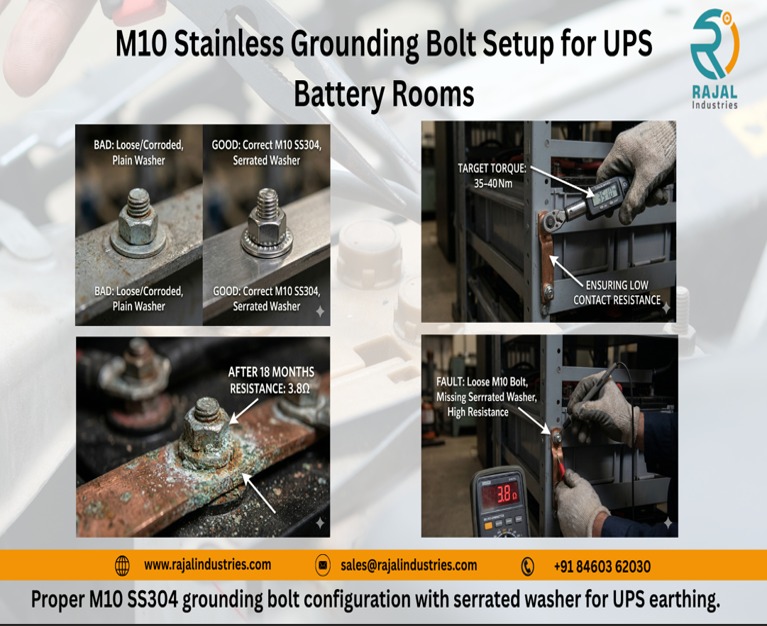
During a UPS battery room audit in a data center, resistance between the battery rack and earth grid measured 3.8 ohms. The acceptable value should have been below 1 ohm.
The grounding strip was intact.
Copper conductor was properly sized.
But the problem was simple.
The M10 grounding bolt connecting the copper lug to the rack was loose.
No serrated washer was used.
Corrosion was visible on the contact surface.
This is how UPS battery grounding systems fail.
Not from cable size.
From poor fastener setup.
And grounding failure increases:
- • Electrical arcing risk
- • Fault current instability
- • Equipment damage
Why UPS Battery Grounding Fails at the Bolt Connection
Grounding depends on:
- • Metal-to-metal contact
- • Proper clamping force
- • Corrosion resistance
- • Long-term preload retention
If the M10 grounding bolt loses torque:
- • Contact resistance increases
- • Heat develops at joint
- • Oxidation builds up
- • Fault current path weakens
Even a small torque loss increases resistance significantly.
Poor fastener setup directly affects UPS battery grounding reliability.
Case Study: Contact Resistance Rise Due to Loose Bolt
Measured values at site:
Initial installation resistance: 0.6 ohm
After 18 months: 3.8 ohm
Findings:
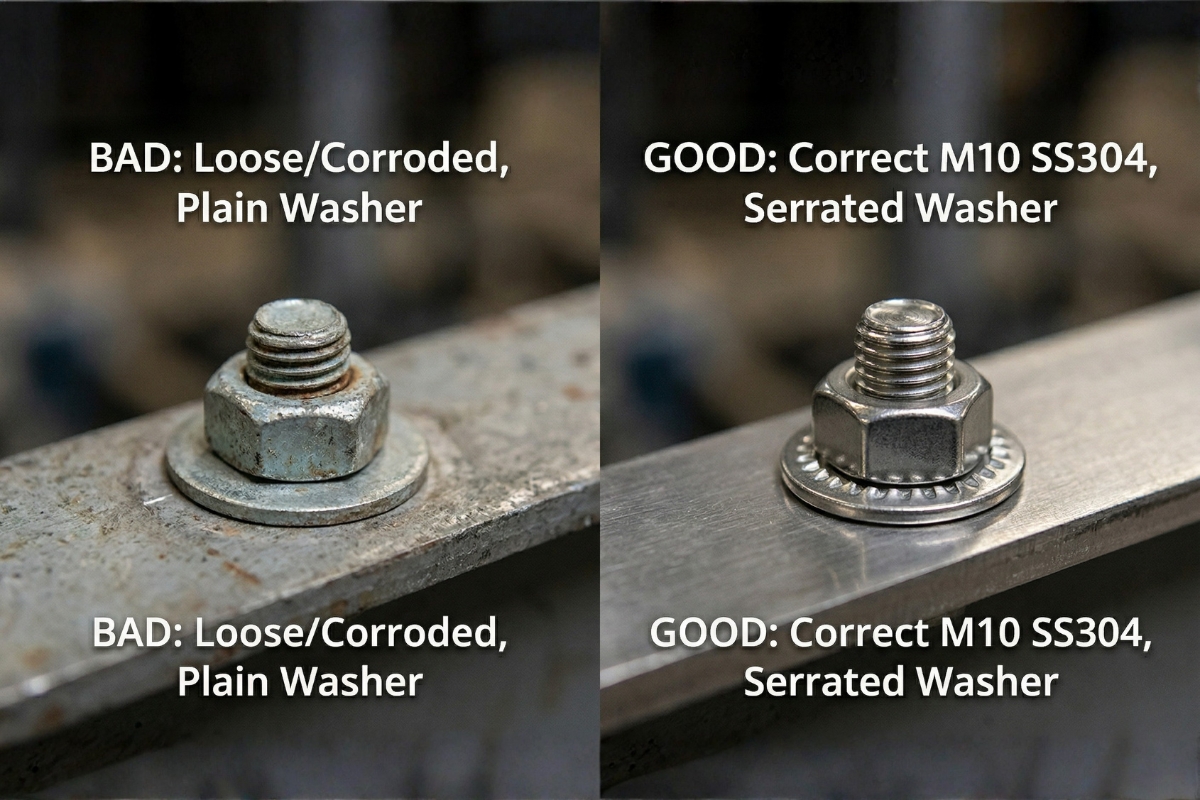
- • Zinc-plated bolt used instead of stainless
- • No serrated washer
- • Spring washer flattened
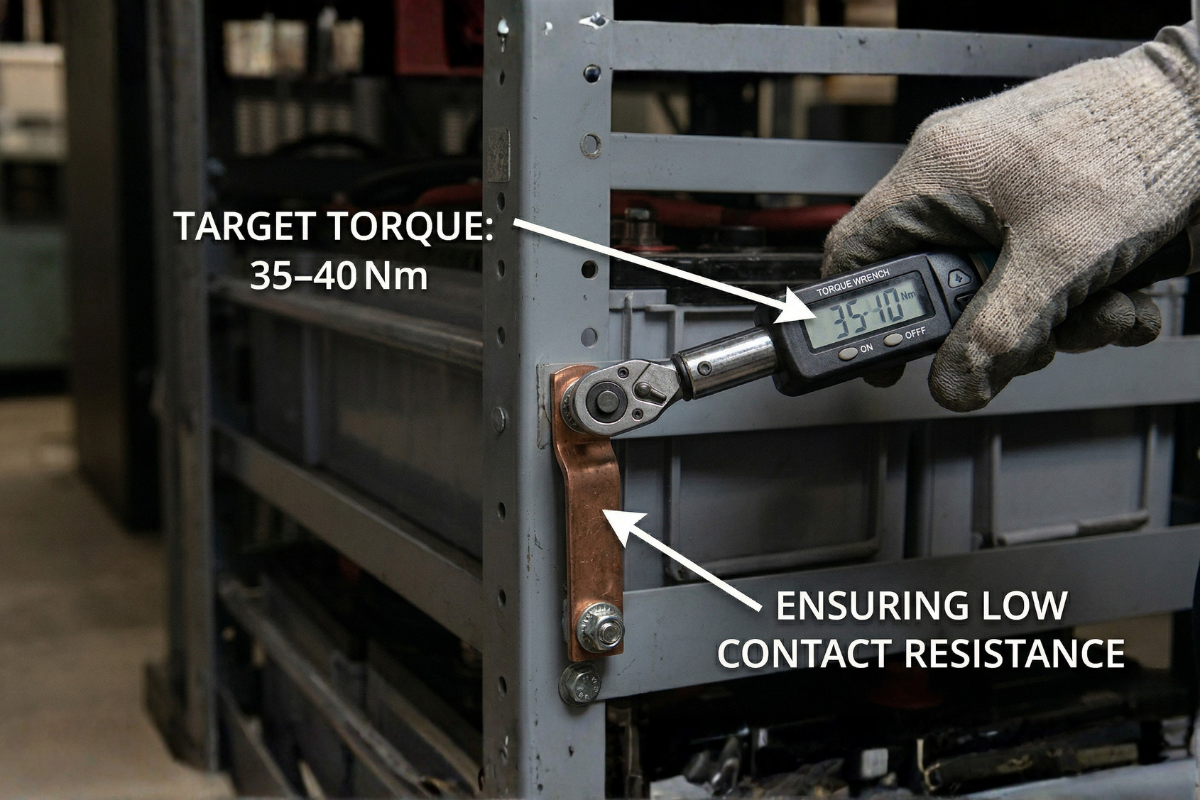
- • Torque measured only 18 Nm (required: 35–40 Nm)
Result:
Ground continuity weakened.
Thermal hotspot observed during load test.
The grounding system failed at the bolt interface.
Correct Grounding Fastener Setup for UPS Battery Rooms
Recommended configuration:
- • M10 SS304 Grounding Bolt
- • Serrated washer (internal tooth preferred)
- • Flat washer (if needed for load distribution)
- • M10 hex nut
- • Proper torque tightening
You can review specifications for our
👉 M10 SS304 Grounding Bolt for UPS Battery Earthing Systems
For vibration-prone installations, use
👉 Serrated Washers for Electrical Bonding Applications
This ensures long-term low resistance contact.
Why SS304 Bolt M10 Is Recommended
SS304 advantages:
- • Corrosion resistance
- • Stable mechanical properties
- • Better long-term conductivity
- • Compatible with copper grounding strips
Zinc bolts may corrode and increase resistance.
For UPS battery rooms with humidity control issues, stainless is safer.
Electrical Contact Pressure Calculation (M10 Bolt)
Thread: M10 coarse
Proof load (SS304 approx.): 450 MPa
Tensile stress area ≈ 58 mm²
Max tensile load:
450 × 58 = 26,100 N
≈ 26.1 kN
Recommended torque range:
M10 SS304 bolt → 35–40 Nm
Proper torque creates required contact pressure between:
- • Copper lug
- • Rack surface
- • Washer
Insufficient torque increases electrical resistance.
Role of Serrated Washer in Grounding
Serrated washer:
- • Breaks oxide layer
- • Creates metal-to-metal bite
- • Maintains contact under vibration
- • Reduces contact resistance
Flat washer alone is insufficient for grounding joints.
Spring washer alone does not guarantee surface penetration.
For electrical earthing, serrated washer is critical.
Comparison: Zinc Bolt vs SS304 Bolt in UPS Grounding
| Parameter | Zinc Bolt | SS304 Bolt |
| Corrosion Resistance | Moderate | High |
| Long-Term Conductivity | Decreases | Stable |
| Suitable for Humid UPS Room | Limited | Recommended |
| Electrical Bond Reliability | Moderate | High |
Inspection Checklist for UPS Battery Grounding
✔ Check torque every 12 months
✔ Measure earth resistance
✔ Inspect corrosion at joint
✔ Ensure serrated washer present
✔ Replace zinc bolts with stainless
✔ Clean contact surfaces before tightening
Grounding must not be treated as secondary hardware.
FAQ (Expanded)
Q1: Why does UPS battery grounding fail even when cables are correct?
Grounding depends on bolt connection integrity. Loose M10 grounding bolts increase resistance and reduce fault current path reliability.
Q2: What is the best bolt for UPS battery grounding?
An M10 SS304 bolt with serrated washer and proper torque (35–40 Nm) ensures stable electrical bonding.
Q3: Can zinc bolts be used for grounding in UPS rooms?
Zinc bolts may corrode and increase resistance over time. Stainless steel grounding bolts are recommended for reliability.
Q4: Why is a serrated washer important in grounding systems?
Serrated washers penetrate oxide layers and improve metal-to-metal contact, reducing contact resistance.
Q5: What torque is safe for M10 SS304 grounding bolt?
35–40 Nm is typical. Exact value depends on joint thickness and thread condition.
Q6: How often should UPS battery grounding bolts be inspected?
At least once per year or during scheduled battery maintenance.
Conclusion
UPS battery grounding does not fail because of cable size.
It fails because of:
- • Loose M10 bolts
- • Missing serrated washers
- • Incorrect torque
- • Corroded contact surfaces
Using:
- • M10 SS304 grounding bolt
- • Serrated washer
- • Correct torque setup
Ensures long-term grounding reliability and electrical safety.
Need a grounding fastener audit for your UPS battery room?
Contact our engineering team for site-specific recommendations.
References
IEEE Std 80 – Guide for Safety in AC Substation Grounding
IEC 60364 – Electrical installations grounding requirements
ISO 3506 – Stainless steel fastener properties
NEC (NFPA 70) – Grounding and bonding requirements