

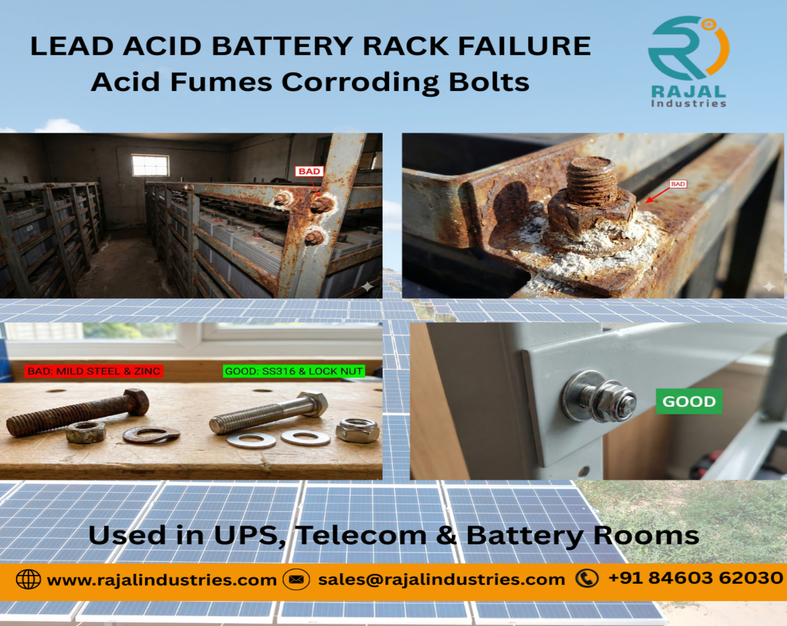
Lead Acid Fumes Corroding Rack Bolts? This Is What Is Failing on Your Site
Lead acid battery rooms release acidic fumes during charging cycles. These fumes attack nearby metal parts, especially the M10 rack bolts holding battery frames together.
Across UPS rooms, telecom battery banks, and power backup systems, engineers are now seeing rusted rack bolts, seized nuts, bent washers, and weak frames. The batteries still work, but the structure slowly becomes unsafe.
This is not a battery chemistry issue. It is a fastener corrosion failure.
When acid vapors settle on mild steel or zinc coated bolts, corrosion begins within weeks. As rust grows, clamping force reduces, joints loosen, and racks start shifting.
How This Problem Appears on Site
Brown rust on M10 rack bolts
White corrosion on nuts
Washers bending or breaking
Frames vibrating or tilting
Bolts difficult to remove
5 Causes of Rack Bolt Corrosion
1) Mild Steel Fasteners
Plain steel reacts quickly with acid fumes.
2) Thin Zinc Coating
Zinc dissolves in acidic environments.
3) No Protective Material
No stainless or coated hardware is used.
4) Poor Ventilation
Fumes remain trapped inside battery rooms.
5) Reused Corroded Bolts
Old rust spreads quickly.
Technical Failures Seen in the Field
| Issue | Result |
| Rusted threads | Seized bolts |
| Loose joints | Frame movement |
| Bent washers | Load loss |
| Snapped bolts | Rack collapse |
Correct Fastener Setup for Battery Racks
Size: M10
Material: SS316
Hardware: Flat washers, lock nuts, hex bolts
How to Prevent Corrosion
Replace zinc bolts with SS316 fasteners
Use flat washers + lock nuts
Improve ventilation
Inspect every 3 months
Engineering Truth
Acid fumes destroy steel. Only stainless survives.
External References
ISO Corrosion Guide – https://www.iso.org
Battery Safety – https://www.iea.org