

Terminal Bolt Overheating in Industrial Batteries? This Is What Is Failing on Your Site
In industrial battery rooms, UPS systems, and telecom backup installations, electrical terminals carry heavy current every day. These connections rely on small M8 and M10 fasteners to maintain tight contact between copper lugs, battery posts, and busbars.
Across many plants, engineers are now noticing hot terminal bolts, burnt insulation, blackened washers, and melted cable sleeves. The battery may still be working, but the joint is slowly overheating and becoming a fire risk.
This is not an electrical component problem. It is a fastener selection and joint design problem. When a bolt loses clamping force, resistance increases. Resistance creates heat. Heat damages the joint.
How This Problem Appears on Site
Terminal bolts too hot to touch
Burn marks on copper lugs
Smell of melted insulation
Loose or discolored nuts
Voltage drop at terminals
5 Causes of Terminal Bolt Overheating
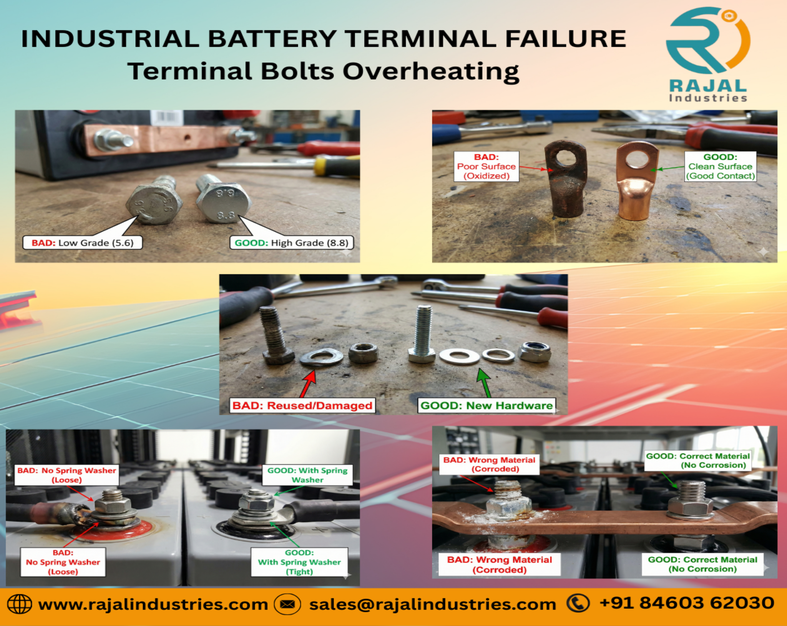
1) Low Tensile Bolt Grade
Mild steel or grade 5.6 bolts stretch under load and lose pressure.
2) No Spring Washer
Without spring washers, vibration loosens the joint.
3) Poor Surface Contact
Oxidized or uneven lugs increase resistance.
4) Wrong Bolt Material
Zinc bolts corrode and increase resistance.
5) Reused or Damaged Fasteners
Old threads reduce clamping force.
Technical Failures Seen in the Field
| Issue | Result |
| Loose terminals | Heat buildup |
| Oxidized lugs | High resistance |
| Burnt washers | Joint failure |
| Snapped bolts | Power loss |
Correct Fastener Setup for Battery Terminals
Sizes: M8, M10
Grades: 8.8
Hardware: Copper terminal bolts, spring washers, nylock nuts, flat washers.
How to Prevent Overheating
Replace bolts with grade 8.8 fasteners
Use spring washers
Clean copper lugs
Tighten to correct torque
Replace burnt hardware
Engineering Truth
Most battery fires start at loose terminals, not cells.
External References
ISO – https://www.iso.org
IEA – https://www.iea.org