
The Real Reason HDG Bolts Rust Early in Solar Installations
Hot-dip galvanizing is trusted in solar projects for one simple reason:
it promises rust protection for decades.
Yet many solar EPCs face this shock:
Bolts look fine.
Installation goes smooth.
And then corrosion begins far too early.
And when testing is done…
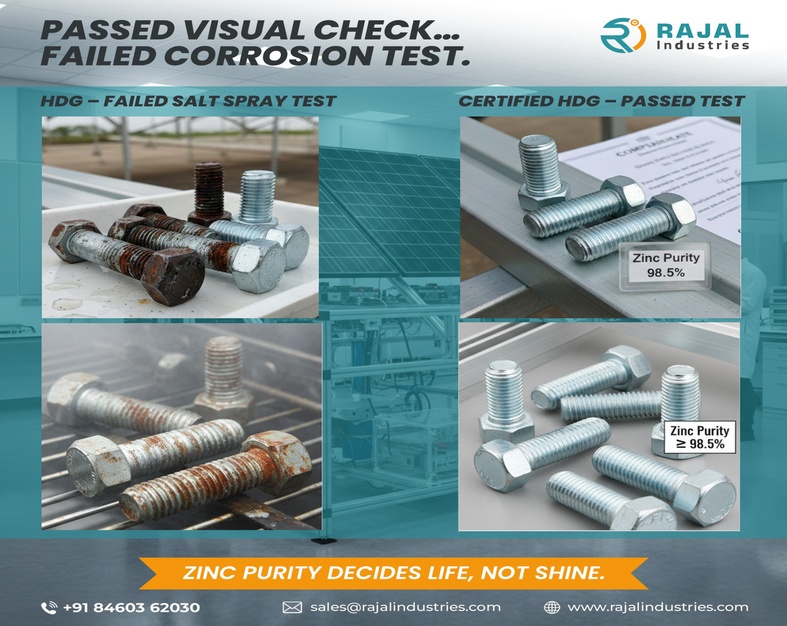
salt spray failure appears.
This isn’t bad luck.
This is bad zinc.
What Salt Spray Testing Really Tells You
Salt spray tests simulate:
• coastal air
• industrial exposure
• humidity cycles
• chemical attack
If a bolt fails here, it will fail on site.
Passing visual inspection means nothing if the zinc itself is weak.
Where Things Go Wrong
Most problems start at the galvanizing stage:
- • Low-grade recycled zinc
• Mixed surface contaminants
• Inconsistent bath temperature
• Poor surface pickling
• Fake coating thickness claims
• No post-galvanization inspection
Zinc may look shiny.
But shine doesn’t stop corrosion.
Purity does.
Why Zinc Purity Matters
High-purity zinc creates:
• stronger alloy bonding
• uniform coating
• better sacrificial protection
• slower corrosion rate
Low-purity zinc:
• cracks early
• corrodes unevenly
• exposes base steel faster
• causes black rust patches
For solar structures, this shortens lifetime drastically.
What to Specify for Solar Projects
For mounting hardware:
✔ Zinc purity ≥ 98.5%
✔ Coating thickness minimum 50–80 microns
✔ Compliance with ISO 1461 / IS 4759
✔ Salt spray testing before dispatch
✔ Coating certificate mandatory
✔ Storage in dry sealed packing
How to Spot Poor Galvanizing Before Damage Happens
Ask your supplier:
- • Which zinc source is used?
• Is it blast furnace zinc or scrap melt?
• Can I see the salt spray report?
• What is average coating thickness?
• Is thread cleaning done after dipping?
If answers are unclear, problems will be clear — later.
Final Word
Solar systems are designed for 25 years.
Your fasteners must survive the same.
Not just look good.
Hold good.