

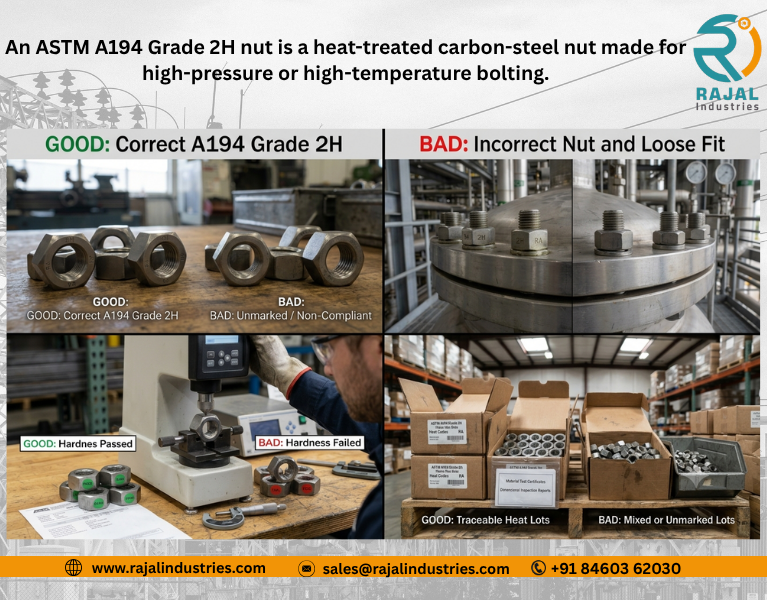
Selecting an ASTM A194 Grade 2H Nut Manufacturer requires more than finding a supplier that can manufacture a heavy hex nut.
Grade 2H nuts are used in specified industrial bolting systems where buyers may need controlled:
- Material chemistry
- Heat treatment
- Hardness
- Proof-load performance
- Thread accuracy
- Dimensions
- Marking
- Traceability
- Testing
- Documentation
For oil & gas, petrochemical, refinery, power and process-plant procurement, use:
Application → Bolt/Stud Specification → Thread → ASTM A194 Grade → Nut Dimensions → Material → Heat Treatment → Mechanical Testing → Finish → Marking → Traceability
The nut should be selected as part of the complete bolting system.
Quick Answer: What Is an ASTM A194 Grade 2H Nut?
An ASTM A194 Grade 2H nut is a heat-treated carbon-steel nut manufactured to the applicable Grade 2H requirements of ASTM A194/A194M for bolting systems used in specified high-pressure or high-temperature service, or both. The complete product specification must also define thread, dimensions, mating bolt/stud, finish and project requirements.
What Is ASTM A194/A194M?
ASTM A194/A194M is the ASTM specification for carbon steel, alloy steel and stainless steel nuts intended for:
- High-pressure service
- High-temperature service
- Or both
The current active edition is:
ASTM A194/A194M-26
This is important for current RFQs and procurement documents.
ASTM A194/A194M-26 Is the Current Edition
The current ASTM specification was updated in February 2026.
Therefore, new procurement documents should not automatically copy an old revision such as:
- A194/A194M-20
- A194/A194M-22
- A194/A194M-23
- A194/A194M-24
without checking the project requirement.
If a contract or approved project specification explicitly requires an older edition, follow that controlled requirement unless it is formally revised.
ASTM A194/A194M Size Scope
The current ASTM A194/A194M-26 scope covers carbon steel, alloy steel and martensitic stainless steel nuts in nominal sizes:
1/4″ through 4″
and:
M12 through M100
It also covers austenitic stainless steel nuts from:
1/4″ and M12 nominal and above.
This is the overall specification scope, not a statement that every grade is automatically available or applicable across every size.
Why Grade-Specific Requirements Still Matter
A standard may cover a broad range of materials and sizes.
But each grade can have its own:
- Material requirements
- Heat treatment
- Mechanical properties
- hardness requirements
- marking
- permitted sizes
- other technical conditions
Therefore:
ASTM A194 Scope ≠ Automatic Grade 2H Approval for Every Size and Application
Always check the current controlled grade requirements.
What Does Grade 2H Mean?
Grade 2H identifies a specific nut grade within ASTM A194/A194M.
It is not simply another name for:
- Heavy hex nut
- High-strength nut
- Structural nut
- Alloy steel nut
- Hot nut
- High-temperature nut
The grade has defined material and mechanical requirements.
Grade 2H vs Heavy Hex
These terms answer different questions.
Grade 2H
Defines a material/mechanical grade under ASTM A194/A194M.
Heavy Hex
Defines the dimensional form of the nut.
Therefore, a product can be specified as:
ASTM A194 Grade 2H Heavy Hex Nut
when both requirements apply.
But:
2H ≠ Heavy Hex
and:
Heavy Hex ≠ 2H
ASTM A194 2H Nut for Oil & Gas
Oil and gas projects can use ASTM A194 2H Nut products in approved bolting systems involving equipment such as:
- Flanged connections
- Piping systems
- Pressure equipment
- Valves
- Process equipment
- Industrial bolting assemblies
The actual equipment, piping class and project specification should determine the approved bolting combination.
ASTM A194 2H Nut for Petrochemical Plants
Petrochemical facilities can involve:
- Elevated temperatures
- pressure
- aggressive operating environments
- critical bolted joints
- strict maintenance requirements
A Grade 2H nut should therefore be purchased from the approved technical specification rather than from a generic “high-strength nut” description.
ASTM A194 2H Nut for Refineries
Refinery applications may include specified bolting systems for:
- Process piping
- heat exchangers
- pressure equipment
- valves
- flanges
- other process connections
The mating stud/bolt specification must be checked before selecting the nut.
ASTM A194 2H Nut for Power Plants
Power-generation projects can require controlled bolting for:
- Piping
- pressure systems
- turbines and associated equipment
- valves
- heat-related equipment
- process assemblies
Grade 2H should be used where the approved equipment or bolting specification calls for it.
ASTM A194 2H Nut for Process Plants
Process industries can include:
- Chemical plants
- fertilizer plants
- energy facilities
- industrial utilities
- processing equipment
Different process conditions can require different bolting materials.
Do not assume Grade 2H is appropriate merely because an application operates at elevated temperature.
High Temperature Nuts: Important Technical Distinction
The secondary keyword High Temperature Nuts is commercially relevant.
But engineering selection should not be:
High temperature = Grade 2H.
Temperature is only one part of material selection.
Engineers may also consider:
- Pressure
- Mating stud/bolt material
- design temperature
- corrosion
- process fluid
- code requirements
- equipment specification
The approved bolting specification controls.
Grade 2H Is Not Universal for Every Temperature
ASTM A194 covers multiple nut grades because industrial service conditions differ.
Different applications may require different:
- Carbon steel grades
- Alloy steel grades
- Stainless steel grades
Therefore, Grade 2H should not be promoted as a universal high-temperature nut.
Grade 2H Material
ASTM A194 Grade 2H belongs to the carbon-steel nut family within the specification.
The material must meet the applicable:
- Chemistry
- heat treatment
- hardness
- mechanical
- processing
requirements of the controlled ASTM edition.
Do not describe Grade 2H generically as stainless steel or assume it is an alloy-steel grade.
Why Material Chemistry Matters
Chemical composition affects the material’s response to:
- Heat treatment
- mechanical loading
- manufacturing
- service conditions
For controlled projects, chemistry should be traceable to the production heat/lot as required.
ASTM A194 Grade 2H Heat Treatment
Heat treatment is an important part of achieving the specified Grade 2H condition.
The manufacturer must follow the requirements of the applicable ASTM specification.
Production controls can include:
- Material heat identification
- furnace batch
- process parameters
- hardness testing
- mechanical testing
- final lot traceability
Heat Treatment Cannot Be Verified by Appearance
A Grade 2H nut can look similar to another carbon-steel heavy hex nut.
Visual appearance cannot prove:
- Correct material
- correct heat treatment
- correct hardness
- proof-load compliance
- Grade 2H compliance
Testing and traceability are required.
ASTM A194 Grade 2H Hardness
Hardness is an important controlled property for Grade 2H.
But:
Hardness Pass ≠ Complete ASTM A194 Compliance
A compliant product can also require correct:
- Chemistry
- heat treatment
- dimensions
- thread
- proof load
- marking
- documentation
depending on the specification and order.
Why Hardness Has Both Minimum and Maximum Importance
For heat-treated industrial fasteners, the objective is not simply:
Higher hardness = better nut.
The material must remain within the specified requirements.
Excessive hardness can also be unacceptable.
Always use the current ASTM acceptance criteria rather than a supplier-created “stronger is better” rule.
ASTM A194 Grade 2H Proof Load
Proof-load testing is another important mechanical verification.
The test checks the nut under a specified axial loading procedure according to the governing standard.
This helps verify mechanical compliance of the finished nut.
Proof Load Is Not the Same as Working Load
Do not use the nut proof load directly as:
- Safe working load
- flange capacity
- piping load
- joint capacity
- allowable bolt load
The complete bolted joint must be designed according to the applicable engineering code and equipment requirements.
Proof Load vs Hardness
| Test | What It Helps Verify |
| Hardness | Material/mechanical condition |
| Proof Load | Nut performance under prescribed axial test |
| Chemistry | Material composition |
| Dimensions | Product geometry |
| Thread Inspection | Mating compatibility |
| Marking | Grade/manufacturer identification |
No single test proves complete compliance.
Cone Proof Load Testing
ASTM A194/A194M also includes cone proof-load testing requirements within its testing framework.
The current ASTM specification specifically identifies hardness, proof-load and cone proof-load tests among the mechanical verification requirements.
The applicable standard should be used for the exact test method and acceptance criteria.
Grade Substitution Is Not Automatically Allowed
This is an important difference for A194 procurement.
The current ASTM A194/A194M-26 scope states that:
Grade substitutions without purchaser permission are not allowed.
Therefore, if the PO calls for Grade 2H, a supplier should not silently provide another ASTM A194 grade.
Why Grade Substitution Control Matters
A different grade may change:
- Chemistry
- heat treatment
- hardness
- temperature capability
- corrosion behaviour
- marking
- project approval
Even if another grade appears stronger, substitution requires purchaser/project approval.
A194 2H Heavy Hex Nut Dimensions
An A194 2H Heavy Hex Nut requires both:
ASTM A194 Grade 2H mechanical/material requirements
and:
Applicable heavy hex dimensional requirements
These should not be confused.
ASME B18.2.2 Heavy Hex Dimensions
For applicable inch-series heavy hex nuts, ASME B18.2.2-2022 remains the current ASME dimensional standard.
It includes dimensional data for heavy hex nuts and heavy hex jam nuts.
Important dimensions include:
- Thread size
- width across flats
- nut height
- width across corners
- bearing geometry
Use the controlled ASME dimensional table for final manufacturing and inspection.
ASTM A194 vs ASME B18.2.2
A simple way to understand the relationship is:
| Standard | Main Role |
| ASTM A194/A194M | Material/mechanical requirements |
| ASME B18.2.2 | Inch-series dimensional requirements |
| Project Specification | Application-specific requirements |
| Thread Standard | Thread form/class |
| Coating Specification | Surface finish |
One standard does not automatically replace the others.
Why Full Dimensional Tables Should Come From the Standard
For manufacturing and inspection, buyers should use the controlled current standard rather than relying on a copied internet chart.
This prevents errors caused by:
- Old editions
- wrong nut style
- incorrect size
- mixed metric/inch values
- transcription errors
ASTM A194 Grade 2H Thread Sizes
Grade 2H nuts may be specified in inch or metric systems within applicable scope and grade requirements.
For inch-series procurement, buyers may encounter threads such as:
- UNC
- other specified Unified threads
depending on the mating stud/bolt and project requirements.
Never select thread independently from the mating fastener.
Thread Diameter Is Not Enough
An RFQ saying:
1″ Grade 2H Nut
is incomplete.
The buyer should identify:
Diameter + TPI + Thread Series/Class + Grade + Nut Style + Finish
where applicable.
Example: 1″-8 UNC Grade 2H Nut
A specification might begin with:
1″-8 UNC ASTM A194 Grade 2H Heavy Hex Nut
This identifies:
- 1″ nominal thread diameter
- 8 threads per inch
- UNC thread series
- ASTM A194
- Grade 2H
- Heavy hex geometry
But the project may still need:
- Finish
- dimensional standard
- marking
- testing
- traceability
- documentation
Metric Grade 2H Nuts
ASTM A194/A194M includes metric requirements within its scope.
Metric procurement should clearly identify:
M Diameter × Pitch + ASTM Grade + Nut Style + Finish + Mating Fastener
Do not convert an inch bolting system to the nearest metric diameter without engineering approval.
Inch and Metric Values Must Not Be Mixed
ASTM A194/A194M treats inch-pound and SI requirements as separate systems.
Do not create a hybrid specification by combining convenient values from both systems.
Use the system required by the project.
Mating Stud Bolt Selection
Grade 2H nuts are commonly encountered with specified high-strength stud-bolting systems.
The correct sequence is:
Equipment/Piping Specification → Stud Bolt Specification → Stud Grade → Diameter → Thread → Required Nut Grade → Finish
Do not begin by selecting the nut independently.
ASTM A193 Bolting Context
ASTM A193/A193M is widely used for alloy-steel and stainless-steel bolting materials for high-temperature or high-pressure service and other special-purpose applications.
In many industrial projects, A194 nuts are specified with mating A193 stud/bolt grades according to the governing engineering specification.
The exact approved pairing must be checked rather than assumed.
ASTM A193 Grade B7 Context
ASTM A193 Grade B7 is widely encountered in industrial stud-bolting applications.
Grade 2H nuts are also widely associated with specified B7 bolting systems.
However:
Do not convert this common industry pairing into a universal rule.
The piping class, equipment specification, temperature, coating and project requirements must control.
Nut and Stud Must Be Treated as a System
Check:
| Requirement | Stud/Bolt | Nut |
| Standard | Specified | ASTM A194 |
| Grade | Specified | 2H |
| Diameter | Matching | Matching |
| Thread | Matching | Matching |
| Finish | Compatible | Compatible |
| Temperature | Approved | Approved |
| Project Specification | Required | Required |
| Traceability | Required where specified | Required where specified |
ASTM A194 2H Nut Surface Finish
Grade 2H nuts can be supplied with different finish requirements where permitted and specified.
Possible project conditions may include:
- Plain
- coated
- hot-dip galvanized where permitted by the complete specification
- other approved coating systems
Never assume the finish from the grade designation alone.
Plain ASTM A194 Grade 2H Nuts
Plain finish may be specified for suitable controlled bolting systems.
The product must still meet applicable:
- Material
- mechanical
- dimensional
- thread
- marking
- traceability
requirements.
Coated Grade 2H Nuts
If a coating is required, evaluate:
- Coating specification
- service temperature
- corrosion environment
- thread fit
- mating stud finish
- installation behaviour
The coating should be part of the approved bolting system.
High Temperature and Coating Compatibility
A coating suitable for atmospheric corrosion protection may not automatically be suitable for every high-temperature service condition.
For process plants, coating selection should consider:
Temperature + Environment + Mating Fastener + Installation + Project Specification
Grade 2H Nut Thread Inspection
Thread inspection should confirm compatibility with the specified mating stud/bolt.
Depending on the project and thread system, controls can include:
- Thread gauges
- pitch/TPI verification
- thread class
- final coated condition
- visual thread inspection
Use calibrated inspection equipment.
Thread Fit Does Not Prove Grade 2H Compliance
A nut can screw perfectly onto the stud and still have the wrong:
- Material
- heat treatment
- hardness
- proof load
- marking
Therefore, trial assembly is only one part of inspection.
ASTM A194 Grade 2H Marking
Grade marking is critical because visually similar heavy hex nuts can belong to different grades.
The applicable ASTM standard defines identification requirements.
A controlled manufacturer should maintain:
Material Heat → Production Lot → Heat Treatment → Testing → Marking → Packing
Why Manufacturer Identification Matters
Manufacturer identification helps connect the product to the source responsible for compliance.
For critical industrial bolting, this supports:
- Traceability
- quality investigation
- project documentation
- field identification
Marking requirements should follow the current ASTM standard.
Traceability for Oil & Gas Projects
A project may require traceability back to:
- Raw-material heat
- production lot
- heat-treatment batch
- mechanical test results
- dimensional inspection
- coating batch where applicable
This should be defined before production.
ASTM A194 Grade 2H Manufacturing Flow
A controlled manufacturing route can include:
Raw Material → Cutting → Forming/Forging → Piercing → Threading → Heat Treatment → Mechanical Testing → Surface Finish → Final Inspection → Marking → Traceability → Packing
The exact manufacturing sequence depends on:
- Size
- material condition
- production route
- project requirements
Raw Material Control
Before manufacturing, verify:
- Material specification
- heat number
- chemistry
- material certificate
- traceability
Do not wait until final inspection to discover a raw-material mismatch.
Forming and Forging
The selected manufacturing process should produce the required heavy hex geometry without compromising the material requirements.
Depending on size and production volume, appropriate forming processes may differ.
Process selection should be based on technical feasibility.
Heat-Treatment Control
For Grade 2H production, heat-treatment control is critical.
Quality controls can include:
- Furnace identification
- batch identification
- time/temperature records
- lot segregation
- post-treatment testing
as required by the quality system and project specification.
Threading
Thread manufacturing should achieve the specified:
- Diameter
- pitch/TPI
- thread form
- thread class
- functional fit
Final inspection should consider any subsequent coating or processing.
Final Mechanical Testing
Depending on applicable requirements, mechanical verification can include:
- Hardness
- proof load
- cone proof load
- other required tests
Acceptance must come from the current controlled ASTM specification.
Dimensional Inspection
Check applicable:
- Thread
- width across flats
- nut height
- width across corners
- bearing surface
- chamfer
- marking
against the applicable dimensional standard/drawing.
Quality Documentation for Grade 2H Nuts
Oil & gas and petrochemical buyers may request:
☐ Material Test Certificate
☐ Chemical Test Report
☐ Heat-Treatment Records
☐ Hardness Report
☐ Proof-Load Report
☐ Dimensional Inspection Report
☐ Thread Inspection Report
☐ Coating Report where applicable
☐ Heat/Lot Traceability
☐ Certificate of Conformity
☐ ITP Records
☐ TPI Release where required
The actual PO/project requirements control.
ASTM A194 2H Nut for EPC Procurement
EPC buyers should specify:
Standard + Edition + Grade + Size + Thread + Nut Style + Finish + Mating Stud + Testing + Marking + Traceability + Documents
This gives manufacturers a measurable requirement.
Poor Grade 2H RFQ
Need 2H nuts for refinery. Quote urgently.
This leaves critical technical questions unanswered.
Better Grade 2H RFQ
Product: Heavy Hex Nut
Standard: ASTM A194/A194M
Grade: 2H
Thread: 1″-8 UNC
Dimensions: Applicable controlled standard
Mating Stud: Specification attached
Finish: Project specification attached
Testing: As ASTM/project ITP
Traceability: Heat/lot required
Documents: MTC + mechanical + dimensional reports
Quantity: 50,000 pcs
ASTM A194 Grade 2H Supplier Qualification
Before approving a 2H Nut Manufacturer, evaluate:
- ASTM A194 experience
- Material sourcing
- Forging/forming capability
- Heat-treatment control
- Threading
- Hardness testing
- Proof-load testing
- Dimensional inspection
- Marking
- Traceability
- Documentation
Supplier Audit Questions
Ask:
- Which ASTM A194 grades are regularly produced?
- Which Grade 2H sizes are produced?
- Which manufacturing processes are in-house?
- Is heat treatment in-house?
- How are furnace batches controlled?
- How is raw material traced?
- Is hardness testing available?
- Is proof-load testing available?
- How are threads inspected?
- How are dimensional requirements controlled?
- How is grade marking controlled?
- Can heat/lot traceability be maintained?
- Can MTC/RMTC be provided?
- Can customer ITPs be followed?
- Can TPI be supported?
- How are process changes controlled?
- What is monthly Grade 2H capacity?
Supplier Qualification Matrix
| Area | Priority |
| ASTM A194 Experience | Very High |
| Material Traceability | Very High |
| Heat Treatment | Very High |
| Hardness Control | Very High |
| Proof-Load Testing | Very High |
| Thread Accuracy | Very High |
| Heavy Hex Dimensions | Very High |
| Marking | Very High |
| Lot Traceability | Very High |
| Documentation | Very High |
| Coating Control | High where applicable |
| ITP/TPI Support | High |
| Capacity | High |
| Delivery | High |
| Price | After Technical Approval |
Common ASTM A194 Grade 2H Procurement Mistakes
Avoid:
- Ordering only by size.
- Calling every heavy hex nut Grade 2H.
- Using Grade 2H for every high-temperature application.
- Ignoring the mating stud specification.
- Using an old ASTM edition without checking the project.
- Mixing inch and metric requirements.
- Approving only by hardness.
- Ignoring proof-load requirements.
- Changing coating without engineering review.
- Accepting unmarked material where marking is required.
- Losing heat/lot traceability.
- Allowing unapproved grade substitution.
- Using generic torque values.
- Assuming thread fit proves compliance.
- Treating MTC documentation as a substitute for physical inspection/testing.
What Is ASTM A194 Grade 2H?
ASTM A194 Grade 2H is a heat-treated carbon-steel nut grade within ASTM A194/A194M, a specification covering nuts intended for high-pressure or high-temperature service, or both. Final selection must also consider the mating stud, thread, dimensions, finish and project specification.
What Is the Current ASTM A194 Standard?
The current active edition is ASTM A194/A194M-26. It covers carbon steel, alloy steel and stainless steel nuts intended for high-pressure or high-temperature service, or both.
Is ASTM A194 Grade 2H a Heavy Hex Nut?
Grade 2H defines material and mechanical requirements. Heavy hex defines geometry. A nut can be specified as an ASTM A194 Grade 2H heavy hex nut when both requirements apply.
Is Grade 2H a Stainless Steel Nut?
No. ASTM A194 Grade 2H belongs to the carbon-steel grade family. ASTM A194/A194M also contains other grades for alloy and stainless steel applications.
Is Grade 2H Suitable for Every High-Temperature Application?
No. Nut selection depends on the service temperature, pressure, mating bolt or stud, process environment, engineering code and project specification. Grade 2H should be used where the approved bolting system requires it.
Can a Supplier Substitute Another Grade for 2H?
Not without purchaser permission. The current ASTM A194/A194M-26 scope states that grade substitutions without purchaser permission are not allowed.
What Tests Are Important for Grade 2H Nuts?
Depending on the applicable requirements, verification includes material chemistry, hardness, proof-load or applicable mechanical testing, dimensions, threads, marking and traceability.
What Should I Send to an ASTM A194 Grade 2H Nut Manufacturer?
Send the ASTM edition, Grade 2H requirement, thread size, heavy hex dimensional requirement, mating stud specification, finish, testing, marking, traceability, ITP, documentation and quantity.
Buyer Checklist Before Ordering ASTM A194 2H Nuts
Confirm:
☐ Application
☐ Equipment/piping specification
☐ ASTM A194 edition
☐ Grade 2H requirement
☐ Mating stud/bolt specification
☐ Stud/bolt grade
☐ Inch or metric
☐ Nominal diameter
☐ Pitch/TPI
☐ Thread series
☐ Thread class/tolerance
☐ Heavy hex requirement
☐ Dimensional standard
☐ Material requirements
☐ Heat treatment
☐ Hardness requirements
☐ Proof-load requirements
☐ Cone proof-load requirements where applicable
☐ Surface finish
☐ Coating compatibility
☐ Service temperature
☐ Pressure/service requirement
☐ Process environment
☐ Marking
☐ Manufacturer identification
☐ Material chemistry
☐ Thread inspection
☐ Dimensional inspection
☐ Mechanical testing
☐ Heat/lot traceability
☐ MTC/RMTC
☐ Heat-treatment records if required
☐ Mechanical test report
☐ DIR
☐ Coating report where applicable
☐ CoC
☐ ITP
☐ TPI
☐ Packing
☐ Quantity
☐ Project demand
Conclusion: Grade 2H Is a Controlled Bolting Specification, Not Just a Nut Name
Selecting an ASTM A194 Grade 2H Nut Manufacturer should begin with the service and mating bolting specification, not simply the nut diameter.
The correct procurement sequence is:
Service → Equipment/Piping Specification → Stud/Bolt → Grade → Thread → ASTM A194 Grade 2H → Heavy Hex Dimensions → Heat Treatment → Mechanical Testing → Finish → Installation → Traceability
The most important technical points are:
Grade 2H = Material/Mechanical Grade
Heavy Hex = Nut Geometry
Thread Fit ≠ Mechanical Compatibility
Hardness Pass ≠ Complete Compliance
High-Temperature Service ≠ Automatically Grade 2H
Common B7/2H Practice ≠ Universal Requirement
For oil & gas, petrochemical, refinery, power and process-plant projects, buyers should qualify the complete bolting system and its documentation.
Rajal Industries can evaluate customer/project requirements for ASTM A194 2H Nuts, A194 2H Heavy Hex Nuts and related industrial bolting components, subject to technical feasibility, material availability, heat treatment, manufacturing capability, testing, applicable standards and customer/project approval.
Looking for an ASTM A194 Grade 2H Nut Manufacturer in India?
Send Rajal Industries:
ASTM Edition + Grade + Mating Stud Specification + Size/Thread + Heavy Hex Requirement + Finish + Testing + ITP + Documentation + Quantity
for technical feasibility and quotation review.