

Selecting the correct Heavy Hex Nut Sizes requires more than choosing a diameter such as 1/2″, 3/4″, 1″ or M20.
For structural steel, EPC, PEB, bridges and infrastructure projects, a complete heavy hex nut specification may need:
Diameter → Thread → Dimensional Standard → Nut Grade → Material → Mechanical Properties → Mating Bolt/Stud → Finish → Testing → Documentation
A heavy hex nut can have the correct nominal thread and still be unsuitable if the wrong grade, thread series, coating or mechanical specification is selected.
Quick Answer: What Are Heavy Hex Nut Sizes?
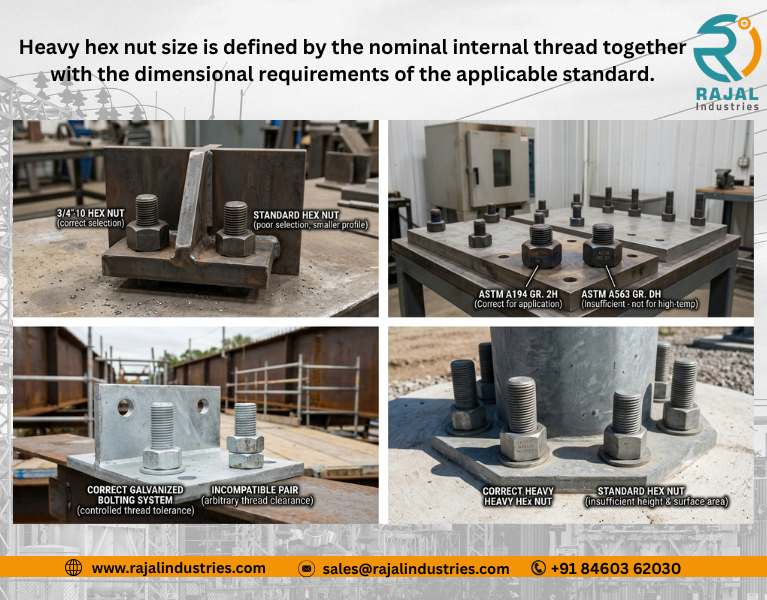
Heavy Hex Nut Sizes are defined by the nominal internal thread together with the dimensional requirements of the applicable heavy-hex standard. Important characteristics include thread diameter, pitch or threads per inch, width across flats, nut height, width across corners and bearing geometry. Nut grade and material must be specified separately.
This distinction is essential:
Size defines geometry and thread. Grade defines mechanical/material requirements.
What Is a Heavy Hex Nut?
A heavy hex nut is a hexagonal nut manufactured to a heavier dimensional pattern than a regular hex nut under the applicable product standard.
The heavy pattern generally provides different:
- Width across flats
- Nut height
- Width across corners
- Bearing geometry
- Tooling envelope
The exact dimensions must come from the governing standard or approved drawing.
Heavy Hex Nut Does Not Mean “Any Large Nut”
The word heavy has a technical dimensional meaning.
It should not be interpreted simply as:
- Large nut
- Thick nut
- High-strength nut
- Heavy-duty nut
- Structural nut
Those descriptions can overlap in particular applications, but they are not technically identical.
Heavy Hex Nut Size vs Heavy Hex Nut Grade
This is one of the most important concepts in this guide.
Consider:
3/4″-10 Heavy Hex Nut
This identifies important thread and geometry information.
It does not automatically define:
- ASTM grade
- Steel chemistry
- Heat treatment
- Proof load
- Hardness
- Coating
- Mating bolt specification
Likewise:
ASTM A563 Grade DH
does not by itself tell the buyer every required dimension, thread or coating detail.
A complete specification needs both.
Main Heavy Hex Nut Dimensions
Important Heavy Hex Nut Dimensions can include:
Nominal Thread Diameter
The nominal internal thread size that must match the mating bolt or stud.
Thread Pitch or TPI
Metric threads normally identify pitch in millimetres.
Inch threads commonly identify threads per inch.
Width Across Flats
The distance between two opposite flat wrenching surfaces.
Width Across Corners
The maximum dimensional envelope across opposite corners.
Nut Height
The axial height of the nut.
Bearing Surface
The surface transmitting load into the washer or connected component.
Chamfer
The shaped edge at the end of the nut as defined by the applicable standard.
Why Width Across Flats Matters
Heavy hex geometry generally uses a larger wrenching envelope than the corresponding regular hex pattern.
This affects:
- Socket size
- Wrench selection
- Site installation
- Structural-steel access
- Fabrication clearance
- Automated tooling
A designer should therefore check both fastener fit and tool fit.
Why Nut Height Matters
Nut height influences:
- Product geometry
- Thread engagement
- Bolt projection
- Tool access
- Assembly envelope
However:
Greater nut height does not automatically equal greater allowable joint load.
Mechanical performance comes from the complete specification.
Why Width Across Corners Matters
Width across corners affects the maximum radial envelope of the nut.
This becomes important near:
- Structural flanges
- stiffeners
- channels
- equipment walls
- anchor plates
- adjacent fasteners
A socket also requires additional clearance beyond the nut itself.
Heavy Hex Nut Dimensions Are Standard-Specific
Do not build a drawing using dimensions from an unknown online chart.
Use the current controlled:
- ASME standard
- ASTM specification
- project drawing
- customer specification
as applicable.
This is especially important for structural work.
Current ASME Standard for Inch Heavy Hex Nut Dimensions
ASME B18.2.2-2022 is the current ASME dimensional standard relevant to inch-series heavy hex nuts.
It includes dimensional requirements for multiple nut forms, including:
- Heavy hex nuts
- Heavy hex jam nuts
- Heavy hex flat nuts
- Other inch-series nut forms
The exact dimensional table should be taken from the controlled standard.
Why We Are Not Reproducing the Full ASME Dimension Table
Engineering buyers need accurate dimensions, but copying an entire controlled standard table into a blog creates two problems:
- Standards can be revised.
- The official standard should remain the final dimensional authority.
This guide therefore explains how to interpret Heavy Hex Nut Sizes and select the correct specification rather than replacing the controlled ASME document.
Common Inch Heavy Hex Nut Sizes
Depending on the applicable specification and product range, buyers may encounter sizes such as:
- 1/2″
- 5/8″
- 3/4″
- 7/8″
- 1″
- 1-1/8″
- 1-1/4″
- 1-3/8″
- 1-1/2″
- 1-3/4″
- 2″
- Larger sizes where supported by the applicable specification
The actual permitted size range depends on the governing nut specification.
1/2″ Heavy Hex Nut
A 1/2-inch heavy hex nut specification should also identify:
- TPI
- thread series
- thread class
- dimensional standard
- nut grade
- finish
Do not order only:
1/2″ Heavy Hex Nut.
5/8″ Heavy Hex Nut
For structural or mechanical use, check:
5/8″ Diameter → Thread → Mating Bolt → Nut Specification → Grade → Finish
The mating fastener specification should guide nut selection.
3/4″ Heavy Hex Nut
A common coarse inch thread designation can be:
3/4″-10 UNC
But a complete structural RFQ may still require:
- ASTM nut specification
- grade
- heavy hex dimensional requirement
- coating
- testing
- traceability
7/8″ Heavy Hex Nut
For a 7/8-inch requirement, confirm:
- Coarse or fine thread
- Mating structural bolt/stud
- Nut grade
- Plain or coated condition
- Project specification
Do not substitute based only on diameter.
1″ Heavy Hex Nut
An inch-series requirement might be written:
1″-8 UNC Heavy Hex Nut
But this does not independently specify:
- Mechanical grade
- material
- finish
- project compliance
These must be added separately.
Heavy Hex Nuts Above 1 Inch
As diameter increases, buyers should pay particular attention to:
- Available material
- manufacturing method
- heat treatment
- thread quality
- proof-load requirements
- tooling
- coating
- inspection
Larger size does not remove the need for grade compatibility.
UNC Heavy Hex Nut Threads
UNC means Unified National Coarse.
A typical designation can be:
3/4″-10 UNC
where:
- 3/4″ = nominal diameter
- 10 = threads per inch
- UNC = thread series
The thread class should also follow the applicable specification.
UNF Heavy Hex Nut Threads
UNF means Unified National Fine.
For example:
3/4″-16 UNF
is not interchangeable with:
3/4″-10 UNC.
Both have the same nominal diameter but different thread pitches.
Never force one onto the other.
Heavy Hex Nut Size Does Not Define Thread Series
A buyer asking for:
1-inch Heavy Hex Nut
has not fully defined the thread.
The RFQ should identify:
Diameter + TPI + Thread Series + Thread Class where required
Metric Heavy Hex Nut Requirements
Heavy-pattern metric nuts can also be required under applicable specifications or customer drawings.
Metric specification should identify:
M Diameter × Pitch + Dimensional Requirement + Mechanical Requirement + Material + Finish
Example:
M24 × 3.0
defines thread information, but it does not define the complete nut.
Do Not Convert Inch Heavy Hex Nuts Directly to Metric
A 1-inch heavy hex nut should not simply be replaced with an M24 or M25 product because the diameters appear close.
Differences can include:
- Thread form
- pitch
- external dimensions
- mechanical properties
- product standard
- bolt compatibility
Metric and inch systems should be treated independently unless the design formally changes.
Inch vs Metric Heavy Hex Nuts
| Feature | Inch System | Metric System |
| Diameter | Fractional/inch | M designation |
| Pitch | Threads per inch | Millimetres |
| Common Thread Terms | UNC / UNF | Coarse / Fine |
| Dimensions | Applicable inch standard | Applicable metric standard/drawing |
| Grade | Applicable ASTM/project specification | Applicable specification |
| Direct Conversion | No | No |
Heavy Hex Nut Standards: Understand Their Different Roles
A heavy hex nut can involve several standards.
Dimensional Standard
Controls product geometry.
Example:
ASME B18.2.2
Material/Mechanical Specification
Controls chemistry, grade and mechanical properties.
Example:
ASTM A563/A563M
Service-Specific Nut Specification
Used for particular service conditions.
Example:
ASTM A194/A194M
Coating Standard
Controls the selected surface treatment.
Project Specification
Can impose additional requirements for:
- testing
- documentation
- marking
- inspection
- approved manufacturers
Do not combine these standards as though they serve the same purpose.
ASTM A563/A563M-26
The active ASTM A563/A563M-26 specification covers carbon and alloy steel nuts for general structural and mechanical uses on bolts, studs and other externally threaded parts.
Its scope includes chemical, mechanical and dimensional requirements for multiple nut grades.
This makes ASTM A563/A563M highly relevant to many structural and mechanical heavy hex nut applications.
Important ASTM A563/A563M Update
For current procurement documents, use:
ASTM A563/A563M-26
where the current edition is required.
Do not automatically copy an older edition from an old supplier datasheet or previous project.
If the project contract explicitly calls for a specific older edition, follow the approved contract requirement unless formally revised.
ASTM A563/A563M Grades
ASTM A563/A563M contains multiple nut grades for different structural/mechanical requirements.
The correct Heavy Hex Nut Grades depend on factors including:
- Mating fastener
- fastener grade
- finish/coating
- project specification
- mechanical requirements
Do not select a grade simply because it is described as “stronger.”
Stronger Grade Substitution Requires Control
The current ASTM A563/A563M scope permits certain stronger-grade substitutions at the supplier’s option with notice to the purchaser unless the inquiry or purchase order prohibits that substitution.
For project procurement, this means the PO should clearly state when:
No grade substitution is permitted without written approval.
This avoids surprises in EPC documentation.
Weathering Nut Grades
ASTM A563/A563M includes grades with specified atmospheric-corrosion/weathering characteristics.
These are intended for appropriate compatible systems.
Do not assume:
Weathering Nut = Stainless Nut.
They are different material concepts.
Heavy Hex Nut Grade Is Not the Same as Material Name
Terms such as:
- Carbon steel
- alloy steel
- stainless steel
describe broad material families.
A grade specification can add requirements for:
- chemistry
- heat treatment
- hardness
- proof load
- marking
Therefore, specifying only “alloy steel heavy hex nut” is usually incomplete for a controlled structural project.
ASTM A194/A194M-26
The current ASTM A194/A194M-26 specification covers carbon steel, alloy steel and stainless steel nuts intended for:
- High-pressure service
- High-temperature service
- Or both
Its current scope includes carbon/alloy/martensitic stainless nuts from 1/4″ through 4″ and metric M12 through M100, plus austenitic stainless nuts from 1/4″ and M12 nominal upward.
ASTM A194 Is Not a Generic Heavy Hex Standard
This distinction is critical.
Do not write:
Heavy Hex Nut = ASTM A194.
ASTM A194/A194M is a material/mechanical specification for a particular service family.
Heavy hex is a dimensional form.
A product can meet both requirements when the application calls for both.
ASTM A194 Grade 2H
Grade 2H is one of the best-known heavy hex nut grades in industrial bolting.
But:
Heavy Hex Nut ≠ Automatically Grade 2H
Grade 2H should be specified when required by the mating bolting system, pressure/temperature service specification or project documentation.
ASTM A563 vs ASTM A194
| Factor | ASTM A563/A563M | ASTM A194/A194M |
| Main Direction | General structural/mechanical nuts | High-pressure/high-temperature nuts |
| Materials | Carbon/alloy steel within scope | Carbon, alloy and stainless grades within scope |
| Heavy Hex Use | Applicable grades/systems | Applicable grades/systems |
| Grade Required | Yes | Yes |
| Interchangeable | No | No |
| Selection Basis | Bolting/project specification | Service/bolting specification |
Do not use this table as a grade substitution chart.
Heavy Hex Nut Grade Selection Starts With the Mating Fastener
A safer engineering sequence is:
Bolt/Stud Specification → Bolt/Stud Grade → Diameter → Thread → Finish → Required Nut Specification → Nut Grade → Heavy Hex Dimensions
This avoids selecting the nut independently from the bolting system.
Structural Bolt Compatibility
For structural connections, the bolt specification may define or guide:
- Nut specification
- nut grade
- nut style
- washer requirements
- coating compatibility
Always check the current controlled bolting specification.
Why Bolt Grade and Nut Grade Are Different
Bolt and nut standards use different designation systems.
Therefore:
Bolt Grade X does not mean Nut Grade X.
Do not try to match grade names numerically unless the applicable specification explicitly establishes the combination.
Heavy Hex Nut Materials
Depending on the governing standard, project and application, materials can include:
- Carbon steel
- Alloy steel
- Weathering grades
- Stainless steel
- Other customer-specified materials
Material must support the required mechanical and environmental performance.
Carbon Steel Heavy Hex Nuts
Carbon steel can be used in applicable structural and mechanical grades.
Important controls can include:
- Chemistry
- mechanical properties
- heat treatment where required
- coating
- thread
- proof load
- hardness
Do not purchase simply by material family.
Alloy Steel Heavy Hex Nuts
Alloy steel can be used where the applicable grade or service requirement calls for it.
A controlled specification should define:
- Chemistry
- heat treatment
- mechanical properties
- testing
The phrase Heavy Duty Nuts does not prove alloy-steel requirements.
Stainless Steel Heavy Hex Nuts
Stainless heavy hex nuts may be required for suitable:
- Corrosive environments
- process equipment
- industrial systems
- customer-specific assemblies
Check:
- Stainless grade
- mechanical properties
- mating stud/bolt
- galling
- temperature
- project specification
Do not assume stainless automatically means 316 or A4.
Material vs Coating
These are separate corrosion decisions.
For example:
Carbon Steel + Galvanizing
and:
Stainless Steel
are different material systems.
Do not describe galvanized carbon steel as equivalent to stainless steel.
Heavy Hex Nut Mechanical Properties
Depending on the applicable grade, important requirements can include:
- Proof load
- hardness
- chemical composition
- heat-treatment condition
- other grade-specific tests
The controlling standard defines the acceptance criteria.
What Is Nut Proof Load?
Proof load is a specified mechanical verification for applicable nuts.
It evaluates the nut under a defined axial loading procedure according to the governing standard.
A compliant nut should satisfy the applicable test criteria.
Proof Load Is Not Safe Working Load
Do not use nut proof load directly as:
- allowable structural load
- connection capacity
- safe working load
- anchor capacity
The connection designer must evaluate the complete joint.
Heavy Hex Nut Hardness
Hardness testing can help verify the specified grade.
But hardness alone cannot prove:
- Correct chemistry
- correct heat treatment
- proof-load compliance
- correct thread
- dimensional compliance
A complete inspection plan is required.
Heat Treatment
Some Heavy Hex Nut Grades require controlled heat treatment.
The manufacturer may need to control:
- Heat-treatment batch
- furnace process
- time/temperature
- hardness
- mechanical testing
- traceability
depending on the governing specification.
Heavy Hex Nut Thread Quality
Thread quality directly affects the mating structural bolt or stud.
Check:
Diameter → Pitch/TPI → Thread Form → Thread Class/Tolerance → Final Coated Condition
The nut must be evaluated in the condition in which it will be supplied and used.
Heavy Hex Nut Thread Inspection
Depending on the applicable specification, inspection can use calibrated:
- GO gauges
- NO-GO gauges
- other specified functional gauges
The gauge system must correspond to the required thread standard.
Plain Heavy Hex Nuts
Plain finish can be appropriate where the approved bolting system requires it.
Possible applications include suitable:
- Indoor structures
- industrial equipment
- protected structural assemblies
- project-specific systems
Plain is a surface condition, not a quality grade.
Hot-Dip Galvanized Heavy Hex Nuts
Hot-dip galvanizing is commonly considered for outdoor structural and infrastructure applications where the project specifies it.
However, threaded fasteners require special attention because zinc coating adds thickness.
The bolt and nut must form a compatible thread system after coating.
Why Galvanized Heavy Hex Nut Dimensions Need Care
The external nut geometry may comply with the heavy hex standard, but the internal thread must also account for the coating system on the mating bolt.
This can involve controlled nut-thread processing according to the applicable specification.
Do not use arbitrary thread clearances.
Over-Tapped Galvanized Nuts
For applicable hot-dip galvanized bolting systems, nut threads may require controlled over-tapping to accommodate the coating on the mating bolt.
The exact allowance is specification- and size-dependent.
Therefore:
Never publish or manufacture using one universal over-tap value for all Heavy Hex Nut Sizes.
Plain vs Galvanized Heavy Hex Nut
| Factor | Plain | Hot-Dip Galvanized |
| Coating | None/specified plain condition | Zinc coating |
| Thread Accommodation | Standard system | Coating-specific control |
| Corrosion Protection | Environment-dependent | Enhanced where suitable |
| Friction | System-specific | Different installation behaviour possible |
| Nut/Bolt Compatibility | Required | Especially critical |
| Selection | Project-specific | Project-specific |
Coating Can Affect Bolting Compatibility
A nut grade or thread arrangement acceptable for a plain bolt may not automatically be the correct choice after galvanizing.
Always recheck the governing bolting specification when finish changes.
Structural Nuts for EPC Projects
EPC projects often require more than dimensional compliance.
Procurement can involve:
- Approved standards
- approved grades
- approved coating
- material traceability
- mechanical testing
- dimensional inspection
- ITP
- third-party inspection
- documentation
The RFQ should define these before pricing.
Heavy Hex Nuts for Structural Steel
For structural steel, identify:
Connection Type → Bolt Specification → Nut Grade → Washer → Coating → Installation Method → Inspection
Do not treat the nut as an independent commodity.
Heavy Hex Nuts for PEB
PEB projects can include:
- Primary structural connections
- anchor systems
- secondary members
- equipment attachments
Not every connection requires the same Structural Nuts.
Use the approved structural fastener schedule.
Heavy Hex Nuts for Bridges
Bridge projects may require strict controls for:
- Material
- grade
- corrosion protection
- lot traceability
- mechanical testing
- installation
- inspection
Do not advertise one generic heavy hex nut as suitable for every bridge project.
Heavy Hex Nuts for Infrastructure
Infrastructure applications can expose fasteners to:
- Weather
- moisture
- industrial atmosphere
- coastal exposure
- temperature cycling
- long service periods
Material and coating should follow the actual project environment.
Heavy Hex Nuts for Anchor Systems
Heavy hex nuts can be used with suitable anchor rods/bolts when required by the approved anchor specification.
Check:
- Anchor rod specification
- diameter
- thread
- nut grade
- washer/plate
- coating
- project requirements
An anchor nut should not be selected from diameter alone.
Heavy Hex Nut vs Standard Hex Nut
| Factor | Standard Hex | Heavy Hex |
| Hex Geometry | Regular pattern | Heavy pattern |
| Width Across Flats | Standard-specific | Larger pattern under applicable standard |
| Height | Standard-specific | Heavy-pattern requirement |
| Tool Envelope | Smaller relative pattern | Larger relative pattern |
| Structural Use | Where specified | Common in specified structural systems |
| Grade | Separate requirement | Separate requirement |
| Automatic Substitution | No | No |
Heavy Hex Nut vs Heavy Hex Jam Nut
These are separate product forms.
A jam nut uses reduced height relative to the corresponding full nut family.
Do not substitute a heavy hex jam nut for a full heavy hex nut solely because:
- Thread matches
- width across flats matches
- material appears similar
The joint must be designed for the correct product.
Heavy Hex Nut vs High Hex Nut
These terms should not be treated as synonyms.
Heavy Hex Nut
Usually refers to a heavier hexagonal dimensional pattern under the relevant standard.
High Hex Nut
Typically describes a taller nut style under another product family.
Always use the terminology of the applicable standard.
Heavy Hex Nut vs Structural Nut
A structural nut describes application/specification context.
A heavy hex nut describes product geometry.
A structural bolting specification may require a heavy hex nut, but the two terms do not mean exactly the same thing.
Heavy Hex Nut vs Heavy Duty Nut
“Heavy Duty Nut” is a broad commercial search term.
For engineering procurement, replace it with:
Nut Type + Standard + Grade + Thread + Finish
This gives suppliers a measurable requirement.
Heavy Hex Nut Selection Workflow
Step 1
Identify the application.
Step 2
Identify the mating bolt or stud.
Step 3
Confirm inch or metric system.
Step 4
Confirm nominal diameter.
Step 5
Confirm thread pitch/TPI.
Step 6
Confirm thread class/tolerance.
Step 7
Select the dimensional standard.
Step 8
Select the nut specification.
Step 9
Select the required nut grade.
Step 10
Confirm material and heat treatment.
Step 11
Select finish/coating.
Step 12
Confirm mechanical testing.
Step 13
Confirm marking and traceability.
Step 14
Confirm project documentation.
Heavy Hex Nut RFQ Checklist
Send the supplier:
☐ Application
☐ Project specification
☐ Mating bolt/stud standard
☐ Mating bolt/stud grade
☐ Nominal diameter
☐ Inch or metric
☐ Thread pitch/TPI
☐ Thread series
☐ Thread class/tolerance
☐ Heavy hex dimensional standard
☐ Nut material specification
☐ Nut grade
☐ Mechanical requirements
☐ Heat-treatment requirement
☐ Finish/coating
☐ Washer specification if part of assembly
☐ Marking requirement
☐ Proof-load requirement
☐ Hardness requirement
☐ Material certificate requirement
☐ Dimensional inspection
☐ Thread inspection
☐ Lot/heat traceability
☐ ITP
☐ TPI if required
☐ Quantity
☐ Project demand
Poor Heavy Hex Nut RFQ
Please quote 50,000 pcs heavy-duty nuts, 1 inch, galvanized.
This leaves too many technical questions unanswered.
Better Heavy Hex Nut RFQ
Product: Heavy Hex Nut
Thread: 1″-8 UNC
Application: Structural steel
Mating Bolt: Approved specification attached
Nut Specification/Grade: Project requirement attached
Dimensions: Applicable ASME requirement
Finish: Hot-dip galvanized per project specification
Testing: Mechanical and dimensional as specified
Traceability: Heat/lot required
Documentation: MTC + test reports + DIR
Quantity: 50,000 pcs
What Are Common Heavy Hex Nut Sizes?
Common Heavy Hex Nut Sizes include inch-series sizes such as 1/2″, 5/8″, 3/4″, 7/8″, 1″, 1-1/8″, 1-1/4″, 1-1/2″ and larger sizes where supported by the governing specification. The thread, grade, dimensional standard and finish must also be specified.
What Are Heavy Hex Nut Dimensions?
Important Heavy Hex Nut Dimensions include nominal thread diameter, thread pitch or TPI, width across flats, width across corners, nut height and bearing geometry. Exact dimensions must follow the applicable standard or approved drawing.
What Standard Covers Heavy Hex Nut Dimensions?
ASME B18.2.2-2022 is the current ASME dimensional standard covering inch-series heavy hex nuts and related nut forms. Material and mechanical requirements are controlled separately by the applicable nut specification.
What Is ASTM A563/A563M?
ASTM A563/A563M-26 covers carbon and alloy steel nuts for general structural and mechanical uses on bolts, studs and other externally threaded parts. The correct nut grade must be selected for the intended bolting system.
What Is the Difference Between ASTM A563 and ASTM A194?
ASTM A563/A563M addresses applicable general structural and mechanical nut applications, while ASTM A194/A194M covers nuts intended for high-pressure or high-temperature service, or both. They should not be treated as interchangeable specifications.
Is Every Heavy Hex Nut Grade 2H?
No. Heavy hex describes geometry. Grade 2H is a specific grade under ASTM A194/A194M. It should be specified only when required by the mating bolting system and service specification.
Does Heavy Hex Mean High Strength?
No. Heavy hex identifies a dimensional pattern. Mechanical strength depends on the nut specification, grade, material, heat treatment and required mechanical properties.
Can Heavy Hex Nuts Be Hot-Dip Galvanized?
Yes, where the applicable specification permits it. The bolt coating, nut-thread accommodation and final mating condition must be controlled as a compatible galvanized bolting system.
Buyer Questions Before Ordering Heavy Hex Nuts
Ask:
- What is the mating bolt or stud?
- Which bolt grade?
- Inch or metric?
- What diameter?
- Which pitch/TPI?
- Which thread series?
- Which dimensional standard?
- Which nut specification?
- Which nut grade?
- Plain or coated?
- Is hot-dip galvanizing required?
- What mechanical testing is required?
- Is proof-load testing required?
- What marking is required?
- Is heat/lot traceability required?
- Which documents are required?
- Is TPI required?
Before approving Heavy Hex Nut Sizes, confirm:
Bolt/Stud + Diameter + Thread + Heavy Hex Dimensions + Nut Specification + Grade + Material + Finish + Mechanical Testing + Traceability
Conclusion: Heavy Hex Nut Size Is Only One Part of the Specification
Correct Heavy Hex Nut Sizes begin with the mating bolt or stud, but structural procurement requires much more than diameter.
The complete selection chain is:
Bolt/Stud → Diameter → Thread → Heavy Hex Dimensions → Nut Specification → Grade → Material → Heat Treatment → Finish → Mechanical Testing → Installation → Traceability
A heavy hex nut can have the correct dimensions and still be unacceptable if:
- The nut grade is wrong.
- It is incompatible with the mating bolt.
- The thread series is wrong.
- Heat treatment is incorrect.
- Proof-load requirements are not met.
- Galvanized thread accommodation is incorrect.
- Required marking is missing.
- Traceability cannot be established.
For EPC, structural steel, PEB, bridges and infrastructure, buyers should therefore specify and qualify the complete bolting system.
Rajal Industries can evaluate standard and customer drawing-based heavy hex nuts and Structural Nuts, subject to technical feasibility, material availability, manufacturing process,
Need Heavy Hex Nuts for an EPC or Structural Project?
Send Rajal Industries:
Drawing + Bolt/Stud Specification + Diameter + Thread + Nut Standard + Grade + Finish + Testing + ITP + Documentation + Quantity
for technical feasibility and quotation review.