

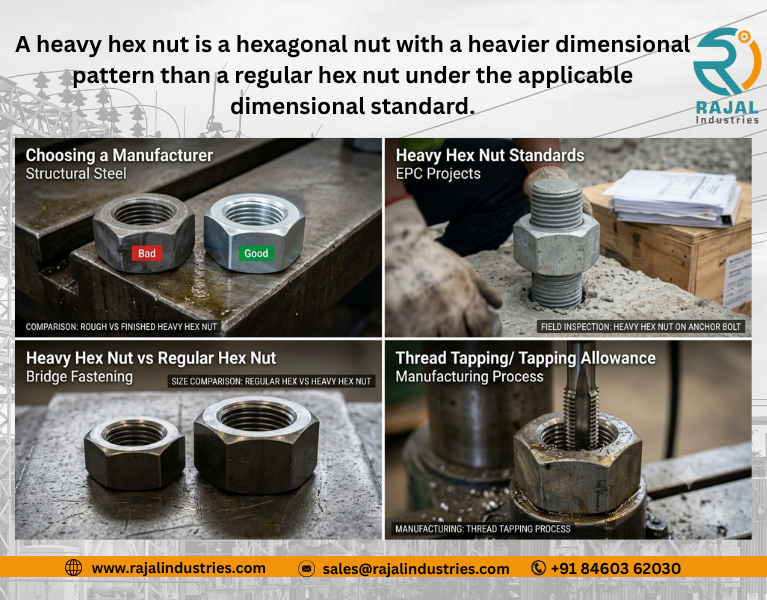
Choosing a reliable Heavy Hex Nut Manufacturer requires more than finding a supplier that can manufacture a large hexagonal nut.
Heavy hex nuts are used in demanding bolted assemblies where the applicable bolt, nut geometry, material, mechanical properties, threads, coating and project specification must work together.
For EPC, structural steel, PEB, bridges, infrastructure and heavy engineering projects, buyers should follow:
Application → Bolt/Stud → Thread → Nut Standard → Nut Grade → Dimensions → Material → Mechanical Properties → Finish → Testing → Documentation
A heavy hex nut should never be selected only from nominal diameter.
What Is a Heavy Hex Nut?
A heavy hex nut is a hexagonal nut with a heavier dimensional pattern than a regular hex nut under the applicable dimensional standard.
Depending on the specification, this generally means differences in characteristics such as:
- Width across flats
- Nut height
- Bearing area
- Overall geometry
The exact dimensions come from the applicable standard.
Heavy hex describes the nut’s dimensional form. It does not by itself define the material or mechanical grade.
What Is a Heavy Hex Nut?
A heavy hex nut is a larger hexagonal nut pattern used in specified structural, mechanical and heavy-duty bolted assemblies. The applicable standard defines its dimensions, while separate material and mechanical specifications define properties such as nut grade, proof-load requirements and material.
Heavy Hex Nut vs Regular Hex Nut
The difference should not be reduced to:
Heavy hex nut = stronger hex nut.
A better comparison is:
| Feature | Regular Hex Nut | Heavy Hex Nut |
| Hex Pattern | Regular | Heavy pattern |
| Width Across Flats | Standard-specific | Generally larger pattern |
| Nut Height | Standard-specific | Generally heavier pattern |
| Bearing Area | Product-specific | Generally larger geometry |
| Mechanical Grade | Separately specified | Separately specified |
| Application | General/OEM | Structural/heavy-duty where specified |
| Interchangeability | Drawing-controlled | Drawing-controlled |
The applicable standard and joint specification determine which product is required.
Heavy Hex Does Not Automatically Mean High Strength
This is one of the most important purchasing points.
Three separate questions must be answered:
1. What is the nut shape?
Heavy hex.
2. What is the material/mechanical grade?
Defined by the applicable material specification.
3. What bolt or stud is it used with?
Defined by the bolting system or project specification.
Therefore:
Heavy Hex Geometry ≠ Nut Grade ≠ Bolt Grade
All three must be specified correctly.
Why Heavy Hex Nuts Are Used
A heavy hex pattern can be specified where the bolting system requires a larger nut geometry.
Depending on the application and standard, the geometry can provide:
- Larger wrenching surfaces
- Greater bearing footprint
- Product geometry suitable for specified structural bolting systems
- Increased nut-body dimensions compared with regular patterns
However, geometry alone does not establish joint capacity.
Heavy Hex Nuts for Structural Steel
Structural steel connections may use heavy hex nuts as part of specified bolting assemblies.
Applications can include suitable:
- Steel structures
- Industrial buildings
- Equipment structures
- Platforms
- Towers
- Fabricated frames
- Structural connections
The engineer/project specification should define the approved:
Bolt + Nut + Washer + Coating + Installation + Testing
Do not substitute one component independently.
Heavy Hex Nuts for EPC Projects
EPC procurement can involve heavy hex nuts for:
- Structural packages
- Equipment foundations
- Steel fabrication
- Industrial plants
- Energy projects
- Petrochemical projects
- Utility infrastructure
- Heavy machinery
For EPC buyers, documentation can be as important as dimensional compliance.
Typical requirements may include:
- Material certificates
- Dimensional reports
- Mechanical test reports
- Heat/lot traceability
- Coating reports
- Third-party inspection where specified
Heavy Hex Nuts for PEB Structures
Pre-engineered building projects can involve large quantities of structural fasteners.
A PEB buyer should clearly separate:
- Primary structural bolting
- Secondary steel fastening
- Anchor systems
- General-purpose fastening
Not every connection requires the same heavy hex nut.
The structural design and approved fastener schedule should control.
Heavy Hex Nuts for Bridges
Bridge fastening requirements can be particularly specification-driven.
Potential considerations include:
- Structural bolting system
- Nut grade
- Bolt grade
- Weather exposure
- Corrosion protection
- Inspection
- Traceability
- Installation procedure
A supplier should not recommend a generic heavy hex nut solely because the application is a bridge.
The project specification must be controlled.
Heavy Hex Nuts for Infrastructure
Infrastructure applications can include suitable:
- Transport structures
- Industrial infrastructure
- Utility structures
- Steel platforms
- Heavy equipment supports
- Fabricated assemblies
Environmental conditions can vary significantly.
Therefore, corrosion protection and material requirements should be defined project by project.
Heavy Hex Nuts for Heavy Engineering
Heavy engineering applications may involve:
- Large machinery
- Equipment frames
- Presses
- Material-handling equipment
- Industrial plants
- Heavy fabricated assemblies
Selection should begin with the approved bolt or stud and joint design.
Heavy Hex Nut Standards
A heavy hex nut specification may involve multiple standards serving different purposes.
For example:
Dimensional Standard
Defines nut geometry.
Material/Mechanical Standard
Defines material, grade and mechanical requirements.
Coating Standard
Defines the specified protective finish.
Project Specification
Can add application-specific requirements.
This is why simply writing:
Heavy Hex Nut
is incomplete.
ASME B18.2.2 Heavy Hex Nuts
ASME B18.2.2-2022 is the current ASME standard for several inch-series nut forms.
It includes dimensional requirements for products such as:
- Hex nuts
- Heavy hex nuts
- Square nuts
- Heavy square nuts
- Hex flange nuts
- Coupling nuts
For an inch-series heavy hex nut, the buyer should identify the applicable dimensional requirement rather than assuming regular hex dimensions.
ASTM A563/A563M Heavy Hex Nuts
ASTM A563/A563M covers carbon and alloy steel nuts for general structural and mechanical use on:
- Bolts
- Studs
- Other externally threaded parts
The current active edition is ASTM A563/A563M-26.
The specification addresses chemical, mechanical and dimensional requirements for multiple nut grades.
ASTM A563 Nut Grades
ASTM A563/A563M includes multiple nut grades for different bolting requirements.
The correct grade should be selected from the applicable:
Bolt Specification + Surface Finish + Project Requirement + ASTM Requirements
Do not order simply:
without specifying the required grade and other necessary details.
ASTM A563 Grade Is Not Bolt Grade
This is another common RFQ problem.
The nut grade and bolt grade use different designation systems.
A buyer should not assume that:
Bolt Grade X = Nut Grade X
The applicable bolt specification or project specification should define the required compatible nut.
Heavy Hex Nut and Structural Bolt Compatibility
The nut must be mechanically suitable for the mating bolt.
Check:
Bolt Specification → Bolt Grade → Diameter → Thread → Surface Finish → Required Nut Grade → Nut Style
This is safer than selecting the nut independently.
Example of Specification Logic
A project may define:
Structural Bolt Specification → Compatible Nut Specification → Compatible Washer Specification
The procurement team should preserve this complete system.
Changing one component can affect:
- Mechanical compatibility
- Thread fit
- Coating
- installation
- project compliance
ASTM A354 Example
ASTM structural/mechanical bolting specifications can explicitly identify compatible nut grades and styles.
For example, ASTM A354 has historically specified A563 heavy hex nut combinations for its quenched-and-tempered alloy-steel fasteners depending on fastener grade and surface finish.
This demonstrates an important principle:
Select the nut from the mating fastener specification, not from appearance alone.
ASTM A194 Heavy Hex Nuts
ASTM A194/A194M is another important nut specification, but it serves a different application family.
The current ASTM A194/A194M-26 specification covers carbon steel, alloy steel and stainless steel nuts intended for:
High-pressure service, high-temperature service, or both.
Therefore:
ASTM A194 should not be used as a generic specification for every heavy hex nut.
ASTM A194 Grade 2H
Grade 2H is a well-known ASTM A194 nut grade used in appropriate bolting systems.
However:
Heavy Hex Nut ≠ Automatically ASTM A194 Grade 2H
The project, bolt/stud specification and service conditions must require it.
Structural Heavy Hex vs High-Temperature Heavy Hex
These application families should be separated.
| Application | Possible Specification Direction |
| General Structural/Mechanical | ASTM A563/A563M where applicable |
| High-Pressure/High-Temperature | ASTM A194/A194M where applicable |
| Customer-Specific Structural System | Project-approved specification |
| Custom Heavy Engineering | Drawing + mechanical requirements |
Do not use this table as a substitution chart. The approved project specification always controls.
Heavy Hex Nut Sizes
Heavy hex nuts can be supplied in inch or metric systems depending on the applicable standard.
Important size information includes:
- Nominal diameter
- Thread pitch/TPI
- Width across flats
- Nut height
- Bearing dimensions
- Chamfer
Inch Heavy Hex Nuts
For inch-series nuts, the buyer should identify:
- Nominal diameter
- UNC/UNF or specified thread series
- Thread class
- Dimensional standard
- Material specification
- Nut grade
- Finish
Example RFQ terminology might include:
3/4″-10 UNC Heavy Hex Nut
but this is still incomplete without the required nut grade, finish and applicable standards.
Metric Heavy Hex Nuts
Metric requirements should identify:
- Nominal diameter
- Pitch
- Product standard/drawing
- Mechanical requirement
- Material
- Finish
Do not convert an inch heavy hex nut to the nearest metric diameter without engineering approval.
Heavy Hex Nut Dimensions
Important dimensions include:
Thread Diameter
Must match the mating bolt or stud.
Thread Pitch
Must match the mating thread.
Width Across Flats
Controls wrench/socket interface and heavy-hex geometry.
Nut Height
Important for thread engagement and product form.
Width Across Corners
Relevant to geometry and tool clearance.
Bearing Surface
Interfaces with the washer or connected component.
Exact values must follow the applicable standard or approved drawing.
Why Width Across Flats Matters
A heavy hex nut typically requires a different wrench/socket envelope than a regular hex nut of the same nominal thread.
This affects:
- Tool selection
- Site installation
- Fabrication access
- Equipment clearance
- Automated tightening
Designers should consider tool access early.
Why Nut Height Matters
Nut height influences:
- Available thread engagement
- Product geometry
- Bolt protrusion
- Assembly clearance
However:
A taller nut does not automatically mean a stronger joint.
Mechanical requirements still come from the applicable specification.
Heavy Hex Nut Materials
Depending on the applicable specification, heavy hex nuts may use:
- Carbon steel
- Alloy steel
- Weathering steel grades where specified
- Stainless steel for suitable specifications/applications
- Customer-specified materials
Material selection must follow the governing nut specification.
Carbon Steel Heavy Hex Nuts
Carbon steel can be used in applicable structural and mechanical nut grades.
Selection depends on:
- Mechanical requirements
- Bolt specification
- Environment
- coating
- project specification
Do not specify only:
Carbon Steel Heavy Hex Nut.
Alloy Steel Heavy Hex Nuts
Alloy steel can be required for particular mechanical or service conditions.
The applicable grade controls:
- Chemistry
- Heat treatment
- hardness
- proof requirements
- other mechanical characteristics
Do not infer alloy steel solely from the words “heavy duty.”
Weathering Applications
Certain nut grades can have enhanced atmospheric corrosion characteristics where the relevant specification permits them.
These should be selected as part of a compatible weathering-steel bolting system.
Do not substitute a weathering nut into a normal bolting system without engineering approval.
Stainless Heavy Hex Nuts
Stainless heavy-pattern nuts can be required under suitable standards or customer specifications.
Selection should consider:
- Stainless grade
- Mechanical properties
- Mating fastener
- Corrosion environment
- Galling
- project specification
Do not assume:
Stainless = A4/316.
Heavy Hex Nut Mechanical Properties
Important mechanical characteristics can include, depending on the applicable standard:
- Proof-load capability
- Hardness
- Material chemistry
- Heat-treatment condition
These are controlled by the nut specification and grade.
Proof Load
Proof-load testing is an important nut verification method under applicable specifications.
It helps verify the nut’s ability to withstand a specified axial loading condition without unacceptable failure under the standard test.
But:
Nut Proof Load ≠ Allowable Joint Load
The complete connection must be designed separately.
Hardness
Hardness can help verify compliance with applicable nut-grade requirements.
However, hardness alone does not prove complete compliance.
The supplier may also need to verify:
- Chemistry
- proof load
- dimensions
- threads
- heat treatment
- coating
depending on the specification.
Heat Treatment
Some heavy hex nut grades require controlled heat treatment to achieve specified mechanical properties.
Heat-treatment control can involve:
- Furnace process
- temperature/time controls
- lot traceability
- hardness verification
- mechanical testing
The exact requirements come from the applicable standard.
Heavy Hex Nut Threads
Thread accuracy is critical because the nut must work with the specified structural bolt or stud.
Verify:
Diameter + Pitch/TPI + Thread Series + Thread Tolerance/Class + Coating Condition
Coarse Threads
Structural bolting commonly uses specified coarse thread systems in many applications.
However, the actual bolt specification controls.
Do not convert a fine-thread or special-thread design to coarse thread simply because coarse threads are more commonly available.
Thread Fit
Correct thread fit is necessary for:
- Assembly
- mechanical performance
- installation
- inspection
A nut that starts on the bolt is not automatically compliant.
Thread gauging should follow the specified system.
Heavy Hex Nut Surface Finishes
Possible finishes can include, where specified:
- Plain
- Zinc-based coatings
- Hot-dip galvanizing
- Mechanical galvanizing
- Other project-approved coating systems
The exact coating must follow the nut/bolt/project specification.
Plain Heavy Hex Nuts
Plain finish can be specified where:
- The project requires it
- The environment allows it
- Additional field coating is applied
- The bolting system specifies plain components
Plain should not be interpreted as poor quality.
It is a finish condition.
Galvanized Heavy Hex Nuts
Outdoor infrastructure and structural projects may require galvanized bolting.
However, galvanizing threaded fasteners requires a compatible bolt-and-nut thread system.
The nut may require specific thread allowance/processing according to the governing specification.
Do not simply galvanize a finished plain nut and assume the thread remains compliant.
Hot-Dip Galvanizing and Nut Threads
Hot-dip galvanizing creates a relatively thick zinc coating.
For mating threads, the bolt and nut must be manufactured and processed as a compatible system.
Important controls can include:
- Thread allowance
- coating process
- nut tapping/over-tapping where specified
- coating thickness
- mating compatibility
The applicable standards should control the details.
Coating Can Change Nut Grade Selection
This is especially important in ASTM bolting systems.
The compatible nut grade/style can depend not only on the bolt grade but also on the surface finish.
Therefore:
Never change from plain to galvanized after nut selection without checking the governing bolting specification.
Heavy Hex Nut Manufacturing Process
A typical manufacturing route can include:
Raw Material → Cutting/Preparation → Hot or Cold Forming as Applicable → Piercing → Threading/Tapping → Heat Treatment if Required → Surface Finish → Inspection → Mechanical Testing → Marking → Packing
The actual route depends on:
- Size
- grade
- material
- quantity
- standard
- manufacturing capability
Hot Forged Heavy Hex Nuts
Hot forging can be suitable for certain:
- Larger sizes
- materials
- grades
- production quantities
The process must still achieve the required:
- Dimensions
- mechanical properties
- thread quality
- surface quality
Cold Formed Heavy Hex Nuts
Cold-forming processes can be suitable for certain size ranges and production volumes where technically feasible.
The selected manufacturing route should be based on the product requirements, not marketing preference.
Machined Heavy Hex Nuts
Machining may be considered for:
- Low quantities
- prototypes
- special dimensions
- special materials
where appropriate.
But machining is not automatically the preferred mass-production process.
Heavy Hex Nut Marking
Certain standards/grades require specific identification markings.
Marking can help identify:
- Manufacturer
- Nut grade
- Other specification-required information
The actual marking requirement should come from the governing standard.
Do not invent customer-independent markings.
Why Traceability Matters
For structural and EPC projects, buyers may need to trace a delivered nut back to:
- Raw material
- Heat number
- Production lot
- Heat treatment
- Test reports
- coating lot
Traceability requirements should be defined before production.
Heavy Hex Nut Inspection
A quality plan can include:
Material → Dimensions → Thread → Mechanical Properties → Heat Treatment → Coating → Marking → Traceability → Packing
Dimensional Inspection
Important checks can include:
- Thread
- Width across flats
- Nut height
- bearing geometry
- chamfer
- other standard-defined dimensions
Use the applicable standard/drawing.
Thread Gauging
Depending on the specified thread system, calibrated thread gauges can be used to verify internal threads.
Inspection must consider the final product condition, particularly where coating affects thread fit.
Mechanical Testing
Depending on grade and specification, testing may include:
- Proof load
- Hardness
- Other required mechanical verification
The standard controls the test method and acceptance criteria.
Chemical Verification
Material chemistry may need verification against the specified nut grade.
Depending on the project, documentation can include:
- Mill certificate
- Material test certificate
- Laboratory results
Coating Inspection
Where coated nuts are specified, inspection may include applicable:
- Coating thickness
- Appearance
- adhesion where specified
- corrosion-related testing
- thread fit
Project requirements should define acceptance.
Heavy Hex Nut Documentation for EPC Buyers
A procurement package may require:
☐ Material Test Certificate
☐ Chemical Test Report
☐ Mechanical Test Report
☐ Dimensional Inspection Report
☐ Thread Inspection
☐ Heat-Treatment Records where applicable
☐ Coating Report where applicable
☐ Lot/Heat Traceability
☐ Certificate of Conformity
☐ Third-Party Inspection where specified
Not every project requires every document.
The PO/ITP should define the requirement.
Inspection and Test Plan
For major EPC projects, the customer may issue an ITP defining:
- Review points
- witness points
- hold points
- inspection stages
- testing
- documentation
The manufacturer should review the ITP before production starts.
Third-Party Inspection
Projects may require inspection by an approved third-party agency.
Possible activities include:
- Material verification
- dimensional inspection
- witness of mechanical testing
- coating inspection
- document review
- final release
This should be agreed before manufacturing.
Heavy Hex Nut Packaging
Packaging should protect:
- Threads
- coating
- identification
- traceability
For EPC/site deliveries, packaging can also separate nuts by:
- Size
- grade
- heat/lot
- project
- PO
Mixing grades or lots can create serious site-control problems.
Common Heavy Hex Nut Procurement Mistakes
Avoid:
- Ordering only by diameter.
- Confusing heavy hex geometry with mechanical grade.
- Ordering ASTM A563 without the required grade.
- Assuming every heavy hex nut is ASTM A194 2H.
- Ignoring the mating bolt specification.
- Changing coating without checking nut compatibility.
- Mixing inch and metric systems.
- Ignoring thread pitch/TPI.
- Assuming galvanized nuts use the same finished thread condition as plain nuts.
- Approving only by hardness.
- Ignoring marking.
- Ignoring lot traceability.
- Using generic torque values.
- Substituting nut grades without engineering/project approval.
Heavy Hex Nut Is Not a Generic “Heavy Duty Nut”
The phrase Heavy Duty Nuts is useful commercially, but engineering specifications should use the actual:
Product Style + Standard + Grade + Thread + Finish
For example:
Heavy Hex Nut, applicable dimensional standard, specified ASTM grade, thread and coating.
This is much clearer than:
Heavy-duty nut.
Heavy Hex Nut vs Structural Nut
“Structural nut” describes the application category.
“Heavy hex nut” describes a nut geometry.
A structural nut can use heavy hex geometry when the applicable structural bolting specification requires it.
Do not treat the two terms as exact synonyms.
Heavy Hex Nut vs High Hex Nut
These terms should also be kept separate.
A heavy hex nut generally refers to a heavier hexagonal dimensional pattern in standards such as inch-series structural/mechanical systems.
A high hex nut generally refers to increased nut height under other product-standard systems.
Do not translate one term into the other automatically.
Heavy Hex Nut vs ASTM A194 2H Nut
ASTM A194 Grade 2H defines a material/mechanical grade within a high-pressure/high-temperature nut specification.
“Heavy hex” describes geometry.
A product may be both:
Heavy Hex + ASTM A194 Grade 2H
when required.
But the terms are not interchangeable.
Heavy Hex Nut vs ASTM A563 Nut
ASTM A563/A563M defines nut material/mechanical requirements for general structural and mechanical uses.
Heavy hex is one possible nut style used within applicable A563 bolting combinations.
Again:
Specification and geometry are separate pieces of information.
How EPC Buyers Should Specify Heavy Hex Nuts
Use this sequence:
Step 1
Identify the mating bolt/stud specification.
Step 2
Identify the bolt grade.
Step 3
Identify nominal diameter and thread.
Step 4
Determine the required compatible nut specification.
Step 5
Determine nut grade.
Step 6
Confirm heavy hex geometry/dimensional standard.
Step 7
Specify finish.
Step 8
Specify testing.
Step 9
Specify marking and traceability.
Step 10
Specify documentation.
Example Heavy Hex Nut RFQ
Product: Heavy Hex Nut
Application: Structural steel project
Mating Bolt: Specification/drawing attached
Thread: As attached
Nut Standard/Grade: Project specification attached
Dimensional Standard: Applicable controlled standard
Finish: Project coating specification
Testing: As ITP
Documentation: MTC + dimensional + mechanical reports
Traceability: Heat/lot required
Quantity: 100,000 pcs
This is much safer than:
Quote 100,000 heavy hex nuts.
What Is a Heavy Hex Nut?
A heavy hex nut is a larger hexagonal nut pattern defined by an applicable dimensional standard. Its geometry is separate from its material and mechanical grade, so buyers must specify the nut standard, grade, thread, finish and mating bolt.
Are Heavy Hex Nuts Stronger Than Regular Hex Nuts?
Not automatically. Heavy hex describes the nut’s geometry. Actual mechanical capability depends on the nut grade, material, heat treatment, proof-load requirements, thread and mating bolt specification.
What Standard Covers Heavy Hex Nuts?
For inch-series dimensions, ASME B18.2.2-2022 includes heavy hex nuts. Material and mechanical requirements may come from specifications such as ASTM A563/A563M for applicable structural/mechanical uses or ASTM A194/A194M for applicable high-pressure/high-temperature service.
What Is ASTM A563?
ASTM A563/A563M is a specification for carbon and alloy steel nuts used for general structural and mechanical applications on bolts, studs and other externally threaded parts. The required nut grade must be specified for the intended bolting system.
Is Every Heavy Hex Nut ASTM A194 Grade 2H?
No. Heavy hex identifies geometry, while ASTM A194 Grade 2H identifies a particular nut grade within a high-pressure/high-temperature specification. A nut should be specified as 2H only when the bolting system or project requires it.
Can Heavy Hex Nuts Be Galvanized?
Yes, where the applicable bolting specification permits and defines the coating system. Galvanized threaded assemblies require compatible nut and bolt thread processing, so coating should be specified as part of the complete bolting system.
What Information Should Be Sent to a Heavy Hex Nut Supplier?
Send the mating bolt or stud specification, diameter, thread, nut standard, nut grade, dimensional standard, material requirements, coating, testing, marking, traceability, documentation and quantity.
Buyer Checklist Before Ordering
Before approving a Heavy Hex Nut Supplier, confirm:
☐ Application
☐ Bolt/stud specification
☐ Bolt/stud grade
☐ Nominal diameter
☐ Inch or metric
☐ Thread pitch/TPI
☐ Thread class/tolerance
☐ Nut dimensional standard
☐ Heavy hex style
☐ Nut material specification
☐ Nut grade
☐ Mechanical requirements
☐ Heat treatment
☐ Surface finish
☐ Coating specification
☐ Bolt/nut coating compatibility
☐ Marking
☐ Proof-load testing
☐ Hardness testing
☐ Material chemistry
☐ Dimensional inspection
☐ Thread gauging
☐ Heat/lot traceability
☐ MTC
☐ Mechanical test report
☐ Coating report
☐ ITP
☐ Third-party inspection if required
☐ Packaging
☐ Quantity
☐ Annual/project demand
Heavy Hex Nut Selection Starts With the Bolting System
Choosing a Heavy Hex Nut Manufacturer is not simply a matter of sourcing a larger hex nut.
The correct sequence is:
Application → Bolt/Stud → Grade → Thread → Nut Specification → Nut Grade → Heavy Hex Dimensions → Finish → Washer → Installation → Testing → Traceability
The key engineering principle is:
Heavy Hex = Geometry. It does not automatically define strength, grade or application.
A heavy hex nut can have the correct external dimensions and still be unsuitable if:
- The wrong nut grade is selected.
- It does not match the mating bolt.
- The thread is incorrect.
- Coating compatibility is ignored.
- Heat treatment is incorrect.
- Proof-load requirements are not met.
- Site installation does not follow the approved procedure.
- Traceability is lost.
For structural steel, EPC, PEB, bridges, infrastructure and heavy engineering projects, the complete Structural Fasteners system should be reviewed before procurement.
Rajal Industries can evaluate standard and customer drawing-based Heavy Hex Nuts, Structural Nuts and related heavy-duty fastener requirements, subject to technical feasibility, material availability, manufacturing process, tooling, testing and customer/project approval.
Looking for a Heavy Hex Nut Manufacturer in India?
Send Rajal Industries:
Drawing + Bolt/Stud Specification + Nut Standard + Nut Grade + Thread + Finish + Testing + ITP + Documentation + Quantity
for technical feasibility and quotation review.