

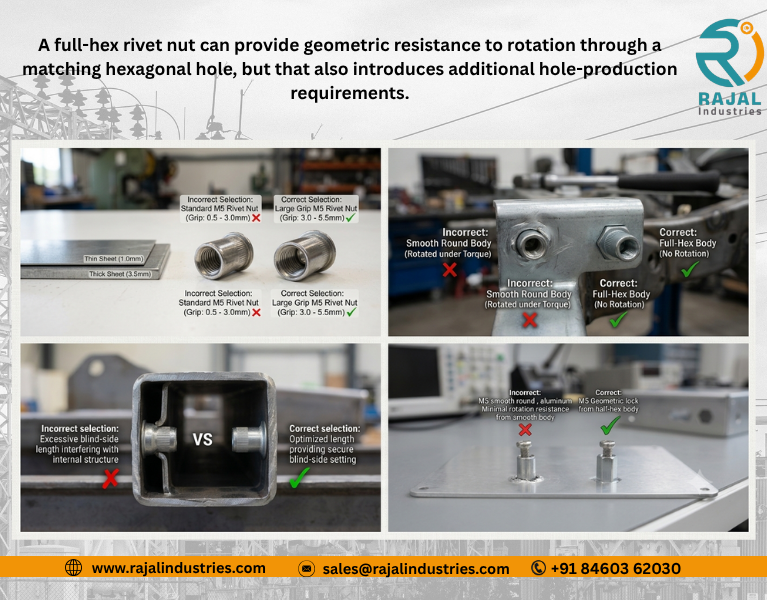
Selecting the correct Rivet Nut Sizes requires much more than choosing an M4, M5, M6 or M8 thread.
A rivet nut must match both sides of the assembly:
Mating Screw Side + Parent Material Side
That means OEM engineers and buyers should evaluate:
Thread Size → Thread Pitch → Sheet Material → Sheet Thickness → Grip Range → Hole Size → Body Style → Head Style → Material → Finish → Installation Tool → Functional Requirement
This is especially important for automotive, HVAC, electronics, appliances, machinery and fabricated sheet-metal assemblies.
Current commercial ranges demonstrate why a single universal rivet-nut dimension chart should not be used. Böllhoff, for example, lists different body lengths and grip ranges within the same thread size depending on product construction. (Böllhoff Media)
Quick Answer: What Size Rivet Nut Do I Need?
Choose a rivet nut by matching the internal thread to the mating screw and the grip range to the actual parent-material thickness.
Then verify:
- Mounting-hole size
- Body diameter
- Body style
- Head style
- Material
- Finish
- Blind-side clearance
- Installation tooling
- Required mechanical performance
An M6 thread alone is not enough information to select the correct rivet nut.
What Does Rivet Nut Size Mean?
When someone asks for a “rivet nut size,” they may be referring only to the internal thread.
Technically, several dimensions matter.
A rivet nut specification can include:
Thread Diameter
Example:
M6
Thread Pitch
Example:
M6 × 1.0
Body Diameter
The outside diameter of the insert body.
Overall Length
Length before installation.
Head Diameter
Outside diameter of the flange/head.
Head Height
Projection of the head above the parent material.
Grip Range
Parent-material thickness range for which the insert is designed.
Mounting Hole
Required hole through the parent material.
Blind-Side Projection
Space required behind the sheet after installation.
Therefore:
Thread size is only one part of Rivet Nut Sizes.
Common Metric Rivet Nut Thread Sizes
Commercial Threaded Rivet Nut ranges commonly include sizes such as:
| Metric Thread | Common Coarse Pitch |
| M3 | 0.5 mm |
| M4 | 0.7 mm |
| M5 | 0.8 mm |
| M6 | 1.0 mm |
| M8 | 1.25 mm |
| M10 | 1.5 mm |
| M12 | 1.75 mm |
These thread sizes are useful starting points for selection.
However, product availability depends on:
- Manufacturer
- Body style
- Head style
- Material
- Grip range
- Product family
For example, current Böllhoff engineering data includes metric RIVNUT products from M3 through M12. (Rivet Nut USA)
Do not interpret this as a universal range for every Rivnut Manufacturer.
M3 Rivet Nut
M3 rivet nuts can be considered for smaller assemblies such as suitable:
- Electronics
- Light enclosures
- Small brackets
- Instrumentation
- Light sheet-metal components
Before choosing M3, check:
- Available sheet thickness
- Hole requirement
- Setting-tool capability
- Screw engagement
- Required load
Small thread size does not eliminate the need for grip-range selection.
M4 Rivet Nut
M4 is frequently considered for:
- Electronics housings
- Electrical equipment
- Appliance panels
- Small brackets
- HVAC controls
- Light machinery covers
A buyer should specify:
M4 × 0.7 + Grip Range + Hole + Body + Head + Material + Finish
rather than simply requesting “M4 rivet nut.”
M5 Rivet Nut
M5 rivet nuts can suit many medium-duty sheet-metal attachment applications.
Potential uses include:
- Enclosures
- HVAC equipment
- Machinery guards
- Appliance frames
- Automotive brackets
- Electronics cabinets
Again, M5 describes the internal thread, not the complete insert.
M6 Rivet Nut
M6 is a common size in industrial sheet-metal assemblies.
Potential applications include:
- Automotive brackets
- Machinery
- HVAC equipment
- Fabricated structures
- Industrial enclosures
- Equipment frames
But there is no single universal M6 rivet nut.
Different M6 products can have different:
- Grip ranges
- Hole sizes
- Body lengths
- Head diameters
- Materials
- Setting requirements
M8 Rivet Nut
M8 rivet nuts may be considered where a larger mating fastener is required.
Possible applications include suitable:
- Machinery
- Automotive equipment
- Fabricated frames
- Industrial equipment
- Structural accessories
The actual joint requirement should determine whether M8 is appropriate.
Do not select a larger rivet nut simply because it appears stronger.
M10 and M12 Rivet Nuts
Larger Rivet Nut Sizes such as M10 and M12 are available in some commercial product families.
They may be used in suitable:
- Machinery
- Heavy fabricated equipment
- Vehicle equipment
- Frames
- Industrial structures
However, larger inserts also require consideration of:
- Larger mounting holes
- More installation capacity
- Parent-material behaviour
- Blind-side space
- Tool accessibility
Böllhoff’s current engineering information includes M10 and M12 products, but dimensions and performance depend on the exact product family. (Böllhoff Media)
Bigger Rivet Nut Does Not Automatically Mean Better
A common purchasing mistake is:
“The M6 failed, so use M8.”
That may not solve the actual problem.
Failure may come from:
- Oversized hole
- Incorrect grip range
- Poor installation
- Weak parent material
- Wrong body style
- Incorrect screw torque
- Insufficient bearing area
Determine the root cause before increasing size.
Rivet Nut Size Selection Table
| Size | Typical Application Direction | Important Check |
| M3 | Electronics / small equipment | Thin material + small hole |
| M4 | Panels / appliances | Grip + installation |
| M5 | Enclosures / HVAC | Hole + body style |
| M6 | Automotive / machinery | Grip + anti-rotation |
| M8 | Machinery / fabrication | Sheet + tool capacity |
| M10 | Industrial equipment | Hole + parent material |
| M12 | Larger equipment | Tooling + joint design |
This table is an application guide only.
It is not a universal engineering rating for each thread size.
What Is Rivet Nut Grip Range?
Rivet Nut Grip Range is the total parent-material thickness range for which a specific rivet nut is designed to set correctly.
For example:
Grip Range: 0.5–3.0 mm
means the specific insert is designed for an approved material stack within that thickness range.
Grip range is one of the most important specifications in rivet-nut selection.
Grip Range Is Not the Same as Body Length
These two values are related, but they are not interchangeable.
Body Length
Physical overall length of the rivet nut before setting.
Grip Range
Thickness range of the material the insert is designed to grip.
Never estimate grip range from body length alone.
Current Grip Range Example
Current Böllhoff RIVKLE technical data provides a useful example.
Within one stainless semi-hexagonal closed-end family:
- M5 versions include grip ranges such as 0.5–3.0 mm and 3.0–4.5 mm
- M6 versions include 0.5–3.0 mm and 3.0–5.5 mm
- M8 includes a 1.5–5.0 mm version
- M10 includes different versions such as 1.0–3.5 mm and 2.5–5.5 mm
These figures apply to those specific Böllhoff products. They are not universal values for all M5, M6, M8 or M10 rivet nuts. (Böllhoff Media)
Why the Same Thread Has Different Grip Ranges
Consider two M6 rivet nuts:
M6 Insert A: designed for thinner sheet
M6 Insert B: designed for thicker sheet
Both accept the same nominal mating screw.
But their body geometry and length can be different.
This is why OEM drawings should identify the correct product or grip requirement.
How Grip Range Works During Installation
Before setting, the rivet nut passes through the mounting hole.
During installation:
Tool Pulls → Deformation Zone Collapses/Bulges → Blind Side Forms → Sheet Is Captured
The deformation must occur correctly around the actual parent-material thickness.
If thickness is outside the designed range, the deformation may not produce the intended retention.
Minimum Grip
The minimum grip defines the lower end of the approved parent-material thickness range.
If the sheet is too thin for the selected product, possible problems include:
- Excessive deformation
- Loose installation
- Poor seating
- Panel distortion
- Reduced functional performance
Maximum Grip
The maximum grip defines the upper end of the product’s intended thickness range.
If the material is too thick:
- The body may not deform sufficiently
- The insert may remain loose
- Retention can be inadequate
- Installation can become inconsistent
Select the correct grip range rather than forcing the wrong product to work.
Grip Range Can Include More Than One Layer
The relevant thickness can sometimes include a stack of material rather than one single sheet.
Böllhoff’s RIVKLE documentation defines grip range as the total thickness of the customer’s part, including situations where it consists of more than one layer. (Böllhoff Media)
However, the actual stack should still be evaluated because:
- Layers can move
- Gaps may exist
- Materials can differ
- Coatings can affect the interface
Test the representative assembly.
Measure Production Parts, Not Only CAD
A drawing may specify:
2.0 mm sheet
but real production parts have tolerances.
Depending on the assembly, also consider:
- Coating
- Paint
- Plating
- Multiple layers
- Formed regions
Selection should cover the approved production condition.
Rivet Nut Grip Range Selection Example
Suppose the parent material measures:
2.0 mm
The wrong approach is:
“Any M6 rivet nut will work.”
The correct approach is:
- Select required thread.
- Confirm actual material thickness.
- Find a product whose approved grip range contains that thickness.
- Confirm mounting hole.
- Check body and head.
- Validate installation.
Avoid Selecting at the Grip-Range Boundary Without Review
Suppose the panel thickness is very close to the manufacturer’s maximum grip.
Production tolerance could push some parts outside the approved range.
For high-volume OEM production, review:
Nominal Thickness + Minimum Thickness + Maximum Thickness
against the selected product.
Rivet Nut Grip Range vs Sheet Thickness
| Condition | Possible Result |
| Sheet below minimum grip | Incorrect deformation / loose fit |
| Sheet within grip range | Intended installation condition |
| Sheet near limit | Tolerance review needed |
| Sheet above maximum grip | Incomplete setting |
| Variable sheet stack | Wider/appropriate grip strategy needed |
Always use product-specific data.
What Is Rivet Nut Hole Size?
The mounting hole is the opening through which the rivet-nut body is inserted.
It must match the actual product.
The hole is generally larger than the internal thread because it must accommodate the outside body of the insert.
Therefore:
M6 thread does not mean a 6 mm mounting hole.
Product-Specific Hole Example
Current commercial data illustrates this clearly.
A typical steel knurled M6 family may use a hole around 9 mm, while M8 can use approximately 11 mm and M10 approximately 13 mm in that particular product design.
Other rivet-nut families can use different mounting-hole dimensions.
Therefore, these values should never be copied into an OEM drawing without confirming the exact insert. (Rivet-Expert)
Why Hole Size Matters
The hole affects:
- Insert fit
- Centering
- Rotation resistance
- Setting
- Retention
- Production repeatability
Hole tolerance is therefore part of the fastener system.
Oversized Hole
An oversized hole can contribute to:
- Movement
- Reduced engagement
- Insert spinning
- Poor setting
- Inconsistent retention
Before changing the rivet nut, inspect the production hole.
Undersized Hole
An undersized hole can cause:
- Difficult insertion
- Coating damage
- Body damage
- Forced assembly
- Panel distortion
Do not hammer the insert into the panel.
Rivet Nut Body Diameter
Body diameter is different from thread diameter.
For example:
M6 internal thread
may require a body significantly larger than 6 mm.
The mounting hole is selected from the rivet-nut body design, not directly from the thread.
Hole Tolerance
A complete drawing should specify the mounting-hole requirement with appropriate tolerance.
Do not write only:
Hole approximately 9 mm.
For production, the exact requirement should come from:
- Approved product drawing
- Manufacturer data
- Validated custom design
Round Hole vs Hex Hole
The correct hole shape depends on Rivet Nut Types.
Round Body
Uses a round mounting hole.
Full Hex Body
Uses a matching hexagonal hole.
Half-Hex Body
Uses the corresponding manufacturer-specified geometry.
Hole and insert should be selected together.
Main Rivet Nut Types
Rivet nuts can be classified by:
Body
- Smooth round
- Knurled/ribbed round
- Full hex
- Half hex
- Specialized slotted designs
Head
- Standard/flat flange
- Large flange
- Thin/reduced head
- Countersunk head
End
- Open
- Closed
Material
- Steel
- Stainless steel
- Aluminium
Current Böllhoff literature illustrates flat, thin and countersunk heads together with plain, knurled and hexagonal body styles and open/closed options. (Böllhoff Media)
Smooth Round Rivet Nut
A smooth cylindrical body allows comparatively simple round-hole preparation.
Potential advantages:
- Simple hole manufacturing
- Easy insertion
- Wide application possibilities
The required anti-rotation performance must still be validated.
Knurled Rivet Nut
Knurling or ribbing increases interaction between the body and suitable parent material.
It can be considered when:
- A round hole is preferred
- Additional resistance to rotation is required
But:
Knurled does not mean spin-proof.
Hole quality, sheet material and installation remain important.
Full-Hex Rivet Nut
A full-hex body engages mechanically with a matching hexagonal hole.
This can provide strong geometric resistance to rotation.
Potential disadvantages include:
- More complex hole preparation
- Additional tooling requirements
Use it when the application justifies the manufacturing complexity.
Half-Hex Rivet Nut
A half-hex design provides hexagonal engagement over part of the body.
Commercial ranges use this configuration for applications requiring anti-rotation performance with specific installation geometry.
The exact dimensions should follow the manufacturer’s drawing.
Standard or Flat Head Rivet Nut
A standard flange provides bearing against the front surface.
It can suit many general sheet-metal applications.
Check:
- Head diameter
- Head height
- Available space
- Parent-material strength
Large-Flange Rivet Nut
A larger flange increases the visible-side bearing area.
It can be useful with suitable:
- Thin sheet
- Softer materials
- Larger bearing requirements
However, it also requires more surface clearance.
Reduced-Head Rivet Nut
A reduced or thin head decreases projection and visible flange size.
It can help where:
- Clearance is limited
- A lower-profile assembly is desired
But the reduced bearing area must suit the application.
Countersunk Rivet Nut
A countersunk design can provide a lower-profile installation when the parent material is correctly prepared.
Do not create a generic countersink.
The countersink:
- Diameter
- Angle
- Depth
- Remaining sheet thickness
should match the approved product.
Open-End Rivet Nut
An open-end insert allows the mating screw to extend through the body when assembly geometry permits.
Check blind-side clearance and screw length.
Closed-End Rivet Nut
A closed-end design prevents the mating screw from projecting through the bottom of the insert.
It can also be useful in applications requiring a more closed fastener construction.
However:
Closed-end does not automatically mean waterproof or pressure-tight.
If sealing matters, specify and test sealing separately.
Rivet Nut Material Selection
Common commercial materials include:
- Steel
- Stainless steel
- Aluminium
Böllhoff’s RIVNUT engineering data publishes mechanical information for aluminium, steel and stainless steel products, confirming that material is an important product-selection variable. (Rivet Nut USA)
Steel Rivet Nuts
Steel can be a practical choice for many:
- Automotive
- HVAC
- Machinery
- Appliance
- Fabrication
applications.
Consider:
- Mechanical requirement
- Corrosion protection
- Setting load
- Parent material
- Cost
Stainless Steel Rivet Nuts
Stainless steel can be selected where the application requires suitable corrosion resistance.
Consider:
- Stainless grade
- Environment
- Setting-tool capacity
- Parent material
- Mating screw
- Cost
Do not assume “stainless” automatically means A4 or 316.
Aluminium Rivet Nuts
Aluminium can be useful where:
- Low mass is important
- Lower setting effort is useful
- Aluminium assemblies are involved
But mechanical performance should still be validated.
Material Does Not Define Strength Alone
Two rivet nuts made from the same broad material category can have different performance because of:
- Geometry
- Wall thickness
- Manufacturing
- Material condition
- Installation
- Parent material
Do not select only from the words:
Steel / Stainless / Aluminium
Rivet Nut Material Selection Matrix
| Requirement | Possible Direction | Must Verify |
| General Industrial | Steel | Finish + performance |
| Outdoor | Coated steel/stainless | Environment |
| Lightweight | Aluminium | Mechanical requirement |
| Corrosive Environment | Suitable stainless/coating | Actual exposure |
| Automotive | Drawing-specified | OEM validation |
| HVAC | Steel/stainless/aluminium | Environment + sheet |
| Electronics | Application-specific | Space + material |
| Machinery | Steel/stainless | Load + installation |
This is a screening guide, not a material specification.
Surface Finish
Depending on the product, steel rivet nuts may use corrosion-protection systems such as:
- Zinc-based coatings
- Zinc-nickel
- Other customer-specified finishes
Finish selection should consider:
Environment + Parent Material + Mating Screw + Corrosion Requirement + Dimensional Fit
Coating Can Affect Dimensions
A surface treatment adds material to the fastener.
For tight-fit products, coating can influence:
- Body diameter
- Thread
- Tool engagement
- Hole fit
Finished production parts should therefore be included in validation.
Parent Material Matters
A rivet nut interacts directly with the parent material.
Common parent materials include:
- Mild steel
- High-strength steel
- Stainless steel
- Aluminium
- Hollow profiles
- Suitable plastics/composites
The same insert can perform differently in each.
Thin Sheet Metal
Rivet nuts are particularly useful where thin sheet cannot provide enough material for a useful directly tapped thread.
But thin sheet can also be more sensitive to:
- Distortion
- Pull-through
- Local bearing
- Hole deformation
Head and body selection should therefore be validated.
Rivet Nut in Aluminium Sheet
Check:
- Aluminium grade
- Sheet thickness
- Hole
- Body style
- Insert material
- Corrosion compatibility
- Functional performance
Do not select solely from thread size.
Rivet Nut in Stainless Steel Sheet
Consider:
- Sheet hardness
- Hole production
- Installation force
- Tool capacity
- Insert material
- Corrosion
- Functional retention
A stainless panel does not automatically require a stainless rivet nut.
Rivet Nuts in Hollow Sections
A Threaded Rivet Nut is especially useful when the back side of a box or tube cannot be reached.
Potential applications include:
- Machinery frames
- Fabricated structures
- Equipment frames
- Vehicle structures
However, sufficient blind-side clearance is still required for deformation.
Blind-Side Clearance
One-side access does not mean the insert needs no space behind the sheet.
During setting, the body deforms on the blind side.
The designer should check:
- Internal wall
- Nearby bracket
- Tube depth
- Component clearance
Böllhoff technical data explicitly identifies blind-side projection as a relevant installed dimension. (Böllhoff Media)
Head-Side Clearance
Also check:
- Flange diameter
- Tool nose diameter
- Nearby bends
- Brackets
- Panel edges
- Other fasteners
A rivet nut may physically fit the hole while the installation tool cannot reach it.
Rivet Nut Installation Methods
Industrial rivet-nut installation can use different controlled methods.
Böllhoff documentation describes stroke and pressure/force-based setting approaches depending on tooling and application. (https://eshop-hu.boellhoff.com/)
The correct process should follow the selected product and installation system.
Stroke-Controlled Setting
With a stroke-controlled approach, tool movement is adjusted to achieve the required deformation.
This can work well in controlled applications with consistent material thickness.
Incorrect stroke can result in:
- Under-setting
- Over-setting
- Sheet deformation
- Thread damage
Force/Pressure-Controlled Setting
A force-controlled system controls the setting action according to the required installation force.
Böllhoff notes this approach can be particularly useful where workpiece thickness varies. (https://eshop-hu.boellhoff.com/)
Again, the correct value is product-specific.
No Universal Rivet Nut Setting Force
Avoid internet tables that imply:
All M6 rivet nuts use one setting force.
The correct requirement depends on:
- Insert geometry
- Material
- Sheet
- Grip
- Tooling
Use validated manufacturer or customer data.
Rivet Nut Size vs Installation Tool
As rivet-nut size and material change, installation-tool requirements can also change.
A tool suitable for a small aluminium insert may not have sufficient capability for a larger stainless product.
Check:
- Thread capacity
- Pull/setting capability
- Mandrel
- Nosepiece
- Access
- Production rate
Mating Screw Compatibility
After installation, the rivet nut becomes the female thread for the mating screw.
Confirm:
Thread Diameter + Pitch + Thread Fit + Screw Length + Screw Material + Finish
Do not approve the insert independently from the mating screw.
Screw Length
Screw length should provide appropriate engagement without causing unwanted interference.
Too long can:
- Extend beyond an open-end insert
- Contact internal equipment
- Bottom in a closed-end design
Too short can reduce engagement.
Rivet Nut Strength Is a System Property
Do not ask only:
How strong is an M6 rivet nut?
The answer depends on:
Rivet Nut + Material + Body + Grip + Sheet + Hole + Installation + Screw + Load Direction
Current Böllhoff engineering data itself reports different ultimate thread-strength values for aluminium, steel and stainless versions of the same nominal metric sizes. (Rivet Nut USA)
Do Not Copy Catalogue Strength Values Into a New Application
Catalogue values are useful for engineering screening.
They should not automatically become the design capacity of an OEM assembly.
Verify:
- Test configuration
- Parent material
- Grip
- Installation
- Load direction
- Safety requirements
before using performance data.
Torque-Out vs Tightening Torque
This distinction is important when comparing Rivnut Sizes.
Torque-Out
Resistance of the installed insert to rotating in the panel under a defined test.
Screw Tightening Torque
Torque applied to the mating screw during assembly.
They are different values.
Do not use torque-out as the screw tightening specification.
Pull-Out vs Joint Strength
Similarly:
Pull-Out
Performance of the insert in a defined test.
Joint Strength
Performance of the complete assembly.
Joint strength can depend on:
- Screw
- Rivet nut
- Sheet
- Bracket
- Hole
- Installation
- Load direction
Do not treat an insert catalogue number as the complete assembly rating.
How to Select Rivet Nut Sizes for Automotive
For automotive applications, check:
Thread → Sheet Grade → Thickness → Hole → Grip → Body → Head → Material → Coating → Installation → Performance → PPAP
Automotive buyers may also require:
- Traceability
- Capability studies
- Control plan
- Functional tests
- Corrosion validation
Rivet Nut Sizes for HVAC
HVAC equipment can use rivet nuts in:
- Cabinets
- Frames
- Covers
- Service panels
- Equipment housings
Selection should consider:
- Sheet thickness
- Corrosion
- Vibration
- Repeated servicing
- Installation volume
Rivet Nut Sizes for Electronics
Electronics and electrical enclosures may prioritize:
- Smaller thread sizes
- Low head projection
- Compact tool access
- Thin sheet compatibility
- Clean appearance
But actual size should follow the load and assembly requirements.
Rivet Nut Sizes for Appliances
Appliance manufacturers should consider:
- Cycle time
- Tool life
- Sheet thickness
- Cost per installed joint
- Corrosion
- Appearance
- Serviceability
A low-cost rivet nut that causes frequent production-line problems can increase total assembly cost.
Rivet Nut Sizes for Machinery
Machinery can require larger threads or greater retention, but selection should still begin with the actual joint.
Do not automatically select M10 or M12 because the equipment is heavy.
Some machinery attachments may be correctly designed around smaller threads, while others need a different fastening method entirely.
Rivet Nut Sizes for Fabrication
Fabricators commonly work with:
- Sheet
- Tubes
- Hollow sections
- Frames
- Profiles
Rivet nuts can provide blind threaded attachment points without placing loose nuts inside closed sections.
Check blind-side clearance before fabrication is finalized.
Common Rivet Nut Sizing Mistakes
Avoid:
- Selecting only by thread size.
- Ignoring grip range.
- Guessing the mounting hole.
- Using one M6 product for every sheet thickness.
- Ignoring sheet tolerance.
- Assuming larger means better.
- Ignoring blind-side clearance.
- Ignoring head clearance.
- Mixing round and hex-hole products.
- Ignoring parent material.
- Using generic installation-force charts.
- Treating torque-out as tightening torque.
- Treating catalogue pull-out as joint strength.
- Ignoring coating thickness.
- Approving the insert without installation trials.
Rivet Nut Size Selection Workflow
Use this engineering sequence:
Step 1
Identify application.
Step 2
Select mating screw/thread requirement.
Step 3
Identify parent material.
Step 4
Measure actual thickness range.
Step 5
Select appropriate Rivet Nut Grip Range.
Step 6
Confirm mounting-hole size and shape.
Step 7
Select body style.
Step 8
Select head style.
Step 9
Select insert material and finish.
Step 10
Check blind-side and tool clearance.
Step 11
Select installation process.
Step 12
Test in representative production material.
Rivet Nut Specification Example
Instead of:
M6 Rivet Nut
specify:
M6 × 1.0 threaded rivet nut, parent material and thickness range as drawing, approved grip range, specified mounting hole, knurled round body, required head style, material/finish per specification, functional testing required.
This greatly reduces supplier ambiguity.
Rivet Nut Size RFQ Checklist
Provide:
☐ Thread diameter
☐ Thread pitch
☐ Parent material
☐ Sheet thickness
☐ Thickness tolerance
☐ Mounting-hole diameter
☐ Hole tolerance
☐ Hole shape
☐ Grip range
☐ Body style
☐ Head style
☐ Open/closed end
☐ Rivet-nut material
☐ Finish
☐ Mating screw
☐ Blind-side clearance
☐ Installation tool
☐ Functional performance
☐ Testing
☐ Quantity
☐ Annual volume
What Are Common Rivet Nut Sizes?
Common metric Rivet Nut Sizes include M3, M4, M5, M6, M8, M10 and M12 in various commercial product families. The available range depends on body style, head, material and manufacturer, so the approved product data should control final selection. (Böllhoff Media)
What Does Rivet Nut Grip Range Mean?
Rivet Nut Grip Range is the parent-material thickness range for which a specific rivet nut is designed to install correctly. The same thread size can have several body lengths and grip ranges, so thread size alone cannot identify the correct insert. (Böllhoff Media)
What Hole Size Do I Need for an M6 Rivet Nut?
There is no universal M6 rivet-nut hole size. Some commercial round-body M6 products use approximately a 9 mm mounting hole, but other designs can differ. Always use the hole dimension and tolerance specified for the exact rivet nut. (Rivet-Expert)
How Do I Select a Rivet Nut Size?
Select a rivet nut by matching the thread to the mating screw, grip range to the actual sheet thickness, mounting hole to the insert body, and then checking body style, head, material, finish, clearance, installation tooling and required performance.
Is M6 the Most Common Rivet Nut Size?
M6 is widely available and used in many industrial applications, but there is no universal “most common” size for every industry. Electronics, automotive, HVAC, machinery and fabrication applications can require different thread sizes depending on the joint design.
Can One M6 Rivet Nut Fit Different Sheet Thicknesses?
Yes, a specific M6 rivet nut can cover a defined grip range, but different M6 products may be required for different thickness ranges. Current commercial catalogues show multiple M6 versions with different grip ranges. (Böllhoff Media)
Are Rivet Nut Sizes Standard?
Metric thread sizes follow established thread systems, but complete rivet-nut dimensions such as body diameter, head dimensions, grip range and mounting hole can vary by product family and manufacturer. Use the approved product drawing rather than assuming universal dimensions.
Questions Buyers Should Ask Before Selecting Rivet Nut Sizes
Ask the supplier:
- What is the exact thread and pitch?
- What grip ranges are available?
- What hole size and tolerance are required?
- Is the body smooth, knurled or hex?
- What head styles are available?
- What material is recommended?
- What finish is available?
- What blind-side clearance is required?
- Which setting tool is required?
- How is correct setting verified?
- What functional test data is available?
- Can you test the insert in our actual sheet?
Buyer Checklist
Before approving any Rivnut Sizes, verify:
Thread + Sheet + Thickness + Grip + Hole + Body + Head + Material + Finish + Clearance + Tool + Testing
If any one of these is unknown, the rivet-nut specification may still be incomplete.
Conclusion: Rivet Nut Sizes Are More Than M3, M4, M5 or M6
The most important lesson for buyers is simple:
Rivet Nut Sizes cannot be selected from thread diameter alone.
The correct selection process is:
Thread → Parent Material → Thickness → Rivet Nut Grip Range → Hole → Body → Head → Material → Finish → Clearance → Tool → Installation → Testing
An M6 rivet nut for 1 mm sheet may not be the same product required for a much thicker panel. Two M6 products from different suppliers may also require different mounting holes or installation conditions.
For automotive, HVAC, electronics, appliances, machinery and fabrication, the rivet nut should therefore be selected as part of the complete installed system.
Rajal Industries can evaluate standard and customer drawing-based Threaded Rivet Nut requirements subject to technical feasibility, tooling, manufacturing process and sample validation.
Need Help Selecting Rivet Nut Sizes for Your OEM Application?
Send Rajal Industries:
Drawing + Thread + Parent Material + Minimum/Nominal/Maximum Thickness + Hole + Grip Range + Body Style + Head Style + Material + Finish + Mating Screw + Installation Requirement + Functional Tests + Quantity
for technical feasibility and quotation review.