

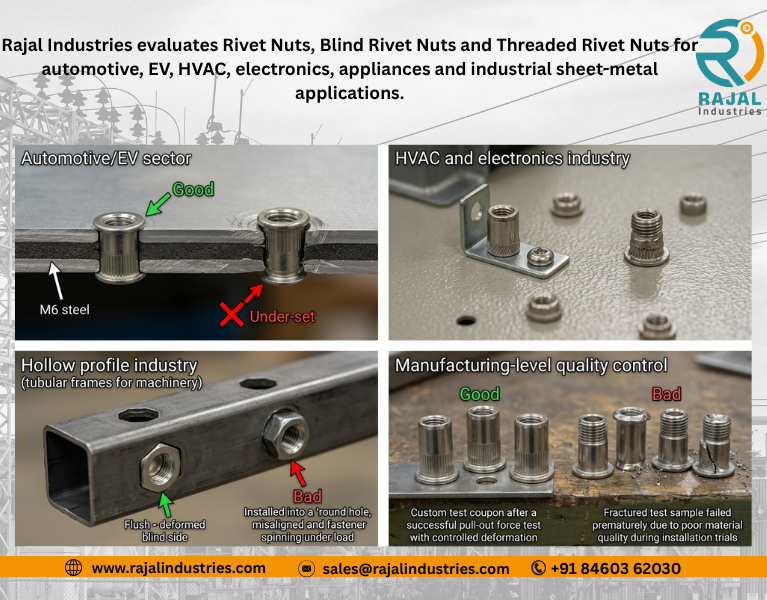
Choosing the right Rivet Nut Manufacturer is important when an OEM needs a reliable internal thread in thin sheet, hollow sections, tubes or assemblies where the rear side is difficult or impossible to access.
A rivet nut is a threaded insert installed into a prepared hole from one accessible side. During installation, the body deforms on the blind side of the parent material and mechanically locks the insert into position.
The result is a reusable female thread for a mating screw or bolt.
Rivet nuts are commonly considered for applications such as:
- Automotive components
- EV battery-related structures and enclosures
- HVAC equipment
- Electrical cabinets
- Electronics
- Appliances
- Machinery covers
- Sheet-metal assemblies
- Hollow profiles
- Industrial enclosures
Current manufacturer ranges show rivet nuts with cylindrical/round, knurled, hexagonal and half-hexagonal bodies, multiple head styles, open or closed ends and materials including steel, aluminium and stainless steel. (FAR)
The correct product depends on much more than thread size.
A better selection sequence is:
Application → Parent Material → Sheet Thickness → Hole → Grip Range → Body Style → Head Style → Thread → Material → Finish → Installation Tool → Performance Requirement → Testing
Quick Answer: What Is a Rivet Nut?
A Threaded Rivet Nut is a mechanically installed threaded insert that creates a female thread in sheet, hollow sections or other suitable parent material.
Unlike a conventional nut, access to the back side is generally not required for installation.
The insert is placed into a prepared hole and a setting tool causes part of its body to deform behind the parent material, mechanically retaining it.
This is why rivet nuts are also commonly called:
- Blind rivet nuts
- Blind threaded inserts
- Rivnuts
- Threaded inserts
Terminology varies between manufacturers and markets.
Why Do OEMs Use Rivet Nuts?
Thin sheet metal may not provide enough material thickness for a useful directly tapped thread.
A rivet nut provides a separate threaded insert.
It can also be useful where:
- Back-side access is unavailable
- Welding is undesirable
- A reusable thread is required
- The assembly uses hollow sections
- The parent material is relatively thin
- Production requires one-side installation
- Dissimilar joining processes need to be considered
The actual suitability depends on the application.
How Does a Rivet Nut Work?
A simplified installation sequence is:
Prepare Hole → Insert Rivet Nut → Engage Setting Tool → Pull/Set Insert → Body Deforms Behind Sheet → Release Tool → Install Mating Screw
During setting, the rivet nut forms a mechanical grip around the parent material.
This creates a fixed threaded attachment point.
What Does “Blind Installation” Mean?
“Blind” means the installer can generally install the fastener from one accessible side of the workpiece.
The installer does not need to hold a conventional nut behind the sheet during installation.
This is particularly useful for:
- Closed sections
- Tubes
- Box sections
- Enclosures
- Vehicle structures
- Cabinets
- Assembled panels
Blind threaded inserts are specifically used to create threads where the opposite side cannot conveniently be accessed. (Newport Fasteners)
Rivet Nut Anatomy
A typical rivet nut contains several functional areas.
Head or Flange
Seats against the visible side of the parent material.
Body
Passes through the prepared hole.
Deformation Zone
Changes shape during installation to grip the blind side.
Internal Thread
Accepts the mating screw or bolt.
Body Features
Depending on design, the body can be:
- Smooth
- Knurled/ribbed
- Hexagonal
- Half-hexagonal
Each feature affects installation and performance.
Rivet Nut vs Standard Nut
| Feature | Standard Nut | Rivet Nut |
| Back-Side Access During Installation | Usually required | Generally not required |
| Creates Captive Thread | No | Yes |
| Thin Sheet Application | Requires access/support | Common application |
| Installation Tool | Spanner/socket | Rivet-nut setting tool |
| Parent-Material Hole | Clearance arrangement | Controlled installation hole |
| Removal of Mating Screw | Nut may need holding | Insert remains installed |
| Hollow Section Use | Difficult in many cases | Major advantage |
Rivet Nut vs Weld Nut
Both can create a permanent threaded location in sheet-metal assemblies, but the installation process is very different.
Weld Nut
Requires a suitable welding process and compatible parent material.
Rivet Nut
Uses mechanical deformation and can generally be installed from one side.
| Factor | Rivet Nut | Weld Nut |
| Joining Process | Mechanical | Welding |
| Heat Input | No welding heat | Welding heat |
| Blind-Side Access | Generally not needed | Process/design dependent |
| Installation Equipment | Setting tool | Welding equipment |
| Parent Material | Application dependent | Must be weld-compatible |
| Finished/Coated Panel | Can be advantageous in some cases | Welding can affect coating/process |
| Thread Replacement | Insert replacement possible but process-dependent | Welded component |
Neither is universally better.
Rivet Nut vs Self-Clinching Nut
This is an important OEM comparison.
A self-clinching nut normally requires access for a press/anvil arrangement to squeeze the fastener into suitable sheet.
A rivet nut is specifically useful where installation is required from one side.
| Factor | Rivet Nut | Self-Clinching Nut |
| Installation Access | One side | Press access/support required |
| Retention Method | Blind-side body deformation | Sheet flows into clinching feature |
| Hole | Product-specific | Product-specific |
| Sheet Compatibility | Product-specific | Hardness/thickness critical |
| Field Installation | Possible with suitable tooling | Usually manufacturing-stage press operation |
| Hollow Sections | Strong advantage | Often difficult |
| Reusable Female Thread | Yes | Yes |
For a detailed comparison, buyers should also review the self-clinching nut selection guides.
Rivet Nut vs Tapped Sheet
Directly tapping thin sheet can provide limited thread engagement because the sheet thickness controls the available thread depth.
A Threaded Rivet Nut adds a dedicated threaded component.
This can be useful when the assembly needs:
- Greater usable thread depth
- Repeated screw removal
- A more robust threaded location
- Blind installation
The final joint strength still depends on the complete assembly.
Rivet Nut vs Cage Nut
A cage nut is normally retained mechanically in a compatible panel or rack opening and can provide limited floating movement.
A rivet nut is mechanically set into the parent material.
Therefore:
Cage Nut = Replaceable/Floating Thread Concept
Rivet Nut = Mechanically Set Blind Threaded Insert
The applications overlap only in certain assemblies.
Rivet Nut vs Threaded Insert
“Threaded insert” is a broad category.
A rivet nut is one type of threaded insert.
Other threaded inserts can be designed for:
- Plastic
- Wood
- Castings
- Machined components
- Thread repair
- Sheet metal
When requesting quotations, using blind rivet nut or threaded rivet nut helps make the required product clearer.
Main Rivet Nut Types
A Rivet Nut Manufacturer may offer several combinations of head and body style.
Common configurations include:
Round Smooth Body
Simple cylindrical body.
Round Knurled or Ribbed Body
Surface features help improve resistance to rotation in suitable applications.
Hex Body
Installed into a matching hexagonal hole to provide strong anti-rotation characteristics.
Half-Hex Body
Uses a partly hexagonal body and matching installation geometry.
Open-End Rivet Nut
Thread/body remains open through the end.
Closed-End Rivet Nut
The blind end is closed for applications requiring that configuration.
Current manufacturer catalogues confirm cylindrical, hexagonal and half-hexagonal body options, with cylindrical versions often using knurling to increase resistance to rotation. (FAR)
Round Body Rivet Nut
Round-body rivet nuts are widely used because the required mounting hole can generally be produced using conventional round-hole processes.
Possible body configurations include:
- Smooth
- Knurled
- Ribbed
The correct design depends on required torque resistance and parent material.
Knurled Rivet Nut
A knurled or ribbed body provides additional engagement with the hole wall.
This can help improve resistance to rotation compared with some smooth round-body designs.
For example, current ribbed rivet-nut product data specifically identifies the splined body as improving torque-to-turn resistance. (Rivet Nuts)
However:
Knurled does not automatically mean the insert can never spin.
Performance still depends on:
- Hole
- Parent material
- Grip range
- Installation
- Body geometry
- Applied load
Hex Body Rivet Nut
A hex-body rivet nut fits into a matching hexagonal hole.
The flats mechanically resist rotation.
This can provide stronger anti-rotation behaviour than many round-body designs.
Current blind-rivet-nut manufacturers describe hexagonal and half-hexagonal bodies as specifically addressing rotation within the mounting hole. (FAR)
Hex Body Requires the Correct Hole
A hex rivet nut should not simply be installed into a normal oversized round hole.
The matching hole geometry is part of the retention system.
Therefore, the drawing should specify:
- Hole shape
- Across-flat dimension where applicable
- Tolerance
- Parent-material thickness
- Rivet-nut body
The insert and hole must be engineered together.
Half-Hex Rivet Nut
A half-hex body combines hexagonal and cylindrical body sections.
It can be useful where the application requires increased anti-rotation performance and the product family supports that installation.
As with a full-hex design, hole preparation becomes an important manufacturing consideration.
Open-End Rivet Nut
An open-end rivet nut has an open body/thread end.
This is a common construction for many sheet-metal applications.
Check:
- Screw length
- Available blind-side clearance
- Environment
- Assembly design
before selection.
Closed-End Rivet Nut
A closed-end rivet nut has a sealed or closed bottom.
Current manufacturers offer open and closed blind-rivet-nut constructions. (FAR)
A closed-end design can be considered where the application benefits from preventing the mating screw from projecting through the insert or where a more closed assembly configuration is required.
Do not automatically describe every closed-end rivet nut as fully liquid- or pressure-tight unless the specific product and complete installed joint are validated for that requirement.
Rivet Nut Head Styles
The head or flange also changes how the insert interfaces with the panel.
Common styles include:
- Large flange
- Standard/flat head
- Reduced head
- Countersunk head
Current manufacturer catalogues list dome/standard, countersunk and reduced-head configurations. (FAR)
Large Flange Rivet Nut
A larger flange provides a larger bearing area against the visible surface.
This can be useful for suitable:
- Thin sheet
- Softer parent material
- Larger bearing requirements
But the larger head also occupies more surface area.
Check:
- Clearance
- Appearance
- Adjacent components
Reduced-Head Rivet Nut
A reduced head minimizes protrusion above the parent surface.
This can be useful where:
- Clearance is limited
- A lower profile is desired
- Nearby components need more space
The smaller bearing area should still be appropriate for the parent material and load.
Countersunk Rivet Nut
A countersunk head can provide a more flush installation when used with the correctly prepared hole.
The countersink geometry must match the product.
Do not create an arbitrary countersink without checking the manufacturer’s or approved drawing dimensions.
Head Style Does Not Define Body Style
These are separate choices.
For example, a product can combine:
Reduced Head + Knurled Round Body
or:
Flat Head + Hex Body
Therefore, an RFQ should identify both.
What Is Rivet Nut Grip Range?
Grip range is one of the most important rivet-nut specifications.
It identifies the parent-material thickness range for which that particular insert is designed to set correctly.
Current product catalogues show that the same thread size can have multiple rivet-nut lengths for different grip ranges. (Rivet Nuts)
This means:
Thread size alone cannot select a rivet nut.
Why Grip Range Matters
Suppose two inserts both use an M6 thread.
One may be designed for a relatively thin panel.
Another may be designed for a thicker panel.
They are not automatically interchangeable.
If the actual sheet thickness falls outside the approved grip range, the insert may not deform and retain as intended.
Grip Range Is Not Thread Size
This distinction is critical.
Thread Size
Controls the mating screw.
Grip Range
Controls the parent-material thickness range.
A complete rivet-nut specification needs both.
Example of Product-Specific Grip Range
Current ribbed rivet-nut data illustrates the concept clearly.
Within one product family, an M6 × 1.0 version is offered for a 0.70–4.20 mm grip range and another M6 version for 4.20–6.60 mm. M8 and M10 versions in that family also use multiple grip ranges. (Rivet Nuts)
These are product-specific examples, not universal M6, M8 or M10 rivet-nut dimensions.
Always use the approved manufacturer’s data or customer drawing.
Sheet Thickness Must Be Known
An RFQ stating:
Need M6 rivet nut
is incomplete.
A better specification includes:
M6 × 1.0 rivet nut for specified sheet thickness/grip range, with required body, head, material and finish.
The Rivet Nut Manufacturer needs the parent-material thickness to select or develop the correct body length.
Hole Diameter Is Critical
The mounting hole directly affects installation.
If the hole is too small:
- Insert may not enter
- Coating may be damaged
- Body can be forced or distorted
If the hole is too large:
- Anti-rotation performance may decrease
- Insert can move
- Setting quality can suffer
- Retention can be reduced
Use the hole size and tolerance specified for the actual product.
Do Not Calculate Hole Size From Thread Size
There is no universal rule such as:
M6 rivet nut = M6 hole.
The rivet-nut body must fit through the hole, so the mounting hole is larger than the internal thread and depends on the product design.
For example, one current round-body family lists an M6 × 1.0 insert with a 10.00 mm mounting hole, while another manufacturer’s M6 cylindrical product uses approximately a 9.1–9.2 mm hole. (Rivet Nuts)
That difference is exactly why the product drawing must control.
Rivet Nut Thread Sizes
Commercial rivet-nut ranges commonly cover several metric thread sizes.
One current manufacturer offers blind rivet nuts with threads from M3 to M12 depending on type. (FAR)
Other product families may have different ranges.
Possible OEM requirements include:
- M3
- M4
- M5
- M6
- M8
- M10
- M12
but this should not be treated as a universal manufacturing range.
Metric and Inch Rivet Nuts
Depending on manufacturer and market, rivet nuts can use:
- Metric threads
- UNC threads
- UNF threads
- Customer-specific threads
Current commercial ribbed rivet-nut ranges include both metric and Unified inch-thread versions. (Rivet Nuts)
The RFQ should clearly specify the thread system.
Rivet Nut Materials
Common material options include:
- Steel
- Stainless steel
- Aluminium
Current blind-rivet-nut manufacturers offer combinations including aluminium, steel, A2 stainless and A4 stainless depending on the product family. (FAR)
Material selection should consider:
Parent Material + Mechanical Requirement + Setting Force + Corrosion + Weight + Environment + Mating Screw
Steel Rivet Nuts
Steel rivet nuts are widely used for industrial and sheet-metal applications.
Possible advantages include:
- Mechanical capability
- Availability
- Multiple finishes
- Cost effectiveness for suitable applications
The actual grade and mechanical requirements should be defined by the product specification.
Stainless Steel Rivet Nuts
Stainless steel can be considered where improved corrosion resistance is required.
Applications may include:
- Outdoor equipment
- Food-related equipment where appropriate
- Industrial environments
- Certain HVAC systems
- Selected automotive or EV applications
However, stainless steel generally requires consideration of installation force and tooling as well as corrosion.
Do not select stainless only because it sounds “premium.”
Aluminium Rivet Nuts
Aluminium rivet nuts can be useful where:
- Low weight is important
- Parent material is aluminium
- Lower setting force is beneficial
- Corrosion/material compatibility supports the selection
The required mechanical performance still needs to be checked.
Rivet Nut Material Comparison
| Material | Potential Advantage | Main Check |
| Steel | Strength + economical availability | Corrosion protection |
| Stainless Steel | Corrosion resistance | Setting/tooling + environment |
| Aluminium | Lightweight + lower setting effort | Mechanical requirement |
This is a screening comparison, not a universal specification.
Rivet Nut Finish
Steel Sheet Metal Fasteners may use finishes such as:
- Zinc-based coatings
- Zinc-nickel
- Other customer-specified surface treatments
Current manufacturers offer galvanized/zinc-treated steel rivet nuts and, in some cases, additional corrosion-resistant treatments such as zinc-nickel or Geomet-type systems. (Sariv)
The required finish should follow the OEM environment and corrosion specification.
Parent Material Compatibility
The parent material can include suitable:
- Steel sheet
- Stainless sheet
- Aluminium sheet
- Hollow sections
- Profiles
- Certain composites or plastics with suitable insert designs
Do not assume one standard rivet nut works equally well in all these materials.
Thin Sheet Applications
Rivet nuts are particularly useful where sheet thickness makes conventional tapping impractical or where back-side nut access is unavailable.
However, thin sheet can also be sensitive to:
- Distortion
- Pull-through
- Local deformation
The head style, body design and installation setting must therefore suit the panel.
Rivet Nuts in Aluminium Sheet
When installing a rivet nut into aluminium, consider:
- Parent-material strength
- Sheet thickness
- Hole quality
- Insert material
- Bearing area
- Galvanic compatibility
- Required torque/pull-out performance
Material combinations should be evaluated for the service environment.
Rivet Nuts in Stainless Sheet
For stainless parent material, check:
- Hole production
- Insert material
- Installation force
- Tool capacity
- Corrosion requirements
- Dissimilar-material considerations
Do not assume a stainless panel automatically requires a stainless rivet nut.
Rivet Nuts in Plastic or Composite Panels
Certain blind threaded inserts are specifically designed for softer or non-metallic parent materials.
For example, cross-nut/slotted-body designs spread into multiple legs and provide a wider blind-side bearing area for suitable thin sheet and plastic applications. (Rivet Nuts)
A standard metal-sheet rivet nut should not automatically be used in plastic without validation.
Rivet Nut Installation Tools
A rivet nut requires suitable setting equipment.
Possible production systems include:
- Manual tools
- Pneumatic tools
- Pneumatic-hydraulic tools
- Hydraulic systems
- Battery/electric tools
- Automated production equipment
Tool selection depends on:
- Rivet-nut size
- Material
- Production volume
- Accessibility
- Required process control
Pull-to-Stroke vs Pull-to-Force Concepts
Industrial rivet-nut tooling can use different setting-control strategies.
The important point for OEM buyers is:
The setting process must match the rivet nut and parent material.
Too little setting can result in inadequate retention.
Too much setting can damage:
- Insert
- Thread
- Parent sheet
- Tool mandrel
The approved rivet-nut/tool process should control installation.
Do Not Use a Generic Installation Force
There is no safe universal statement such as:
All M6 steel rivet nuts require X kN.
Installation depends on:
- Product geometry
- Material
- Grip range
- Parent material
- Tooling
- Manufacturer specification
Use validated product data.
Rivet Nut Performance Requirements
Depending on the application, OEMs may evaluate:
Torque Resistance
Resistance to the installed insert rotating in the parent material.
Push-Out / Pull-Out Behaviour
Resistance to displacement from the installed panel under the specified test condition.
Thread Performance
Ability of the internal thread to perform as specified.
Installation Quality
Correct deformation and seating.
These characteristics are product- and application-specific.
Torque-Out Is Not Screw Tightening Torque
This distinction is critical.
Torque-Out / Spin Resistance
Measures resistance of the installed insert to rotating in the parent material under a defined test.
Screw Tightening Torque
Relates to tightening the mating screw and forming the bolted joint.
They are not the same value.
Do not use a rivet-nut torque-out value as a universal screw-tightening torque.
Pull-Out Is Not Complete Joint Strength
Similarly:
Insert Pull-Out Performance
Describes a particular insert/parent-material test.
Final Joint Strength
Depends on:
- Screw
- Insert
- Sheet
- Bracket
- Load direction
- Geometry
- Installation
Do not treat a catalogue pull-out value as the capacity of the entire assembly.
Why Body Style Affects Rotation Resistance
When a mating screw is tightened, torque is transferred into the installed insert.
The insert must resist rotating in the panel.
Anti-rotation can be influenced by:
- Body shape
- Knurling
- Hole geometry
- Parent material
- Installation quality
Hex-body designs use geometric engagement, while knurled round bodies use surface interaction with the hole.
Why the Head Matters
The head helps provide bearing against the visible side of the sheet.
Its design influences:
- Bearing area
- Protrusion
- Appearance
- Clearance
- Parent-material interaction
Do not select a reduced head solely for appearance if the application requires a larger bearing area.
Automotive Rivet Nut Applications
Potential automotive uses can include:
- Body structures
- Brackets
- Interior mounting
- Underbody components
- Equipment mounting
- Sheet-metal assemblies
Actual fastener selection depends on the OEM drawing and vehicle requirements.
Rivet Nuts for EV Applications
EV assemblies can contain:
- Battery-related enclosures
- Electronics housings
- Brackets
- Covers
- Sheet-metal structures
Blind threaded inserts can be useful where one-side access and removable bolted components are required.
However, EV applications may introduce additional requirements for:
- Corrosion
- Sealing
- electrical considerations
- lightweight materials
- traceability
- automation
- OEM validation
These should be defined by the customer.
Rivet Nuts for HVAC
Potential HVAC applications include:
- Sheet-metal cabinets
- Duct equipment
- Frames
- Covers
- Service panels
- Equipment housings
Rivet nuts can create reusable threaded locations without requiring a loose nut behind the sheet.
Rivet Nuts for Electronics
Electronics applications can include:
- Enclosures
- Racks
- Equipment housings
- Mounting panels
- Brackets
Important selection factors include:
- Sheet thickness
- available space
- head profile
- thread size
- installation access
- corrosion/finish
Rivet Nuts for Appliances
Potential uses include:
- Cabinets
- Frames
- Service panels
- Internal brackets
- Equipment mounts
Production-volume appliances can place additional importance on:
- Installation cycle
- repeatability
- tool life
- automated feeding
- cost per installed joint
Rivet Nuts for General Sheet Metal
A rivet nut can be useful when the design needs:
Thin Sheet + Reusable Thread + One-Side Installation
This is one of the most important application combinations for the product family.
Rivet Nuts in Hollow Sections
Hollow profiles are a major application because installing a conventional nut inside the section may be impossible after fabrication.
The rivet nut can be installed from the accessible outer surface.
Potential examples include:
- Tubular frames
- Box sections
- Equipment structures
- Fabricated profiles
Common Rivet Nut Failure: Insert Spins
An installed rivet nut may rotate when the mating screw is tightened.
Possible causes include:
- Oversized hole
- Wrong body style
- Incorrect grip range
- Under-setting
- Parent-material issue
- Insufficient anti-rotation feature
Do not immediately blame the nut without checking the hole and installation process.
Common Failure: Insert Pulls Out
Possible causes include:
- Wrong grip range
- Weak/thin parent material
- Incorrect head/body selection
- Poor setting
- Oversized hole
- Excessive application load
The complete assembly needs investigation.
Common Failure: Sheet Distortion
Possible causes include:
- Excessive setting
- Very thin sheet
- Inappropriate head/body design
- Tool setup
- Parent-material weakness
The setting process should be optimized using representative production material.
Common Failure: Thread Damage
Possible causes include:
- Setting-tool mandrel problem
- Over-setting
- Poor thread manufacture
- Coating interference
- Wrong mating screw
- Cross-threading
Thread inspection should be part of production control.
Common Failure: Rivet Nut Is Loose After Setting
Possible causes include:
- Under-setting
- Wrong grip range
- Oversized hole
- Incorrect insert length
- Wrong product
- Parent-material variation
Measure the actual sheet before changing tool settings.
Common Failure: Head Does Not Seat Properly
Investigate:
- Hole burr
- Hole deformation
- Incorrect countersink
- Damaged flange
- Misaligned installation tool
- Contamination
- Wrong product
Good installation starts with good hole preparation.
Manufacturing Rivet Nuts
A typical manufacturing flow can include:
Raw Material → Forming/Machining → Body Features → Thread Formation → Heat/Material Processing if Required → Surface Treatment → Dimensional Inspection → Thread Inspection → Functional Setting Test → Packing
The exact process depends on rivet-nut design, material and production volume.
Why Body Geometry Requires Control
The body must deform in a controlled way during installation.
Important characteristics can include:
- Wall thickness
- Body diameter
- Body length
- Deformation-zone geometry
- Knurling
- Hex dimensions
- Head dimensions
Variation in these characteristics can affect installation.
Thread Manufacturing
The internal thread must correctly engage the setting-tool mandrel and later the customer’s mating screw.
Quality control should consider:
- Thread diameter
- Pitch
- Tolerance
- Damage
- Surface treatment
Thread quality is particularly important because the installation tool itself engages the thread.
Hole Preparation Quality
The OEM process should control:
- Hole diameter
- Hole shape
- Burr
- Roundness
- Position
- Surface condition
For hex-body inserts, hole geometry becomes even more important.
Functional Setting Test
A Rivet Nut Manufacturer should not rely only on loose-part dimensional inspection.
A useful functional test uses a representative panel or controlled test coupon.
The test can check:
- Insertion
- Setting
- Head seating
- Blind-side deformation
- Thread condition
- Rotation resistance
- Removal/pull performance where specified
Representative Sheet Testing
The best test coupon should represent the real application as closely as practical.
Consider:
- Material
- Thickness
- Hole
- Coating
- Surface condition
An insert that works in a thick laboratory steel plate may behave differently in the customer’s thin aluminium production panel.
Rivet Nut Quality Control
A practical control plan can include:
Material Verification → Dimensions → Body Geometry → Thread → Finish → Hole/Grip Compatibility → Functional Setting → Torque/Push/Pull Testing as Required → Final Inspection → Packing
Important Inspection Characteristics
| Characteristic | Why It Matters |
| Thread | Tool + mating screw compatibility |
| Body Diameter | Hole fit |
| Body Length | Grip range |
| Wall/Deformation Zone | Setting behaviour |
| Head Diameter | Bearing |
| Head Height | Clearance |
| Knurl/Hex Geometry | Anti-rotation |
| Material | Mechanical behaviour |
| Finish | Corrosion + fit |
Rivet Nut Documentation for OEM Buyers
Depending on the project, buyers may request:
- Material certificate
- Dimensional inspection report
- Thread inspection
- Coating report
- Functional installation report
- Torque-out test
- Push-out/pull-out test
- Corrosion test
- Lot traceability
- PPAP documentation
Requirements should be agreed before production.
Automotive and EV PPAP Requirements
Automotive buyers may require a formal approval process.
Depending on customer requirements, this can include:
- Approved drawing
- Material data
- Dimensional results
- Process flow
- Control plan
- PFMEA
- MSA
- Capability studies
- Sample approval
- Traceability
The exact PPAP level and documentation should come from the customer.
Common Rivet Nut Buying Mistakes
Avoid:
- Buying only by thread size.
- Ignoring grip range.
- Guessing hole diameter from thread size.
- Ignoring sheet material.
- Ignoring sheet thickness.
- Selecting body style only by appearance.
- Assuming knurled means it cannot spin.
- Using a hex insert without a compatible hole.
- Ignoring head clearance.
- Ignoring installation-tool capacity.
- Using generic setting-force values.
- Confusing torque-out with screw tightening torque.
- Treating pull-out as total joint capacity.
- Approving only loose parts without setting trials.
- Ignoring corrosion and material compatibility.
Poor Rivet Nut RFQ
Need M6 rivet nuts. Quote 100,000 pcs.
This leaves too many engineering questions unanswered.
Better Rivet Nut RFQ
We require M6 × 1.0 blind rivet nuts for a 1.5 mm automotive sheet-metal panel. Please review the attached joint drawing and confirm suitable grip range, mounting-hole requirement, head style, body style, material, finish, setting-tool requirements and functional testing. Annual demand is 500,000 pcs.
This gives the Rivet Nut Supplier enough information to begin a proper technical review.
Rivet Nut RFQ Checklist
| Requirement | Buyer Should Provide |
| Application | Automotive / EV / HVAC / etc. |
| Thread | Diameter + pitch |
| Parent Material | Steel / aluminium / etc. |
| Sheet Thickness | Actual range |
| Hole | Diameter/shape/tolerance |
| Grip Range | Required |
| Body Style | Round/knurled/hex/etc. |
| Head Style | Large/reduced/countersunk |
| Open/Closed End | Required |
| Rivet Nut Material | Required |
| Finish | Required |
| Mating Screw | Specification |
| Installation Tool | Existing/new |
| Functional Requirement | Torque/pull/etc. |
| Documentation | Required |
| Quantity | Order quantity |
| Annual Volume | Forecast |
Questions to Ask a Rivet Nut Manufacturer
Before approving a Rivet Nut Manufacturer, ask:
- Which rivet-nut types do you manufacture?
- Which metric and inch threads can you produce?
- What grip ranges are available?
- Can you manufacture round, knurled and hex bodies?
- Which head styles are available?
- Can you manufacture open- and closed-end designs?
- Which materials are available?
- Which coatings are available?
- How do you control body dimensions?
- How are threads inspected?
- Can you test rivet nuts in our actual sheet?
- Can you perform torque-out or pull/push testing to our requirement?
- Can you support PPAP?
- Can you develop drawing-based custom rivet nuts?
- Can you support high-volume automated assembly?
Supplier Qualification Matrix
| Requirement | Priority |
| Thread Quality | Very High |
| Grip Range Control | Very High |
| Body Geometry | Very High |
| Functional Setting | Very High |
| Hole Compatibility | Very High |
| Material Control | Very High |
| Torque Resistance | High |
| Pull/Push Performance | High |
| Finish/Corrosion | High |
| Tooling Knowledge | High |
| Traceability | High |
| PPAP Capability | Automotive/EV High |
| Production Capacity | High |
| Delivery | High |
| Price | Compare after technical compliance |
What Is a Rivet Nut?
A rivet nut is a blind threaded insert installed into a prepared hole from one accessible side. During setting, its body deforms behind the parent material and creates a retained female thread for a mating screw or bolt.
Why Use a Rivet Nut in Sheet Metal?
A rivet nut can create a reusable female thread in thin sheet where direct tapping may provide insufficient thread engagement or where a conventional nut cannot be accessed from the back side.
What Is Rivet Nut Grip Range?
Grip range is the parent-material thickness range for which a particular rivet nut is designed. The same thread size can be available in multiple body lengths and grip ranges, so sheet thickness must be known before selecting the insert. (Rivet Nuts)
What Is the Difference Between a Rivet Nut and a Rivnut?
Rivet nut and Rivnut are commonly used for the same general type of blind threaded insert. Buyers should still specify the actual thread, grip range, body style, head, material, finish and installation requirements rather than relying only on the product name.
Does a Rivet Nut Need Back-Side Access?
Generally, no. One of the main advantages of a blind rivet nut is that it can be installed from one accessible side of the workpiece, making it useful for hollow sections, enclosures and closed sheet-metal assemblies. (Newport Fasteners)
What Materials Are Rivet Nuts Made From?
Common rivet-nut materials include steel, aluminium and stainless steel. Current commercial ranges include aluminium, steel, A2 stainless and A4 stainless depending on the design. Material should be selected from mechanical, corrosion, setting and parent-material requirements. (FAR)
Which Is Better, Round or Hex Rivet Nut?
Neither is universally better. Round-body rivet nuts simplify hole production, while hex-body designs can provide stronger geometric resistance to rotation when installed in a correctly sized hexagonal hole. The application and manufacturing process should determine the choice. (FAR)
Can Rivet Nuts Be Used in Automotive and EV Applications?
Yes. Rivet nuts can provide blind-installed reusable threads for suitable automotive and EV sheet-metal assemblies. The OEM should define the parent material, grip range, hole, mechanical performance, corrosion requirements, installation process and approval documentation.
Can Rajal Industries Manufacture Rivet Nuts?
Rajal Industries can evaluate customer requirements for Threaded Rivet Nut and drawing-based Sheet Metal Fasteners for automotive, EV, HVAC, electronics, appliances and industrial sheet-metal applications.
A technical review should include:
Drawing + Thread + Parent Material + Sheet Thickness + Hole + Grip Range + Body Style + Head Style + Material + Finish + Mating Screw + Functional Requirement + Installation Process + Quantity
Custom or specialized rivet-nut requirements should be evaluated subject to technical feasibility, tooling, manufacturing process and sample validation.
Conclusion: Rivet Nut Performance Depends on the Installed System
Selecting a Rivet Nut Manufacturer should involve much more than asking for an M5, M6 or M8 threaded insert.
A reliable selection process is:
Application → Sheet Material → Thickness → Hole → Grip Range → Body → Head → Thread → Material → Finish → Mating Screw → Installation → Testing
For automotive, EV, HVAC, electronics, appliances and industrial sheet metal, the rivet nut must work with the actual parent material and production process.
A correctly manufactured Threaded Rivet Nut can still fail if the hole, grip range or setting process is wrong. Likewise, a good assembly process cannot compensate for an incorrectly manufactured insert.
Rajal Industries can evaluate drawing-based rivet nuts and custom Sheet Metal Fasteners for OEM requirements, subject to technical feasibility, tooling and sample validation.
Looking for a Rivet Nut Manufacturer in India?
Send Rajal Industries:
Drawing + Thread + Parent Material + Sheet Thickness + Hole + Grip Range + Body Style + Head Style + Material + Finish + Mating Screw + Functional Test Requirements + Annual Quantity
for technical feasibility and quotation review.