

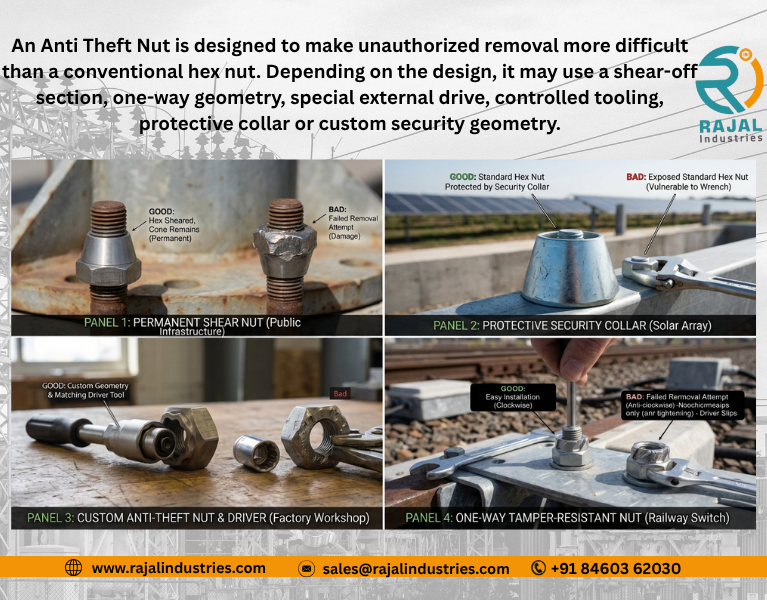
An Anti Theft Nut is designed to make unauthorized removal more difficult than a conventional hex nut.
Instead of relying on an ordinary hexagonal wrenching surface, different security designs can use:
- Breakaway or shear-off geometry
- One-way installation
- Special external drive profiles
- Controlled driver tools
- Smooth or conical profiles
- Protective collars or enclosures
- Customer-specific security geometry
Current commercial security-fastener systems demonstrate several of these approaches, including shear nuts, permanent special-drive nuts, removable special-drive nuts and protective systems around conventional fasteners.
However, the term anti-theft should not be interpreted as an absolute guarantee that a fastener can never be removed.
A better engineering description is:
Tamper-resistant fastener designed to increase the difficulty, time or specialized tooling required for unauthorized removal.
For solar, railways, telecom towers, utilities and public infrastructure, selecting the right Anti Theft Nut starts with the security requirement and maintenance strategy, not simply the thread size.
What Are the Main Anti Theft Nut Types?
Common security concepts include:
| Anti-Theft Nut Type | Security Principle | Removal Strategy |
| Shear Nut | Installation section breaks away | Normally permanent |
| Permanent Special-Drive Nut | Non-standard external drive | Intended as permanent |
| Removable Security Nut | Matching controlled driver | Authorized removal possible |
| One-Way Nut | Geometry restricts reverse operation | Restricted/permanent |
| Protective Collar/Enclosure | Blocks access to conventional hex | Usually permanent protection |
| Custom Security Nut | Customer-specific geometry/tool | Design dependent |
These are functional categories. Exact geometry, material, dimensions and performance vary by product design.
How Does an Anti Theft Nut Work?
A conventional hex nut provides six accessible wrenching surfaces.
A standard:
- Spanner
- Socket
- Adjustable wrench
can normally engage those surfaces.
An Anti Theft Nut changes that interface.
Depending on the design, it may:
- Remove the wrenching feature after installation.
- Use geometry that works primarily in the tightening direction.
- Require a non-standard driver.
- Require controlled tooling for both installation and removal.
- Shield the conventional nut from external tool access.
This increases the difficulty of unauthorized removal.
Security Nut vs Standard Hex Nut
| Feature | Standard Hex Nut | Security Nut |
| Standard spanner access | Yes | Often restricted |
| Standard socket removal | Yes | Often restricted |
| Special tool | Normally no | Often |
| Permanent designs | Not normally | Available |
| Controlled-removal designs | Not required | Available |
| Tamper resistance | Limited | Design dependent |
| Maintenance planning | Simple | Must be considered |
The correct choice depends on both security and maintenance.
Anti Theft Nut Does Not Mean Theft-Proof
No fastener should automatically be described as impossible to remove.
Given enough:
- Time
- Access
- Cutting equipment
- Gripping tools
- Destructive methods
a determined person may still defeat many fastening systems.
Therefore, Tamper Resistant Nuts are normally one part of a wider security strategy.
For example, a solar site may also use:
- Fencing
- CCTV
- Access control
- Equipment identification
- Alarm systems
- Security fasteners
The fastener increases resistance at the mechanical connection.
Type 1: Shear Nut
A shear nut is one of the most important permanent Security Nut Types.
It normally has two functional sections:
Installation Section + Security Body
During installation, the upper wrenching section is tightened until its designed shear condition is reached.
The installation section then separates.
A smoother, typically conical body remains.
Current commercial shear systems use this principle: a hexagonal installation portion shears at a predetermined product-specific torque, leaving a tamper-resistant cone.
How a Shear Nut Works
The basic sequence is:
Place Nut → Engage Standard Tool → Tighten → Reach Designed Breakaway Condition → Hex Section Separates → Security Profile Remains
After breakaway, the standard wrenching surface is no longer available.
This makes normal spanner or socket removal significantly more difficult.
Shear Nut Installation Advantage
One practical advantage is that some shear-nut designs can initially be installed using ordinary hex installation tooling.
The security feature becomes active after the installation section breaks away.
This can simplify site installation compared with security systems that require a special driver from the beginning.
Shear Nut Limitation
The same permanent feature that provides security creates a maintenance limitation.
If equipment later requires:
- Replacement
- Adjustment
- Inspection
- Repair
- Relocation
the permanent nut can complicate authorized removal.
Therefore:
Do not specify a shear nut until the maintenance strategy is understood.
Shear Torque Is Product-Specific
This is an important engineering rule.
Commercial shear-nut data demonstrates that breakaway ranges vary with the actual product, size, material and design. For example, one current A2 stainless product family covers M4 through M20 with different specified shear ranges for each size.
Another galvanized product family covers M8 through M24 and publishes different breakaway ranges.
These values should not be copied into a generic Anti Theft Nut specification.
For a Rajal Industries product, any breakaway requirement should come from the approved design and validation testing.
Why Thread Size Alone Cannot Determine Shear Torque
Two M10 shear nuts may differ in:
- Material
- Heat treatment
- Shear-neck geometry
- Wall thickness
- Finish
- Manufacturing tolerance
- Intended security performance
Therefore:
M10 Thread ≠ Universal M10 Shear Torque
The product drawing and functional specification must control.
Type 2: Permanent Special-Drive Security Nut
Not every permanent Anti Theft Nut needs a breakaway section.
Another approach uses a non-standard external profile with a matching installation driver.
The nut is installed to the required joint condition using the matching tool, while the final geometry restricts engagement with ordinary sockets and spanners.
Commercial permanent systems using this approach are available and are specifically distinguished from shear-point designs.
Why Use a Permanent Special-Drive Nut Instead of a Shear Nut?
A special-drive permanent design can offer advantages where the buyer wants:
- Controlled installation tooling
- No breakaway debris
- No exposed post-shear surface
- Ability to verify or adjust installation before final acceptance
- Different external security geometry
The correct design still depends on the joint.
Shear Nut vs Permanent Special-Drive Nut
| Factor | Shear Nut | Permanent Special-Drive Nut |
| Security Method | Drive section breaks away | Restricted external geometry |
| Installation Tool | Can use standard hex tool on some designs | Matching special driver |
| Breakaway Feature | Yes | Not necessarily |
| Permanent Intent | Yes | Yes |
| Breakaway Debris | Possible | No shear section |
| Re-Torque Before Service | Design dependent | Possible on some designs |
| Maintenance | Difficult | Difficult |
Type 3: Removable Security Nut
A removable security nut is designed for applications that require both:
Tamper Resistance + Authorized Maintenance
Instead of making removal effectively permanent, the nut uses a special external profile that requires a matching driver.
Current commercial removable security-nut systems use dedicated matching driver sockets for both installation and removal.
This can be useful for:
- Telecom cabinets
- Utility equipment
- Railway electrical equipment
- Service panels
- Outdoor equipment
- Controlled-access infrastructure
When Should You Choose a Removable Security Nut?
Consider a removable design when the protected equipment may require:
- Periodic inspection
- Repair
- Replacement
- Adjustment
- Upgrade
- Scheduled maintenance
A permanent design may provide strong removal resistance but create unnecessary lifecycle cost if technicians later need regular access.
Permanent vs Removable Anti Theft Nut
| Requirement | Permanent Nut | Removable Security Nut |
| Maximum restriction of normal removal | Strong fit | Strong but controlled |
| Regular maintenance | Poor fit | Better fit |
| Component replacement | Difficult | Easier |
| Dedicated tool | Depends on design | Usually required |
| Tool management | Moderate/high | High |
| One-time installation | Strong fit | Possible |
| Long-term service access | Limited | Better |
Type 4: One-Way Security Nut
A one-way Anti Theft Nut uses geometry intended to favour installation while restricting reverse operation.
The exact geometry can vary.
The principle is:
Easy/Controlled Tightening → Difficult Conventional Reverse Engagement
This approach is useful where the fastener is intended to remain permanently installed.
One-Way Does Not Mean Impossible to Remove
“One-way” describes the intended drive behaviour.
It should not be interpreted as a guarantee against every destructive removal method.
For SEO and engineering content, use:
One-Way Tamper-Resistant Nut
rather than:
Impossible-to-Remove Nut
Type 5: Protective Security Collar
A different strategy is to keep the conventional fastener and protect access to it.
A collar can surround the standard hexagonal nut so ordinary tools cannot easily grip it.
Commercial conical collar systems are used specifically to transform standard hex fasteners into more tamper-resistant assemblies.
Why Use a Security Collar?
A protective collar can be useful where:
- Existing hardware already uses standard nuts
- Changing the entire fastener specification is undesirable
- Security needs to be added to an existing joint
- External tool access can be physically blocked
However, the collar and underlying fastener should be evaluated as one system.
Type 6: Security Enclosure
A security enclosure works on a similar principle but can fully enclose or shield access to the conventional fastener.
This approach changes the attack surface without necessarily changing the original threaded fastener.
Commercial permanent enclosure systems exist for this purpose.
Security Nut vs Security Collar vs Security Enclosure
| Design | What Provides Security? |
| Security Nut | Nut geometry itself |
| Security Collar | Collar blocks gripping access |
| Security Enclosure | Enclosure shields fastener |
| Shear Nut | Wrenching section disappears |
| Removable Security Nut | Controlled driver interface |
Understanding this difference helps buyers avoid specifying the wrong product.
Type 7: Custom Anti Theft Nut
A custom Anti Theft Nut can be developed around an OEM’s own security requirements.
Possible custom features include:
- Unique external profile
- Customer-specific driver
- Custom lobe geometry
- Special wrenching interface
- One-way feature
- Breakaway section
- Special thread
- Customer marking
- Controlled tool distribution
This can be useful where widely available security-tool geometry does not provide enough control.
Custom Nut and Driver Should Be Developed Together
For a proprietary security system, treat the nut and tool as one product system:
Security Requirement → Nut Geometry → Driver Geometry → Material → Manufacturing → Prototype → Installation Testing → Removal Evaluation → Final Validation
Developing the nut first and the driver later can create avoidable fit and manufacturing problems.
Intellectual Property Matters
Many commercial security-fastener profiles are proprietary.
For example, current commercial product families include patented and trademarked security designs with dedicated drivers.
Therefore, a manufacturer should not simply copy a branded security profile.
For custom development, use:
- Customer-owned drawing
- Licensed design
- Independently developed geometry
and review intellectual-property requirements before tooling.
Security Nut Types by Removal Strategy
A useful procurement classification is:
Category A: Permanent
Examples:
- Shear nut
- One-way nut
- Permanent special-drive nut
- Permanent security enclosure
Category B: Controlled Removal
Examples:
- Removable special-drive nut
- Customer-specific removable security nut
This classification is often more useful to an OEM buyer than simply comparing product appearance.
How Secure Is an Anti Theft Nut?
Security depends on several factors:
Nut Geometry + Tool Availability + External Access + Material + Installation + Surrounding Joint + Attack Method
A complex-looking profile is not automatically highly secure.
Tool Availability Matters
Consider two security nuts.
Nut A
Uses an unusual-looking drive, but its tool is widely available online.
Nut B
Uses a controlled driver distributed only to authorized users.
Depending on the threat model, Nut B may provide better tool-control security.
This illustrates why security cannot be judged only by visual complexity.
Manufacturer Security Ratings Are Not Universal Standards
Some security-fastener suppliers publish their own security levels.
For example, Hafren currently uses a five-level system that considers factors such as public tool availability, controlled tooling, one-way fixing and bespoke drivers.
That is a manufacturer-specific classification.
It should not be presented as an ISO, DIN or universal industry security rating.
For OEM projects, define the actual threat and test requirements.
Security Selection by Threat Level
A practical engineering approach is:
| Threat | Possible Design Direction |
| Casual tampering | Non-standard security geometry |
| Opportunistic theft | Higher-control security design |
| Public vandalism | Permanent or restricted-tool design |
| Unauthorized servicing | Removable controlled-tool design |
| Valuable exposed equipment | Security fastener + wider site security |
| High-risk custom equipment | Custom nut/tool system may be considered |
This is a selection framework, not a universal security ranking.
Anti Theft Nut Sizes
Commercial Security Nuts are available across multiple metric thread sizes.
Current examples demonstrate that one permanent special-drive family is offered from M5 through M12, while some shear-nut families extend from smaller sizes through M20 or M24 depending on material and design.
This should not be interpreted as a universal range for every security nut.
Typical Thread Selection Logic
Possible application requirements may involve:
- M5
- M6
- M8
- M10
- M12
- M16
- M20
- M24
depending on the joint.
But the thread must come from the mechanical design.
Do not increase the thread size merely to increase security.
M5 and M6 Security Nuts
Smaller security threads can be suitable for appropriate:
- Cabinets
- Enclosures
- Equipment panels
- Public fixtures
- Electronics hardware
The mechanical requirements of the joint still control the selection.
M8 and M10 Anti Theft Nuts
M8 and M10 may appear in:
- Solar equipment
- Telecom infrastructure
- Utility installations
- Outdoor equipment
- Public infrastructure
But the same thread can be used with very different security designs.
For example:
M10 Shear Nut ≠ M10 Removable Security Nut ≠ M10 Permanent Special-Drive Nut
M12 Security Nuts
M12 may be considered for larger equipment and infrastructure joints.
Review:
- Mating bolt/stud
- Mechanical requirement
- Security design
- Tool access
- Corrosion
- Maintenance
Thread diameter alone does not determine suitability.
Larger M16–M24 Security Nuts
Some commercial shear systems extend into larger sizes.
Such sizes may be relevant to larger infrastructure applications, but the buyer must verify:
- Joint loading
- Thread specification
- Nut mechanical performance
- Installation method
- Breakaway behaviour
- Corrosion protection
Do not substitute a security nut into a structural joint solely because the thread matches.
Anti Theft Nut Material Options
Common material directions can include:
- Carbon/mild steel
- Case-hardened steel for suitable designs
- Stainless steel
- Customer-specified alloy/material
Current commercial security-nut families demonstrate case-hardened steel, mild steel, A2 stainless and A4 stainless options depending on the product type.
The correct material depends on the complete application.
Carbon Steel Anti Theft Nuts
Steel can provide:
- Manufacturing flexibility
- Mechanical performance
- Heat-treatment options
- Multiple coating choices
Potential applications include:
- Solar
- Utilities
- Infrastructure
- Equipment
Outdoor steel products normally require an appropriate corrosion-protection strategy.
Case-Hardened Security Nuts
Some special-drive commercial security nuts use case-hardened steel.
Case hardening can support the functional requirements of certain security geometries, but it should not be treated as mandatory for every anti-theft design.
Material and heat treatment should follow the approved product design.
Stainless Steel Anti Theft Nuts
Stainless security nuts can be considered for applications requiring corrosion resistance.
Current shear-nut product families are available in both A2 and A4 stainless steel.
Selection should consider:
- Environment
- Mating fastener
- Structure material
- Mechanical requirement
- Security design
A2 Stainless Steel
A2 stainless can be suitable for many general atmospheric applications where its corrosion performance meets the project requirement.
Commercial permanent and removable special-drive nuts are available in A2 stainless.
Do not automatically specify A2 for every outdoor project.
A4 Stainless Steel
A4 stainless can be considered where more demanding corrosion exposure justifies it.
Examples may include certain:
- Coastal
- Chloride
- Industrial
environments.
Actual suitability should follow the project’s corrosion specification.
Zinc-Plated Security Nuts
Zinc-based coatings can be used on suitable steel Anti Theft Fasteners.
Current commercial permanent and removable security nuts are available with zinc-plated finishes.
The drawing should specify the required coating system rather than simply stating “silver finish.”
Galvanized Anti Theft Nuts
Galvanized security nuts can be useful for suitable outdoor infrastructure.
A current commercial galvanized shear-nut family includes sizes M8 through M24.
However, coating thickness, thread fit and mating hardware must be considered.
Anti Theft Nut Material Selection Matrix
| Environment/Application | Material Direction to Evaluate | Main Check |
| Indoor Equipment | Steel / stainless | Mechanical + finish |
| Outdoor Infrastructure | Protected steel / stainless | Corrosion |
| Solar | Project-specific steel/stainless | Structure + corrosion |
| Telecom Tower | Project-specific material | Outdoor exposure + maintenance |
| Railway Equipment | Project specification | Approval + mechanical |
| Coastal Infrastructure | Higher corrosion resistance may be required | Chloride exposure |
| Utility Cabinet | Steel/stainless depending design | Access + corrosion |
This is a screening guide, not a material specification.
Anti Theft Nuts for Solar
Solar installations can have accessible hardware associated with:
- Modules
- Mounting structures
- Equipment frames
- Electrical enclosures
- Cable-management systems
- Other site equipment
Where unauthorized removal is a concern, Anti Theft Fasteners can increase mechanical removal difficulty.
Solar Selection Rule: Structural First, Security Second
A security fastener should not compromise the engineered solar connection.
Before replacing a standard nut, confirm:
- Bolt/stud
- Nut mechanical requirement
- Preload requirement
- Installation method
- Corrosion system
- Electrical bonding if applicable
- Maintenance requirement
Then evaluate the security feature.
Permanent Security Nuts for Solar
Permanent designs may be useful where:
- The connection should not normally be reopened
- Unauthorized component removal is a concern
- Future destructive removal is acceptable
But long-term solar O&M should be considered before approval.
Removable Security Nuts for Solar
A controlled-removal design may be better where:
- Modules can require replacement
- Equipment may be serviced
- Structure adjustments may be necessary
The matching tool can be controlled by authorized O&M personnel.
Anti Theft Nuts for Railways
Potential railway and transport applications can include:
- Signalling equipment
- Trackside cabinets
- Electrical equipment
- Station fixtures
- Public-facing equipment
Security fasteners are commercially used for rail and transport infrastructure, but project/operator requirements should control actual approval.
Never claim a generic nut is “railway approved” without documented approval.
Railway Security Requirements
Review:
Security + Vibration + Mechanical Load + Corrosion + Maintenance + Traceability + Operator Specification
An Anti Theft Nut addresses security.
It does not automatically address all the other requirements.
Anti Theft Nuts for Telecom Towers
Telecom infrastructure can include:
- Tower equipment
- Outdoor cabinets
- Antenna-related hardware
- Electrical equipment
- Battery enclosures
- Cable infrastructure
Unauthorized access or component theft can make security hardware useful.
Telecom Tower Structural Warning
Do not replace critical tower structural nuts simply because an anti-theft nut has the same thread.
Tower connections may have specific:
- Strength
- Structural
- Preload
- Corrosion
- Installation
requirements.
Any substitution should receive engineering approval.
Removable Security Nuts for Telecom Equipment
Telecom systems often need maintenance.
Therefore, removable Security Nuts can be attractive for serviceable equipment because authorized technicians can retain the required driver.
This can provide:
Tamper Resistance + Controlled Maintenance Access
Anti Theft Nuts for Utilities
Potential applications include:
- Electrical cabinets
- Metering equipment
- Outdoor controls
- Utility enclosures
- Publicly accessible equipment
The correct security design depends on how often authorized personnel require access.
Anti Theft Nuts for Public Infrastructure
Applications can include:
- Road signs
- Lighting equipment
- Street furniture
- Barriers
- Public fixtures
- Transport equipment
- Outdoor cabinets
Where maintenance is rare, permanent designs can be considered.
Where maintenance is frequent, removable security designs may be more practical.
Security Nut vs Lock Nut
This distinction is essential.
Security Nut
Primarily addresses unauthorized removal.
Lock Nut
Primarily addresses loosening under specified joint conditions.
Therefore:
Security ≠ Vibration Locking
If the application requires both, specify and validate both functions.
Security Nut vs Nyloc Nut
A Nyloc nut uses a nylon insert to create prevailing torque.
Its normal external hexagon can still be engaged by common tools.
Therefore:
Nyloc Nut ≠ Anti Theft Nut
A project needing both loosening resistance and tamper resistance requires a more complete joint solution.
Security Nut vs Standard Flange Nut
A flange nut provides an integrated bearing surface.
It does not automatically provide tamper resistance.
Likewise, an anti-theft profile does not automatically provide the same bearing characteristics as the specified flange nut.
Security Nut vs Heavy Hex Nut
Heavy hex nuts can be used in demanding structural and industrial bolted connections.
Their function and mechanical requirements are different from security nuts.
Do not replace a heavy hex nut with an Anti Theft Nut solely because the thread diameter matches.
Security Nut vs Security Bolt
A security nut protects the female-threaded component of a bolted joint.
A security bolt protects the male-threaded fastener side.
Which side requires protection depends on:
- Accessibility
- Assembly design
- Tool access
- Maintenance
In some applications, both sides may need consideration.
Security Nut vs Protective Collar
A security nut changes the nut itself.
A protective collar changes access around the nut.
A collar may be attractive where an existing standard fastener specification should remain unchanged, subject to engineering validation.
How to Select an Anti Theft Nut
Use this sequence:
Step 1: Identify the Application
Solar, railway, telecom, utility or other infrastructure.
Step 2: Define the Threat
Casual tampering, vandalism, unauthorized access or theft.
Step 3: Decide Permanent vs Removable
Will authorized removal ever be needed?
Step 4: Identify Joint Function
Structural or non-structural?
Step 5: Confirm Thread
Diameter, pitch and tolerance.
Step 6: Confirm Mating Fastener
Bolt, stud, anchor or threaded rod.
Step 7: Define Mechanical Requirement
Do not allow the security feature to replace mechanical engineering.
Step 8: Select Security Design
Shear, permanent special drive, removable drive, one-way, collar or custom.
Step 9: Select Material
Steel, stainless or another specified material.
Step 10: Select Corrosion Protection
Based on actual environment.
Step 11: Define Tool Strategy
Standard installation tool, special driver or controlled tool.
Step 12: Validate
Test the actual nut, mating fastener and assembly.
Anti Theft Nut Selection Matrix
| Buyer Question | Why It Matters |
| What are we protecting? | Defines security need |
| Who can access the joint? | Threat assessment |
| Must it be removable? | Permanent vs removable |
| Is it structural? | Mechanical requirements |
| What thread is used? | Mating compatibility |
| What environment? | Material/finish |
| Who controls the tool? | Security |
| Is maintenance required? | Lifecycle |
| What testing is required? | Approval |
Common Anti Theft Nut Selection Mistakes
Avoid:
- Assuming “anti-theft” means impossible to remove.
- Choosing only by thread size.
- Using a permanent nut on serviceable equipment.
- Assuming all security nuts are shear nuts.
- Treating manufacturer security ratings as universal standards.
- Copying generic shear-torque values.
- Ignoring mating bolt or stud requirements.
- Ignoring structural requirements.
- Assuming anti-theft means vibration resistant.
- Ignoring corrosion.
- Ignoring future maintenance.
- Selecting special-drive geometry without checking tool availability.
- Copying proprietary security profiles.
- Approving from appearance alone.
- Skipping functional installation testing.
Poor Anti Theft Nut RFQ
Need M10 anti-theft nuts. Please quote.
This is not enough information.
Better Anti Theft Nut RFQ
We require M10 tamper-resistant nuts for outdoor telecom infrastructure. The equipment requires authorized maintenance, so the nut must be removable using a controlled matching driver. Please review the attached joint drawing and confirm thread, material, finish, security geometry, mating-fastener compatibility, driver tool, samples, MOQ and annual-volume pricing.
Technical RFQ Checklist
| Requirement | Information Needed |
| Application | Solar / rail / telecom / utility |
| Protected Component | Description |
| Threat | Tampering / theft / unauthorized access |
| Permanent/Removable | Required |
| Thread | Diameter + pitch |
| Mating Fastener | Bolt / stud / rod |
| Structural Requirement | Drawing/specification |
| Nut Material | Required |
| Finish | Required |
| Environment | Indoor/outdoor/coastal/etc. |
| Security Type | Shear / special drive / custom |
| Installation Tool | Required |
| Removal Tool | If applicable |
| Testing | Customer requirement |
| Quantity | Order quantity |
| Annual Demand | Forecast |
What Is an Anti Theft Nut?
An Anti Theft Nut is a threaded fastener designed to make unauthorized removal more difficult than a standard hex nut. It can use a shear-off section, one-way geometry, special driver, removable security profile or protective system depending on the application.
What Are the Main Security Nut Types?
Main Security Nut Types include shear nuts, permanent special-drive nuts, removable security nuts, one-way nuts, protective collars and custom security nuts. The correct type depends on security risk, maintenance, mechanical requirements and tool control.
What Is a Shear Nut?
A shear nut uses an installation section designed to separate at a product-specific breakaway condition, leaving a smoother security profile that is more difficult to grip with conventional tools. It is normally intended as a permanent fastening solution.
Can Anti Theft Nuts Be Removed?
Some can. Permanent designs intentionally restrict normal removal, while removable Security Nuts require a matching specialized driver for authorized installation and removal. The maintenance strategy should determine which type is selected.
What Material Is Used for Anti Theft Nuts?
Anti Theft Nuts can be manufactured from materials such as steel and stainless steel depending on the design. Commercial products demonstrate mild steel, case-hardened steel, A2 stainless and A4 stainless options. Material should be selected from mechanical, corrosion and security requirements.
Are Security Nuts Vibration Resistant?
Not automatically. Tamper resistance and vibration loosening are different engineering requirements. If a joint requires both functions, each should be specified and validated separately.
Can Anti Theft Nuts Be Used for Solar?
Yes, they can be considered for suitable solar applications where unauthorized removal is a concern. However, a security nut should not replace specified structural hardware without checking mechanical strength, preload, corrosion, installation and maintenance requirements.
Which Anti Theft Nut Is Best?
The correct Anti Theft Nut depends on the application. A permanent shear or one-way design can suit connections that should not normally be reopened, while a removable security nut can be better for equipment requiring authorized maintenance. Mechanical and corrosion requirements must also be satisfied.
Can Rajal Industries Manufacture Anti Theft Nuts?
Rajal Industries can evaluate customer requirements for:
- Anti Theft Nut
- Security Nuts
- Tamper Resistant Nuts
- Anti Theft Fasteners
- Drawing-based security nuts
- Custom security geometry
- Matching installation/removal tooling
Development should be subject to:
Drawing Review → IP Review → Material → Thread → Security Geometry → Manufacturing Feasibility → Tooling → Samples → Functional Testing → Customer Approval
Custom or proprietary designs should only proceed after confirming the right to manufacture the geometry.
Conclusion: Select the Anti Theft Nut as Part of the Complete Security System
The correct Anti Theft Nut is not simply the nut with the most unusual shape.
Selection should follow:
Threat → Access → Permanent/Removable → Joint Function → Thread → Mating Fastener → Security Design → Material → Corrosion → Tool → Installation → Testing → Maintenance
A shear nut can suit a permanent connection. A removable security nut can provide controlled maintenance access. A custom nut-and-driver system can provide another option where specialized security requirements justify development.
For solar, railways, telecom towers, utilities and infrastructure, Security Nuts and Tamper Resistant Nuts should also be evaluated against mechanical, corrosion and lifecycle requirements.
Rajal Industries can evaluate drawing-based Anti Theft Fasteners and custom security-nut requirements subject to manufacturing feasibility, tooling, intellectual-property review and functional validation.
Need an Anti Theft Nut for an Infrastructure Project?
Send Rajal Industries:
Drawing + Application + Security Threat + Permanent/Removable Requirement + Thread + Mating Bolt/Stud + Mechanical Requirement + Material + Finish + Environment + Tool Requirement + Testing Requirement + Quantity
for technical feasibility and quotation review.