

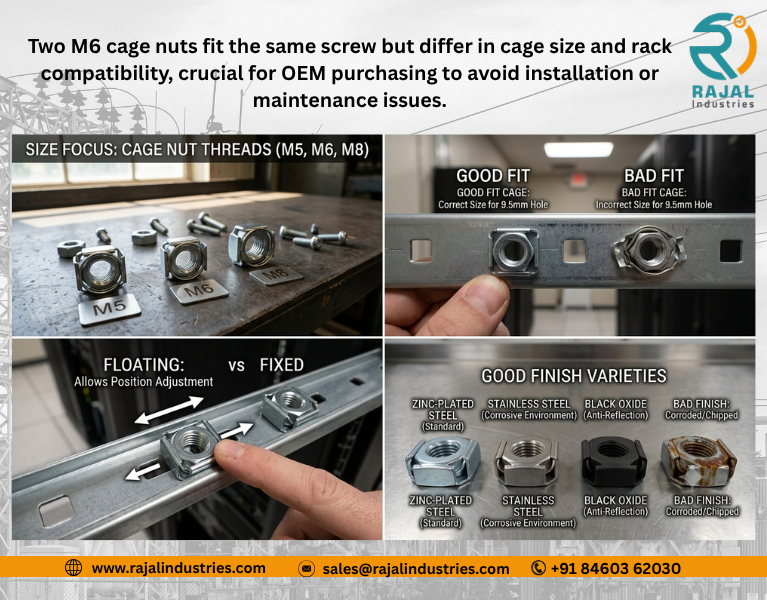
Choosing the correct Cage Nut Sizes for a server rack requires more than selecting M5, M6 or M8.
A cage nut is a multi-part fastening system. The threaded nut must match the screw, while the surrounding spring cage must correctly fit the square or shaped mounting hole in the rack rail or enclosure.
For this reason, buyers should evaluate:
Thread Size → Thread Pitch → Rack Hole → Rail Thickness → Cage Geometry → Nut Float → Mating Screw → Material → Finish → Load Requirement → Installation
Two M6 cage nuts may accept the same screw but still have different cage dimensions and fit different mounting rails.
This guide explains Cage Nut Types, thread sizes, rack-hole compatibility, materials and practical selection factors for data centers, telecom, networking, server cabinets and industrial enclosures.
Quick Answer: What Are Common Cage Nut Sizes?
Metric Cage Nut Sizes commonly encountered in rack and enclosure applications include:
- M5
- M6
- M8
M6 is widely encountered in metric server-rack hardware, but it is not a universal requirement for all 19-inch racks.
Other rack systems may use M5, M8 or inch-series threads.
The correct size should be determined by the rack rail + cage nut + mating screw + equipment mounting requirement, not by the 19-inch rack designation alone.
What Does Cage Nut Size Mean?
When someone asks for an “M6 cage nut,” the M6 identifies the nominal diameter of the internal metric thread.
It does not fully define:
- Cage width
- Cage height
- Compatible square-hole size
- Rail thickness
- Spring-tab geometry
- Nut movement
- Material
- Finish
- Load performance
Therefore:
Thread size and cage size are not the same thing.
This is one of the most important points for server-rack buyers.
What Is a Cage Nut?
A cage nut combines:
Threaded Nut
Provides the internal thread for the mounting screw.
Spring Cage
Retains the nut inside a compatible rack or panel opening.
The cage allows the threaded mounting point to be installed without permanently welding or pressing a nut into the rack rail.
This makes cage nuts useful where equipment needs to be:
- Installed
- Removed
- Repositioned
- Replaced
- Serviced
Cage Nut Size vs Rack Hole Size
These are separate specifications.
Cage Nut Thread Size
Examples: M5, M6 or M8.
Rack Hole Size
Defines the opening into which the cage is installed.
A correct thread does not guarantee correct rack fit.
For OEM procurement, specify both.
Example: Two M6 Cage Nuts
Consider:
Cage Nut A: M6 thread, Cage Design A
Cage Nut B: M6 thread, Cage Design B
Both accept an M6 mating screw.
However, they may have different:
- Square-hole requirements
- Rail-thickness ranges
- Spring geometry
- Floating movement
Therefore, they are not automatically interchangeable.
Common Cage Nut Sizes for Server Racks
A practical starting point for metric systems is:
| Thread Size | Typical Selection Context | Buyer Must Confirm |
| M5 | Suitable rack/panel systems | Hole, rail thickness, screw |
| M6 | Widely used metric rack hardware | Hole, rail thickness, screw |
| M8 | Larger rack/enclosure designs where specified | Hole, rail, load, screw |
This is a selection guide, not a universal rack standard.
M5 Cage Nuts
M5 cage nuts may be used in suitable:
- Equipment racks
- Cabinets
- Electrical enclosures
- Networking systems
- Telecom equipment
An M5 specification should still define:
M5 Thread + Pitch + Cage Geometry + Hole + Rail Thickness + Material + Finish + Mating Screw
M6 Cage Nuts
M6 is one of the most recognizable Server Rack Nut sizes in metric rack hardware.
Applications can include:
- Server racks
- Network racks
- Data-center cabinets
- Telecom racks
- Rack shelves
- Patch panels
- Rack accessories
However, “M6” alone does not tell the supplier which cage geometry is required.
Real-World M6 Rack Hardware Example
A current Rittal rack-mounting product uses an M6 thread with a 9.5 × 9.5 mm mounting hole and specifies a 1.2–4.5 mm clamping range. The product uses sheet steel with a zinc-plated finish. (Homepage)
These values demonstrate an important engineering point:
Thread, mounting hole and compatible sheet thickness are separate characteristics.
They are specifications for that particular product, not universal dimensions for every M6 cage nut.
M8 Cage Nuts
M8 cage nuts can be considered where the rack, enclosure or equipment design specifically calls for an M8 threaded mounting point.
Buyers should verify:
- Hole geometry
- Cage dimensions
- Rail thickness
- Screw
- Required mechanical performance
- Equipment mounting instructions
Do not assume that a larger thread automatically provides a better rack mounting solution.
Is M8 Stronger Than M6 for a Server Rack?
Thread diameter alone should not be used to determine equipment load capacity.
The complete mounting system includes:
Equipment + Mounting Bracket + Screw + Cage Nut + Rack Rail + Rack Structure
Equipment may also use:
- Slide rails
- Rear supports
- Shelves
- Multiple mounting points
Follow the rack and equipment manufacturer’s approved mounting method.
Metric vs Inch Cage Nut Sizes
Not every rack system uses metric threads.
International buyers may encounter inch-series rack hardware.
Therefore, the RFQ should state the complete thread specification rather than simply saying:
Standard server rack cage nut.
A metric and inch thread can look similar but should never be forced together.
Are All 19-Inch Racks M6?
No.
The 19-inch designation describes the rack system’s mechanical format, not one universal cage-nut thread.
IEC 60297-3-100:2008 specifies basic dimensions for front panels, subracks, chassis, racks and cabinets in the 482.6 mm (19-inch) series. It does not define M6 as the mandatory cage-nut thread for every rack. (IEC Webstore)
Important Standards Note for Server Rack Nuts
Buyers should be careful with statements such as:
“M6 cage nut according to IEC 60297.”
That description can be misleading.
IEC 60297-3-100 covers the basic mechanical dimensions of the 482.6 mm rack system. It should not be treated as a universal cage-nut product specification. (IEC Webstore)
For cage nut sourcing, the actual rack rail and cage nut drawings remain important.
Current IEC 60297 Context
The IEC 60297 family continues to cover mechanical structures for electrical and electronic equipment based on the 482.6 mm series.
IEC also published IEC TR 60297-3-1:2023, which explains technological schemes and applications of the IEC 60297 series. (IEC Webstore)
This reinforces the distinction between the rack-system standard and the detailed specification of a particular cage nut.
What Is 1U in a Server Rack?
Rack equipment height is commonly described in rack units, or U.
IEC 60297-3-105:2008 specifically addresses dimensions and design aspects for 1U-high chassis installed in IEC 60297-3-100-compliant racks and cabinets. (IEC Webstore)
However:
1U does not determine the cage nut thread size.
Equipment height and mounting-fastener specification are separate issues.
Main Cage Nut Types
Important Cage Nut Types include:
- Square-hole cage nuts
- Floating cage nuts
- Fixed or limited-movement cage nuts
- Rack-mount cage nuts
- Panel/enclosure cage nuts
- Custom cage nuts
The exact terminology can vary between manufacturers.
Type 1: Square-Hole Cage Nut
This is the cage nut design most buyers associate with server racks.
The spring cage engages a compatible square opening in the rack rail.
Potential advantages include:
- Replaceability
- Configurable mounting positions
- No welding
- Easy service
- Thread replacement if damaged
Why Square Holes Are Useful
A square-hole rail allows removable mounting hardware to be positioned where needed.
If the threaded nut becomes damaged, the cage nut can often be replaced instead of repairing the rack rail itself.
This is valuable for data-center racks that may be reconfigured throughout their service life.
Are All Square Rack Holes the Same Size?
No.
Do not assume every square-hole rack accepts the same cage nut.
Rack designs can vary in:
- Hole dimensions
- Rail thickness
- Material
- Coating
- Cage engagement
- Equipment system
Always verify the actual rail specification.
Type 2: Floating Cage Nut
A floating cage nut permits controlled movement of the threaded nut inside its cage.
This movement helps compensate for small positional differences between:
- Rack opening
- Equipment mounting hole
- Screw
It can make equipment installation easier.
What Does Cage Nut Float Mean?
Float is the designed movement available to the nut within the retaining cage.
It can occur in one or more directions depending on the design.
The purpose is alignment.
It should not be interpreted as uncontrolled looseness.
Is a Moving Cage Nut Defective?
Not necessarily.
If the design is a floating cage nut, some movement is intentional.
The important questions are:
- Is the movement within design limits?
- Does the nut remain captured?
- Does it align correctly?
- Can the screw be installed normally?
Type 3: Fixed or Limited-Movement Cage Nut
Some designs provide less movement than a floating cage nut.
This may be useful where tighter positioning is desired.
The buyer should not assume all cage nuts provide the same amount of float.
Type 4: Rack Mount Cage Nuts
Rack Mount Cage Nuts are designed around equipment-rack mounting requirements.
Potential applications include:
- Servers
- Switches
- Patch panels
- Shelves
- Power equipment
- Cable-management accessories
The actual rack and equipment instructions should control selection.
Type 5: Panel and Enclosure Cage Nuts
Cage nuts can also be used in suitable:
- Electrical cabinets
- Control panels
- Industrial enclosures
- Telecom cabinets
- Electronic equipment
They provide a removable threaded attachment where the panel geometry supports the cage design.
Type 6: Custom Cage Nuts
OEMs may require custom cage nuts with:
- Special thread
- Custom cage width
- Different spring geometry
- Special float
- Custom panel thickness range
- Special coating
- Customer-specific hole geometry
These products should be developed against an approved drawing.
Cage Nut Types Comparison
| Type | Main Characteristic | Typical Selection Reason |
| Square-Hole Cage Nut | Clips into square opening | Rack mounting |
| Floating Cage Nut | Controlled nut movement | Alignment |
| Limited-Movement Design | Reduced float | Position control |
| Rack Mount Cage Nut | Rack-oriented design | Server/network equipment |
| Panel Cage Nut | Enclosure-oriented | Cabinets/panels |
| Custom Cage Nut | Drawing-specific | OEM requirement |
Cage Nut Dimensions Buyers Should Specify
Important dimensions can include:
Thread Diameter
Examples: M5, M6, M8.
Thread Pitch
Must match the screw.
Nut Body Dimensions
Must fit inside the cage.
Cage Width
Influences mounting-hole compatibility.
Cage Height
Influences fit and retention.
Overall Depth
Important where rear clearance is limited.
Spring-Tab Geometry
Controls engagement with the rail.
Hole Dimensions
Defines the receiving interface.
Rail Thickness
Influences cage retention.
Why Cage Nut Dimensions Are More Complex Than Hex Nut Dimensions
For a normal hex nut, major concerns include:
Thread + Nut Geometry + Mechanical Properties
For a cage nut, the buyer must additionally consider:
Rack Hole + Rail Thickness + Spring Cage + Float + Installation
This is why a generic M6 cage nut dimensional table can be misleading.
Rack Hole Size
The receiving opening is one of the most important dimensions in a cage-nut system.
If the hole is incompatible:
- Cage may not install
- Spring tabs may deform
- Retention may be poor
- Cage may fall out
- Removal may become difficult
The cage and rail should therefore be designed or selected together.
Why We Should Not Publish One Universal M6 Cage Nut Hole Size
Some commercial products use specific hole sizes.
For example, the Rittal product cited earlier uses a 9.5 × 9.5 mm mounting hole for its particular M6 mounting solution. (Homepage)
That does not establish 9.5 × 9.5 mm as the universal M6 cage-nut hole.
A different manufacturer may use another cage design.
Rail Thickness
Rail or panel thickness affects how the spring cage engages the opening.
If the rail is too thick:
- Installation may become difficult
- Cage can deform
- Spring tabs may be overstressed
If it is too thin:
- Retention may become insufficient
- Cage can feel loose
Always check the product’s compatible thickness range.
Cage Nut Grip or Clamping Range
Some manufacturers publish a compatible thickness or clamping range for their product.
The Rittal example above specifies 1.2–4.5 mm for that particular M6 expanding mounting product. (Homepage)
Again, this should not be copied as a universal M6 cage nut range.
Spring Tab Geometry
The spring tabs are functional parts of the cage.
They influence:
- Installation force
- Retention
- Removal
- Cage movement
- Rail engagement
Small dimensional changes can affect installation performance.
Cage Nut Materials
A cage nut can use different materials for its two major components.
Nut Component
Needs suitable:
- Thread strength
- Mechanical properties
- Formability or machinability
- Coating compatibility
Cage Component
Needs suitable:
- Spring behaviour
- Formability
- Retention
- Corrosion resistance
The nut and cage do not necessarily require the same material.
Spring Steel Cage
Spring steel or another suitable spring-capable material may be used for the retaining cage depending on the design.
The material must support:
- Forming
- Elastic deflection
- Retention
- Repeated handling where specified
The exact grade should follow the approved specification.
Steel Cage Nuts
Steel is commonly used for rack-mounting hardware.
A current Rittal M6 product, for example, specifies sheet steel with a zinc-plated finish. (Homepage)
This is a commercial example rather than a universal material requirement.
Stainless Steel Cage Nuts
Stainless materials can be considered for certain:
- Corrosive environments
- Outdoor enclosures
- Special industrial applications
However, the buyer should verify:
- Cage spring behaviour
- Nut mechanical requirements
- Mating screw
- Corrosion environment
- Galling considerations where relevant
Do not automatically specify stainless for every outdoor application.
Cage Nut Surface Finishes
Surface treatment can be selected for:
- Corrosion protection
- Appearance
- Environmental requirement
- OEM specification
The finish should be controlled on the final assembled product.
Why Coating Thickness Matters
Cage nuts have small functional clearances.
Excessive or inconsistent coating can affect:
- Thread fit
- Nut movement
- Cage installation
- Spring engagement
Therefore, coating is not purely cosmetic.
Cage Nut Applications in Data Centers
Cage Nut Applications in data centers can include mounting:
- Servers
- Storage equipment
- Network switches
- Rack shelves
- Patch panels
- Power distribution equipment
- Cable-management hardware
The equipment manufacturer should define the required support arrangement.
Why Data Centers Use Cage Nuts
Potential advantages include:
- Configurable rack positions
- Easy replacement
- No permanent thread required at every mounting point
- Serviceability
- Equipment changes over rack life
This is particularly useful in frequently reconfigured environments.
Cage Nut Applications in Networking
Networking cabinets may contain:
- Switches
- Routers
- Patch panels
- Fibre equipment
- Cable-management accessories
Server Rack Nuts or cage nuts provide one possible mounting interface.
Cage Nut Applications in Telecom
Telecom racks and cabinets can use cage nuts for:
- Communication equipment
- Network modules
- Shelves
- Electronic hardware
- Cable-management systems
Environmental requirements should be considered separately for indoor and outdoor telecom equipment.
Cage Nut Applications in Server Cabinets
Server cabinets may use cage nuts across vertical mounting rails.
Selection should consider:
- Rack-hole geometry
- Rail thickness
- Equipment screw
- Equipment weight/support system
- Service requirements
Do not select only from the cabinet’s overall width.
Cage Nut Applications in Industrial Enclosures
Cage nuts can also be useful in suitable industrial enclosures for:
- Removable panels
- Equipment brackets
- Electronic modules
- Internal accessories
- Serviceable components
Other fasteners may be better where permanent attachment is required.
Cage Nut vs Rivet Nut
| Factor | Cage Nut | Rivet Nut |
| Replaceability | High | Lower |
| Installation Principle | Cage retention | Mechanical deformation |
| Floating Alignment | Possible | Generally fixed |
| Rack Reconfiguration | Strong fit | Less flexible |
| Field Replacement | Easier | More involved |
| Typical Design Intent | Configurable mounting | Permanent/semi-permanent insert |
Cage Nut vs Self-Clinching Nut
A self-clinching nut becomes mechanically locked into suitable sheet metal using a press installation process.
A cage nut remains replaceable.
Choose based on:
- Sheet design
- Load
- Production process
- Alignment requirement
- Field service
- Replaceability
Cage Nut vs Weld Nut
A weld nut requires a welding process.
A cage nut does not.
Cage nuts can be attractive where:
- Welding is undesirable
- Replaceability is important
- Rack positions need configuration
- Controlled float is useful
A weld nut may be better where a permanent attachment is required.
Cage Nut vs Tapped Rack Rail
A tapped rail contains permanent threaded holes.
A square-hole rail with cage nuts uses replaceable threaded inserts.
Tapped Rail
Can simplify hardware count.
Cage-Nut Rail
Can provide easier thread replacement and configuration flexibility.
The rack system should determine the approach.
How to Select Cage Nut Sizes for a Server Rack
Use this sequence:
Step 1: Identify the Rack
Obtain the rack or rail drawing.
Step 2: Measure/Confirm the Mounting Hole
Check hole shape and dimensions.
Step 3: Confirm Rail Thickness
This affects cage engagement.
Step 4: Identify the Required Thread
M5, M6, M8 or another specified thread.
Step 5: Confirm Thread Pitch
Match the screw.
Step 6: Select Cage Design
Fixed, floating or customer-specific.
Step 7: Confirm Mating Screw
Check thread and length.
Step 8: Select Material and Finish
Based on environment.
Step 9: Review Equipment Support
Follow rack and equipment instructions.
Step 10: Test Samples
Validate installation before production.
Common Cage Nut Selection Mistakes
Avoid:
- Selecting only by M-size.
- Assuming all M6 cage nuts are identical.
- Assuming all 19-inch racks use M6.
- Ignoring square-hole dimensions.
- Ignoring rail thickness.
- Ignoring thread pitch.
- Mixing metric and inch hardware.
- Ignoring cage float.
- Ignoring screw length.
- Assuming larger thread means higher rack capacity.
- Using a universal cage-nut load chart.
- Ignoring coating thickness.
- Assuming all square rack holes are identical.
- Skipping sample installation.
- Selecting the lowest price before checking rack compatibility.
Poor Cage Nut RFQ
Need M6 cage nuts for 19-inch rack. Please quote.
This is incomplete.
Better Cage Nut RFQ
We require M6 cage nuts for server-rack mounting. Please review the attached rack-rail drawing and confirm thread specification, square-hole compatibility, rail-thickness range, cage dimensions, fixed/floating design, cage and nut materials, surface finish, mating screw compatibility, sample lead time, MOQ and annual-volume pricing.
Cage Nut Technical RFQ Checklist
| Requirement | Buyer Input |
| Application | Server / telecom / networking / enclosure |
| Thread | M5 / M6 / M8 / other |
| Pitch | Exact requirement |
| Hole Shape | Square / drawing-specific |
| Hole Dimensions | Exact dimensions |
| Rail Thickness | Exact/range |
| Cage Type | Fixed / floating |
| Float | If controlled |
| Cage Material | Specification |
| Nut Material | Specification |
| Finish | Required coating |
| Mating Screw | Full specification |
| Screw Length | As required |
| Environment | Indoor/outdoor/industrial |
| Functional Testing | Required |
| Quantity | Order quantity |
| Annual Demand | Forecast |
What Cage Nut Sizes Are Used in Server Racks?
Common metric Cage Nut Sizes used in rack and enclosure systems include M5, M6 and M8. M6 is widely used in metric server-rack hardware, but it is not universal. The correct size must match the rack rail, cage geometry, mounting hole and equipment screw.
What Size Cage Nut Do I Need for a 19-Inch Rack?
A 19-inch rack designation does not determine one cage nut size. Check the rack manufacturer’s rail specification, square-hole dimensions, rail thickness and required mounting screw. M6 is common in many metric systems, but M5, M8 and other thread systems also exist. IEC 60297-3-100 defines the basic 482.6 mm rack structure rather than one universal cage-nut thread. (IEC Webstore)
Are M6 Cage Nuts Universal?
No. M6 defines the internal thread diameter, not the complete cage geometry. M6 cage nuts can differ in mounting-hole compatibility, rail-thickness range, spring design, float, material and finish. Always check the actual rack rail before ordering.
What Is the Difference Between M5 and M6 Cage Nuts?
M5 and M6 identify different metric thread diameters. The mating screw must use the correct thread, while the cage must independently match the rack hole and rail thickness. Do not substitute M5 and M6 solely because their cages appear similar.
What Is a Floating Cage Nut?
A floating cage nut allows controlled movement of the threaded nut within its retaining cage. This movement helps align the screw with the equipment mounting hole while keeping the nut captured behind the rack rail or panel.
How Do I Measure a Cage Nut?
For sourcing, identify:
Thread Diameter + Pitch + Cage Width + Cage Height + Overall Depth + Spring Geometry + Mounting-Hole Dimensions + Rail Thickness
Where possible, use the original drawing rather than reverse engineering from one worn sample.
Are Cage Nuts Standardized by IEC 60297?
IEC 60297 standardizes mechanical structures and interfaces for 482.6 mm (19-inch) electronic equipment systems. It should not be treated as a universal cage-nut dimensional standard. The actual cage nut must still be matched to the specific rack rail, hole and screw. (IEC Webstore)
Conclusion: Cage Nut Sizes Must Match Both the Screw and the Rack
Correct Cage Nut Sizes cannot be selected from M5, M6 or M8 alone.
A reliable specification considers:
Thread → Screw → Rack Hole → Rail Thickness → Cage Geometry → Float → Material → Finish → Installation → Functional Validation
This is particularly important for Server Rack Nuts because the threaded nut and spring cage perform different functions.
For data centers, telecom, networking, server cabinets and industrial enclosures, buyers should validate Rack Mount Cage Nuts using the actual production rail or a representative controlled fixture.
Rajal Industries can evaluate standard and drawing-based cage nut assemblies for OEM applications, subject to technical feasibility, tooling and sample approval.