

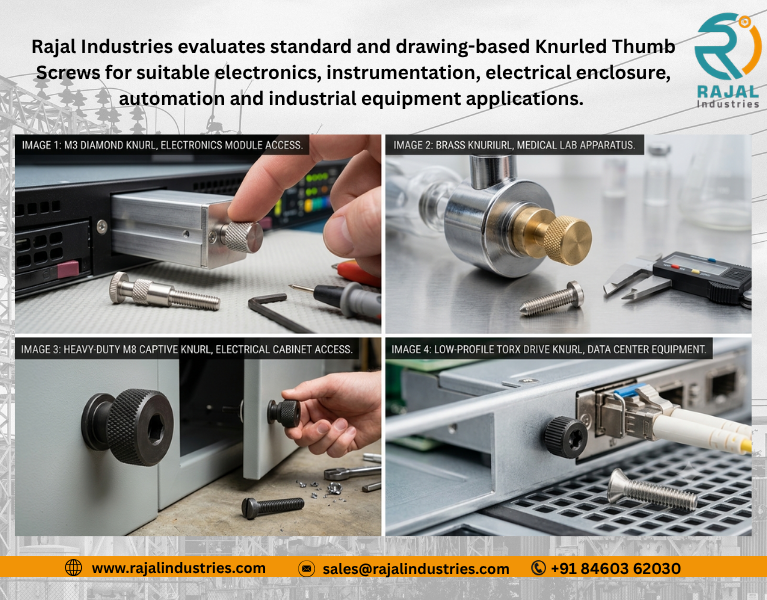
A Knurled Thumb Screw Manufacturer produces hand-operated fasteners designed for applications where a component needs to be tightened, loosened or adjusted without always using a separate tool.
The enlarged head provides a gripping surface, while knurling can improve finger grip during manual operation.
Knurled thumb screws can be used in suitable:
- Electronics equipment
- Medical equipment
- Laboratory instruments
- Electrical enclosures
- Industrial machinery
- Automation equipment
- Measurement instruments
- Telecom equipment
- Fixtures and tooling
- Service-access assemblies
For OEM applications, however, selecting a thumb screw requires more than choosing a thread size.
A complete specification can include:
Thread + Length + Head Diameter + Head Height + Knurl + Material + Mechanical Requirement + Finish + Tip/End + Installation + Application
Quick Answer: What Is a Knurled Thumb Screw?
A knurled thumb screw is a threaded fastener with a head designed to provide finger grip for manual tightening, loosening or adjustment. The head normally has a textured knurled surface to improve handling.
Depending on the application, Knurled Screws can be manufactured in different threads, lengths, head dimensions, materials, finishes and end configurations.
What Does a Knurled Thumb Screw Manufacturer Do?
A Knurled Thumb Screw Manufacturer converts the OEM’s functional and dimensional requirements into a repeatable production fastener.
Depending on the design and manufacturing feasibility, this can involve:
Material → Head Formation/Machining → Knurling → Thread Production → Secondary Operations → Heat Treatment Where Required → Finish → Inspection → Packaging
For custom Precision Screws, the exact manufacturing route depends on geometry, material, volume, tolerance and customer specification.
What Is Knurling?
Knurling is a textured pattern formed on a surface to improve grip or provide another specified functional surface.
On a thumb screw, the knurled area is commonly located around the outside diameter of the head.
Its main purpose is usually to help the user grip and rotate the screw.
Why Use a Knurled Head?
Compare a smooth cylindrical head with a knurled head.
Smooth Head
The fingers depend mainly on surface friction.
Knurled Head
The textured surface provides additional grip features.
This can be useful where the screw is intentionally operated by hand.
Knurling Does Not Automatically Mean Tool-Free
A knurled head may be designed for manual operation, but some thumb screws can also include a drive such as:
- Slotted
- Phillips
- Hex socket
- Other customer-specified drive
This allows the OEM to combine:
Manual Grip + Optional Tool Engagement
where appropriate.
Thumb Screw vs Conventional Machine Screw
| Feature | Knurled Thumb Screw | Conventional Machine Screw |
| Manual Grip | Strong design focus | Usually limited |
| Enlarged Head | Common | Design dependent |
| Knurled Surface | Common | Usually no |
| Tool-Free Operation | Often possible | Usually tool-operated |
| Tool Drive | Optional | Common |
| Frequent Adjustment | Useful | Application dependent |
| Compact Head | Often larger | Often easier |
| Precision Geometry | OEM dependent | OEM dependent |
A thumb screw is not automatically better. It is useful where manual access provides a practical benefit.
Why OEMs Use Knurled Thumb Screws
Common reasons include:
- Faster manual adjustment
- Easier panel access
- Reduced tool dependence
- Convenient setup changes
- Frequent component removal
- Repeated equipment servicing
- Manual positioning
- Operator-friendly handling
The actual benefit depends on the equipment design.
Main Industrial Applications
| Industry | Potential Application | Main Requirement |
| Electronics | Covers, modules, fixtures | Manual service |
| Medical Equipment | Covers, accessories, adjustments | Controlled repeatability |
| Laboratory Equipment | Fixtures, holders, panels | Frequent adjustment |
| Instrumentation | Adjustment assemblies | Precise handling |
| Electrical Equipment | Service covers | Access |
| Automation | Guides, fixtures, guards | Setup changes |
| Machinery | Adjustable components | Manual operation |
| Telecom | Equipment covers | Serviceability |
| Test Equipment | Fixtures and panels | Frequent access |
| Optical Equipment | Suitable adjustment assemblies | Controlled movement |
Knurled Thumb Screws for Electronics
Electronics equipment can benefit from thumb screws where users or technicians frequently access:
- Service panels
- Equipment covers
- Removable modules
- Test fixtures
- Adjustment mechanisms
- Instrument housings
The large gripping head can simplify manual operation.
Electronics Design Considerations
Before selecting a thumb screw, review:
Head Diameter + Head Height + Finger Access + Internal Clearance + Thread + Required Tightening
A large head improves grip but also occupies more space.
Head Clearance in Compact Electronics
Compact electronics can have nearby:
- Connectors
- Switches
- Cables
- Displays
- Adjacent screws
- Enclosure walls
The thumb screw should be accessible without interfering with these components.
Thumb Screws for Electronics Service Panels
Where a cover is intentionally opened frequently, a knurled screw can reduce dependence on a screwdriver.
However, if the cover must not be opened casually, tool-free access may be inappropriate.
The equipment’s access-control requirements should come first.
Knurled Thumb Screws for Medical Equipment
Suitable Precision Screws may be used in certain medical-equipment assemblies where manual adjustment, positioning or service access is required.
Potential applications can include:
- Equipment covers
- Instrument fixtures
- Accessory mounts
- Adjustment assemblies
- Laboratory-related medical equipment
- Diagnostic-equipment hardware
Final fastener requirements should follow the medical-equipment manufacturer’s approved design.
Important Medical Equipment Limitation
A screw being manufactured accurately does not by itself establish that it is suitable for a medical device.
Medical-equipment applications can involve additional requirements for:
- Material
- Cleaning
- Corrosion
- Biocompatibility where applicable
- Validation
- Traceability
- Regulatory controls
These requirements depend on the specific device and use.
Medical Equipment: Patient-Contact vs Equipment Hardware
This distinction is important.
A thumb screw used on the external housing of diagnostic equipment is not necessarily subject to the same requirements as a component that directly contacts a patient.
Therefore, specify the actual application rather than simply saying:
“Medical thumb screw.”
Thumb Screws for Laboratory Equipment
Laboratory equipment can contain frequently adjusted:
- Fixtures
- Holders
- Covers
- Brackets
- Guides
- Instrument assemblies
Knurled heads can provide convenient manual control where tool-free adjustment is intentional.
Laboratory Equipment Selection Priorities
Review:
Adjustment Frequency + Grip + Thread + Material + Environment + Cleaning + Required Holding Function
Thumb Screws for Industrial Machinery
Industrial machinery can use knurled thumb screws for suitable:
- Adjustment points
- Fixtures
- Guides
- Stops
- Covers
- Inspection panels
- Removable accessories
The design should consider how frequently the operator needs to manipulate the screw.
Thumb Screw Does Not Replace a Structural Fastener
A thumb screw should not automatically be substituted for a conventional bolt or structural fastener simply because the thread fits.
The joint may have requirements involving:
- Clamp load
- Strength
- Fatigue
- Vibration
- Safety
Final selection should follow the approved machine design.
Knurled Screws for Automation Equipment
Automation equipment often requires quick setup changes.
Potential applications can include:
- Sensor brackets
- Adjustable guides
- Fixtures
- Stops
- Machine accessories
- Control covers
A suitable knurled screw can make manual repositioning easier.
Manual Adjustment Example
Consider an adjustable guide that changes position between production setups.
Conventional Screw
Find Tool → Loosen → Adjust → Tighten → Store Tool
Thumb Screw
Grip → Loosen → Adjust → Tighten
This can simplify repeated setup where the required holding function can safely be achieved by manual operation.
Thumb Screws for Electrical Enclosures
Suitable thumb screws can be used on electrical equipment where intentional manual access is acceptable.
Potential applications include:
- Service covers
- Control panels
- Instrument panels
- Removable access plates
But:
Tool-Free Access ≠ Safe Access
Electrical safety requirements remain separate.
Electrical Safety Consideration
Thumb screws do not replace:
- Locks
- Interlocks
- Electrical isolation
- Authorized-access procedures
- Protective enclosure design
If tool-free access is not appropriate, another fastener design should be considered.
Thumb Screws for Telecom Equipment
Potential applications include suitable:
- Equipment covers
- Rack equipment
- Communication enclosures
- Internal adjustment hardware
- Test and maintenance fixtures
For publicly accessible telecom equipment, manual operation may be undesirable unless the complete equipment design provides suitable access control.
Thumb Screws for Data-Center Equipment
Suitable thumb screws can be useful for:
- Rack-mounted equipment
- Service panels
- Removable modules
- Equipment covers
- Test or maintenance assemblies
In dense racks, head projection and finger access should be checked carefully.
Knurled Thumb Screws for Instrumentation
Instrumentation is a natural application area because manual adjustment may be frequent.
Potential uses include:
- Adjustment points
- Instrument covers
- Mounting fixtures
- Sensor positioning
- Measurement equipment
- Test assemblies
Thumb Screws for Fixtures and Tooling
Manufacturing fixtures can use thumb screws for:
- Workpiece positioning
- Adjustable stops
- Guide positioning
- Temporary retention
- Setup changes
Where higher clamp force or controlled tightening is required, the OEM should determine whether manual operation is sufficient.
Knurled Thumb Screw Head Design
The head is one of the defining features.
Important dimensions can include:
- Head diameter
- Head height
- Knurled outside diameter
- Knurled width
- Edge geometry
- Optional drive
- Transition to shank
Head Diameter
A larger head can improve finger access and turning leverage.
But it also increases:
- Required space
- Projection
- Material
- Potential interference
Therefore:
Bigger Head ≠ Automatically Better Thumb Screw
Head Height
Head height influences:
- Grip area
- Knurl width
- Overall projection
- Available drive depth
- Appearance
Compact equipment may require a lower profile.
Knurl Types
Depending on drawing requirements and manufacturing feasibility, knurling may be specified in different patterns.
Common conceptual directions include:
- Straight knurl
- Diamond/cross knurl
- Customer-specified pattern
The OEM drawing should define critical requirements where the knurl form matters.
Straight Knurl
A straight knurl has grooves generally running parallel to the screw axis.
It can provide a textured gripping surface and a clean industrial appearance.
Diamond Knurl
A diamond or cross-pattern knurl creates intersecting surface features.
It can provide grip in multiple directions and is commonly associated with hand-operated cylindrical components.
Straight vs Diamond Knurl
| Feature | Straight Knurl | Diamond Knurl |
| Pattern | Axial | Crossed |
| Manual Grip | Useful | Useful |
| Appearance | Linear | Diamond texture |
| Manufacturing | Process dependent | Process dependent |
| Selection | Drawing/application | Drawing/application |
Do not select a knurl pattern only from appearance if the customer drawing specifies one.
Knurl Specification Matters
“Knurled head” may not be enough for a custom Knurled Thumb Screw Manufacturer RFQ.
Where functionally important, define:
Knurl Type + Knurled Diameter + Width + Pattern Requirement + Acceptance Criteria
Knurling Process
Knurling may be produced using a suitable manufacturing method depending on:
- Material
- Head geometry
- Volume
- Tolerance
- Surface requirement
- Manufacturing route
The supplier should determine the practical process during feasibility review.
Formed vs Cut/Machined Features
Custom Knurled Screws can potentially involve:
- Cold forming
- Machining
- Knurl forming
- Thread rolling
- Thread cutting
- Secondary operations
The correct route depends on geometry and production quantity.
High-Volume Manufacturing Direction
For repeat OEM volumes, a forming-based production route may be practical where geometry and material permit.
Potential process concept:
Wire/Material → Heading/Forming → Knurl/Secondary Forming → Thread Rolling → Finish → Inspection
This is only a conceptual route. Actual manufacturing should follow the approved part design.
CNC/Machined Thumb Screw Direction
Machining can be useful for:
- Prototype quantities
- Lower volumes
- Complex geometry
- Special shoulders
- Precision diameters
- Development samples
However, it may not be the most economical route for every high-volume part.
Manufacturing Route Selection
| Requirement | Potential Manufacturing Direction |
| Prototype | CNC/secondary machining |
| Low Volume | Machining or suitable mixed process |
| Medium Volume | Process dependent |
| High Repeat Volume | Forming may become attractive |
| Complex Shoulder | Secondary machining may be required |
| Special Knurl | Drawing/process dependent |
| Custom Tip | Secondary operation possible |
| Tight Precision Feature | Process-specific review |
Thread Types for Knurled Thumb Screws
Thumb screws can use suitable:
- Metric machine threads
- Unified threads
- Customer-specified threads
The thread should match the actual mating component.
Common Metric Thread Examples
| Thread | Nominal Diameter | Coarse Pitch |
| M3 × 0.5 | 3 mm | 0.5 mm |
| M4 × 0.7 | 4 mm | 0.7 mm |
| M5 × 0.8 | 5 mm | 0.8 mm |
| M6 × 1.0 | 6 mm | 1.0 mm |
| M8 × 1.25 | 8 mm | 1.25 mm |
These are common metric coarse-thread examples, not a claimed manufacturing range.
Unified Threads
For export and customer-specific OEM Screws, Unified threads may also be required.
Specify the complete designation rather than only the nominal diameter.
The manufacturer should follow the customer’s approved drawing or referenced thread specification.
Fully Threaded vs Partially Threaded Thumb Screws
Depending on the design, a thumb screw can have:
Fully Threaded Shank
Useful where thread is required through most of the available length.
Partially Threaded / Shoulder Arrangement
Useful where an unthreaded section performs another function such as guidance, positioning or clearance.
Shoulder Thumb Screws
A custom thumb screw may include a controlled shoulder.
Potential functions include:
- Spacing
- Guidance
- Positioning
- Controlled movement
- Captive arrangements in suitable designs
Important dimensions include:
Shoulder Diameter + Shoulder Length + Thread + Head Geometry
Captive Knurled Thumb Screws
Some applications can combine:
Knurled Thumb Head + Captive Retention
This can be useful where a panel needs:
- Manual access
- Repeated servicing
- Screw retention
The captive feature must be designed separately from the knurl.
Thumb Screw vs Captive Thumb Screw
| Feature | Standard Thumb Screw | Captive Thumb Screw |
| Manual Operation | Yes | Yes |
| Knurled Head | Common | Common |
| Fully Removable | Usually | Designed to remain retained |
| Panel Retention | No | Yes |
| Captive Travel | No | Important |
| Retention Geometry | No | Required |
Thumb Screw End Styles
Depending on the application, the threaded end can require different geometry.
Possible customer-defined directions include:
- Standard end
- Flat end
- Rounded end
- Dog-point style
- Other special point
Do not select the end style independently from the mating component.
Flat-End Thumb Screws
A flat end can be used in suitable applications where the screw bears against a surface.
The mating material and required holding function should be reviewed.
Rounded-End Thumb Screws
A rounded end can be considered where the contact geometry benefits from a less sharp bearing point.
Again, the actual function should be defined by the OEM.
Dog-Point Thumb Screws
A dog-point style end can provide positioning or guidance in suitable assemblies.
The point diameter, length and mating feature should be defined by the drawing.
Thumb Screw Material Options
Material selection should consider:
Mechanical Requirement + Environment + Mating Material + Appearance + Customer Specification
Potential directions include:
- Carbon steel
- Suitable alloy steel
- Stainless steel
- Brass where specifically required
- Other customer-specified materials
Carbon Steel Knurled Thumb Screws
Carbon steel can provide an economical direction for many industrial applications when paired with an appropriate finish.
Specify the actual material and required mechanical properties rather than only:
Steel
Stainless Steel Knurled Thumb Screws
Stainless steel can be useful where corrosion resistance, appearance or customer specification requires it.
Common directions include:
- SS304/A2-type
- SS316/A4-type
- Customer-specified stainless grade
SS304 vs SS316 Thumb Screws
SS304/A2-type stainless can suit many general industrial applications where its corrosion performance is sufficient.
SS316/A4-type stainless can be evaluated for more demanding chloride-related environments.
Do not automatically specify SS316 simply because equipment is installed outdoors.
Brass Knurled Thumb Screws
Brass may be specified for suitable:
- Instrumentation
- Electrical
- Decorative
- Low-load adjustment
applications where its properties are appropriate.
The final selection should follow the approved equipment design.
Material Comparison
| Material | Potential Application Direction | Main Consideration |
| Carbon Steel | General industrial | Finish/corrosion |
| Alloy Steel | Defined mechanical requirement | Heat treatment |
| SS304/A2-Type | General corrosion resistance | Environment |
| SS316/A4-Type | Chloride-related exposure | Need/cost |
| Brass | Selected instrument/electrical uses | Strength/application |
| Customer Material | Special OEM requirement | Manufacturability |
Material Compatibility
Review the complete assembly:
Thumb Screw + Mating Thread + Panel/Bracket + Environment
For dissimilar metals in moisture-prone environments, galvanic compatibility may need consideration.
Finish Options
Depending on material and customer requirements, finishes can include suitable:
- Zinc-based finishes
- Black finishes
- Nickel-related finishes where specified
- Passivation for suitable stainless parts
- Customer-specified coatings
The exact finish system should be specified rather than only its appearance.
Black Thumb Screws
“Black” is not a complete technical finish specification.
The buyer should define the required:
- Finish type
- Appearance
- Corrosion performance
- Thickness where relevant
- Acceptance criteria
Finish and Knurl Definition
A thick coating can affect the appearance and feel of a fine knurled surface.
Where grip or visual quality is important, approve production-intended finished samples.
Precision Screws and Dimensional Control
The term Precision Screws should be connected to measurable requirements.
Depending on the application, critical features can include:
- Thread
- Overall length
- Head diameter
- Head height
- Shoulder diameter
- Shoulder length
- Knurled diameter
- Drive
- Point geometry
- Concentricity or runout where specified
Do not use “precision” only as a marketing term.
Critical-to-Function Dimensions
For a custom knurled thumb screw, identify which dimensions actually affect function.
For example:
Thread → Assembly
Head Diameter → Finger Grip + Clearance
Head Height → Grip + Projection
Shoulder → Positioning
Point → Contact Function
Knurl → Manual Handling
This helps focus manufacturing and inspection controls.
Head Diameter Tolerance
A head can be both:
- Functional
- Cosmetic
If it must fit within a recess or between adjacent components, head diameter may become a critical dimension.
Head Height Tolerance
Head height can affect:
- Overall projection
- Grip
- Drive depth
- Equipment clearance
Compact electronics and instruments may require particular attention.
Knurled Diameter Inspection
The drawing should make clear how the knurled outside diameter is controlled where it is critical.
Knurled surfaces differ from smooth machined diameters, so inspection requirements should match the drawing and manufacturing method.
Thread Inspection
Depending on customer requirements, thread inspection can include suitable:
- GO/NO-GO gauges
- Dimensional checks
- Visual inspection
- Customer-specified methods
The inspection plan should follow the approved thread requirement.
Material Verification
For OEM production, required material documentation can depend on the application.
Potential controls include:
- Material certificate
- Chemical verification where specified
- Mechanical verification where specified
- Heat-treatment documentation where applicable
Finish Inspection
Depending on specification:
- Appearance
- Coating thickness
- Corrosion-related testing
- Adhesion or other customer-defined requirements
may need verification.
Do not apply the same testing package to every thumb screw automatically.
Functional Thumb Screw Test
A simple functional test can be:
Install → Hand Tighten/Operate as Intended → Loosen → Repeat → Check Grip → Check Thread → Check Clearance
For special adjustment or holding applications, the OEM should define the actual functional acceptance criteria.
Repeated Operation
A thumb screw can be used more frequently than an ordinary assembly fastener.
Where repeated operation matters, evaluate:
- Thread wear
- Knurl condition
- Head wear
- Mating-thread wear
- Finish
- Manual grip
- Adjustment consistency
There is no universal cycle count for all applications.
Thumb Screw Tightening
Do not assume a thumb screw should always be tightened as hard as possible by hand.
The required tightening depends on:
- Thread
- Head
- Joint
- Mating material
- Required holding function
For applications requiring controlled preload or torque, the OEM should define an appropriate installation method.
Manual Tightening Limitation
Human hand force varies significantly.
Therefore, a thumb screw may not be appropriate where the joint requires tightly controlled installation preload unless the design includes a suitable controlled tightening method.
Thumb Screws and Vibration
Another important distinction:
Manual Operation ≠ Vibration Resistance
If the equipment vibrates, the joint should be evaluated separately for loosening.
Do not assume knurling provides any thread-locking function.
Thumb Screws and Security
A hand-operated thumb screw is generally designed to make access easier.
That may conflict with applications requiring restricted access.
Therefore:
Convenient Manual Access ↔ Access Control
should be considered during design.
Custom Knurled Thumb Screws
Custom manufacturing can be useful when the OEM requires:
- Special head diameter
- Special head height
- Unique knurl
- Shoulder
- Reduced shank
- Special point
- Special thread length
- Optional tool drive
- Captive feature
- Customer material
- Customer finish
When Customization Makes Sense
Customization is more justified where a standard catalogue part cannot satisfy:
Fit + Function + Service + Environment + Production Requirement
Do not create custom geometry simply for appearance if a standard part performs the required function.
Drawing-Based Manufacturing
For custom Precision Screws, the customer drawing should ideally define:
- Thread
- Overall length
- Head dimensions
- Knurl requirement
- Shoulder if any
- End geometry
- Drive
- Material
- Finish
- Tolerances
- Special notes
Sample-Based Localization
For an existing imported thumb screw, provide:
Existing Sample + Drawing if Available + Mating Component + Application + Material/Finish Requirement
A physical sample can support dimensional review, but it does not necessarily reveal the original material, tolerance or coating specification.
Standard Thumb Screw vs Custom OEM Screw
| Requirement | Standard | Custom |
| Common Thread | Strong option | Possible |
| Common Head | Strong option | Possible |
| Special Head Diameter | Limited | Strong option |
| Special Knurl | Limited | Strong option |
| Shoulder | Limited | Strong option |
| Special Point | Limited | Strong option |
| Captive Feature | Product dependent | Strong option |
| Special Drive | Limited | Strong option |
| Low Volume | Often better | Tooling may not justify |
| High Repeat Volume | Good | Custom can become practical |
Manufacturing Feasibility Review
Before quoting a custom part, the manufacturer should review:
Geometry + Material + Tolerance + Volume + Tooling + Secondary Operations + Finish + Inspection
This avoids designing a screw that is technically possible but commercially inefficient.
Prototype vs Production Design
A CNC-machined prototype may prove:
- Dimensions
- Fit
- Basic function
But it does not automatically prove that the same geometry can be economically mass-produced by a different process.
Production feasibility should be reviewed before design freeze.
Supplier vs Manufacturer
A Thumb Screw Supplier may provide catalogue or sourced products.
A manufacturer may be more relevant where the OEM needs:
- Drawing-based customization
- Tooling
- Process development
- Material control
- Special dimensions
- Inspection
- Repeat production
The buyer should understand who actually controls manufacturing.
How to Evaluate a Knurled Thumb Screw Manufacturer
Ask whether the supplier/manufacturer can support:
- Drawing review
- Thread requirements
- Head geometry
- Knurl requirements
- Shoulder/reduced shank
- Special end geometry
- Material
- Finish
- Tooling
- Prototype/sample development
- Dimensional inspection
- Thread inspection
- Material verification
- Functional testing
- Pilot production
- Bulk repeat production
Manufacturer Qualification Matrix
| Capability | Priority |
| Drawing Compliance | High |
| Thread Control | High |
| Head Geometry | High |
| Knurl Control | High |
| Material Control | High |
| Finish Control | High |
| Functional Fit | High |
| Inspection | High |
| Sample Development | High |
| Custom Tooling | Custom projects |
| Production Capacity | Commercial |
| Traceability | Application dependent |
| Lead Time | Commercial |
| Price | Compare after compliance |
Rajal Industries as a Knurled Thumb Screw Manufacturer
Rajal Industries can evaluate standard and drawing-based Knurled Thumb Screw Manufacturer requirements for suitable industrial OEM applications.
Depending on technical feasibility and customer specifications, requirements can be reviewed for suitable:
- Knurled Screws
- Thumb screws
- Precision Screws
- Custom OEM screws
- Electronics fasteners
- Instrumentation screws
- Industrial equipment screws
- Electrical enclosure screws
- Captive thumb screw concepts
- Metric threads
- Customer-specified Unified threads
- Straight or customer-defined knurl requirements
- Suitable cross/diamond knurl requirements
- Shoulder configurations
- Special end configurations
- Carbon steel
- Suitable alloy steel
- Stainless steel
- Customer-specified materials
- Customer-specified finishes
- Custom tooling
- Samples
- Dimensional inspection
- Thread verification
- Material/mechanical verification where required
- Pilot production
- Bulk production
Final capability should be confirmed after review of the approved drawing, material, tolerance, finish, functional requirement, quantity and required manufacturing process.
What Should a Buyer Send for Quotation?
A Knurled Thumb Screw Manufacturer can evaluate the requirement more accurately when the RFQ includes:
Drawing + Thread + Length + Head Diameter + Head Height + Knurl + Drive + Shoulder/Point if Any + Material + Finish + Tolerances + Application + Quantity
For an existing part, also provide a physical sample and mating component where possible.
Buyer RFQ Checklist
Screw Geometry
☐ Drawing
☐ Thread
☐ Pitch/TPI
☐ Overall length
☐ Thread length
☐ Head diameter
☐ Head height
☐ Knurled diameter
☐ Knurl requirement
☐ Shoulder
☐ Point/end
☐ Optional drive
Material
☐ Grade
☐ Mechanical requirement
☐ Heat treatment if applicable
Finish
☐ Finish type
☐ Appearance
☐ Corrosion requirement
Application
☐ Equipment
☐ Manual operation
☐ Service frequency
☐ Mating component
☐ Environment
Quality
☐ Dimensional inspection
☐ Thread verification
☐ Material documentation
☐ Finish verification
☐ Functional testing
Commercial
☐ Sample quantity
☐ Tooling
☐ MOQ
☐ First order
☐ Annual quantity
☐ Packaging
☐ Delivery location
Common Buyer Mistakes
1. Specifying Only “M4 Thumb Screw”
This does not define the head, knurl, length, material or finish.
2. Selecting Head Diameter Only for Appearance
It affects grip and equipment clearance.
3. Ignoring Knurl Geometry
For custom parts, the required texture should be defined where functionally important.
4. Assuming Tool-Free Is Always Better
Some equipment requires controlled access.
5. Ignoring Mating Material
Thread and material compatibility matter.
6. Calling Every Thumb Screw a Precision Screw
Precision should be connected to defined tolerances and functional requirements.
7. Specifying “Stainless” Without Grade
Specify the required stainless grade.
8. Specifying “Black” Without Finish
Color does not define coating performance.
9. Ignoring Production Volume
The best manufacturing process can change with quantity.
10. Copying a Sample Without Understanding the Application
A sample may not reveal the complete engineering specification.
Bulk Buyer Quick Answer
What should I send to source custom knurled thumb screws?
Send:
Approved Drawing + Thread + Length + Head Diameter + Head Height + Knurl Requirement + Drive + Shoulder/End Geometry + Material + Finish + Tolerances + Application + Testing Requirements + Quantity
For an existing imported component, provide the sample and mating assembly where available.
Step 1: Define What the Thumb Screw Actually Does
Before selecting dimensions, define its function.
Is the screw used to:
- Fasten a removable cover?
- Adjust a component?
- Position a bracket?
- Hold a fixture?
- Clamp a component?
- Retain an accessory?
- Provide frequent service access?
- Position a guide or stop?
The answer changes the required screw geometry.
Functional Selection Matrix
| Function | Main Selection Priority |
| Removable Cover | Manual access + thread |
| Adjustment | Grip + controlled movement |
| Positioning | Point/shoulder geometry |
| Fixture | Holding function + repeated use |
| Service Panel | Fast operation |
| Instrument | Precision + compact geometry |
| Equipment Accessory | Repeatable assembly |
| Captive Panel | Manual grip + retention |
Step 2: Decide Whether a Thumb Screw Is the Right Fastener
A thumb screw is most useful where intentional manual operation provides a practical benefit.
Choose it because the application needs:
Grip + Manual Rotation + Repeated Access
not simply because it looks different from a machine screw.
When a Knurled Thumb Screw Is a Strong Candidate
Suitable applications can include those where:
- Frequent adjustment is required
- A technician repeatedly removes a component
- Tool-free access is intentional
- Operators make regular setup changes
- Small fixtures require manual positioning
- Equipment needs convenient service access
When a Thumb Screw May Not Be Suitable
Another fastener may be preferable where:
- High controlled preload is critical
- Tool-free access creates a safety concern
- Unauthorized access must be restricted
- Head projection is severely limited
- Structural joint performance controls selection
- Manual tightening cannot reliably satisfy the joint requirement
Knurled Thumb Screw vs Machine Screw
| Feature | Knurled Thumb Screw | Machine Screw |
| Finger Grip | High | Usually limited |
| Tool-Free Operation | Often possible | Usually not |
| Head Size | Often larger | Usually more compact |
| Frequent Adjustment | Strong application | Possible |
| Controlled Tool Tightening | Optional/design dependent | Common |
| Restricted Access | Usually weaker | Easier to control |
| Compact Equipment | Head clearance important | Often easier |
| Manual Setup | Strong advantage | Tool required |
Knurled Thumb Screw vs Wing Screw
Both can provide manual operation, but the head geometry is very different.
Knurled Thumb Screw
Uses a generally cylindrical gripping head.
Wing Screw
Uses projecting wings for manual leverage.
| Factor | Knurled Thumb Screw | Wing Screw |
| Head Shape | Cylindrical | Winged |
| Grip | Knurled circumference | Wings |
| Radial Clearance | Usually more compact | Larger |
| Manual Leverage | Design dependent | Often greater |
| Equipment Appearance | Compact/industrial | More prominent |
| Dense Equipment | Often easier | Check wing clearance |
| Snagging/Interference | Lower direction | Higher projection possible |
| Tool Drive Option | Possible | Design dependent |
When Knurled Screws May Be Better Than Wing Screws
A knurled head can be useful where:
- Radial space is limited
- A compact cylindrical shape is preferred
- Equipment has closely spaced controls
- A cleaner external profile is required
- Optional screwdriver/hex/Torx operation is desired
When a Wing Screw May Be Considered
A wing screw can be useful where:
- Larger manual leverage is desirable
- There is enough clearance around the head
- Fast manual operation is more important than compact geometry
Final selection should follow the actual joint requirement.
Knurled Thumb Screw vs Captive Thumb Screw
A standard thumb screw can normally be completely removed.
A captive thumb screw adds retention.
| Feature | Standard Thumb Screw | Captive Thumb Screw |
| Manual Grip | Yes | Yes |
| Knurled Head | Common | Common |
| Fully Removable | Usually | Designed to remain retained |
| Retention Feature | No | Yes |
| Captive Travel | No | Important |
| Panel Geometry | Conventional | Critical |
| Service Hardware Retention | No | Yes |
If the screw must remain attached to a service panel, evaluate a captive configuration rather than assuming a normal thumb screw will provide retention.
Step 3: Select the Knurl Pattern
The knurl is a major functional and visual feature.
Two common conceptual directions are:
Straight Knurl
and
Diamond/Cross Knurl
The customer drawing should control the actual requirement.
Straight Knurl
A straight knurl generally creates grooves parallel to the screw axis.
Potential advantages include:
- Defined finger texture
- Simple visual pattern
- Industrial appearance
- Useful circumferential grip
Diamond Knurl
A diamond/cross knurl creates intersecting grooves.
Potential advantages can include:
- Multi-directional texture
- Strong tactile surface
- Familiar manual-control appearance
The required pattern should be confirmed from the drawing rather than assumed.
Straight vs Diamond Knurl Decision Guide
| Requirement | Straight Knurl | Diamond/Cross Knurl |
| Manual Grip | Suitable | Suitable |
| Linear Appearance | Strong | No |
| Cross-Pattern Appearance | No | Strong |
| Frequent Hand Operation | Suitable | Suitable |
| Customer Drawing Controls | Yes | Yes |
| Precision OD Requirement | Drawing/process dependent | Drawing/process dependent |
Neither pattern is universally better.
Knurl Size and Grip
Grip does not depend only on whether the pattern is straight or diamond.
It can also depend on:
- Head diameter
- Knurl depth/profile
- Knurl spacing
- Knurled width
- Surface finish
- User access
- Gloves where applicable
Therefore, avoid specifying:
“Heavy knurl”
without a drawing or agreed reference where the geometry is important.
Knurl Sharpness
A very aggressive knurl may improve tactile grip but can be uncomfortable for repeated manual operation.
A very shallow knurl may provide insufficient tactile benefit.
The correct balance depends on the application.
Medical and Laboratory Equipment Grip
For frequently handled equipment, consider:
Grip + Comfort + Cleaning + Surface Condition
An aggressive texture may not automatically be the best choice simply because it provides stronger grip.
Step 4: Select Head Diameter
Head diameter influences both:
Manual Leverage + Available Grip Area
A larger diameter can make rotation easier.
However, it also requires more equipment space.
Head Diameter Selection Questions
Ask:
- Can the user comfortably reach the head?
- Is enough radial clearance available?
- Are other controls nearby?
- Does the screw need to fit inside a recess?
- Is manual leverage sufficient?
- Will the head interfere with cables or adjacent equipment?
Head Diameter Trade-Off
Larger Head → Easier Grip / More Leverage → More Space Required
Smaller Head → More Compact → Less Grip Area / Leverage
The best diameter balances both.
Step 5: Select Head Height
Head height influences:
- Grip width
- Knurled area
- Projection
- Appearance
- Optional drive depth
- Finger access
A very low head can reduce available gripping surface.
A very tall head can interfere with equipment.
Head Diameter and Height Should Be Selected Together
Do not design head diameter independently from height.
The user grips a three-dimensional head.
A large but extremely thin head may not provide the expected handling benefit.
Head Selection Matrix
| Application | Head Direction | Main Check |
| Electronics | Compact | Clearance |
| Medical Equipment | Application-specific | Handling/cleaning |
| Instrumentation | Controlled profile | Adjustment |
| Industrial Fixture | Larger grip possible | Holding function |
| Electrical Panel | Service-friendly | Access requirement |
| Rack Equipment | Low projection | Adjacent equipment |
| Laboratory Fixture | Frequent handling | Comfort |
Step 6: Decide Whether an Optional Tool Drive Is Needed
A thumb screw can still include a drive.
Possible configurations include:
- Knurled head only
- Knurled + slot
- Knurled + Phillips
- Knurled + hex socket
- Knurled + other customer-defined drive
Why Add a Tool Drive?
An optional drive can be useful where the OEM wants:
Manual Adjustment + Tool Assistance When Needed
For example, a technician may initially loosen the screw with a tool and then continue by hand.
Manual Operation vs Tool Assistance
| Requirement | Hand Only | Hand + Tool Drive |
| Simple Adjustment | Strong | Strong |
| Tool-Free Intent | Best fit | Still possible |
| Additional Tool Assistance | No | Yes |
| Head Complexity | Lower | Higher |
| Drive Manufacturing | No | Required |
| Controlled Tightening | Limited | Potentially better |
The approved installation requirement should determine the choice.
Step 7: Select Thread Diameter and Pitch
The thread should be selected from the mating component and joint requirement.
For existing equipment:
Maintain the approved thread unless the OEM approves a design change.
Specify the complete thread designation.
Examples:
M4 × 0.7
rather than only:
M4
Metric vs Unified Threads
A Thumb Screw Supplier serving OEM/export requirements may need to support either system depending on the customer drawing.
Never substitute a similar-looking metric thread for a Unified thread or vice versa.
Fine vs Coarse Thread
Where the OEM has a choice, thread pitch can influence:
- Axial movement per rotation
- Thread engagement
- Adjustment behaviour
- Mating component requirements
Do not automatically choose a fine thread because the application is described as “precision.”
The actual assembly determines the requirement.
Step 8: Select Thread Length
Thread length should match:
- Mating component
- Required engagement
- Assembly stack
- Adjustment range
- Screw function
More thread is not automatically better.
Adjustment Applications
For an adjustment screw, the available threaded movement may directly affect the adjustment range.
Review:
Starting Position → Required Adjustment Range → Mating Thread → End Position
Step 9: Determine Overall Length
Overall length depends on:
Head Reference → Shank/Shoulder → Thread → Point
It should be derived from the actual assembly rather than selected from appearance.
Excessive Length
A screw that is too long can:
- Project into equipment
- Contact components
- Limit adjustment
- Damage a surface
- Create unwanted interference
Insufficient Length
A screw that is too short can result in:
- Inadequate engagement
- Insufficient adjustment
- Poor holding function
- Assembly difficulty
Step 10: Select Shoulder or Unthreaded Shank
Some custom Precision Screws need an unthreaded section.
Potential functions include:
- Guidance
- Alignment
- Spacing
- Controlled movement
- Positioning
- Captive retention
Shoulder Selection
Specify:
Shoulder Diameter + Shoulder Length + Transition + Tolerance
where the shoulder performs a functional role.
Do not treat it as an unimportant cosmetic dimension.
Step 11: Select the End or Point
The screw end can be important when the screw contacts another component.
Potential configurations include:
- Standard machine-screw end
- Flat end
- Rounded end
- Dog point
- Customer-specific geometry
Point Selection Matrix
| End Type | Potential Function | Main Check |
| Standard End | General fastening | Mating thread |
| Flat | Surface contact | Contact pressure |
| Rounded | Suitable adjustment/contact | Mating surface |
| Dog Point | Guidance/positioning | Hole/recess geometry |
| Custom | Specialized OEM function | Drawing |
Avoid Surface Damage
Where a thumb screw bears directly against another component, check whether the end can:
- Mark the surface
- Deform softer material
- Damage a finish
- Create concentrated contact
Point geometry should follow the functional requirement.
Step 12: Select Material
A useful material decision is:
Function → Environment → Mating Material → Appearance → Customer Specification
Carbon Steel Thumb Screws
Carbon steel can suit many industrial applications with an appropriate surface finish.
Potential advantages include:
- Established manufacturing routes
- Suitable mechanical performance
- Multiple finish options
- Commercial practicality
Actual grade should follow the drawing.
Stainless Steel Thumb Screws
Stainless can be useful for:
- Corrosion resistance
- Clean appearance
- Selected medical/laboratory equipment
- Instrumentation
- Outdoor equipment
But “stainless” should not be the complete material specification.
SS304/A2-Type
Can suit many general environments where its corrosion resistance is sufficient.
SS316/A4-Type
Can be evaluated for more demanding chloride-related exposure.
Again:
Medical Equipment ≠ Automatically SS316
and:
Outdoor Equipment ≠ Automatically SS316
Brass Thumb Screws
Brass can be useful in selected applications where its particular combination of:
- Machinability
- Appearance
- Electrical characteristics
- Corrosion behaviour
is appropriate.
Mechanical requirements should still be checked.
Material Selection Matrix
| Requirement | Carbon Steel | SS304/A2-Type | SS316/A4-Type | Brass |
| General Industrial | Strong direction | Possible | Usually requirement-specific | Application-specific |
| Corrosion Resistance | Finish dependent | Good direction | Higher chloride resistance direction | Environment dependent |
| Medical Equipment | Application dependent | Possible | Possible | Specialized |
| Instrumentation | Possible | Strong direction | Possible | Strong in selected uses |
| Outdoor | Coating dependent | Application dependent | Application dependent | Application dependent |
| High Strength | Grade dependent | Design dependent | Design dependent | Generally lower direction |
Final selection should follow the actual mechanical and environmental requirements.
Medical Equipment Material Selection
For medical equipment, define whether the screw is:
- External equipment hardware
- Internal equipment hardware
- In a cleaning environment
- In direct or indirect patient contact
- Subject to special regulatory requirements
The phrase “medical equipment screw” is not enough to determine material.
Biocompatibility Caution
Do not claim that a material is suitable for patient contact simply because the base material is commonly used in medical products.
Biocompatibility depends on the actual:
- Material
- Finish
- Manufacturing condition
- Contact type
- Contact duration
- Device requirements
The medical-device OEM should define the applicable requirement.
Step 13: Select Finish
Finish selection can consider:
Corrosion + Appearance + Friction + Knurl Definition + Customer Requirement
Typical Finish Directions
Depending on material and specification:
- Zinc-based coating
- Black finish
- Nickel-related finish
- Passivation
- Other engineered coating
- Customer-defined finish
Finish Selection Matrix
| Requirement | Finish Consideration |
| General Indoor | Suitable industrial finish |
| Appearance Critical | Defined cosmetic requirement |
| Corrosion Requirement | Performance-based specification |
| Stainless | Passivation where specified |
| Fine Knurl | Coating buildup/definition |
| Repeated Handling | Wear/appearance |
| Medical Equipment | OEM-defined cleaning/material requirements |
Cosmetic Requirements
Thumb screws are often visible and manually handled.
OEMs may therefore care about:
- Consistent color
- Surface marks
- Knurl appearance
- Burrs
- Head finish
- Plating variation
If appearance matters, define an acceptance standard rather than relying on subjective inspection.
Knurl Burr Control
Because users directly handle the head, burrs or excessively sharp edges can affect:
- Comfort
- Appearance
- Safety of normal handling
Edge and surface quality should be part of the inspection plan where relevant.
Step 14: Consider Manual Tightening
One of the most important engineering limitations is that hand tightening varies by user.
Factors include:
- Hand size
- Grip strength
- Gloves
- Head diameter
- Knurl
- Accessibility
- Surface condition
Therefore, do not assume a consistent clamp load from manual operation alone.
When Controlled Tightening Is Required
If the assembly requires a defined installation condition, consider whether:
- A tool drive is required
- A controlled process is required
- A different fastener is more appropriate
The thumb screw should not be selected only for convenience if the joint requires something else.
Step 15: Consider Vibration
Knurling improves finger grip.
It does not lock the thread.
Therefore:
Knurled Head ≠ Vibration Resistance
If equipment vibrates, evaluate the complete joint separately.
Vibration Selection Questions
Ask:
- What vibration does the assembly experience?
- What clamp condition is required?
- How frequently is the screw adjusted?
- Is a locking feature required?
- Can the mating thread tolerate repeated use?
The approved engineering design should define the solution.
Step 16: Consider Access Control
Thumb screws make manual access easier.
That is beneficial in some applications and undesirable in others.
Access Decision
Appropriate
Equipment intentionally designed for regular user/technician access.
Potentially Inappropriate
Equipment that should require a tool or authorized access procedure.
Electronics Selection Matrix
| Electronics Application | Priority |
| Service Cover | Fast access |
| Test Fixture | Frequent adjustment |
| Removable Module | Handling |
| Instrument Housing | Compact grip |
| Sensor Fixture | Positioning |
| Rack Equipment | Head clearance |
| Internal Adjustment | Precision movement |
Medical Equipment Selection Matrix
| Application | Main Review |
| Equipment Cover | Service access |
| Instrument Fixture | Repeatable positioning |
| Accessory Mount | Holding function |
| Adjustment Assembly | Grip + movement |
| Laboratory Medical Equipment | Cleaning/environment |
| Patient-Contact Area | OEM regulatory requirements |
Instrumentation Selection Matrix
| Application | Selection Priority |
| Adjustment Screw | Thread + point |
| Mounting Fixture | Holding |
| Instrument Cover | Access |
| Sensor Positioning | Shoulder/point |
| Optical Fixture | Precision geometry |
| Test Equipment | Repeated operation |
Industrial Equipment Selection Matrix
| Application | Priority |
| Adjustable Guide | Manual setup |
| Fixture | Holding function |
| Stop | Point geometry |
| Inspection Cover | Access |
| Sensor Bracket | Positioning |
| Machine Accessory | Repeatability |
| Guard/Panel | Safety review |
Machinery Guarding Caution
Do not replace a tool-operated guard fastener with a thumb screw simply to make access easier.
Machine guarding can involve safety requirements for:
- Access
- Interlocks
- Tool operation
- Risk reduction
The machine designer should determine the appropriate fastening system.
Manufacturing Process Selection
A Knurled Thumb Screw Manufacturer should select the production route based on:
Geometry + Material + Tolerance + Quantity + Tooling + Surface Finish
Possible Production Routes
Route A: Machined
Bar/Blank → CNC Turning → Knurl → Thread → Secondary Operations → Finish
Potentially suitable for development, lower volumes or complex geometry.
Route B: Formed
Wire → Heading/Forming → Knurl/Secondary Operation → Thread Rolling → Finish
Potentially attractive for suitable higher-volume designs.
Route C: Hybrid
Formed Blank → Secondary Machining → Knurl → Thread → Finish
Useful where volume supports forming but certain dimensions require secondary processing.
Actual feasibility depends on the design.
CNC vs Formed Thumb Screws
| Factor | CNC/Machined | Formed/Production Route |
| Prototype | Strong | Tooling may delay |
| Low Volume | Strong | Application dependent |
| High Volume | Can be expensive | Potentially efficient |
| Complex Geometry | Flexible | Feasibility dependent |
| Tooling | Lower initial tooling direction | Higher initial tooling possible |
| Material Waste | More possible | Often lower direction |
| Design Changes | Easier early | Harder after tooling |
| Repeat Production | Good | Strong where optimized |
Design for Production
A prototype should not be frozen before asking:
Can this geometry be produced efficiently at the expected annual volume?
A small geometry change can sometimes significantly simplify:
- Tooling
- Forming
- Machining
- Inspection
- Production cycle
Any change should still require OEM approval.
Thread Rolling vs Cut Thread
The thread manufacturing method depends on:
- Material
- Geometry
- Quantity
- Thread location
- Production route
- Customer requirement
Do not assume every custom Precision Screw should use the same thread process.
Inspection Plan for Knurled Thumb Screws
A useful inspection plan can include:
Dimensional
- Thread
- Overall length
- Thread length
- Head diameter
- Head height
- Shoulder
- Point
- Drive
Knurl
- Pattern
- Width
- Outside dimension where specified
- Appearance
- Burr condition
Material
- Grade verification
- Mechanical properties where specified
Finish
- Appearance
- Coating requirement
- Customer-specified testing
Functional
- Mating-thread fit
- Manual grip
- Assembly clearance
- Adjustment/holding function
First Article / Sample Approval
For a custom part:
Drawing Approval → Tooling/Process → Sample → Dimensional Report → Material/Finish Verification → Assembly Test → Customer Approval
For critical OEM projects, customer-specific PPAP, first-article or other documentation requirements should be agreed before production.
Functional Sample Testing
Do not evaluate only the screw on a table.
Install it in the actual or representative assembly.
Check:
Grip → Rotation → Thread Start → Adjustment/Tightening → Clearance → Removal → Reinstallation
Repeated-Use Testing
Where frequent adjustment is expected:
Install → Operate → Remove/Loosen → Re-Engage → Repeat
Monitor:
- Thread
- Knurl
- Head
- Finish
- Mating component
- Manual handling
- Functional consistency
The OEM should define the required test duration or cycle count.
Troubleshooting Guide
| Problem | Possible Cause | Check |
| Difficult to Grip | Head/knurl unsuitable | Diameter + knurl |
| Head Interferes | Too large | Equipment clearance |
| Knurl Too Sharp | Aggressive geometry/burr | Knurl + finishing |
| Knurl Too Smooth | Insufficient texture | Knurl specification |
| Screw Hard to Turn | Thread/alignment | Thread + mating part |
| Screw Wobbles | Fit/engagement | Thread + assembly |
| Screw Too Short | Incorrect length | Assembly stack |
| Screw Bottoms Out | Excessive length | Hole depth |
| Surface Gets Marked | Point unsuitable | End geometry |
| Screw Loosens | Joint/vibration issue | Locking requirement |
| Finish Wears | Repeated handling | Coating requirement |
| Stainless Thread Seizes | Galling | Material pairing/process |
| Head Finish Uneven | Process issue | Cosmetic specification |
| Tool Drive Damages | Tool/drive mismatch | Drive + tool |
| Adjustment Is Inconsistent | Thread/point/assembly | Functional design |
Problem: Thumb Screw Is Difficult to Grip
Check:
Head Diameter + Head Height + Knurl + Finger Clearance
The problem may not be the knurl alone.
A good knurl cannot compensate for a head that the user cannot physically reach.
Problem: Screw Requires Too Much Hand Force
Investigate:
- Thread condition
- Misalignment
- Mating thread
- Surface condition
- Contamination
- Screw geometry
Do not automatically make the head larger before identifying the cause.
Problem: Knurl Feels Too Sharp
Possible causes include:
- Aggressive knurl geometry
- Burrs
- Edge condition
- Finishing
For frequently operated parts, evaluate the actual user interaction.
Problem: Thumb Screw Loosens in Vibration
This is not necessarily a knurl defect.
The knurl affects manual grip.
Investigate the joint’s:
Preload + Thread + Mating Part + Vibration + Locking Requirement
Problem: Stainless Screw Binds or Seizes
Repeated stainless-on-stainless thread operation can require galling consideration.
Review:
- Material pairing
- Thread fit
- Surface condition
- Installation
- Lubrication where approved
- Service frequency
Problem: Coating Reduces Knurl Definition
Review:
Base Knurl Geometry + Coating Type + Coating Thickness + Finished Sample
Approve the final production-intended appearance and grip rather than only an unfinished sample.
Supplier Qualification Questions
Ask a potential Thumb Screw Supplier or manufacturer:
- Do you manufacture or trade the part?
- Can you review custom drawings?
- Which manufacturing route do you propose?
- Can you produce the required knurl?
- Can you control head diameter and height?
- Can you manufacture the required thread?
- Can you produce shoulders or special points?
- Can you add an optional drive?
- Can you support the specified material?
- Can you provide the specified finish?
- What tooling is required?
- Can you make samples?
- How will the knurl be inspected?
- How will the thread be inspected?
- Can you provide material documentation?
- Can you support customer-specific quality documentation?
- Can you perform functional checks?
- Can you support pilot production?
- What is the practical MOQ?
- What is the repeat-production capacity?
Supplier Comparison Matrix
| Factor | Supplier A | Supplier B | Supplier C |
| Drawing Compliance | |||
| Manufacturing Route | |||
| Knurl Capability | |||
| Thread Capability | |||
| Special Geometry | |||
| Material | |||
| Finish | |||
| Inspection | |||
| Samples | |||
| Tooling | |||
| MOQ | |||
| Lead Time | |||
| Bulk Capacity | |||
| Documentation | |||
| Price |
Compare price after confirming technical equivalence.
Imported Thumb Screw Localization
For an existing imported part, provide:
Existing Screw + Approved Drawing + Mating Component + Application + Material/Finish Specification + Quantity
Localization Workflow
Existing Sample → Application Review → Measurement → Drawing Comparison → Material/Finish Verification → Manufacturing Feasibility → Process Selection → Tooling → Samples → Inspection → Assembly Test → Pilot Lot → Approval → Bulk Production
Sample Reverse Engineering Limitation
A sample can help identify geometry.
It cannot reliably tell the manufacturer the original:
- Nominal dimensions
- Tolerances
- Material specification
- Mechanical properties
- Coating specification
- Inspection plan
- Regulatory requirement
The approved technical documentation should take priority where available.
Complete OEM RFQ Checklist
Application
☐ Electronics
☐ Medical equipment
☐ Instrumentation
☐ Industrial machinery
☐ Automation
☐ Electrical equipment
☐ Telecom/data center
☐ Fixture/tooling
☐ Other
Thread
☐ Metric/Unified
☐ Diameter
☐ Pitch/TPI
☐ Thread tolerance/class
☐ Thread length
Head
☐ Diameter
☐ Height
☐ Profile
☐ Edge geometry
☐ Optional drive
Knurl
☐ Straight
☐ Diamond/cross
☐ Customer-specific
☐ Width
☐ Outside dimension if critical
☐ Appearance requirement
Shank/End
☐ Fully threaded
☐ Shoulder
☐ Reduced shank
☐ Flat end
☐ Rounded end
☐ Dog point
☐ Custom
Material
☐ Carbon steel
☐ Alloy steel
☐ SS304/A2-type
☐ SS316/A4-type
☐ Brass
☐ Customer-specified
Finish
☐ Finish specification
☐ Color
☐ Corrosion requirement
☐ Cosmetic requirement
Quality
☐ Dimensional report
☐ Thread inspection
☐ Material certificate
☐ Mechanical testing where specified
☐ Finish inspection
☐ Functional testing
☐ Customer-specific documentation
Commercial
☐ Prototype quantity
☐ Sample quantity
☐ Pilot quantity
☐ MOQ
☐ First order
☐ Annual quantity
☐ Packaging
☐ Delivery destination
15 Buyer Mistakes to Avoid
- Specifying only thread size.
- Ignoring head diameter.
- Ignoring finger clearance.
- Selecting knurl only by appearance.
- Using an undefined term such as “heavy knurl.”
- Assuming larger head is always better.
- Ignoring optional tool-drive requirements.
- Selecting overall length without checking the assembly.
- Ignoring point geometry in adjustment applications.
- Calling every tight-tolerance part a Precision Screw without defining tolerances.
- Specifying “stainless steel” without a grade.
- Specifying “black” without a finish system.
- Assuming manual tightening provides controlled preload.
- Assuming knurling prevents vibration loosening.
- Comparing suppliers only by unit price.
Frequently Asked Questions
What is a knurled thumb screw?
A knurled thumb screw is a threaded fastener with a head designed for manual gripping and rotation. The knurled surface provides texture that can make tightening, loosening or adjustment easier without always requiring a separate tool.
What are knurled thumb screws used for?
They can be used in suitable electronics, medical equipment, instrumentation, laboratory equipment, machinery, automation, electrical enclosures, fixtures and other assemblies requiring manual access or adjustment.
What is the difference between a thumb screw and a machine screw?
A thumb screw is designed primarily for manual operation using an enlarged gripping head. A conventional machine screw is normally designed around tool-operated fastening.
What is the difference between a thumb screw and a wing screw?
A thumb screw generally uses a cylindrical gripping head, while a wing screw has projecting wings. Wing screws can provide greater manual leverage but require more radial clearance.
Which knurl is better, straight or diamond?
Neither is universally better. Both can provide manual grip. Selection depends on the desired handling, appearance, manufacturing process and customer drawing.
How do I select the head diameter?
Select head diameter according to required grip, available finger access, turning leverage and equipment clearance. A larger head can improve handling but occupies more space.
Can a thumb screw have a screwdriver drive?
Yes. A knurled thumb screw can include a suitable slot, Phillips, hex socket or other customer-defined drive where both manual and tool-assisted operation are required.
Can knurled thumb screws be captive?
Yes. A suitable thumb screw can incorporate a separate captive-retention design so it remains attached to a panel after disengagement.
Which material is best for thumb screws?
There is no universal best material. Carbon steel, suitable alloy steel, stainless steel, brass or other materials can be selected according to mechanical, environmental, mating-material and customer requirements.
Are stainless thumb screws suitable for medical equipment?
They can be suitable for some medical-equipment applications, but material selection depends on the specific device, environment, cleaning, contact and regulatory requirements.
Is SS316 required for medical equipment?
No. The application determines the material. The term “medical equipment” alone does not establish a requirement for SS316.
Are thumb screws suitable for vibrating equipment?
They can be used where the complete joint is appropriately engineered, but knurling itself does not provide vibration resistance.
Can thumb screws provide controlled torque?
Manual tightening varies between users. If controlled installation is required, the OEM should define an appropriate tool, process or alternative fastening approach.
Can custom knurled thumb screws be manufactured from drawings?
Yes, subject to manufacturing feasibility. A complete drawing should define the thread, head, knurl, length, material, finish, tolerances and any special shoulder, point or drive requirements.
What should I send to a Knurled Thumb Screw Manufacturer for quotation?
Send the approved drawing, thread, overall length, head dimensions, knurl requirements, drive, shoulder or point geometry, material, finish, tolerances, application, quality requirements and expected quantity.
AEO / GEO Quick Answers
How do I select a knurled thumb screw?
Select a knurled thumb screw by defining its application, manual-operation requirement, thread, length, head diameter and height, knurl pattern, shoulder or point, material and finish. Also check finger access, equipment clearance, mating thread and repeated-use requirements before final approval.
What is the purpose of knurling on a thumb screw?
Knurling creates a textured surface around the thumb-screw head to improve finger grip during manual tightening, loosening or adjustment. The required knurl pattern and geometry depend on handling, appearance, manufacturing method and the OEM drawing.
Straight knurl or diamond knurl: which should I choose?
Straight and diamond knurls can both provide manual grip. Straight knurl provides a linear pattern, while diamond knurl creates a crossed texture. The best choice depends on the required grip, appearance, manufacturing process and customer specification.
Can thumb screws be used in medical equipment?
Thumb screws can be used in suitable medical-equipment assemblies for access, adjustment, fixtures or accessories. The OEM must separately define material, cleaning, traceability, patient-contact and regulatory requirements applicable to the specific device.
What information does a Thumb Screw Supplier need for a custom quotation?
A Thumb Screw Supplier should receive the drawing, thread, length, head dimensions, knurl pattern, drive, shoulder or point, material, finish, tolerances, application, testing requirements and quantity. Existing samples and mating components are also useful for localization projects.
Final Buyer Selection Checklist
Before approving a custom thumb screw:
☐ Application is clearly defined
☐ Manual operation provides a real benefit
☐ Tool-free access is appropriate
☐ Thread diameter confirmed
☐ Pitch/TPI confirmed
☐ Thread length confirmed
☐ Overall length confirmed
☐ Head diameter provides sufficient grip
☐ Head fits available space
☐ Head height is suitable
☐ Knurl pattern is defined
☐ Knurl width/geometry defined where critical
☐ Optional tool drive confirmed
☐ Shoulder defined where required
☐ Point/end geometry confirmed
☐ Material grade specified
☐ Mating material reviewed
☐ Finish specified technically
☐ Corrosion requirement defined
☐ Cosmetic requirement defined where needed
☐ Vibration requirement considered separately
☐ Manual tightening is suitable for the joint
☐ Manufacturing process reviewed
☐ Production volume considered
☐ Critical dimensions identified
☐ Thread inspection defined
☐ Functional assembly test completed
☐ Repeated-use test completed where required
☐ Production-intended finish approved
☐ Quality documentation agreed
☐ Samples approved before bulk production
Key Takeaways
- A Knurled Thumb Screw Manufacturer should understand the application, not only the thread size.
- Thumb screws are best suited where manual operation provides a practical benefit.
- Knurled thumb screws and wing screws provide manual operation using different head geometries.
- Straight and diamond knurls can both provide grip.
- Head diameter affects both grip and equipment clearance.
- Head height affects grip area, projection and optional drive depth.
- A thumb screw can include an optional tool drive.
- Thread and length should follow the actual mating assembly.
- Shoulder and point geometry can be critical in adjustment applications.
- Carbon steel, stainless steel and brass can all be suitable depending on the application.
- Medical-equipment use does not automatically require SS316.
- “Black” is not a complete finish specification.
- Knurling does not provide vibration resistance.
- Manual tightening does not guarantee controlled preload.
- Tool-free access is not suitable for every enclosure.
- CNC manufacturing can suit prototypes and complex lower-volume parts.
- Forming can become attractive for suitable repeat volumes.
- Precision Screws should have defined measurable requirements.
- Final inspection should include functional assembly where appropriate.
- A custom Thumb Screw Supplier should be compared on technical capability before price.
Conclusion
Choosing a knurled thumb screw starts with one basic question:
Why does the user need to operate this screw by hand?
Once that function is clear, the specification can be developed through:
Application → Thread → Length → Head → Knurl → Shoulder/Point → Material → Finish → Manufacturing Process → Inspection → Functional Validation
For electronics, instrumentation and industrial equipment, manual accessibility and equipment clearance are often major considerations. Medical-equipment projects may add application-specific material, cleaning, traceability or regulatory requirements.
Rajal Industries can evaluate drawing-based Knurled Screws, Precision Screws and custom thumb screws for suitable OEM applications, subject to technical feasibility, approved specifications, required tooling, material, finish, inspection and production quantity.