

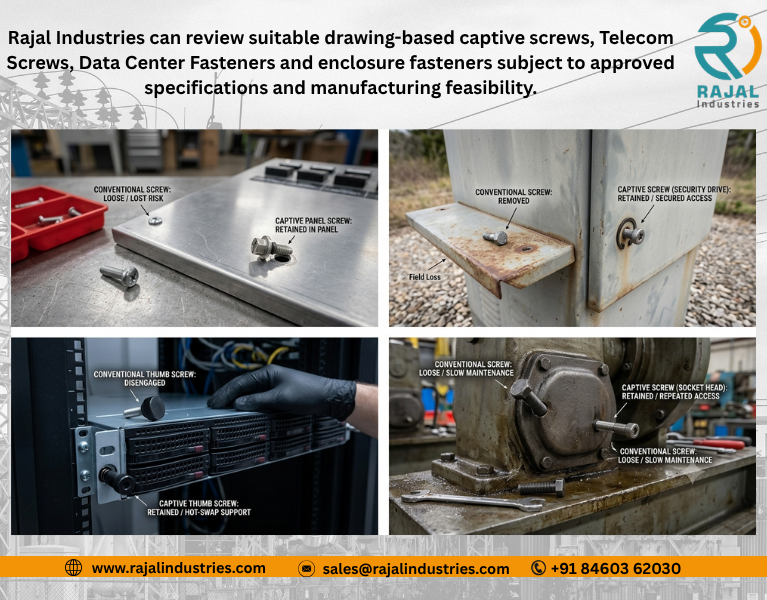
Captive Panel Screw Applications are common where a panel, cover or enclosure needs to be opened for installation, inspection or maintenance while the fasteners remain attached to the panel.
Unlike a conventional screw that can be completely removed and misplaced, a captive screw is designed to remain retained after disengaging from its mating thread.
This makes captive Panel Screws useful in suitable:
- Electrical panels
- Control cabinets
- Switchgear
- Telecom cabinets
- Data-center equipment
- Server and network enclosures
- Power-distribution equipment
- Electronics housings
- Industrial machinery
- Service-access panels
The main benefit is simple:
Release the Panel → Keep the Screw with the Panel → Service the Equipment → Re-engage the Same Fastener
Quick Answer: Where Are Captive Panel Screws Used?
Captive panel screws are used on serviceable panels, covers and enclosures where loose or lost fasteners are undesirable.
Typical Captive Panel Screw Applications include electrical cabinets, switchgear, telecom equipment, data-center enclosures, electronics, industrial machinery and frequently accessed service panels.
The exact fastener should be selected according to the panel, mating thread, required captive travel, service frequency, material, finish and environment.
Why Captive Screws Are Used in Industrial Equipment
Consider a maintenance technician opening an enclosure secured with six conventional screws.
Each screw must be:
Removed → Stored → Protected from Loss → Matched Again → Reinstalled
With a suitable captive design:
Loosen → Disengage → Screw Remains Retained → Open Panel
This can simplify service handling.
Main Reasons OEMs Use Captive Panel Screws
Captive screws can help:
- Reduce lost fasteners
- Reduce dropped hardware
- Keep screws with the correct panel
- Simplify field servicing
- Improve maintenance handling
- Reduce replacement-fastener mismatch
- Support repeated panel access
- Improve hardware control during assembly
These benefits depend on a correctly designed captive system.
Captive Screw vs Conventional Screw in Service Panels
| Requirement | Conventional Screw | Captive Panel Screw |
| Fastens Panel | Yes | Yes |
| Can Fully Separate | Yes | Designed not to |
| Lost Screw Risk | Higher | Reduced |
| Screw Stays with Panel | No | Yes |
| Retention System | No | Yes |
| Captive Travel | Not required | Important |
| Panel Geometry Important | Yes | Especially important |
| Service Handling | Conventional | Often easier |
Captive Does Not Mean Tool-Free
A captive screw can still require:
- Phillips screwdriver
- Torx bit
- Hex key
- Socket
- Security tool
- Other specified tool
“Captive” describes retention, not the drive.
Captive Does Not Mean Tamper Resistant
A captive screw may remain attached to the panel but still be easy to loosen.
Therefore:
Captive Retention ≠ Tamper Resistance
Where controlled access is required, the OEM can evaluate a suitable security drive separately.
Captive Does Not Mean Vibration Resistant
Another important distinction is:
Captive Function ≠ Vibration Resistance
Captivity describes what happens after the screw is disengaged from its mating thread.
Vibration performance depends on the complete joint, including:
- Thread
- Clamp condition
- Mating component
- Installation
- Locking method where required
- Equipment environment
Do not select a captive screw only because the equipment vibrates.
Application Selection Model
A useful application review is:
Equipment → Panel Function → Access Frequency → Loose-Hardware Risk → Panel Geometry → Retention → Thread → Head/Drive → Material → Finish → Validation
This keeps the captive feature connected to the actual equipment.
Captive Panel Screw Applications by Industry
| Industry/Application | Typical Location | Main Reason to Evaluate Captive Screws |
| Electrical Panels | Access covers | Retained service hardware |
| Control Cabinets | Service panels | Repeated access |
| Switchgear | Approved access covers | Hardware control |
| Telecom | Outdoor/indoor cabinets | Field servicing |
| Data Centers | Equipment covers | Maintenance handling |
| Server/Network Equipment | Service panels | Retained fasteners |
| Power Distribution | Access panels | Serviceability |
| Electronics | Covers/housings | Small hardware retention |
| Machinery | Inspection panels | Maintenance |
| Test Equipment | Frequently opened covers | Repeated access |
| Transportation Equipment | Selected panels | Hardware retention |
| Industrial Enclosures | Doors/covers | Controlled servicing |
Captive Panel Screws in Electrical Panels
Electrical panels are a major application for captive Panel Screws.
Potential locations include:
- Front access covers
- Terminal covers
- Internal service panels
- Control-panel covers
- Inspection covers
- Equipment-access plates
The objective can be:
Secure During Operation + Retained During Maintenance
Why Captive Screws Can Help Electrical Panel Maintenance
During servicing, conventional screws may need to be placed:
- On the floor
- In a tray
- On equipment
- In a technician’s pocket
A retained screw stays with its panel.
This can reduce unnecessary handling of loose fasteners.
Loose Hardware Inside Electrical Equipment
A loose metallic fastener inside electrical equipment can be undesirable.
Depending on where it falls, it may:
- Be difficult to retrieve
- Interfere with components
- Delay servicing
- Become foreign hardware inside the enclosure
A captive fastener can reduce the possibility of a service screw becoming loose from its panel.
Important Electrical Safety Limitation
Captive screws should not be treated as a substitute for:
- Electrical isolation
- Locks
- Interlocks
- Protective enclosure design
- Authorized-access procedures
- Required electrical safety systems
The electrical equipment designer remains responsible for the complete safety design.
Captive Screws for Control Panels
Control panels may be opened for:
- Wiring changes
- Inspection
- PLC servicing
- Relay replacement
- Terminal work
- Troubleshooting
- Preventive maintenance
Suitable captive fasteners can keep access-cover hardware with the panel throughout these operations.
Control Panel Application Example
Consider a removable service plate using four screws.
Conventional Arrangement
Remove 4 Screws → Store 4 Screws → Service → Find/Reposition Screws → Reinstall
Captive Arrangement
Loosen 4 Screws → Fully Disengage → Screws Stay with Plate → Service → Re-engage
The actual benefit depends on the equipment design and service procedure.
Captive Screws in Switchgear
Suitable captive fasteners may be considered on selected switchgear access covers where approved by the equipment manufacturer.
Possible areas include:
- Service covers
- Inspection panels
- Control compartments
- Auxiliary compartments
- Selected removable panels
Switchgear Selection Priorities
Review:
Panel Retention + Internal Clearance + Authorized Access + Service Requirement + Electrical Design
Do not assume that a captive fastener suitable for a general enclosure is automatically suitable for every switchgear location.
Panel Screw Length in Electrical Equipment
Length deserves special attention because the screw may project internally.
Potential nearby components can include:
- Conductors
- Terminals
- Busbars
- Relays
- PCBs
- Wiring ducts
- Connectors
Both the tightened and released screw positions should be reviewed.
Released Position Matters
A captive screw can move axially when disengaged.
Therefore, engineers should check:
Fastened Position
and
Released Position
for clearance.
This is particularly important in compact electrical equipment.
Captive Screws for Electrical Enclosures
General electrical enclosures can use captive screws where covers require periodic removal or opening.
Applications may include:
- Junction enclosures
- Control enclosures
- Instrumentation enclosures
- Power-control cabinets
- Electronics cabinets
The enclosure’s sealing and ingress-protection requirements remain separate design considerations.
Captive Screws and Sealed Enclosures
If the enclosure uses a gasket or sealing system, the captive fastener must still provide the fastening behaviour required by the approved enclosure design.
Captivity alone does not guarantee:
- IP rating
- Water resistance
- Dust resistance
- Gasket compression
Those requirements depend on the complete enclosure.
Captive Panel Screws in Telecom Cabinets
Telecom equipment is another strong application because cabinets may require servicing at distributed field locations.
Suitable Telecom Screws can be used for:
- Outdoor cabinet panels
- Communication equipment covers
- Network equipment enclosures
- Radio equipment covers
- Power-system panels
- Internal service plates
- Access doors and removable panels
Why Telecom Field Service Benefits from Captive Screws
A technician working at a remote site may have:
- Limited work surface
- Outdoor conditions
- Small hardware
- Multiple panels
- Time-sensitive maintenance
A retained screw reduces the need to manage loose fasteners during servicing.
Telecom Application Principle
A practical design goal is:
Technician Loosens Screw → Thread Disengages → Panel Opens → Screw Remains with Panel
When service is complete:
Panel Returns → Screw Aligns → Thread Re-engages → Panel Secured
Both sequences should be validated.
Outdoor Telecom Cabinets
Outdoor telecom equipment adds environmental considerations.
The fastener system may need to account for:
- Rain
- Humidity
- Condensation
- Industrial exposure
- Coastal conditions where applicable
- Temperature changes
Material and finish should follow the actual environment.
Telecom Screws: Carbon Steel or Stainless?
There is no universal answer.
Suitable coated carbon steel may work in some applications.
Suitable stainless steel may be preferred in others.
Selection should consider:
Environment + Mechanical Requirement + Mating Material + Finish + Customer Specification
SS304 vs SS316 for Telecom Cabinets
Do not automatically specify SS316 because a telecom cabinet is outdoors.
Review actual exposure.
SS304/A2-type stainless can suit many environments where its corrosion resistance is sufficient.
SS316/A4-type stainless may be evaluated for more demanding chloride-related exposure.
Coastal Telecom Equipment
For equipment near coastal environments, review:
- Chloride exposure
- Screw material
- Panel material
- Finish
- Galvanic compatibility
- Water retention
- Service life
The screw should not be considered separately from the enclosure.
Stainless Screw + Aluminium Telecom Cabinet
This combination may require galvanic-corrosion consideration in suitable environments.
Review:
Fastener Material + Aluminium Panel + Moisture + Surface Treatments
The correct solution depends on the actual assembly and exposure.
Captive Telecom Screws and Security
Some telecom equipment may be accessible to the public.
The OEM may therefore need:
Captive Retention + Controlled Access
A suitable security-drive captive screw can be evaluated where justified.
Captive vs Security in Telecom
| Requirement | Captive Feature | Security Feature |
| Keep Screw with Panel | Yes | No |
| Reduce Lost Hardware | Yes | No |
| Make Casual Unauthorized Removal Harder | No | Yes |
| Requires Retention Geometry | Yes | No |
| May Require Special Tool | Not necessarily | Often |
| Can Be Combined | Yes | Yes |
Captive Panel Screws in Data Centers
Suitable Data Center Fasteners can support serviceability where equipment covers and access panels need to be opened while keeping hardware retained.
Potential applications include:
- Server-related enclosures
- Network equipment
- Rack-mounted equipment
- Power-distribution equipment
- Cooling equipment
- Control systems
- Equipment access covers
- Service panels
The specific screw design remains dependent on the equipment.
Why Hardware Retention Matters in Data Centers
Data-center environments can contain:
- Dense equipment
- Repeated maintenance
- Multiple racks
- Numerous small components
- Restricted working space
Keeping fasteners attached to the serviced panel can simplify hardware management.
Captive Screws for Server and Network Equipment
Potential uses include:
- Equipment covers
- Rack-mounted device panels
- Network-switch housings
- Power equipment
- Service-access plates
The fastener should be compatible with:
- Equipment clearance
- Mating hardware
- Tool access
- Service frequency
Captive Screws for Rack-Mounted Equipment
Rack equipment can use different mating systems, including suitable:
- Threaded rails
- Cage nuts
- Inserts
- Other OEM hardware
The captive screw must match the actual mating thread and available alignment.
Captive Screw + Cage Nut
Where a cage nut is used, check:
- Thread compatibility
- Cage-nut position
- Available float
- Screw length
- Panel stack
- Thread engagement
- Released position
Captivity does not correct a mismatched cage nut.
Data Center Fasteners and Tool Access
Equipment density can limit screwdriver or bit access.
Review:
Head Projection + Drive + Tool Diameter + Adjacent Equipment + Service Direction
A screw that is technically correct but difficult to reach can create maintenance problems.
Data Center Fasteners and Service Frequency
Some equipment panels may be opened frequently.
Others may rarely be touched.
Service frequency affects whether the design should prioritize:
- Rapid manual access
- Conventional tool access
- Controlled security access
- Repeated thread durability
Captive Thumb Screws in Data-Center Equipment
Suitable captive thumb screws can be useful where rapid access is intentionally required.
Potential advantages:
- Fast manual operation
- No loose screw
- Easy servicing
But they may be unsuitable where controlled tool access is required.
Tool-Operated Captive Screws in Data Centers
Tool-operated captive screws can be more appropriate where:
- Accidental loosening is undesirable
- Equipment access is controlled
- Smaller head projection is preferred
- Defined installation is required
Data Center Application Selection
| Requirement | Direction to Evaluate |
| Frequent Access | Reusable captive design |
| Tool-Free Service | Suitable thumb/knurled design |
| Controlled Access | Tool-operated/security design |
| Dense Equipment | Low projection + tool clearance |
| Cage Nut | Correct thread + alignment |
| Corrosion-Controlled Indoor | Application-specific material/finish |
| Power Equipment | Electrical clearance review |
| Repeated Service | Thread + retention durability |
Data-Center Safety Limitation
Using captive screws does not automatically make equipment:
- Electrically safe to service
- Hot-swappable
- Tool-less
- Compliant with a particular rack or data-center standard
- Suitable for live maintenance
These are equipment-level design requirements.
Captive Screws for Data-Center Power Equipment
Suitable applications may include selected access covers on:
- Power-distribution units
- UPS-related enclosures
- Power-control cabinets
- Battery-system enclosures
- Monitoring equipment
Final fastener selection should follow the equipment manufacturer’s approved design and safety requirements.
Captive Screws for Cooling Equipment
Data-center cooling equipment can require regular maintenance.
Potential locations include:
- Filter access panels
- Service covers
- Control enclosures
- Inspection panels
Captive hardware can reduce loose fasteners during servicing.
Captive Screws in Electronics Equipment
Electronics equipment often contains:
- Small fasteners
- Dense internal components
- Frequent servicing
- Limited internal clearance
Suitable captive screws can be useful for:
- Covers
- Service plates
- Electronics housings
- Instrument panels
- Test equipment
Why Small Captive Screws Need Careful Design
As screw size decreases, less space is available for:
- Head
- Drive
- Shoulder
- Reduced shank
- Retention feature
Manufacturing tolerances can therefore become especially important.
Electronics Internal Clearance
The released captive screw should not interfere with:
- PCB assemblies
- Connectors
- Cables
- Fans
- Sensors
- Internal mechanisms
Check the complete travel range.
Captive Screws in Industrial Machinery
Suitable Captive Panel Screw Applications can include:
- Inspection covers
- Control panels
- Service doors
- Sensor covers
- Equipment housings
- Maintenance panels
Captive screws can help keep maintenance hardware attached to the equipment panel.
Machinery Guarding Limitation
A captive screw does not automatically make a machine guard safe or compliant.
Guard design may require:
- Risk assessment
- Interlocks
- Tool-controlled access
- Specific safety hardware
- Applicable machinery standards
Use the fastener only as part of the approved guarding design.
Captive Screws for Test & Measurement Equipment
Test equipment may be opened frequently for:
- Calibration
- Adjustment
- Component access
- Maintenance
Captive screws can be useful where small removable hardware would otherwise need to be managed separately.
Captive Screws for Transportation Equipment
Suitable captive fasteners may be evaluated for selected:
- Equipment covers
- Interior access panels
- Electronics enclosures
- Service compartments
However, transportation applications can have additional vibration, fire, structural and regulatory requirements.
Captive function alone does not establish suitability.
Captive Screws in Public Infrastructure
Selected public equipment can use captive fasteners where maintenance panels require retained hardware.
Potential examples include:
- Public electronics
- Information equipment
- Utility enclosures
- Monitoring cabinets
- Signage equipment
Where vandalism is a concern, the OEM may also evaluate a security drive.
Captive Screws in Automation Equipment
Automation systems can contain serviceable:
- Controller housings
- Sensor panels
- Electrical covers
- Interface panels
- Machine enclosures
The design should balance:
Service Speed + Retention + Tool Access + Mechanical Requirement
Captive Screws for Battery & Energy Equipment
Suitable captive fasteners may also be considered on selected service panels for:
- Battery cabinets
- Energy-storage enclosures
- Inverter equipment
- Power electronics
- Monitoring systems
Electrical, thermal and safety requirements remain independent of the captive function.
Captive Screws for Solar Electrical Equipment
Potential applications can include suitable:
- Inverter enclosures
- Control boxes
- Monitoring equipment
- Electrical cabinets
Outdoor environmental exposure and maintenance requirements should be considered.
Captive Screws for HVAC Equipment
HVAC equipment can contain:
- Control panels
- Filter covers
- Service panels
- Electrical compartments
- Inspection covers
Captive Panel Screws can be useful where these panels are repeatedly opened for servicing.
Captive Screws for Generator & Power Equipment
Potential applications can include:
- Control enclosures
- Inspection panels
- Electronics covers
- Selected service doors
Review:
- Vibration
- Environment
- Service frequency
- Thread system
- Joint requirement
Again:
Captive ≠ Vibration Resistant
Industry Application Summary
| Industry | Typical Captive Application | Main Priority |
| Electrical | Access panel | Loose-hardware control |
| Switchgear | Service cover | Controlled maintenance |
| Telecom | Cabinet panel | Field service |
| Data Center | Equipment cover | Hardware retention |
| Electronics | Housing | Small hardware control |
| Machinery | Inspection panel | Maintenance |
| HVAC | Service cover | Frequent access |
| Energy/BESS | Equipment enclosure | Serviceability |
| Solar | Electrical enclosure | Outdoor service |
| Transportation | Equipment panel | Retention |
| Test Equipment | Cover | Repeated access |
| Public Infrastructure | Service enclosure | Retention + possible security |
How Service Frequency Changes Application Selection
Rare Access
Priorities may include:
- Reliable fastening
- Retention when eventually opened
- Environmental durability
Periodic Access
Priorities can include:
- Easy tool engagement
- Reliable disengagement
- Good re-engagement
Frequent Access
Priorities can include:
- Repeated-service durability
- Fast operation
- Reliable captive movement
- Suitable manual or tool-assisted head
Service Frequency Matrix
| Access Frequency | Captive Design Priority |
| Rare | Reliable retention |
| Periodic | Retention + serviceability |
| Frequent | Retention + fast/reliable re-engagement |
| Very Frequent | Service-focused head/drive + durability |
There is no universal service-cycle number for all applications.
Captive Panel Screw Application Selection Checklist
Before specifying the screw, define:
Equipment
☐ Industry
☐ Equipment type
☐ Panel function
☐ Indoor/outdoor
Service
☐ Access frequency
☐ Authorized user
☐ Manual/tool operation
☐ Repeated servicing
Panel
☐ Material
☐ Thickness
☐ Hole
☐ Finish
Captive Requirement
☐ Retention method
☐ Required travel
☐ Panel release
☐ Retainer
Joint
☐ Mating thread
☐ Thread engagement
☐ Internal clearance
☐ Released-position clearance
Environment
☐ Humidity
☐ Outdoor exposure
☐ Coastal exposure if applicable
☐ Industrial contaminants
Validation
☐ Screw remains captive
☐ Panel releases
☐ Screw re-engages
☐ Final-finish fit
☐ Repeated service where required
Application Mistakes to Avoid
1. Using Captive Screws Everywhere
Captive fasteners add value where retained hardware solves a real service problem.
They are not automatically necessary for every panel.
2. Treating Captive as Security
Retention does not prevent unauthorized loosening.
3. Treating Captive as Vibration Locking
These are separate requirements.
4. Ignoring Released Screw Position
The disengaged screw can interfere with equipment.
5. Ignoring Service Frequency
A frequently opened panel needs different attention from a rarely opened cover.
6. Selecting Material Only from Industry Name
“Telecom” or “data center” does not define the environment.
7. Assuming Stainless Is Always Required Outdoors
Evaluate actual corrosion exposure.
8. Ignoring Panel Geometry
Captive function depends on the panel and retainer.
9. Ignoring Mating Hardware
Thread compatibility still matters.
10. Testing Only the Loose Screw
The complete assembly should be validated.
Captive Panel Screw Application Validation
A useful application test is:
Install Screw in Production-Representative Panel → Verify Retention → Engage Mating Thread → Tighten → Loosen → Fully Disengage → Open Panel → Verify Screw Remains Captive → Close Panel → Re-Engage
For frequently serviced equipment, repeat according to the OEM’s defined requirement.
Final-Finish Application Testing
Test using production-intended:
Screw + Retainer + Panel + Finish + Mating Hardware
because coating and finishing can change close clearances.
OEM Application Approval
Before bulk approval, confirm:
- Screw fits panel
- Retention works
- Thread engages
- Panel seats
- Screw fully disengages
- Panel opens
- Screw remains retained
- Released screw clears internal/external equipment
- Screw can be re-engaged
- Material/finish suits the environment
Manufacturer Application Review
For custom Captive Panel Screw Applications, a manufacturer should ideally receive more than a loose screw drawing.
Useful inputs include:
Screw Drawing + Panel/Assembly Drawing + Application + Service Frequency + Panel Thickness + Retention Method + Required Travel + Mating Thread + Material + Finish + Quantity
Rajal Industries Application Review
Rajal Industries can evaluate drawing-based captive screws, Telecom Screws, Data Center Fasteners, Panel Screws and enclosure fasteners for suitable OEM applications, subject to technical and manufacturing feasibility.
Potential application reviews can include suitable:
- Electrical panels
- Control cabinets
- Telecom enclosures
- Data-center equipment
- Electronics housings
- Industrial machinery
- HVAC equipment
- Energy equipment
- Service-access panels
- Other drawing-based industrial enclosures
Depending on the approved specification and feasibility, projects can be reviewed for:
- Metric or customer-specified Unified threads
- Reduced-shank designs
- Shoulder designs
- Suitable retainer systems
- Different head/drive configurations
- Carbon steel
- Suitable alloy steel
- Stainless steel
- Customer-specified finishes
- Custom tooling
- Samples
- Dimensional inspection
- Material/mechanical verification
- Functional captive testing
- Pilot production
- Bulk OEM manufacturing
Final feasibility should be confirmed against the approved drawing and complete application requirements.
Bulk Buyer Quick Answer
What should an OEM send for a captive panel screw application review?
Send:
Application + Screw Drawing + Panel Drawing + Panel Thickness + Retention Method + Required Travel + Mating Thread + Head/Drive + Material + Finish + Service Frequency + Testing Requirement + Expected Quantity
For an existing imported assembly, provide the approved screw, retainer and mating panel where available.
Detailed Electrical Panel Application Matrix
Electrical equipment contains many different panel types. Captive screws may be useful for some but unnecessary for others.
| Electrical Application | Service Requirement | Why Captive Screws May Help | Key Check |
| Control Cabinet Cover | Periodic | Retains service hardware | Internal clearance |
| Terminal Cover | Periodic | Reduces loose screws | Electrical clearance |
| Inspection Panel | Frequent | Faster hardware handling | Repeated service |
| Instrument Panel | Periodic | Keeps screws with cover | Small-component clearance |
| PLC Cabinet | Periodic | Maintenance handling | Wiring/PCB clearance |
| Switchgear Access Cover | Application-specific | Hardware retention | OEM safety design |
| Power Cabinet | Periodic | Serviceability | Internal projection |
| Junction Enclosure | Occasional | Retained cover screws | Sealing |
| Electronics Cover | Frequent | Small screw retention | Alignment |
| Removable Service Plate | Frequent | Keeps hardware together | Captive travel |
The fastener should still meet the equipment manufacturer’s mechanical and electrical requirements.
Electrical Panel Service Sequence
A properly designed captive panel system can follow:
Equipment Isolated as Required → Screw Loosened → Thread Fully Disengaged → Screw Remains Captive → Panel Opened → Maintenance Completed → Panel Repositioned → Screw Re-engaged
The captive fastener only supports the mechanical panel-retention function.
It does not define the electrical safety procedure.
Electrical Panel Screw Selection Priorities
For electrical equipment, evaluate:
Retention + Internal Clearance + Service Frequency + Mating Thread + Tool Access + Material/Finish
Internal clearance deserves particular attention because the screw can have different positions when:
- Tightened
- Partly loosened
- Fully disengaged
Captive Screws Near Electrical Components
A captive screw should be checked against nearby:
- Busbars
- Terminals
- Conductors
- PCB assemblies
- Relays
- Connectors
- Wiring
- Sensors
- Other hardware
Do not approve the screw only from an external enclosure view.
Released-Position Clearance
Consider a captive screw that moves outward when loosened.
The released position may solve internal-clearance concerns but create an external problem if it interferes with:
- Adjacent cabinet doors
- Equipment mounted nearby
- Handles
- Cable management
- Another removable panel
Therefore:
Internal Clearance + External Clearance
should both be checked.
Captive Screws for Switchgear
Switchgear may contain different compartments with very different access requirements.
Suitable captive screws may be evaluated for selected serviceable covers, but fastener selection should follow the switchgear manufacturer’s approved design.
Do not assume the same Panel Screws can be used on:
- Cosmetic covers
- Control compartments
- Electrical access covers
- Structural panels
without separate engineering review.
Captive Screws and Electrical Safety
A captive screw should not be presented as an electrical safety device.
It does not replace:
Isolation + Interlocking + Locking + Grounding/Earthing + Enclosure Protection + Warning + Authorized-Service Procedures
where those measures are required.
Captive Screws for Control Cabinets
Control cabinets can be strong candidates because technicians may periodically access:
- PLCs
- Relays
- Terminal blocks
- Power supplies
- Communication modules
- Control wiring
A captive design can keep the access-panel fasteners together during troubleshooting or modification.
Control Cabinet Example
Application
Four-screw removable service cover.
Problem
Conventional screws are completely removed whenever technicians access internal controls.
Captive Direction
Evaluate:
Reusable Captive Screw + Suitable Retention + Machine Thread + Tool-Operated Head + Required Travel
Validation
The cover should release completely while all four screws remain retained.
Captive Screws for Terminal Covers
Terminal covers can contain relatively small fasteners.
Captivity may be useful where the cover is periodically removed.
However, screw projection should be checked carefully because electrical termination areas can have limited internal space.
Captive Screws and Gasketed Panels
Some electrical and telecom enclosures use gaskets.
The fastener may contribute to panel seating, but captive retention itself does not establish sealing performance.
The enclosure designer should validate:
Fastener Arrangement + Panel Stiffness + Gasket + Compression + Surface + Assembly
Captive Screw Does Not Guarantee IP Rating
This distinction should be clear:
A Captive Panel Screw does not by itself provide an IP rating.
Ingress protection is an enclosure-level characteristic.
Changing from the approved conventional screw to a captive screw may require enclosure re-evaluation if it changes:
- Clamping
- Head bearing
- Hole geometry
- Gasket compression
- Panel seating
Captive Screws in Telecom Equipment
Telecom Screws may be used in both indoor and outdoor equipment.
The two environments should not automatically receive the same material and finish.
Indoor vs Outdoor Telecom Applications
| Requirement | Indoor Telecom | Outdoor Telecom |
| Captive Retention | Application-specific | Application-specific |
| Repeated Service | Common | Common |
| Humidity | Evaluate | Important |
| Rain Exposure | Normally limited | Possible |
| Chloride Exposure | Location dependent | Location dependent |
| Corrosion Review | Required as appropriate | Higher priority |
| Tool Access | Important | Important |
| Security | Site dependent | Often worth reviewing |
| Final-Finish Testing | Useful | Important |
Indoor Telecom Equipment
Potential applications include:
- Network cabinets
- Communication racks
- Electronics enclosures
- Power equipment
- Distribution equipment
- Equipment covers
Main selection priorities can be:
Serviceability + Retention + Thread Compatibility + Equipment Clearance
Outdoor Telecom Equipment
Outdoor equipment can add:
Weather + Moisture + Corrosion + Public Access + Field Maintenance
The fastener design should therefore consider more than captive retention.
Telecom Field Maintenance
A field technician may work:
- Outdoors
- On a ladder or platform
- In limited space
- At remote sites
- Around multiple small components
Keeping Telecom Screws retained with the access panel can simplify hardware handling.
Telecom Field-Service Failure Scenario
Imagine six conventional screws securing a cabinet panel.
During servicing:
Six Screws Removed → One Dropped → Five Available for Reassembly
The technician now has a replacement or reassembly problem.
A correctly functioning captive system reduces this type of loose-fastener risk.
Captive Telecom Screw Design Priorities
A useful sequence is:
Field Service → Panel Retention → Corrosion Environment → Thread → Head/Drive → Security Requirement → Final-Finish Validation
Captive + Security Telecom Screws
Outdoor or publicly accessible telecom cabinets may require both:
Captive Function
Keep the screw attached to the panel.
Security Function
Make unauthorized loosening more difficult.
These requirements can be combined in a suitable custom design.
Captive + Security Does Not Mean Theft-Proof
Even a specialized fastener should not be marketed as making equipment impossible to open or steal.
Security fasteners can increase the difficulty of unauthorized access.
Complete equipment security also depends on:
- Panel accessibility
- Hinges
- Locks
- Cabinet construction
- Alternate removal paths
- Site security
Tool Management for Telecom Service
If a security drive is used, consider:
- Technician tool availability
- Replacement bits
- Tool identification
- Regional maintenance teams
- Emergency servicing
A highly unusual drive can create maintenance problems if authorized technicians cannot obtain the correct tool.
Data Center Fasteners: Detailed Applications
Data Center Fasteners can be used across several equipment categories.
Potential captive applications include:
- Rack-mounted equipment
- Network equipment
- Power distribution
- UPS enclosures
- Monitoring systems
- Cooling equipment
- Server-related enclosures
- Cable-management equipment
- Control panels
- Service covers
The actual suitability depends on each equipment design.
Data Center Application Matrix
| Equipment | Potential Captive Location | Main Priority |
| Rack Equipment | Front/rear service panel | Fast servicing |
| Network Equipment | Equipment cover | Hardware retention |
| Power Distribution | Access panel | Service + clearance |
| UPS Equipment | Selected service cover | Maintenance |
| Monitoring System | Electronics cover | Small hardware control |
| Cooling Equipment | Filter/service cover | Frequent access |
| Control Cabinet | Access panel | Retention |
| Server-Related Equipment | Service cover | Hardware management |
| Cable Equipment | Removable cover | Fast service |
Captive Screws for Rack Equipment
Rack equipment can have tight dimensional constraints.
Review:
- Rack spacing
- Adjacent equipment
- Head projection
- Released projection
- Tool access
- Mating hardware
- Panel thickness
A large thumb head may be convenient but unsuitable if it interferes with adjacent equipment.
Data Center Rack Screw vs Captive Equipment Screw
Do not assume every “rack screw” needs to be captive.
There is a difference between:
Rack-Mounting Fastener
Attaches equipment to a rack.
Captive Equipment Fastener
Remains attached to an equipment panel or cover.
A product can potentially combine functions in a suitable design, but the terms are not interchangeable.
Cage Nuts and Captive Screws
A captive screw may engage a cage nut in suitable equipment.
The complete stack can include:
Captive Panel → Bracket/Rail → Cage Nut
Check:
- Thread
- Screw reach
- Cage-nut float
- Alignment
- Panel stack
- Required engagement
Floating Mating Hardware
Floating nuts can help accommodate alignment, but excessive screw movement plus nut movement can make thread starting difficult.
Therefore, evaluate:
Captive Screw Float + Mating Nut Float + Panel Alignment
together.
Data Center Power Equipment
Potential captive applications include selected service covers on:
- PDUs
- UPS-related equipment
- Power-control enclosures
- Monitoring cabinets
- Battery-system enclosures
Electrical safety and equipment certification remain separate from captive screw selection.
Data Center Cooling Equipment
Cooling systems can require frequent access for:
- Filter servicing
- Inspection
- Electrical maintenance
- Fan servicing
- Control maintenance
Retained Panel Screws may reduce loose hardware during repeated servicing.
Captive Screws for High-Frequency Maintenance
Where a cover is opened often, evaluate:
- Drive wear
- Thread wear
- Retainer wear
- Panel-hole wear
- Re-engagement
- Service speed
The fastener should be evaluated as a repeated-use system.
Captive Thumb Screw vs Tool-Operated Screw
| Requirement | Captive Thumb Screw | Tool-Operated Captive Screw |
| Fast Manual Access | Excellent direction | Moderate |
| Tool Required | Usually no | Yes |
| Head Projection | Often higher | Can be lower |
| Controlled Access | Lower | Better |
| Frequent Maintenance | Useful | Useful |
| Dense Equipment | Check clearance | Often easier |
| Public Access | Usually less suitable | Better direction |
| Security Drive Possible | Limited by design | Yes |
Captive Panel Screw vs Quarter-Turn Fastener
Not every service panel needs a threaded captive screw.
Another concept can be a quarter-turn panel fastener.
The two should not automatically be treated as equivalent.
| Factor | Captive Panel Screw | Quarter-Turn Concept |
| Threaded Engagement | Usually | Different mechanism |
| Multiple Turns | Usually | Reduced rotation |
| Fast Service | Good | Can be very fast |
| Captive Design | Available | Often available |
| Clamp Behaviour | Design dependent | Design dependent |
| Mating Hardware | Threaded component | Matching receptacle/system |
| Existing Thread Compatibility | Often easier | May require redesign |
| Application Validation | Required | Required |
When a Quarter-Turn Concept May Be Evaluated
It may be worth considering where:
- Very frequent access is required
- Rapid opening is a major priority
- Equipment is designed around the matching receptacle
However, changing from a threaded screw to a quarter-turn system can require panel and receptacle redesign.
When a Captive Threaded Screw May Be Better
A captive screw may be preferred where:
- Existing threaded mating hardware is retained
- Threaded fastening is required
- Conventional tool operation is acceptable
- OEM wants captivity without changing the complete panel system
Captive Screw vs Loose Machine Screw
| Factor | Loose Machine Screw | Captive Panel Screw |
| Simple Geometry | Usually | Can be more complex |
| Cost | Often lower | Can be higher |
| Retained Hardware | No | Yes |
| Service Handling | More loose parts | Fewer loose parts |
| Panel Modification | Conventional | May require retention feature |
| Custom Tooling | Less likely | Possible |
| Functional Captive Test | No | Yes |
This is why captive screws should be used where their functional benefit justifies the additional complexity.
Captive Screw vs SEMS Screw in Applications
A SEMS screw is useful where a preassembled washer is desired.
A captive panel screw is useful where the fastener must remain with the panel.
SEMS
Screw + Retained Washer
Captive Panel Screw
Screw + Panel Retention
An application can potentially require both functions, but they should be specified separately.
Application Decision: Do You Actually Need a Captive Screw?
Ask five questions:
- Is the panel removable or regularly opened?
- Is losing a screw a practical problem?
- Could a dropped screw create maintenance difficulty?
- Does the screw need to remain associated with a specific panel?
- Does the service benefit justify the additional captive design?
If most answers are no, a conventional fastener may remain sufficient.
Service-Frequency Decision Matrix
| Service Frequency | Conventional Screw | Captive Screw | Design Focus |
| Almost Never | Often sufficient | Evaluate if loss risk matters | Reliability |
| Occasional | Possible | Useful in some cases | Retention |
| Periodic | Possible | Strong candidate | Serviceability |
| Frequent | More handling | Strong candidate | Repeated use |
| Very Frequent | Less convenient | Strong candidate | Speed + durability |
This is application guidance, not a universal design rule.
Environment Selection Matrix
| Environment | Main Fastener Consideration |
| Controlled Indoor | Functional fit + suitable finish |
| Humid Indoor | Corrosion review |
| Outdoor | Defined corrosion system |
| Industrial Outdoor | Exposure-specific material/finish |
| Coastal | Chloride + galvanic review |
| High-Contaminant Area | Application-specific review |
Material Selection by Application
Material should follow:
Environment + Mechanical Requirement + Mating Material + Customer Specification
Potential directions include:
- Coated carbon steel
- Suitable alloy steel where mechanically required
- SS304/A2-type stainless
- SS316/A4-type stainless
- Other customer-specified materials
Do Not Use This Rule
Indoor = Carbon Steel
Outdoor = Stainless Steel
That is too simplistic.
An indoor industrial environment can be corrosive, while a properly protected carbon-steel fastener may suit some outdoor equipment depending on the specified system.
Coating and Captive Movement
Captive assemblies can contain close clearances.
Finish thickness can affect:
Reduced Shank ↔ Retainer ↔ Panel Hole
A design that works before coating may bind after finishing.
Final-Finish Application Rule
Approve:
Production-Intended Finish + Production-Representative Panel + Actual Retention System
not only unfinished prototype components.
Captive Screws in Vibrating Equipment
Some telecom, HVAC, transportation, generator and machinery equipment can experience vibration.
The engineering question becomes:
How Is the Joint Kept Secure During Operation?
Captivity answers a different question:
What Happens to the Screw After It Is Disengaged?
Vibration Control and Captivity
Possible joint-retention approaches depend on the approved design and may involve:
- Proper preload
- Suitable thread-locking method
- Locking hardware
- Prevailing-torque concepts
- Other engineered methods
Do not assume the captive feature itself provides vibration resistance.
Captive Screw Installation
Installation can be:
- Manual
- Powered
- Semi-automated
- Automated where suitable
The installation process should account for the retention system.
Captive Screw Assembly Sequence
Depending on the design:
Screw Inserted → Retainer Installed/Formed → Captive Function Verified → Panel Assembled → Mating Thread Engaged
The exact sequence depends on the captive design.
Automated Assembly Considerations
For automated OEM production, review:
- Feeding
- Orientation
- Head geometry
- Drive engagement
- Retainer assembly
- Panel positioning
- Thread starting
- Functional verification
A complex captive design may require a different automation approach from a conventional screw.
Repeated-Service Validation
For frequently opened panels, evaluate the complete service cycle:
Tighten → Loosen → Fully Disengage → Open Panel → Close Panel → Align → Re-Engage → Tighten
Repeat according to the OEM’s approved service requirement.
What to Monitor During Service Testing
Check:
- Screw remains captive
- Retainer remains secure
- Thread remains functional
- Drive remains usable
- Panel hole does not wear excessively
- Screw moves freely
- Re-engagement remains reliable
- Finish remains acceptable for the requirement
Application Failure Troubleshooting
| Problem | Possible Application Cause | Check |
| Screw Falls Out | Retention unsuitable | Retainer + geometry |
| Panel Won’t Open | Insufficient travel | Thread + travel |
| Screw Won’t Re-Engage | Misalignment | Panel + mating thread |
| Screw Binds | Clearance/finish | Shank + hole |
| Screw Rattles | Excessive clearance | Retention system |
| Drive Wears | Frequent service/tool issue | Drive + tool |
| Thread Wears | Repeated service | Thread + mating material |
| Corrosion | Environment mismatch | Material + finish |
| Screw Hits Components | Clearance problem | Released/tightened positions |
| Gasket Doesn’t Seal | Joint/panel issue | Clamp + gasket |
| Screw Loosens in Vibration | Joint retention issue | Joint design |
| Security Tool Unavailable | Service planning issue | Tool distribution |
Application Failure: Panel Does Not Release
A captive screw is not functioning correctly for the application if its thread remains partly engaged when the panel is supposed to open.
Check:
Thread Length + Required Engagement + Captive Travel + Panel Stack
Application Failure: Difficult Re-Engagement
Possible causes include:
- Excessive lateral movement
- Floating nut movement
- Panel misalignment
- Damaged threads
- Poor lead-in
- Retainer geometry
The screw should be tested in the actual assembly.
Application Failure: Fastener Corrosion
Do not immediately change to the most expensive stainless grade.
First identify:
Environment → Existing Material → Finish → Failure Location → Mating Material → Moisture/Contaminant Exposure
Then determine the appropriate corrective action.
Application Failure: Screw Becomes Loose During Operation
This should be treated separately from captive retention.
Investigate:
- Joint design
- Tightening
- Thread condition
- Vibration
- Mating component
- Required locking method
Do not attempt to solve it by changing only the captive shank.
Imported Captive Screw Localization
Many OEMs may have an existing imported enclosure or equipment fastener they want to source locally.
A useful localization package includes:
Existing Screw + Retainer + Panel + Mating Hardware + Approved Drawing + Material Specification + Finish Specification + Application Information
Localization Application Review
The manufacturer should understand:
- What equipment uses the screw?
- Where is the panel?
- How often is it opened?
- How is the screw retained?
- How much travel is required?
- What does it engage?
- What environment does it see?
- What happens if the screw does not remain captive?
This is more useful than copying dimensions blindly.
Reverse Engineering Limitation
A sample can reveal geometry.
It may not reveal the original:
- Material specification
- Mechanical requirement
- Tolerance
- Finish specification
- Corrosion performance
- Service-life requirement
- Inspection criteria
Where possible, use the approved technical specification together with the sample.
OEM Localization Workflow
Application Review → Existing Assembly → Drawing → Material/Finish → Dimensional Study → Manufacturing Feasibility → Tooling → Samples → Final-Finish Functional Test → Pilot Lot → OEM Approval → Bulk Production
Supplier Qualification for Captive Panel Screw Applications
Ask the supplier:
- Can you review the complete panel assembly?
- Have you understood how the screw remains captive?
- Can you manufacture the required retention geometry?
- Can you supply or assemble the retainer where required?
- Can you manufacture the required thread?
- Can you control reduced-shank or shoulder dimensions?
- Can you provide the specified material?
- Can you provide the required finish?
- Can you account for coating buildup?
- Can you test the screw in a representative panel?
- Can you verify full thread disengagement?
- Can you verify panel release?
- Can you verify retention?
- Can you test re-engagement?
- Can you support repeated-service testing if required?
- Can you provide dimensional reports?
- Can you provide material/mechanical verification where specified?
- Can you develop tooling?
- Can you provide pilot lots?
- Can you support the required production volume?
Supplier Application Evaluation Matrix
| Requirement | Weight |
| Drawing Compliance | High |
| Captive Function | High |
| Panel Compatibility | High |
| Mating Thread Compatibility | High |
| Material Compliance | High |
| Finish Compliance | High |
| Functional Testing | High |
| Repeated-Service Capability | Application dependent |
| Quality Documentation | Medium-High |
| Traceability | Application dependent |
| Tooling Capability | Custom designs |
| Production Capacity | Commercial requirement |
| Lead Time | Commercial requirement |
| Unit Price | Compare after compliance |
For custom Data Center Fasteners or Telecom Screws, lowest price should not compensate for failure to meet the functional assembly requirement.
Complete Application RFQ Checklist
Application
☐ Electrical panel
☐ Telecom cabinet
☐ Data-center equipment
☐ Electronics
☐ Machinery
☐ HVAC
☐ Energy equipment
☐ Other
Service
☐ Access frequency
☐ Authorized user
☐ Tool requirement
☐ Repeated-service requirement
Panel
☐ Drawing
☐ Material
☐ Thickness
☐ Hole
☐ Finish
Captive System
☐ Retention method
☐ Retainer
☐ Required travel
☐ Released position
Screw
☐ Thread
☐ Thread length
☐ Overall length
☐ Head
☐ Drive
☐ Shoulder/reduced shank
☐ Retention feature
Mating System
☐ Tapped hole
☐ Insert
☐ Nut
☐ Cage nut
☐ Other
☐ Thread engagement
Environment
☐ Indoor
☐ Outdoor
☐ Humid
☐ Coastal
☐ Industrial exposure
☐ Customer-specific corrosion requirement
Validation
☐ Dimensional inspection
☐ Material verification
☐ Finish verification
☐ Captive retention
☐ Full disengagement
☐ Panel release
☐ Re-engagement
☐ Final-finish test
☐ Repeated service where required
Commercial
☐ Tooling
☐ Samples
☐ Pilot lot
☐ MOQ
☐ Annual demand
☐ Packaging
☐ Delivery location
Frequently Asked Questions
What are the main Captive Panel Screw Applications?
The main Captive Panel Screw Applications include electrical panels, control cabinets, telecom enclosures, data-center equipment, electronics housings, industrial machinery and other service-access panels where keeping the fastener attached can simplify maintenance.
Why are captive screws used in electrical panels?
Captive screws can keep access-cover hardware attached to the panel when technicians open electrical equipment for inspection or maintenance. This can reduce loose or misplaced service screws.
Are captive screws suitable for switchgear?
They may be suitable for selected switchgear panels where approved by the equipment manufacturer. Electrical safety, access, clearance and equipment requirements must be evaluated separately.
Why are captive screws used in telecom cabinets?
Suitable Telecom Screws can remain attached to cabinet panels during field maintenance, reducing the need for technicians to manage loose fasteners.
Are captive screws useful for outdoor telecom cabinets?
Yes, where the application benefits from retained service hardware. The material, finish, corrosion environment, mating material and possible security requirements should also be evaluated.
What fasteners are used in data-center equipment?
Different equipment uses different fasteners. Suitable Data Center Fasteners can include captive screws on service covers and equipment panels where hardware retention and repeated servicing are useful.
Can captive screws be used with cage nuts?
Yes, in suitable designs. Thread compatibility, cage-nut float, alignment, screw length, panel stack and required engagement should be checked.
Are captive screws suitable for server racks?
They can be used in suitable rack-mounted equipment or service-panel designs, but not every rack-mounting screw needs to be captive.
Are captive panel screws tool-free?
Not necessarily. They can use thumb heads or conventional drives such as Phillips, Torx or hex socket depending on the application.
Are captive screws tamper resistant?
Not automatically. Captive retention and tamper resistance are different functions. A suitable security drive can be combined with a captive design where required.
Are captive screws vibration resistant?
Captivity alone does not provide vibration resistance. Joint design, preload, thread condition, locking method and application requirements determine vibration performance.
Do captive screws provide an IP rating?
No. Ingress protection is an enclosure-level requirement involving the complete panel, gasket, joints and fasteners.
Which material is best for outdoor captive screws?
There is no universal best material. Selection depends on corrosion exposure, mechanical requirements, mating materials, finish and customer specification.
Should outdoor telecom screws always be SS316?
No. SS316/A4-type stainless may be useful for certain demanding chloride environments, but it is not automatically required for every outdoor telecom application.
Can captive screws be used in data-center cooling equipment?
Suitable captive screws can be used on service or inspection panels where retained hardware benefits maintenance, subject to the equipment design.
What is the difference between a captive screw and a quarter-turn fastener?
A captive screw generally uses threaded engagement, while a quarter-turn system uses a different locking mechanism and matching receptacle. Both can provide retained panel fastening in suitable designs.
Can a SEMS screw replace a captive panel screw?
Not automatically. A SEMS screw retains a washer on the screw, while a captive panel screw is designed to remain retained with the panel.
How do I know whether my application needs captive screws?
Consider service frequency, loose-hardware risk, panel design, maintenance environment and whether retaining the screw with the panel provides a practical benefit.
AEO / GEO Quick Answers
Where are captive panel screws used?
Captive Panel Screw Applications include electrical panels, control cabinets, telecom cabinets, data-center equipment, electronics enclosures and industrial machinery. They are especially useful on service-access panels where screws need to disengage from the mating thread but remain attached during maintenance.
Why use captive screws in electrical panels?
Captive screws keep service fasteners attached to electrical access panels after loosening. This can reduce loose or lost hardware during maintenance while allowing the panel to open, provided the screw has sufficient captive travel and correct internal clearance.
Why are captive screws useful in telecom cabinets?
Captive Telecom Screws can simplify field servicing because technicians do not need to separately handle every screw after opening a cabinet. Outdoor applications should also consider corrosion, material compatibility, security, tool access and repeated service.
What are captive screws used for in data centers?
Captive Data Center Fasteners can be used on service panels, network equipment, power equipment, cooling equipment and other suitable enclosures where retaining fasteners during maintenance improves hardware management and serviceability.
Captive screw or quarter-turn fastener: which is better?
Neither is universally better. Captive threaded screws can suit equipment using threaded mating hardware, while quarter-turn systems can be useful where very rapid access is required. The choice depends on panel design, clamp requirement, service frequency, mating hardware and OEM specifications.
Final Application Decision Checklist
Before converting an ordinary screw to a captive design, ask:
☐ Does the panel need to open?
☐ How often is it serviced?
☐ Is loose hardware a practical problem?
☐ Could dropped screws cause maintenance difficulty?
☐ Does the screw need to stay with the panel?
☐ Is the panel suitable for a retention feature?
☐ Is adequate captive travel available?
☐ Can the thread fully disengage?
☐ Does the released screw clear nearby components?
☐ Can the screw re-engage reliably?
☐ Does the material suit the environment?
☐ Does the finish preserve captive clearances?
☐ Is security also required?
☐ Is vibration a separate concern?
☐ Are sealing/IP requirements affected?
☐ Has the production-finish assembly been tested?
If the answers support captive retention, the design can move to detailed engineering review.
Key Takeaways
- The strongest Captive Panel Screw Applications involve serviceable panels where loose hardware creates a practical problem.
- Electrical panels can benefit from retained service hardware.
- Internal electrical clearance must be checked in both fastened and released positions.
- Captive screws do not replace electrical safety systems.
- Captive screws do not automatically provide an IP rating.
- Telecom Screws for outdoor cabinets require environmental and corrosion review.
- Public telecom equipment may benefit from captive + security functions.
- Data-center equipment can benefit where repeated maintenance makes hardware retention useful.
- Data Center Fasteners should be selected according to the actual equipment, not the words “data center.”
- Rack screws and captive equipment screws are not automatically the same.
- Cage-nut compatibility requires thread and alignment review.
- Thumb screws can improve access but may increase head projection.
- Captive screws and quarter-turn fasteners solve similar service problems differently.
- Captive and SEMS fasteners are not equivalent.
- Captive retention does not provide vibration locking.
- Material should follow the actual environment.
- SS316 is not automatically necessary outdoors.
- Coating thickness can affect captive movement.
- Final-finish assembly testing is important.
- Frequently serviced applications should consider repeated-use durability.
- Localization should evaluate the complete panel assembly, not only the loose screw.
Conclusion
The value of captive screws becomes clearest when maintenance requires a panel to be opened but there is a strong reason not to completely remove its fasteners.
For electrical equipment:
Retention + Internal Clearance + Safe Service Design
For telecom cabinets:
Retention + Field Service + Environment + Possible Access Control
For data-center equipment:
Retention + Repeated Maintenance + Equipment Clearance
These application requirements should determine the fastener rather than selecting a captive design simply because it appears more advanced than a conventional screw.
Rajal Industries can evaluate drawing-based captive Panel Screws, Telecom Screws, Data Center Fasteners and other enclosure fasteners for suitable OEM applications, subject to the approved drawing, panel and retention design, material, finish, mating hardware, functional requirements, testing and manufacturing feasibility.